D.4 Induction questions for IB Physics
68 questions on Induction, written by Augment in the style of IB exam papers. Six of them are below in full, to answer on paper.
- IB Physics
- Part of D Fields
- HL only
Questions by paper and level
| Paper | Questions |
|---|---|
| Paper 1A | 30 |
| Paper 2 | 38 |
| Every paper | 68 |
Counted on
Questions to try
Written by Augment in the style of IB exams, not past papers. Answer them on paper, then check each one against its markscheme with a free account.
A circular loop of wire of diameter 20 cm is held in a uniform magnetic field of strength 0.40 T. The plane of the loop makes an angle of 30° with the direction of the field. What is the magnetic flux through the loop?
A square coil of 200 turns and side 5.0 cm lies perpendicular to a uniform magnetic field. The field strength falls steadily from 0.40 T to zero in 0.25 s.
- (a)
State Faraday’s law of electromagnetic induction.
2 marks
- (b)
Calculate the emf induced in the coil.
3 marks
What is the weber, the unit of magnetic flux, expressed in SI base units?
A small cylindrical magnet of mass 12 g is dropped from rest into the top of a long vertical copper tube. The magnet does not touch the walls of the tube. The magnet quickly reaches a constant speed of and falls through most of the tube at this speed.
- (a)
Explain why the magnet reaches a constant speed.
3 marks
- (b)
Calculate the rate at which thermal energy is produced in the tube while the magnet falls at constant speed.
2 marks
- (c)
Outline how the direction of the induced currents is consistent with the principle of conservation of energy.
2 marks
A flat search coil of 250 turns, each of area 2.0 cm, is placed with its plane perpendicular to a magnetic field. The magnetic field strength increases uniformly from zero to 0.30 T in 15 ms. What is the magnitude of the emf induced in the coil?
A drop-tower ride at a theme park has a gondola of total mass 4200 kg, including the riders. The gondola is lifted at constant speed from the ground to the top of the tower, 100 m above the ground, in 50 s. It is then released from rest and falls freely for 62 m. In the next 28 m it passes through a braking section, where copper fins on the gondola pass between strong permanent magnets fixed to the tower. The gondola stops 10 m above the ground and is then lowered slowly to the ground.
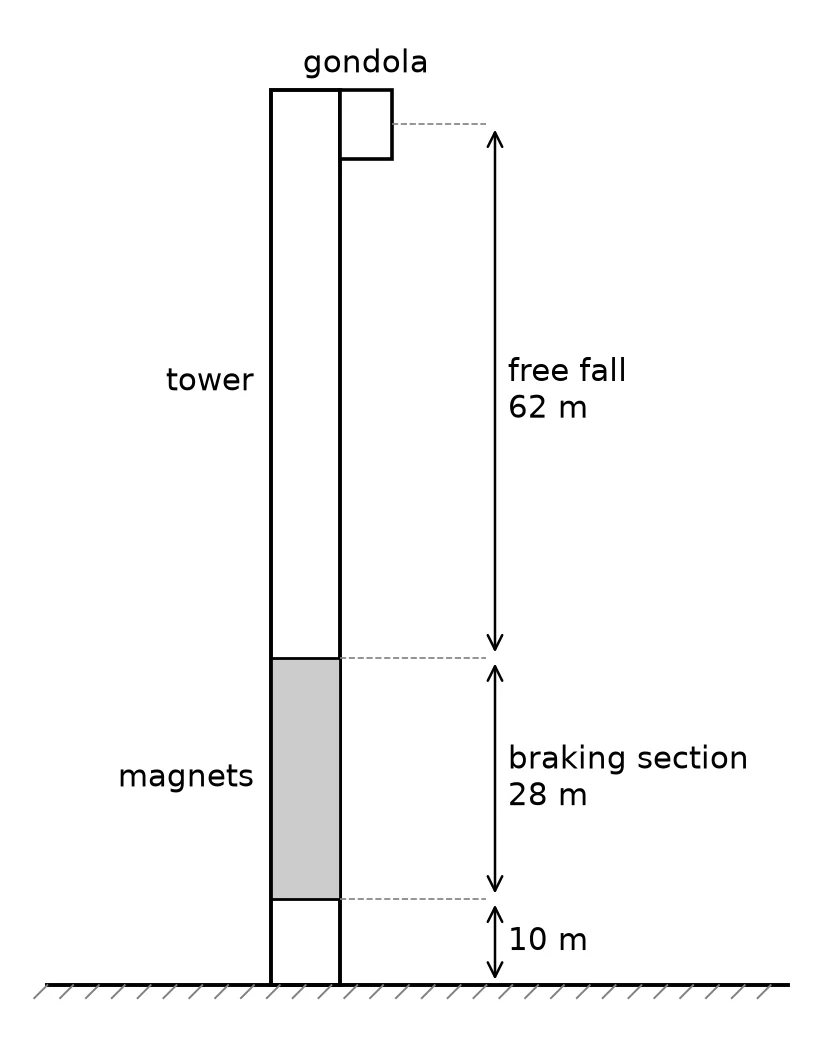
Air resistance and friction are negligible.
- (a)
Calculate the useful power output of the motor that lifts the gondola.
2 marks
- (b)
The motor has an efficiency of 0.75 and is supplied from a 400 V supply. Calculate the current in the motor.
2 marks
- (c)
Show that the speed of the gondola as it enters the braking section is about .
2 marks
- (d)
Explain how the magnets produce a braking force on the gondola.
3 marks
- (e)
Determine the average braking force on the gondola in the braking section.
3 marks
- (f)
Calculate the average deceleration of the gondola in the braking section, as a multiple of .
2 marks
- (g)
Sketch a graph to show the variation with time of the speed of the gondola from its release until it stops. Numbers are not required on the axes.
2 marks
- (h)
The copper fins have a total mass of 180 kg. The specific heat capacity of copper is . Estimate the rise in temperature of the fins during one ride, assuming that all the energy removed in the braking section becomes internal energy of the fins.
2 marks
- (i)
Suggest why a mechanical brake is also needed to hold the gondola at rest at the end of the braking section.
2 marks
Practice all 68 in Augment
Free with an account. Every question has its markscheme, and Augment keeps the ones you got wrong so you can come back to them.
More questions in Fields
- D.1Gravitational fields
- D.2Electric and magnetic fields
- D.3Motion in electromagnetic fields
- D.4InductionThis page
Check your answers in Augment
A free account opens all 68 questions on Induction with their markschemes, and keeps a record of what you have marked.