D.2 Electric and magnetic fields questions for IB Physics
110 questions on Electric and magnetic fields, written by Augment in the style of IB exam papers. Six of them are below in full, to answer on paper.
- IB Physics
- Part of D Fields
- SL and HL
Questions by paper and level
SL and HL questions are for students at either level. HL only questions cover what only HL students study.
| Paper | SL and HL | HL only | All |
|---|---|---|---|
| Paper 1A | 27 | 16 | 43 |
| Paper 1B | 5 | 2 | 7 |
| Paper 2 | 31 | 29 | 60 |
| Every paper | 63 | 47 | 110 |
Counted on
Questions to try
Written by Augment in the style of IB exams, not past papers. Answer them on paper, then check each one against its markscheme with a free account.
A small magnet stays at rest on the vertical steel door of a refrigerator. One of the forces acting on the magnet is the magnetic force exerted on it by the door. Which force forms a Newton's third law pair with this force?
A group of students analyse data from an accelerator experiment. A beam of alpha particles is directed at a thin copper foil (proton number ) inside an evacuated chamber. A detector at a large fixed scattering angle counts the scattered alpha particles. For each initial kinetic energy of the alpha particles, the students calculate
/ MeV | 6.0 | 8.0 | 10.0 | 12.0 | 14.0 | 16.0 | 18.0 |
|---|---|---|---|---|---|---|---|
± 0.05 | 1.02 | 0.98 | 1.01 | 0.99 | 0.76 | 0.43 | 0.11 |
- (a)
State why the chamber is evacuated.
1 mark
- (b)
Calculate the percentage uncertainty in when MeV.
1 mark
- (c)
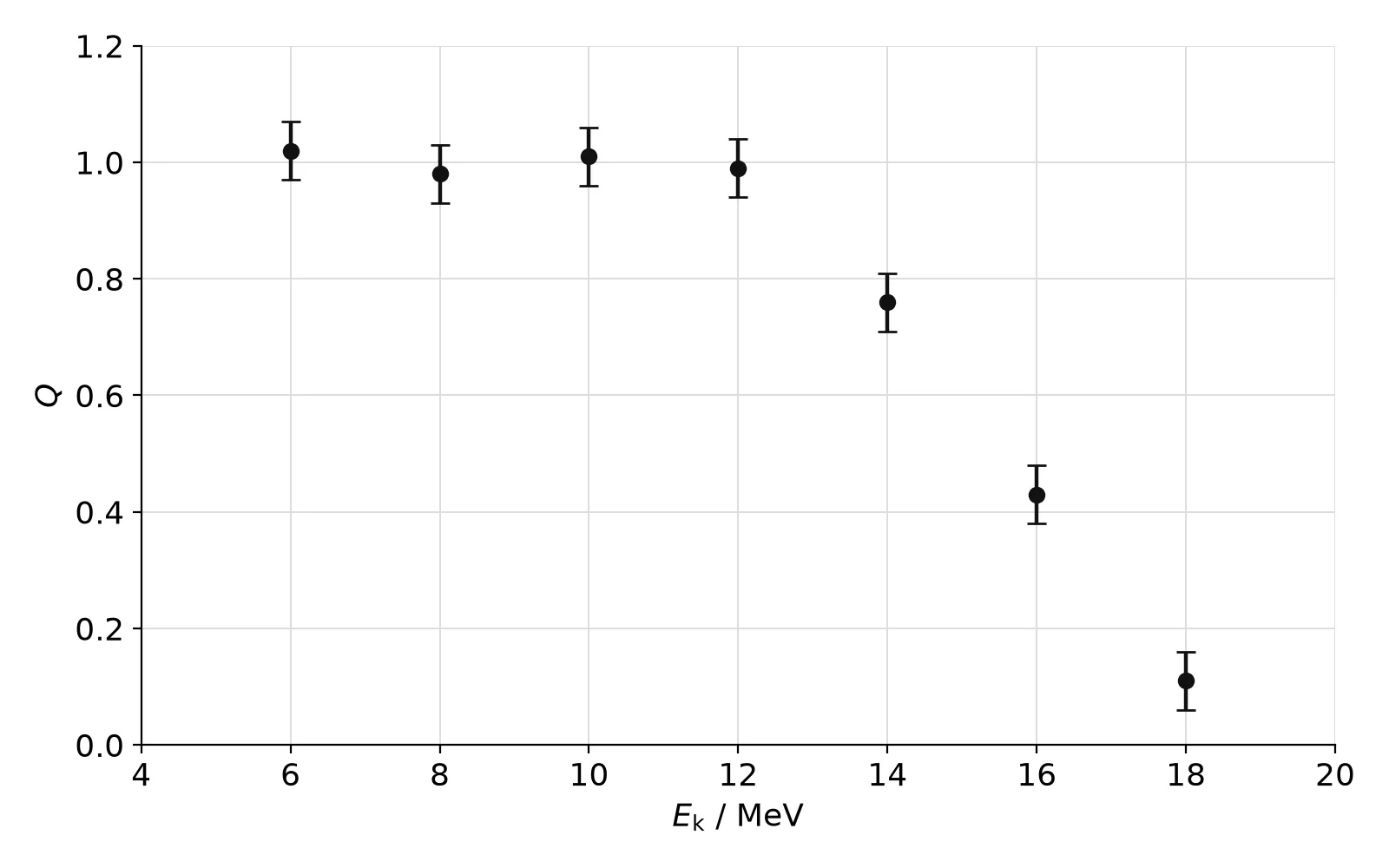
The graph shows the variation of with .
Estimate, using the graph, the kinetic energy above which the measured count rate deviates from the prediction.
2 marks
- (d)
Show that the distance of closest approach of an alpha particle of kinetic energy in a head-on collision with a copper nucleus is about m.
2 marks
- (e)
Explain why falls below 1 when is greater than .
2 marks
- (f)
Assume that the deviation begins when the distance of closest approach equals the sum of the radii of the alpha particle and the copper nucleus. Determine the radius of a copper nucleus.
2 marks
- (g)
Estimate the nucleon number of the copper nuclei.
2 marks
A small oil droplet of radius 1.5 μm falls vertically through air between two horizontal metal plates that are 6.0 mm apart. The density of the oil is 920 kg m, the density of air is 1.2 kg m and the viscosity of air is Pa s. At first there is no potential difference between the plates.
- (a)
Show that the terminal speed of the droplet is about 0.25 mm s.
3 marks
- (b)
Outline why the buoyancy force on the droplet can be neglected.
1 mark
- (c)
A potential difference of 450 V is now applied between the plates, with the upper plate positive. The droplet carries a charge of . Calculate the electric force on the droplet.
2 marks
- (d)
Determine the new terminal velocity of the droplet.
2 marks
- (e)
Determine the potential difference that would make the droplet rise at a constant speed of 0.25 mm s.
2 marks
A rubber balloon is rubbed on a wool jumper. The balloon becomes negatively charged. Which describes the transfer of charge?
A group of students test Coulomb's law. A small conducting sphere A is mounted on an insulating rod that stands on a top-pan balance. An identical sphere B is held directly above A by an insulating rod in a clamp. The separation between the centres of the spheres can be changed by moving the clamp.
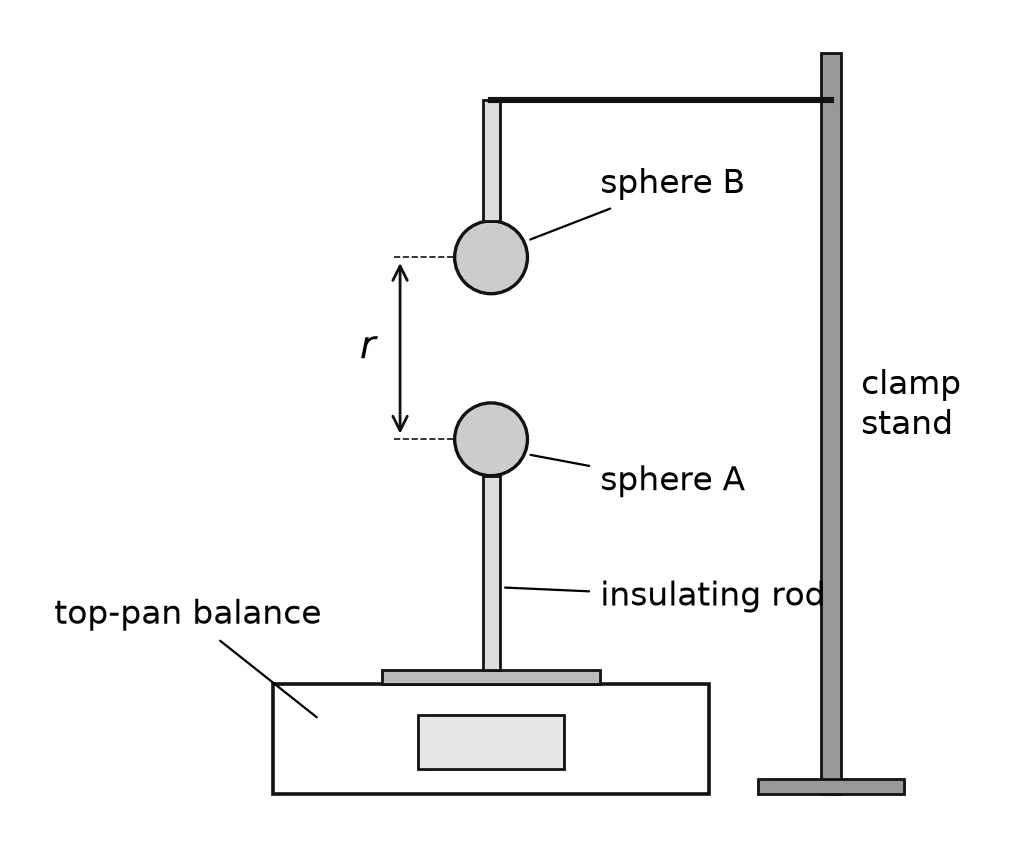
The balance is set to read zero with both spheres uncharged. Both spheres are then given the same positive charge by touching them to the same terminal of a high-voltage supply.
- (a)
Outline why the reading on the balance becomes positive when the spheres are charged.
1 mark
- (b)
The students record the balance reading for different values of .
/ cm ± 0.1 cm
/ g ± 0.01 g
3.0
0.58
4.0
0.33
5.0
0.21
6.0
0.15
8.0
0.08
10.0
0.05
Calculate, for , the electric force between the spheres and its absolute uncertainty.
2 marks
- (c)
Calculate the percentage uncertainty in for .
2 marks
- (d)
The graph shows the variation of with , where is the electric force between the spheres. The error bars show the uncertainty in ; the uncertainty in is not shown. The line of best fit is drawn.
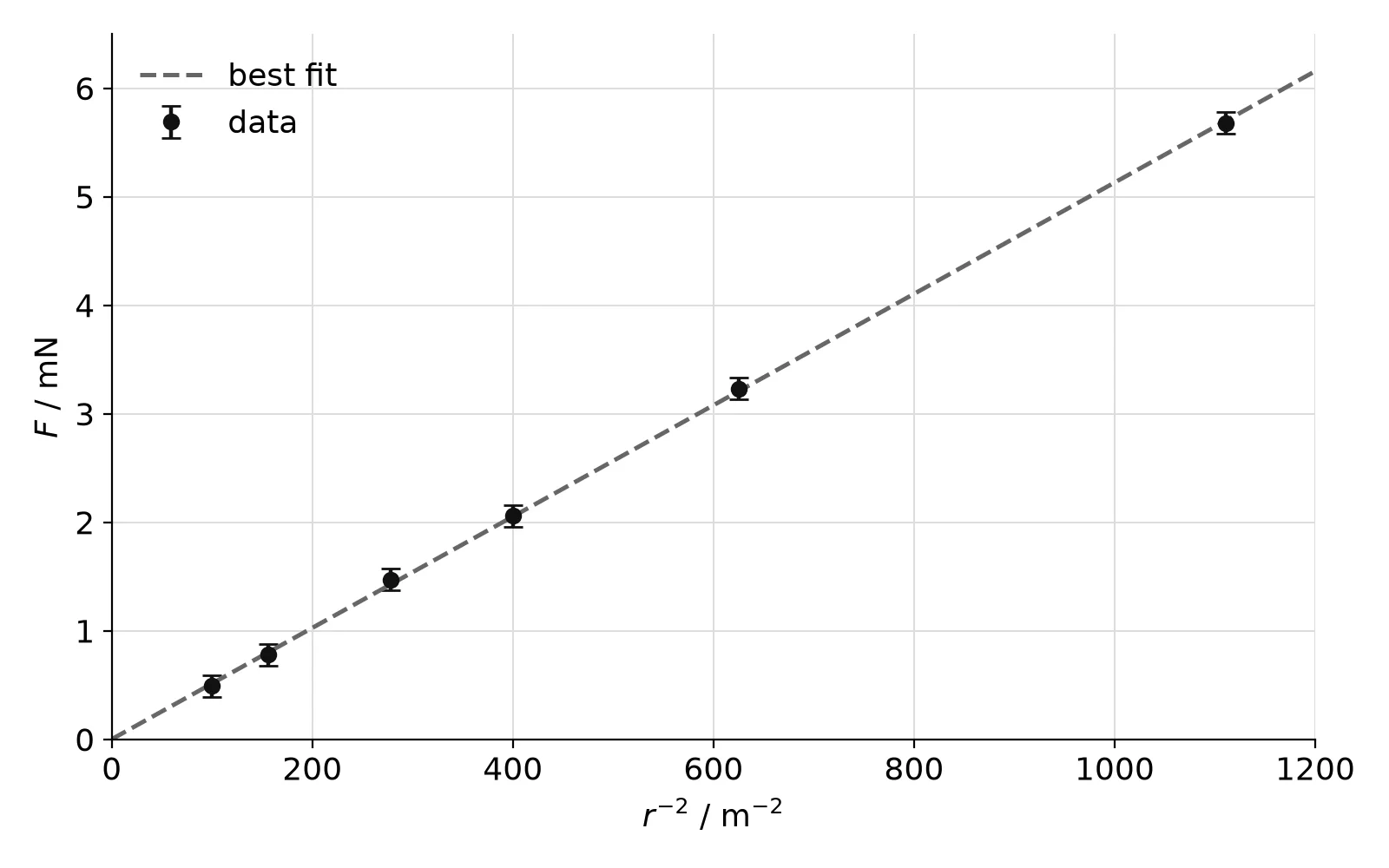
Determine, using the graph, the charge on each sphere.
3 marks
- (e)
The students claim that the data show that is proportional to . Discuss this claim.
2 marks
- (f)
After taking the last reading, the students return sphere B to . The balance now reads 0.49 g. Suggest a reason for this and an improvement to the procedure.
2 marks
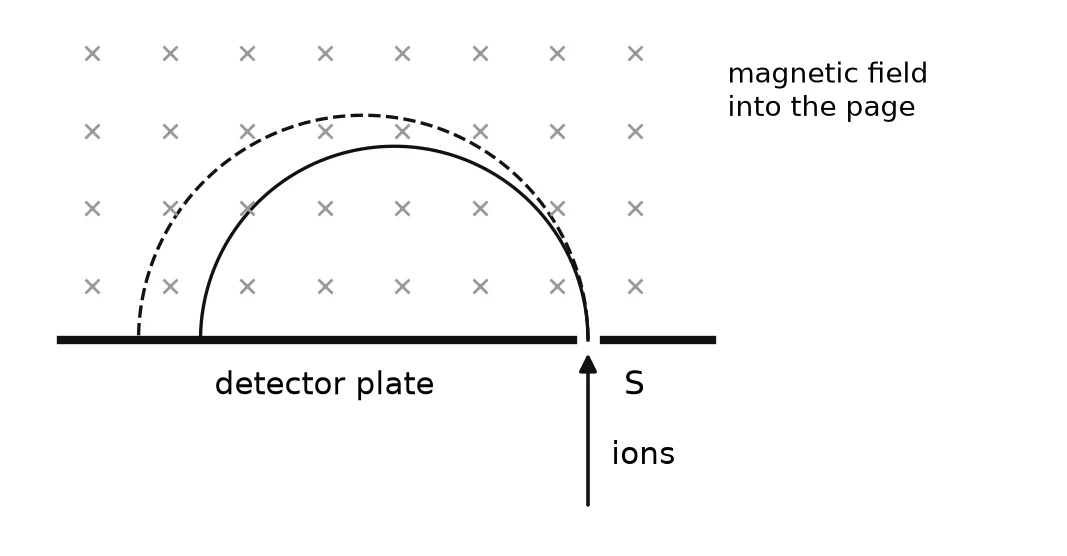
In a mass spectrometer, singly charged positive ions of neon-20 (mass 20 u) and neon-22 (mass 22 u) all move with a speed of m s. They enter a region of uniform magnetic field of strength 0.20 T through a slit S. The field is directed into the page. The ions travel in semicircles and strike a detector plate.
- (a)
Explain why the ions move in a circular path.
2 marks
- (b)
Outline why the kinetic energy of an ion does not change while it is in the field.
1 mark
- (c)
Show that the radius of the path of a neon-20 ion is about 6 cm.
2 marks
- (d)
Determine the distance between the points where the neon-20 and the neon-22 ions strike the detector plate.
2 marks
- (e)
Calculate the time that a neon-20 ion spends in the magnetic field. State, with a reason, whether a faster neon-20 ion would spend more time, less time or the same time in the field.
2 marks
- (f)
Calculate the centripetal acceleration of a neon-20 ion in the field.
1 mark
Practice all 110 in Augment
Free with an account. Every question has its markscheme, and Augment keeps the ones you got wrong so you can come back to them.
More questions in Fields
- D.1Gravitational fields
- D.2Electric and magnetic fieldsThis page
- D.3Motion in electromagnetic fields
- D.4InductionHL only
Check your answers in Augment
A free account opens all 110 questions on Electric and magnetic fields with their markschemes, and keeps a record of what you have marked.