D.1 Gravitational fields questions for IB Physics
101 questions on Gravitational fields, written by Augment in the style of IB exam papers. Six of them are below in full, to answer on paper.
- IB Physics
- Part of D Fields
- SL and HL
Questions by paper and level
SL and HL questions are for students at either level. HL only questions cover what only HL students study.
| Paper | SL and HL | HL only | All |
|---|---|---|---|
| Paper 1A | 25 | 12 | 37 |
| Paper 1B | 4 | 1 | 5 |
| Paper 2 | 33 | 26 | 59 |
| Every paper | 62 | 39 | 101 |
Counted on
Questions to try
Written by Augment in the style of IB exams, not past papers. Answer them on paper, then check each one against its markscheme with a free account.
In a torsion-balance experiment, two small lead spheres attract each other with a gravitational force . One sphere is replaced by a sphere of twice the mass and the separation of the centres of the spheres is tripled. What is the new gravitational force between the spheres?
A group of students measure the acceleration of free fall in the laboratory. A steel ball is held by an electromagnet above a light gate. When the electromagnet is switched off, the ball falls from rest and a timer measures the time the ball takes to reach the light beam. The distance is measured from the bottom of the ball to the light beam with a metre rule. The diagram is not to scale.
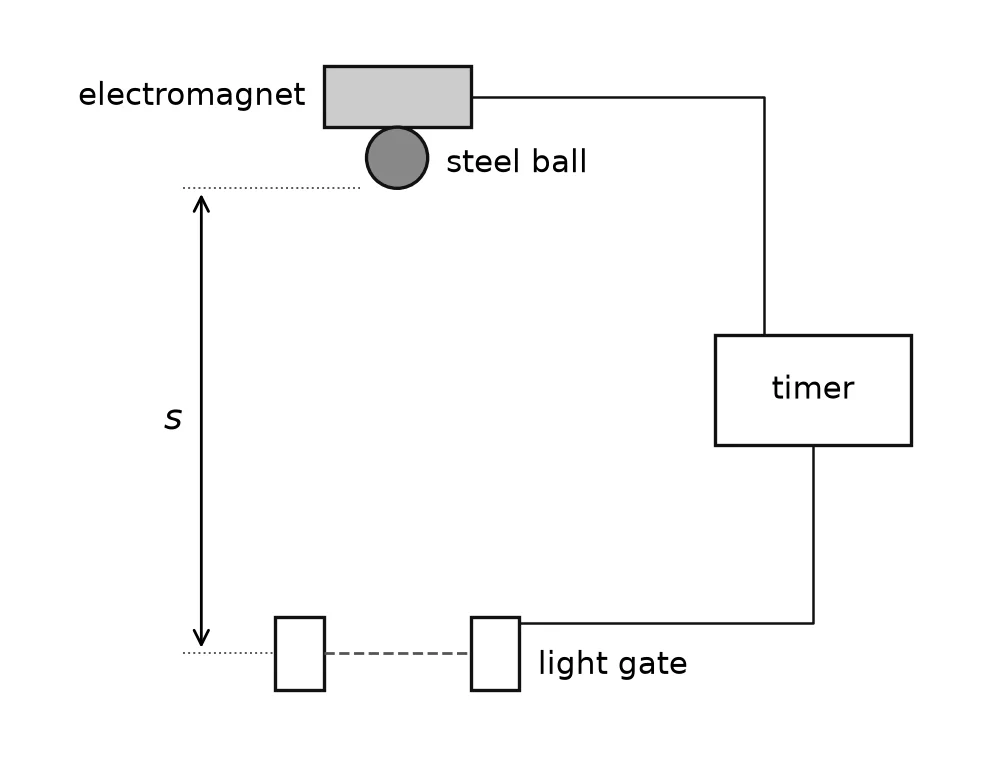
For each value of the students record five times. The readings for m are:
Trial | 1 | 2 | 3 | 4 | 5 |
|---|---|---|---|---|---|
/ s | 0.364 | 0.371 | 0.366 | 0.369 | 0.365 |
- (a)(i)
Determine the mean value of for m and its absolute uncertainty.
2 marks
- (a)(ii)
Calculate the percentage uncertainty in for m.
2 marks
- (b)
The students' theory is that . They plot the variation of with . The horizontal error bars show the uncertainty in ; the uncertainty in is too small to show. The line of best fit is drawn.
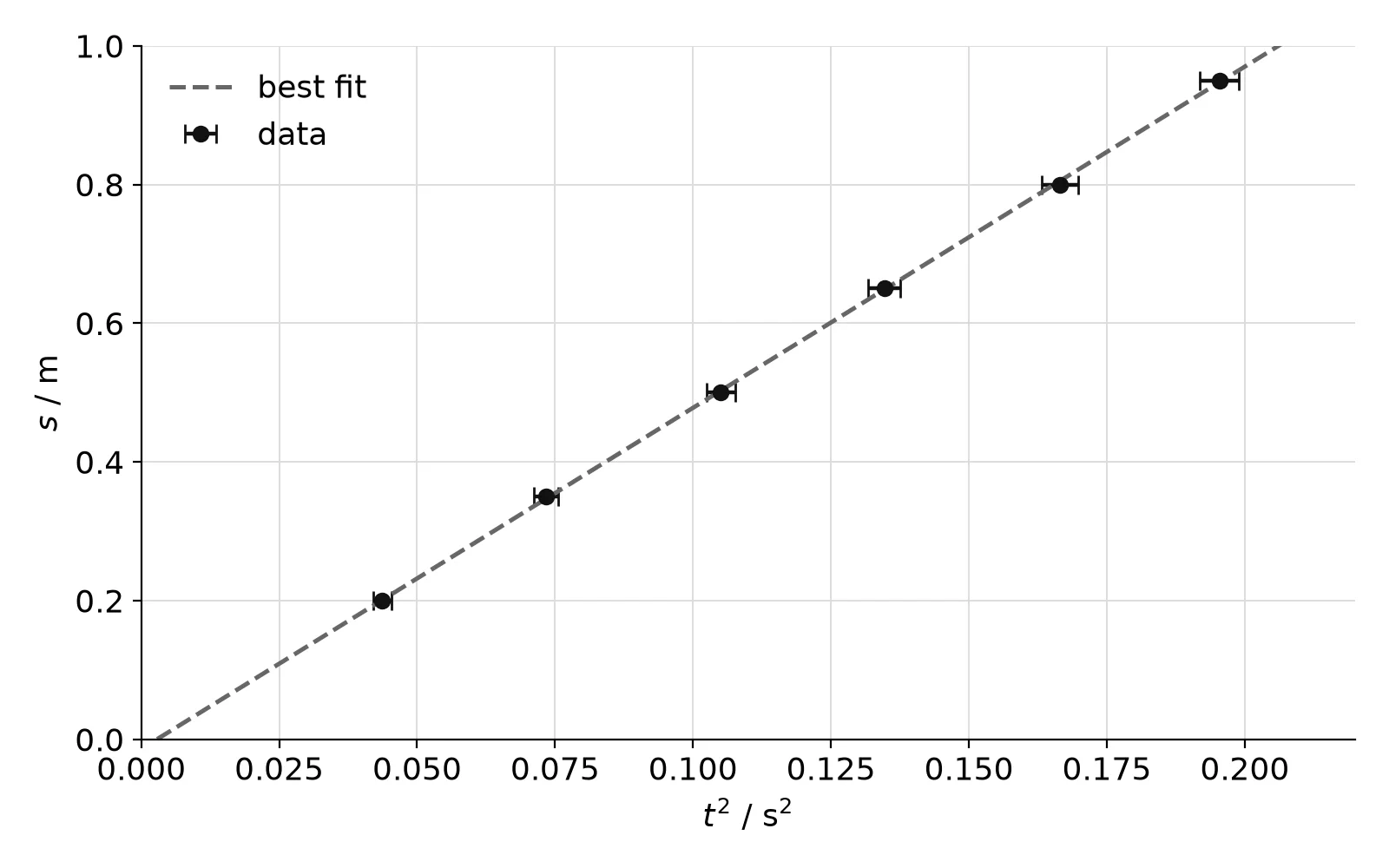
Outline why plotting against is a suitable way to test the theory.
2 marks
- (c)
Determine, using the graph, a value for .
3 marks
- (d)
The line of best fit does not pass through the origin. Suggest one reason for this.
1 mark
- (e)
The radius of the Earth is m. Calculate, using your answer to (c), the mass of the Earth.
2 marks
A lunar lander of mass 15 000 kg is descending vertically towards the surface of the Moon. At a height of 150 m it is moving downwards at . Its engine then provides a constant upward force, so that the lander decelerates uniformly and comes to rest at a height of 4.0 m. The engine is then switched off and the lander falls to the surface.
The following data are given:
mass of the Moon
radius of the Moon
Ignore the change in mass of the lander due to the fuel used.
- (a)
Show that the gravitational field strength at the surface of the Moon is about .
2 marks
- (b)
Calculate the magnitude of the deceleration of the lander while the engine is on.
2 marks
- (c)
Calculate the time for which the engine is on.
1 mark
- (d)
Determine the force provided by the engine during the deceleration.
2 marks
- (e)
Calculate the speed with which the lander reaches the surface.
2 marks
- (f)
Outline why the lander cannot use a parachute to slow its descent.
1 mark
Newton's law of gravitation, , is used with equal to the distance between the centres of the two bodies. For which pair of bodies does this give the exact gravitational force between them?
A group of students photograph Jupiter through a small telescope on many clear nights over two months. On each image they measure the position of each of Jupiter's four largest moons. For each moon they deduce the radius of its circular orbit around Jupiter and its orbital period . Their results are:
Moon | / m ± m | / days ± 0.01 days |
|---|---|---|
Io | 4.2 | 1.77 |
Europa | 6.8 | 3.55 |
Ganymede | 10.6 | 7.15 |
Callisto | 19.0 | 16.70 |
- (a)
Show that, for moons in circular orbits around a planet of mass , .
2 marks
- (b)
Calculate the absolute uncertainty in for Io.
2 marks
- (c)
The graph shows the variation of with for the four moons, with error bars for and the line of best fit.
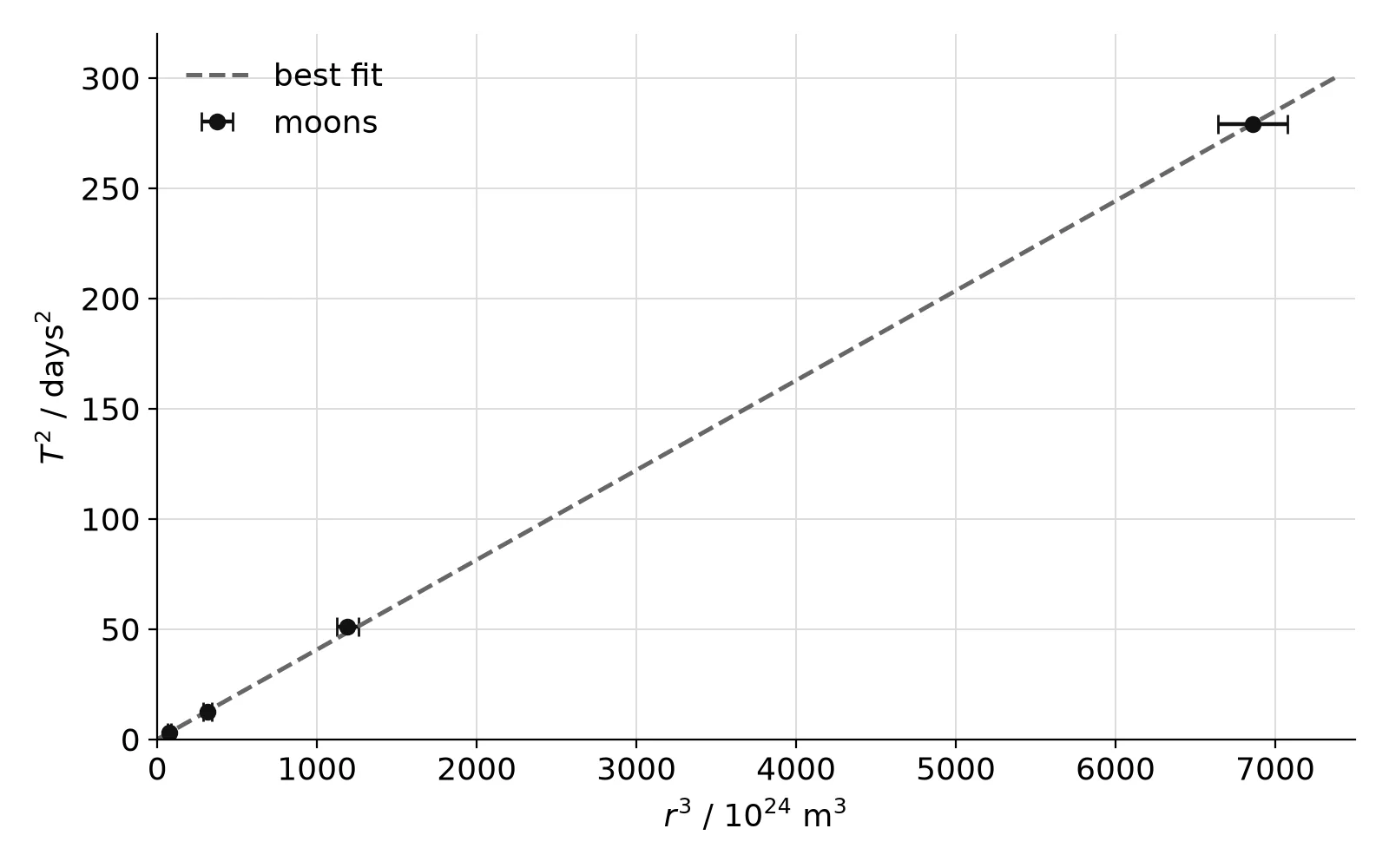
Outline why no error bars are shown for .
1 mark
- (d)
Determine, using the graph, the mass of Jupiter.
3 marks
- (e)
Discuss the choice of a graph of against for these data.
2 marks
A rover on the surface of Mars launches a small sample capsule of mass 0.50 kg from a level plain. The capsule leaves the launcher at ground level with a speed of at above the horizontal.
The following data are given:
mass of Mars
radius of Mars
The atmosphere of Mars is very thin. Ignore air resistance unless a part says otherwise.
- (a)
Show that the gravitational field strength at the surface of Mars is about .
2 marks
- (b)(i)
Calculate the time of flight of the capsule.
2 marks
- (b)(ii)
Calculate the horizontal distance travelled by the capsule.
2 marks
- (b)(iii)
Calculate the maximum height reached by the capsule.
2 marks
- (c)
The same launcher is used on Earth, with the same launch speed and angle. Determine the ratio . Ignore air resistance on Earth.
2 marks
- (d)
Explain, without calculation, why the capsule lands with the same speed as it was launched.
2 marks
- (e)(i)
A later mission must send a sample capsule away from Mars completely. Show that the escape speed from the surface of Mars is about .
2 marks
- (e)(ii)
Calculate the minimum energy needed to move the 0.50 kg capsule from the surface of Mars to infinity.
2 marks
- (e)(iii)
Outline why the escape speed does not depend on the direction in which the capsule is launched.
1 mark
- (f)
Radio signals from the rover travel to Earth at the speed of light. On one day the distance between Mars and Earth is . Calculate the time taken for a signal from the rover to reach Earth.
1 mark
- (g)
The thin atmosphere of Mars does exert a small drag force on the capsule. Predict how the horizontal distance and the speed on landing compare with your answers to (b)(ii) and (d).
2 marks
Practice all 101 in Augment
Free with an account. Every question has its markscheme, and Augment keeps the ones you got wrong so you can come back to them.
More questions in Fields
- D.1Gravitational fieldsThis page
- D.2Electric and magnetic fields
- D.3Motion in electromagnetic fields
- D.4InductionHL only
Check your answers in Augment
A free account opens all 101 questions on Gravitational fields with their markschemes, and keeps a record of what you have marked.