D.2 Electric and magnetic fields · IB Physics | Augment Education
D.2 Electric and magnetic fields
Electric charge and how objects are charged, Coulomb’s law, electric field strength and field lines, Millikan’s oil-drop experiment and magnetic field patterns; HL adds electric potential, potential energy and equipotentials.
IB Physics
Part of D Fields
SL and HL
Key terms introduced here
Each is in the Physics glossary, with every other term in the subject.
Charging two different materials by rubbing them together, which transfers electrons from one to the other and leaves them with equal and opposite charges.
The constant in Coulomb's law, k=1/4πε0=8.99×109N m2C−2
Notes on D.2 Electric and magnetic fields
70 min readLast reviewed
Questions on D.2
110 exam-style questions on this subtopic, written in the style of the IB papers. The first has its markscheme open. Counted on
Question 1 · PHY-000831 mark
A small magnet stays at rest on the vertical steel door of a refrigerator. One of the forces acting on the magnet is the magnetic force exerted on it by the door. Which force forms a Newton's third law pair with this force?
A
the normal force exerted by the door on the magnet
B
the friction force exerted by the door on the magnet
C
the gravitational force exerted by Earth on the magnet
D
the magnetic force exerted by the magnet on the door
Explanation
A third-law pair consists of two forces of the same type acting on different bodies: the door pulls the magnet, so the magnet pulls the door with an equal and opposite magnetic force. A is the force that balances the magnetic attraction, but it acts on the same body and is a different type of force; B and C balance each other.
The answer is D.
Question 2 · PHY-0038710 marks
A small oil droplet of radius 1.5 μm falls vertically through air between two horizontal metal plates that are 6.0 mm apart. The density of the oil is 920 kg m−3
Try a quick-fire question
One of 100 short multiple-choice questions on D.2. Pick an answer to see why it's right or wrong.
The diagram shows equipotential lines. A charge of +2.0μC moves from A to C. How much work does the electric field do on it?
Flashcards for D.2
The official deck for this part of the syllabus.
D.2 Electric and magnetic fields · front
What is electric charge?
D.2 Electric and magnetic fields · front
Express the coulomb in SI base units.
D.2 Electric and magnetic fields265 cards
From the data booklet
The entries of the physics data booklet that D.2 uses. Each opens in the explained booklet.
The electric force between two point charges is proportional to the product of the charges and inversely proportional to the square of their separation: F=kq1q2/r2.
A scalar property of particles such as protons and electrons that makes them exert electric forces on each other; it is positive or negative and measured in coulombs (C).
The work done per unit charge in bringing a small positive test charge from infinity to a point, Ve=kQ/r for a point charge; a scalar measured in volts.
The work done to assemble a system of charges from infinite separation; for two point charges Ep=kq1q2/r, positive for like charges and negative for unlike charges.
The sudden conduction of an insulator such as air when the electric field becomes strong enough to ionise it, producing a spark; for dry air about 3×10⁶V m−1.
The separation of charge in a conductor caused by a nearby charged object; with earthing it charges the conductor, without contact, with the opposite sign to the object.
A line showing the direction in which the north pole of a small compass would point at each point; the lines form closed loops, running from N to S outside a magnet.
One of the two ends of a magnet, north or south, where its field is most concentrated; like poles repel and unlike poles attract, and poles always come in pairs.
An experiment (1909–1913) in which charged oil drops were held stationary in a uniform electric field, showing that charge is quantised and measuring the elementary charge.
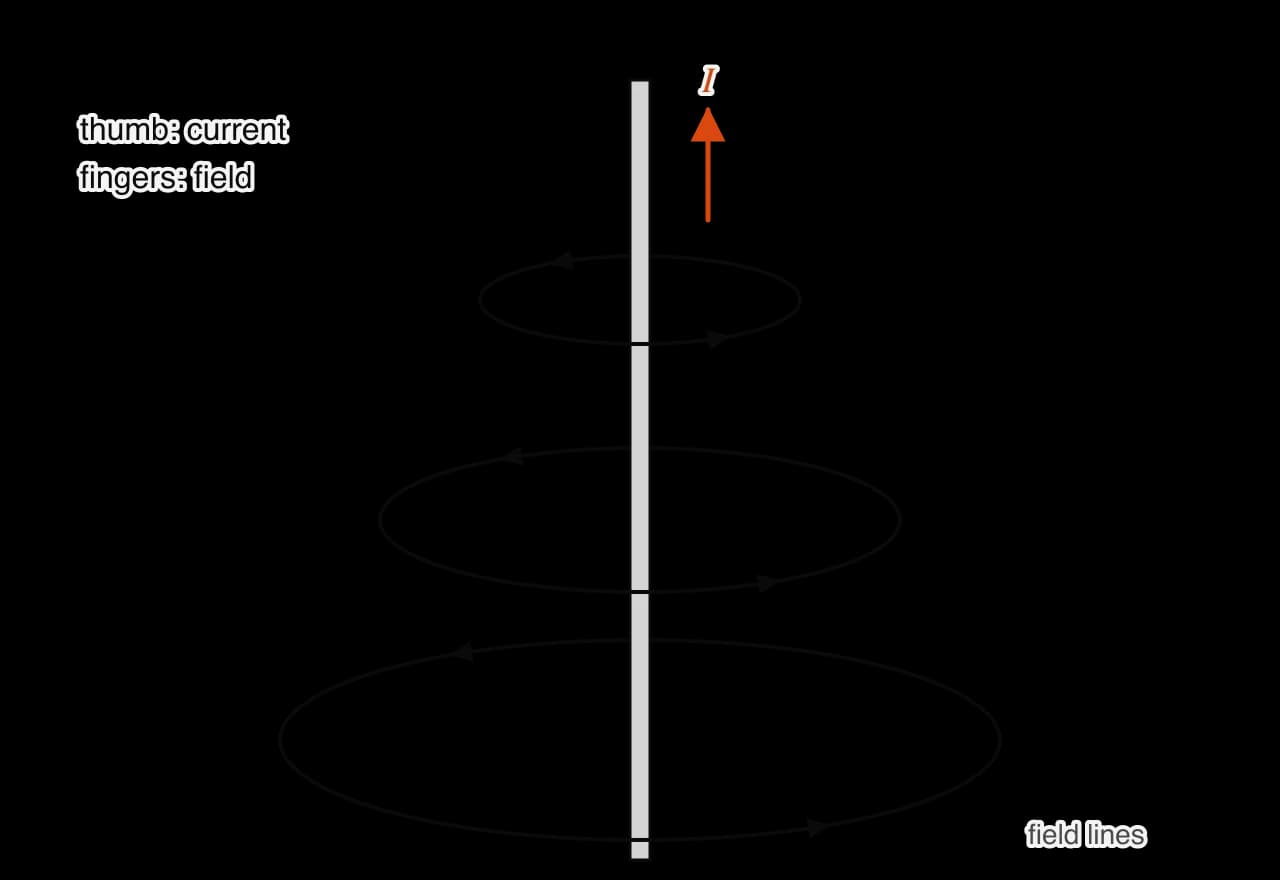
A rule for the field of a current: grip the wire with the right hand, thumb along the conventional current, and the curled fingers give the direction of the magnetic field lines.
A small positive charge used to detect and measure an electric field, small enough not to disturb the charges producing the field.
Field strength equals the negative potential gradient, and no work is done moving a charge along an equipotential surface, which is always perpendicular to the field lines (HL).
Electric and magnetic fields explain how charged particles and currents push and pull on each other without touching. The electric force holds electrons in atoms and atoms in molecules, so it is responsible for almost every everyday force other than weight: friction, tension, normal forces and fluid resistance are all electric forces between atoms. Magnetic fields, produced by moving charges and by magnets, steer charged particles, turn electric motors and protect Earth from much of the radiation streaming from the Sun.
Both are described with the same tools used for gravity: a force law between two bodies, a field strength defined as force per unit of the property that feels the field, and field lines that turn the field into a picture. Comparing the three fields, and seeing where they differ, is one of the clearest ways to understand each of them.
Electric charge
Electric charge is a property of some particles that makes them exert forces on each other. It comes in two types, called positive and negative. Protons carry positive charge, electrons carry negative charge of exactly the same size, and neutrons carry none. An atom has equal numbers of protons and electrons, so it is neutral: its total charge is zero, even though it is full of charged particles.
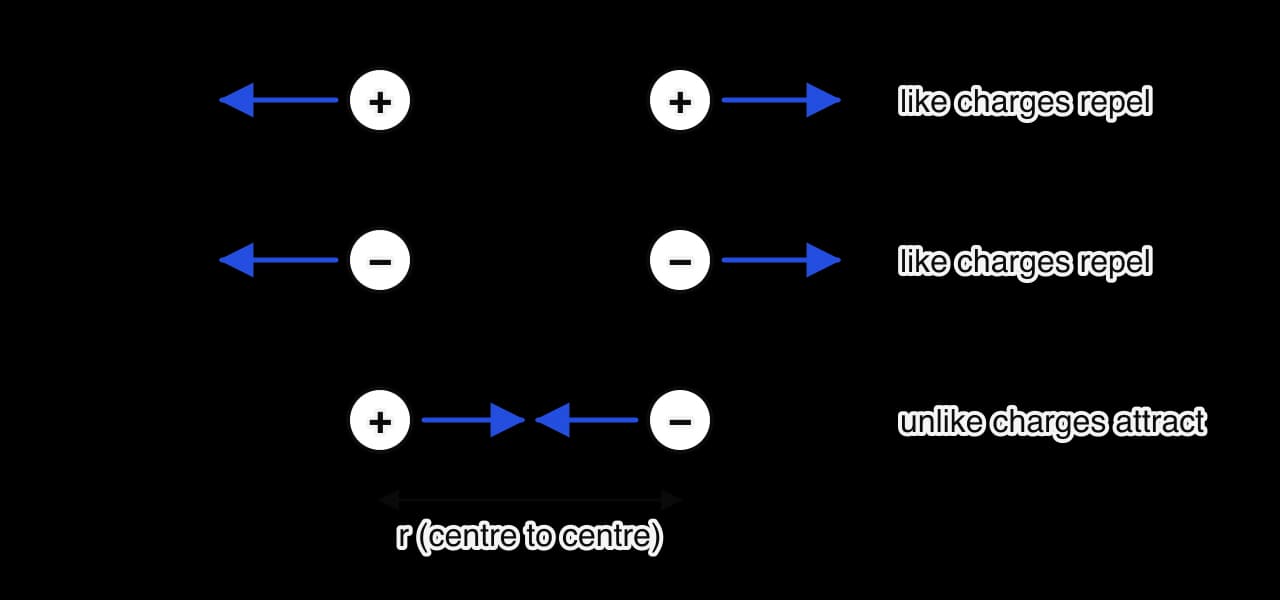
The forces between charges follow one simple rule: like charges repel and unlike charges attract. Two positive charges push each other apart, as do two negative charges, while a positive and a negative charge pull together. The forces on the two charges are always equal in size and opposite in direction, as Newton's third law requires, and they act along the line joining the charges.
The forces on two point charges act along the line joining them, are equal in size and opposite in direction (a Newton’s third law pair), and point apart for like charges and together for unlike charges. Blue arrows are forces.
The charge on a proton is the elementary charge, e=1.60×10⁻¹⁹C, and an electron carries −e. One coulomb is therefore an enormous charge on the atomic scale: it is the charge of about 6.25×10¹⁸ electrons. The charges produced by rubbing a balloon are typically a few nanocoulombs (1nC=10−9C) or less.
Conductors and insulators
How a material behaves when charged depends on whether charge can move through it. In a conductor such as a metal, some electrons are free to move through the whole material. Any extra charge placed on a conductor spreads out until it reaches equilibrium, and on an isolated conductor it ends up on the outer surface. In an insulator such as plastic, glass or dry wood, the electrons are bound to their own atoms. Charge placed on an insulator stays where it was put.
In solid conductors only electrons move. The positive charge of the protons is locked into the nuclei of atoms fixed in the lattice. A body becomes negatively charged by gaining electrons and positively charged by losing them; a positive charge never "flows" into a metal. In liquids, gases and living tissue, positive and negative ions can both move, and the charge carriers can be of either sign.
Conservation of charge
Conservation of charge is one of the most precisely tested laws in physics, and no exception has ever been observed. When a rod is rubbed with a cloth, the rod gains exactly as much negative charge as the cloth loses, so the total stays zero. The law also holds where particles are created and destroyed. In beta-minus decay a neutron (charge 0) becomes a proton (+e), an electron (−e) and an antineutrino (0), so the total charge is 0 before and after. When a high-energy photon produces an electron and a positron, the two new charges, −e and +e, add up to zero.
In circuits, conservation of charge is the reason the current entering a junction equals the current leaving it: charge cannot pile up or vanish at a point in a wire.
How objects become charged
Objects are charged by moving electrons on to or off them. There are three ways of doing this, and a fourth process, earthing, that removes the charge again.
Charging by friction
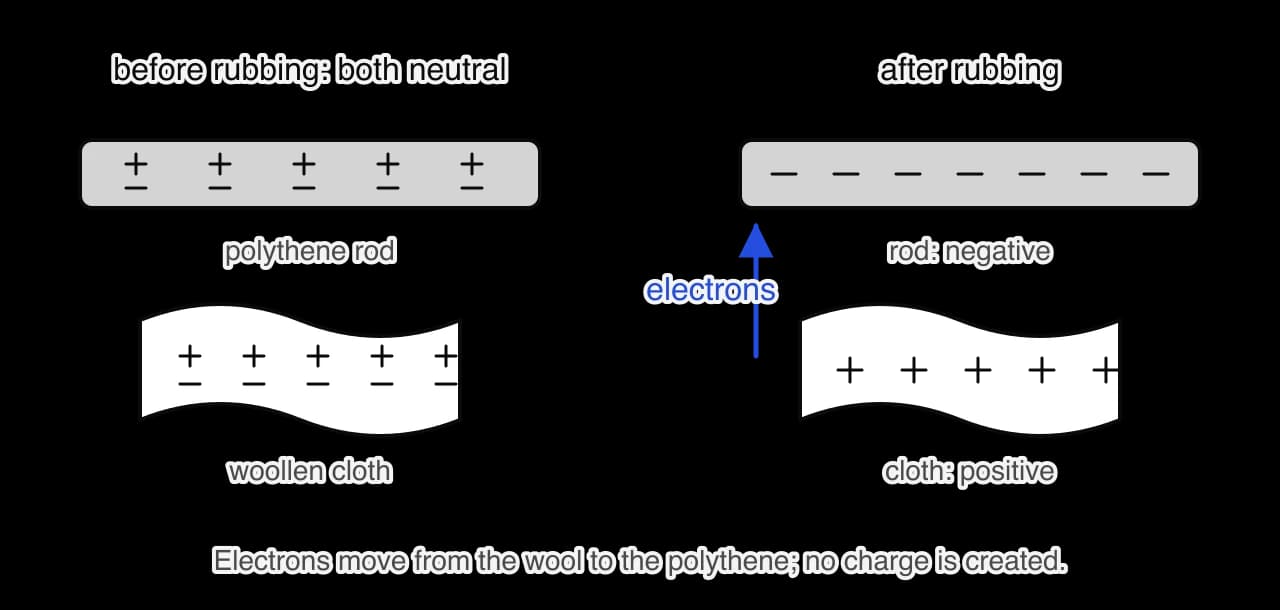
When two different insulating materials are rubbed together, electrons are transferred from one surface to the other. Which way they go depends on how tightly each material holds its outer electrons. Polythene rubbed with wool gains electrons and becomes negative, leaving the wool positive; glass or acetate rubbed with silk loses electrons and becomes positive. The rubbing only increases the area of close contact between the surfaces; the transfer itself happens wherever the surfaces touch.
Rubbing moves electrons from the wool to the polythene. The rod gains exactly as much negative charge as the cloth is left with positive charge.
Charging by friction works best with insulators, because the transferred charge stays in place. A metal rod held in the hand can be charged by friction too, but the charge immediately flows away through the hand and body. This is why sparks after walking across a nylon carpet are worse in dry weather: moist air and a damp surface layer let the charge leak away.
Charging by contact
When a charged object touches a neutral conductor, some of its charge spreads on to the conductor. A negative rod touching a metal sphere gives the sphere some of its excess electrons; a positive rod touching the sphere takes electrons from it. Either way the sphere ends up with charge of the same sign as the object that touched it. This is charging by contact (also called charging by conduction).
If two identical conducting spheres touch, symmetry means the total charge is shared equally between them. For spheres of different sizes the larger sphere takes the larger share, but the total is still conserved.
Earthing
Earth is a very large conductor. When a charged conductor is connected to the ground by a wire (or by a person standing on the floor), charge flows between it and Earth until the conductor is neutral. A negatively charged object loses its excess electrons to Earth; a positively charged object gains electrons from Earth. Earth is so large that the charge it gains or loses makes no measurable difference to it.
Earthing is used for safety wherever static charge is dangerous. Road tankers and aircraft are connected to earth by a cable before fuel is pumped, because fuel flowing through a hose charges the hose and tank by friction, and a spark near fuel vapour could start a fire. The earth wire in a mains plug serves the same purpose for a metal appliance case.
Charging by electrostatic induction
A charged object can charge a conductor without touching it. Bringing a negative rod close to a neutral metal sphere repels the free electrons in the sphere to its far side, leaving the near side with a net positive charge. The total charge on the sphere is still zero, but its charge is separated. If the far side is then earthed, the repelled electrons flow away to Earth. Breaking the earth connection first, and only then removing the rod, traps the sphere with a net positive charge, which spreads evenly over its surface.
Charging a metal sphere by induction with a negative rod. The rod never touches the sphere, and the sphere ends up with the opposite sign of charge to the rod.
Bring the charged rod close to the neutral conductor (but not touching). Charges separate: opposite charge gathers on the near side.
With the rod still in place, earth the far side. Charge of the same sign as the rod leaves (here electrons flow to Earth).
Remove the earth connection while the rod is still close.
Remove the rod. The remaining charge, opposite in sign to the rod's, spreads over the conductor.
The order of the last two steps matters. If the rod were removed first, the electrons would flow back from Earth and the sphere would end up neutral. Electrostatic induction never uses up the rod's charge, so the same rod can charge many spheres. If a positive rod is used instead, electrons are drawn up from Earth into the sphere, and it ends up negative.
Induction also explains why a charged object attracts small neutral objects. A charged comb held over scraps of paper separates the charge in each scrap slightly (in an insulator the electrons shift within each molecule rather than across the whole object). The opposite charge is nearer the comb than the like charge, and since the electric force weakens with distance, the attraction is larger than the repulsion and the paper jumps up.
Coulomb’s law
The force between two charges depends on the sizes of the charges and on their separation in a simple way. Charles-Augustin de Coulomb established the relationship in 1785 by measuring the force between small charged spheres with a sensitive torsion balance, and it is now called Coulomb's law.
F=kr2q1q2wherek=4πε01
Here q1 and q2 are the charges in coulombs and r is the distance between their centres in metres. The Coulomb constant is k=8.99×10⁹N m2C−2. It is written in terms of the permittivity of free space, ε0=8.85×10⁻¹²C2N−1m−2, a constant that describes how a vacuum transmits electric forces. Both values are in the data booklet.
Coulomb's law applies exactly to point charges: charges whose size is negligible compared with their separation. It also applies to uniformly charged spheres, provided r is measured between the centres, because outside a sphere its charge acts as if it were concentrated at the centre.
Using the equation
The sign of the product q1q2 shows the type of force. A positive product (like charges) means repulsion and a negative product (unlike charges) means attraction. In calculations it is usually clearer to substitute the sizes of the charges, find the size of the force, and decide its direction from "like repel, unlike attract".
Two features of the law matter most in practice. The force is proportional to each charge, so doubling one charge doubles the force. The force follows an inverse-square law, so doubling the separation reduces the force to a quarter, and tripling it reduces the force to a ninth.
F = F₀(r₀/r)²
Inverse-square law: when the separation doubles the force falls to a quarter, and when it triples the force falls to a ninth.
Electric and gravitational forces compared
Coulomb's law has the same form as Newton's law of gravitation, F=Gm1m2/r2: both are inverse-square laws for point sources. There are two important differences. Gravity only ever attracts, while electric forces can attract or repel. And the electric force between charged particles is far stronger than the gravitational force between them.
Charges in a medium: permittivity
The value ε0 applies to charges in a vacuum. When the space between charges is filled with an insulating material, the molecules of the material are polarised by the field and partly cancel it, so the force is smaller. Coulomb's law in a medium uses the permittivity ε of the material in place of ε0:
F=4πε1r2q1q2
The relative permittivity εr=ε/ε0 is the factor by which the material increases the permittivity, and therefore the factor by which it reduces the force compared with a vacuum.
Medium
Relative permittivity εr (about 20 °C)
Force compared with a vacuum
Vacuum
1 (exactly)
F
Air
1.0006
almost exactly F
Paper
2 to 4 (depends on the paper)
F/2 to F/4
Glass
4 to 10 (depends on the glass)
F/4 to F/10
Ethanol
about 25
about F/25
Water
about 80
about F/80
Typical values; they vary with the sample, temperature and frequency. Data: The Engineering ToolBox, Relative Permittivity table, accessed 2026.
Air is so close to a vacuum that ε0 is used for charges in air. Water's very large relative permittivity explains why it dissolves ionic crystals such as sodium chloride: the attraction between a sodium ion and a chloride ion in water is about 80 times weaker than in a vacuum, small enough for the random thermal motion of water molecules to pull the ions apart.
Forces from several charges
When several charges act on one charge, the force from each is calculated with Coulomb's law as if the others were not there, and the forces are added as vectors. This is the principle of superposition. For charges on a straight line, choose a positive direction and give each force a sign.
Electric field strength
A charge affects the space around it so that any other charge placed there feels a force. This region of influence is an electric field. The field idea separates the problem into two steps: a source charge creates a field, and the field then exerts a force on whatever charge is placed in it. Fields store energy, and when a source charge moves, the change in its field spreads outwards at the speed of light, so a field is a physical thing in its own right rather than only a calculating aid.
To measure a field at a point, a small positive test charge q is placed there and the force on it is measured. The test charge must be small enough not to disturb the charges that create the field.
Electric field strength is the electric equivalent of gravitational field strength g=F/m, the force per unit mass. Once E is known, the force on any charge q at that point follows from F=qE. A positive charge is pushed in the direction of E; a negative charge, such as an electron, is pushed in the opposite direction.
YouTube
Chris Doner (IB Physics): fields and test charges, and how a test charge is used to define field strength.
The field of a point charge
Combining Coulomb's law with the definition of field strength gives the field at a distance r from a point charge Q. The force on a test charge q is F=kQq/r2, so dividing by q:
E=qF=r2kQ
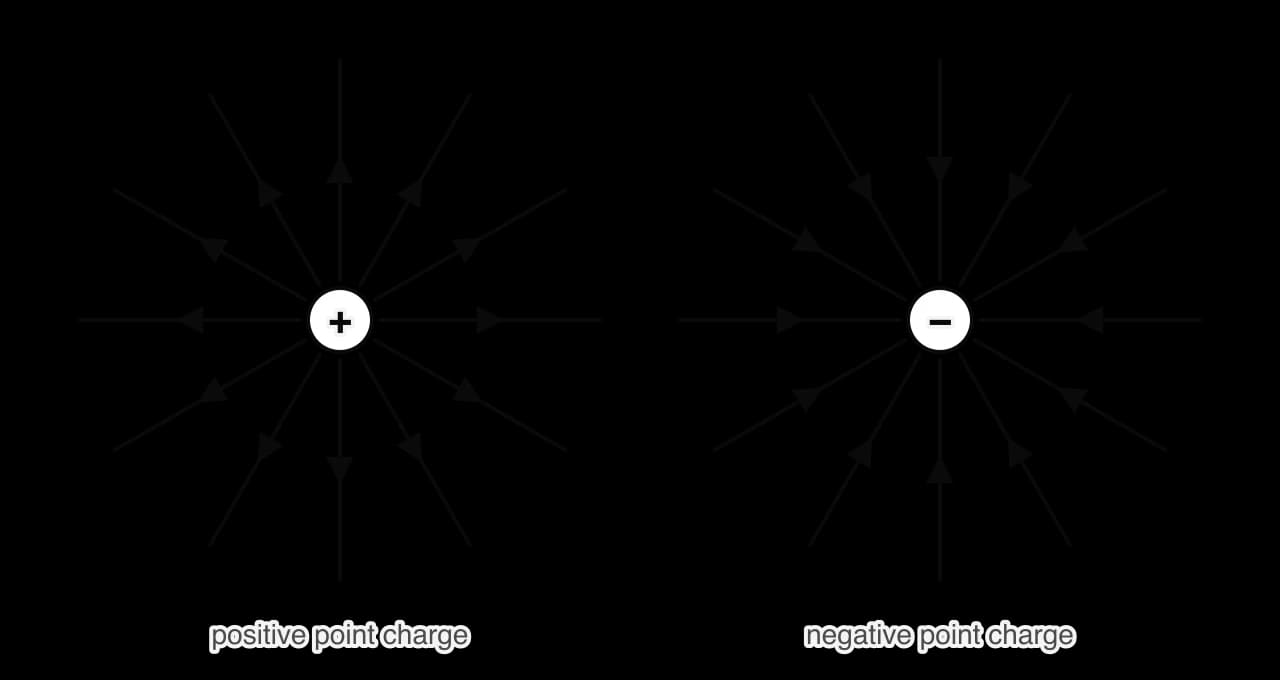
The test charge cancels: the field depends only on the source charge Q and the distance from it. The field of a positive charge points radially outwards and the field of a negative charge points radially inwards. Like the force, the field strength obeys an inverse-square law.
Fields of several charges
Electric fields superpose: the resultant field at a point is the vector sum of the fields of each charge. Along the line joining two charges, all the fields are parallel, so they can be added with signs. A useful habit is to sketch an arrow for each field at the point first, using "away from positive, towards negative".
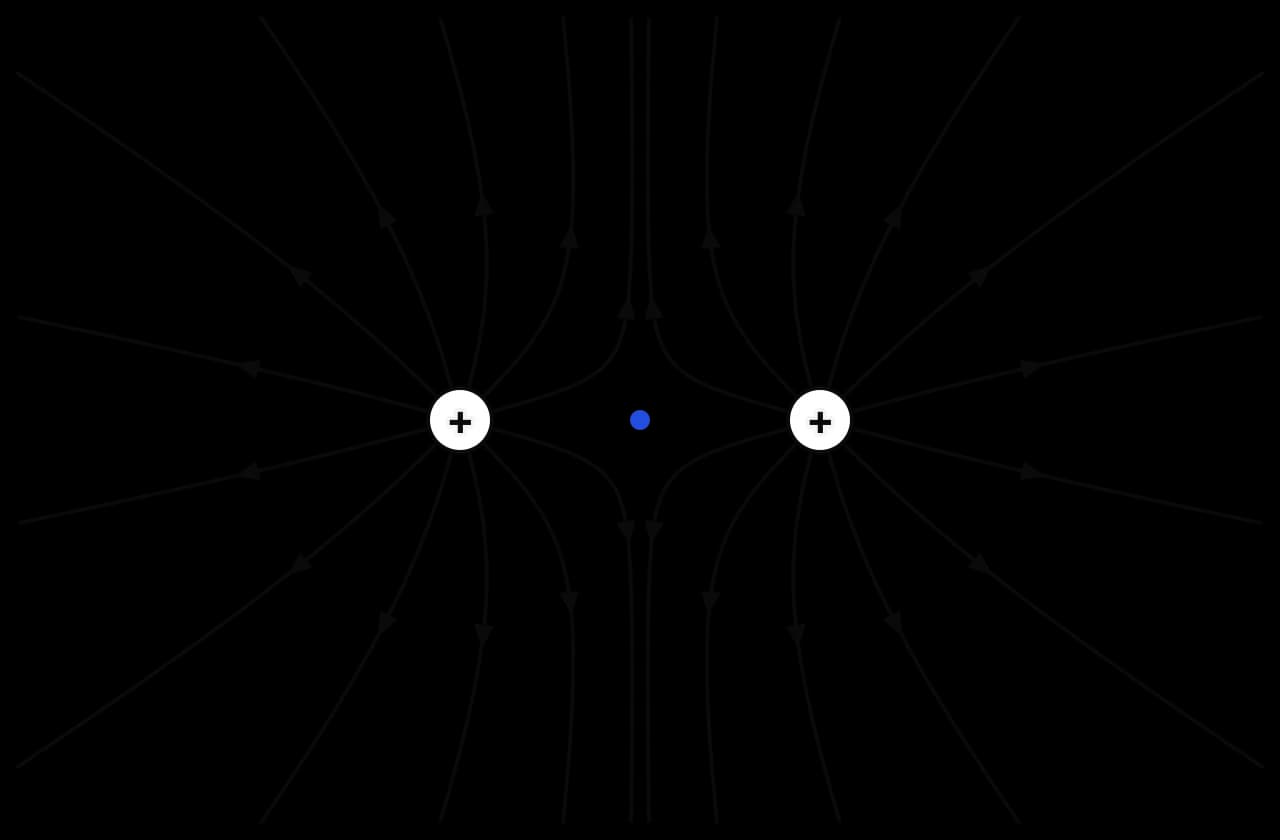
Between two like charges the fields point in opposite directions, so there is a point where they cancel. This is a neutral point: the resultant field there is zero, and a charge placed there feels no force. Between two unlike charges the fields always add. If the unlike charges are unequal in size, the neutral point lies outside the pair, on the side of the smaller charge; equal and opposite charges have no neutral point at all.
Electric field lines
An electric field line is a line drawn so that its direction at every point is the direction of the field there, which is the direction of the force on a positive test charge. Field lines turn a field into a picture, and drawing them correctly follows a few rules.
Lines start on positive charges and end on negative charges (or go off to infinity). Each line has an arrow showing its direction.
Lines never cross, because the field can only have one direction at any point.
The density of lines (how closely they are packed) is proportional to the field strength: the field is strongest where the lines are closest together.
The number of lines leaving or entering a charge is proportional to the size of the charge.
Lines meet the surface of a conductor at right angles, and there are no field lines inside a conductor.
A positive test charge released in a field accelerates along the direction of the field line at its position. It does not necessarily follow the line afterwards, because once it is moving its inertia can carry it off the line; a field line shows the direction of the force, not the path.
Isolated point charges
The field of an isolated point charge is a radial field: the lines are straight and point directly away from a positive charge or directly towards a negative one. The lines spread out as the distance increases. For a point charge, the number of lines crossing a sphere centred on the charge is the same at every radius, but the area of the sphere grows as r2, so the line density falls as 1/r2, which is the inverse-square law.
Radial fields. The lines point away from a positive charge and towards a negative one, and they spread out with distance because the field gets weaker.
Two point charges
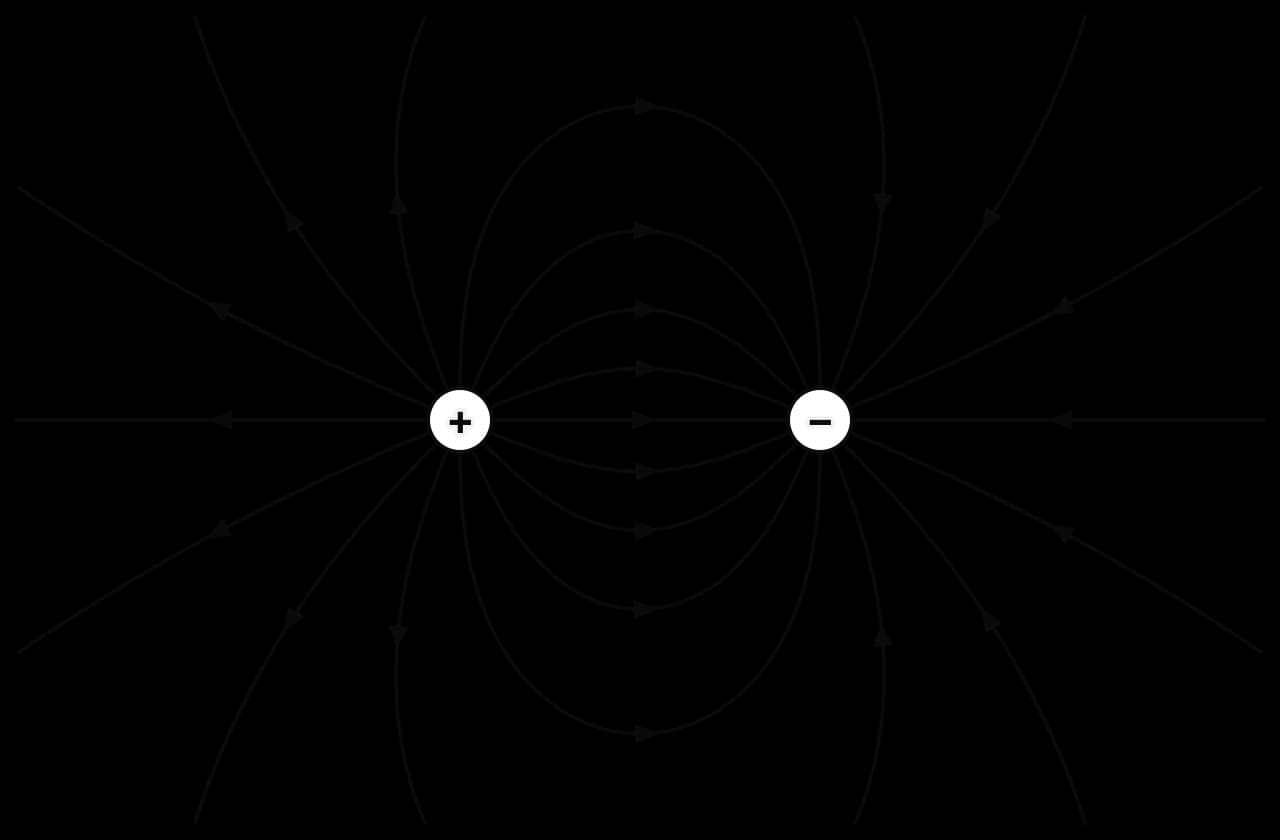
The field near two charges is found by adding their fields at every point. For a pair of equal and opposite charges, every line that leaves the positive charge curves round and ends on the negative charge. The lines are densest on the line joining the charges, where the two fields add.
Equal and opposite charges: every line leaving the positive charge ends on the negative charge (lines leaving the frame return from far away). The field is strongest where the lines crowd together, between the charges.
For two equal like charges, the lines from each charge are pushed away from the other. No line joins the two charges, and midway between them is a neutral point. Far from the pair, the pattern looks like the radial field of a single charge equal to the total, 2Q.
Two equal positive charges. The lines from each charge are pushed away from the other, leaving a neutral point (blue dot) midway between them where the field strength is zero.
When the charges are unequal, the number of lines from each is in proportion to its charge. For +2Q and −Q, only half of the lines from +2Q end on −Q, and the rest go off to infinity, so the far field is like that of a single charge +Q.
Charges +2Q and −Q. Twice as many lines leave +2Q as end on −Q, so half of the lines from +2Q never return and the far field looks like that of a single charge +Q.
A charged conducting sphere
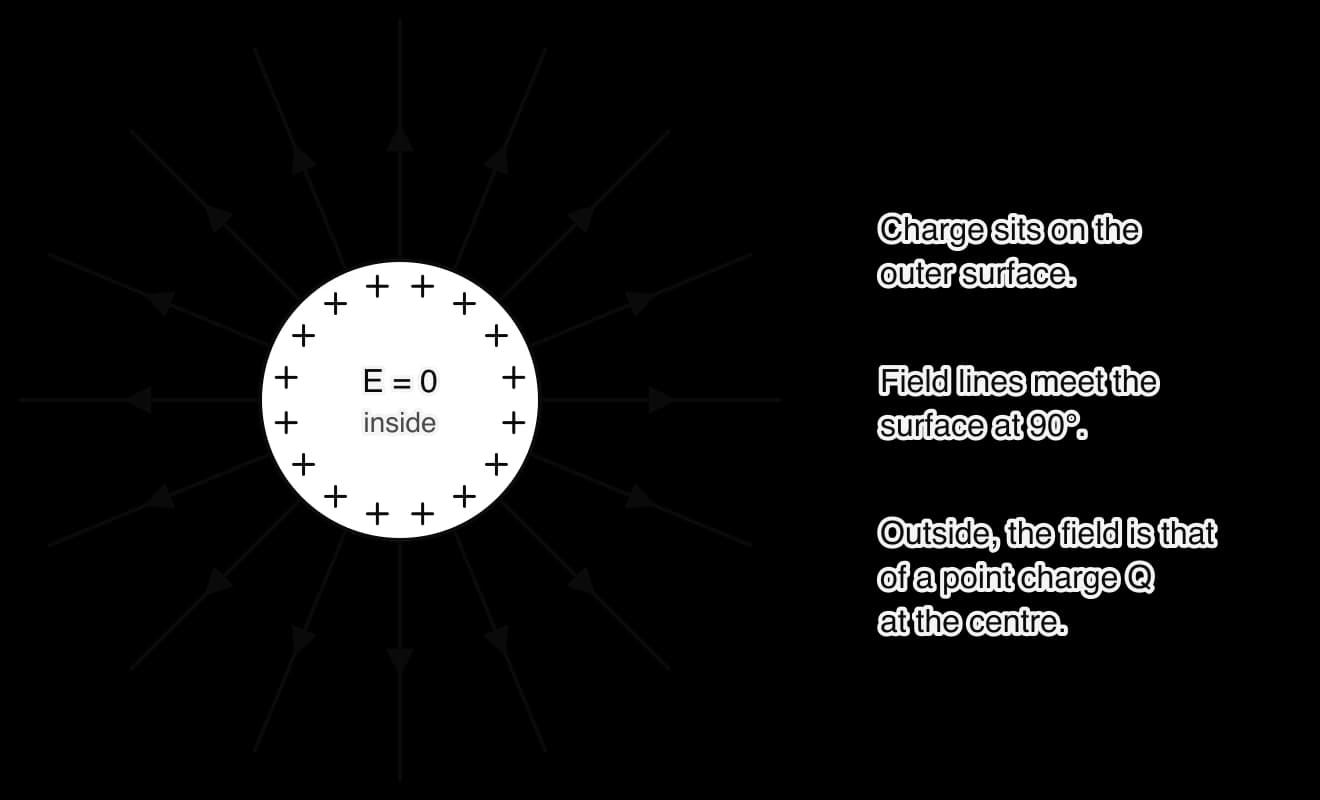
When a metal sphere is charged, the free charges repel each other and spread out until they sit on the outer surface, distributed evenly. Inside the metal the field is then exactly zero. If it were not, the free electrons would feel a force and keep moving, and the charge would not be in equilibrium.
A charged conducting sphere. Outside, the lines are radial, exactly as if all the charge were a point at the centre; inside the metal there is no field at all.
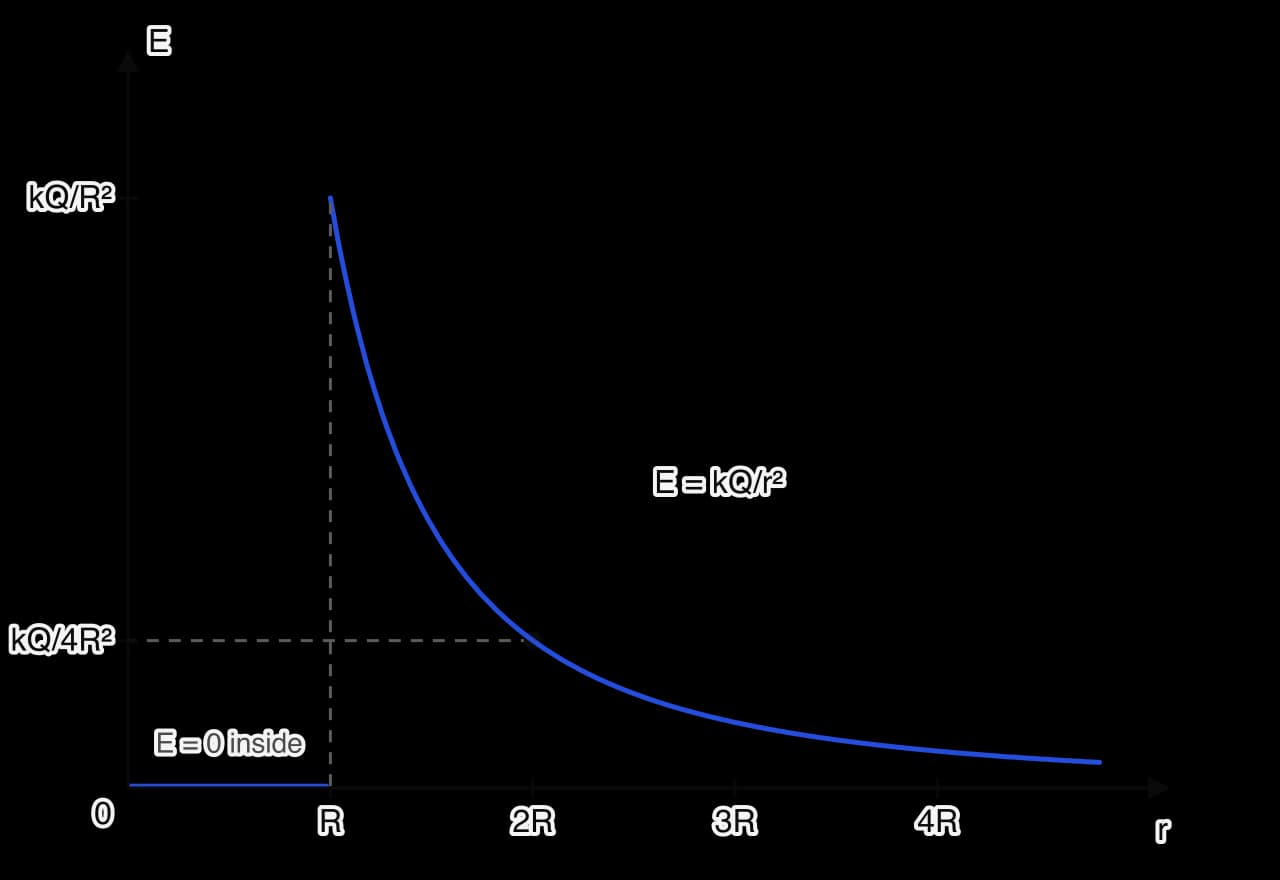
Outside, the field lines are radial and meet the surface at right angles. The field is exactly that of a point charge Q at the centre, E=kQ/r2 for r≥R, so the strongest field is just outside the surface, E=kQ/R2. The same is true of a hollow conducting sphere: there is no field anywhere inside the cavity.
Field strength of a charged conducting sphere of radius R: zero inside, largest just outside the surface, then falling with the inverse square of the distance from the centre.
A hollow conductor therefore shields its interior from external electric fields. This is the principle of a Faraday cage: a car or an aircraft struck by lightning protects the people inside because the charge flows over the metal skin, and the field inside the metal shell stays close to zero.
The uniform field between parallel plates
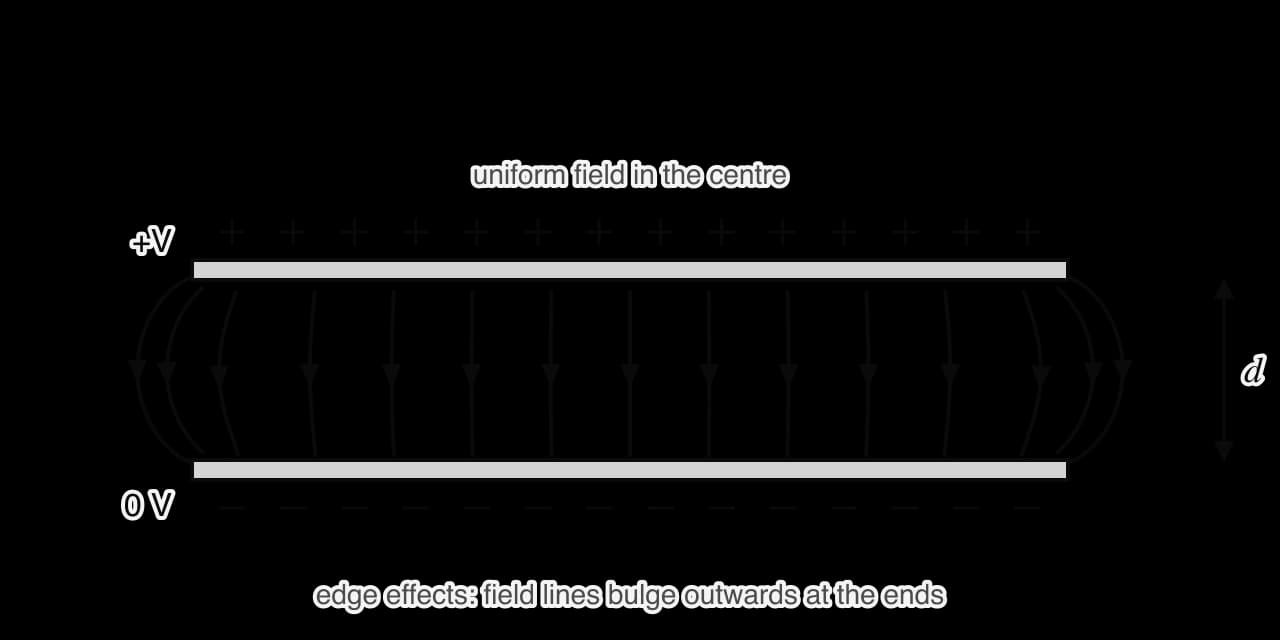
Two flat, parallel metal plates connected to the terminals of a supply carry equal and opposite charges. Between the plates, away from the edges, the field lines are straight, parallel and equally spaced, running from the positive plate to the negative plate. Equal spacing means the field has the same strength everywhere in this region: the field is a uniform field.
Between parallel plates the field lines are straight, parallel and equally spaced, so the field is uniform. Near the ends of the plates the lines bulge outwards and the field becomes weaker and non-uniform.
For plates with a potential difference V between them and a separation d, the field strength is
E=dV
The equation follows from the energy transferred to a charge. Moving a charge q from one plate to the other, against a constant force qE over a distance d, takes work W=qEd. By the definition of potential difference the same work is W=qV. Equating the two gives qEd=qV, so E=V/d. The field depends only on the pd and the separation, not on where a charge sits between the plates, and the force F=qE on a charge is the same at every point in the uniform region.
The equation also shows why the units V m−1 and N C−1 are the same: 1V m−1=1J C−1m−1=1N m C−1m−1=1N C−1.
Edge effects
Near the ends of the plates the field lines bulge outwards. In this fringe region the lines are curved and spread out, so the field is weaker and no longer uniform, and E=V/d no longer applies. These edge effects matter less when the plates are long compared with their separation: for plates many times wider than the gap, almost all of the space between them has a uniform field. Experiments that rely on a uniform field therefore keep the charged particles near the centre of the plates.
When the field is too strong: sparks
Air is a good insulator only up to a point. In dry air at sea-level pressure, a field of about 3×10⁶V m−1 is strong enough to tear electrons from air molecules. The freed electrons are accelerated, collide with more molecules and free more electrons, and the air suddenly conducts as a spark. This electrical breakdown produces the crackle when a charged jumper is pulled off, the spark from a Van de Graaff generator's dome and, on the largest scale, lightning, where charge separated inside a thundercloud discharges to the ground or to another part of the cloud.
Millikan’s oil-drop experiment
The charge on a single electron is far too small to measure directly, so it was found from the charges on tiny objects carrying only a few electrons' worth of charge. By 1900 experiments had shown that electrons exist and had measured their charge-to-mass ratio, but not the size of their charge. Between 1909 and 1913 Robert Millikan, working with his student Harvey Fletcher, measured the charge on tiny oil drops, in what became known as Millikan's oil-drop experiment, by balancing the electric force on each drop against its weight. The results showed that electric charge is not continuous: it always comes in whole-number multiples of one smallest amount.
The apparatus
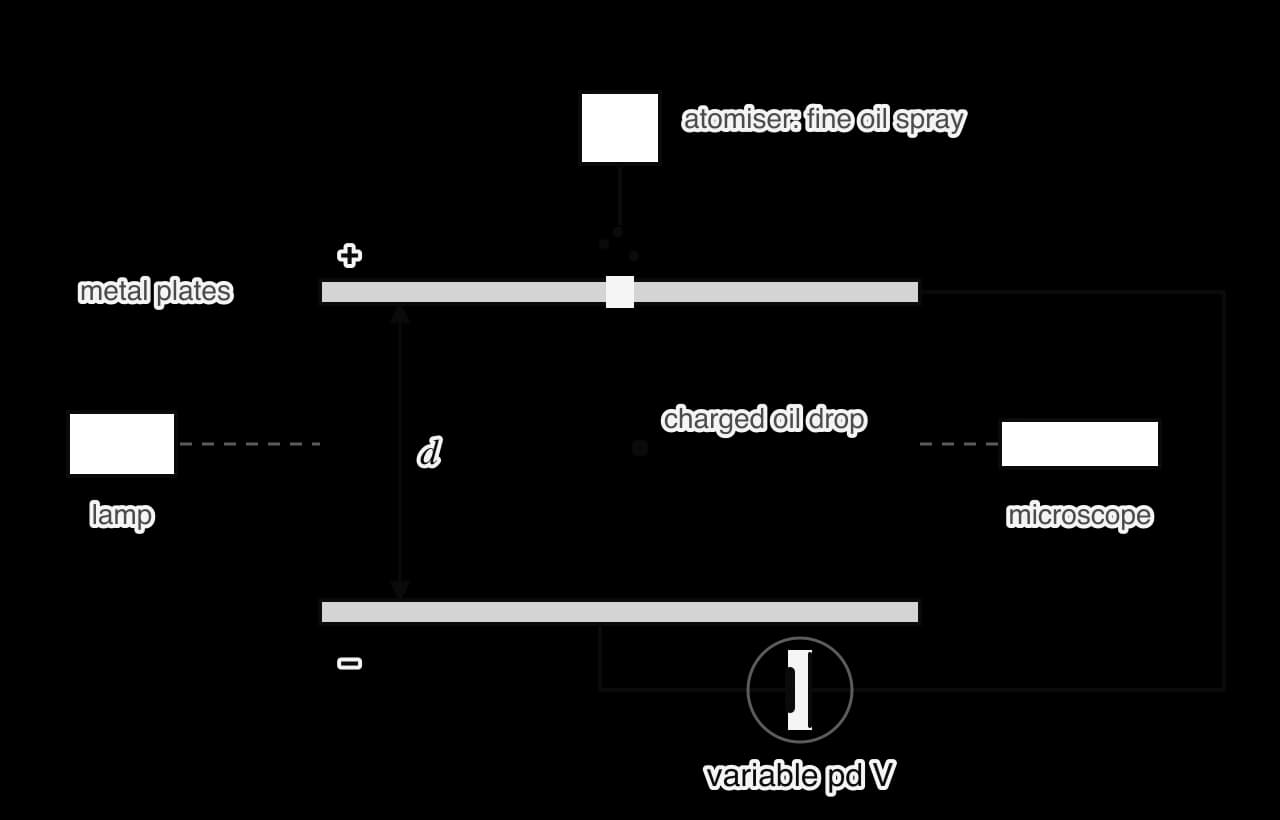
A fine spray of oil drops is blown into the space above two horizontal metal plates, and a few drops fall through a small hole in the upper plate. Spraying charges many drops by friction, and the air between the plates can also be ionised (for example with X-rays) so that drops pick up or lose charge. A lamp lights the drops and a microscope with a scale lets one drop be watched and its speed measured. A variable pd V across the plates, a distance d apart, produces a uniform field E=V/d.
Millikan’s oil-drop apparatus (simplified). One charged drop is watched through the microscope while the pd across the plates is adjusted.
Balancing a drop
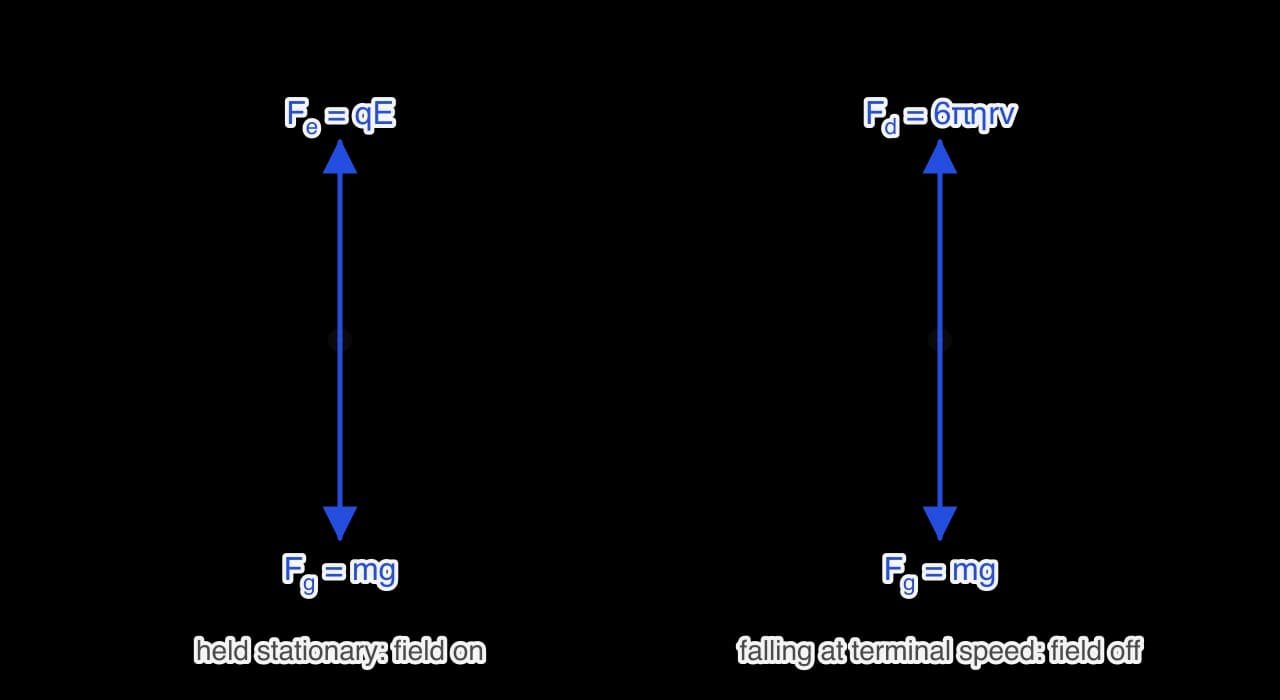
With the field switched on, the pd is adjusted until the chosen drop hangs motionless. The drop is then in equilibrium: the upward electric force balances its weight (the upthrust from the air is small and is ignored here).
Free-body diagrams of the drop (buoyancy is neglected). In both cases the forces are balanced, so the drop has zero acceleration. Blue arrows are forces.
qE=mg⇒dqV=mg⇒q=Vmgd
The electric force must point upwards. With the upper plate positive, the field between the plates points downwards, so a drop held stationary must be negatively charged. Every quantity except the mass of the drop can be read directly from the apparatus.
Finding the mass of the drop
The drop is far too small to weigh, so its mass is found from its terminal speed. With the field switched off, the drop falls and quickly reaches a constant speed v, at which its weight is balanced by the viscous drag of the air, given by Stokes' law Fd=6πηrv (from A.2). Viscous drag is the particular form of fluid resistance on a small sphere moving slowly through a fluid of viscosity η. With the oil's density ρ, the mass of a drop of radius r is m=34πr3ρ, so at terminal speed
34πr3ρg=6πηrv⇒r=2ρg9ηv
Timing the drop over a measured distance gives v, and the radius and then the mass follow. Millikan's main source of error turned out to be the value he used for the viscosity of air, which was slightly too low.
Evidence for the quantisation of charge
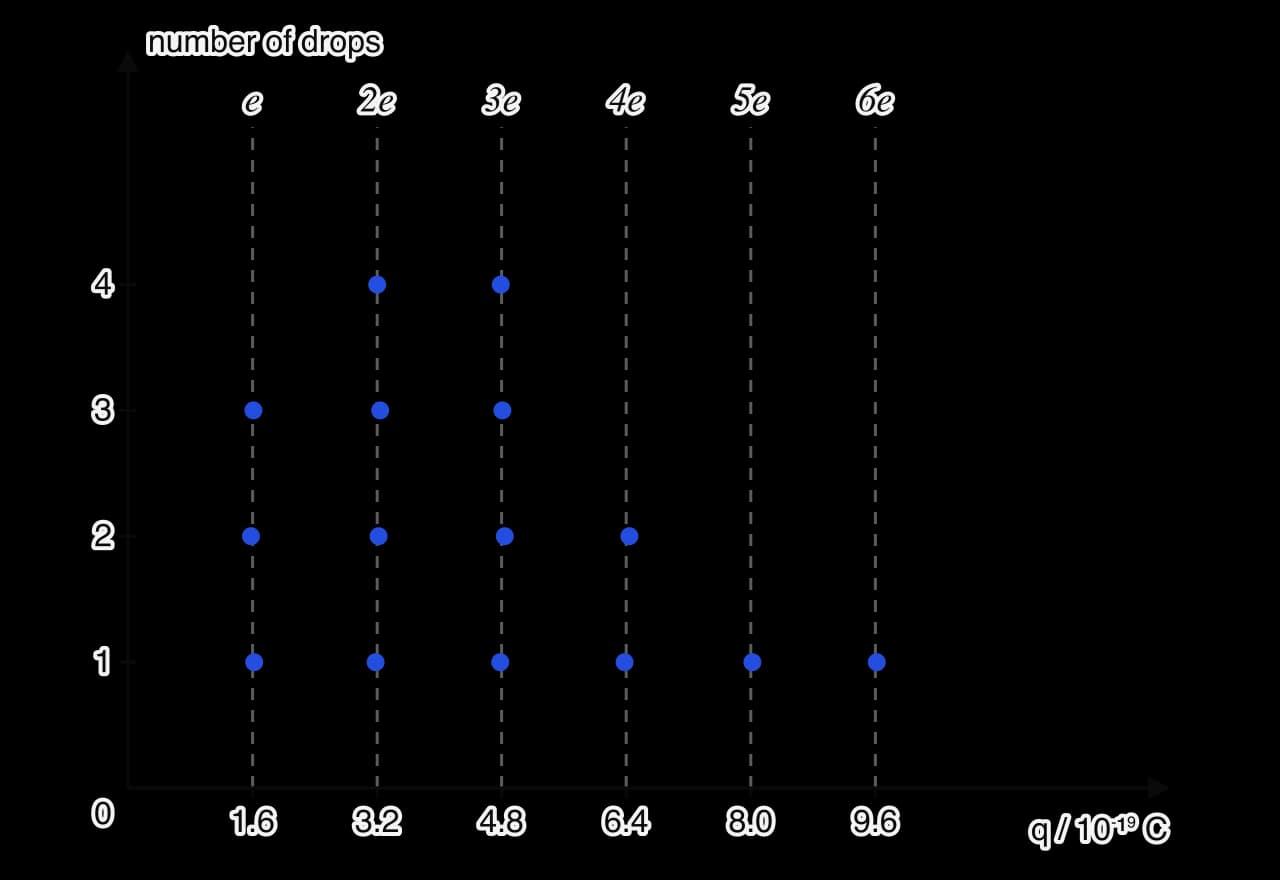
Millikan measured the charges on well over a hundred drops, and on the same drop before and after it gained or lost charge. Every value was a whole-number multiple of about 1.6×10⁻¹⁹C: he found drops carrying e, 2e, 3e and so on, but never 1.5e or 0.7e. The changes in the charge on a single drop were also multiples of the same value. The conclusion is that charge is quantised.
Charges measured on 15 drops (illustrative data). The values cluster at whole-number multiples of 1.6 × 10⁻¹⁹ C, with gaps between, which is the signature of a quantised quantity.
Quantisation of charge is strong evidence that charge is carried by particles: the smallest charge a drop can gain or lose is the charge of one electron. To find e from a set of measured charges, a student looks for the largest value of which every measurement is a whole-number multiple; the differences between measured charges are particularly useful, because each difference must also be a multiple of e.
Millikan published e=1.592×10⁻¹⁹C in 1913 and received the Nobel Prize in Physics in 1923. Once a better value of the viscosity of air was used, his data gave a result very close to the modern value, which is now fixed exactly at 1.602176634×10⁻¹⁹C as part of the definition of the SI units. His notebooks show that he did not publish every drop he measured (his 1913 paper gives full data for 58 drops), and historians have since debated how he chose which drops to include; later analyses found that the excluded drops changed the uncertainty in his value but not his conclusion. The episode is often used to discuss how scientists decide which data are reliable, and why independent repetition of an experiment matters.
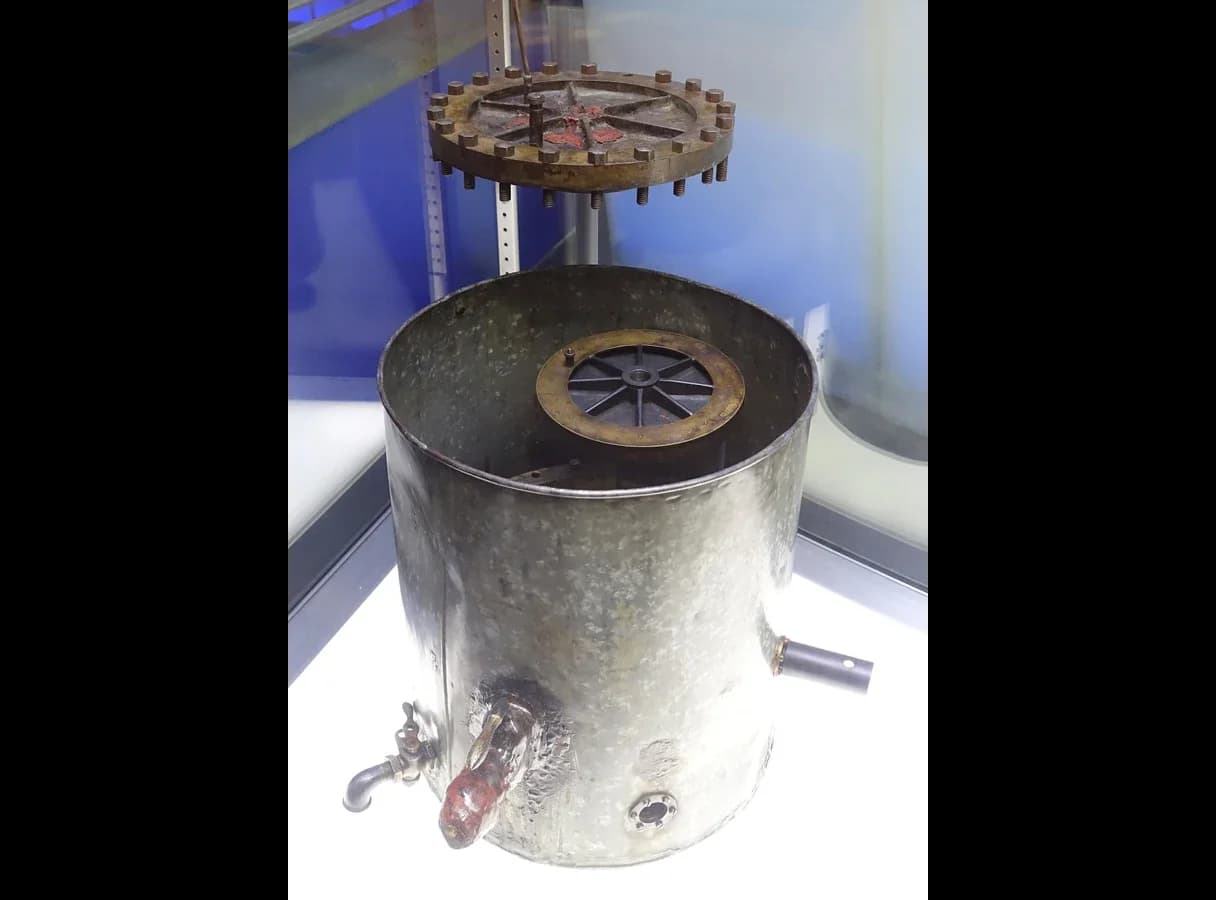
The oil-drop apparatus used by Millikan and Fletcher around 1916, now in the Museum of Science and Industry, Chicago. Image: Wikimedia Commons (public domain).
Magnetic fields and field lines
A magnetic field is a region in which a magnet, a magnetic material such as iron, or a moving charge experiences a magnetic force. Magnetic fields are produced by permanent magnets and by electric currents, and on the atomic scale both come from moving charges: the magnetism of a bar magnet comes from the spin and orbital motion of electrons in its atoms.
Every magnet has two magnetic poles, called north (N) and south (S). The names come from the compass: a freely suspended magnet turns until its north-seeking pole, its N pole, points towards Earth's geographic north. As with charges, like poles repel and unlike poles attract. A major difference from electric charge is that magnetic poles always come in pairs. Cutting a bar magnet in half produces two smaller magnets, each with its own N and S pole; no isolated N or S pole (a magnetic monopole) has ever been found.
Magnetic field lines follow rules similar to those for electric field lines. They never cross, and their density shows the field strength: where the lines are close together the field is strong. Unlike electric field lines, which start and end on charges, magnetic field lines have no start or end. They form closed loops, continuing through the inside of a magnet from its S pole back to its N pole. This is the field-line picture of the fact that there are no magnetic monopoles.
The strength of a magnetic field is measured by the magnetic flux density B, in teslas (T). It is defined from the force on a current or a moving charge, which is the subject of D.3. For comparison, Earth's field at the surface is about 5×10⁻⁵T, a small fridge magnet produces a few thousandths of a tesla close to its surface, and the solenoid of a hospital MRI scanner produces 1.5 T or 3 T.
Mapping a field
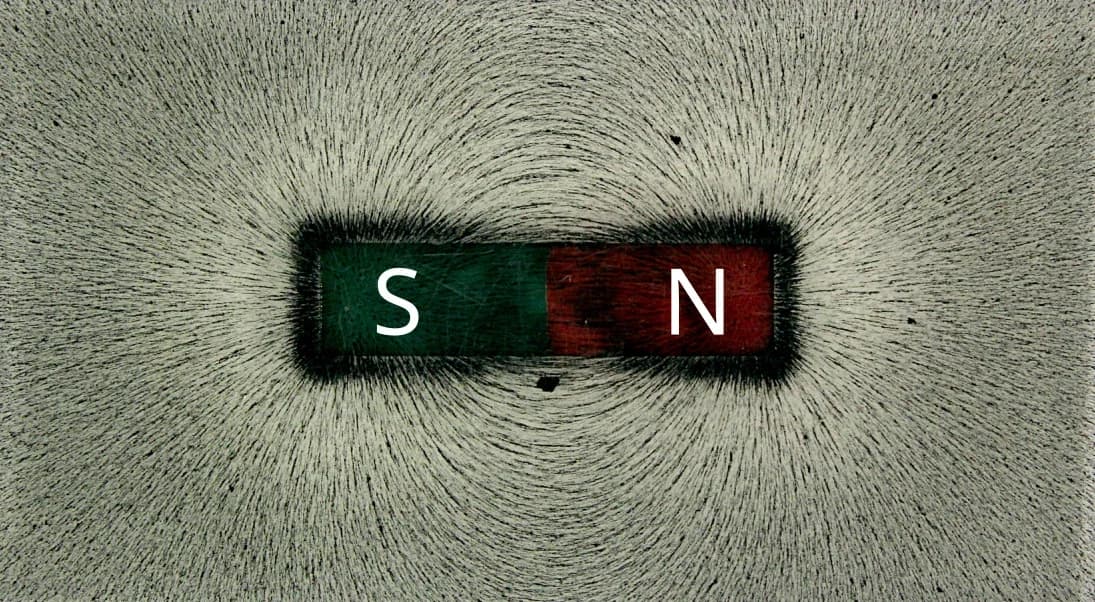
A field pattern can be found in two ways. Iron filings sprinkled on a card over a magnet become tiny magnets themselves and line up along the field, showing the shape of the lines but not their direction. A small plotting compass placed at many points, with a dot marked at each end of the needle, traces individual lines and gives their direction from the way the N end of the needle points.
Iron filings over a bar magnet. Each filing becomes a tiny magnet and lines up with the field, so the pattern shows the shape of the field lines, densest at the poles. Image: MikeRun, Vera Wurmsdobler, CC BY-SA 4.0, via Wikimedia Commons.
Bar magnets
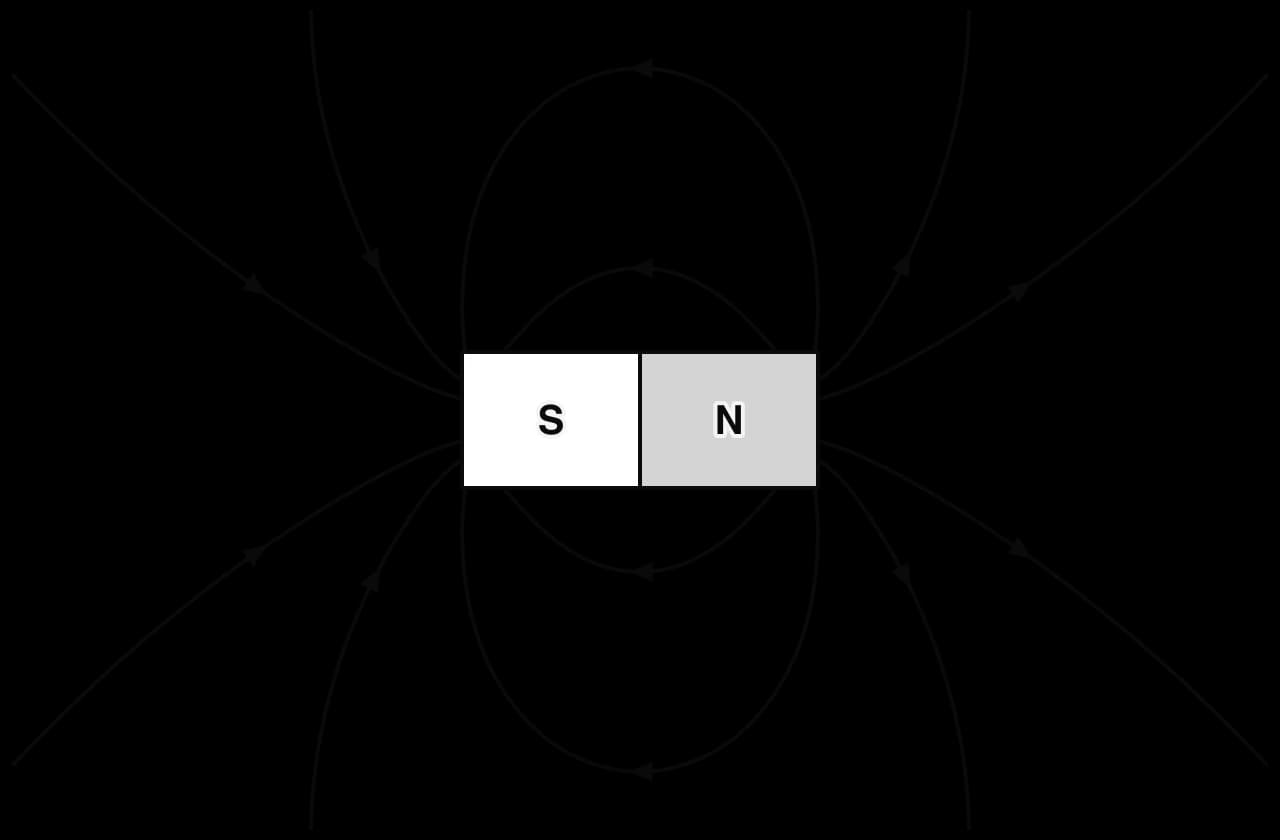
The field of a bar magnet leaves the N pole, curves round in loops on all sides and enters the S pole. The lines are most concentrated at the poles, which is where iron filings cluster and where the magnet attracts iron most strongly. Far from the magnet the field weakens rapidly.
The field of a bar magnet, computed for an ideal magnet. Outside the magnet the lines run from the north pole to the south pole; they are most concentrated, and the field strongest, at the poles.
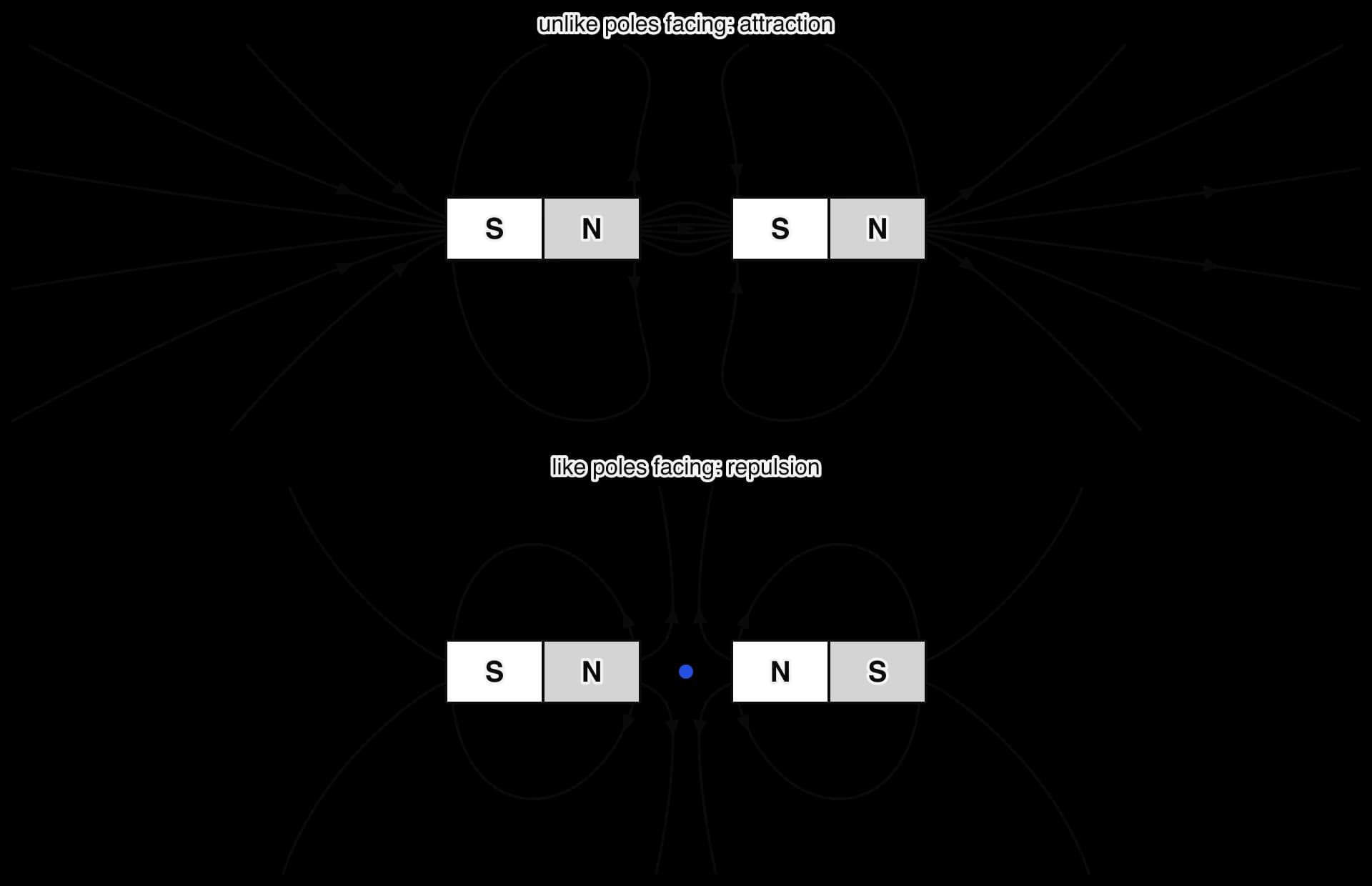
When two magnets are placed end to end, their fields add. With unlike poles facing, lines run directly across the gap from N to S, and the magnets attract. With like poles facing, the lines from the two poles turn away from each other and there is a neutral point midway between them, where the two fields cancel; the magnets repel. A useful picture is that field lines behave like stretched elastic bands that also push sideways on each other: lines joining two magnets pull them together, and lines squeezed between them push them apart.
Unlike poles facing each other: lines cross the gap from N to S and the magnets attract. Like poles facing: the lines turn away from each other, leaving a neutral point (blue dot) where the field is zero, and the magnets repel.
Earth’s magnetic field
Earth's magnetic field is produced by electric currents in its molten outer core of iron and nickel. Near the surface it has very nearly the shape of the field of a bar magnet placed at the centre of Earth, tilted at about 10∘ to the rotation axis. Because the N pole of a compass needle is attracted to the north, the pole of this imaginary magnet that lies under the Arctic must be a south magnetic pole: the field lines leave the southern hemisphere, loop round outside Earth and enter the northern hemisphere.
Earth’s magnetic field is close to that of a bar magnet tilted slightly from the rotation axis. The magnet’s south pole lies under the Arctic, which is why the north pole of a compass needle points north.
The field strength at the surface varies from about 25μT near the equator to about 65μT near the magnetic poles. Except at the magnetic equator, the field is not horizontal: in Europe it points steeply down into the ground, so a compass needle free to tilt dips downwards. Both the strength and the direction change slowly over decades, and rocks show that the field has reversed its direction many times over Earth's history. The field also deflects many of the charged particles streaming from the Sun, an effect taken further in D.3.
YouTube
Chris Doner (IB Physics): magnetic fields, an IB lesson on magnetic field lines and the fields of magnets and currents.
Magnetic fields of electric currents
Every electric current produces a magnetic field, and the shape of the field depends on the shape of the conductor. The first evidence for this link between electricity and magnetism came in 1820, when Hans Christian Ørsted saw a compass needle near a wire swing round as a current was switched on.
A long straight wire
The field lines of a long straight wire are concentric circles centred on the wire, in planes perpendicular to it. The field is strongest close to the wire, and the circles are drawn further apart at greater distances because the field weakens. Reversing the current reverses the direction of the lines.
Right-hand grip rule: with the thumb along the current (orange), the curled fingers give the direction of the magnetic field lines. Seen from above, an upward current has an anticlockwise field.
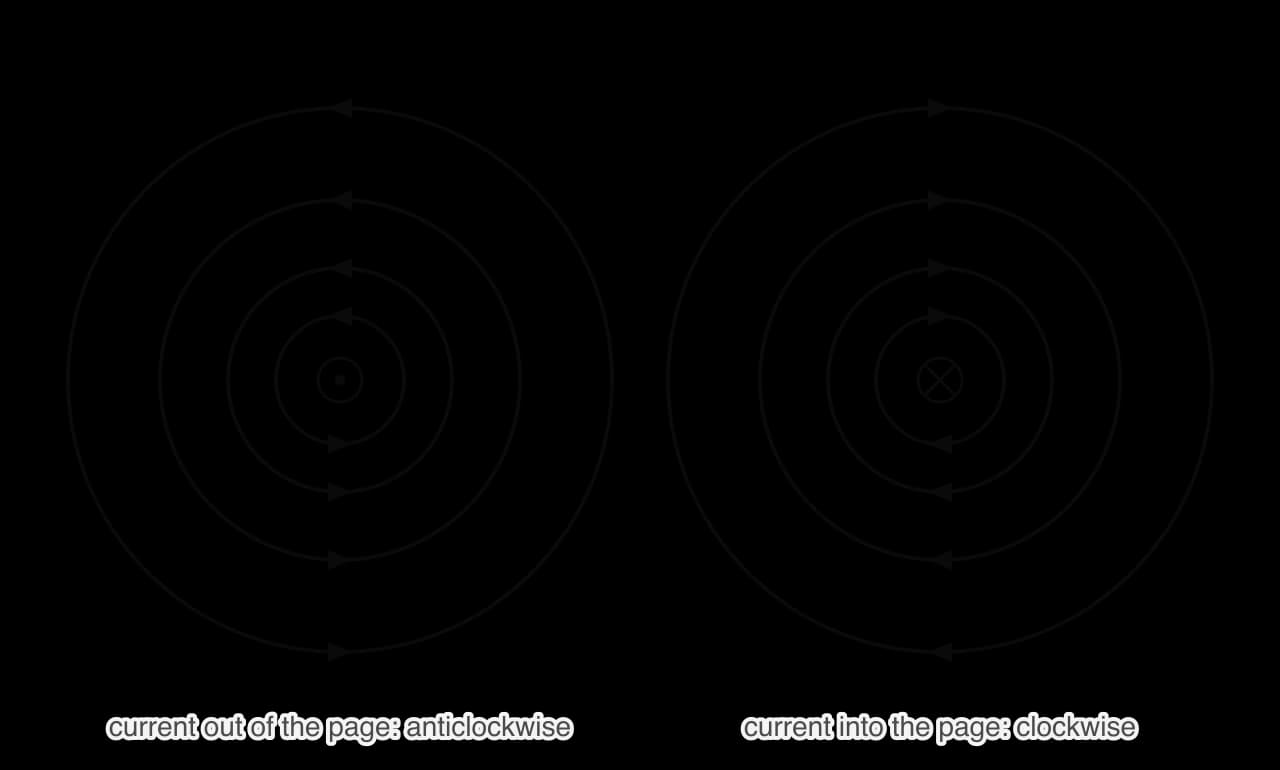
In diagrams, a current or field perpendicular to the page is shown with a symbol: ⊙ (a dot, like the tip of an arrow coming towards the reader) for out of the page and ⊗ (a cross, like the tail feathers of an arrow going away) for into the page. Seen end-on, the right-hand grip rule gives anticlockwise field lines round a current coming out of the page and clockwise lines round a current going into it.
Field lines round a long straight wire are concentric circles. Their direction follows the right-hand grip rule, and they spread out with distance because the field weakens.
A flat circular coil
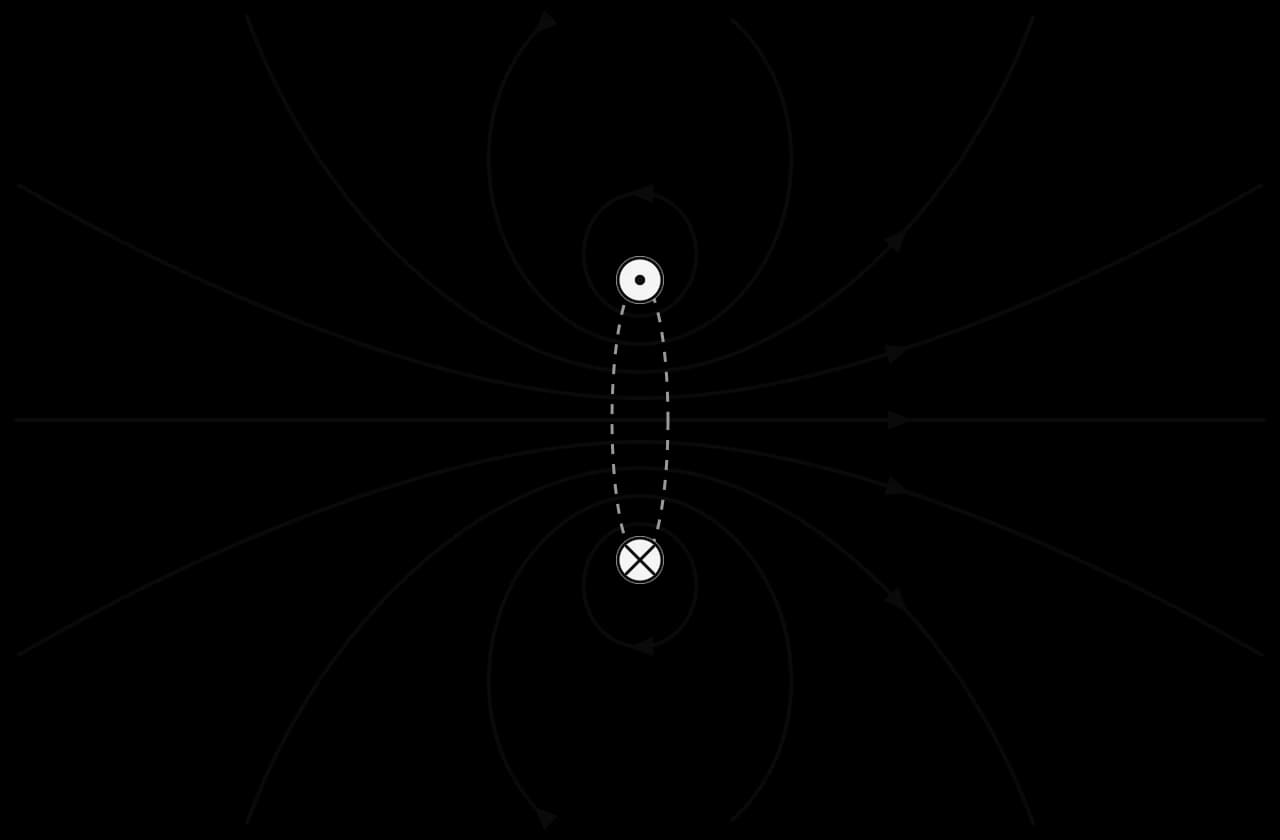
A flat circular coil is a straight wire bent into a loop. Close to the wire, the lines are still circles round it. In the middle of the coil, the fields from all parts of the loop point the same way, so they add to give a strong field along the axis. The cross-section through the centre of the coil shows the current coming out of the page on one side and going into the page on the other, with the lines circling each side in opposite senses and passing through the coil as nearly straight lines.
A flat circular coil, cut through its centre. Close to the wire the lines are circles like those round a straight wire; at the centre they combine into a strong field along the axis.
The coil behaves like a short, flat magnet: the face that the lines leave is a north pole and the face they enter is a south pole. The direction follows from the right-hand grip rule applied to any part of the wire.
An air-core solenoid
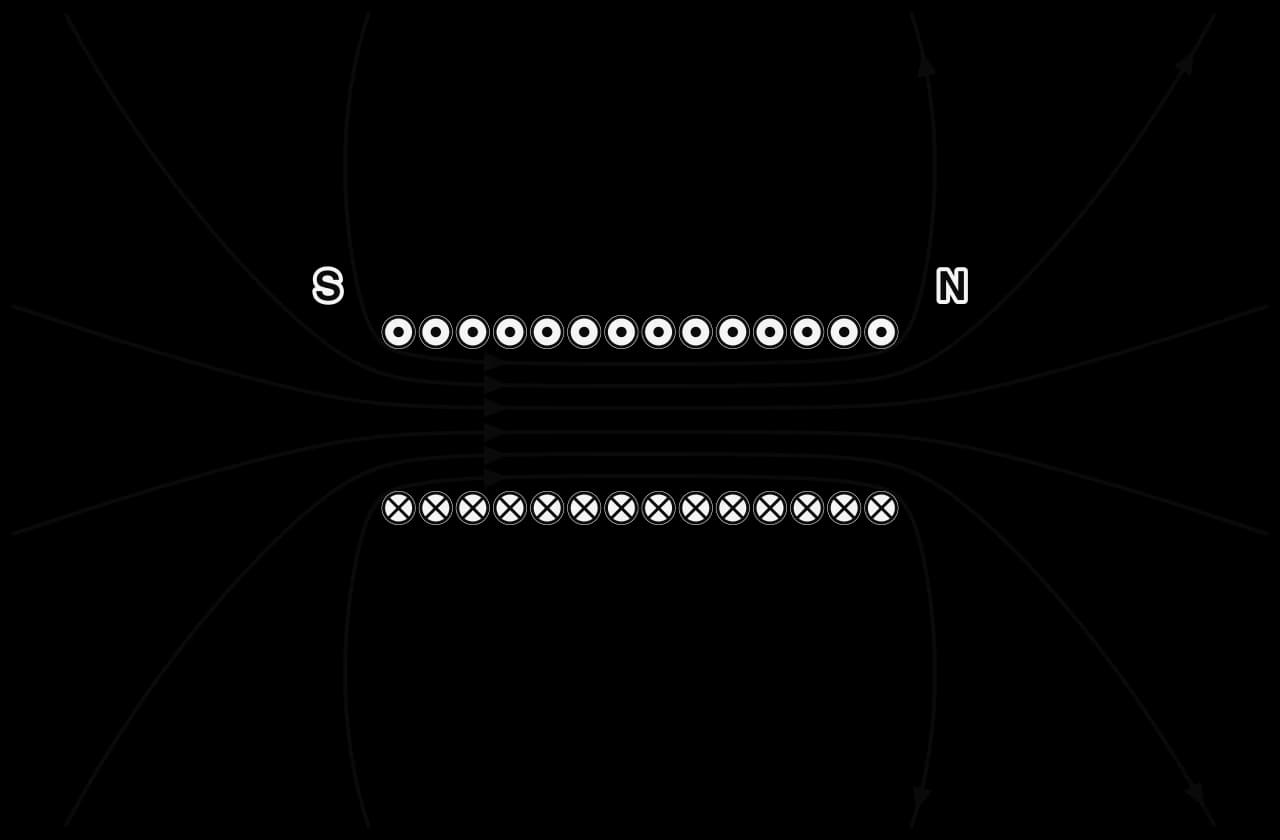
A solenoid is a long coil of wire wound as a helix. The fields of all its turns add, and the result has two important features. Inside, away from the ends, the field lines are straight, parallel and equally spaced, so the field there is strong and uniform. Outside, the field has the same shape as that of a bar magnet, and it is much weaker than inside. One end of the solenoid acts as a north pole and the other as a south pole.
The field of a long solenoid: uniform inside, and outside the same shape as a bar magnet’s. The end where the lines emerge acts as a north pole.
The poles are found with a second version of the right-hand grip rule: curl the fingers of the right hand in the direction of the current round the turns, and the thumb points along the field inside the solenoid, towards its north end. An equivalent way to remember it is to look at one end: if the current flows anticlockwise round that end, it is a north pole; if it flows clockwise, it is a south pole.
The field of a solenoid increases with the current and with the number of turns per unit length, and it is unaffected by the diameter of the coil for a long solenoid. Placing an iron core inside multiplies the field greatly, which is how electromagnets work, but the field patterns here are for an air-core solenoid. Solenoids are used wherever a strong, uniform field is needed: in MRI scanners, in particle detectors and, with an iron core, in relays, door locks and loudspeakers.
Arrangement
Shape of the field lines
Direction
Bar magnet
Loops from N to S outside the magnet, densest at the poles
N to S outside, S to N inside
Long straight wire
Concentric circles round the wire, spreading out with distance
Right-hand grip rule: thumb along the current
Flat circular coil
Circles round each side of the wire, combining into a strong field along the axis
Grip rule on the wire; one face N, the other S
Air-core solenoid
Straight, parallel and evenly spaced inside; like a bar magnet outside
Fingers along the current, thumb points to the N end
Gravitational, electric and magnetic fields are all described with field lines, and comparing them brings out what is special about each. Gravitational field lines all point inwards, towards masses, because gravity only attracts. Electric field lines start on positive charges and end on negative ones. Magnetic field lines have neither start nor end, because there are no magnetic monopoles.
Electric potential energy (HL)
Two charges that repel each other store energy when they are pushed together, just as a compressed spring does; two charges that attract each other release energy as they come together. This stored energy belongs to the system of charges, not to either charge alone, and it depends only on their separation. It is defined by imagining the charges assembled from a very great distance.
At infinite separation the charges do not interact, so their electric potential energy is zero there. The sign of Ep then follows from the work needed:
Like charges (q1q2>0): work must be done to push them together against the repulsion, so Ep is positive and increases as r decreases. Released, the charges fly apart and the potential energy becomes kinetic energy.
Unlike charges (q1q2<0): they attract, so they would do work on whatever held them back as they came together. Ep
like charges: Eₚ > 0
unlike charges: Eₚ < 0
Electric potential energy of two point charges against separation. Both curves approach zero at large r; repelling charges have positive potential energy, attracting charges negative.
Gravitational potential energy is always negative, Ep=−Gm1m2/r, because masses only attract. Electric potential energy can have either sign, but the attracting case has exactly the same shape as gravity, and for the same reason: a bound system has less energy than its separated parts.
Systems of several charges
For more than two charges, the potential energy of the system is the sum of the potential energies of every pair. Three charges have three pairs, and four charges have six. Each pair is counted once, and the signs are kept.
Electric potential (HL)
Potential energy depends on both the field and the charge placed in it. Dividing by the charge removes the dependence on the charge, in the same way that field strength is force per unit charge.
For the field of a point charge Q, the electric potential at a distance r is
Ve=rkQ
The sign of Q is included. Near a positive charge the potential is positive, because work is needed to push a positive test charge towards it; near a negative charge it is negative. The potential falls off as 1/r, more slowly than the field strength, which falls as 1/r2. The potential energy of a charge q at a point of potential Ve is Ep=qVe, which for a point-charge field gives back Ep=kQq/r.
positive charge: V = kQ/r
negative charge: V = −k|Q|/r
Potential near a positive and a negative point charge. Both tend to zero at infinity; a positive test charge moves naturally from high potential to low potential.
The potential difference used in circuits (B.5) is the difference in electric potential between two points: ΔVe=VB−VA. Only differences in potential have physical effects, which is why the choice of zero (at infinity for isolated charges, or at Earth for circuits) is a convention.
Potential due to several charges
Because potential is a scalar, the potential at a point due to several charges is simply the algebraic sum of the potentials due to each charge. There are no directions to resolve, so potential is much easier to calculate than field strength.
Four point charges at the corners of a square of side 0.40 m. P is the centre, equidistant from all four.
Inside and outside a charged conducting sphere
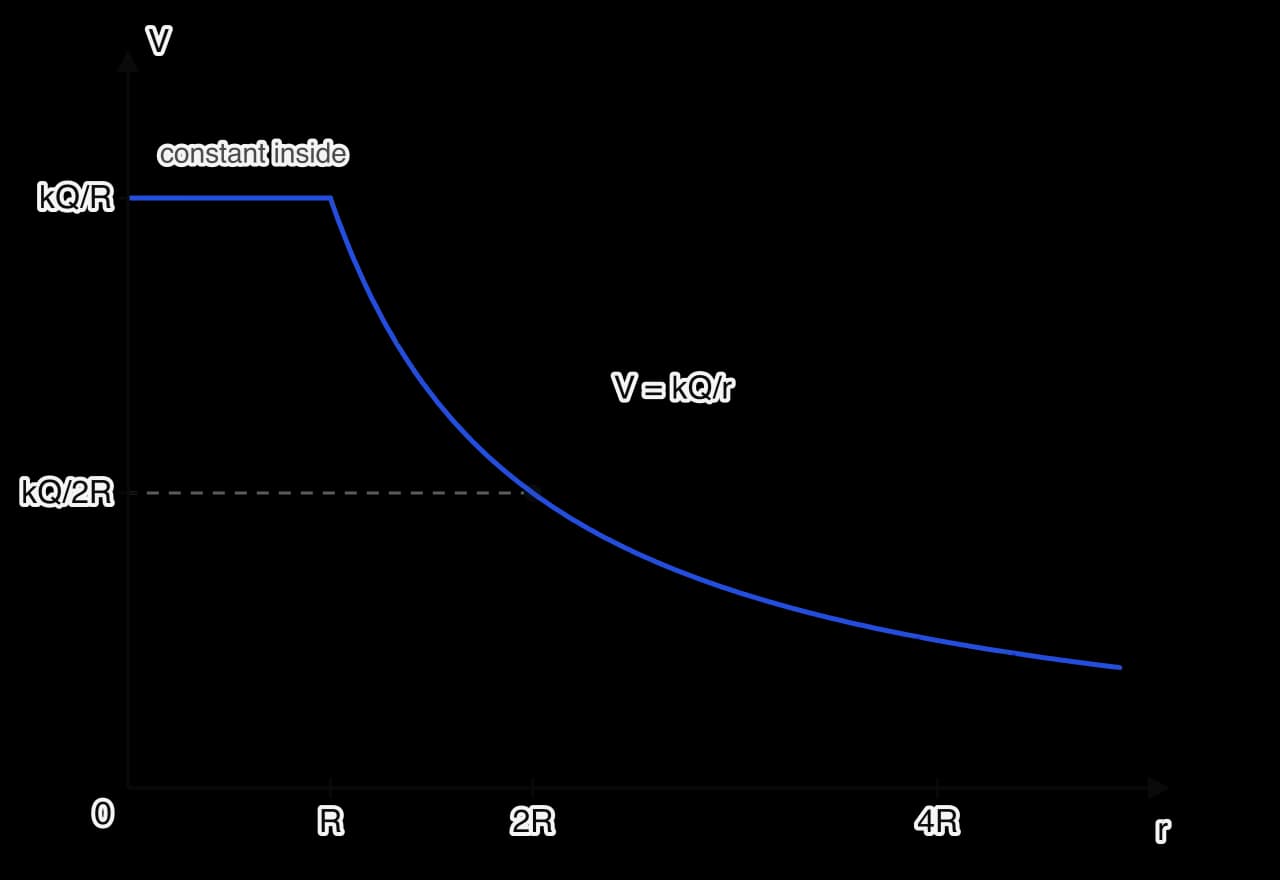
Outside a charged conducting sphere of radius R, the potential is that of a point charge at its centre, Ve=kQ/r. At the surface it is kQ/R. Inside, the field is zero, so no work is done moving a test charge around inside the sphere, and the potential everywhere inside is the same as at the surface. The whole conductor, solid or hollow, is at a single potential.
Potential of a charged conducting sphere: constant inside and on the surface, then falling as 1/r outside. A flat V–r graph means a zero potential gradient, so E = 0 inside.
A Van de Graaff generator builds up charge on a hollow metal dome in this way. The potential of the dome rises as charge is added, until the field just outside the surface, E=kQ/R2=Ve/R, reaches the breakdown field of air and the dome discharges as a spark.
Work done in electric fields (HL)
From the definition of potential, the work done in moving a charge q between two points with potential difference ΔVe is
W=qΔVe
This is the work done by an external agent to move the charge slowly from the first point to the second, and it equals the increase in the electric potential energy. Moving a positive charge to a higher potential needs work; moving it to a lower potential, the field does the work and the charge can gain kinetic energy instead. For a negative charge it is the other way round: electrons are accelerated towards regions of higher potential.
The electric field is a conservative field, like gravity: the work done depends only on the start and end points, not on the path between them. Carrying a charge round any closed path and back to its starting point takes zero net work.
Working in electronvolts
For particles, energies in joules are inconveniently small, so they are often given in electronvolts. An electronvolt is the energy transferred when a charge of size e moves through a potential difference of 1 V: 1eV=1.60×10⁻¹⁹J. A particle with charge e accelerated through 2000 V gains 2000 eV, or 2.0 keV, with no arithmetic needed; an alpha particle (charge 2e) accelerated through the same pd gains 4.0 keV.
In a uniform field, W=qΔVe agrees with force times distance. Between plates a distance d apart with pd V, the force on the charge is qE=qV/d, and the work over the full gap is (qV/d)×d=qV.
Potential gradient (HL)
Consider a positive test charge q moved a small distance Δr against a field of strength E. The work done on it is W=qEΔr if it moves directly against the field, and the same work is qΔVe. Equating them, and noting that the potential increases when moving against the field, gives
E=−ΔrΔVe
The minus sign shows that the field points in the direction in which the potential decreases most rapidly. A positive charge is pushed "downhill" in potential, from high to low. The size of the field is the steepness of the potential: where the potential changes quickly with distance, the field is strong.
On a graph of Ve against r, the field strength at any point is the negative of the gradient of the tangent there.
Where the potential is constant, the gradient is zero and so is the field, as inside a charged conductor.
For parallel plates the potential falls steadily from one plate to the other, so the gradient is constant and E=V/d is the size of the potential gradient.
Conversely, the size of the change in potential between two points is the area under a graph of E against r between them.
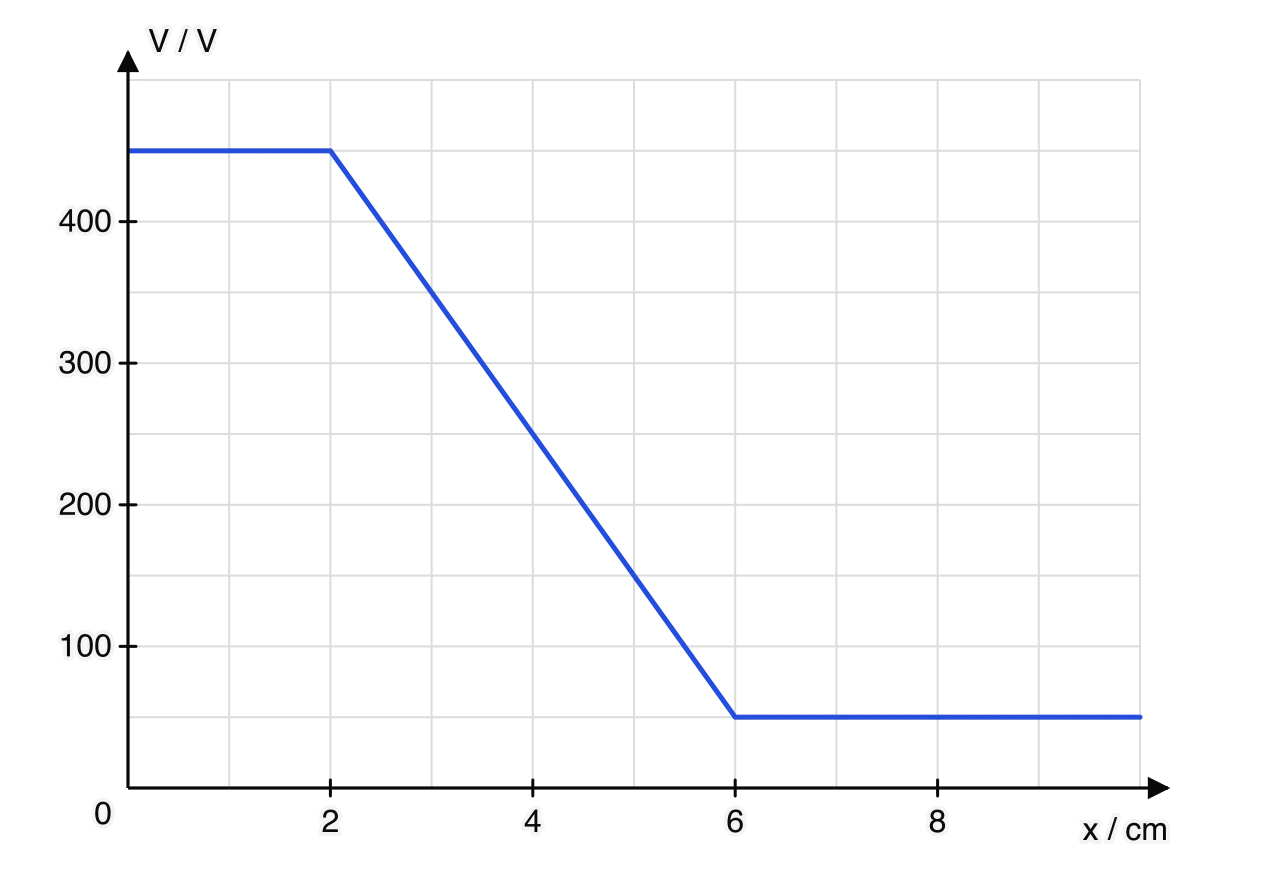
The graph shows how the potential varies along a line through a region of space. The field in each region follows from the gradient.
Variation of potential V with position x along a line through a region of electric field.
Equipotential surfaces (HL)
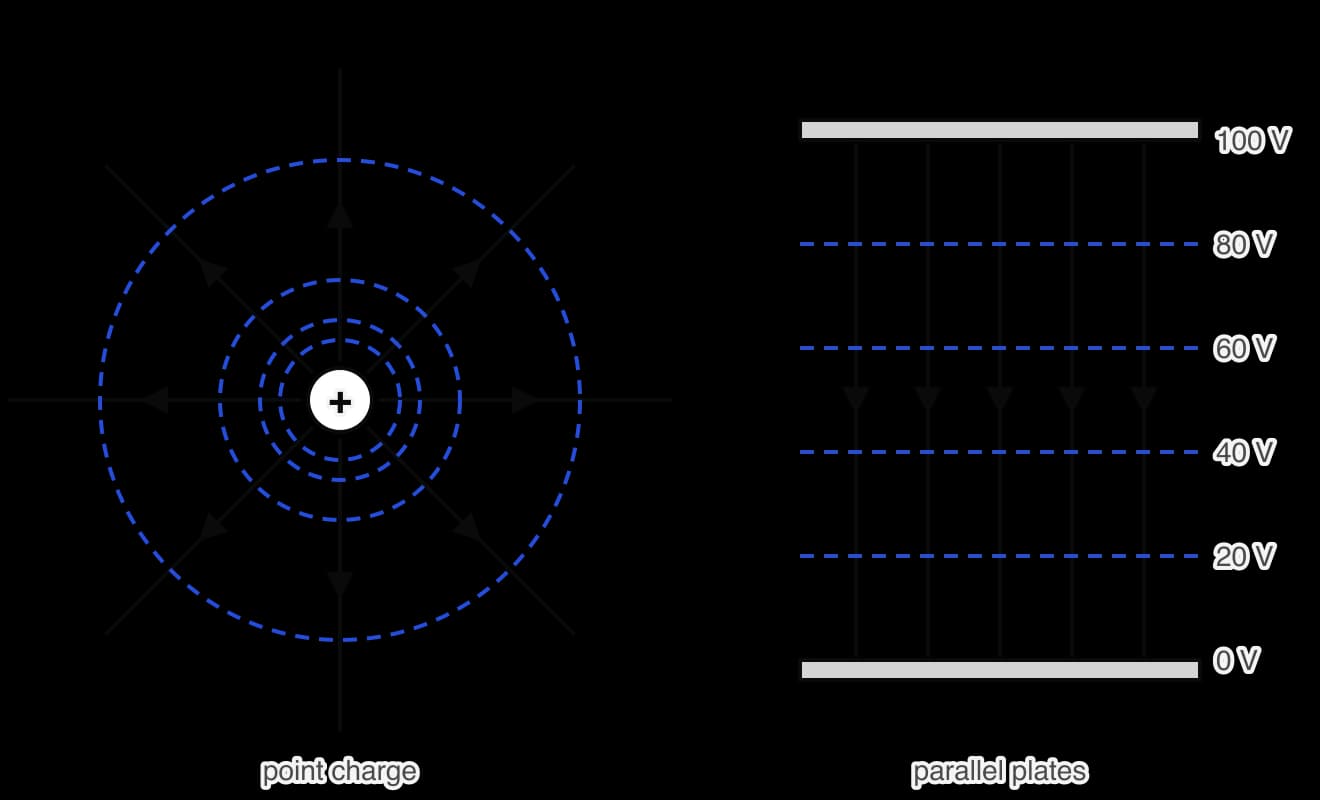
Because W=qΔVe and ΔVe=0 between any two points on an equipotential surface, moving a charge along it transfers no energy. The field therefore has no component along the surface: if it did, the field would do work on a charge moving along it. So equipotential surfaces are always perpendicular to field lines. On a two-dimensional diagram, equipotential surfaces appear as lines, usually drawn dashed, at equal steps of potential.
Point charge: the equipotentials are concentric spheres centred on the charge (circles on paper). Drawn at equal steps of potential, they get further apart with distance, because Ve=kQ/r changes more slowly far from the charge, where the field is weak.
Parallel plates: the equipotentials are flat planes parallel to the plates, equally spaced because the field is uniform.
Equipotentials (dashed blue) cut field lines (black) at right angles. Drawn at equal steps of potential, they are evenly spaced in a uniform field but spread out round a point charge, where the field weakens with distance.
The spacing of equipotentials drawn at equal potential steps therefore shows the field strength, just as the spacing of field lines does: close equipotentials mean a large potential gradient and a strong field.
Equipotentials of pairs of charges
For two or more charges, the potential at each point is the scalar sum of the potentials of the charges, and the equipotentials are the lines that join points with equal sums. Close to each charge, the potential of that charge dominates and the equipotentials are nearly circles round it. Further out, they merge into shapes that surround the whole group.
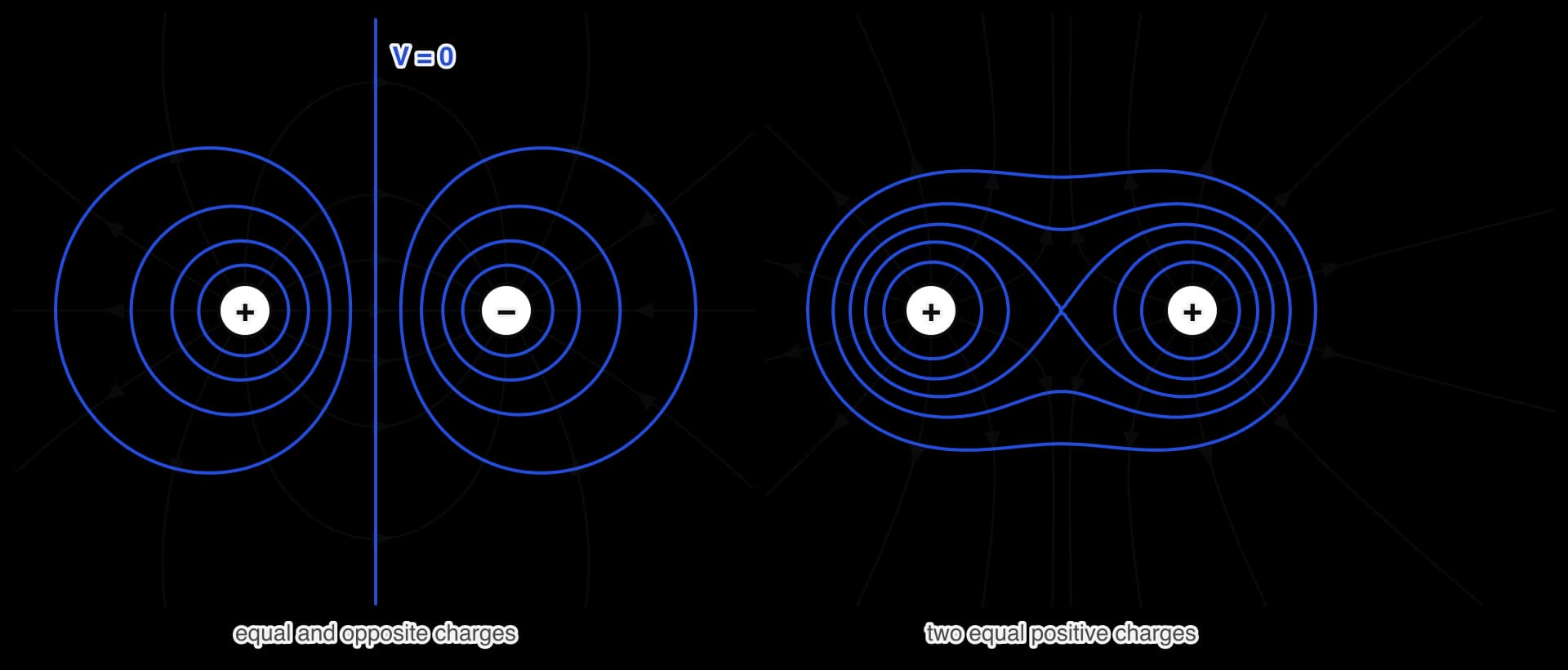
Equal and opposite charges: the potentials cancel at every point equidistant from the two charges, so the perpendicular bisector of the line joining them is the Ve=0 equipotential (a plane in three dimensions). The field on this plane is not zero: it points parallel to the line from the positive to the negative charge.
Equal like charges: small closed equipotentials surround each charge; one equipotential crosses itself at the neutral point, forming a figure of eight; further out, the equipotentials enclose both charges and become nearly circular, like those of a single charge 2Q.
Equipotentials (blue) and field lines (black) for two pairs of charges. Wherever they meet, the two sets cross at right angles. Midway between equal and opposite charges the potential is zero along the whole perpendicular bisector.
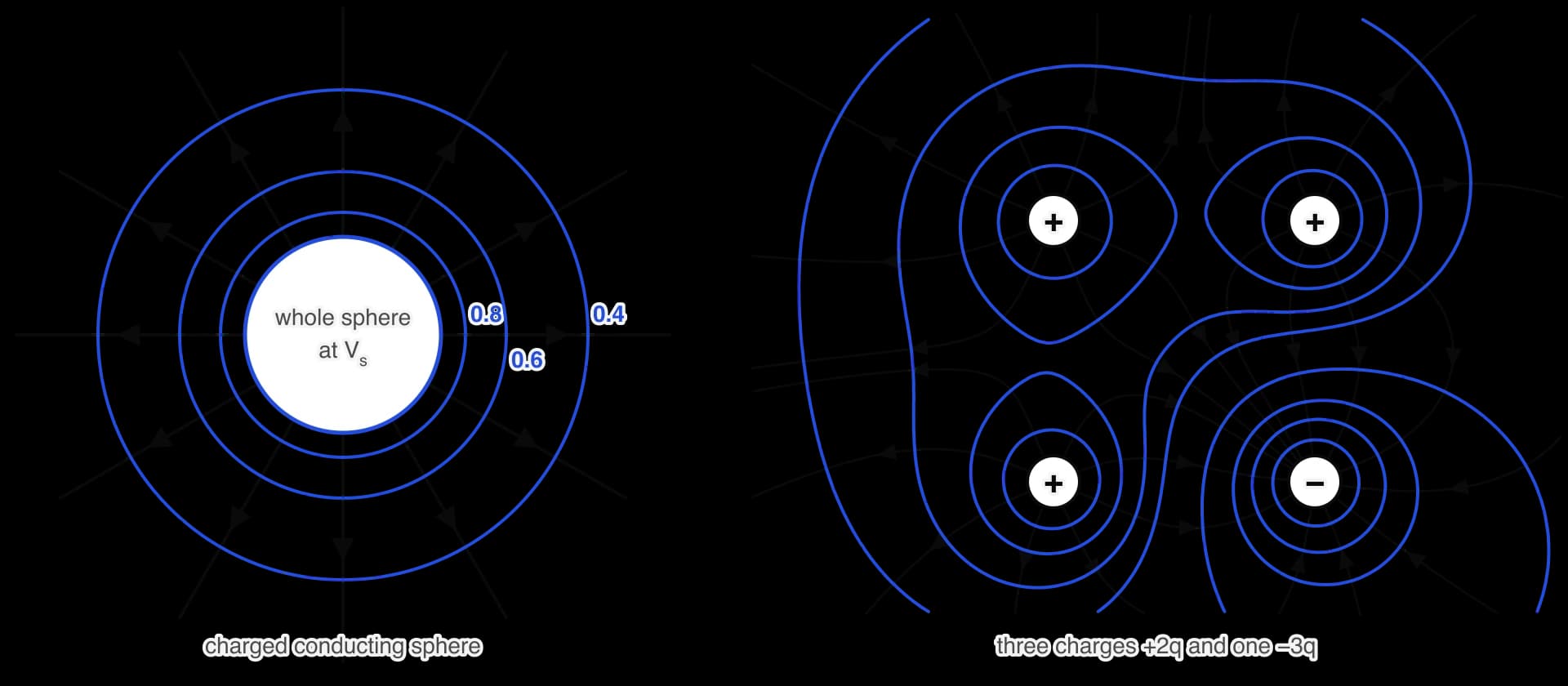
For up to four point charges the same method applies: find the potential at a few points as the sum of kQ/r for every charge, join points of equal potential, and check that the result crosses the field lines at right angles. Near each charge the equipotentials are circles centred on that charge; far away they become circles centred on the whole group, with the total charge setting the potential.
Left: outside a charged conducting sphere the equipotentials are concentric spheres (labelled as fractions of the surface potential Vₛ), and the sphere itself, inside and on the surface, is one equipotential. Right: computed equipotentials (blue) of four charges; close to each charge they are nearly circles centred on it, and everywhere they cross the field lines at right angles.
Conductors are equipotentials
Any conductor in equilibrium is an equipotential, because the field inside it is zero. Its surface is one equipotential surface, which is why field lines always meet a conductor at right angles. For a charged conducting sphere, solid or hollow, the equipotentials outside are concentric spheres, and the whole interior is at the potential of the surface.
Quantity
Gravitational field
Electric field
Force between two bodies
F=Gr2m1m2, always attractive
F=kr2q1q2
Field strength
g=mF=r2GM
Potential energy (HL)
Ep=−Grm1m2
Potential (HL)
Vg=−rGM
Ve=rkQ
Field and potential (HL)
g=−ΔrΔVg
E=−ΔrΔVe
Work done (HL)
W=mΔVg
W=qΔVe
The two fields share the same mathematics because both come from inverse-square forces between point sources. The differences between the rows all come from one fact: charge has two signs, while mass has only one.
Applying the ideas in exam questions
Paper 1A: charging a sphere by induction
Paper 1A: the field of a straight wire
Paper 1A (HL): field and potential between unlike charges
Paper 1B: measuring the elementary charge
A group of students uses an oil-drop apparatus with horizontal plates (6.0±0.1)mm apart. For each of four drops they find the mass m from its terminal speed and then adjust the pd V until the drop is stationary. The mass of each drop has an uncertainty of ±5%.
Drop
m / 10−15 kg
V / V ± 5 V
1
2.0
245
2
1.6
294
3
4.1
301
4
3.3
303
Paper 2: two point charges on a line
Paper 2 (HL): a charged conducting sphere
Self-check
To do:
I can state the rule for the forces between like and unlike charges.
To do:
I can state the law of conservation of charge and apply it to charging and to particle processes.
To do:
I can describe charging by friction, by contact and by electrostatic induction, including the role of earthing, in terms of electron movement.
To do:
I can use Coulomb’s law, including ratio problems, resultant forces from several charges and the effect of a medium’s permittivity.
To do:
I can define electric field strength and calculate it for point charges and for parallel plates using E = F/q, E = kQ/r² and E = V/d.
To do:
I can find the resultant field of two charges on a line and locate a neutral point.
To do:
I can draw field lines for point charges, pairs of charges, a charged conducting sphere and parallel plates, including edge effects.
To do:
I can describe Millikan’s oil-drop experiment, use qE = mg to find the charge on a drop, and explain how the results show that charge is quantised.
To do:
I can draw the magnetic field patterns of a bar magnet, a long straight wire, a flat circular coil and a solenoid, and give their directions with the right-hand grip rule.
To do:
I can describe Earth’s magnetic field and explain which kind of magnetic pole lies near the geographic North Pole.
To do:
HL: I can calculate the electric potential energy of a system of charges and interpret its sign.
To do:
HL: I can define electric potential and calculate it for point charges, several charges and a charged conducting sphere.
To do:
HL: I can calculate work done in electric fields with W = qΔV, in joules and in electronvolts.
To do:
HL: I can use E = −ΔV/Δr to find field strength from a potential–distance graph.
To do:
HL: I can sketch equipotentials for point charges, pairs of charges, a conducting sphere and parallel plates, and explain why they are perpendicular to field lines.
, the density of air is 1.2 kg m
−3
and the viscosity of air is
1.8×10⁻⁵
Pa s. At first there is no potential difference between the plates.
(a)
Show that the terminal speed of the droplet is about 0.25 mm s−1.
[3]3 marks
(b)
Outline why the buoyancy force on the droplet can be neglected.
[1]1 mark
(c)
A potential difference of 450 V is now applied between the plates, with the upper plate positive. The droplet carries a charge of −5e. Calculate the electric force on the droplet.
[2]2 marks
(d)
Determine the new terminal velocity of the droplet.
[2]2 marks
(e)
Determine the potential difference that would make the droplet rise at a constant speed of 0.25 mm s−1.
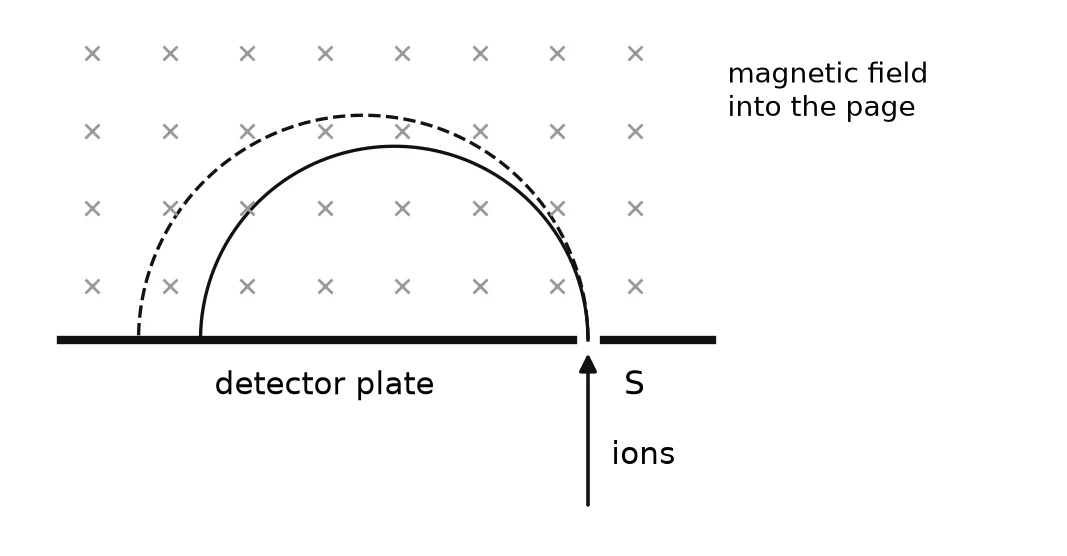
In a mass spectrometer, singly charged positive ions of neon-20 (mass 20 u) and neon-22 (mass 22 u) all move with a speed of 6.0×10⁴ m s−1. They enter a region of uniform magnetic field of strength 0.20 T through a slit S. The field is directed into the page. The ions travel in semicircles and strike a detector plate.
(a)
Explain why the ions move in a circular path.
[2]2 marks
(b)
Outline why the kinetic energy of an ion does not change while it is in the field.
[1]1 mark
(c)
Show that the radius of the path of a neon-20 ion is about 6 cm.
[2]2 marks
(d)
Determine the distance between the points where the neon-20 and the neon-22 ions strike the detector plate.
[2]2 marks
(e)
Calculate the time that a neon-20 ion spends in the magnetic field. State, with a reason, whether a faster neon-20 ion would spend more time, less time or the same time in the field.
[2]2 marks
(f)
Calculate the centripetal acceleration of a neon-20 ion in the field.
Gravity is completely negligible inside the atom. It dominates on astronomical scales only because large bodies are almost exactly neutral, so their electric forces cancel, while their masses always add.
(b) In water ε=80ε0, so the force is 80 times smaller:
Fwater=802.9×10−9=3.7×10⁻¹¹N
Both forces are attractive. The model of point charges in a continuous medium is only approximate at such small distances, where a few water molecules sit between the ions, but it shows correctly why water is such a good solvent for salts.
Force from C. C and B are unlike charges 0.30 m apart, so C pulls B towards C, in the +x direction:
FC=0.3028.99×109×1.0×10−6×2.0×10−6=0.200Nin the +x direction
Add with signs.F=−1.35+0.200=−1.15N, so the resultant force on B is 1.1N towards A. The force from A is larger because A is both the larger charge and the nearer one.
, directed towards the positive plate.
Mass.
m=34πr3ρ=34π×(9.35×10−7)3×880=3.0×10⁻¹⁵kg
(b) Charge. The drop is in equilibrium, so qV/d=mg:
q=Vmgd=4903.0×10−15×9.8×8.0×10−3=4.8×10⁻¹⁹C
eq=1.60×10−194.8×10−19=3.0
The drop carries three elementary charges. A drop less than two micrometres across needs a field of only about 6×10⁴V m−1 to hold it up, which shows how small its weight is.
,
2e
,
5e
,
3e
and
7e
.
Best value. Adding the charges and the multiples: 4+2+5+3+7(6.41+3.18+8.03+4.83+11.2)×10−19=2133.65×10−19=1.60×10⁻¹⁹C.
A small number of drops can never prove that no smaller unit exists (the data would also fit e/2). Millikan's confidence came from hundreds of drops and from charges that changed in single steps of e.
is
negative
and becomes more negative as
r
decreases. To separate the charges completely, energy equal to
∣Ep∣
must be supplied.
.
.
, so the equipotentials are 1.0 cm apart, five gaps across the 5.0 cm.
, attractive or repulsive
E=qF=r2kQ
, always negative
Ep=krq1q2, positive or negative
✓
C ✓
«N C⁻¹» away from A ✓
«N C⁻¹» towards B, so the fields are equal and opposite and