
Kepler’s laws, Newton’s law of gravitation, gravitational field strength and field lines, and orbits; at HL, potential, equipotentials, escape speed and orbital energy.
Each is in the Physics glossary, with every other term in the subject.
The point of an orbit around the Sun that is farthest from the Sun, where the orbiting body moves slowest.
The mean distance between the Earth and the Sun, .
The fluid resistance a satellite meets from the thin upper atmosphere; it removes energy, so the orbit shrinks and the satellite's speed increases.
A closed oval curve with two points inside it called foci; planetary orbits are ellipses with the Sun at one focus.
The minimum launch speed for an unpowered object to escape completely from a body's gravitational field,
A line showing the direction of the force on a test mass (or charge) at each point; the closer the lines, the stronger the field.
A circular equatorial orbit with a period of one day, travelling west to east, so the satellite stays above the same point on the Earth; it is about 36 000 km above the surface.
The constant in Newton's law of gravitation,
A region of space in which a mass experiences a force because of its mass.
The work done per unit mass to bring a small test mass from infinity to a point, ; a scalar measured in , zero at infinity.
Each planet moves in an ellipse with the Sun at one focus.
The line joining a planet to the Sun sweeps out equal areas in equal intervals of time, so the planet moves fastest when closest to the Sun.
For bodies orbiting the same central mass, the square of the orbital period is proportional to the cube of the semi-major axis (the radius for a circular orbit): .
An orbit a few hundred to about two thousand kilometres above the Earth's surface, with a period of roughly 90 to 120 minutes.
A point where the fields of two or more bodies cancel, so the resultant field strength is zero.
Every point mass attracts every other with a force proportional to the product of the masses and inversely proportional to the square of their separation: .
The total (kinetic plus gravitational potential) energy of a body in a circular orbit, ; it is negative because the body is bound.
The time for one complete orbit; for a circular orbit .
The speed of a body in a circular orbit of radius around a mass ,
The point of an orbit around the Sun that is closest to the Sun, where the orbiting body moves fastest.
A body whose size is negligible, so that all its mass can be treated as being at one point.
The rate of change of potential with distance, ; the field strength is minus the potential gradient.
A field whose lines point straight towards (or away from) a single central point, such as the field outside a spherical mass; its strength falls with distance.
Half the longest diameter of an ellipse; for an orbit, the mean of the closest and farthest distances from the central body.
A mass small enough not to disturb the field it is placed in, used to define the field strength or potential at a point.
An instrument that measures a very small force from the angle through which it twists a rod hanging on a thin wire; Cavendish used one to measure in 1798.
A field with the same magnitude and direction at every point, shown by parallel, equally spaced field lines.
The sensation of having no weight when a body and its surroundings are in free fall together, so no support force acts on it; gravity still acts.
101 exam-style questions on this subtopic, written in the style of the IB papers. The first has its markscheme open. Counted on
A lunar lander of mass 15 000 kg is descending vertically towards the surface of the Moon. At a height of 150 m it is moving downwards at . Its engine then provides a constant upward force, so that the lander decelerates uniformly and comes to rest at a height of 4.0 m. The engine is then switched off and the lander falls to the surface.
The following data are given:
mass of the Moon
One of 90 short multiple-choice questions on D.1. Pick an answer to see why it's right or wrong.
Two spherical asteroids attract each other with a force . The mass of one asteroid is tripled and the separation of their centres is halved. What is the new force?
The official deck for this part of the syllabus.
Why are Kepler's laws of planetary motion described as empirical laws?
State Kepler's first law.
The entries of the physics data booklet that D.1 uses. Each opens in the explained booklet.
With a free account, Augment remembers where you stopped and what you have practiced.
Field lines show the direction and, by their spacing, the strength of a gravitational field.
In a circular orbit gravity provides the centripetal force, which fixes the orbital speed and period at each radius.
Gravitational potential energy and gravitational potential are zero at infinity and negative everywhere else (HL).
The field strength is minus the potential gradient, and equipotential surfaces are perpendicular to field lines (HL).
The work done moving a mass between two points equals the mass multiplied by the change in potential (HL).
Escape speed and orbital speed both follow from energy and force in the field; a satellite’s total energy is negative (HL).
Fluid resistance from the thin upper atmosphere makes a satellite’s orbit shrink while its speed increases (HL).
Gravitation is the attraction between any two bodies that have mass. It holds the planets in orbit around the Sun and the Moon in orbit around the Earth, sets the weight of every object on the surface, and decides how much energy a rocket needs to reach orbit or leave the Earth altogether. A single law, Newton’s law of gravitation, explains all of these, and the idea of a gravitational field turns it into a tool for describing the space around any mass.
The same field ideas reappear for electric charges in D.2: field strength, field lines, potential and equipotentials all have electric versions, so a clear picture of the gravitational case makes the rest of the theme easier.
Kepler’s laws are three rules that describe the motion of every planet around the Sun. Johannes Kepler found them between 1609 and 1619 by analysing decades of careful naked-eye observations of Mars and the other planets made by Tycho Brahe. They are empirical laws: they describe a pattern in the data very accurately, but they do not say why planets move this way. That explanation came later from Newton’s law of gravitation.
An ellipse is a closed oval curve with two special points inside it, the foci. The Sun sits at one focus; the other focus is empty. The longest diameter of the ellipse is its major axis, and half of it, the semi-major axis , is the average of the planet’s closest and farthest distances from the Sun. The closest point of the orbit is the perihelion and the farthest point is the aphelion.
The orbits of the planets are only slightly elliptical. The Earth’s distance from the Sun varies by only about 3% over a year, between about 147 million km in early January and 152 million km in early July, so drawn to scale its orbit would look like a circle. For this reason orbits are usually modelled as circles in calculations, with the radius taking the place of the semi-major axis. Comets have much more elongated orbits: Halley’s comet ranges from inside the orbit of Venus to beyond the orbit of Neptune.
Near perihelion the planet is close to the Sun, so the line to the Sun is short. To sweep out the same area in the same time, the planet must cover a longer stretch of its orbit, so it moves faster. Near aphelion the line is long and the planet covers only a short arc in the same time, so it moves more slowly.
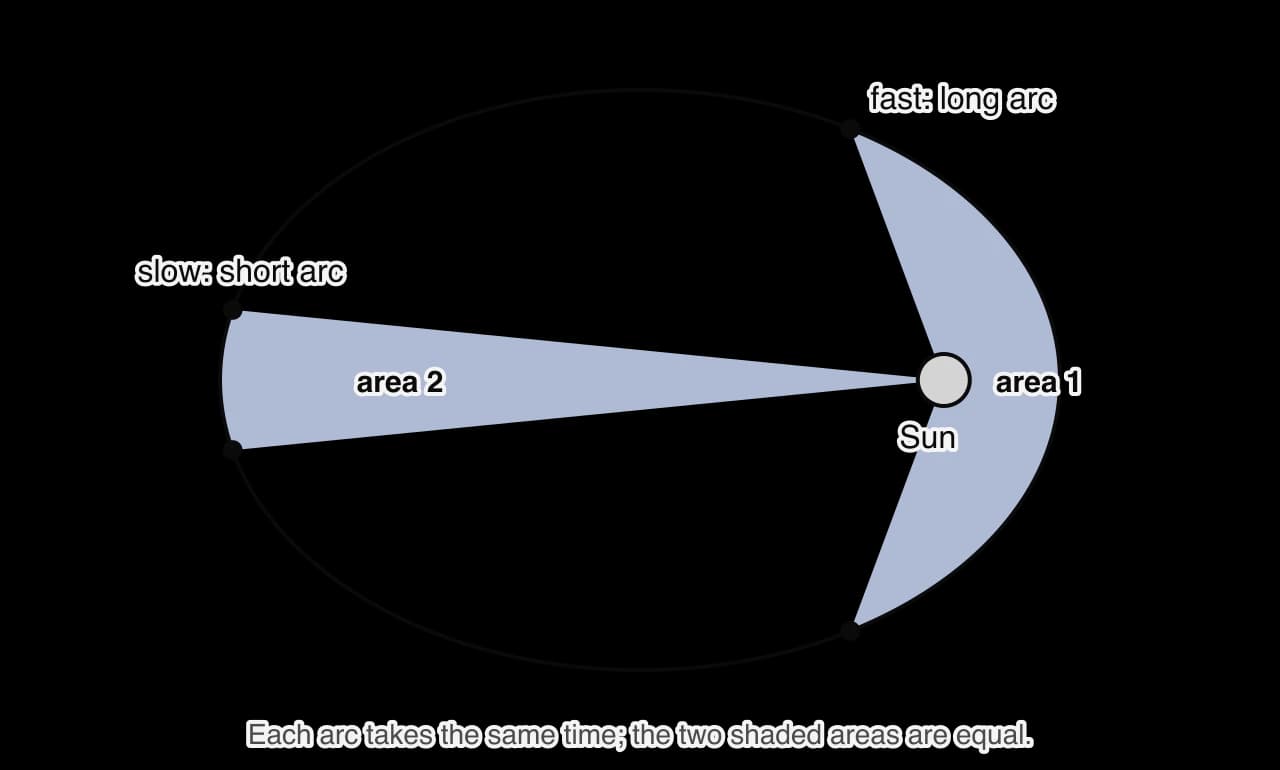
The Earth reaches perihelion in early January, when it moves at about 30.3 km s⁻¹, and aphelion in early July, at about 29.3 km s⁻¹. One consequence is that the Northern Hemisphere’s winter half-year (from the September equinox to the March equinox) is about a week shorter than its summer half-year.
The second law is a consequence of a deeper principle. The gravitational force on a planet always points straight at the Sun, so it exerts no turning effect about the Sun and the planet’s angular momentum about the Sun stays constant. In energy terms, the planet speeds up as it falls towards the Sun and slows down as it climbs away from it, trading gravitational potential energy for kinetic energy and back again.
The third law links different planets orbiting the same Sun. Planets further out take longer to go round, and not simply in proportion: doubling the orbital radius multiplies the period by . Measuring in years and in astronomical units (AU, the mean Earth–Sun distance) gives for the Earth, and so very nearly 1 for every planet.
Planet | / AU | / years | / year² AU⁻³ |
|---|---|---|---|
Mercury | 0.387 | 0.241 | 1.00 |
Venus | 0.723 | 0.615 | 1.00 |
Earth | 1.000 | 1.000 | 1.00 |
Mars | 1.524 | 1.881 | 1.00 |
Jupiter | 5.203 | 11.86 | 1.00 |
Saturn | 9.537 | 29.46 | 1.00 |
Data: NASA planetary fact sheets, accessed 2026. The ratio is the same for all six planets to three significant figures, even though their periods range from under three months to almost thirty years.
The law applies to any set of bodies orbiting the same central mass, not just to planets orbiting the Sun. The constant of proportionality depends on the central mass, so moons of Jupiter share one value of and moons of Saturn share another. A graph of against is a straight line through the origin, which is the clearest way to test the law with data.

Moon | / m | / days | / m³ | / days² | |
|---|---|---|---|---|---|
Io | 4.217 | 1.769 | 74.99 | 3.129 | 0.0417 |
Europa | 6.709 | 3.551 | 302.0 | 12.61 | 0.0418 |
Ganymede | 10.70 | 7.155 | 1225 | 51.19 | 0.0418 |
Callisto | 18.83 | 16.689 | 6677 | 278.5 | 0.0417 |
Kepler’s laws are an example of how science often progresses: a precise pattern is found in observations first, and a theory that explains it comes later. Kepler could not say why the planets obeyed his rules. Newton showed in 1687 that all three laws follow from a single inverse-square law of attraction, which turned three separate descriptions into one explanation.
The force that makes an apple fall and the force that holds the Moon in its orbit are the same force. Newton tested this idea: he compared the Moon’s acceleration towards the Earth with the acceleration of a falling object at the surface and found that the ratio matched an inverse-square law: the Moon is about 60 Earth radii away, and its acceleration is about of at the surface.
Here is the magnitude of the force on each mass, and are the masses, is the distance between them and is the gravitational constant, . The law is called universal because the same equation, with the same value of , applies everywhere: to apples, moons, planets, stars and galaxies.

The force is always attractive. There is no such thing as negative mass, so gravity never pushes bodies apart.
The forces form a Newton’s third law pair. The Earth pulls the Moon with exactly the same size of force as the Moon pulls the Earth, in the opposite direction. The Earth’s acceleration is much smaller only because its mass is much larger.
The force acts along the line joining the two masses, and is measured between their centres.
The force follows an inverse-square law. Doubling reduces to a quarter; tripling reduces it to a ninth.
 YouTube
Between everyday objects the force is tiny because is so small. Two students of masses 60 kg and 70 kg sitting 1.0 m apart attract each other with a force of about N, comparable to the weight of a single grain of fine sand. Gravity only becomes large when at least one of the masses is astronomical.
Many problems ask how the force changes when the masses or the distance change. Writing the new force as a ratio of the old one cancels and any quantities that stay the same, so no data are needed.
Astronomical observations give only the product for a planet or the Sun, never on its own. Finding needs the force between known laboratory masses, which is tiny. In 1798 Henry Cavendish made the first precise measurement with a torsion balance. A light rod carrying two small lead spheres hung from a thin wire. Two large lead spheres, each about 158 kg, were brought close to the small ones. Their gravitational attraction twisted the rod through a small angle, which Cavendish read from a distance with a telescope to avoid disturbing the apparatus with air currents or body heat.

By first finding how much torque was needed to twist the wire through each degree (from the period of the rod’s slow oscillation), Cavendish could convert the angle into a force. With the masses and their separation known, Newton’s law gave . Cavendish presented his result as the mean density of the Earth, about 5.4 times that of water, which is why the experiment is often described as "weighing the Earth": once is known, the Earth’s mass follows from at its surface through . His value corresponds to , within about 1% of today’s value.
remains the least precisely known of the fundamental constants, because gravity between laboratory masses is so weak that tiny disturbances matter. Different modern experiments still disagree in the fourth significant figure, an example of how hard it is to remove systematic errors from a delicate measurement.
Newton’s law is stated for point masses, bodies whose size is negligible. Real bodies are extended: every part of the Earth attracts every part of the Moon. Two results allow real bodies to be treated as points.
A body that is far away compared with its own size behaves as a point mass. The Sun and the Earth are about 150 million km apart and each is tiny compared with that distance, so the size of either barely matters.
A uniform sphere, or any spherically symmetric body, attracts an external mass exactly as if all its mass were concentrated at its centre. Newton proved this result (the shell theorem). It holds even at the surface: the Earth pulls a person standing on it as if all 6 × 10²⁴ kg were at a point 6370 km below their feet.
Because of the second result, in Newton’s law is always the distance from the centre of a planet, never the height above its surface. For a satellite at height above a planet of radius , .
The point-mass model breaks down for bodies that are close together compared with their sizes and not spherical, such as two cubes touching, and for points inside a body. Close to an irregular body such as a small asteroid or comet, the field is noticeably different from that of a point mass.
Newton’s law describes a force between two bodies that are not touching, which troubled Newton himself: how does the Moon "know" the Earth is there? The field model answers this. A mass changes the space around it by setting up a gravitational field. Any other mass placed in that field experiences a force, which is produced by the field at its location. The Earth does not act directly on the Moon across empty space; the Earth produces a field, and the field acts on the Moon.
The strength of the field at a point is defined by the force on a small test mass placed there. The test mass must be small enough not to disturb the field being measured.
The unit is the same as , because . This is no coincidence: by Newton’s second law, a mass acted on only by gravity accelerates at . The gravitational field strength at a point and the free-fall acceleration there are the same quantity. Near the Earth’s surface both are or .
Combining Newton’s law with the definition of gives the field strength at distance from the centre of a point mass, or of a spherical mass (for points outside it):
The test mass cancels: depends only on the mass that creates the field and on the distance from it. The field points towards the centre of . This kind of field, pointing towards one central point and weakening with distance, is a radial field.
Rearranged, the same equation gives a useful relation between a planet’s surface field strength , its radius and its mass: . Once Cavendish had measured , this relation gave the mass of the Earth from two quantities that were already known, and .
Outside a planet, falls with the inverse square of the distance from the centre. At a height equal to one Earth radius above the surface, the distance from the centre is and the field strength is . At it is . The field never quite reaches zero, but it soon becomes very small.
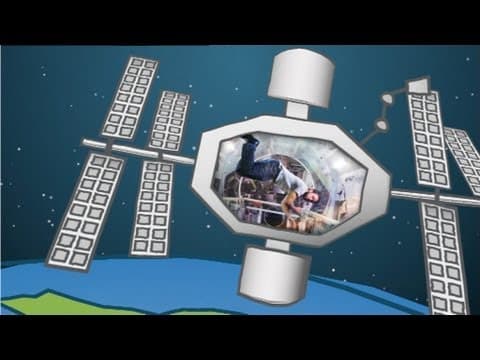
Astronauts on the Space Station feel weightless because they, the station and everything in it share the same free-fall acceleration. Nothing presses on anything else, so there is no support force, and a set of bathroom scales would read zero. The sensation is the same as the moment of free fall at the top of a roller-coaster drop, sustained indefinitely.
 YouTube
Because , a planet’s surface field depends on both its mass and its radius. A more massive planet does not necessarily have a stronger surface field if it is also much larger.
Body | Mass / kg | Radius / m | Surface / N kg⁻¹ |
|---|---|---|---|
Moon | 1.62 | ||
Mars | 3.73 | ||
Earth | 9.81 | ||
Jupiter | 24.8 (at the cloud tops) |
Data: NASA planetary fact sheets, accessed 2026. Jupiter is about 320 times as massive as the Earth, yet its surface field is only about 2.5 times stronger, because its radius is about 11 times larger and the field depends on the inverse square of the radius.
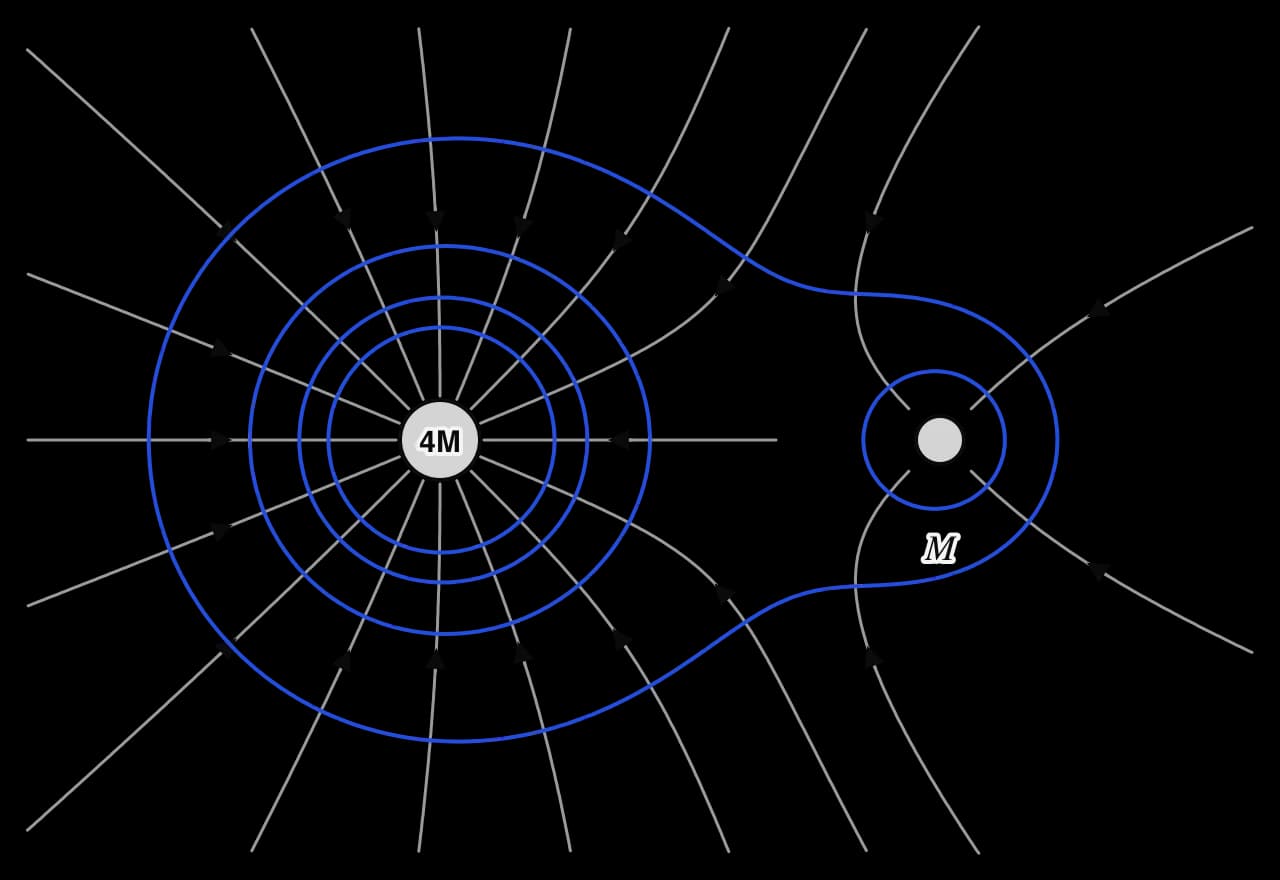
Gravitational field strength is a vector, so where two masses both contribute, the resultant field is the vector sum of the separate fields. On the line joining two bodies the two fields point in opposite directions (each towards its own source), so the resultant is the difference of their magnitudes, in the direction of the stronger one.
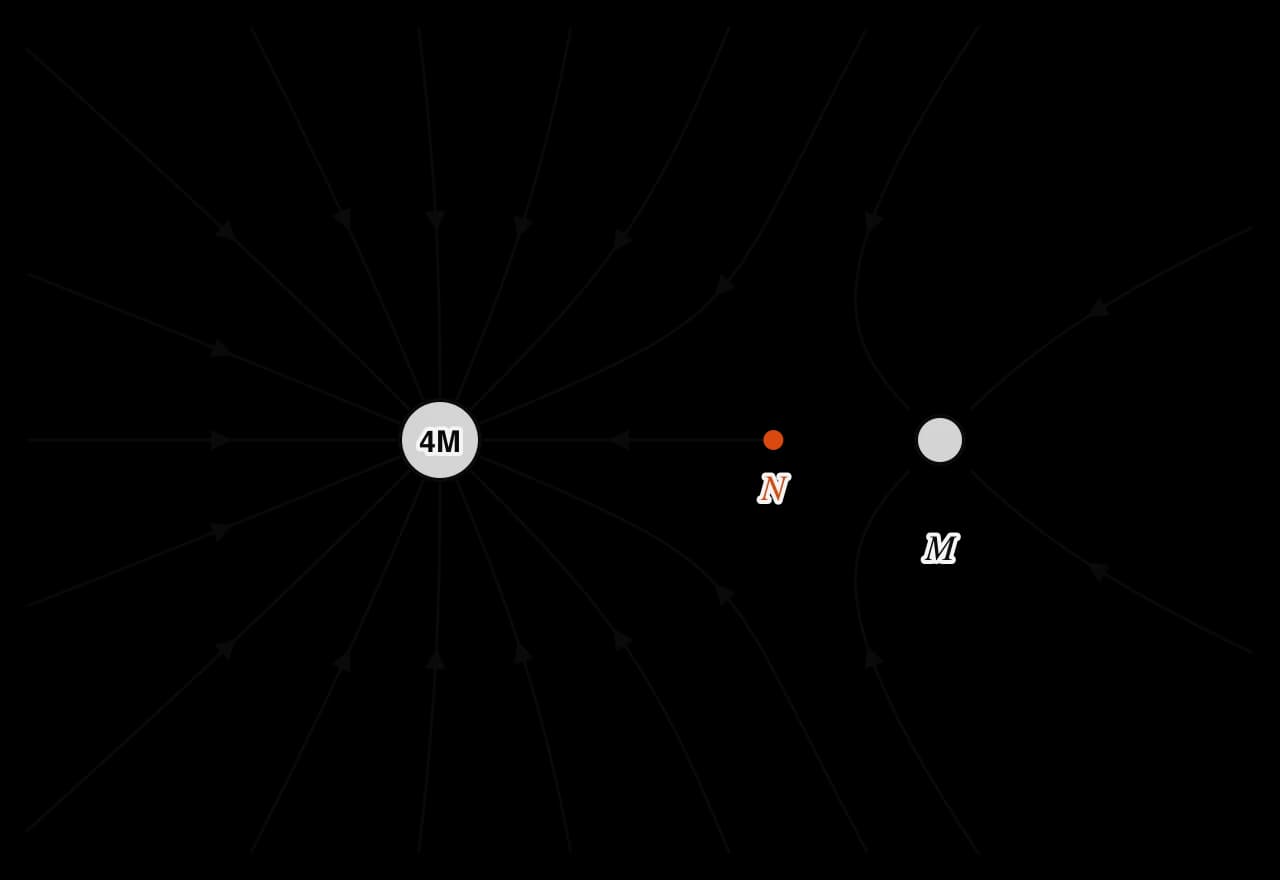
Somewhere between the two bodies the fields are equal and opposite and the resultant is zero. This is the neutral point. It lies closer to the smaller mass, because the smaller mass’s field is only as strong as the larger one’s when the point is nearer to it.
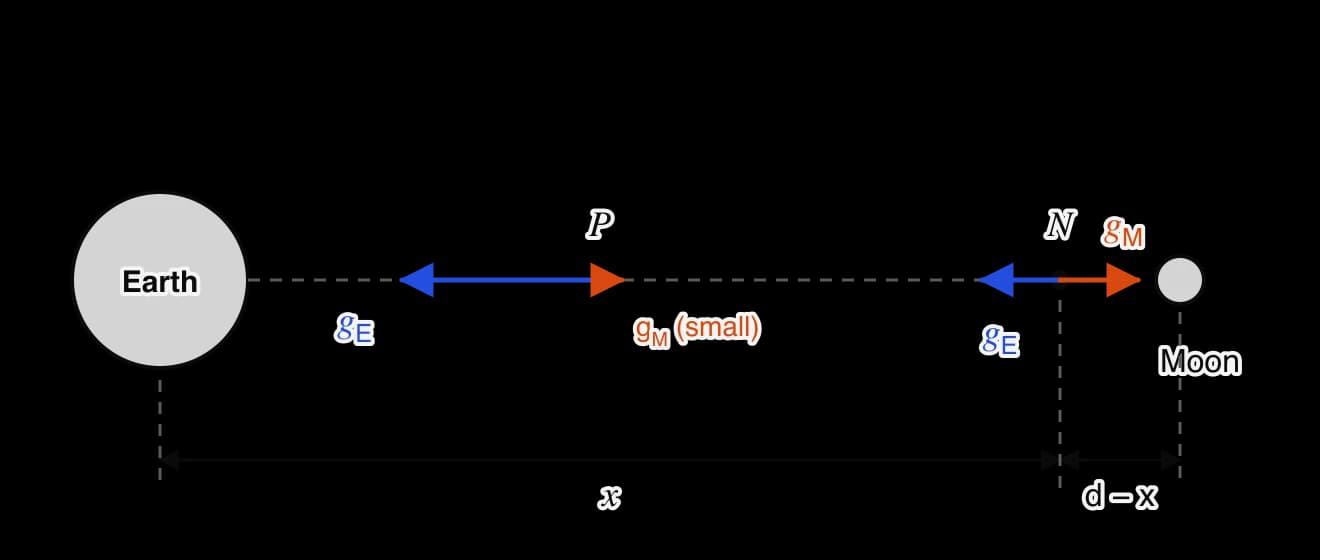
Between the neutral point and the Earth, the resultant field points towards the Earth; beyond it, towards the Moon. A spacecraft travelling to the Moon is slowed by the Earth’s pull for most of the journey and then speeds up once it passes the neutral point.
A field can be pictured with field lines. A field line shows the direction of the force that a small test mass would experience at each point along it.
Direction. The arrow on a field line points the way a test mass would be pulled. Gravitational field lines always point towards the masses that create the field and end on them; they never start on a mass.
Strength. Where the lines are close together the field is strong; where they spread out it is weak. The number of lines ending on a body is proportional to its mass.
No crossing. Field lines never cross, because the field has only one direction at each point.
Direction at a point. The field at a point is along the tangent to the field line through it.
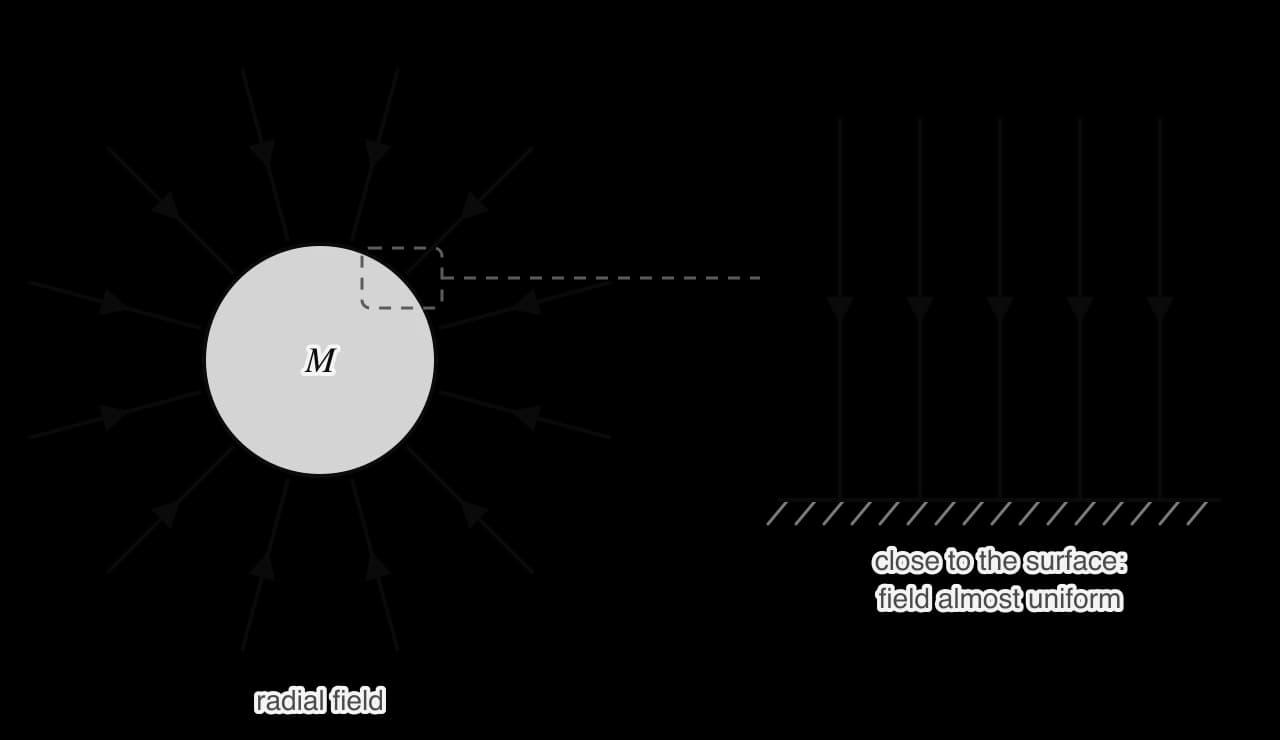
Around a single spherical mass the lines are straight and radial, getting further apart with distance, which shows the inverse-square weakening. Close to the surface of a large body such as the Earth, over a region much smaller than the planet, the lines are almost parallel and equally spaced. A field like this, with the same magnitude and direction everywhere, is a uniform field. Near the surface of the Earth, downwards to a good approximation, over the height of any building.
With two masses the pattern combines both fields. The lines near each mass are almost radial, but between the masses they bend away from the neutral point, where the field is zero and no line passes. Far from both masses the pattern looks like that of a single mass equal to their total, at their centre of mass.
Newton explained orbits with a thought experiment. A cannon on top of an extremely high mountain fires a ball horizontally. The ball falls under gravity and lands some distance away. A faster ball lands further away, and because the Earth is round, the ground curves away beneath it as it travels. At one particular speed the ground curves away exactly as fast as the ball falls, so the ball never lands and keeps falling around the Earth.
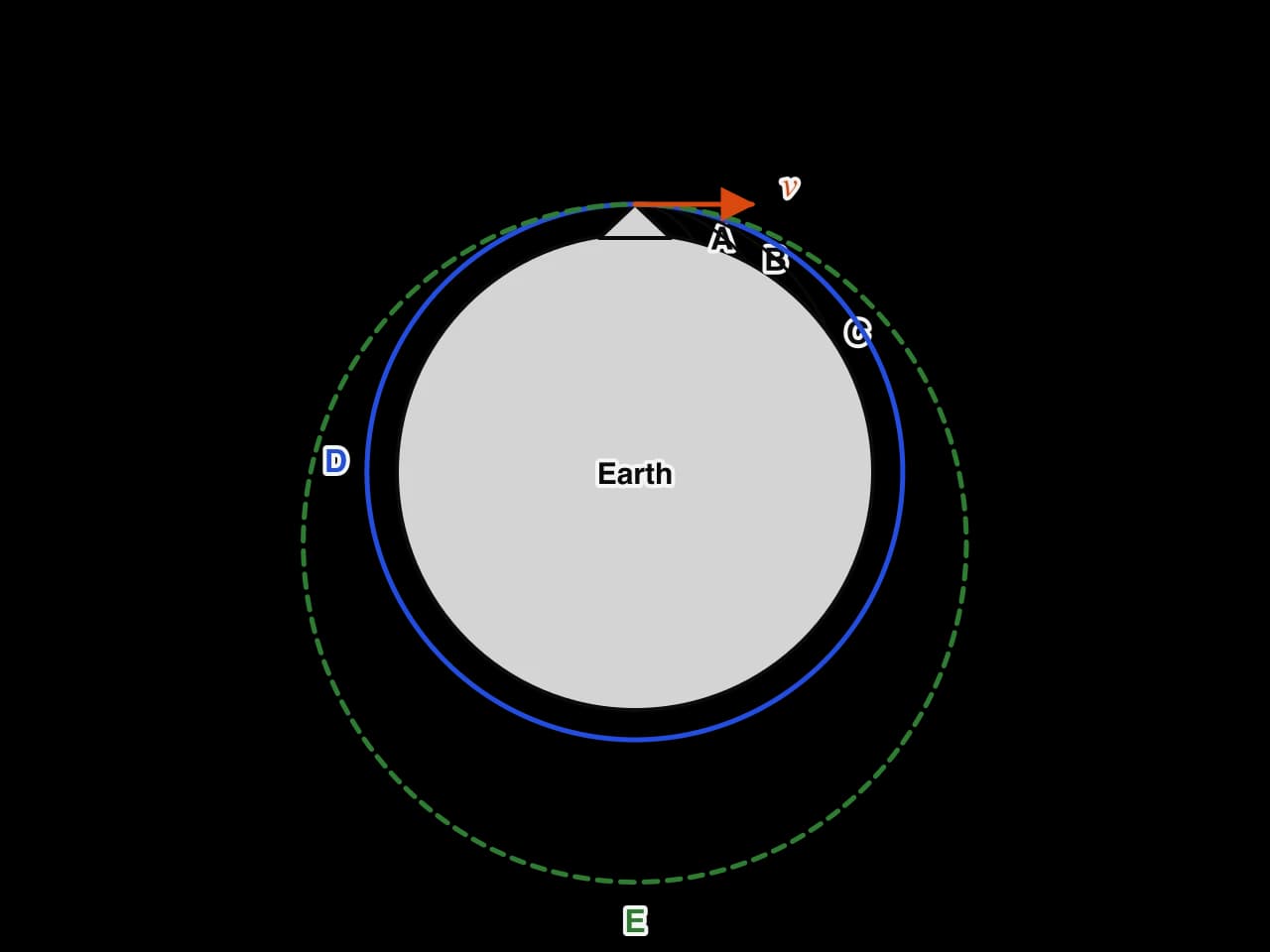
A satellite in orbit is therefore in free fall. It is accelerating towards the centre of the Earth at all times, with acceleration equal to the local field strength . Its sideways velocity keeps it from ever reaching the ground.
A body moving in a circle at constant speed and radius needs a resultant force towards the centre of size , the centripetal force (A.2). For a satellite, the only force acting is gravity, which points to the centre of the planet. In a circular orbit, gravity is exactly the centripetal force.
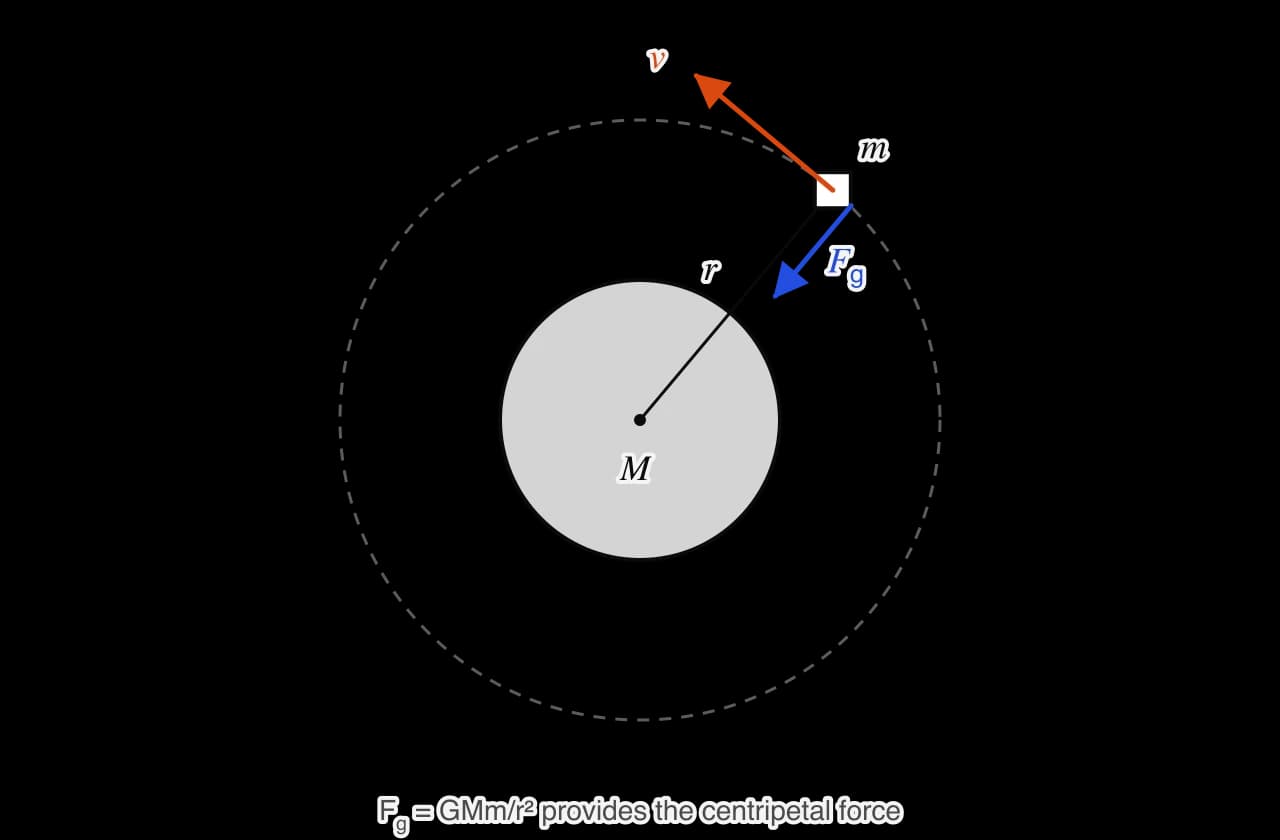
Because the gravitational force is always at right angles to the velocity in a circular orbit, it does no work on the satellite. Its kinetic energy and speed stay constant; only the direction of motion changes. No engine is needed to keep a satellite moving.
Setting the gravitational force equal to the centripetal force gives the speed of a satellite in a circular orbit of radius around a mass :
The orbital speed does not depend on the mass of the satellite: a small piece of debris and the whole Space Station move at the same speed in the same orbit. Orbits further out are slower, with . An equivalent form is , using the local field strength at the orbit.
Writing the speed as in the force equation links the orbital period to the radius:
This is Kepler’s third law, , now with the constant of proportionality identified: . Every body orbiting the same central mass shares the same value of , and a larger central mass gives shorter periods at the same radius. The same result follows from using the angular speed, with .
When two bodies orbit the same central mass, the period equation can be used as a ratio. The constant cancels, which is why Kepler could use the law long before or any planetary mass was known.
A geostationary orbit is a circular orbit in which a satellite stays above the same point on the Earth’s equator. Three conditions must all hold: the orbit lies in the plane of the equator, the satellite moves in the same direction as the Earth rotates (west to east), and its period equals the Earth’s rotation period, one day. Seen from the ground the satellite is fixed in the sky, so a dish aerial pointed at it never needs to move. Geostationary satellites carry television broadcasts, communications and weather images of a whole hemisphere.
Satellites are placed in many other orbits for different purposes. Low Earth orbits, a few hundred kilometres up, are used for the Space Station, for Earth observation and for large internet constellations; they are close enough for detailed imaging and fast signals, but each satellite is visible from one place for only a few minutes. GPS satellites orbit about 20 200 km up with a period of about 12 hours. The higher the orbit, the longer the period and the lower the speed, exactly as Kepler’s third law and predict.
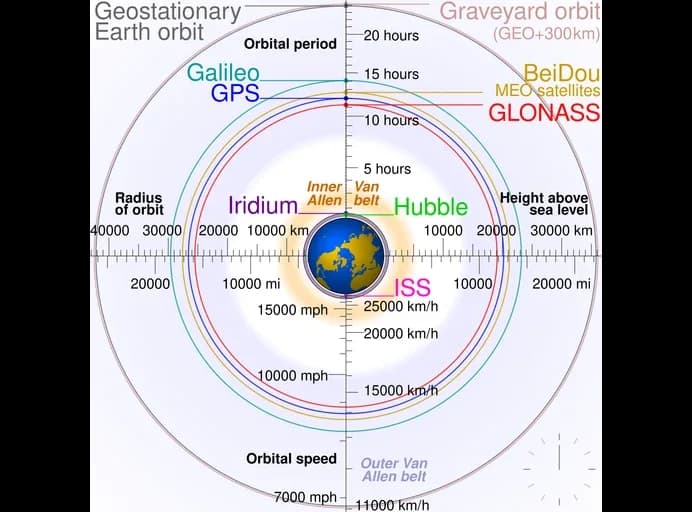
Orbit | Height above surface / km | / m | Period | Speed / km s⁻¹ |
|---|---|---|---|---|
International Space Station | ≈ 410 | 6.78 | 93 min | 7.7 |
GPS satellites | ≈ 20 200 | 26.6 | 12 h | 3.9 |
Geostationary | ≈ 35 800 | 42.2 | 24 h | 3.1 |
The Moon | ≈ 378 000 | 384 | 27.3 days | 1.0 |
Speeds, and the periods of the satellites, calculated from and with ; heights rounded. The Moon’s period is the measured sidereal value (the simple calculation gives 27.4 days because it ignores the Moon’s own mass).
Newton’s theory did more than explain known orbits. In the 1840s the planet Uranus was found to drift slightly from its predicted path. Urbain Le Verrier used Newton’s law to calculate where an unknown planet would have to be to cause the drift, and in 1846 Johann Galle found Neptune within about one degree of the predicted position. A theory that predicts something nobody has yet seen, and is then confirmed, gains strong support. The same theory later failed in a small way: the orbit of Mercury slowly rotates by slightly more than Newton’s law allows, a discrepancy that was explained only by Einstein’s general relativity in 1915. Newton’s law is an excellent model for weak fields, but like every model it has a limited range of validity.
Near the Earth’s surface the change in gravitational potential energy is (A.3). This works only while is constant, over heights that are small compared with the radius of the Earth. For a rocket travelling to orbit, or a spacecraft leaving the Earth, changes with distance and a more general expression is needed.
Gravitational potential energy belongs to a system of masses, not to one mass alone, and depends on their separation. A natural reference is the configuration in which the masses are infinitely far apart. There the force between them is zero, and the potential energy is defined to be zero.
The minus sign follows from the definition. Gravity is attractive, so when two masses are brought together from infinity, the field does positive work on them and the external agent assembling the system would have to hold them back: the work done by the agent is negative. The potential energy therefore falls from zero as the masses approach. Every finite separation has a negative potential energy, and the closer the masses, the more negative it is.
A change in potential energy is what matters physically. Moving a mass from distance to a greater distance from a planet of mass increases the potential energy of the system by
For a small height change near the surface, this reduces to the familiar . The general expression is needed whenever the height change is a noticeable fraction of the planet’s radius.
With and :
If , then , and since
Potential energy depends on both the mass creating the field and the mass placed in it. Dividing by the test mass gives a property of the field alone, just as field strength is force per unit mass.
Like potential energy, potential is zero at infinity and negative everywhere else. A mass at a point where the potential is has potential energy . Because potential is a scalar, the potential due to several masses is simply the sum of their separate potentials, with no directions to worry about.
Along the line from the Earth to the Moon the potential is the sum of two negative terms, and . The resulting graph has a maximum (least negative value) between the bodies, at the neutral point, where its gradient is zero. A spacecraft travelling to the Moon must be given enough energy to climb over this "hill"; after that it falls towards the Moon.
The field strength and the potential are connected. The field at a point equals minus the rate at which the potential changes with distance, the potential gradient:
On a graph of against , the field strength at any point is minus the gradient of the tangent there. The minus sign means that the field points in the direction in which the potential decreases: towards the masses, where the potential is most negative. The steeper the potential graph, the stronger the field.
The work needed to move a mass between two points in a field depends only on the potentials at the two points, not on the route taken:
If the mass moves to a higher (less negative) potential, is positive and work must be done on it, for example by a rocket engine. If it moves to a lower potential, the field does the work and the mass gains kinetic energy if nothing else acts. Because gravity is a conservative force, the path does not matter: a spacecraft that spirals out gains exactly as much potential energy as one that travels straight up to the same final distance.
Moving a mass along an equipotential surface involves no change in potential, so by no work is done by or against the field. The gravitational force can therefore have no component along the surface: field lines are always perpendicular to equipotential surfaces. Knowing either the field lines or the equipotentials allows the other to be drawn.
Around a point or spherical mass the equipotentials are concentric spheres (circles in a drawing). Drawn at equal steps of potential, they get further apart with distance, because the field weakens and a larger distance is needed for the same change in potential.
In a uniform field near a surface the equipotentials are equally spaced horizontal planes. A step corresponds to a height ; near the Earth, equipotentials 98 J kg⁻¹ apart are 10 m apart.
Around two masses the equipotentials are near-circles around each mass close by, merging into single closed surfaces around both further out.
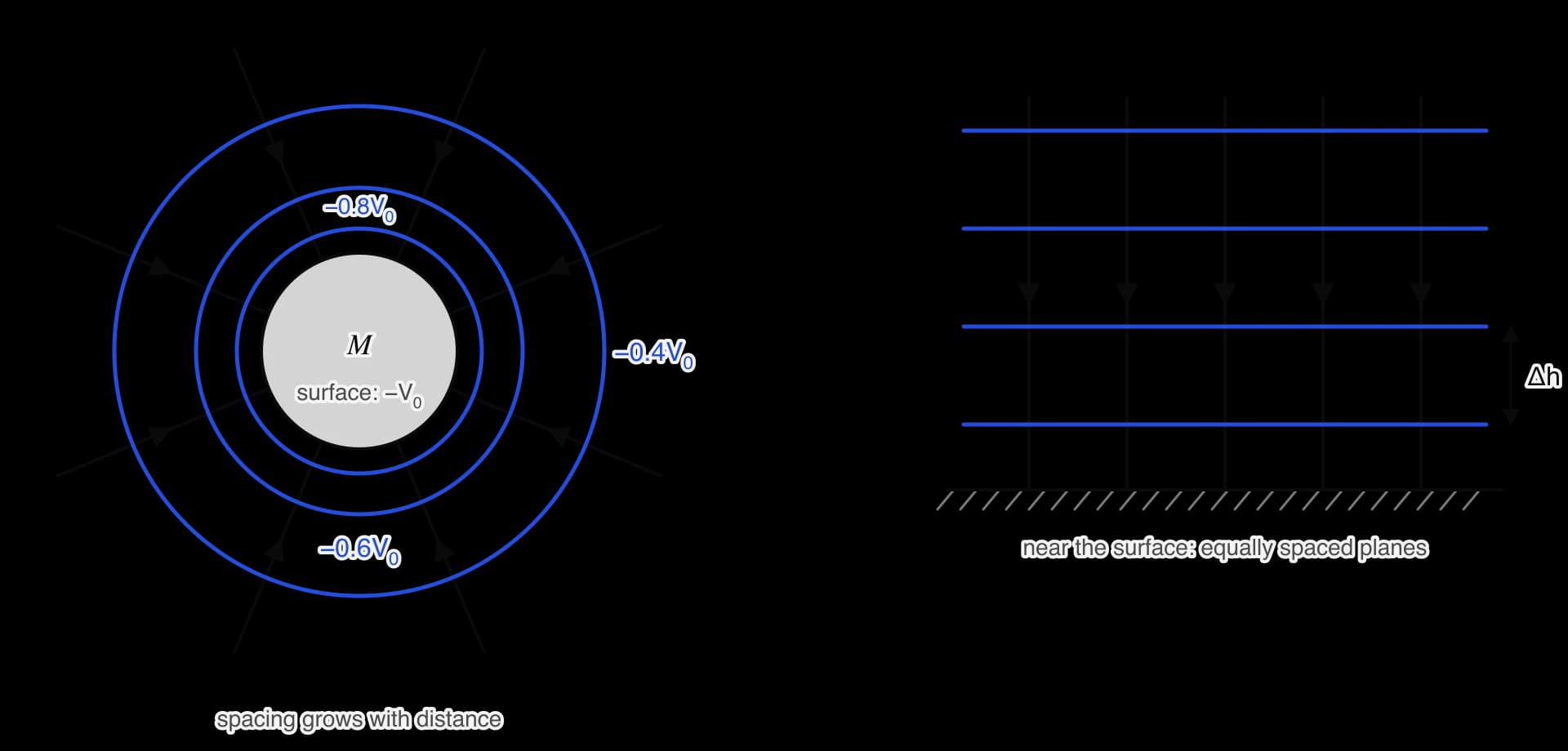
The analogy with a contour map is close. A contour line joins points at the same height, and a walker following one neither climbs nor descends; equipotentials join points of equal potential, and a mass moved along one gains no potential energy. Where contours crowd together the hillside is steep; where equipotentials crowd together the field is strong.
A ball thrown upwards slows down, stops and falls back. Thrown faster, it rises higher before returning, and because weakens with height, each extra metre of height costs a little less energy. At one particular speed the ball has just enough kinetic energy to reach infinity, where its potential energy is zero, arriving there with zero speed. This is the escape speed.
At launch the object has kinetic energy and potential energy . At infinity, if it arrives with zero speed, both are zero. Conservation of energy gives
The escape speed does not depend on the mass of the object, nor on the direction of launch (as long as the path does not hit the planet), because energy is a scalar. At the surface of a planet, with , it can also be written .
Body | Escape speed from the surface / km s⁻¹ |
|---|---|
Moon | 2.4 |
Mars | 5.0 |
Earth | 11.2 |
Jupiter | 59.5 |
Sun | 618 |
Values calculated from the masses and radii in the NASA planetary fact sheets, accessed 2026.
Escape speed links gravitation with the kinetic theory of gases (B.3). Gas molecules move with a range of speeds, and the fastest ones in the upper atmosphere can exceed the escape speed and leak away into space. On the Moon, with its low escape speed, any atmosphere is lost quickly; the Earth keeps nitrogen and oxygen but has lost most of its light hydrogen and helium, whose molecules move fastest at a given temperature.
Escape speed depends on where the launch starts. To leave the Solar System from the distance of the Earth’s orbit ( m), an object must escape the Sun’s field, which needs about 42 km s⁻¹ relative to the Sun. The Earth itself already moves around the Sun at about 30 km s⁻¹, so a spacecraft launched in the direction of the Earth’s motion has a large part of this speed already. The two Voyager spacecraft, launched in 1977, gained the rest from rocket boosts and from close passes ("gravity assists") of Jupiter and Saturn. Voyager 1 is now on a path out of the Solar System at about 17 km s⁻¹ and in 2012 became the first spacecraft to cross into interstellar space.
From a graph of potential against distance, the energy per kilogram needed to escape from a point is the magnitude of the potential there, . Setting gives . At the Earth’s surface, , so , the same result.
A satellite of mass in a circular orbit of radius has speed , so its kinetic energy is
Its gravitational potential energy is . Adding the two gives the total energy:
These three results are linked very simply: and . The kinetic energy is half the magnitude of the potential energy at every orbital radius.
The negative total energy means the satellite is bound: energy has to be supplied to free it. Raising a satellite to a higher orbit makes its total energy less negative, so energy must be supplied even though the satellite ends up moving more slowly. Its potential energy increases by twice as much as its kinetic energy decreases.
To place a satellite in orbit from rest on the surface of a non-rotating planet, the energy supplied must take it from its surface energy, (potential only), to its orbital total energy, .
A satellite already in orbit has total energy . To escape, its total energy must be raised to zero, so the extra energy needed is , equal to its existing kinetic energy. Its kinetic energy must therefore double, and its speed must increase by a factor of : the escape speed at any radius is times the orbital speed there.
In an elliptical orbit the total energy is still constant, but energy passes back and forth between kinetic and potential. As a planet or comet moves from aphelion towards perihelion it gets closer to the Sun, so its gravitational potential energy decreases and its kinetic energy and speed increase, in agreement with Kepler’s second law. Between perihelion and aphelion the reverse happens.
Even at 400 km above the surface there are a few gas molecules, and a satellite moving at nearly 8 km s⁻¹ collides with them continually. This atmospheric drag is a form of fluid resistance: a small force opposite to the satellite’s velocity, which does negative work and transfers some of the satellite’s energy to the surrounding gas as internal energy.
The effect follows directly from the orbital energy equations, assuming the fluid resistance is small so that the orbit stays almost circular at each moment:
Fluid resistance removes energy, so the total energy decreases (becomes more negative).
A more negative total energy means a smaller orbital radius : the satellite spirals slowly inwards and loses height.
The kinetic energy is larger at smaller , so the satellite’s speed increases.
The potential energy decreases, by twice the amount by which the kinetic energy increases. The energy transferred to the gas equals the difference.
It seems strange that a resistive force speeds the satellite up. The explanation lies in the direction of gravity. As the orbit shrinks, the satellite’s path tilts slightly inwards, so its velocity is no longer exactly at right angles to the gravitational force. Gravity now has a small component along the velocity and does positive work. This work is twice the energy lost to fluid resistance, so the speed increases.
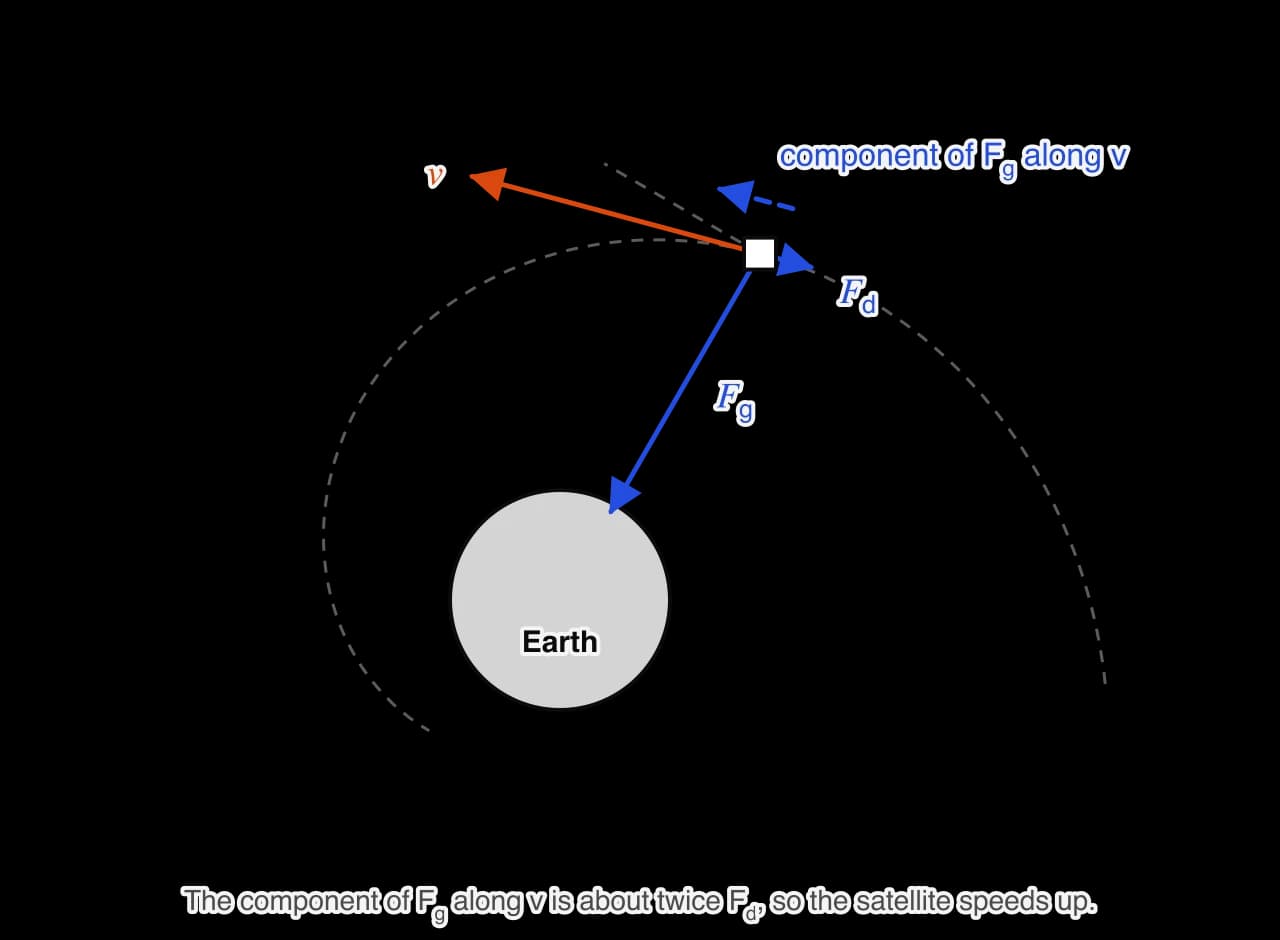
The International Space Station loses height continually in this way, typically by about 1 to 3 km each month depending on solar activity, which heats and expands the upper atmosphere. Every few weeks the engines of the station or of a docked supply craft fire forwards to raise the orbit again. Satellites without propulsion spiral down, faster and faster as the air becomes denser, until they re-enter the dense lower atmosphere and largely burn up.
Each question is in the style of Paper 1A, 1B or 2. Try it before opening the markscheme.
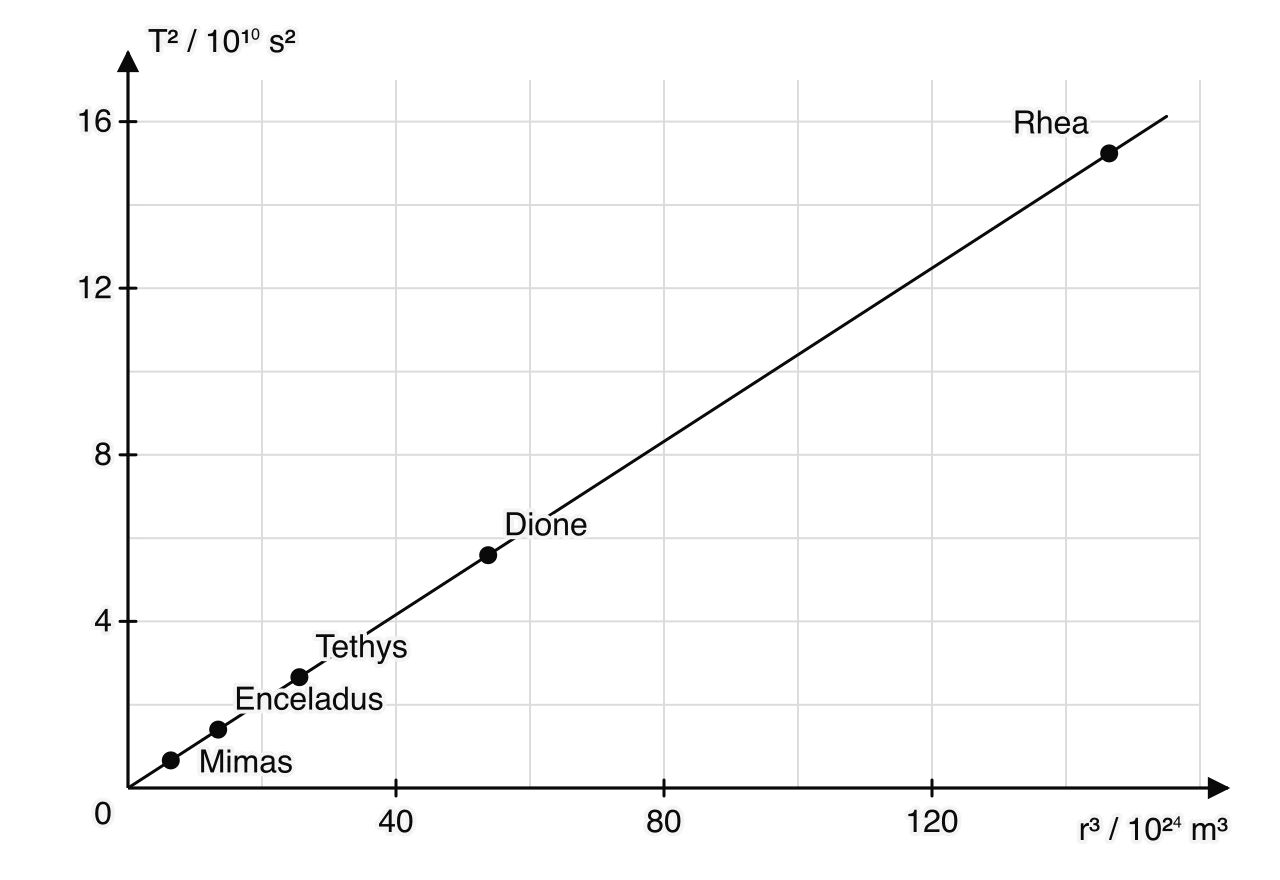
A group of students uses published data for five moons of Saturn to test Kepler’s third law and to determine the mass of Saturn. They plot the square of the orbital period, , against the cube of the mean orbital radius, , as shown in the graph of the five moons.
The graph shows how the gravitational potential varies with distance from the centre of a planet of radius m. At the surface, .
I can state Kepler’s three laws and describe how a planet’s speed changes around an elliptical orbit.
I can use T² ∝ r³ in ratio form and test it with a graph of T² against r³.
I can state Newton’s law of gravitation and use it, including ratio questions.
I can explain when an extended body can be treated as a point mass, and always measure r from the centre.
I can define gravitational field strength and derive g = GM/r².
I can calculate g at a height above a planet and on other planets, and find the neutral point between two bodies.
I can find the resultant field of two bodies along the line joining them.
I can sketch and interpret field lines for a sphere, near a surface and for two masses.
I can explain why an orbit is free fall and why gravity does no work in a circular orbit.
I can derive the orbital speed and T² = 4π²r³/GM and use them, including for geostationary orbits and to find a central mass.
I can define gravitational potential energy and potential and explain why they are negative (HL).
I can find g from the gradient of a potential–distance graph and use W = mΔV (HL).
I can draw equipotentials and explain why they are perpendicular to field lines (HL).
I can derive and use the escape speed, from equations or from a potential graph (HL).
I can derive the kinetic, potential and total energy of a satellite and calculate the energy to change orbit, to launch into orbit and to escape from orbit (HL).
I can explain why atmospheric drag lowers an orbit and increases the satellite’s speed (HL).
radius of the Moon
Ignore the change in mass of the lander due to the fuel used.
Show that the gravitational field strength at the surface of the Moon is about .
2 marks
✓
✓
Must see the substitution OR an answer to at least 3 s.f.
Calculate the magnitude of the deceleration of the lander while the engine is on.
2 marks
distance = «» 146 «m» ✓
«
Calculate the time for which the engine is on.
1 mark
« OR
Determine the force provided by the engine during the deceleration.
2 marks
OR
Calculate the speed with which the lander reaches the surface.
2 marks
✓
Outline why the lander cannot use a parachute to slow its descent.
1 mark
the Moon has no atmosphere, so there is no air resistance «drag» on a parachute ✓
A rover on the surface of Mars launches a small sample capsule of mass 0.50 kg from a level plain. The capsule leaves the launcher at ground level with a speed of at above the horizontal.
The following data are given:
mass of Mars
radius of Mars
The atmosphere of Mars is very thin. Ignore air resistance unless a part says otherwise.
Show that the gravitational field strength at the surface of Mars is about .
2 marks
Calculate the time of flight of the capsule.
2 marks
Calculate the horizontal distance travelled by the capsule.
2 marks
Calculate the maximum height reached by the capsule.
2 marks
The same launcher is used on Earth, with the same launch speed and angle. Determine the ratio
A small probe of mass 25 kg is launched vertically upwards from the surface of the Moon at a speed of . The Moon has no atmosphere.
The following data are given:
mass of the Moon
radius of the Moon
Show that the gravitational field strength at the surface of the Moon is about .
1 mark
A student calculates the maximum height of the probe using
And 1 more in the data booklet.
This enormous force acts on both bodies. It is the centripetal force that keeps the Moon in its orbit, and the same force on the Earth makes the Earth wobble slightly around the common centre of mass of the pair.
The answer, given to one more significant figure than the 9.8 in the question, agrees with the measured value. The small differences across the Earth’s surface (about 9.78 at the equator to 9.83 at the poles) come from the planet’s rotation and its slightly flattened shape.
At the height of the Space Station gravity is still almost nine-tenths as strong as on the ground. The astronauts float because they and the station are falling freely together, not because gravity has disappeared.
The two fields are subtracted because they point in opposite directions. At the midpoint the Moon’s contribution is only about 1% of the Earth’s.
Period. One orbit is a distance at constant speed .
The station travels at about 27 600 km per hour and goes round the Earth about 15.5 times a day, in agreement with its published period of about 93 minutes.
A geostationary satellite is about 36 000 km above the equator, about 5.6 Earth radii above the surface. (Strictly, the Earth turns once relative to the stars in 23 h 56 min, which gives a radius about 0.2% smaller; 24 h is the value normally used in calculations.)
Near-surface estimate. J.
The estimate is about 6% too large, because is already about 12% weaker at 400 km than at the surface. For larger heights the error grows quickly: would predict an unlimited energy for an unlimited height, while the true increase can never exceed .
The potential at geostationary height is still negative but much closer to zero. Every kilogram lifted from the surface to that height gains about J of potential energy.
The magnitude, , is a quarter of , as the inverse-square law predicts at . The minus sign shows that the field points towards decreasing : towards the Earth.
This is only the increase in potential energy. To place the satellite in orbit it must also be given the kinetic energy of orbital motion, so the total energy needed is larger.
About 11.2 km s⁻¹ is needed to leave the Earth but only about 2.4 km s⁻¹ to leave the Moon. This is why the Apollo lunar modules could return to lunar orbit with a small engine, while launch from the Earth needed the huge Saturn V rocket.
As expected, and .
Energy must be supplied even though the satellite ends up slower. Its kinetic energy falls by J while its potential energy rises by twice that.
Most of this energy, J, is the kinetic energy of orbital motion; lifting the satellite 400 km takes only about J. Reaching low orbit is mainly a matter of reaching about 7.7 km s⁻¹ sideways, not of climbing.
Speeds. and .
The orbit has dropped by about 45 km and the satellite has sped up by about 26 m s⁻¹. Its kinetic energy has risen by J (equal to the energy lost) while its potential energy has fallen by J.
B comes from using the height as the distance from the centre. C and D come from treating the field as inversely proportional to distance rather than to its square.
(b) gradient from a large triangle, e.g. ✓
✓
Accept 1.00–1.08 × 10⁻¹⁵. Unit needed for MP2.
(c) ✓
«kg» ✓
Allow ECF from (b). Award [2] for a bald correct answer.
(d) «%» ✓
substituted and rearranged to ✓
(b)(ii) «m» ✓
«m» ✓
Allow ECF from the radius. Award [1 max] if the period is not converted to seconds.
(c) «m s⁻¹» ✓
OR = 7.4 × 10³ «m s⁻¹». Allow ECF from (b)(ii).
(d) total energy decreases «work done against fluid resistance» ✓
orbital radius decreases «since becomes more negative» ✓
kinetic energy/speed increases «since » ✓
Do not award MP2 or MP3 without a reason linked to energy. OWTTE.
2 marks
Explain, without calculation, why the capsule lands with the same speed as it was launched.
2 marks
A later mission must send a sample capsule away from Mars completely. Show that the escape speed from the surface of Mars is about .
2 marks
Calculate the minimum energy needed to move the 0.50 kg capsule from the surface of Mars to infinity.
2 marks
Outline why the escape speed does not depend on the direction in which the capsule is launched.
1 mark
Radio signals from the rover travel to Earth at the speed of light. On one day the distance between Mars and Earth is . Calculate the time taken for a signal from the rover to reach Earth.
1 mark
The thin atmosphere of Mars does exert a small drag force on the capsule. Predict how the horizontal distance and the speed on landing compare with your answers to (b)(ii) and (d).
2 marks
2 marks
Determine the actual maximum height of the probe above the Moon's surface.
3 marks
Explain why the answers to (b) and (c) are different.
2 marks
Calculate the escape speed from the surface of the Moon.
2 marks