B.3 Gas laws questions for IB Physics
98 questions on Gas laws, written by Augment in the style of IB exam papers. Six of them are below in full, to answer on paper.
- IB Physics
- Part of B The particulate nature of matter
- SL and HL
Questions by paper and level
SL and HL questions are for students at either level. HL only questions cover what only HL students study.
| Paper | SL and HL | HL only | All |
|---|---|---|---|
| Paper 1A | 32 | 5 | 37 |
| Paper 1B | 6 | 0 | 6 |
| Paper 2 | 30 | 25 | 55 |
| Every paper | 68 | 30 | 98 |
Counted on
Questions to try
Written by Augment in the style of IB exams, not past papers. Answer them on paper, then check each one against its markscheme with a free account.
Helium in the cylinder of a model engine changes from a pressure of 100 kPa and volume to a pressure of 250 kPa and volume . Helium behaves as an ideal monatomic gas. What is the change in the internal energy of the helium?
A group of students investigates how the pressure of a fixed mass of air varies with its volume at constant temperature. Air is trapped in a syringe that is connected by a short plastic tube to a pressure sensor. The students read the volume from the scale on the syringe and the pressure from the sensor. The temperature of the laboratory is 20 °C.
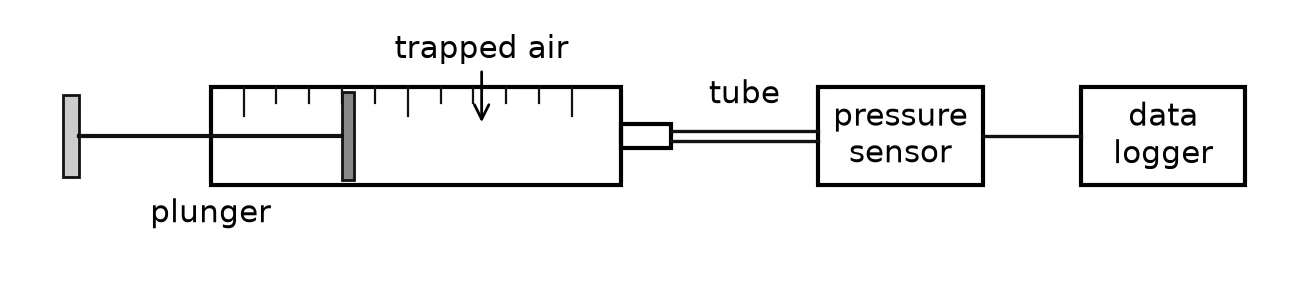
The students push the plunger in slowly, in steps, and wait for about a minute before taking each reading. The table shows their data.
/ cm3 ± 0.5 | / kPa ± 1 | / kPa-1 |
|---|---|---|
60.0 | 101 | 9.90 |
50.0 | 120 | 8.33 |
40.0 | 149 | 6.71 |
30.0 | 194 | 5.15 |
25.0 | 231 | 4.33 |
20.0 | 280 | 3.57 |
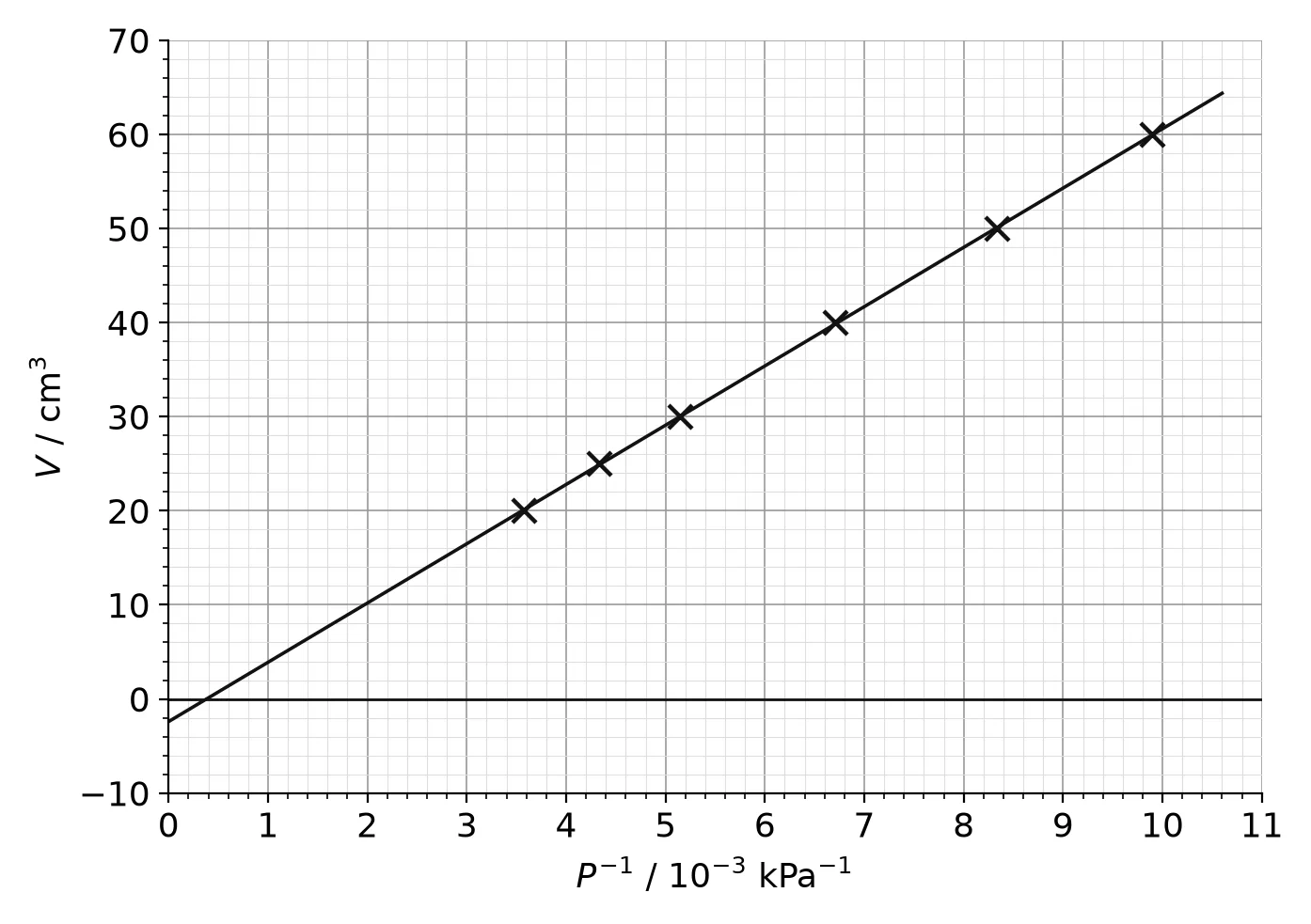
The graph shows the variation of with , with the line of best fit. The uncertainties in are too small to be shown.
- (a)
Outline why the students wait before taking each reading.
1 mark
- (b)
Show, using the reading for , that the uncertainty in is too small to be shown on the graph.
2 marks
- (c)
Explain why the students plotted against rather than against .
2 marks
- (d)
Determine, using the graph, the amount of air, in mol, in the apparatus.
3 marks
- (e)
The line of best fit does not pass through the origin. State the intercept on the axis and outline what it represents.
2 marks
- (f)
A student concludes from the graph that the pressure of the air is inversely proportional to the volume read from the syringe. Comment on this conclusion.
2 marks
A weather balloon is filled with helium and released from the ground. The following data are available at launch:
mass of the balloon fabric = 0.80 kg
mass of the instrument package and parachute = 1.50 kg
volume of helium = 3.6 m
density of helium = 0.165 kg m
density of the surrounding air = 1.20 kg m
The volume of the fabric and the package can be ignored.
- (a)
Calculate the buoyancy force on the balloon at launch.
2 marks
- (b)
Show that the resultant force on the balloon at launch is about 14 N.
2 marks
- (c)
Calculate the initial acceleration of the balloon.
2 marks
- (d)
Explain why the balloon soon rises at a constant speed.
3 marks
- (e)
Near the ground, the drag force on the balloon is given by , where kg m. Determine the constant speed of the balloon.
2 marks
- (f)
At launch the pressure of the air is 101 kPa and its temperature is 288 K. At a height of 10 km the pressure is 28 kPa and the temperature is 223 K. The helium is at the same pressure and temperature as the surrounding air, and the fabric stretches freely. Calculate the volume of the balloon at a height of 10 km.
2 marks
- (g)
Air can be treated as an ideal gas. Show that the buoyancy force on the balloon at a height of 10 km is the same as at launch.
3 marks
- (h)
Suggest why the balloon does not stop at a height where it floats in equilibrium, but continues to rise until the fabric bursts.
2 marks
- (i)
Assume that the balloon rises at constant speed with the resultant force from (b) balanced by drag all the way to 18 km. Calculate the work done against drag during the ascent, and state what this energy becomes.
2 marks
0.20 mol of argon is held in a cylinder by a freely moving piston, so its pressure stays constant. The argon is heated and its temperature rises by 40 K. Argon behaves as an ideal monatomic gas. What is the thermal energy supplied to the argon?
A student investigates how the volume of a fixed mass of air varies with its temperature at constant pressure. Air is trapped in a glass capillary tube of uniform bore, sealed at the bottom, by a short thread of oil. The top of the tube is open to the atmosphere. The tube is fixed to a ruler and placed in a beaker of water. The water is heated in steps and the length of the air column is measured at each water temperature .
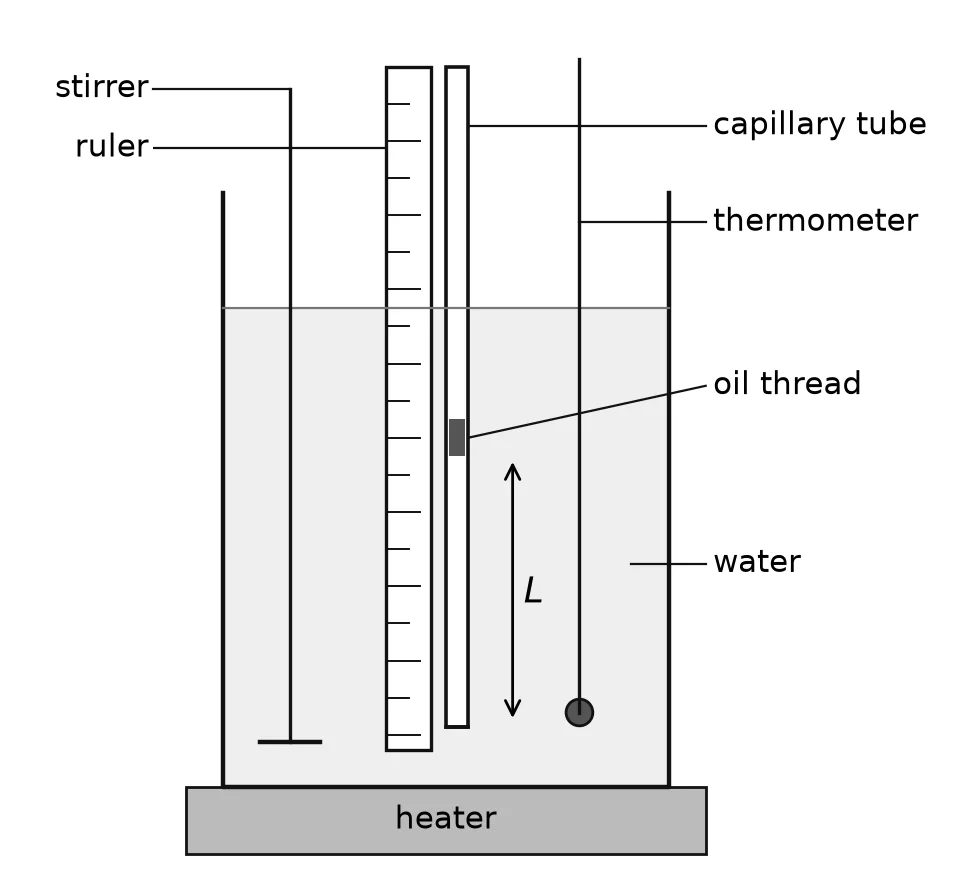
The table shows the student's data.
/ °C ± 1 | / mm ± 0.5 |
|---|---|
15 | 63.5 |
30 | 66.5 |
45 | 70.0 |
60 | 73.0 |
75 | 76.5 |
90 | 80.0 |
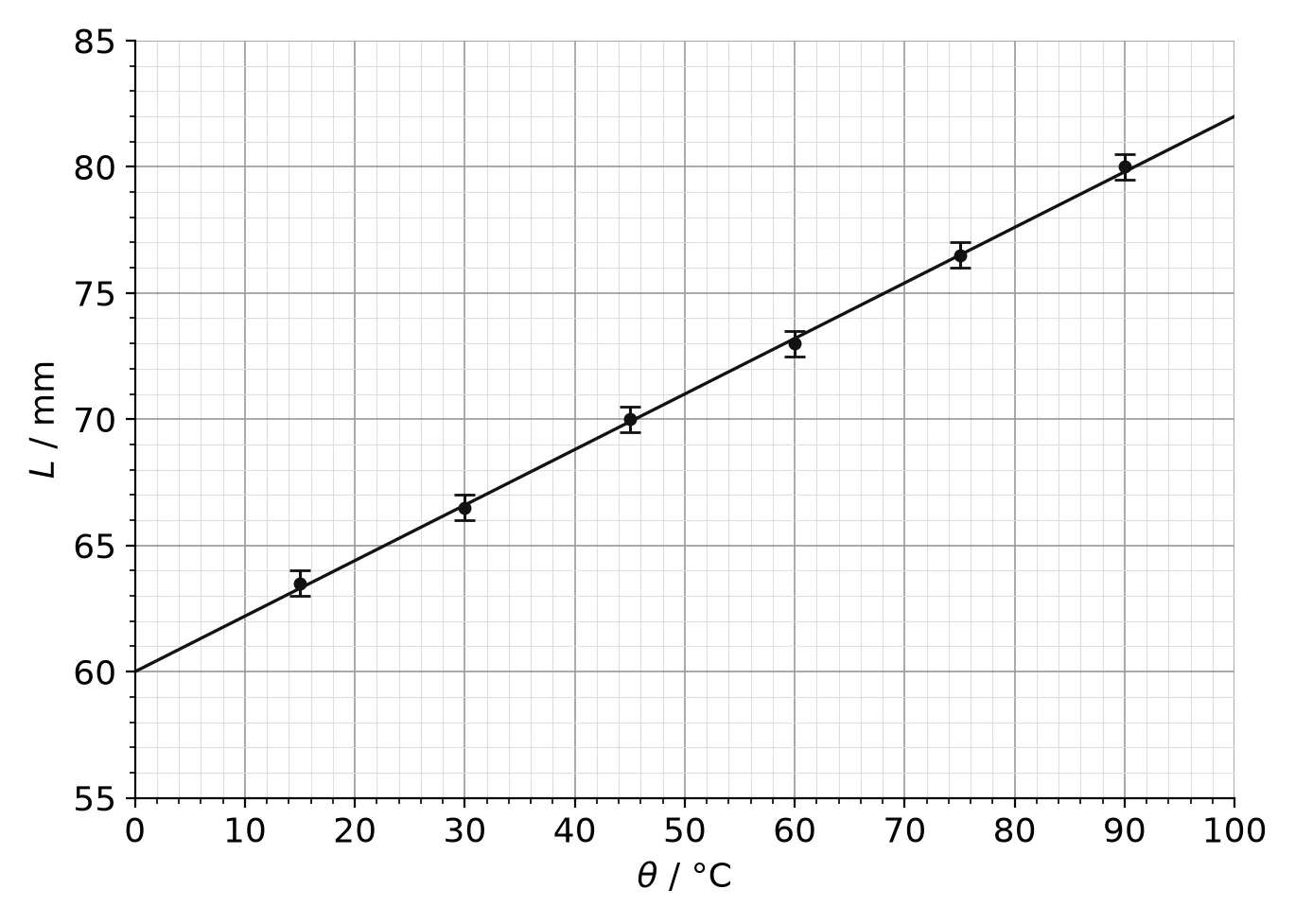
The graph shows the variation of with , with error bars for and the line of best fit. The uncertainties in are not shown.
- (a)
State why can be used as a measure of the volume of the trapped air.
1 mark
- (b)
Outline why the pressure of the trapped air stays constant during the experiment.
1 mark
- (c)
Calculate the percentage uncertainty in for the reading at 15 °C.
1 mark
- (d)
Suggest why the student stirs the water and waits before taking each reading.
1 mark
- (e)
Determine, using the line of best fit, the temperature in °C at which the volume of the air would be zero.
3 marks
- (f)
The student draws the lines of maximum and minimum gradient through the error bars. They give values of −250 °C and −300 °C for the temperature at which the volume would be zero. Deduce whether the student's result in (e) is consistent with the accepted value of absolute zero.
2 marks
- (g)
Outline why the student cannot test the relationship by cooling the air to temperatures close to −273 °C.
1 mark
A gas-fired power station has an electrical power output of 800 MW and an overall efficiency of 0.55. The fuel may be treated as pure methane.
The following data are available:
energy released per kilogram of methane burned: J kg-1
mass of carbon dioxide produced per kilogram of methane burned: 2.75 kg
molar mass of methane: 16 g mol-1
- (a)
Calculate the rate at which energy is supplied by the fuel.
1 mark
- (b)
Show that the mass of methane burned each second is about 26 kg.
2 marks
- (c)
Calculate the mass of carbon dioxide released by the power station in one year.
2 marks
- (d)
Sketch a Sankey diagram for the power station. Label each arrow with its power.
2 marks
- (e)
60 % of the wasted energy is transferred to river water used for cooling. The temperature of the cooling water rises by 8.0 K. The specific heat capacity of water is 4200 J kg-1 K-1.
Calculate the mass of cooling water that flows through the power station each second.
2 marks
- (f)
The power station keeps a reserve of methane in a storage tank of volume at a pressure of Pa and a temperature of 15 °C. Assume that methane behaves as an ideal gas.
Determine the time for which this reserve can keep the power station running at full output.
3 marks
- (g)
Explain how the carbon dioxide released by the power station can lead to an increase in the mean surface temperature of the Earth.
3 marks
- (h)
A nuclear power station with the same electrical output has an overall efficiency of 0.33. Each fission of a uranium-235 nucleus releases J. Determine the mass of uranium-235 that undergoes fission each day.
3 marks
- (i)
Discuss, with reference to the climate, one advantage and one disadvantage of generating electricity with the nuclear power station rather than the gas-fired power station.
2 marks
Practice all 98 in Augment
Free with an account. Every question has its markscheme, and Augment keeps the ones you got wrong so you can come back to them.
More questions in The particulate nature of matter
- B.1Thermal energy transfers
- B.2Greenhouse effect
- B.3Gas lawsThis page
- B.4ThermodynamicsHL only
- B.5Current and circuits
Check your answers in Augment
A free account opens all 98 questions on Gas laws with their markschemes, and keeps a record of what you have marked.