B.5 Current and circuits questions for IB Physics
122 questions on Current and circuits, written by Augment in the style of IB exam papers. Six of them are below in full, to answer on paper.
- IB Physics
- Part of B The particulate nature of matter
- SL and HL
Questions by paper and level
SL and HL questions are for students at either level. HL only questions cover what only HL students study.
| Paper | SL and HL | HL only | All |
|---|---|---|---|
| Paper 1A | 41 | 5 | 46 |
| Paper 1B | 9 | 1 | 10 |
| Paper 2 | 44 | 22 | 66 |
| Every paper | 94 | 28 | 122 |
Counted on
Questions to try
Written by Augment in the style of IB exams, not past papers. Answer them on paper, then check each one against its markscheme with a free account.
The cell in the circuit has negligible internal resistance.

What is the potential difference across ?
A group of students uses a small electric motor to wind a string onto a spool. The string lifts a load of mass from rest through a vertical height of . The potential difference across the motor is kept at . The students measure the current in the motor and use a hand-operated stopwatch to measure the time taken to lift the load.
/ kg | / A ± 0.01 A | / s ± 0.2 s |
|---|---|---|
0.050 | 0.25 | 3.0 |
0.100 | 0.30 | 3.1 |
0.150 | 0.36 | 3.1 |
0.200 | 0.41 | 3.3 |
0.250 | 0.46 | 3.6 |
0.300 | 0.52 | 4.1 |
The students calculate the efficiency of the motor for each load. The graph shows the variation of with .

- (a)
State one variable, other than the potential difference, that the students should control.
1 mark
- (b)(i)
Show that the efficiency of the motor when is about 0.19.
2 marks
- (b)(ii)
Determine the absolute uncertainty in the efficiency when .
3 marks
- (c)
One student suggests that the efficiency of the motor increases as the load increases. Discuss whether the data support this suggestion.
2 marks
- (d)
Suggest one change to the method that would reduce the percentage uncertainty in .
1 mark
- (e)
Outline why the efficiency of the motor is low for the smallest loads.
2 marks
In a drop-tower amusement ride, a gondola carrying riders is raised to the top of a vertical tower by an electric motor. The gondola is then released from rest and falls freely through 38.0 m. Brakes then act, giving the gondola a uniform deceleration, and it comes to rest after falling a further 16.0 m. The total mass of the gondola and riders is 4800 kg. Ignore air resistance unless a part says otherwise.
- (a)(i)
The motor raises the gondola and riders through a vertical height of 58 m in 40 s at constant speed. Calculate the useful power output of the motor.
2 marks
- (a)(ii)
The motor has an efficiency of 75 % and is supplied at a potential difference of 600 V. Calculate the current in the motor.
2 marks
- (b)(i)
Calculate the speed of the gondola at the end of the free fall.
2 marks
- (b)(ii)
Calculate the time taken for the free fall.
1 mark
- (c)
Outline why the seat exerts no force on a rider during the free fall.
2 marks
- (d)(i)
Show that the deceleration of the gondola during braking is about .
2 marks
- (d)(ii)
Determine the force exerted by the seat on a rider of mass 70 kg during braking.
2 marks
- (e)
Sketch a graph to show the variation with time of the speed of the gondola from its release until it comes to rest. Add values to the axes.
2 marks
- (f)
The brakes transfer energy to copper fins of total mass 320 kg. The specific heat capacity of copper is . Determine the rise in temperature of the fins during one ride, assuming that all the energy removed by the brakes is transferred to the fins.
3 marks
- (g)
In practice air resistance acts on the gondola during the fall. Outline the effect of this on the speed of the gondola when braking starts and on the braking distance needed for the same deceleration.
2 marks
A lightning stroke transfers a charge of 15 C between a cloud and the ground in a time of 0.60 ms. What is the average current in the stroke?
A group of students determine the specific heat capacity of aluminium. An electrical heater is placed in a hole in an aluminium block of mass 1.00 kg and a thermometer is placed in a second hole. The block is surrounded by insulation.
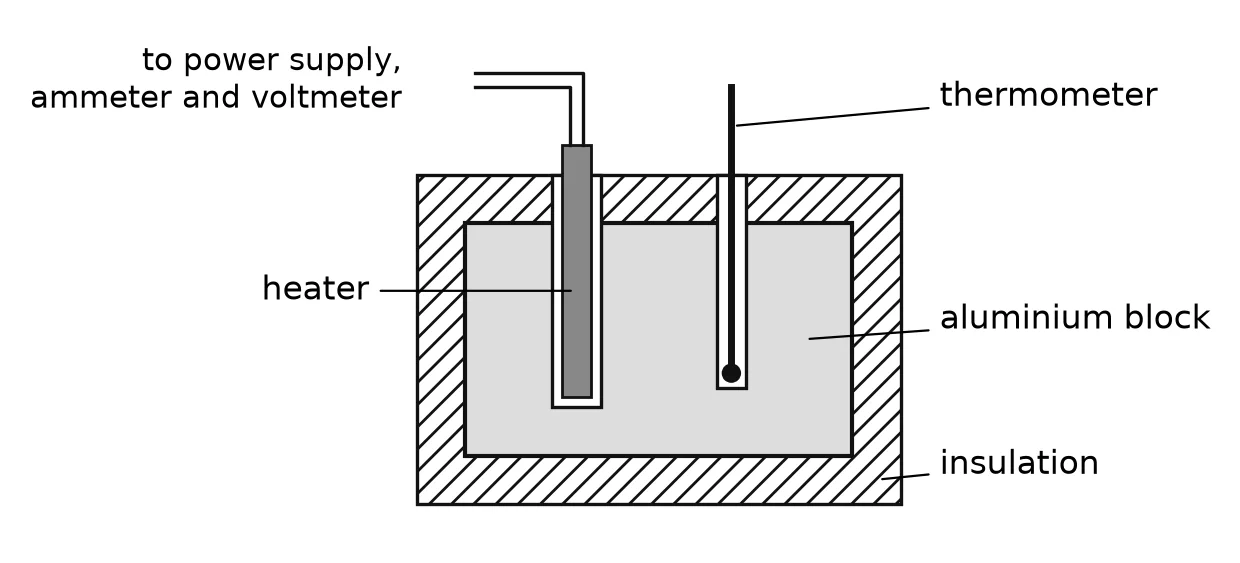
The heater is switched on at time . During the experiment the potential difference across the heater is and the current in it is .
- (a)
Calculate the power of the heater and its absolute uncertainty.
2 marks
- (b)
The temperature of the block is recorded every minute. The graph shows the variation of with . The error bars show the uncertainty of in . The students have drawn the line of best fit for the data from min onwards.
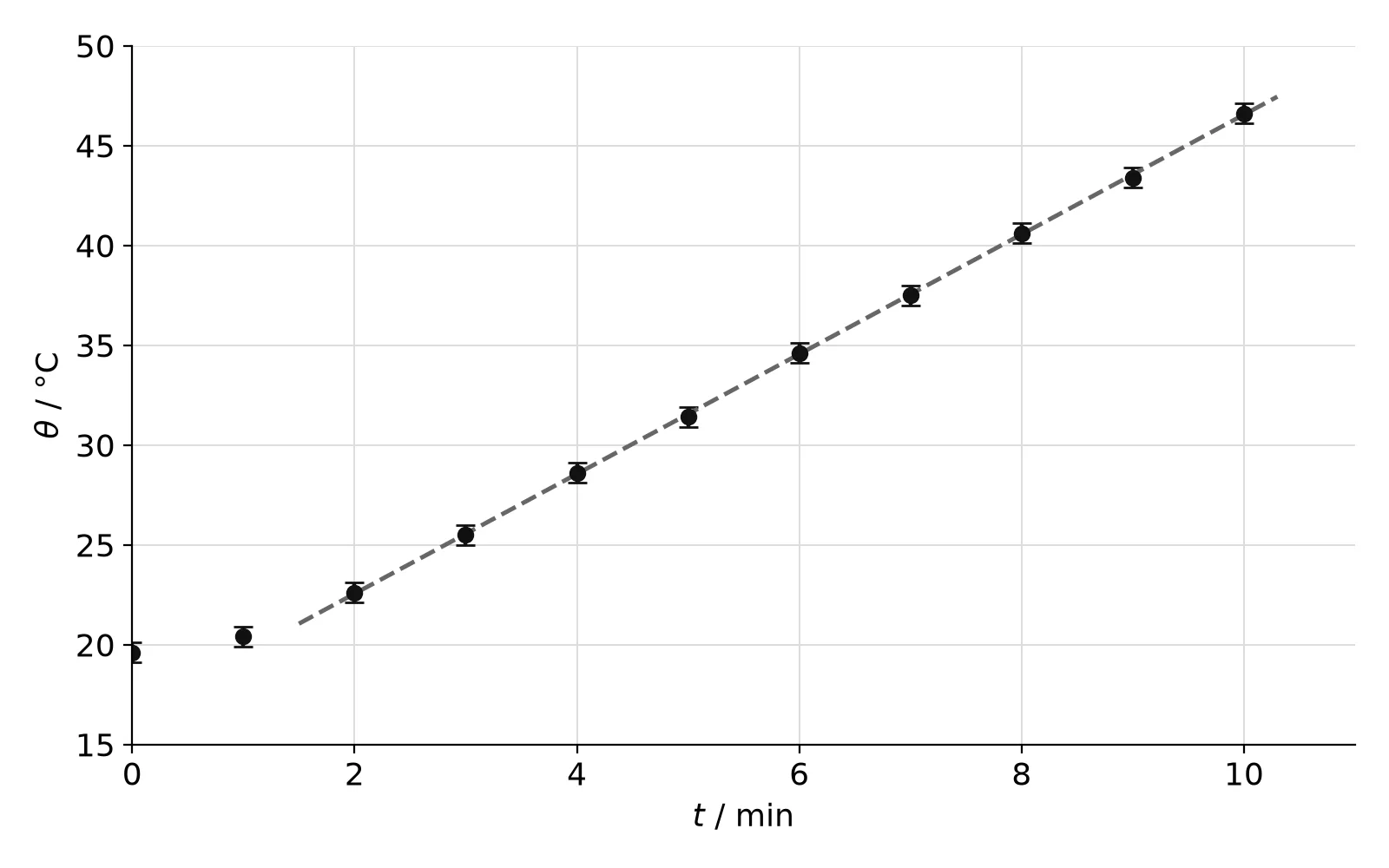
Outline why the temperature rises more slowly during the first two minutes than later in the experiment.
1 mark
- (c)
Determine, using the graph, the specific heat capacity of aluminium.
3 marks
- (d)
The students estimate that the uncertainty in the gradient is 4 %. Calculate the absolute uncertainty in their value of the specific heat capacity.
2 marks
- (e)
The accepted value of the specific heat capacity of aluminium is . Comment on the students' result.
1 mark
- (f)
Explain whether thermal energy transfer from the block to the surroundings causes the students' value to be larger or smaller than the true value.
2 marks
A commuter rides an electric-assist bicycle. The total mass of the rider and bicycle is 95 kg. The battery has an emf of 36 V, a charge capacity of 14 A h and a volume of . Assume that the pd across the battery terminals stays at 36 V.
- (a)
Show that the energy stored in the fully charged battery is about 1.8 MJ.
2 marks
- (b)
Calculate the energy density of the battery.
1 mark
- (c)
On a level road the commuter travels at a constant speed of . The total resistive force is 22 N. The rider's legs provide a useful power of 70 W and the motor provides the rest. Calculate the useful power output of the motor.
2 marks
- (d)
The motor has an efficiency of 0.80. Calculate the current in the motor.
2 marks
- (e)
Part of the route climbs a straight hill that rises 45 m over a distance of 1.5 km along the road. The commuter climbs at a constant speed of , the total resistive force is now 12 N and the rider still provides 70 W. Determine the useful power output of the motor on the hill.
3 marks
- (f)
Estimate the distance the commuter could travel on a level road at , as in (c), using one full charge of the battery.
3 marks
- (g)
At the end of the journey the commuter brakes on a level road from to rest. Half of the kinetic energy is transferred to the two aluminium wheel rims, which have a total mass of 0.80 kg. The specific heat capacity of aluminium is . Calculate the rise in temperature of the rims.
3 marks
- (h)
While the commuter rides at constant speed on the level road, the motor and the rider do positive work on the bicycle. Explain why the kinetic energy of the commuter and bicycle does not change.
2 marks
- (i)
Suggest why the range of the bicycle is smaller when the commuter rides faster on a level road.
2 marks
Practice all 122 in Augment
Free with an account. Every question has its markscheme, and Augment keeps the ones you got wrong so you can come back to them.
More questions in The particulate nature of matter
- B.1Thermal energy transfers
- B.2Greenhouse effect
- B.3Gas laws
- B.4ThermodynamicsHL only
- B.5Current and circuitsThis page
Check your answers in Augment
A free account opens all 122 questions on Current and circuits with their markschemes, and keeps a record of what you have marked.