Pressure, the mole, the empirical gas laws and the ideal gas equation; the kinetic model, pressure from molecular collisions, temperature as mean kinetic energy, and real gases.
Each is in the Physics glossary, with every other term in the subject.
The number of particles in a sample divided by the Avogadro constant, ; measured in moles.
The number of particles in one mole of a substance,
98 exam-style questions on this subtopic, written in the style of the IB papers. The first has its markscheme open. Counted on
A weather balloon is filled with helium and released from the ground. The following data are available at launch:
mass of the balloon fabric = 0.80 kg
mass of the instrument package and parachute = 1.50 kg
volume of helium = 3.6 m
density of helium = 0.165 kg m
density of the surrounding air = 1.20 kg m
One of 60 short multiple-choice questions on B.3. Pick an answer to see why it's right or wrong.
In an experiment on Boyle’s law, the piston of a sealed syringe of air is moved slowly. Why?
The official deck for this part of the syllabus.
Define pressure.
Pressure is the force acting [direction relative to the surface] to a surface divided by the area of the surface.
The entries of the physics data booklet that B.3 uses. Each opens in the explained booklet.
With a free account, Augment remembers where you stopped and what you have practiced.
For a fixed mass of gas at constant temperature, pressure is inversely proportional to volume: = constant.
The random, jerky movement of small particles suspended in a fluid, caused by uneven bombardment by the fluid's molecules.
For a fixed mass of gas at constant pressure, volume is proportional to absolute temperature: = constant.
A law found from experimental measurements that describes a pattern without explaining its cause.
The pressure of a fluid above atmospheric pressure, as read by a tyre gauge; absolute pressure = gauge pressure + atmospheric pressure.
A gas that obeys exactly; modelled by kinetic theory as point molecules with no forces between them except in elastic collisions.
The equation linking the pressure, volume, temperature and amount of an ideal gas.
A curve on a P–V diagram joining states of a gas at the same temperature; for an ideal gas, = constant along it.
The model of a gas as a very large number of tiny molecules in random motion, colliding elastically, with no forces between them except in collisions.
The constant in the ideal gas equation .
The mass of one mole of a substance, ; usually quoted in .
The SI unit of amount of substance: one mole contains exactly particles, about .
Made of single atoms rather than molecules of several atoms, as in helium, neon and argon.
A graph of pressure against volume on which each point is a state of a gas and each line a change of state.
The SI unit of pressure: .
The force acting perpendicular to a surface per unit area of the surface, ; measured in pascals (Pa).
For a fixed mass of gas at constant volume, pressure is proportional to absolute temperature: = constant.
An actual gas, whose molecules have volume and attract each other, so it deviates from ideal behaviour at high pressure, low temperature and high density.
The square root of the mean of the squares of the speeds of the molecules in a gas; the speed in .
One of the measurable quantities that fix the state of a gas: pressure, volume, temperature and amount of substance.
The kinetic model treats a gas as a huge number of tiny, randomly moving molecules, and explains the gas laws.
Gas pressure comes from the change in momentum of molecules colliding with the walls, and .
The absolute temperature of a gas is proportional to the mean translational kinetic energy of its molecules.
The internal energy of an ideal monatomic gas is .
Real gases behave like an ideal gas at low pressure, high temperature and low density.
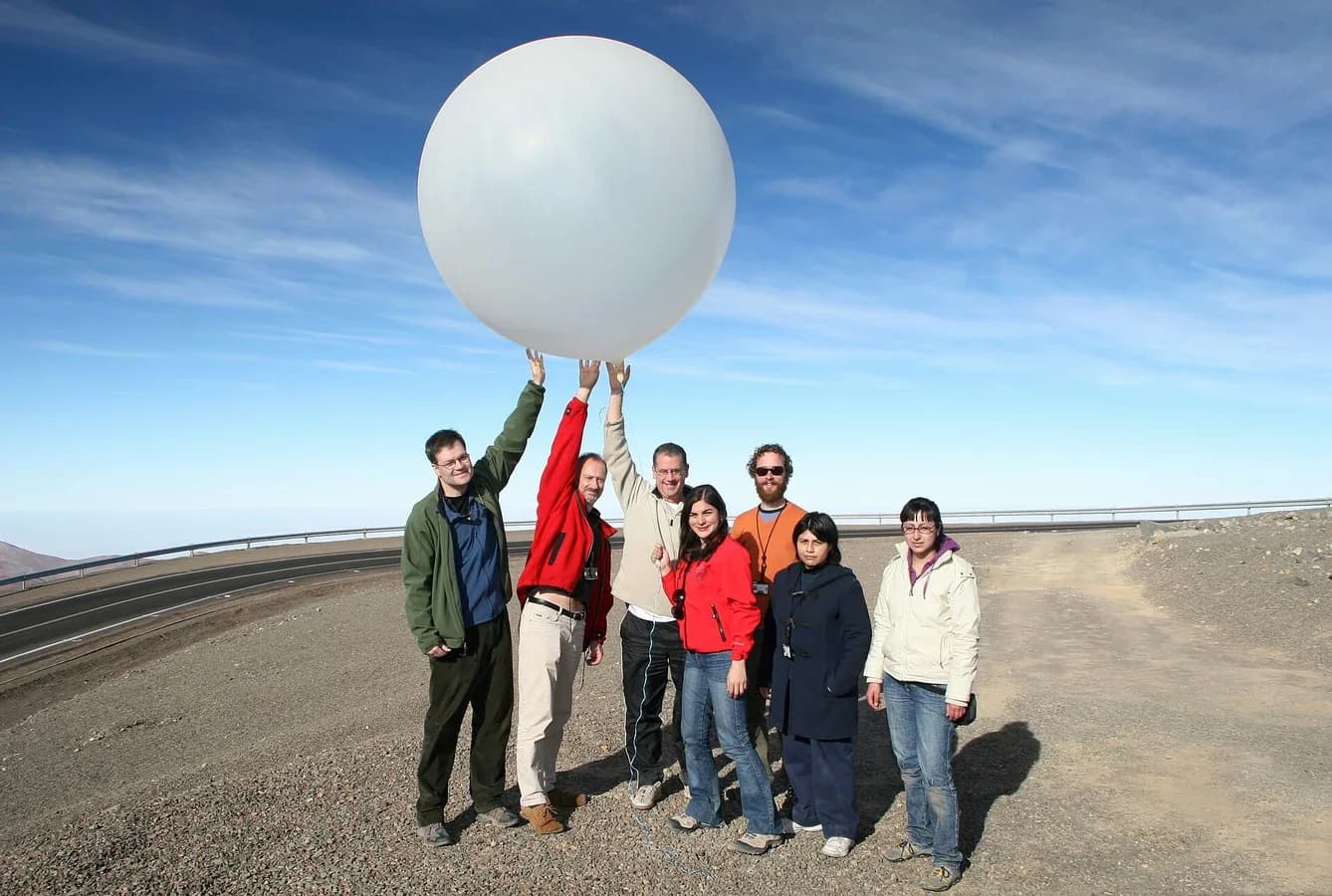
A gas is the simplest state of matter to describe. A sample of gas is fixed by just a few measurable quantities: its pressure, volume, temperature and amount. Experiments in the seventeenth and eighteenth centuries found simple laws linking these quantities, and the kinetic theory later explained those laws in terms of the motion of molecules. The same ideas predict how a car tyre responds to a long drive, why a weather balloon swells as it rises, and how fast the molecules of the air are moving.
A gas pushes on every surface it touches: the walls of its container, the skin of a balloon, the inside of a tyre. The effect of a push depends on the force and also on the area it is spread over, so it is described by a pressure.
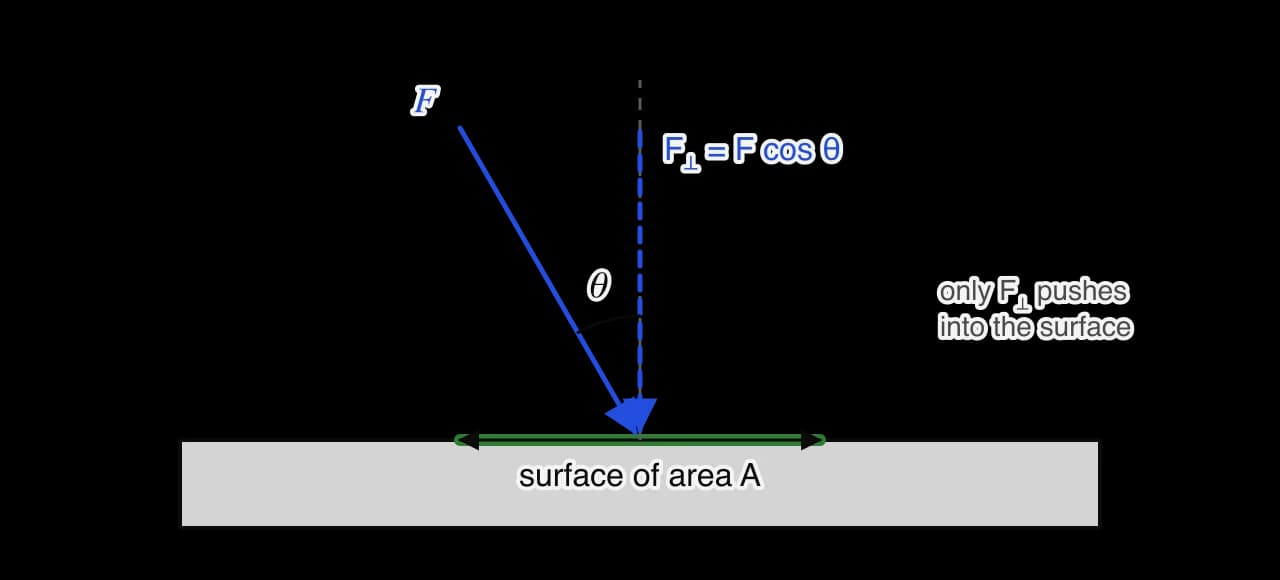
Pressure is a scalar: at a point in a gas it acts equally in all directions, and on any surface the force it produces is perpendicular to that surface. Only the perpendicular component of a force contributes. If a force acts at an angle to the normal, the pressure it produces is .
The pascal is a small unit. Atmospheric pressure at sea level is about (100 kPa), so the air presses on each square metre of a surface with a force of about N, roughly the weight of a 10-tonne lorry. People are not crushed because the fluids in the body push outwards with the same pressure, and a window survives because air on both sides pushes equally.
A tyre gauge reads the pressure above atmospheric pressure, called the gauge pressure. A typical car tyre is inflated to a gauge pressure of about 230 kPa, so the absolute pressure of the air inside is about . The gas laws always use the absolute pressure, the total force per unit area exerted by the gas.
The gas laws depend on how many particles a gas contains, not on what they are. Counting particles directly is impossible because the numbers are so large, so physicists count them in batches called moles.
The amount of substance , measured in moles (mol), is the number of particles divided by the Avogadro constant:
The particles can be atoms (helium, neon, argon are monatomic gases) or molecules (nitrogen , oxygen , carbon dioxide ). In gas physics the word "molecule" is used for the particles in either case.
The molar mass of a substance is the mass of one mole of it. It is usually quoted in and is numerically equal to the relative molecular mass. The amount of substance in a sample of mass is
Gas | Formula | Molar mass / | Mass of one molecule / kg |
|---|---|---|---|
Helium | He | 4.0 | |
Nitrogen | 28 | ||
Oxygen | 32 | ||
Carbon dioxide | 44 | ||
Air (mixture) | — | 29 | (mean) |
The mass of one molecule is , with in kg . For nitrogen, .
The four quantities that describe a gas sample, pressure , volume , temperature and amount , are its state variables. When one is held fixed along with the amount of gas, experiment shows a simple relationship between the other two. These relationships are empirical laws: they summarise measurements without explaining them. Each is obeyed closely by real gases at ordinary pressures and temperatures.
Boyle’s law is investigated by trapping air in a sealed syringe or a tube connected to a pressure gauge, and changing the volume slowly so that the temperature stays at room temperature. Doubling the pressure halves the volume. A graph of against is a curve called an isotherm, since every point on it is at the same temperature.
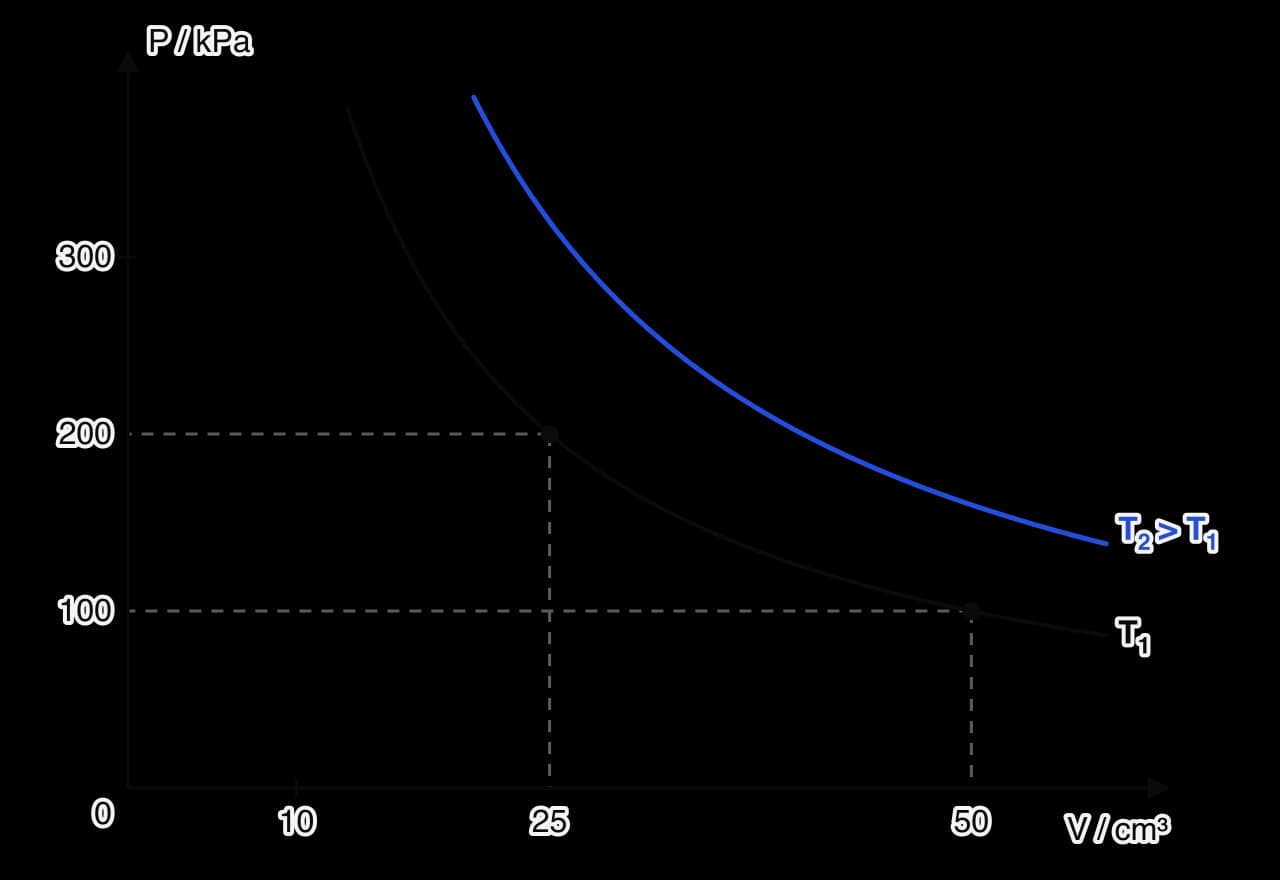
A curve is hard to test by eye, so the data are usually linearised. Since , a graph of against is a straight line through the origin, and its gradient is the constant .
When a fixed mass of gas is heated at constant pressure (for example in a tube closed by a freely moving bead of liquid), its volume increases steadily. A graph of volume against Celsius temperature is a straight line, but it does not pass through the origin: at 0 °C the gas still has a volume.

When the line is extended to lower temperatures, it reaches zero volume at about −273 °C. Every gas, and every amount of gas, gives a line that meets the axis at the same point. This temperature is absolute zero, the lowest temperature possible. Real gases liquefy long before they get there, so the point is found by extrapolation, never by measurement.
Measuring temperature from absolute zero gives the absolute temperature in kelvin, with . On this scale the straight line passes through the origin, and the law takes a simple form.
The pressure law is investigated with a flask of air in a water bath, linked to a pressure gauge. The volume of the flask hardly changes as it warms, so it is effectively constant. Readings are taken at several temperatures, each after the water has been stirred and held steady long enough for the air to reach the water temperature.
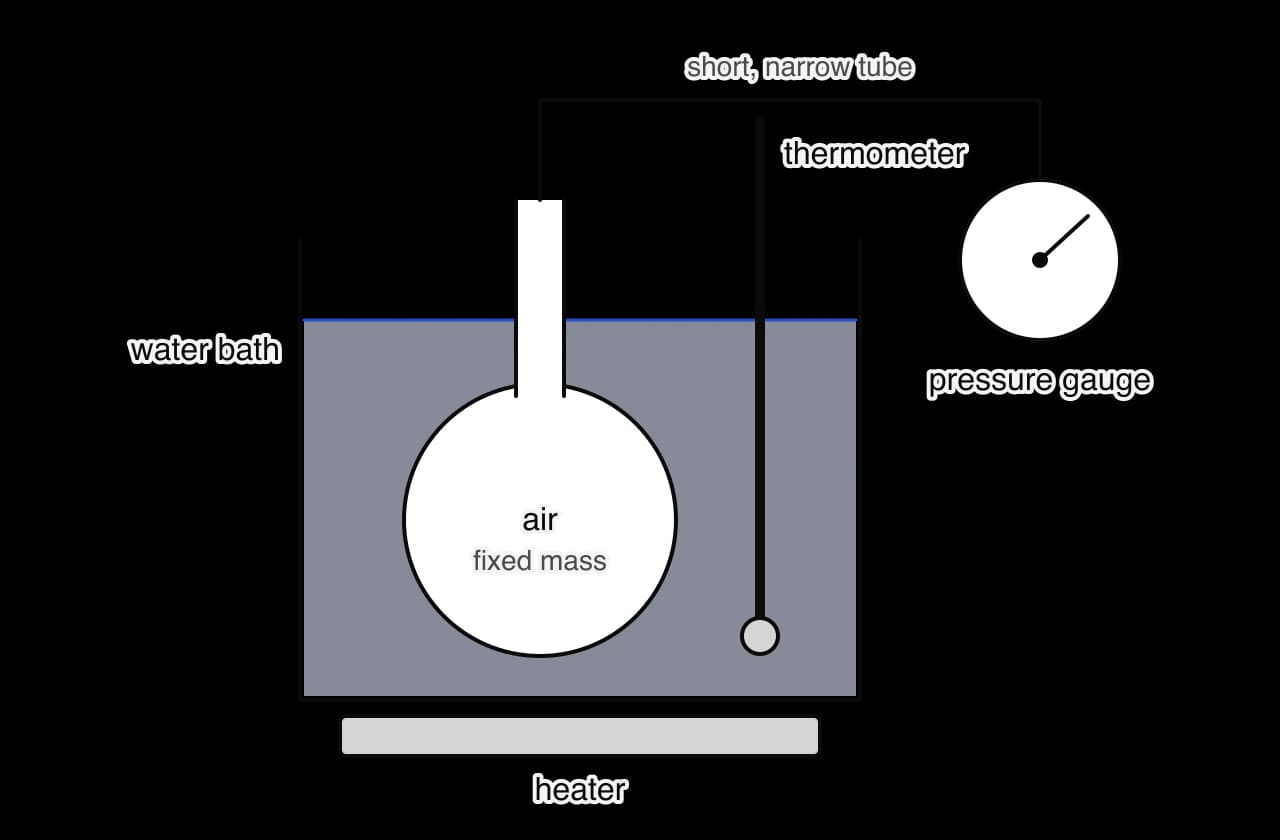
A graph of pressure against Celsius temperature is again a straight line, and its extrapolation to zero pressure gives another estimate of absolute zero. The tube to the gauge should be short and narrow, because the air in it is not in the water bath and stays nearer room temperature, which makes the measured pressure rise less than it should.
For a fixed amount of gas, the three empirical laws are special cases of a single relationship:
Holding T constant gives Boyle’s law, holding P constant gives Charles’s law, and holding V constant gives the pressure law. The combined form is useful when all three variables change at once.
Experiments also show that at fixed pressure and temperature the volume of a gas is proportional to the amount of gas: twice as many molecules need twice the space. So the constant in is proportional to , and the constant of proportionality is the same for every gas. This gives the ideal gas equation:
Here is the molar gas constant. The units work out because . All quantities must be in SI units: in Pa, in and in K.
No real gas is perfectly ideal gas, but most gases at room temperature and atmospheric pressure obey the equation to better than 1 %. One mole of any ideal gas at 273 K and 101 kPa occupies , about 22 litres.
Writing turns the equation into one about the number of molecules :
The Boltzmann constant is the gas constant per molecule rather than per mole. The form is used when a problem counts molecules; when it counts moles.
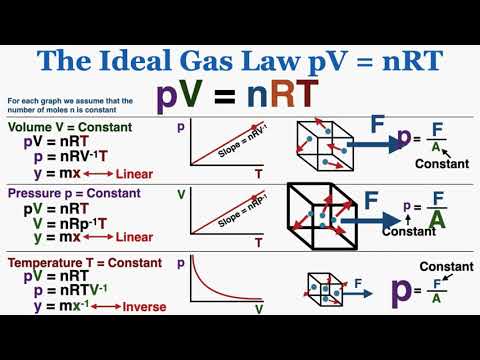
Since , a graph of against absolute temperature is a straight line through the origin with gradient . It is the same line whether the temperature change happens at constant pressure, constant volume, or neither. More gas gives a steeper line.
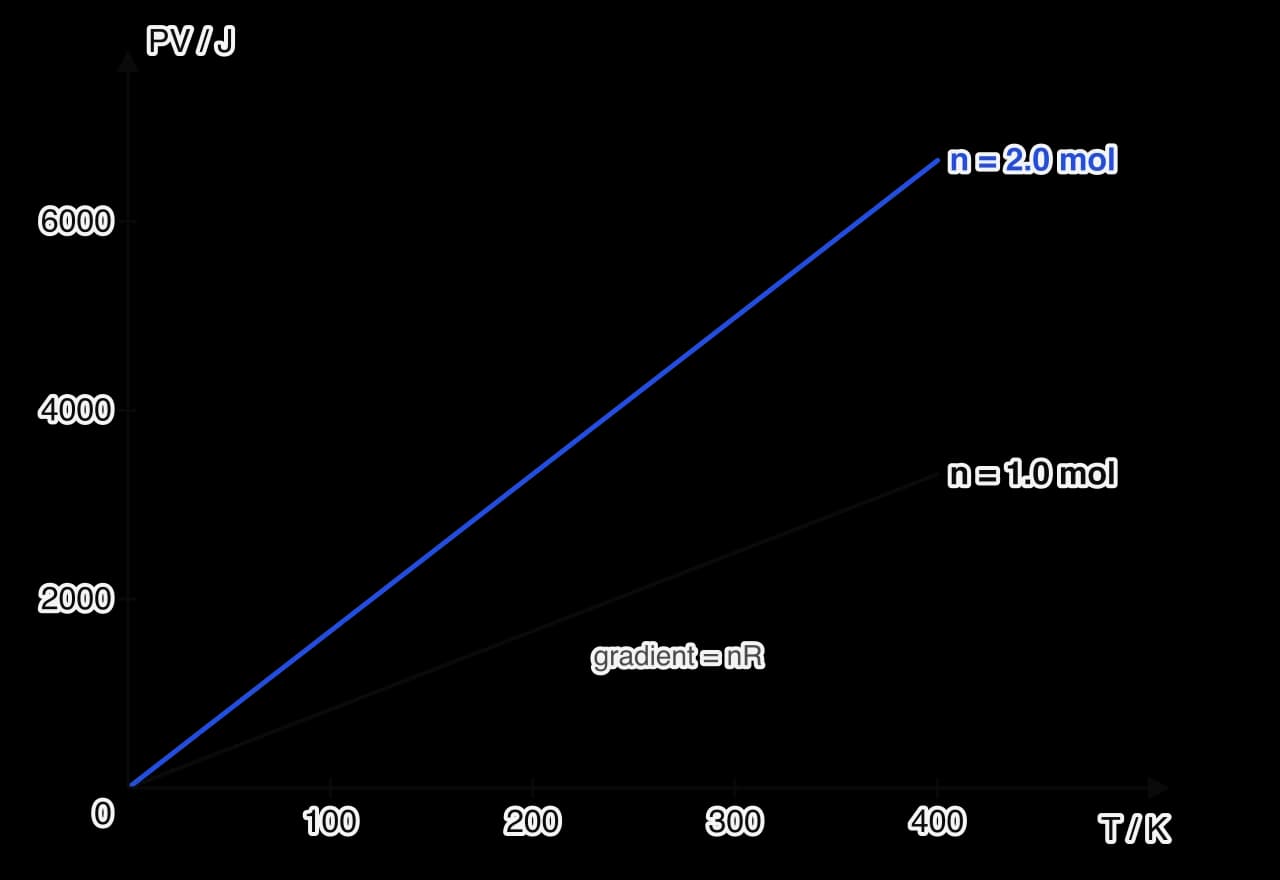
When gas is added, removed or shared between containers, is not constant for the whole process, but can be found for each state and the moles added up. Gas always flows from high pressure to low pressure until the pressures are equal, and the total number of moles is conserved unless gas escapes.
Gas leaking from a rigid cylinder is treated the same way. The volume is fixed, so the amount of gas left is proportional to , and comparing before and after gives the amount that escaped.
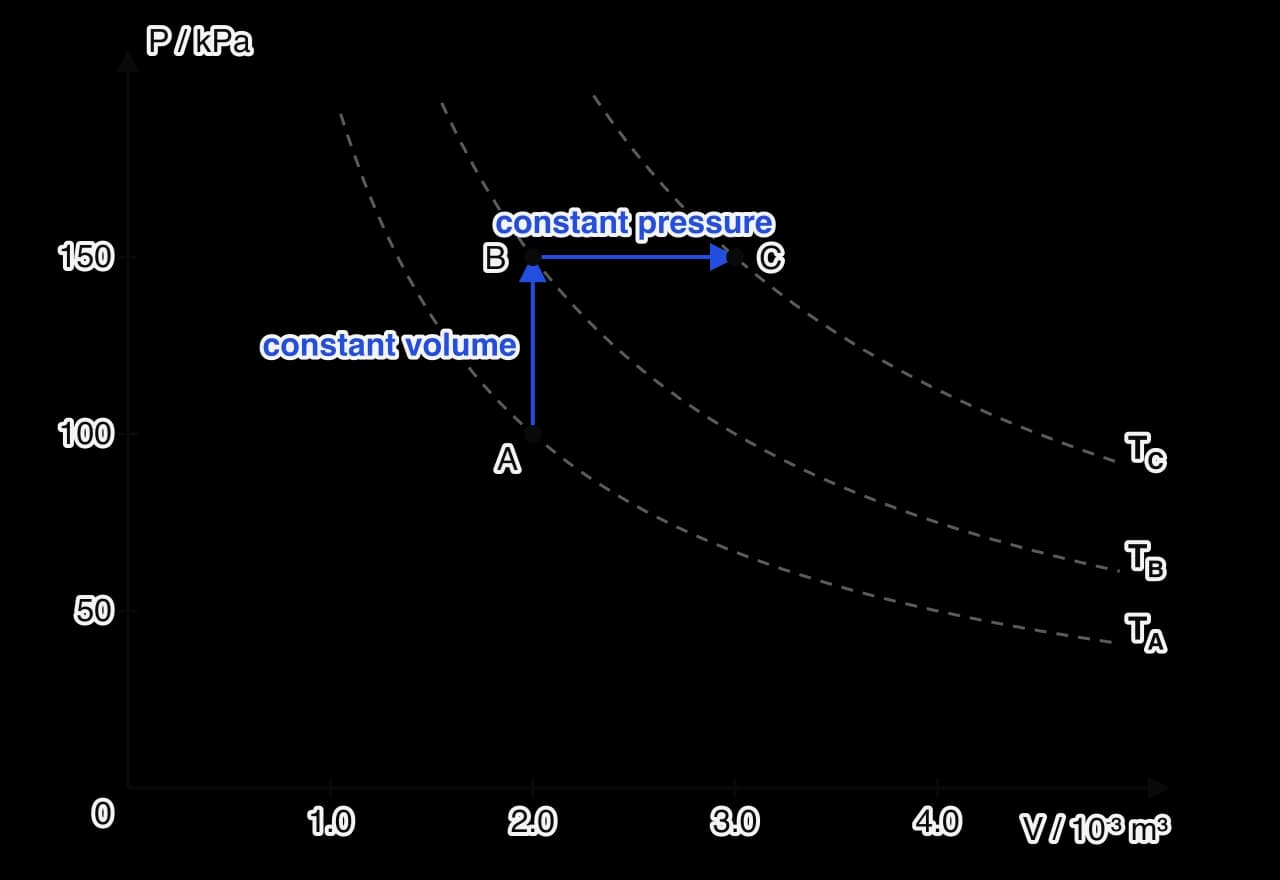
A P–V diagram plots the pressure of a gas against its volume. Each point is one state of the gas, and because , each point also has a definite temperature. A change from one state to another is drawn as a line: vertical for a change at constant volume, horizontal for one at constant pressure, and along an isotherm for one at constant temperature. Isotherms further from the origin are at higher temperatures.
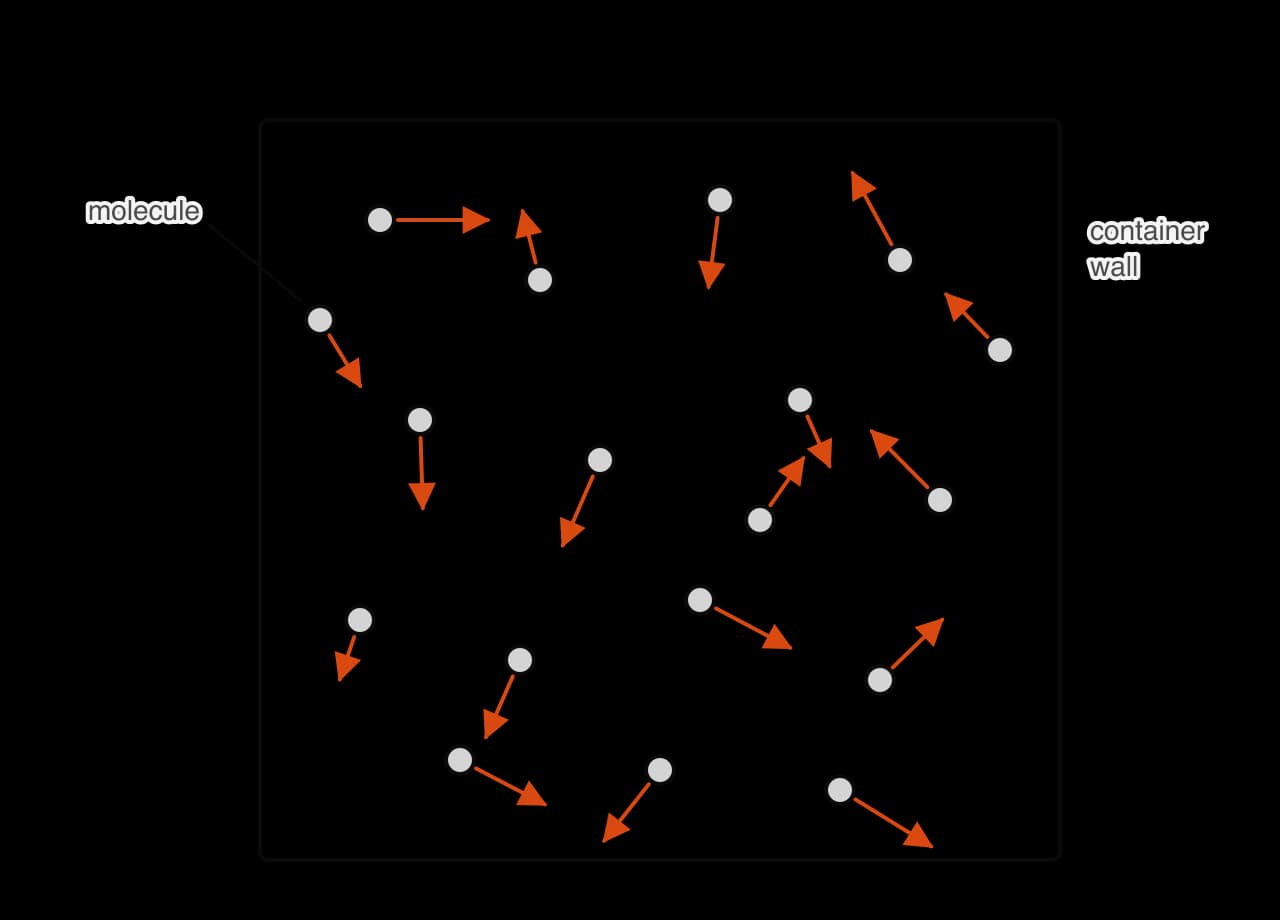
The gas laws describe what gases do. The kinetic theory explains why, by treating a gas as a very large number of molecules in constant random motion and applying Newton’s laws to them. The kinetic model rests on a set of simplifying assumptions, and a gas that satisfies them exactly is an ideal gas.
Assumption of the kinetic model | What it means physically |
|---|---|
A gas consists of a very large number of identical molecules in random motion. | Statistical averages are reliable, and no direction of motion is preferred. |
The volume of the molecules is negligible compared with the volume of the container. | The molecules are point-like; almost all of a gas is empty space. |
There are no intermolecular forces except during collisions. | Between collisions each molecule moves in a straight line at constant speed, and the molecules have no potential energy. |
Collisions between molecules, and with the walls, are elastic. | No kinetic energy is lost in collisions, so the gas does not slow down and cool by itself. |
The duration of a collision is negligible compared with the time between collisions. | Molecules spend almost all their time moving freely, not interacting. |
Newton’s laws are assumed to apply to the molecules. Gravity is ignored: in a container of ordinary size, the speeds of the molecules are so high that their weight has no measurable effect on their motion.
Each assumption is a simplification. Real molecules have size, they attract each other weakly, and their collisions take a short but finite time. The ideal gas is a model: it is useful because it captures the essential behaviour with simple mathematics, and its limitations show up exactly where the assumptions fail, at high pressure and low temperature.
The molecules do not all move at the same speed. Collisions constantly exchange energy between them, so at any instant some are slow and some are fast, with a spread of speeds around a typical value. The kinetic theory works with averages over this spread. A small particle of smoke or pollen seen under a microscope jiggles about irregularly because it is struck unevenly by molecules from different sides, and this Brownian motion was early direct evidence that the molecules exist and move randomly.
 YouTube
A molecule that hits a wall and bounces off has its velocity component perpendicular to the wall reversed. Its momentum changes, so by Newton’s second law the wall must have exerted a force on it. By Newton’s third law the molecule exerts an equal and opposite force on the wall. Each collision gives only a tiny impulse, but there are enormous numbers of collisions every second on every square centimetre, and their combined effect is a steady average force on the wall. That force per unit area is the gas pressure.
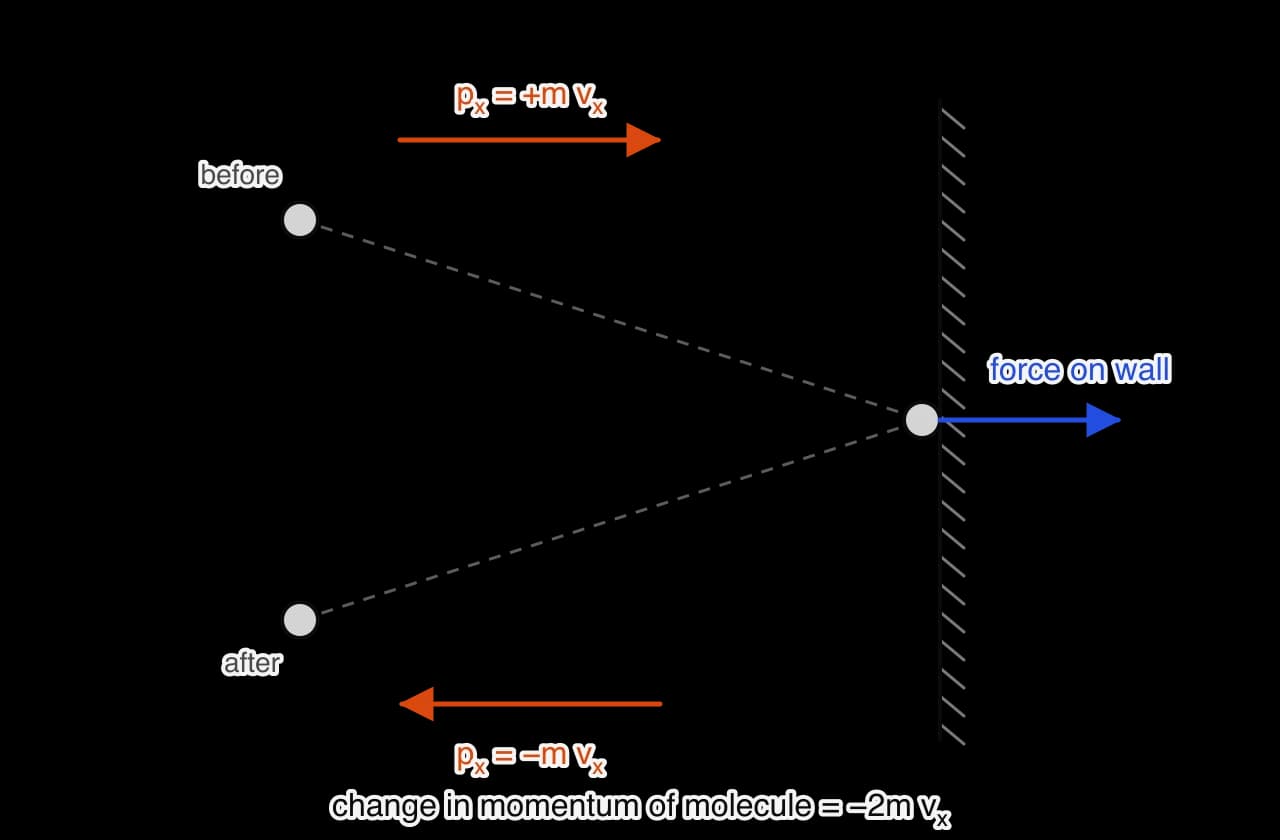
For a molecule of mass whose velocity component perpendicular to the wall is , the momentum changes from to , a change of magnitude . Faster molecules produce larger changes of momentum per collision and also hit the walls more often.
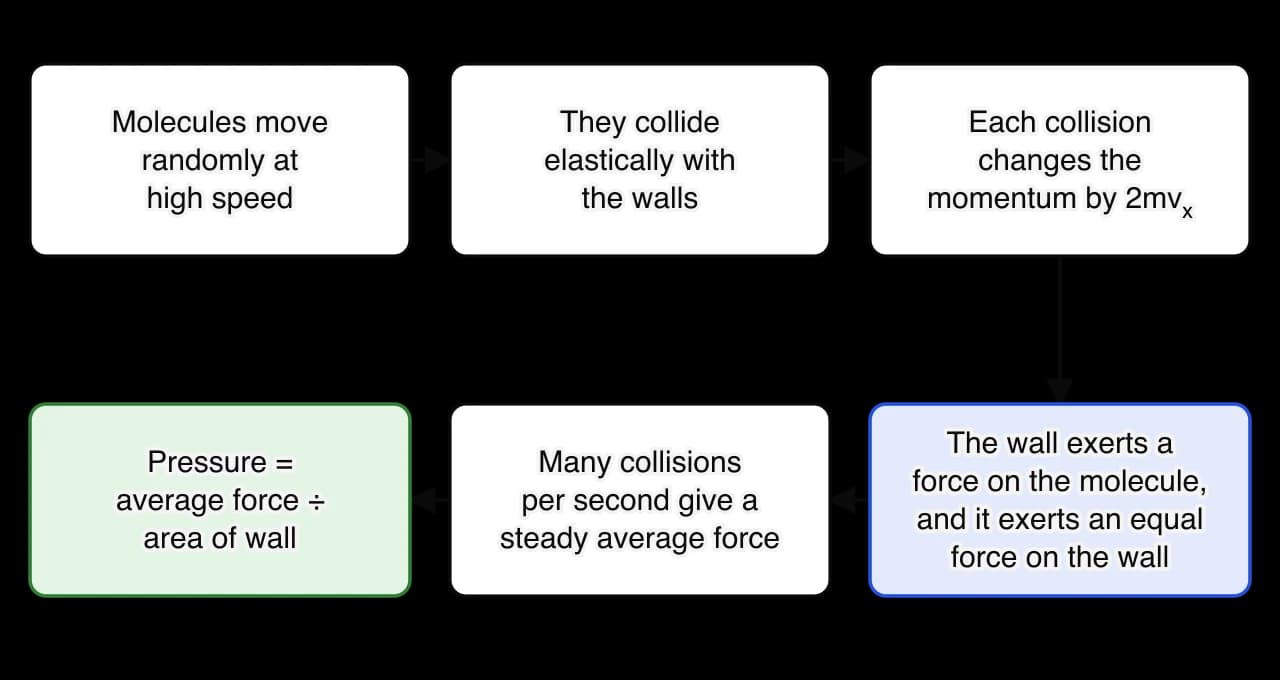
The kinetic model explains each empirical law in the same chain of reasoning: what happens to the speed of the molecules, how often they hit the walls, and how hard.
Change | Molecular explanation |
|---|---|
Volume decreases at constant temperature (Boyle’s law): pressure rises | The mean speed of the molecules is unchanged, but each molecule has less distance to travel between walls and the same number of molecules is crowded onto a smaller wall area, so there are more collisions per second per unit area. The average force per unit area rises. |
Temperature rises at constant volume (pressure law): pressure rises | The molecules move faster on average. Each collision changes momentum by more, and the collisions happen more often, so the average force on the walls increases. |
Temperature rises at constant pressure (Charles’s law): volume increases | Faster molecules would raise the pressure, but the gas expands (for example pushing back a piston). In a larger volume the collisions become less frequent, which compensates for the harder impacts and keeps the pressure the same. |
More gas added at constant volume and temperature: pressure rises | There are more molecules, each moving with the same mean speed, so more collisions per second per unit area. |
Applying Newton’s laws to all the molecules in a container gives a link between the pressure of a gas, its density and the speed of its molecules:
Here is the mean of the squares of the molecular speeds. Its square root, , is the root-mean-square speed, a kind of average speed of the molecules. It is about 9 % larger than the ordinary mean speed, because squaring gives the fastest molecules extra weight. The equation is usually quoted with described as the average speed of the molecules; the average meant is this root-mean-square value. The density is the total mass of the molecules divided by the volume, .
Consider one molecule of mass in a cubical box of side , with velocity components , , .
At each collision with the right-hand wall, its momentum changes by .
It travels (across and back) between collisions with that wall, so the time between them is .
The average force on the wall from this molecule is the rate of change of momentum:
Adding up the contributions of all molecules and dividing by the wall area :
The motion is random, so no direction is special and
Every assumption of the kinetic model is used: elastic collisions (the speed is the same after rebounding), negligible collision time and no intermolecular forces (straight-line paths between walls), negligible volume of the molecules, and random motion of a large number of molecules (the factor of one third).
The kinetic theory and the ideal gas equation describe the same gas, so they can be compared. Writing in gives . The ideal gas equation gives . Equating them:
The left-hand side is the mean translational kinetic energy of one molecule, :
This is the key result of kinetic theory. The absolute temperature of an ideal gas is a measure of the average kinetic energy of the random motion of its molecules, and the two are directly proportional. Doubling the kelvin temperature doubles the mean kinetic energy. The mean kinetic energy depends only on temperature, not on the mass of the molecule: at the same temperature a helium atom and a carbon dioxide molecule have the same average kinetic energy, so the lighter helium atom moves faster.
Combining with and shows that , so the root-mean-square speed is proportional to and to . Quadrupling the absolute temperature only doubles the speed.
The result also gives meaning to absolute zero. In the ideal gas model, is the temperature at which the molecules would have no kinetic energy of random motion. Nothing can have less than zero kinetic energy, so no lower temperature is possible.
The internal energy of a substance is the total of the random kinetic energies and the intermolecular potential energies of its particles. In an ideal gas there are no intermolecular forces, so the potential energy term is zero and the internal energy is purely kinetic.
In a monatomic gas (one whose particles are single atoms, such as helium, neon or argon) the only kinetic energy is that of translation, so the internal energy is the number of atoms multiplied by the mean kinetic energy of each:
The internal energy of a given ideal gas depends only on its temperature. Two samples of the same gas at the same temperature have internal energies in proportion to their amounts, whatever their pressures and volumes. Since , the internal energy can also be found directly from the pressure and volume: .
Internal energy links this topic to energy transfers. Heating a gas, or doing work on it by compressing it, increases its internal energy and therefore its temperature. The first law of thermodynamics (HL) makes these energy changes quantitative.
A real gas obeys the ideal gas equation only approximately. The approximation is very good when the molecules are far apart and moving fast, so that the assumptions of the kinetic model are close to true. An ideal gas is a good model of a real gas at low pressure, high temperature and low density.
Deviations appear when the assumptions fail:
Molecular volume. At high pressure and density the molecules are packed closer together and their own volume is no longer a negligible fraction of the container. Less free space is available than suggests, so the gas is harder to compress than an ideal gas.
Intermolecular forces. At low temperature the molecules move slowly, and the weak attractions between them have time to act during close approaches. Molecules about to hit a wall are pulled back slightly by the others, so they strike less hard and the pressure is lower than the ideal value. The gas also has some intermolecular potential energy, so no longer holds exactly.
Liquefaction. If a real gas is cooled and compressed enough, the attractions win and it condenses into a liquid. An ideal gas, which has no intermolecular forces, could never liquefy.
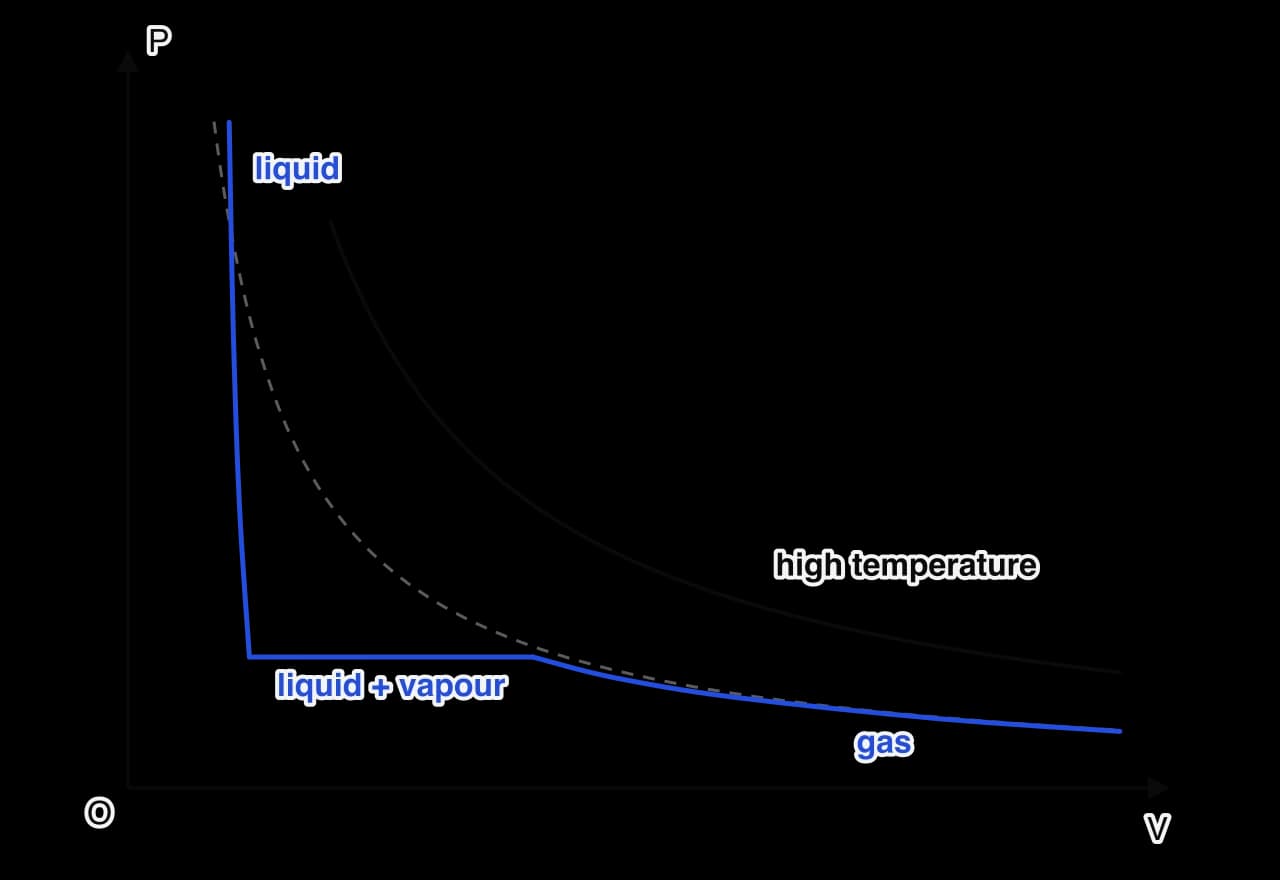
The P–V sketch of a real gas shows these effects together. At high temperature the isotherm is close to the ideal curve. At a lower temperature the gas follows the ideal curve at large volumes, but as it is compressed it begins to condense: the pressure stops rising while gas turns to liquid, and once it is all liquid, a tiny reduction in volume needs a large increase in pressure.
Both the agreement and the deviations are useful. Where the ideal gas law works, it confirms that gases really are mostly empty space filled with fast-moving particles. Where it fails, the size and pattern of the deviation measure the size of molecules and the strength of the forces between them.
 YouTube
Explanations are marked in the same way, one mark for each correct link in the chain of reasoning.
Choosing the right form of the gas equation saves a conversion step and a source of error.
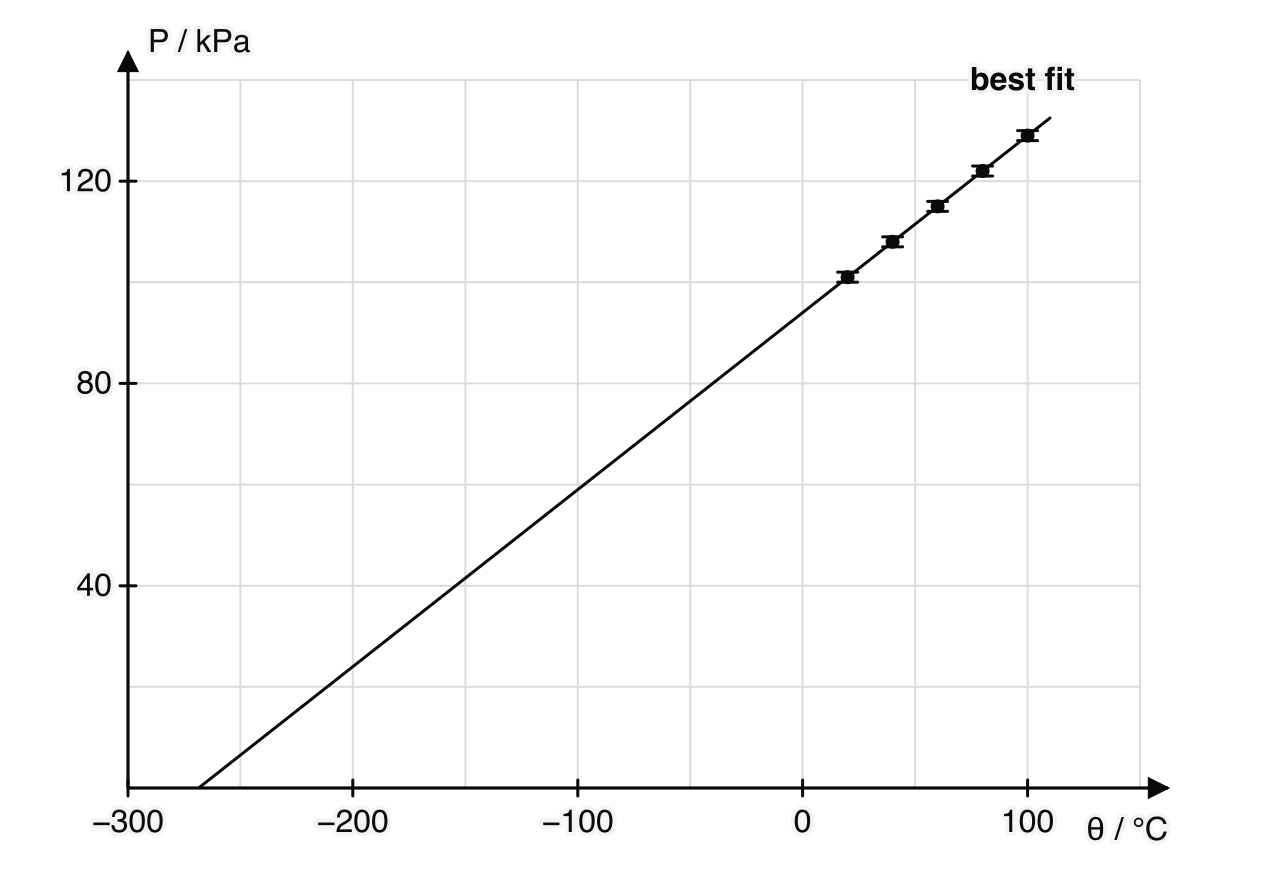
A group of students uses a flask of air in a water bath connected to a pressure gauge to measure the pressure of a fixed mass of air at different Celsius temperatures . The uncertainty in is negligible. Their results and graph are given.
/ °C | / kPa ± 1 |
|---|---|
20 | 101 |
40 | 108 |
60 | 115 |
80 | 122 |
100 | 129 |
I can define pressure, use P = F/A with the perpendicular component of a force, and distinguish absolute and gauge pressure.
I can use n = N/N_A and n = m/M, keeping mass and molar mass in consistent units.
I can state Boyle’s law, Charles’s law and the pressure law, and describe an experiment for each.
I can explain how extrapolating a gas-law graph gives absolute zero, and convert between °C and K.
I can use PV/T = constant, PV = nRT and PV = Nk_BT, including two-container problems and gas leaving a cylinder.
I can interpret graphs of P against V, P against 1/V, V or P against temperature, and PV against T.
I can show changes at constant volume, pressure and temperature on a P–V diagram and find the temperature of each state.
I can state the assumptions of the kinetic model of an ideal gas.
I can explain gas pressure, and each gas law, in terms of molecular collisions and changes of momentum.
I can use P = ⅓ρv² to find the root-mean-square speed of molecules.
I can relate the mean kinetic energy of molecules to absolute temperature, using ½mv² = (3/2)k_BT.
I can calculate the internal energy of an ideal monatomic gas with U = (3/2)nRT = (3/2)Nk_BT.
I can explain why real gases deviate from ideal behaviour and state the conditions under which the ideal gas model works well.
The volume of the fabric and the package can be ignored.
Calculate the buoyancy force on the balloon at launch.
2 marks
✓
«N» ✓
Award [1 max] for the density of helium used (5.8 N).
Show that the resultant force on the balloon at launch is about 14 N.
2 marks
total mass «kg» ✓
Calculate the initial acceleration of the balloon.
2 marks
✓
«m s
Explain why the balloon soon rises at a constant speed.
3 marks
as the balloon rises, a drag force acts downwards ✓
the drag increases as the speed increases, so the resultant force decreases ✓
when weight + drag = buoyancy, the resultant force «and acceleration» is zero ✓
Near the ground, the drag force on the balloon is given by , where kg m
At launch the pressure of the air is 101 kPa and its temperature is 288 K. At a height of 10 km the pressure is 28 kPa and the temperature is 223 K. The helium is at the same pressure and temperature as the surrounding air, and the fabric stretches freely. Calculate the volume of the balloon at a height of 10 km.
2 marks
= constant OR
Air can be treated as an ideal gas. Show that the buoyancy force on the balloon at a height of 10 km is the same as at launch.
3 marks
density of air «from
Suggest why the balloon does not stop at a height where it floats in equilibrium, but continues to rise until the fabric bursts.
2 marks
the buoyancy force stays the same as the balloon expands, and the weight is unchanged ✓
so there is always a resultant upward force «until the balloon can no longer expand and bursts» ✓
Assume that the balloon rises at constant speed with the resultant force from (b) balanced by drag all the way to 18 km. Calculate the work done against drag during the ascent, and state what this energy becomes.
2 marks
Helium in the cylinder of a model engine changes from a pressure of 100 kPa and volume to a pressure of 250 kPa and volume . Helium behaves as an ideal monatomic gas. What is the change in the internal energy of the helium?
0.20 mol of argon is held in a cylinder by a freely moving piston, so its pressure stays constant. The argon is heated and its temperature rises by 40 K. Argon behaves as an ideal monatomic gas. What is the thermal energy supplied to the argon?
The volume units cancel, so the volumes can stay in cm³. The pressure rises by a factor of 120/45 ≈ 2.7, the same factor by which the volume fell.
The final pressure lies between the two starting pressures, closer to the value in the larger container, as expected. The kPa and the factor 10⁻³ cancel on both sides.
extrapolation to : ✓
«°C» ✓ (Accept −260 °C to −280 °C.)
(c) uncertainty from the spread: , so ±20 «°C» to 1 s.f. ✓
✓ (Accept ; value and uncertainty must be to the same precision.)
(d) −273 °C lies within the range −290 °C to −250 °C, so the result is consistent with the accepted value ✓
(e) readings taken before the air reaches thermal equilibrium with the water / the air in the connecting tube is outside the bath ✓
the measured pressure is too low at high temperature, so the gradient is too small «and the intercept too far from zero» OWTTE ✓
Must see full substitution or an answer to at least 3 s.f.
(b) «kg» ✓ (Accept 7.97 kg.)
(c) «mol» ✓
«mol» ✓
«kg» ✓ (Allow ECF from (a). Award [2 max] for 5.3 kg, which ignores the change in temperature.)
(d) at high pressure the molecules are closer together / the gas is denser ✓
so the volume of the molecules is not negligible / intermolecular forces are not negligible ✓
2 marks
✓
«m s» ✓
Allow ECF from (b).