B.1 Thermal energy transfers questions for IB Physics
176 questions on Thermal energy transfers, written by Augment in the style of IB exam papers. Six of them are below in full, to answer on paper.
- IB Physics
- Part of B The particulate nature of matter
- SL and HL
Questions by paper and level
SL and HL questions are for students at either level. HL only questions cover what only HL students study.
| Paper | SL and HL | HL only | All |
|---|---|---|---|
| Paper 1A | 51 | 1 | 52 |
| Paper 1B | 16 | 0 | 16 |
| Paper 2 | 81 | 27 | 108 |
| Every paper | 148 | 28 | 176 |
Counted on
Questions to try
Written by Augment in the style of IB exams, not past papers. Answer them on paper, then check each one against its markscheme with a free account.
Three statements about the molecules of a liquid are:
I. The molecules vibrate about fixed positions and cannot move past one another.
II. The mean separation of the molecules is similar to that in the solid phase.
III. The attractive forces between the molecules are significant.
Which statements are correct?
A group of students investigate the thermal radiation emitted by the faces of a hollow metal cube filled with hot water. One face of the cube is painted matt black and the opposite face is polished metal. A radiation sensor is placed 5.0 cm from the matt black face. The output pd of the sensor is proportional to the net intensity of the radiation it receives.
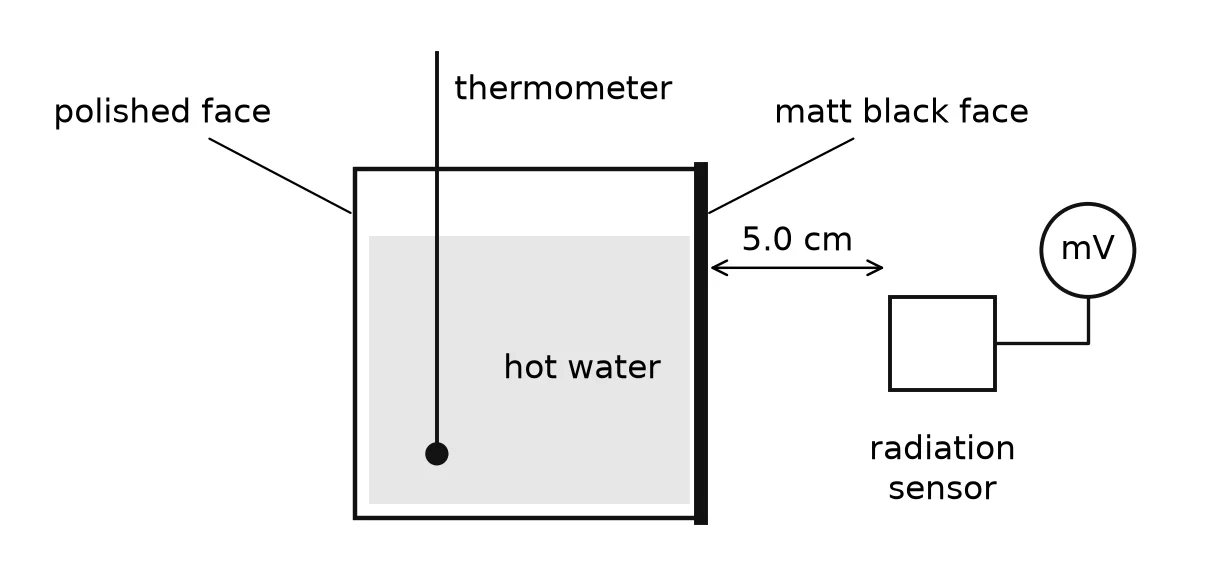
The water temperature is measured with a thermometer with an uncertainty of . The water is allowed to cool and readings are taken every 10 °C. The absolute temperature is .
/ °C ± 0.5 °C | / | / mV ± 0.05 mV |
|---|---|---|
40.0 | 9.60 | 0.86 |
50.0 | 10.88 | 1.43 |
60.0 | 12.30 | 1.95 |
70.0 | 13.84 | 2.62 |
80.0 | 15.53 | 3.24 |
90.0 | 17.36 | 4.02 |
- (a)
Calculate the percentage uncertainty in when .
2 marks
- (b)
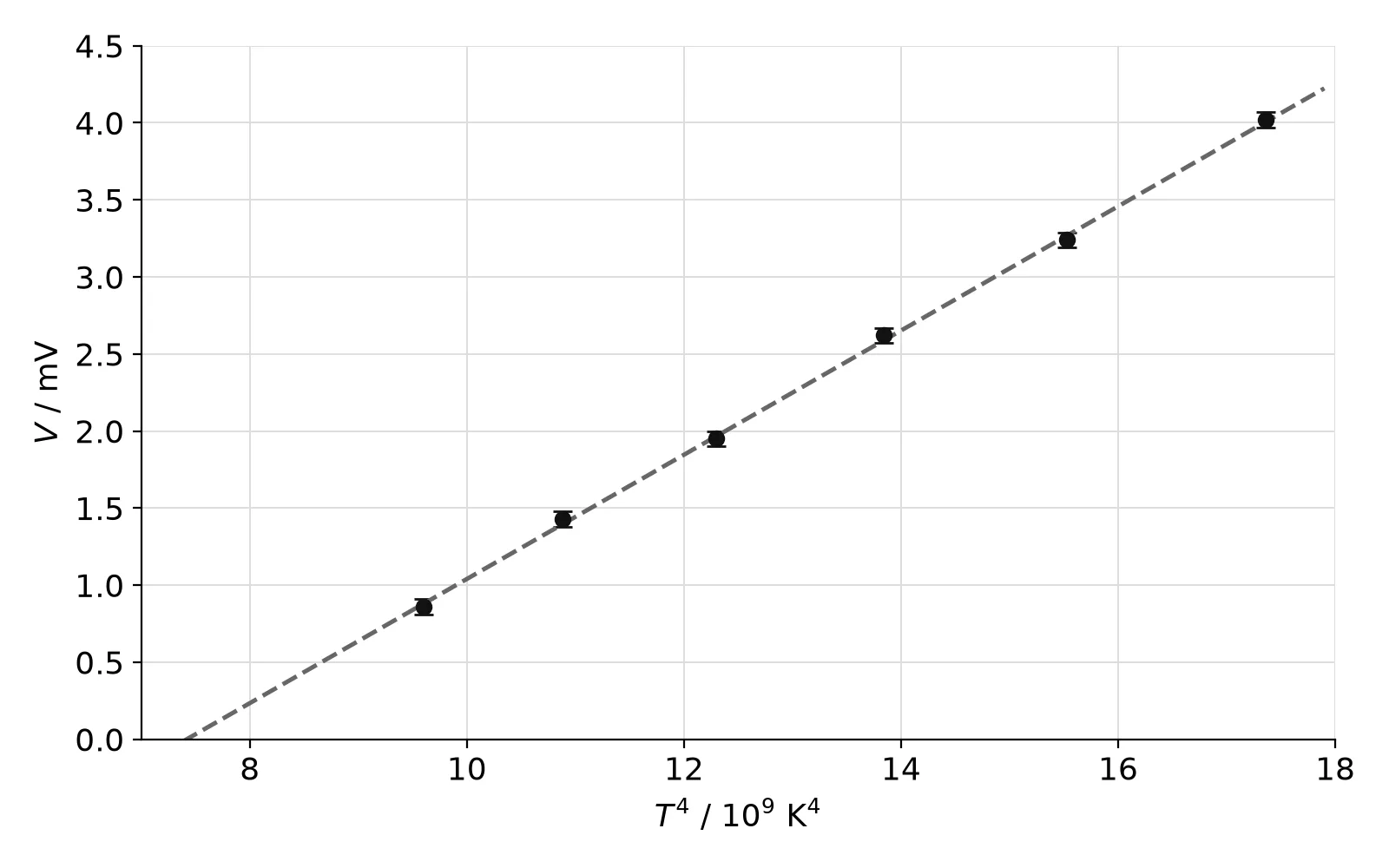
The graph shows the variation of with for the matt black face, with the line of best fit.
Outline why no error bars are shown for .
1 mark
- (c)
Determine the gradient of the line of best fit. Give a suitable unit for your answer.
2 marks
- (d)
The line of best fit does not pass through the origin. Explain why is zero at the value of where the line meets the axis, and deduce the temperature of the room.
3 marks
- (e)
The experiment is repeated with the sensor facing the polished face. The gradient of the new line is . The emissivity of the matt black face is 0.95.
Calculate the emissivity of the polished face.
2 marks
- (f)
Suggest one change to the procedure that would make the temperature of the matt black face closer to the measured value of .
1 mark
In a drop-tower amusement ride, a gondola carrying riders is raised to the top of a vertical tower by an electric motor. The gondola is then released from rest and falls freely through 38.0 m. Brakes then act, giving the gondola a uniform deceleration, and it comes to rest after falling a further 16.0 m. The total mass of the gondola and riders is 4800 kg. Ignore air resistance unless a part says otherwise.
- (a)(i)
The motor raises the gondola and riders through a vertical height of 58 m in 40 s at constant speed. Calculate the useful power output of the motor.
2 marks
- (a)(ii)
The motor has an efficiency of 75 % and is supplied at a potential difference of 600 V. Calculate the current in the motor.
2 marks
- (b)(i)
Calculate the speed of the gondola at the end of the free fall.
2 marks
- (b)(ii)
Calculate the time taken for the free fall.
1 mark
- (c)
Outline why the seat exerts no force on a rider during the free fall.
2 marks
- (d)(i)
Show that the deceleration of the gondola during braking is about .
2 marks
- (d)(ii)
Determine the force exerted by the seat on a rider of mass 70 kg during braking.
2 marks
- (e)
Sketch a graph to show the variation with time of the speed of the gondola from its release until it comes to rest. Add values to the axes.
2 marks
- (f)
The brakes transfer energy to copper fins of total mass 320 kg. The specific heat capacity of copper is . Determine the rise in temperature of the fins during one ride, assuming that all the energy removed by the brakes is transferred to the fins.
3 marks
- (g)
In practice air resistance acts on the gondola during the fall. Outline the effect of this on the speed of the gondola when braking starts and on the braking distance needed for the same deceleration.
2 marks
At 100 °C and atmospheric pressure, liquid water has a density of and water vapour has a density of .
What is, approximately, ?
A group of students test the hypothesis that air containing a higher concentration of carbon dioxide (CO2) warms more when it is irradiated by a lamp. Two identical sealed clear plastic bottles are placed side by side, 30 cm from a lamp. Bottle P contains air and bottle Q contains air enriched with CO2. A temperature probe of resolution 0.1 °C is sealed into each bottle.
The lamp is switched on at time and the rise in temperature of the gas in each bottle is recorded. The experiment is repeated three times. The readings at min are:
Bottle | Trial 1: / °C | Trial 2: / °C | Trial 3: / °C |
|---|---|---|---|
P (air) | 6.0 | 6.5 | 6.1 |
Q (CO2-enriched) | 7.8 | 8.4 | 8.1 |
- (a)
State two variables, other than the distance from the lamp, that the students should keep the same for both bottles.
2 marks
- (b)
Calculate, for bottle Q at min, the mean value of and its absolute uncertainty.
2 marks
- (c)
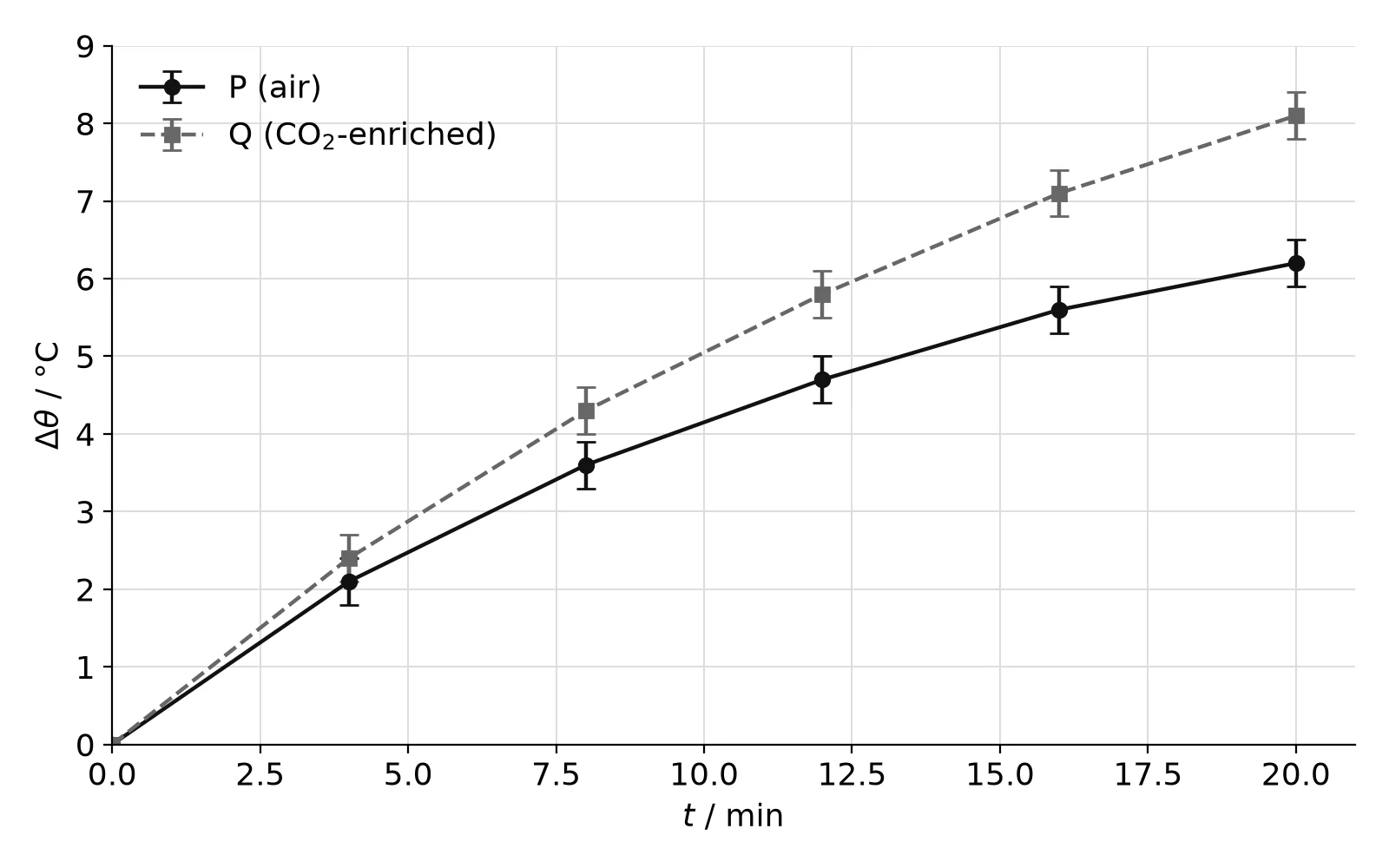
The graph shows the variation with of the mean values of for both bottles.
Discuss whether the data support the hypothesis.
2 marks
- (d)
Explain, with reference to molecular energy levels, why CO2 absorbs infrared radiation.
2 marks
- (e)
A student suggests placing a piece of black card at the bottom of each bottle. Explain how this would make the experiment a better model of the greenhouse effect in the atmosphere.
2 marks
A car of mass 1200 kg travels on a level road. When the driver applies the brakes fully at a speed of , the car stops in a distance of 14 m. Assume that the braking force is constant and is the same at all speeds, and ignore air resistance.
- (a)
Calculate the braking force.
2 marks
- (b)
Show that the braking distance is proportional to the square of the speed at which the brakes are applied.
2 marks
- (c)
Hence calculate the braking distance when the brakes are applied at .
1 mark
- (d)
The car has four steel brake discs, each of mass 6.5 kg. The specific heat capacity of steel is . When the car stops from , 80 % of its kinetic energy is shared equally between the discs as internal energy. Calculate the rise in temperature of each disc.
3 marks
- (e)
Drivers on a long, steep downhill road are advised not to rely only on their brakes to control their speed. Explain, with reference to energy transfers, why.
2 marks
Practice all 176 in Augment
Free with an account. Every question has its markscheme, and Augment keeps the ones you got wrong so you can come back to them.
More questions in The particulate nature of matter
- B.1Thermal energy transfersThis page
- B.2Greenhouse effect
- B.3Gas laws
- B.4ThermodynamicsHL only
- B.5Current and circuits
Check your answers in Augment
A free account opens all 176 questions on Thermal energy transfers with their markschemes, and keeps a record of what you have marked.