B.2 Greenhouse effect questions for IB Physics
61 questions on Greenhouse effect, written by Augment in the style of IB exam papers. Six of them are below in full, to answer on paper.
- IB Physics
- Part of B The particulate nature of matter
- SL and HL
Questions by paper and level
SL and HL questions are for students at either level. HL only questions cover what only HL students study.
| Paper | SL and HL | HL only | All |
|---|---|---|---|
| Paper 1A | 25 | 0 | 25 |
| Paper 1B | 5 | 0 | 5 |
| Paper 2 | 28 | 3 | 31 |
| Every paper | 58 | 3 | 61 |
Counted on
Questions to try
Written by Augment in the style of IB exams, not past papers. Answer them on paper, then check each one against its markscheme with a free account.
Radiation falls on the surface of a planet. Which ratio is equal to the albedo of the surface?
A group of students investigate the thermal radiation emitted by the faces of a hollow metal cube filled with hot water. One face of the cube is painted matt black and the opposite face is polished metal. A radiation sensor is placed 5.0 cm from the matt black face. The output pd of the sensor is proportional to the net intensity of the radiation it receives.
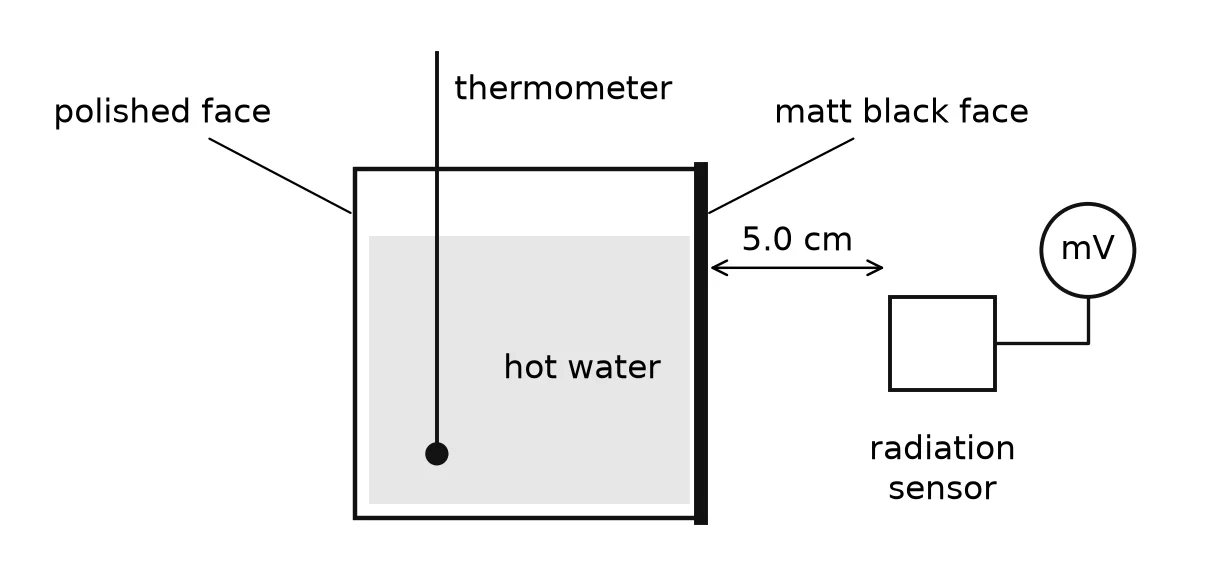
The water temperature is measured with a thermometer with an uncertainty of . The water is allowed to cool and readings are taken every 10 °C. The absolute temperature is .
/ °C ± 0.5 °C | / | / mV ± 0.05 mV |
|---|---|---|
40.0 | 9.60 | 0.86 |
50.0 | 10.88 | 1.43 |
60.0 | 12.30 | 1.95 |
70.0 | 13.84 | 2.62 |
80.0 | 15.53 | 3.24 |
90.0 | 17.36 | 4.02 |
- (a)
Calculate the percentage uncertainty in when .
2 marks
- (b)
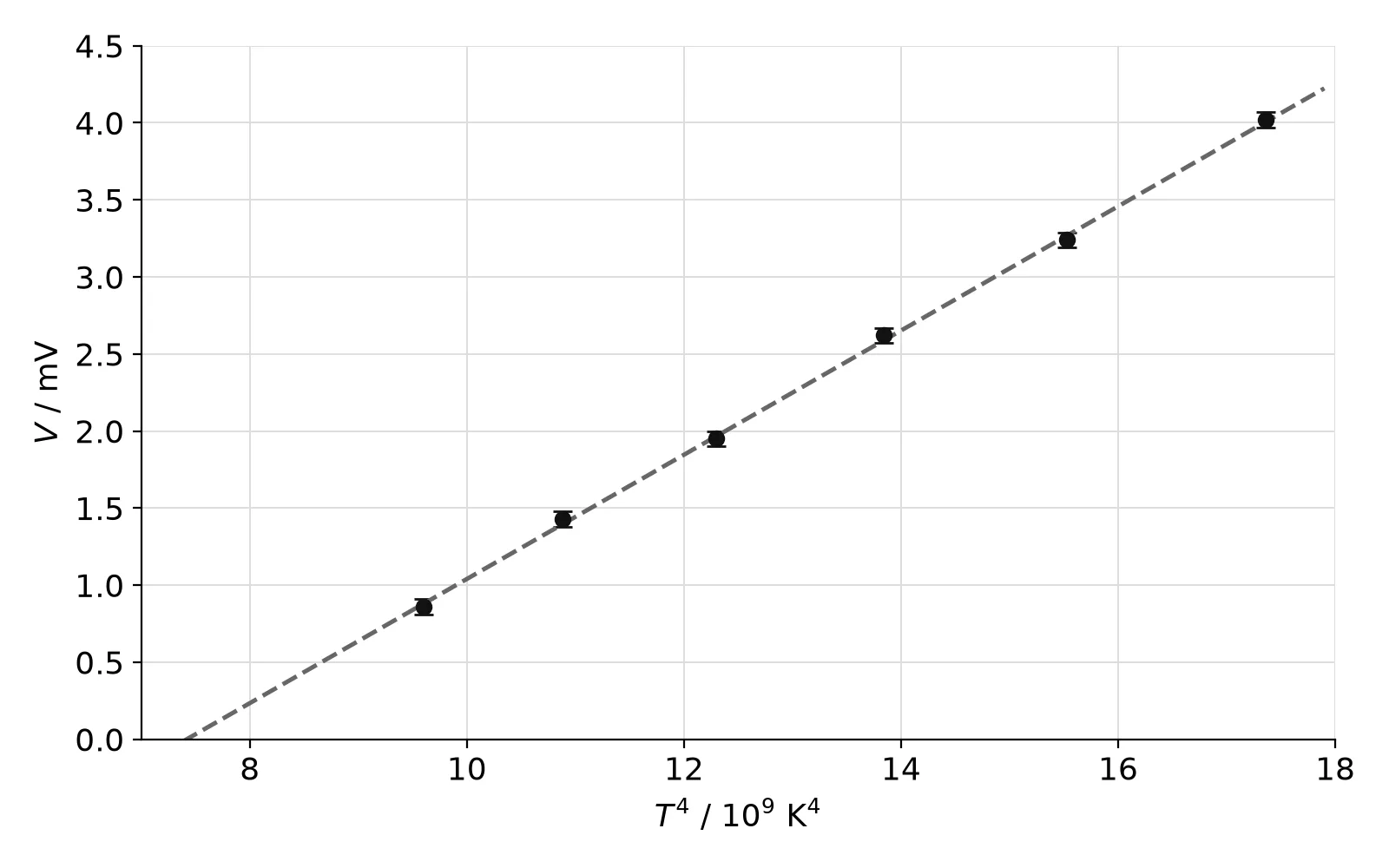
The graph shows the variation of with for the matt black face, with the line of best fit.
Outline why no error bars are shown for .
1 mark
- (c)
Determine the gradient of the line of best fit. Give a suitable unit for your answer.
2 marks
- (d)
The line of best fit does not pass through the origin. Explain why is zero at the value of where the line meets the axis, and deduce the temperature of the room.
3 marks
- (e)
The experiment is repeated with the sensor facing the polished face. The gradient of the new line is . The emissivity of the matt black face is 0.95.
Calculate the emissivity of the polished face.
2 marks
- (f)
Suggest one change to the procedure that would make the temperature of the matt black face closer to the measured value of .
1 mark
A valley glacier has a surface area of 3.5 km2. On a summer afternoon the intensity of the solar radiation incident on the glacier is 480 W m-2. The albedo of the glacier surface is 0.62.
- (a)
State what is meant by albedo.
1 mark
- (b)
Calculate the total power scattered by the glacier.
2 marks
- (c)
The mean albedo of the whole Earth is about 0.30, but the albedo of any one region changes with time. Outline two reasons why.
2 marks
The dark back surface of a solar panel has an area of 2.0 m2. On a sunny day this surface is at a temperature of 320 K and radiates a total power of 1.10 kW. What is the emissivity of the back surface?
A group of students model the effect of sea ice on the albedo of a polar region. A dark board represents open sea and pieces of white card represent ice. A lamp shines on the board. A light sensor measures the incident intensity when it faces the lamp, and the intensity scattered by the board when it faces the board.
The students vary the fraction of the board covered by white card. The incident intensity is lx throughout. The uncertainty in each reading of is lx.
/ lx ± 10 lx | albedo | |
|---|---|---|
0.10 | 170 | |
0.25 | 305 | 0.244 |
0.40 | 425 | 0.340 |
0.55 | 620 | 0.496 |
0.70 | 680 | 0.544 |
0.85 | 815 | 0.652 |
- (a)
Calculate the albedo of the board when , and its absolute uncertainty.
3 marks
- (b)
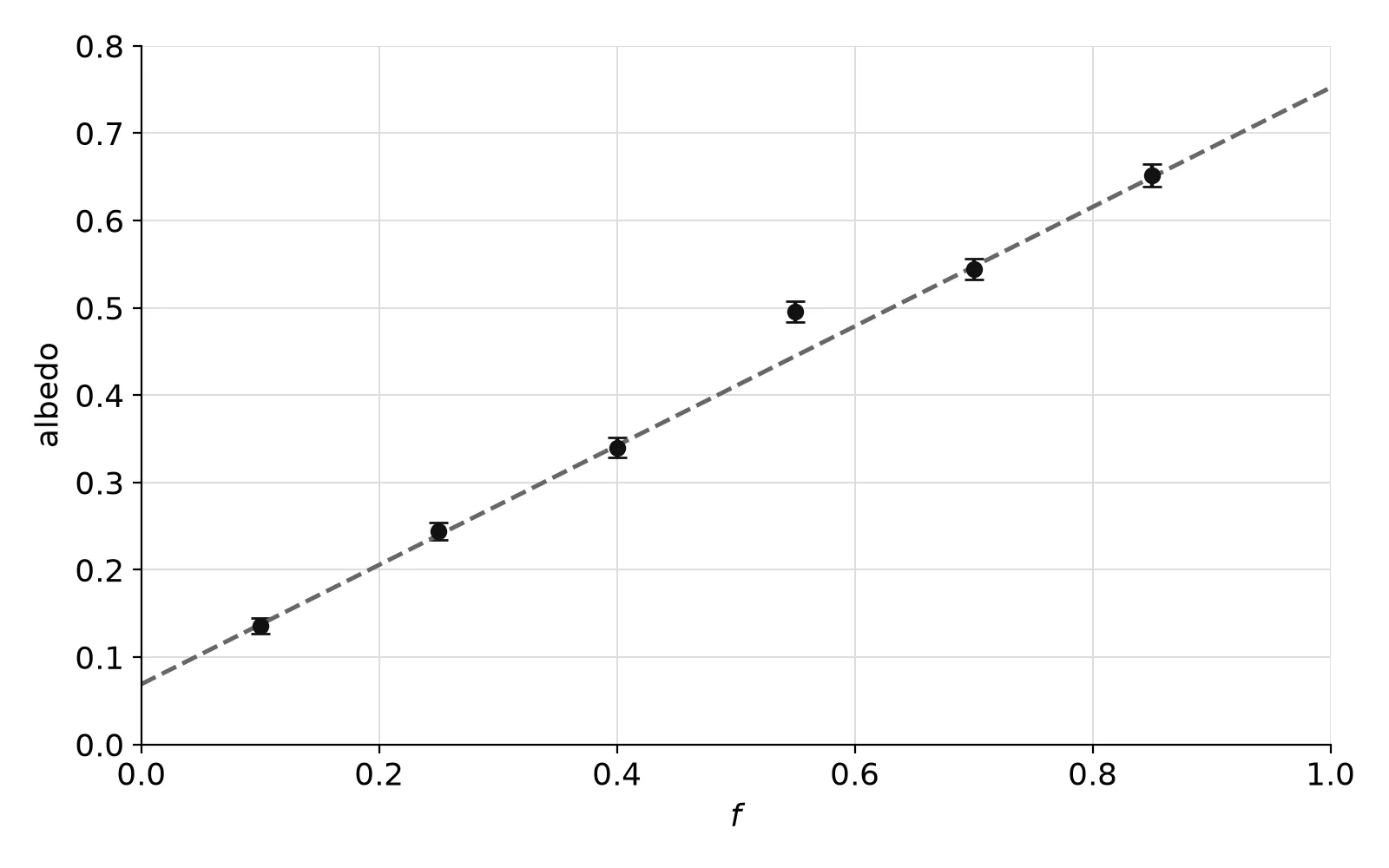
The graph shows the variation of the albedo with , with a line of best fit.
Identify the anomalous data point and suggest one reason for it.
2 marks
- (c)
Determine, using the graph, the albedo of the dark board and the albedo of the white card.
2 marks
- (d)
Light from the room adds a constant 15 lx to every reading of . Explain the effect of this on the two albedos determined in (c).
2 marks
- (e)
The board models a polar sea in which the sea ice is melting. Explain how the melting of sea ice can increase the rate at which the region warms.
2 marks
The Earth may be modelled as a sphere of radius that receives radiation from the Sun. The intensity of the solar radiation at the top of the atmosphere, perpendicular to the direction of the Sun, is the solar constant .
- (a)
Explain why the mean intensity of the solar radiation incident on the top of the atmosphere, averaged over the whole surface of the Earth, is .
2 marks
- (b)
The albedo of the Earth is 0.30. Calculate the mean intensity of the solar radiation absorbed by the Earth.
1 mark
- (c)
Show that the equilibrium temperature of the Earth, if it emitted as a black body, would be about 250 K.
2 marks
- (d)
The mean surface temperature of the Earth is 288 K. Outline why this is greater than the value in (c).
1 mark
Practice all 61 in Augment
Free with an account. Every question has its markscheme, and Augment keeps the ones you got wrong so you can come back to them.
More questions in The particulate nature of matter
- B.1Thermal energy transfers
- B.2Greenhouse effectThis page
- B.3Gas laws
- B.4ThermodynamicsHL only
- B.5Current and circuits
Check your answers in Augment
A free account opens all 61 questions on Greenhouse effect with their markschemes, and keeps a record of what you have marked.