Model the Earth’s energy balance with albedo, emissivity and the solar constant, explain the greenhouse effect with molecular energy levels and resonance, and analyse its human enhancement.
IB Physics
Part of B The particulate nature of matter
SL and HL
Key terms introduced here
Each is in the Physics glossary, with every other term in the subject.
The total power scattered (reflected) by a surface or planet divided by the total power incident on it; a number from 0 to 1. The Earth's mean albedo is about 0.30.
The range of infrared wavelengths, about 8–13 μm, that the atmosphere absorbs only weakly, so surface radiation in this range escapes directly to space.
The additional warming of the Earth's surface caused by increases in greenhouse gas concentrations due to human activity, mainly the burning of fossil fuels.
The temperature at which a planet radiates as much power as it absorbs; without an atmosphere it satisfies (1−α)S/4=eσT4
Notes on B.2 Greenhouse effect
34 min readLast reviewed
The Earth is warmed by the Sun and cools by radiating infrared into space. The balance between these two flows of energy sets its temperature. Without an atmosphere the mean surface temperature would be about −18 °C; the observed mean is about +15 °C. The difference of about 33 K is the natural greenhouse effect, and it makes liquid oceans and life possible. Since the Industrial Revolution, human activity has raised the concentrations of the gases responsible, and the resulting warming is one of the most important applications of thermal physics today.
Questions on B.2
61 exam-style questions on this subtopic, written in the style of the IB papers. The first has its markscheme open. Counted on
Question 1 · PHY-002621 mark
Radiation falls on the surface of a planet. Which ratio is equal to the albedo of the surface?
A
total power incidenttotal power absorbed
B
total power absorbedtotal power scattered
Try a quick-fire question
One of 55 short multiple-choice questions on B.2. Pick an answer to see why it's right or wrong.
The diagram shows the mean energy flows, in W m−2, for a planet in energy balance. What is X?
Flashcards for B.2
The official deck for this part of the syllabus.
B.2 Greenhouse effect · front
Why is radiation the only significant way a planet exchanges energy with its surroundings?
B.2 Greenhouse effect · front
State the condition for the mean temperature of a planet to stay constant.
B.2 Greenhouse effect167 cards
From the data booklet
The entries of the physics data booklet that B.2 uses. Each opens in the explained booklet.
The warming of a planet's surface by atmospheric gases that let through short-wavelength sunlight but absorb the infrared emitted by the surface and re-emit it in all directions, partly back to the surface.
A body whose emissivity is less than 1 but about the same at all wavelengths, so it radiates a fixed fraction of the black-body power at its temperature.
The solar power per unit area averaged over a planet's whole surface, S/4, because the planet intercepts sunlight over a disc of area πR2 but has a surface area 4πR2.
A simple energy-balance model in which the atmosphere is one layer of uniform temperature and emissivity, transparent to sunlight, that exchanges infrared with the surface and space.
The intensity of the Sun's radiation at the Earth's mean distance from the Sun, on a surface perpendicular to the radiation outside the atmosphere: S=1.36×10³W m−2.
A positive feedback in which warmer air holds more water vapour, a greenhouse gas, which increases the warming.
Scope.
Energy balance is treated with simple models: a planet without an atmosphere, and a single atmospheric layer exchanging energy with the surface. Detailed climate models and multi-layer atmospheres are not needed. The value of the solar constant is given in the data booklet; the factor of four in the mean incoming intensity has to be explained and recalled.
Energy balance of a planet
The temperature of a planet is a consequence of the principle of conservation of energy. A planet receives energy from its star as radiation and loses energy by emitting thermal radiation, mostly infrared, into space. Space is almost empty, so radiation is the only significant way the planet can exchange energy with its surroundings.
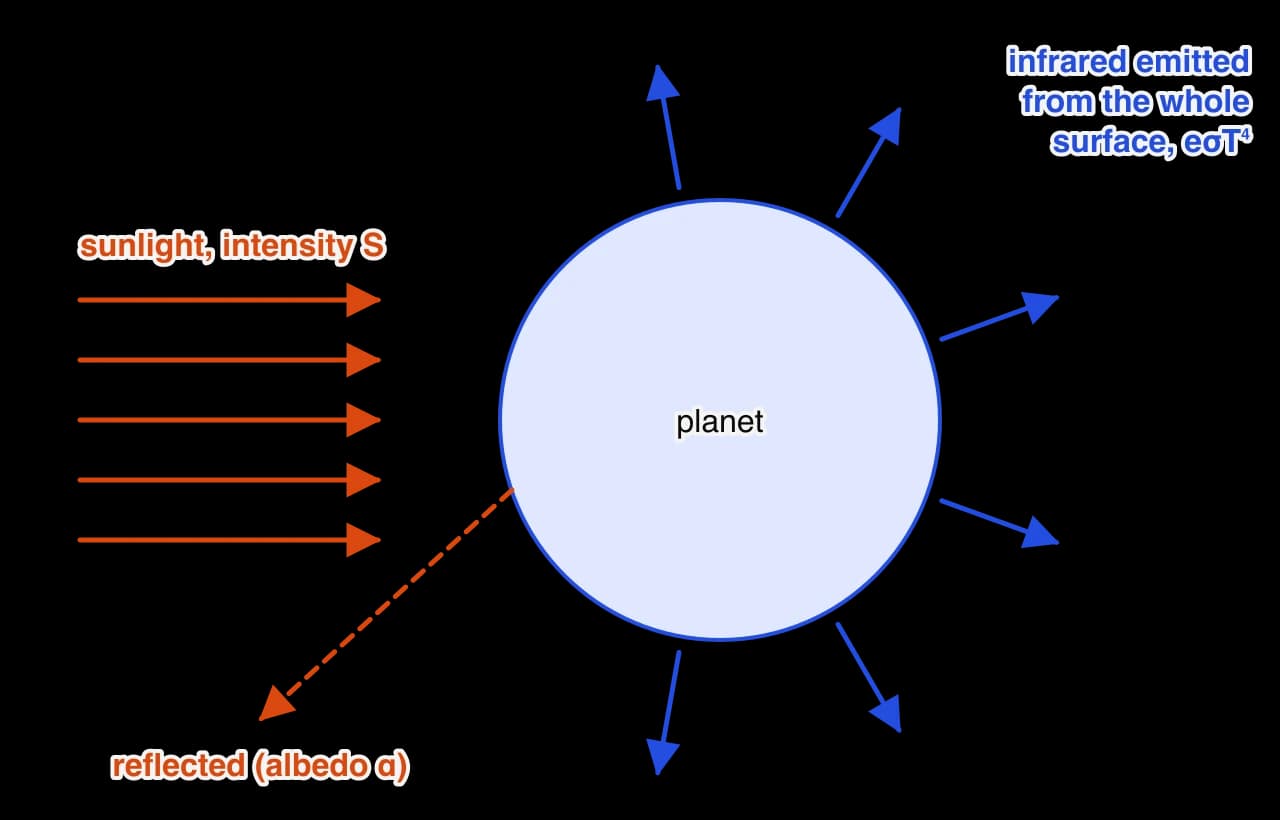
A planet in energy balance. Sunlight (orange) arrives from one direction and some is reflected; the absorbed power is re-radiated as infrared (blue) from the entire surface. At equilibrium the power absorbed equals the power emitted.
If the planet absorbs more power than it emits, its internal energy increases and its temperature rises. A higher temperature makes it emit more (the emitted power grows as T4), until the emitted power equals the absorbed power. The planet is then in energy balance, and its temperature stays constant. If the absorbed power then increases, for example because the planet reflects less sunlight, the temperature rises until a new balance is reached at a higher temperature.
power absorbed from the Sun=power radiated into space
To use this equation, three quantities are needed: how strongly the planet's surface radiates (its emissivity), what fraction of sunlight it reflects (its albedo), and how much sunlight reaches it (the solar constant).
Emissivity
A black body is the best possible emitter. Real surfaces at the same temperature emit less, and the ratio is their emissivity.
For a body of surface area A and emissivity e at temperature T, the Stefan–Boltzmann law becomes
P=eσAT4
A black body has e=1. A surface whose emissivity is less than 1 but roughly the same at all wavelengths is called a grey body. Good absorbers are good emitters, so a surface's emissivity at a given wavelength equals its absorptivity there. Polished metals have low emissivities, around 0.02–0.1, which is why a silvered vacuum flask radiates little. Most natural surfaces have high emissivities in the infrared.
Surface
Emissivity in the infrared (approximate)
Black body (ideal)
1
Water and oceans
0.96–0.99
Ice and snow
0.97–0.99
Soil and rock
0.90–0.95
Polished aluminium
0.03–0.06
The Earth seen from space (surface and atmosphere together)
about 0.61
Typical broadband thermal-infrared values for natural surfaces from the ASTER spectral library (Baldridge et al., NASA JPL, 2009); polished aluminium from standard heat-transfer tables (Incropera et al., Fundamentals of Heat and Mass Transfer, 7th edn, 2011). The Earth value is calculated from its emitted intensity and mean surface temperature.
The last row is an effective emissivity. Seen from space, the Earth radiates about 240W m−2, while a black body at the mean surface temperature of 288 K would radiate σ(288)4=390W m−2. The ratio, about 0.61, measures how strongly the atmosphere holds back the surface's radiation. It is not a property of any one surface.
Albedo
An albedo of 0 means all incident radiation is absorbed; an albedo of 1 means all of it is reflected. The fraction absorbed is 1−α. Light surfaces such as fresh snow and thick cloud tops have high albedos; dark surfaces such as open ocean and forests have low albedos.
Surface
Typical albedo
Fresh snow
0.80–0.90
Sea ice
0.50–0.70
Thick cloud
0.60–0.90
Desert sand
0.30–0.40
Grassland
0.15–0.25
Forest
0.08–0.15
Open ocean (sun high in the sky)
0.05–0.10
The Earth as a whole
about 0.30
Typical ranges; snow, sea ice and ocean values as given by the US National Snow and Ice Data Center (NSIDC), All About Sea Ice, accessed 2026. Values vary with conditions such as grain size, melt ponds and the angle of the Sun.
The Earth's average albedo is about 0.30, and most of the reflection comes from clouds rather than the surface. The albedo varies from place to place and from moment to moment:
Cloud cover changes from day to day; a cloudy region reflects much more than a clear one.
Surface type: ice, snow and deserts reflect more than oceans and forests, and seasonal snow cover changes the albedo of whole continents.
Latitude: near the poles, sunlight arrives at a low angle, and water and ice reflect much more strongly at grazing incidence; the polar regions also hold most of the ice and snow.
Time of day: when the Sun is low in the sky, in the early morning and evening, the albedo of water rises sharply for the same reason.
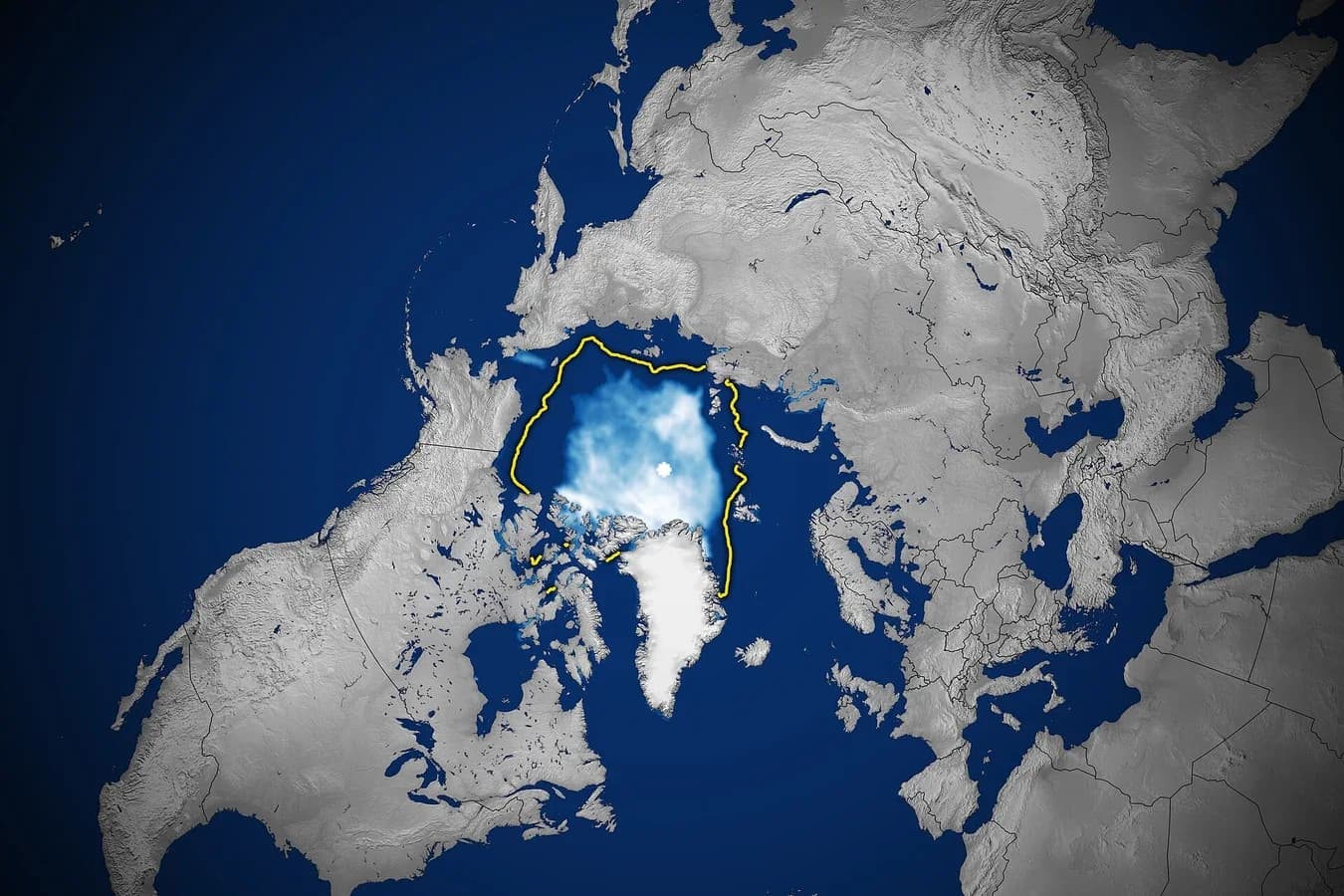
Arctic sea ice at its 2024 minimum, 4.28 million km² (white), against the 1981–2010 average minimum (yellow outline), about 1.9 million km² larger. Bright ice reflects most sunlight; the dark ocean that replaces it absorbs most of it. Image: Wikimedia Commons (public domain).
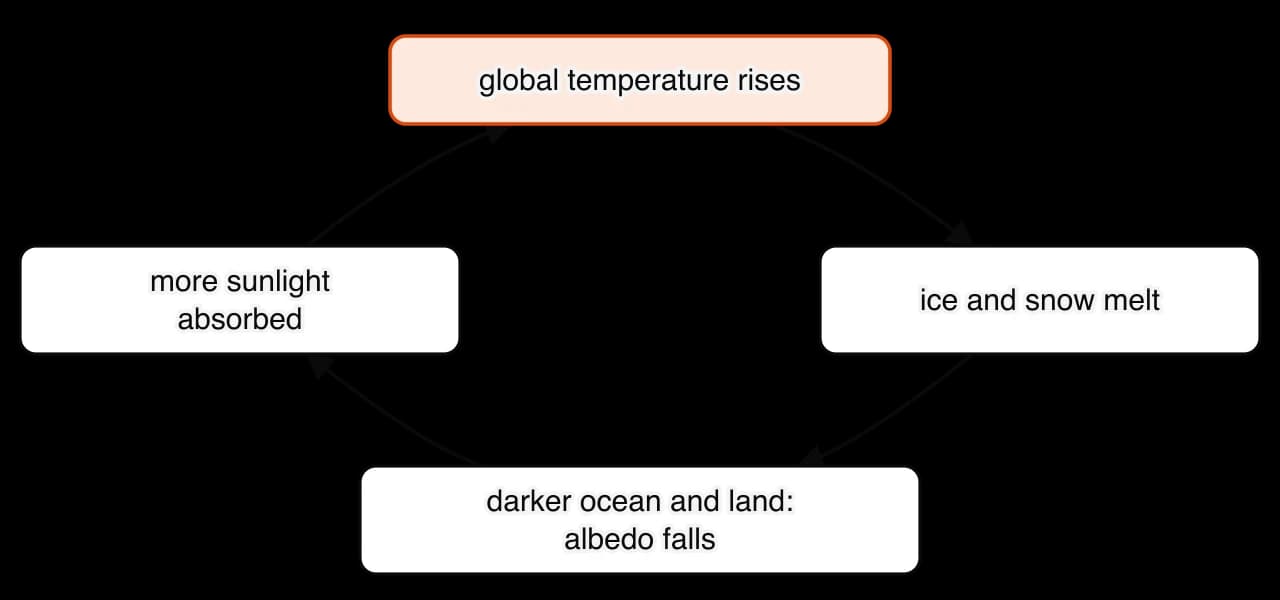
The difference between ice and ocean matters for the climate. Sea ice reflects more than half the sunlight falling on it, while open water absorbs over 90%. When Arctic ice melts, the dark water that replaces it absorbs more energy, which warms the region and melts more ice. This is the ice–albedo feedback.
The solar constant and the mean incoming intensity
The solar constant is an apparent brightness: S=L⊙/4πd2, where d is the Earth–Sun distance. It is not quite constant, because the Earth's orbit is slightly elliptical (the intensity is about 7% higher in early January, when the Earth is nearest the Sun, than in early July) and the Sun's output varies by about 0.1% over its 11-year activity cycle. For another planet, the inverse-square law scales it: at a distance d in astronomical units, the intensity is S/d2.
Why the mean intensity is S/4
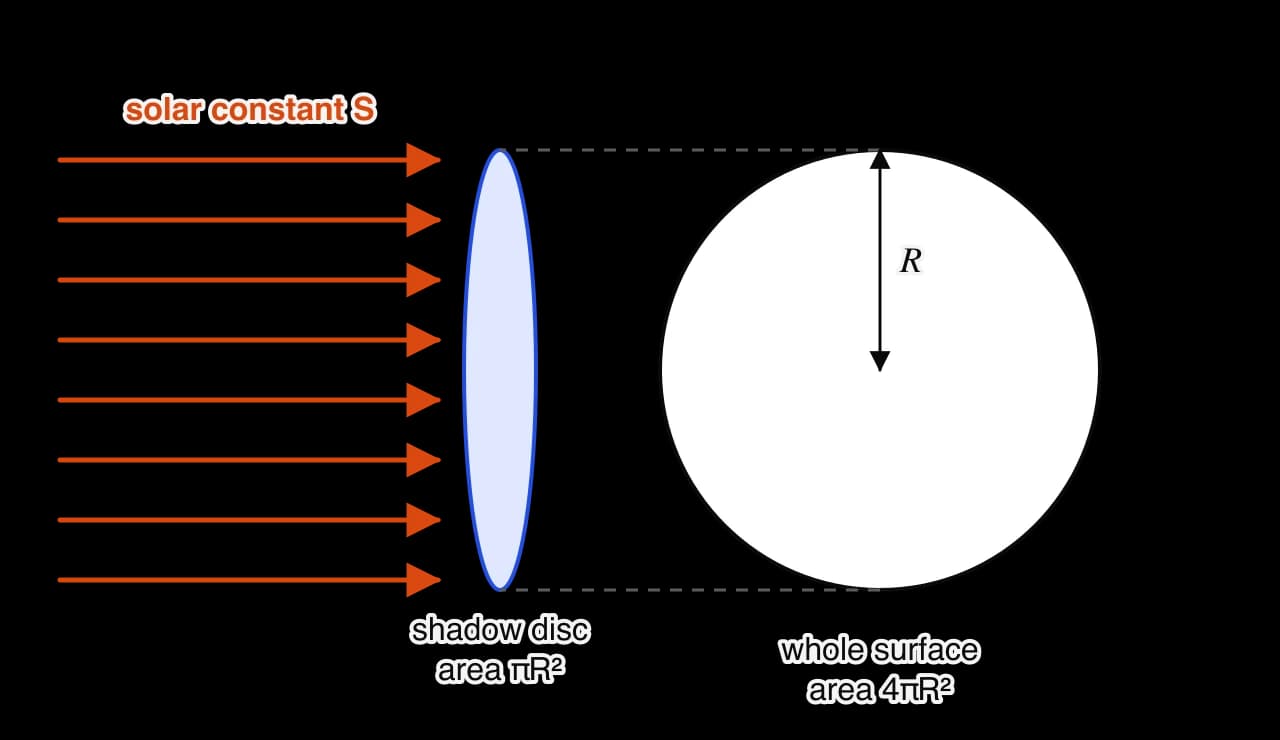
Sunlight arrives at the Earth as a parallel beam. The Earth blocks this beam over its cross-section, a disc of area πR2, so the total power intercepted is S×πR2. But this power is shared over the whole surface of the sphere, area 4πR2, as the Earth rotates and as day alternates with night. The power per square metre averaged over the whole surface is the mean incoming intensity.
The planet intercepts sunlight over its cross-section, a disc of area πR², but spreads that power over its whole surface of area 4πR². The mean intensity over the surface is therefore S/4.
mean incoming intensity=4πR2SπR2=4S=41.36×103=340W m−2
The factor of four combines two effects: at any moment half the Earth is in darkness (a factor of 2), and on the day side most of the surface is tilted to the beam, so it receives less than S per square metre (another factor of 2 on average). Including the albedo, the mean intensity absorbed by the Earth is
absorbed intensity=4(1−α)S
The equilibrium temperature of a planet without an atmosphere
For a planet with no atmosphere, balance between absorbed and emitted intensity, both averaged over the whole surface, gives
4(1−α)S=eσT4
The temperature found this way is the planet's equilibrium temperature, and the equation is the simplest energy-balance model. It assumes that the whole surface is at one temperature T, that the planet radiates from its entire surface, and that it has no internal source of energy. Solving for T:
T=(4eσ(1−α)S)1/4
The same model works for the Moon, which has no atmosphere and is at almost the same distance from the Sun as the Earth. With a lower albedo of about 0.11, it absorbs more of the sunlight that reaches it.
Body
Distance from Sun / AU
Albedo
Equilibrium temperature (black body) / K
Observed mean surface temperature / K
Venus
0.72
0.77
227
737
Earth
1.00
0.29
254
288
Moon
1.00
0.11
270
no single mean: about 100 at night to 390 at noon
Mars
1.52
0.25
210
about 210
Data: NASA Space Science Data Coordinated Archive (NSSDC), planetary fact sheets (Bond albedo, black-body temperature, mean surface temperature), accessed 2026.
Mars, with a very thin atmosphere, is close to its equilibrium temperature. The Earth is 34 K warmer than its equilibrium value. Venus reflects so much sunlight that its equilibrium temperature is lower than the Earth's, yet its surface is hotter than the melting point of lead, because its dense atmosphere is about 96% carbon dioxide at a surface pressure about 90 times the Earth's. The planets act as a natural test of the energy-balance model: the bodies whose temperatures depart from it are exactly those with substantial atmospheres.
The greenhouse effect
YouTube
Chris Doner: IB Physics, The Greenhouse effect, an overview of the mechanism for IB students.
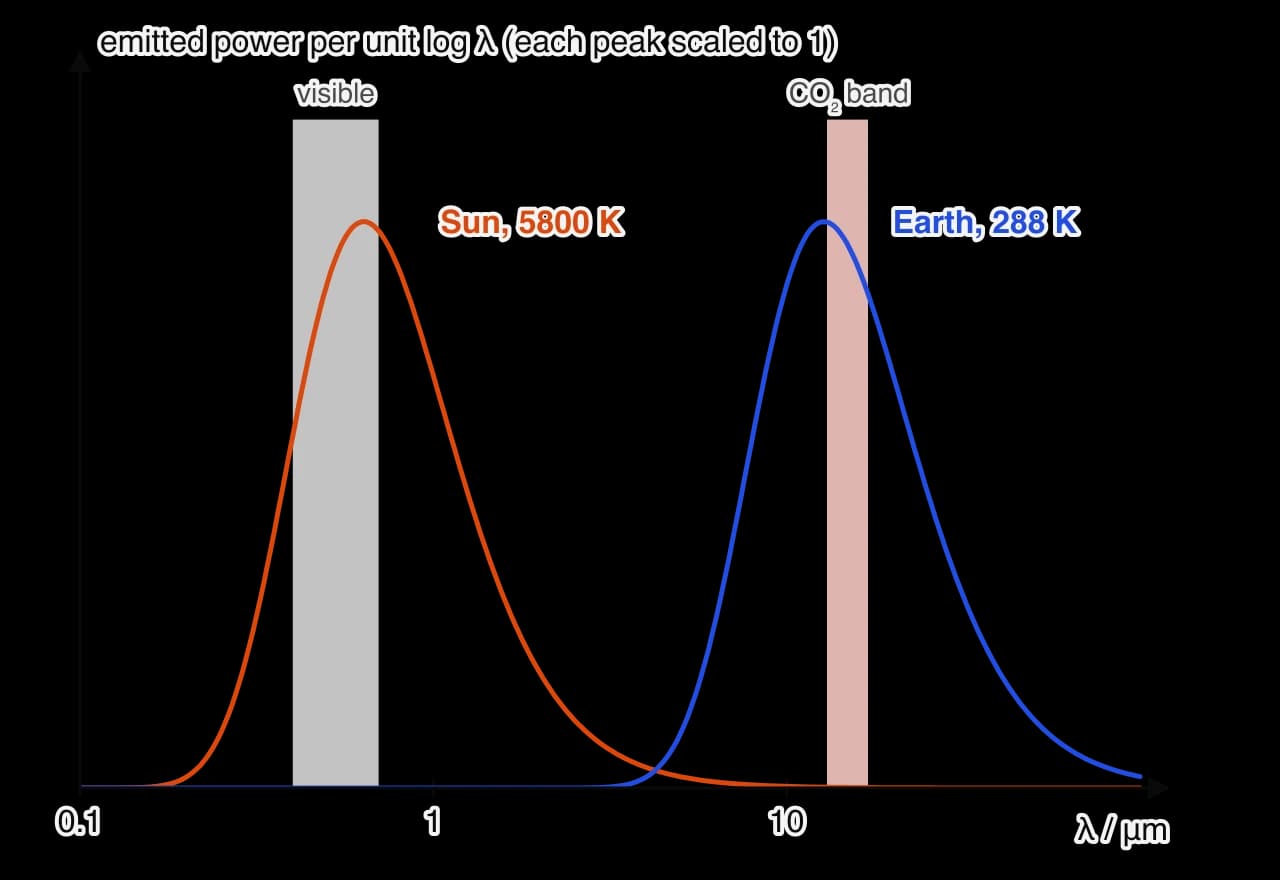
The atmosphere warms the surface because it treats incoming and outgoing radiation differently. By Wien's law, the Sun's surface at about 5800 K emits most strongly near 500 nm, in the visible. The Earth's surface at 288 K emits most strongly near 10 μm, in the far infrared. The two spectra hardly overlap.
Sunlight is mainly visible and near-infrared, while the Earth’s surface emits long-wavelength infrared; the two spectra barely overlap. Greenhouse gases absorb strongly in parts of the infrared, such as the CO₂ band near 15 μm (red), but little in the visible.
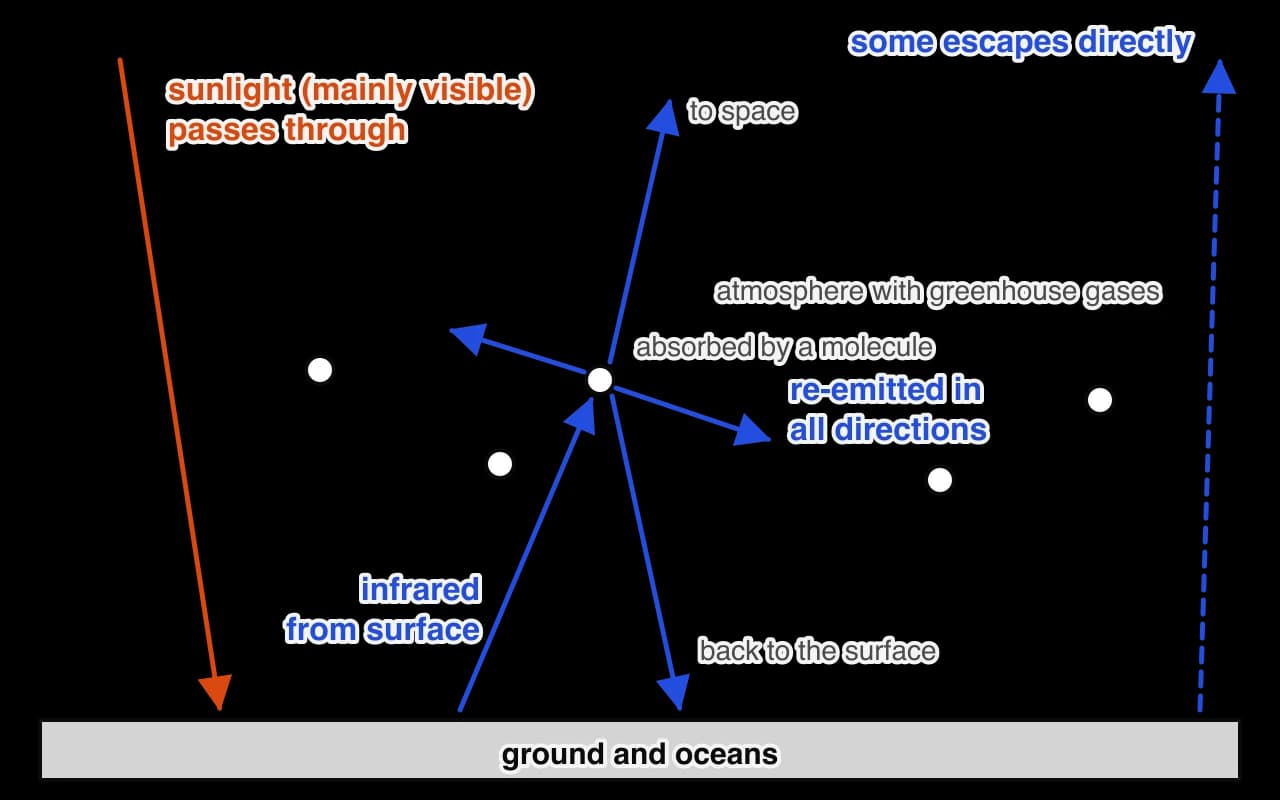
The greenhouse effect works in four steps:
Most incoming solar radiation, mainly visible and near-infrared, passes through the atmosphere, and much of it is absorbed by the surface, which warms.
The warm surface emits infrared radiation, with a much longer wavelength than sunlight.
Greenhouse gas molecules in the atmosphere absorb much of this infrared.
The molecules re-emit infrared in all directions. Part of it travels back down and is absorbed by the surface, so the surface receives energy from both the Sun and the atmosphere, and reaches a higher equilibrium temperature than it would without the gases.
The greenhouse effect. Short-wavelength sunlight (orange) passes through the atmosphere and warms the surface. The surface emits infrared (blue), much of which greenhouse gas molecules absorb and re-emit in all directions, so part of it returns to the surface.
Some infrared, mainly between about 8 and 13 μm, passes through the atmosphere with little absorption. This range is called the atmospheric window. The radiation that finally escapes to space comes mostly from the cold upper atmosphere rather than from the warm surface, so the Earth seen from space radiates like a body at about 255 K, its equilibrium temperature, even though its surface is at about 288 K.
The main greenhouse gases
Nitrogen and oxygen make up 99% of dry air but absorb almost no infrared. The greenhouse gases are minor components whose molecules have three or more atoms. Their vibrations can change the distribution of electric charge in the molecule, which is what allows them to absorb infrared.
Gas
Natural sources
Main human sources
Concentration in 2025
Before 1750
Water vapour, H₂O
Evaporation from oceans, lakes and plants
Little direct effect; concentration rises as the air warms
variable, up to about 4%
variable
Carbon dioxide, CO₂
Respiration, volcanoes, decay, exchange with the oceans
Data: NOAA Global Monitoring Laboratory (CO₂ at Mauna Loa; CH₄ and N₂O global means), annual means, 2025 (accessed 2026); pre-industrial values from IPCC AR6 WGI (2021).
Water vapour is the largest contributor to the natural greenhouse effect, but its concentration is controlled by temperature: extra water vapour rains out within days, while warmer air holds more of it. It therefore acts as a feedback that amplifies changes started by other gases, rather than as a cause. Carbon dioxide remains in the atmosphere for centuries and its concentration is set by emissions, so it controls the long-term change. Methane is about 200 times less abundant than CO₂, but each molecule absorbs infrared far more effectively.
Absorption by molecular energy levels
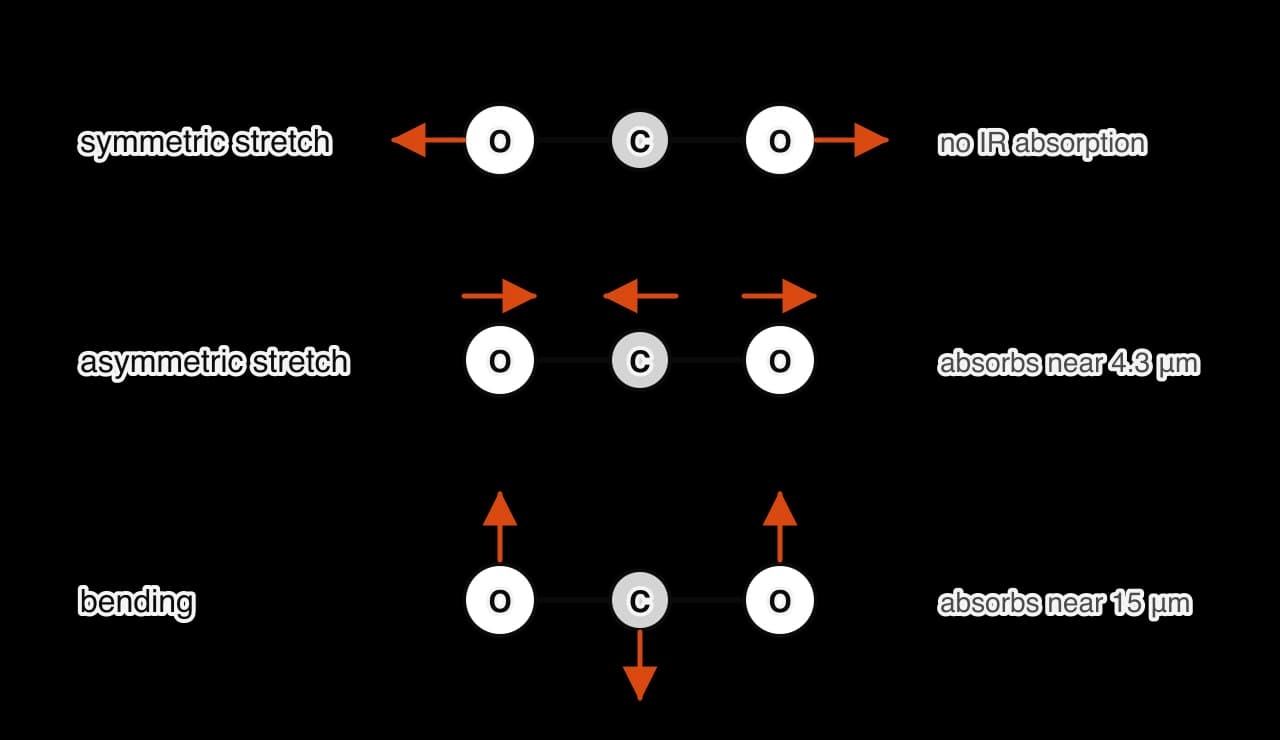
The energy of a molecule's vibrations is quantised: it can exist only in certain discrete vibrational energy levels. A molecule absorbs a photon only if the photon's energy E=hf equals the difference between two of its energy levels. For the vibrations of molecules such as CO₂ and H₂O, the spacing of these levels corresponds to photons in the infrared.
Vibrational modes of a CO₂ molecule (orange arrows: atom motions). Only modes that make the molecule’s charge distribution oscillate absorb infrared; the bending mode, at about 15 μm, lies near the peak of the Earth’s emission.
Visible photons from the Sun carry energies of about 2–3 eV, which match none of these vibrational spacings, so greenhouse gases are almost transparent to sunlight. Infrared photons from the Earth's surface have energies of about 0.1 eV, close to the vibrational spacings, so they are absorbed. After absorbing, the molecule either re-emits a photon of the same energy, in a random direction, or shares the energy with neighbouring molecules in collisions, warming the air, which then radiates in turn.
The resonance model
The same absorption can be described classically. The atoms in a molecule are held together by bonds that behave like springs, so the molecule has natural frequencies of vibration, typically 1013–1014 Hz, in the infrared. An electromagnetic wave exerts an oscillating force on the charged parts of the molecule. When the frequency of the radiation equals a natural frequency, resonance occurs: the molecule absorbs energy and vibrates with large amplitude.
In the resonance model, the bending mode of CO₂ has a natural frequency of f=c/λ=3.00×108/15×10−6=2.0×1013Hz, and infrared at this frequency drives it strongly. Visible light has a frequency about 30 times higher, far from any vibrational natural frequency, so it produces almost no response. A mode absorbs only if the vibration makes the molecule's electric charge distribution oscillate. That is why the symmetric stretch of CO₂, which keeps the molecule symmetric, does not absorb, and why the symmetric two-atom molecules N₂ and O₂ are not greenhouse gases.
Modelling the surface and the atmosphere
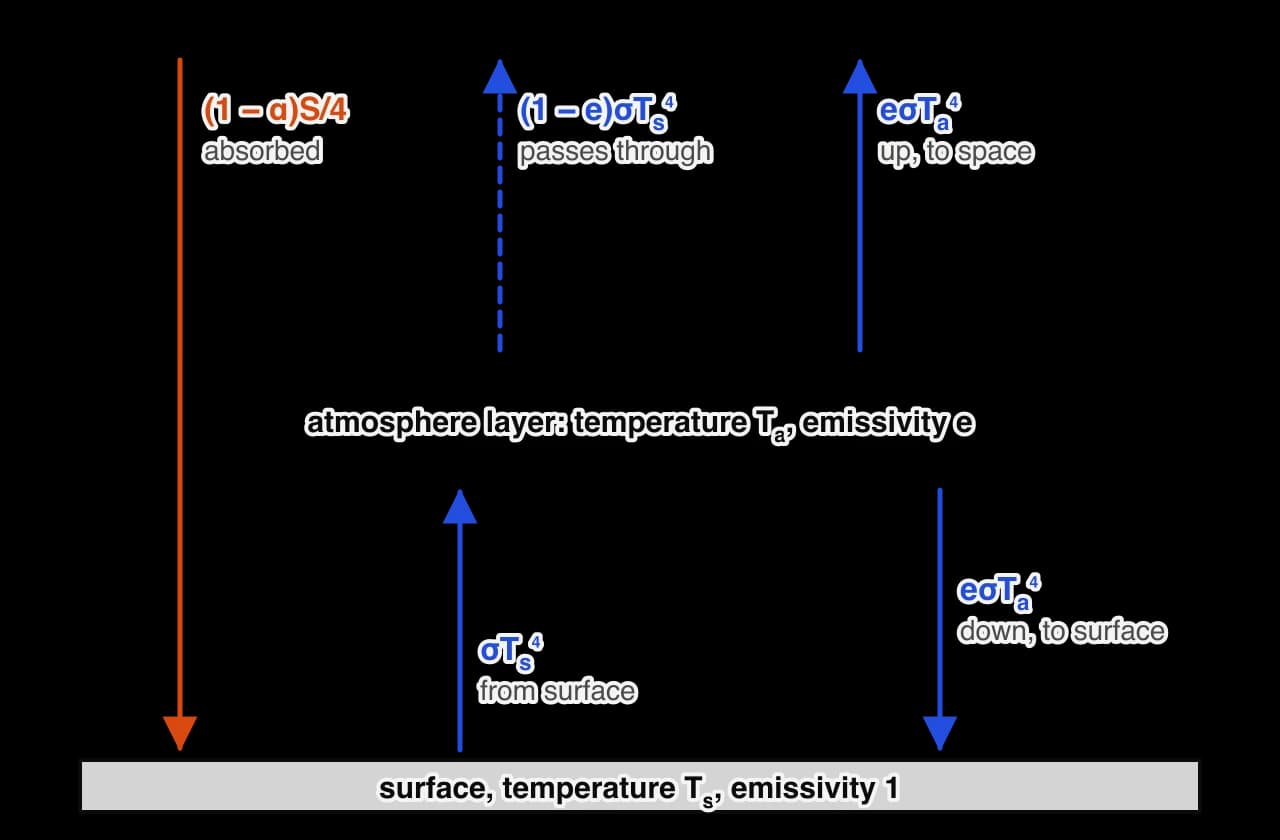
A simple model shows quantitatively how the atmosphere raises the surface temperature. In this single-layer model, the atmosphere is represented by one layer at a uniform temperature Ta. It is assumed to be transparent to sunlight and to absorb a fraction e of the infrared emitted by the surface; by the rule that good absorbers are good emitters, its emissivity is also e. The surface, at Ts, absorbs all the incoming sunlight that is not reflected and radiates as a black body.
A single-layer model of the atmosphere. The layer is transparent to sunlight (orange) but absorbs a fraction e of the surface’s infrared (blue), and radiates eσTₐ⁴ both up and down. Intensities are averaged over the whole Earth.
Energy balance is applied separately to each part of the system. All intensities are averages over the whole Earth.
The atmosphere absorbs eσTs4 from the surface and emits eσTa4 from each of its two faces: eσTs4=2eσTa4.
The surface absorbs the sunlight and the downward radiation from the atmosphere, and emits as a black body: 4(1−α)S+eσTa4=σTs4
The whole Earth, seen from space, absorbs the sunlight and emits what passes through the layer plus the layer's upward emission: 4(1−α)S=(1−e)σTs4+eσTa4
Any two of these equations determine the two temperatures (the third follows from them). The first gives Ta4=Ts4/2. Substituting into the second:
σTs4(1−2e)=4(1−α)S
With no absorbing atmosphere (e=0), this reduces to the planet-without-atmosphere result, 255 K. As e increases, the factor 1−e/2 decreases and the surface temperature rises. A perfectly absorbing layer (e=1) would raise the surface intensity to twice the absorbed solar value, giving Ts=21/4×255=303K.
The model also predicts the effect of adding greenhouse gases, which increases the fraction of infrared the atmosphere absorbs.
The Earth’s measured energy budget
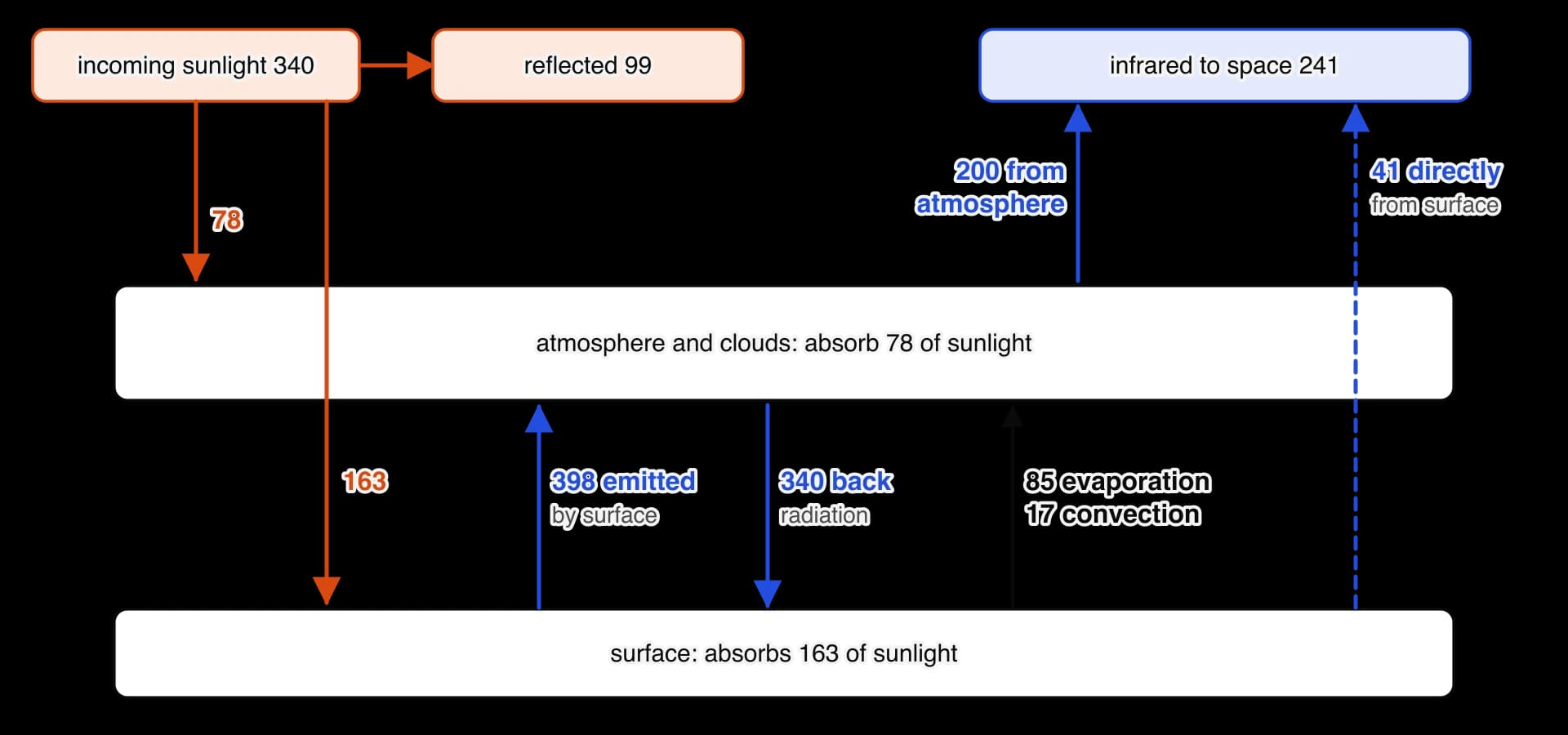
Satellite and surface measurements give the real global mean energy flows. They include processes the single-layer model leaves out: the atmosphere and clouds absorb some sunlight directly, and the surface also loses energy by evaporation (the latent heat carried by water vapour, released when it condenses in clouds) and by convection of warm air.
Global mean energy flows in W m⁻² (orange: sunlight; blue: infrared). Values converted from NASA Earth Observatory’s percentages of the 340 W m⁻² mean incoming intensity (Climate and Earth’s Energy Budget, updated 2025, after Trenberth et al. 2009).
The budget balances at each level. At the top of the atmosphere, 340 W m⁻² comes in and 99 + 241 = 340 W m⁻² goes out. At the surface, 163 + 340 = 503 W m⁻² is absorbed and 398 + 85 + 17 = 500 W m⁻² leaves; the small difference comes from rounding the published percentages. The real budget is out of balance by about 1 W m⁻² (estimates for recent decades range from about 0.8 W m⁻² to more than 1 W m⁻²), the extra energy that is now warming the Earth, mostly its oceans. The back radiation from the atmosphere, 340 W m⁻², is about twice the sunlight absorbed by the surface. Instruments at the surface measure this downward infrared directly, and it is the clearest evidence of the greenhouse effect at work.
Why the surface receives more than the Sun supplies
The surface absorbs 163 W m⁻² of sunlight but emits 398 W m⁻². This does not violate conservation of energy. Energy circulates between the surface and the atmosphere: most of the infrared the surface emits is absorbed by the atmosphere, and a large part comes back as back radiation. The net flow is what matters, and it balances. From space, the Earth absorbs 241 W m⁻² and emits 241 W m⁻² (to within the small imbalance), exactly as the planet-without-atmosphere model requires; the atmosphere changes the temperature at which the surface must radiate to achieve that balance.
The enhanced greenhouse effect
Since about 1750, and especially since 1950, human activity has added greenhouse gases to the atmosphere faster than natural processes remove them. The burning of fossil fuels (coal, oil and natural gas) for electricity, transport, heating and industry is the primary cause: it returns to the atmosphere carbon that was stored underground for millions of years. Deforestation adds further CO₂, both by releasing the carbon in the trees and by removing a store that would absorb it. Agriculture and the extraction of fossil fuels add methane and nitrous oxide.
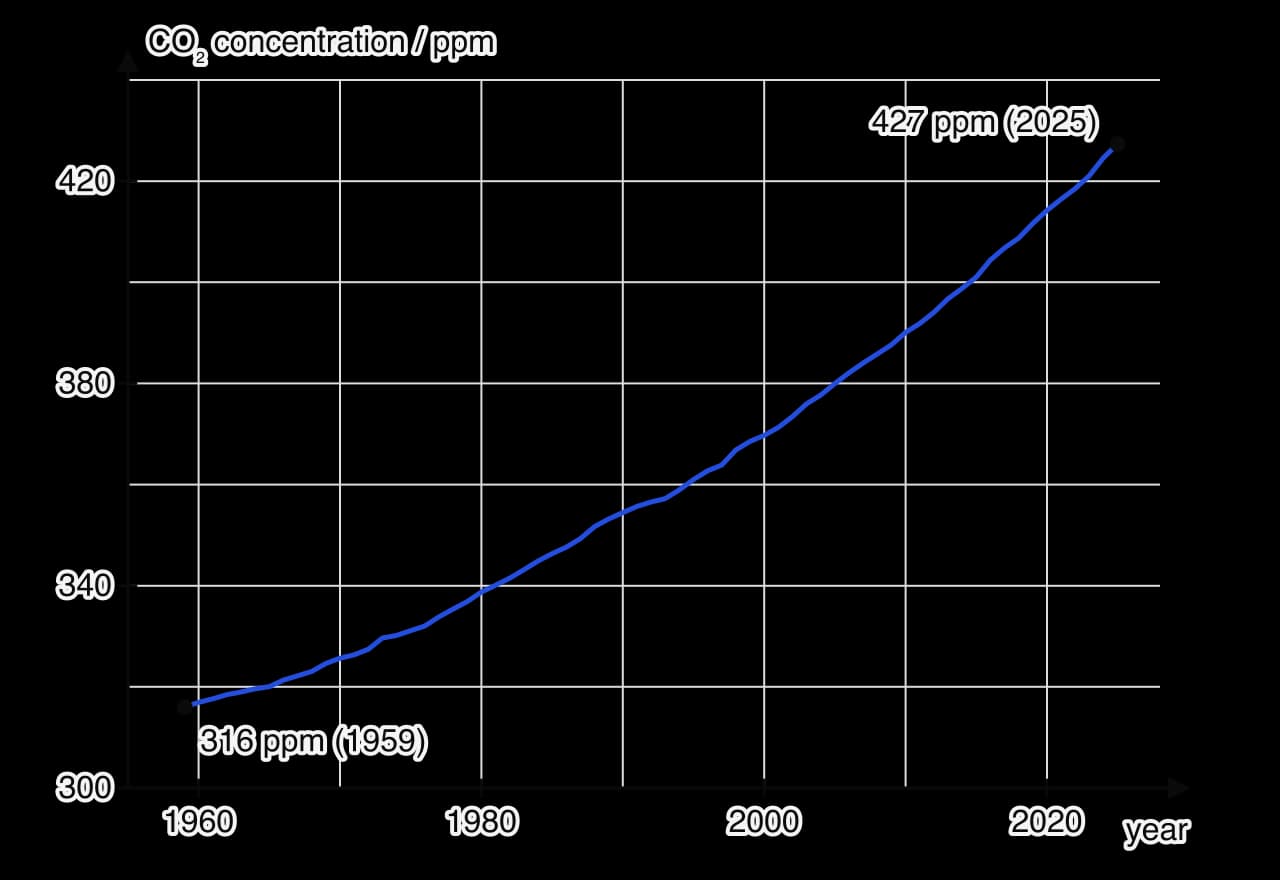
The longest continuous record of atmospheric CO₂ began in 1958 at Mauna Loa Observatory in Hawaii, an isolated site far from local sources. It is known as the Keeling curve after the scientist who started it.
Annual mean atmospheric CO₂ at Mauna Loa Observatory, Hawaii. Data: NOAA Global Monitoring Laboratory, Mauna Loa annual means, 1959–2025 (accessed 2026).
The concentration has risen from 316 ppm in 1959 to 427 ppm in 2025, about 54% above the pre-industrial value of 278 ppm, and the rate of increase has itself grown, from under 1 ppm per year in the 1960s to about 2–3 ppm per year since 2010, with rises of more than 3 ppm in both 2023 and 2024. The monthly measurements (smoothed out in the annual means) also show a seasonal cycle: concentrations fall each northern summer as plants take up CO₂ and rise each winter. Measurements of air bubbles trapped in Antarctic ice show that CO₂ stayed between about 170 and 300 ppm for at least 800 000 years before the industrial era.
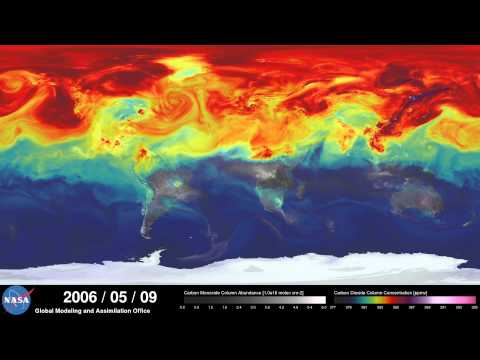
YouTube
NASA Goddard: A Year in the Life of Earth’s CO2, a NASA visualisation of carbon dioxide in the atmosphere through one year.
Evidence of warming
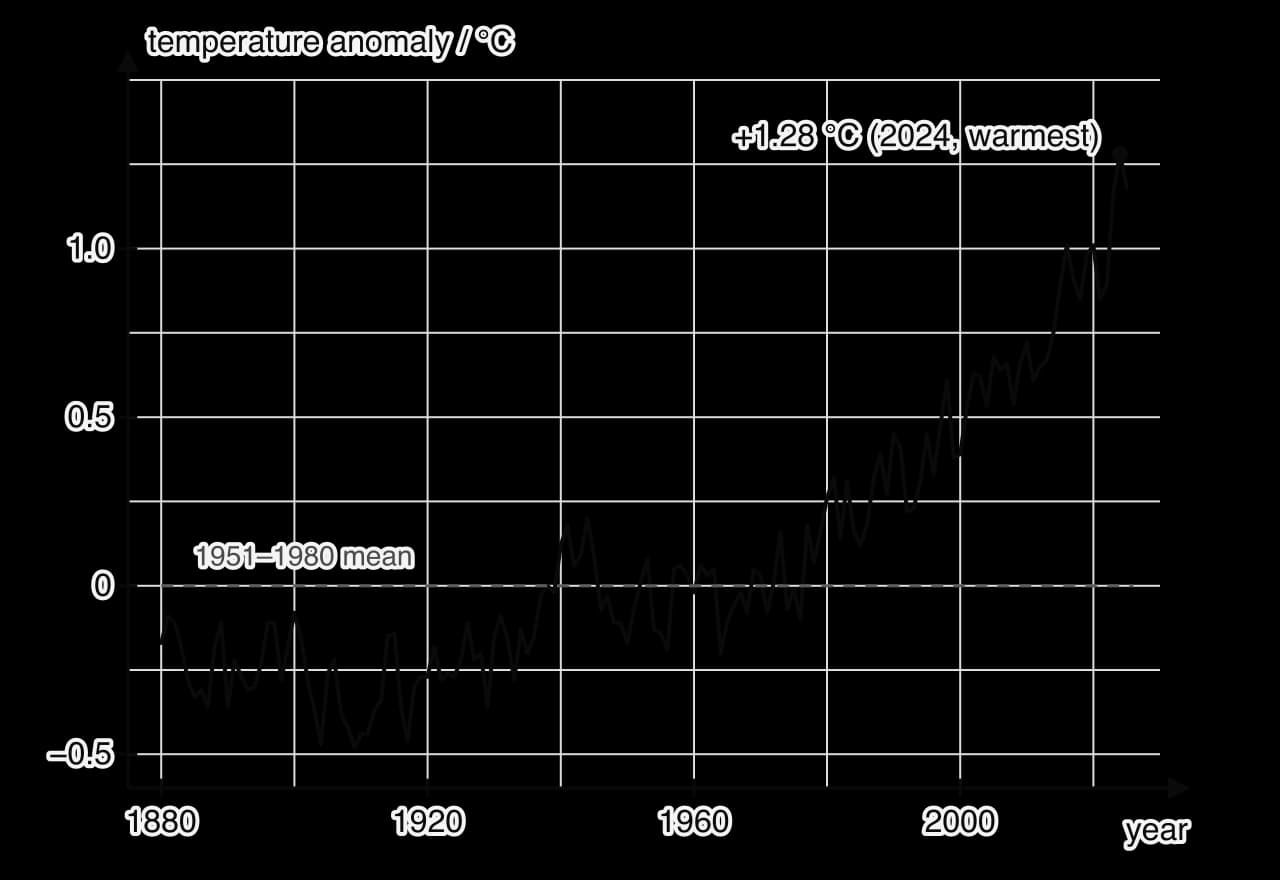
Over the same period, the global mean surface temperature has risen. Temperature records from thousands of weather stations, ships and buoys, combined by several independent groups, all show the same trend.
Global mean surface temperature relative to the 1951–1980 average. Data: NASA GISS Surface Temperature Analysis (GISTEMP v4), annual means, 1880–2025 (accessed 2026).
The anomaly, the difference from a reference average, was close to zero until about 1980 and has risen by about 0.2 °C per decade since then. 2024 was the warmest year in the record and 2025 the second warmest. The year-to-year wiggles come from natural variations such as El Niño and volcanic eruptions, but they are small compared with the long-term rise.
A correlation between two rising quantities does not by itself prove that one causes the other. The case that greenhouse gases cause the warming rests on several independent lines of evidence: the absorption of infrared by CO₂, measured in laboratories since the nineteenth century; satellite measurements showing less outgoing infrared at exactly the wavelengths CO₂ absorbs; the increased back radiation measured at the surface; the cooling of the upper atmosphere while the lower atmosphere warms, which more greenhouse gas predicts but a brighter Sun would not; and climate models, built on the physics of energy balance, that reproduce the observed warming only when human emissions are included.
Feedbacks
The direct warming from added CO₂ is amplified or reduced by feedbacks, processes in which a change causes further changes that affect the original one. A positive feedback amplifies a change; a negative feedback reduces it.
The ice–albedo feedback is a positive feedback: warming reduces the albedo, which causes further warming.
Ice–albedo feedback (positive): warming melts ice and snow, lowering the albedo, so more sunlight is absorbed and the warming increases.
Water vapour feedback (positive): warmer air holds more water vapour, itself a greenhouse gas, so the warming increases. This is the largest single feedback.
Permafrost feedback (positive): thawing frozen soils in the Arctic release stored CO₂ and methane.
Radiation feedback (negative): a warmer surface radiates more, since emission grows as T4. This is what eventually restores balance.
Cloud feedbacks: more low cloud would increase the albedo (cooling), while more high cloud would trap more infrared (warming). Their net effect is the largest uncertainty in climate models.
Reducing the enhanced greenhouse effect means reducing net emissions: replacing fossil fuels with renewable and nuclear energy, improving energy efficiency, stopping deforestation and capturing CO₂. Because CO₂ stays in the atmosphere for centuries, the temperature will not fall quickly even if emissions stop; the concentration reached determines the long-term warming. This is a global problem, since CO₂ emitted anywhere mixes through the whole atmosphere within about a year.
Applying the ideas in exam questions
Paper 1A: the mean incoming intensity
Paper 1A: statements about the greenhouse effect
Paper 1B: atmospheric CO₂ data
A student uses NOAA annual mean CO₂ concentrations measured at Mauna Loa. Each annual mean has an uncertainty of ±0.1 ppm.
Year
CO₂ concentration / ppm ± 0.1
1965
320.0
1985
346.4
2005
380.0
2024
424.6
Paper 2: a single-layer model of the Earth
Paper 2: albedo and equilibrium temperature
Self-check
To do:
I can explain how conservation of energy sets a planet’s equilibrium temperature.
To do:
I can define emissivity and use P=eσAT4.
To do:
I can define albedo, quote typical values and explain why the Earth’s albedo varies with cloud cover, surface, latitude and time of day.
To do:
I can state what the solar constant is and scale it to other planets with the inverse-square law.
To do:
I can explain why the mean incoming intensity is S/4 and why the absorbed intensity is (1−α)S/4.
To do:
I can calculate the equilibrium temperature of a planet or moon without an atmosphere and compare it with observations.
To do:
I can name the four main greenhouse gases and give natural and human sources of each.
To do:
I can explain the greenhouse effect: short-wavelength sunlight in, infrared out, absorption and re-emission in all directions.
To do:
I can explain infrared absorption using both molecular energy levels and the resonance model.
To do:
I can apply energy balance to the surface and to the atmosphere in a single-layer model, to find an emissivity or a temperature.
To do:
I can interpret the Earth’s energy budget and the Mauna Loa CO₂ and global temperature records.
To do:
I can explain the enhanced greenhouse effect, its main cause, and the role of positive and negative feedbacks.
C
σT4power radiated per unit area
D
total power incidenttotal power scattered
Explanation
Albedo is the fraction of the incident power that is scattered (reflected) back, so it is total scattered power divided by total incident power. A is the fraction absorbed, which equals 1 − albedo. C is the definition of emissivity. B divides by the wrong total.
The answer is D.
Question 2 · PHY-002631 mark
The dark back surface of a solar panel has an area of 2.0 m2. On a sunny day this surface is at a temperature of 320 K and radiates a total power of 1.10 kW. What is the emissivity of the back surface?
Three statements about the albedo of regions of the Earth are:
I. The albedo of a region increases when thick cloud forms above it. II. Snow-covered polar regions usually have a higher albedo than forests near the equator. III. The albedo of a region stays the same throughout the day.
Must see full substitution OR answer to at least 3 s.f.
(c)σTs4=240+152=392 «W m⁻²» ✓
Ts=(5.67×10−8392)1/4=288 «K» ✓
Allow use of 150 W m⁻² (giving 288 K). Allow ECF from (b).
(d) more CO₂ molecules to absorb infrared «from the surface» / infrared frequency matches the natural frequency of molecular vibration (resonance) ✓
so a larger fraction of the surface’s infrared is absorbed «and re-emitted», and a good absorber is a good emitter, so e increases ✓
(e) the real atmosphere is not at one uniform temperature / the atmosphere also absorbs some sunlight / evaporation and convection also transfer energy from the surface / clouds and changing albedo are ignored ✓
Accept any reasonable limitation of the single-layer model.
✓
(b)σT4=40.70×1.36×103 OR 238 «W m⁻²» ✓
T=255 «K» ✓
Award [2] for a bald correct answer.
(c) ocean absorbs more solar radiation than ice / the albedo decreases so more energy is absorbed ✓
this warms the region further, so more ice melts, amplifying the original change ✓