Model matter as particles, link temperature to kinetic energy, calculate specific and latent heats, and describe conduction, convection and black-body radiation, including stars.
Each is in the Physics glossary, with every other term in the subject.
Temperature measured from absolute zero, in kelvin: .
The lowest possible temperature, 0 K or −273 °C, at which the particles of a substance would have minimum (in the ideal gas model, zero) kinetic energy.
The power received per unit area from a star at the observer,
Thermal physics explains what happens when matter is heated or cooled: why a metal spoon in hot soup warms up, why sweating cools the body and why a kettle takes minutes to boil but much longer to boil dry. It rests on a simple model, matter made of particles in constant motion, and connects it to quantities that can be measured in a laboratory: temperature, mass and energy. The same ideas, applied to radiation, let astronomers find the temperature and size of stars that are many light years away.
176 exam-style questions on this subtopic, written in the style of the IB papers. The first has its markscheme open. Counted on
In a drop-tower amusement ride, a gondola carrying riders is raised to the top of a vertical tower by an electric motor. The gondola is then released from rest and falls freely through 38.0 m. Brakes then act, giving the gondola a uniform deceleration, and it comes to rest after falling a further 16.0 m. The total mass of the gondola and riders is 4800 kg. Ignore air resistance unless a part says otherwise.
The motor raises the gondola and riders through a vertical height of 58 m in 40 s at constant speed. Calculate the useful power output of the motor.
2 marks
work done = «»
One of 65 short multiple-choice questions on B.1. Pick an answer to see why it's right or wrong.
What is absolute zero?
The official deck for this part of the syllabus.
State three basic assumptions of the particle model of matter.
Intermolecular forces are […] when particles are a little apart and strongly repulsive when they are pushed very close together.
The entries of the physics data booklet that B.1 uses. Each opens in the explained booklet.
With a free account, Augment remembers where you stopped and what you have practiced.
An idealised object that absorbs all radiation falling on it and emits the maximum possible radiation at each wavelength, with a spectrum set only by its temperature.
The change from liquid to gas throughout the liquid, with bubbles of vapour forming, at a fixed temperature for a given pressure.
The gas constant per molecule, .
The change from gas to liquid, during which energy equal to the latent heat of vaporization is released.
The transfer of thermal energy through a material, without bulk movement of the material, by collisions between particles and, in metals, by free electrons.
The transfer of thermal energy by the bulk movement of a fluid, driven by differences in density between warmer and cooler parts of the fluid.
A continuous circulation of fluid in which warmer, less dense fluid rises and cooler, denser fluid sinks, carrying energy round the loop.
Mass per unit volume, ; measured in .
The power radiated per unit area by a surface divided by the power per unit area a black body at the same temperature would radiate, ; a number from 0 to 1.
The change from liquid to gas at the surface of a liquid, at any temperature, as the fastest molecules escape; it cools the remaining liquid.
The change from liquid to solid at the melting point, during which energy is released at constant temperature.
The energy needed to raise the temperature of a particular object by 1 K, equal to ; measured in .
A graph of temperature against time for a substance heated at constant power: sloping sections where one phase warms, flat sections where the phase changes.
The forces between the particles of a substance: attractive at moderate separations and strongly repulsive when particles are pushed very close together.
A relationship in which a quantity is inversely proportional to the square of the distance from a point source, as when radiation spreads over a sphere of area .
The total power radiated by a star or other body, in watts; for a black body .
The change from solid to liquid at the melting point, during which energy is absorbed at constant temperature.
A way of finding a specific heat capacity, latent heat or temperature by mixing a hot and a cold substance in an insulated container and equating the energy lost by one to the energy gained by the other.
A change between solid, liquid and gas, which happens at constant temperature while energy changes the intermolecular potential energy of the particles.
The energy needed to raise the temperature of 1 kg of a substance by 1 K, ; measured in .
The energy needed to change the phase of 1 kg of a substance at constant temperature, ; measured in .
The energy needed to melt 1 kg of a solid at its melting point without changing its temperature (released again on freezing).
The energy needed to turn 1 kg of a liquid into gas at its boiling point without changing its temperature (released again on condensing).
The constant in the Stefan–Boltzmann law.
The total power radiated by a black body is proportional to its surface area and to the fourth power of its kelvin temperature: .
A measure of how hot a body is; on the particle model, the kelvin temperature is proportional to the mean random kinetic energy of the particles.
The change in temperature per unit distance through a material, ; measured in .
The rate of thermal energy transfer per unit area per unit temperature gradient through a material, in ; measured in .
Energy transferred from one body to another because of a temperature difference between them.
The state of two bodies between which there is no net transfer of thermal energy, because they are at the same temperature.
Electromagnetic radiation, mainly infrared at everyday temperatures, emitted by every body above absolute zero because of the thermal motion of its charged particles.
The peak wavelength of a black body's spectrum is inversely proportional to its kelvin temperature: .
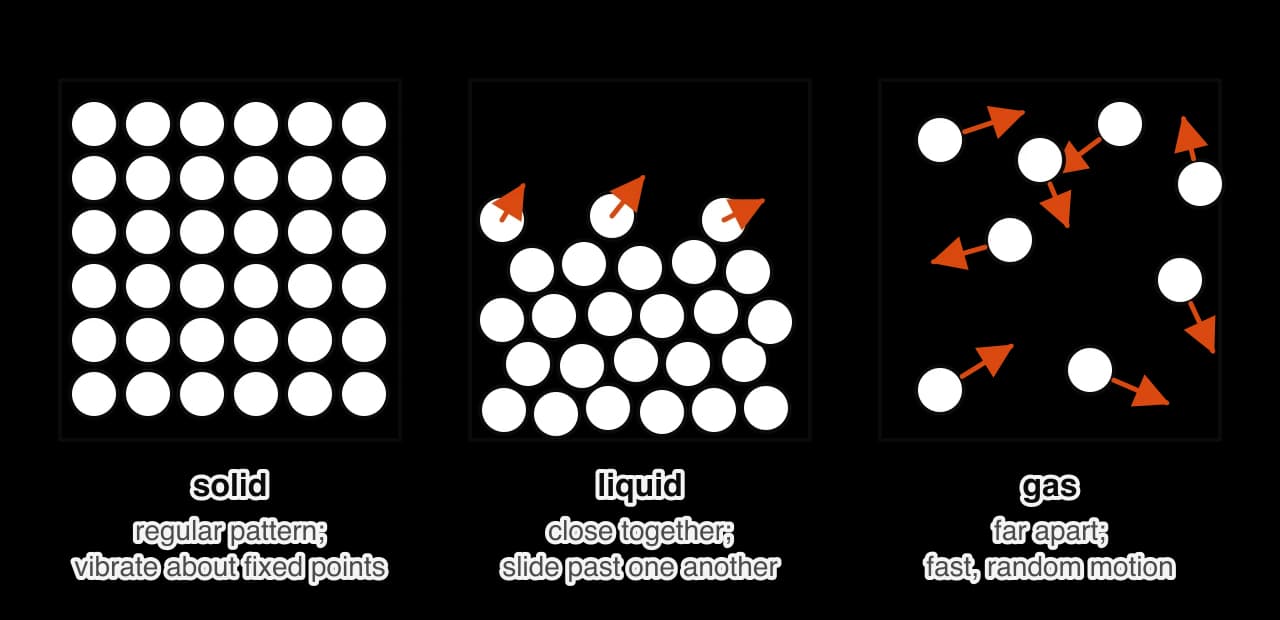
All matter is made of particles (atoms, molecules or ions) that are in constant random motion. Between the particles act intermolecular forces: attractive when the particles are a little apart, strongly repulsive when they are pushed very close. The three states of matter differ in how strongly these forces hold the particles and in how much kinetic energy the particles have to overcome them.
The particle models of the three states show the key differences. In a solid, strong intermolecular forces hold each particle near a fixed position in a regular pattern, and the particles vibrate about those positions. In a liquid, the particles are still close together, but they have enough energy to slide past one another, so a liquid flows and takes the shape of its container while keeping its volume. In a gas, the particles are far apart and move quickly in random directions, colliding with one another and with the walls; the forces between them are negligible except during collisions.
Property | Solid | Liquid | Gas |
|---|---|---|---|
Arrangement | Regular, close packed | Disordered, close packed | Disordered, far apart |
Motion | Vibration about fixed positions | Vibration and movement past neighbours | Fast, random translation |
Typical separation | About one particle diameter | About one particle diameter | About ten diameters (at room conditions) |
Intermolecular forces | Strong | Weaker than in a solid, still significant | Negligible except in collisions |
Shape and volume | Fixed shape, fixed volume | Takes the container’s shape, fixed volume | Fills the whole container |
Compressibility | Very low | Very low | High |
The model explains the everyday properties. Solids and liquids are hard to compress because their particles already touch, and pushing them closer meets strong repulsion. Gases are easy to compress because most of their volume is empty space. A gas has a density roughly a thousand times lower than that of the same substance as a liquid, because each particle occupies about times more volume: ten times the separation in each of three dimensions.
The particle model is a model: a simplified picture that explains and predicts. It does not show the internal structure of atoms or the details of how real molecules interact, and it treats particles as small hard spheres. Its value lies in how many observations it explains with very few assumptions, from diffusion and Brownian motion to the gas laws.
Because the particles in a solid or a liquid are packed closely, the density of a substance changes only a little on melting. Most substances are slightly denser as solids than as liquids. Water is an important exception: ice () is less dense than liquid water (), because the hydrogen bonds in ice hold the molecules in an open hexagonal structure. Ice therefore floats, and lakes freeze from the top down, which insulates the water below.
Substance | Density / kg m⁻³ |
|---|---|
Air (20 °C, sea level) | 1.2 |
Expanded polystyrene | about 20 |
Ice | 917 |
Water (4 °C) | 1000 |
Aluminium | 2700 |
Iron | 7900 |
Copper | 8960 |
Data: CRC Handbook of Chemistry and Physics, 104th edition (2023), rounded; densities of solids at room temperature.
Temperature is a measure of how hot or cold a body is. On the particle model it has a precise meaning: the temperature of a substance is a measure of the mean random kinetic energy of its particles. Heating a gas makes its molecules move faster on average; heating a solid makes its particles vibrate with larger amplitude.
The Celsius scale was originally defined from two fixed points, the melting point of pure ice (0 °C) and the boiling point of pure water at atmospheric pressure (100 °C); today it is defined from the kelvin. Its zero is arbitrary, and negative temperatures are common. The kelvin scale, the SI temperature scale, starts instead at absolute zero, the temperature at which the particles of a substance have the least possible energy. Nothing can be cooled below absolute zero, so the kelvin scale has no negative values.
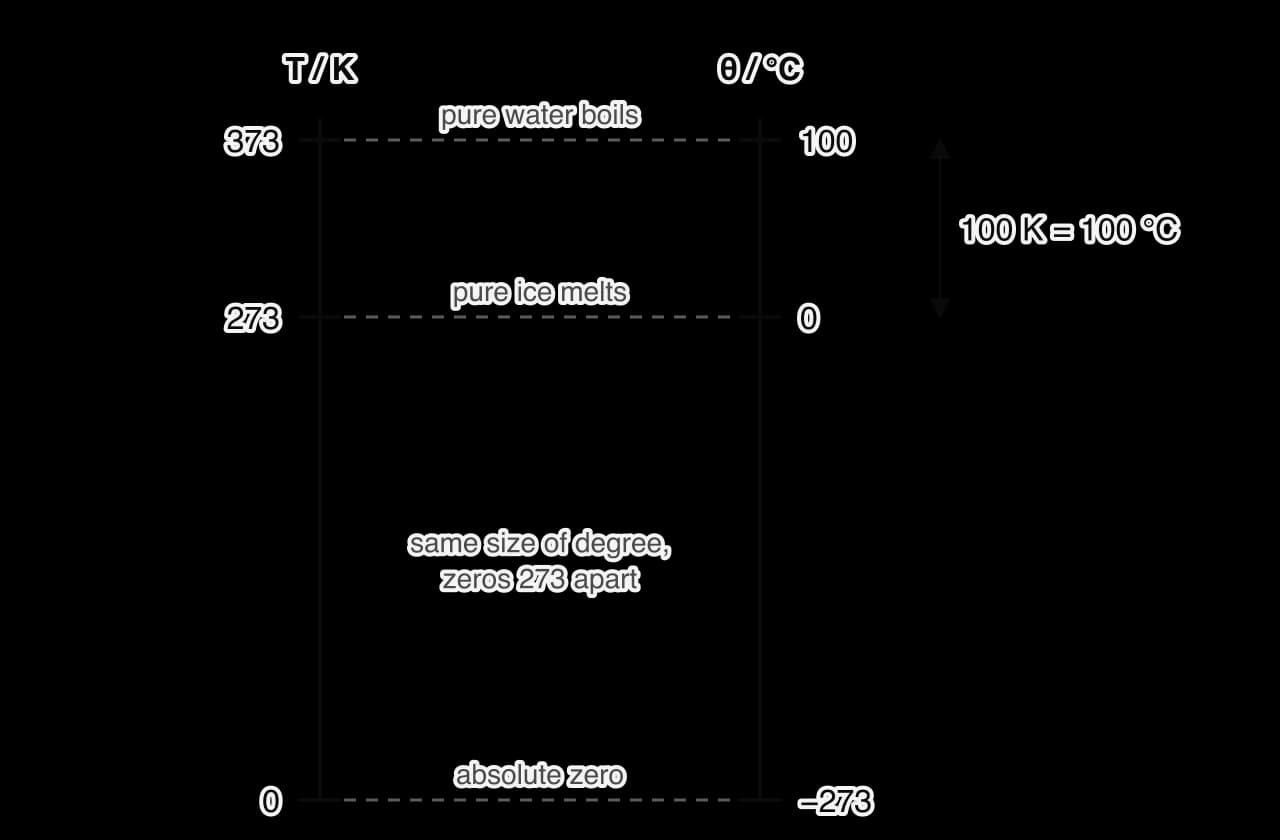
The kelvin and the degree Celsius are the same size, so the two scales are offset by a constant:
A temperature change therefore has the same numerical value on both scales: warming from 20 °C to 50 °C is a rise of 30 °C, and also a rise of 30 K (from 293 K to 323 K). In equations that use a change, , either scale works. In equations that use a temperature itself, such as or the Stefan–Boltzmann law, must be in kelvin.
For the particles of an ideal gas, the mean random translational kinetic energy is directly proportional to the kelvin temperature:
Here is the Boltzmann constant, a fundamental constant that links energy per particle to temperature. The bar over shows a mean: at any instant some molecules move faster and some slower, but the average depends only on . Doubling the kelvin temperature doubles the mean kinetic energy, and at absolute zero the mean random kinetic energy would be at its minimum.
The equation is written for the particles of an ideal gas, whose internal energy is all kinetic. In solids and liquids the particles also store potential energy, but the kelvin temperature remains a measure of their mean random kinetic energy. The speed that a mean kinetic energy corresponds to depends on the mass of the particles: at the same temperature, light hydrogen molecules move about four times faster on average than oxygen molecules, which are sixteen times more massive.
When two bodies at different temperatures are in thermal contact, energy is transferred between them because of the temperature difference. This energy in transit is called thermal energy, or heat, . Particles in the hotter body have a larger mean kinetic energy, so in collisions at the boundary they pass energy to the slower particles on the colder side more often than they receive it. Energy passes both ways at the boundary, but the net transfer is always from the higher temperature to the lower.
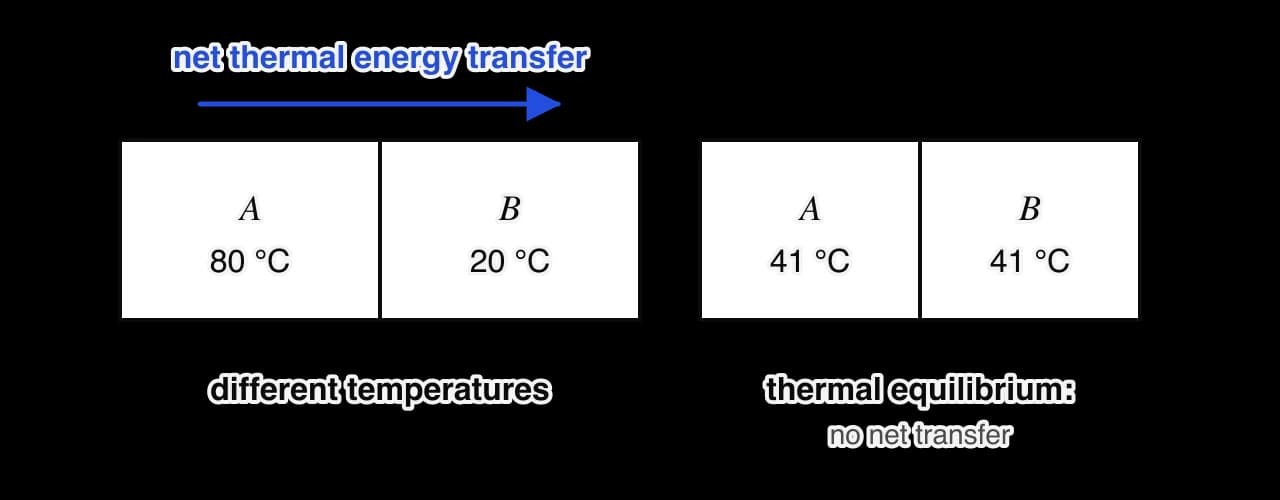
The net transfer stops when the two temperatures are equal. The bodies are then in thermal equilibrium. This is the principle behind every thermometer: the thermometer exchanges energy with the object until both are at the same temperature, and only then is its reading the object's temperature.
The internal energy has two parts. The random kinetic energy comes from the translation, rotation and vibration of the particles; it is linked to the temperature. The intermolecular potential energy comes from the forces between the particles and depends on how far apart they are. Because the forces are attractive, separating particles increases their potential energy, in the same way that lifting a mass away from the Earth increases its gravitational potential energy.
State | Random kinetic energy | Intermolecular potential energy |
|---|---|---|
Solid | Vibrations about fixed positions | Lowest: particles held closest by strong forces |
Liquid (at the same temperature, e.g. at the melting point) | Same mean value as the solid | Higher: some bonds broken, particles freer |
Gas (at the boiling point) | Same mean value as the liquid | Highest: particles separated, potential energy close to zero |
Ideal gas | All of the internal energy | Zero by assumption (no intermolecular forces) |
Comparing internal energy across the phases at one temperature shows where the energy of a phase change goes. A kilogram of steam at 100 °C has much more internal energy than a kilogram of water at 100 °C: the mean kinetic energies are the same, because the temperature is the same, but the molecules of steam are far apart and have a much higher intermolecular potential energy.
The internal energy of a body can be increased in two ways: by heating it (a transfer of thermal energy) or by doing work on it (for example, rubbing it or compressing it). Rubbing hands together raises their temperature with no hotter body involved.
Supplying the same energy to equal masses of different substances produces different temperature rises. A kilogram of water needs about 4200 J to warm by 1 K, while a kilogram of copper needs only about 390 J. The property that measures this is the specific heat capacity.
From the definition, the energy transferred to a mass when its temperature changes by is
The equation applies only while the substance stays in one phase. The product , in , is the heat capacity of the particular object: the energy needed to raise its temperature by 1 K. A positive means energy was supplied; a negative means energy was given out. Because is a change, it can be calculated in either kelvin or degrees Celsius.
Substance | Specific heat capacity / J kg⁻¹ K⁻¹ |
|---|---|
Water | 4180 |
Ice | 2100 |
Steam | 2000 (approximately) |
Aluminium | 900 |
Glass | 840 |
Iron | 450 |
Copper | 390 |
Lead | 130 |
Data: CRC Handbook of Chemistry and Physics, 104th edition (2023), rounded; values at about 25 °C, except ice (just below 0 °C) and steam (about 100 °C).
Water has an unusually high specific heat capacity, so large bodies of water warm and cool slowly. Oceans absorb energy in summer and release it in winter, which gives coastal regions milder summers and winters than places far inland at the same latitude. The same property makes water a good coolant in car engines and power stations and a good store of energy in central-heating systems.
A common method heats a metal block of known mass with an electrical heater and measures the temperature rise. The electrical energy supplied is , where is the current in the heater, the potential difference across it and the heating time.
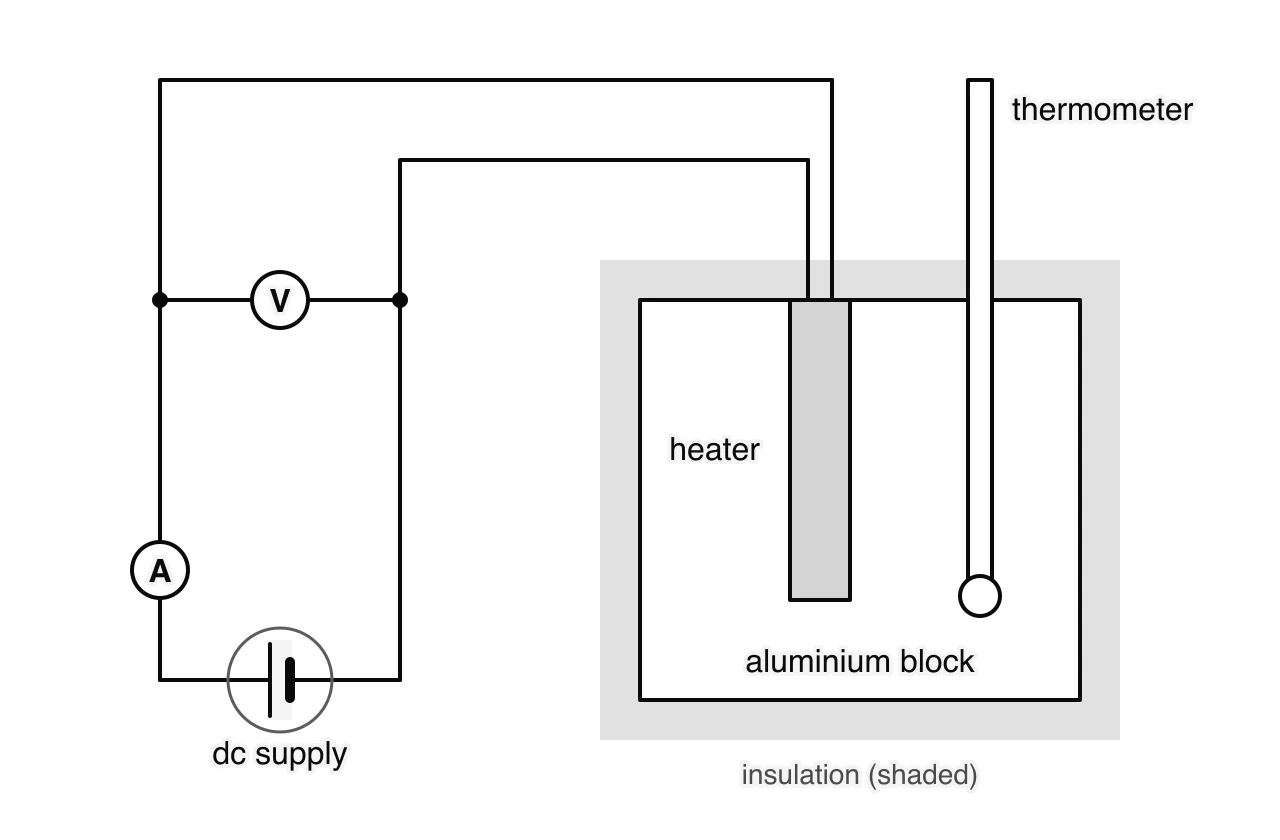
Measure the mass of the block and its starting temperature.
Switch on the heater and start a stopwatch; record the ammeter and voltmeter readings (they should stay constant).
Record the temperature at regular intervals, or the final temperature after a measured time.
Calculate , or plot temperature against time and use the gradient: .
In practice some energy escapes to the surroundings, and the rate of loss increases as the block gets hotter than the room. The temperature–time graph of the block therefore curves away from a straight line.
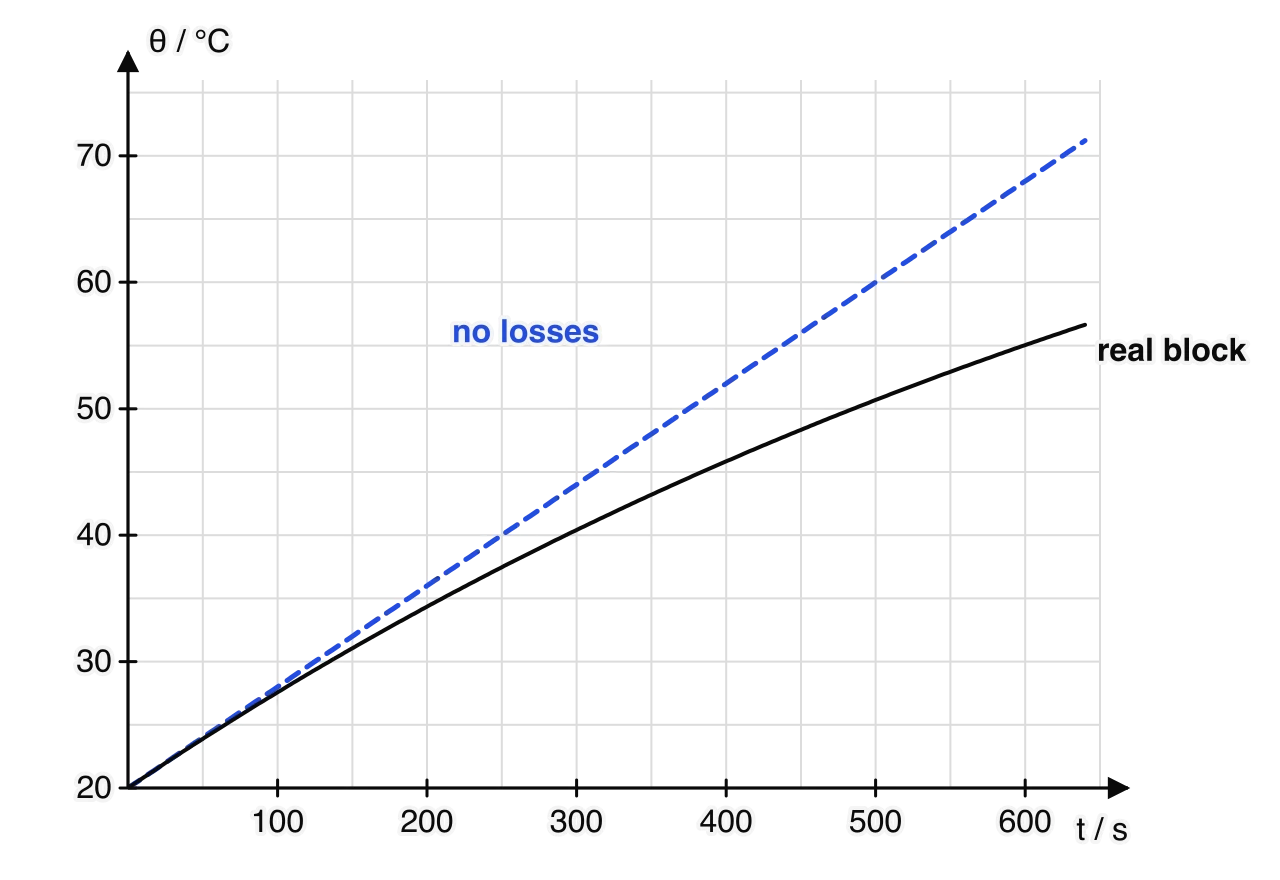
Energy losses make the measured temperature rise smaller than it would be if all the energy stayed in the block, so the calculated value of is too large. Insulating the block, putting oil or thermal paste in the holes for good contact, and using the gradient near the start of the heating (when the block is close to room temperature) all reduce this systematic error. Starting a little below room temperature and finishing the same amount above it makes energy gained from the room in the first half roughly cancel energy lost in the second half.
When a hot object is placed in a cooler liquid in an insulated container, energy flows from the hot object to the liquid until both reach the same final temperature. If no energy is lost to the surroundings, conservation of energy gives
Each side is written as , with each taken as a positive size (higher temperature minus lower). This method of mixtures can be used to find an unknown specific heat capacity, an unknown starting temperature or the final temperature of a mixture.
A phase change is a change of state: solid to liquid, liquid to gas, or the reverse. The names of the processes are:
Process | Change | Energy |
|---|---|---|
Melting | solid → liquid | absorbed |
Freezing (solidifying) | liquid → solid | released |
Boiling | liquid → gas, throughout the liquid at the boiling point | absorbed |
Evaporation | liquid → gas, from the surface, at any temperature | absorbed |
Condensation | gas → liquid | released |
During a phase change the temperature stays constant even though energy is still being supplied or removed. The energy changes the arrangement of the particles rather than their speed. In melting, it breaks some of the bonds holding the particles in a lattice; in boiling, it separates the particles completely, working against the attractive intermolecular forces. The intermolecular potential energy increases while the mean kinetic energy, and therefore the temperature, stays the same.
The energy for a phase change of mass m is
The same energy is released when the change is reversed: 1 kg of steam condensing at 100 °C gives out as much energy as was needed to boil it. This is why a scald from steam is much more severe than one from water at the same temperature.
Substance | Melting point / °C | Specific latent heat of fusion / J kg⁻¹ | Boiling point / °C | Specific latent heat of vaporization / J kg⁻¹ |
|---|---|---|---|---|
Water | 0 | 100 | ||
Ethanol | −114 | 78 | ||
Lead | 327 | 1750 |
Data: CRC Handbook of Chemistry and Physics, 104th edition (2023), rounded; latent heats at the normal melting and boiling points.
The specific latent heat of vaporization is always much larger than the specific latent heat of fusion. Melting breaks only some of the bonds between neighbouring particles, and the liquid particles stay close together. Vaporization separates the particles completely, and the gas also expands against the atmosphere, so far more energy is needed per kilogram.
A heating curve is a graph of temperature against time for a substance heated at constant power. It consists of sloping sections, where one phase warms up (), and flat sections, where the phase changes ().
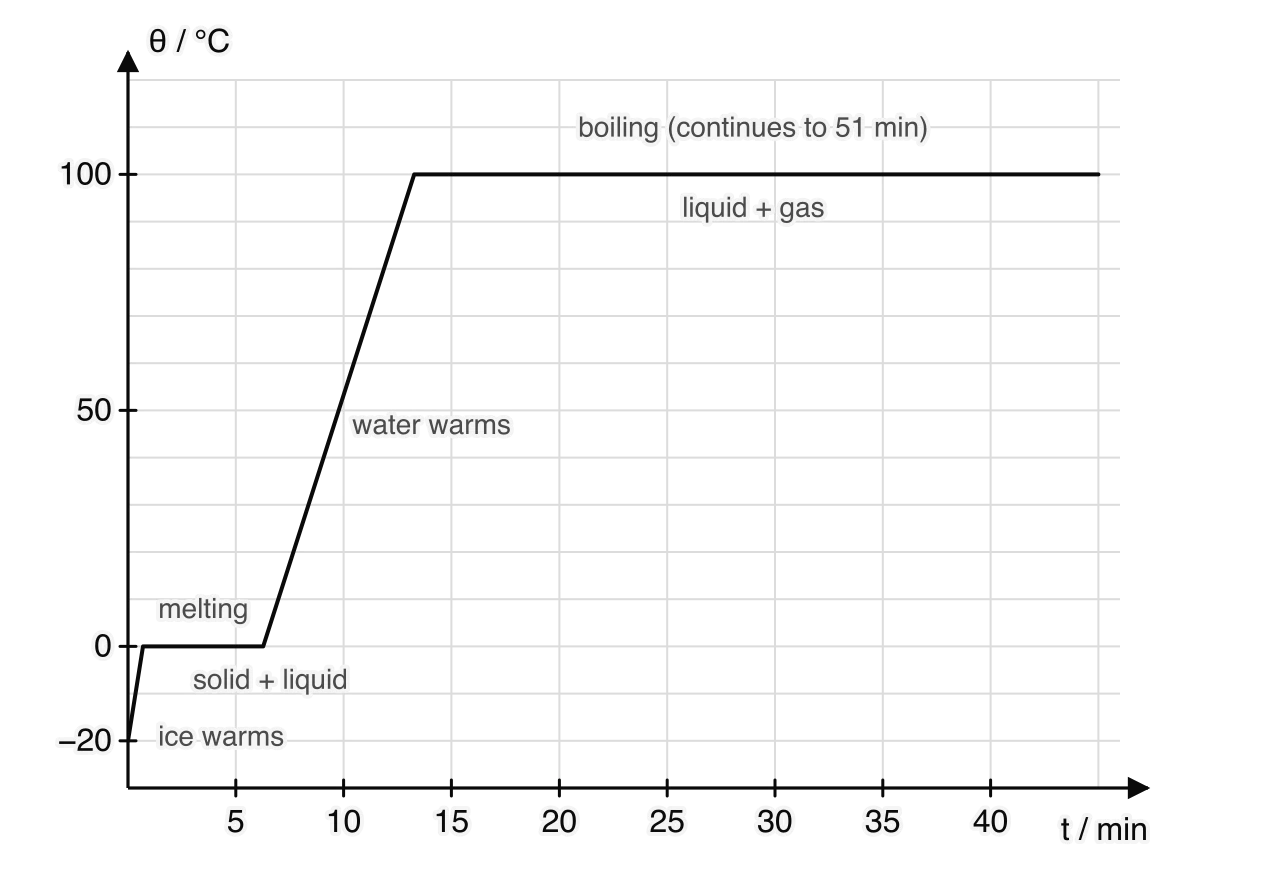
The gradient of a sloping section is , so a steeper gradient means a smaller specific heat capacity. In the heating curve of ice, the ice warms about twice as fast as the water because is about half of .
The length of a flat section is , so a longer plateau means a larger latent heat.
A cooling curve, for a substance losing energy at a steady rate, is the same shape reversed: the temperature stays constant while the liquid freezes or the gas condenses.
Phase changes and temperature changes are often combined in one problem. The energy for each stage is calculated separately and the stages are added, using the specific heat capacity of the right phase in each.
Boiling happens at one temperature for a given pressure, throughout the liquid: bubbles of vapour form inside it. Evaporation happens at any temperature, but only at the surface. The particle model explains why evaporation cools a liquid.
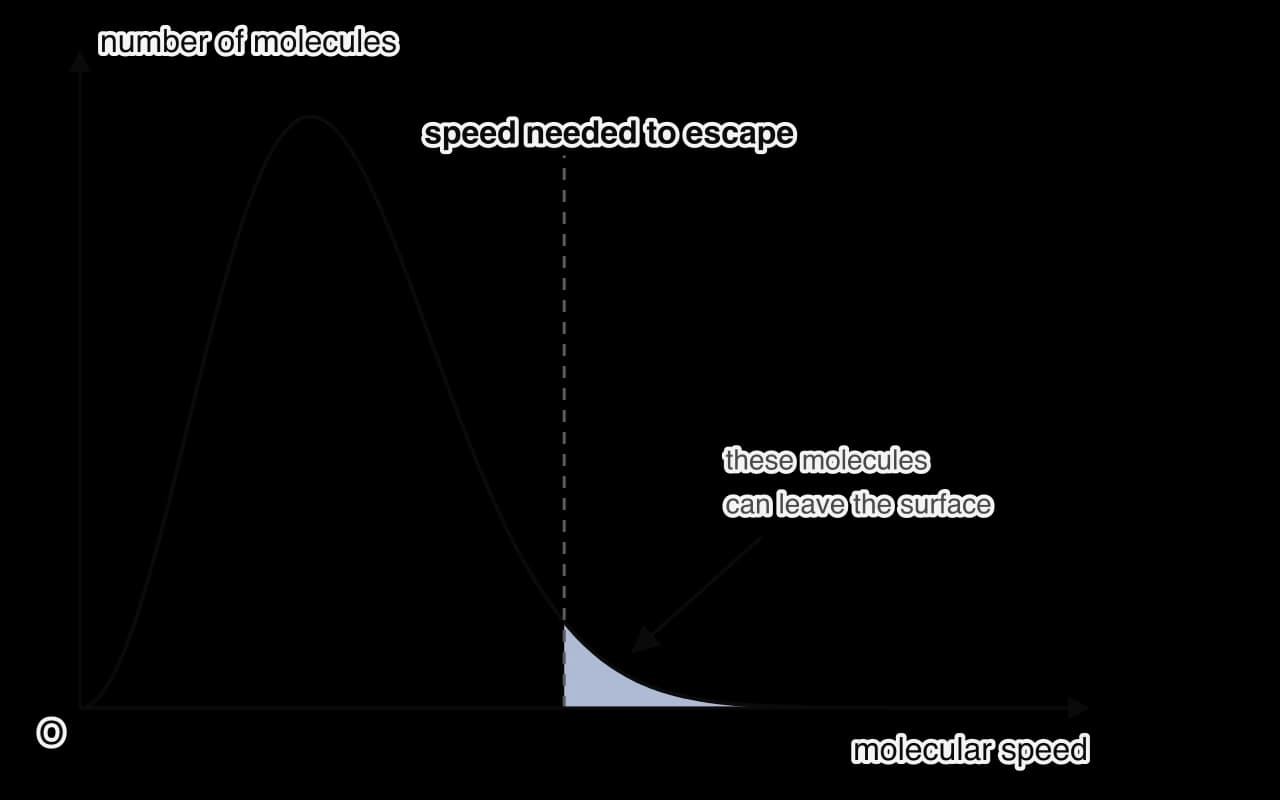
At any temperature, the molecules of a liquid have a range of speeds. Only the fastest molecules near the surface have enough kinetic energy to overcome the attraction of their neighbours and escape. Because evaporation removes the most energetic molecules, the mean kinetic energy of the molecules left behind falls, and so does the temperature of the liquid. Sweating cools the body in exactly this way: energy for the evaporation comes from the skin.
The rate of evaporation increases with:
a higher temperature (more molecules above the escape speed);
a larger surface area (more molecules at the surface);
moving air over the surface (escaped molecules are carried away before they can re-enter the liquid);
lower humidity (fewer vapour molecules in the air returning to the liquid).
 YouTube
Thermal energy is transferred by three main mechanisms: conduction, convection and thermal radiation. Conduction is the transfer of energy through a material without the material itself moving. When one end of a metal rod is heated, its particles vibrate with more kinetic energy. They collide with their neighbours and pass on some of that energy, which passes it on again, so energy moves along the rod from the region of higher temperature to the region of lower temperature.
In metals, a second, much faster process dominates. Metals contain free (delocalised) electrons that move rapidly through the lattice. Electrons in the hot region gain kinetic energy and carry it quickly to colder regions, where they transfer it in collisions with the lattice. This is why good electrical conductors are also good thermal conductors. Most non-metals have no free electrons, so they conduct only by lattice vibrations and are generally much poorer conductors. Gases are the poorest conductors of all, because their molecules are far apart and collide relatively rarely.
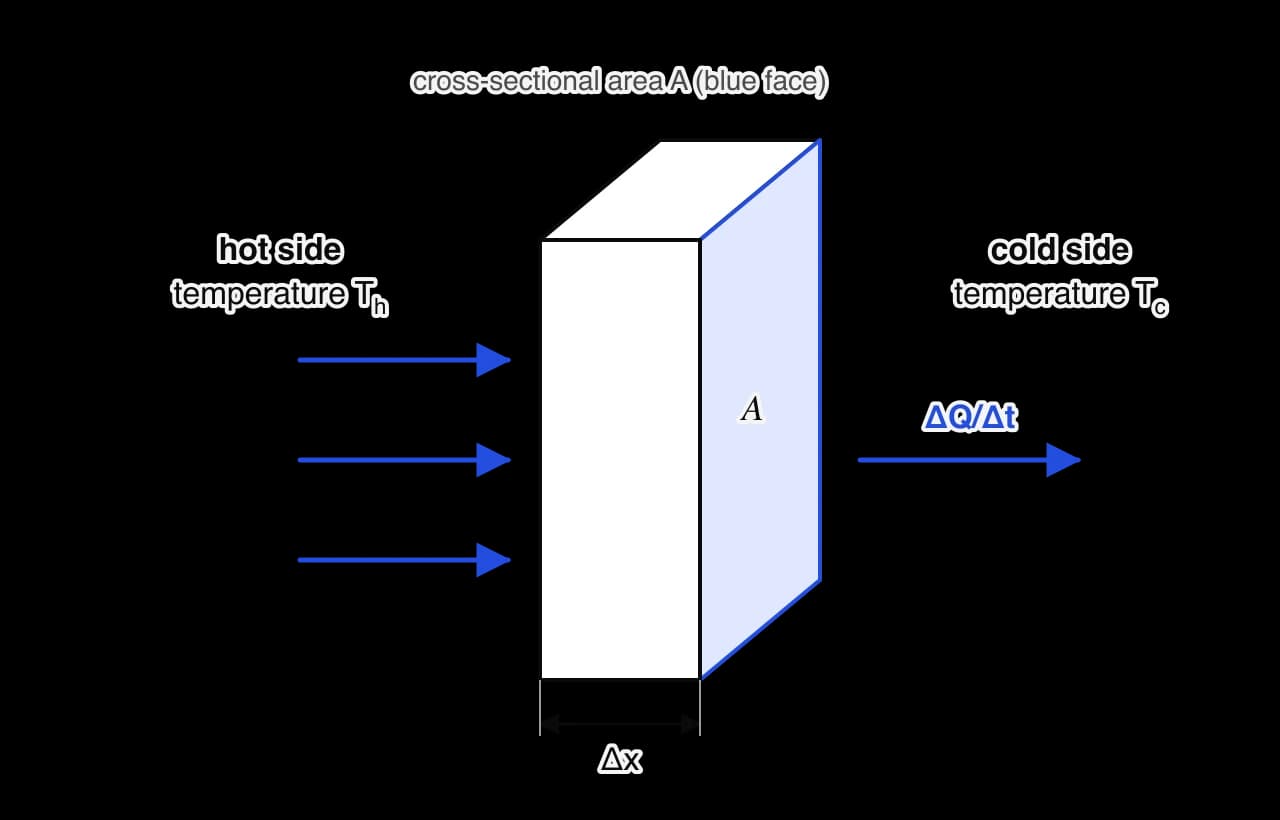
For a slab of material of cross-sectional area and thickness , with a temperature difference between its faces, the rate of thermal energy transfer by conduction is
where is the thermal conductivity of the material. The rate is a power, in watts. The quantity is the temperature gradient across the slab. Doubling the area doubles the rate; doubling the thickness halves it. Energy always flows down the temperature gradient, from hot to cold, so some versions of the equation carry a minus sign to show the direction; calculations use the magnitudes.
Material | Thermal conductivity / W m⁻¹ K⁻¹ |
|---|---|
Copper | 390 |
Aluminium | 240 |
Steel | 50 |
Glass | 0.8–1.0 |
Brick | 0.6–1.0 |
Water | 0.6 |
Wood | 0.1–0.2 |
Expanded polystyrene | 0.03 |
Air (still) | 0.025 |
Data: CRC Handbook of Chemistry and Physics, 104th edition (2023), rounded to typical room-temperature values; steel, glass, brick and wood vary with composition.
The values span more than four orders of magnitude. Good insulators, such as expanded polystyrene, wool and the down in a winter jacket, work by trapping air in small pockets where it cannot move, so energy can cross them only by conduction through the still air.
In double glazing, two panes are separated by a sealed gap of air or argon, typically 12–16 mm wide. The gas has a thermal conductivity about forty times lower than glass, and the gap is too narrow for much convection, so the rate of conduction is cut sharply.
Convection is the transfer of thermal energy by the bulk movement of a fluid (a liquid or a gas). It cannot happen in solids. When part of a fluid is heated, it expands, so its density falls. The warmer, less dense fluid rises and the cooler, denser fluid around it sinks to take its place. The result is a continuous circulation called a convection current, which carries energy from the heated region to the rest of the fluid.
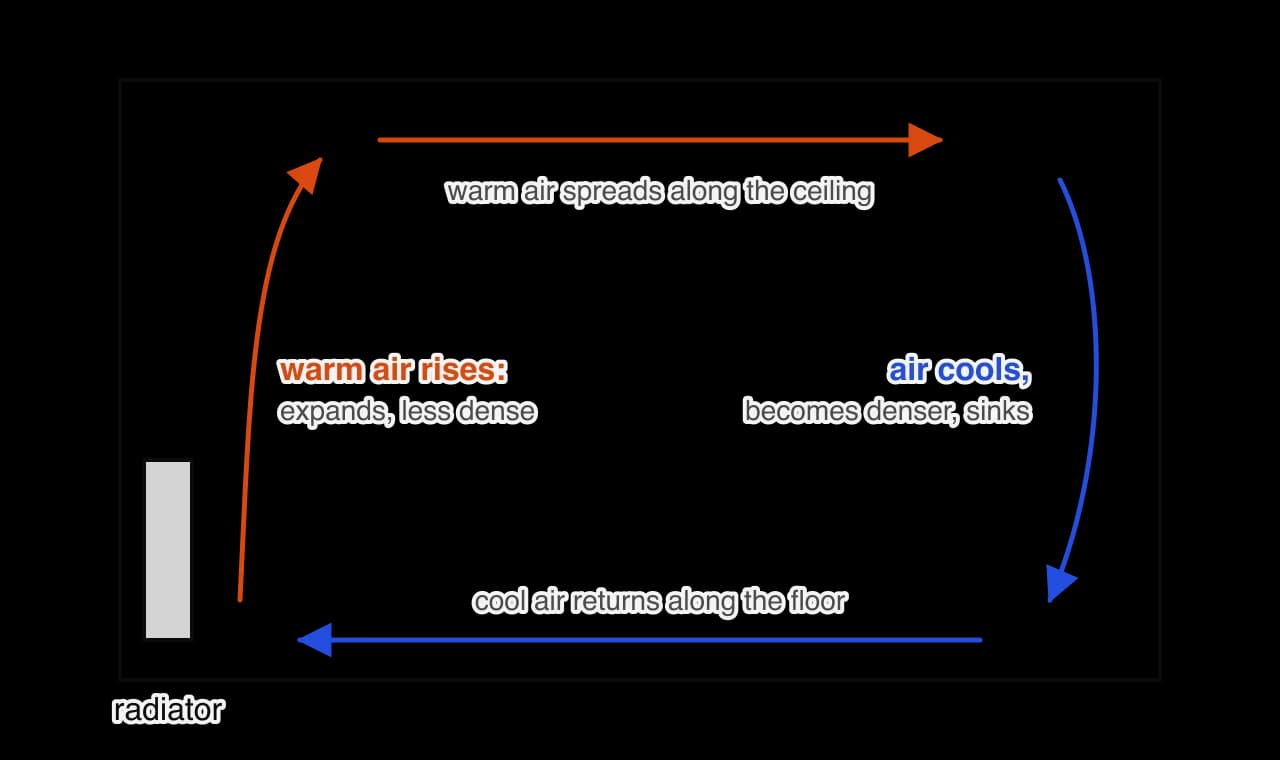
Convection currents explain many everyday and natural effects:
A radiator warms a whole room even though air is a poor conductor; heaters are placed low down and cooling units high up so that the convection current reaches the whole room.
Water in a pan heated from below warms throughout, because heated water rises from the base and cooler water sinks.
Sea breezes form on sunny days: land warms faster than the sea (it has a lower specific heat capacity), the air above the land rises, and cooler air flows in from the sea to replace it. At night the pattern reverses.
Large-scale convection in the atmosphere and oceans carries energy from the equator towards the poles, and slow convection in the Earth’s mantle contributes to the movement of tectonic plates.
Convection driven only by density differences is called natural convection. When a fan or pump moves the fluid, as in a fan heater or a car’s cooling system, the transfer is called forced convection.
All bodies at a temperature above absolute zero emit electromagnetic radiation because of the thermal motion of their charged particles. This thermal radiation needs no medium: it travels through a vacuum at the speed of light, which is how energy reaches the Earth from the Sun. At everyday temperatures almost all of it is infrared; a body must be at roughly 800 K or above before it emits enough visible light to glow red.
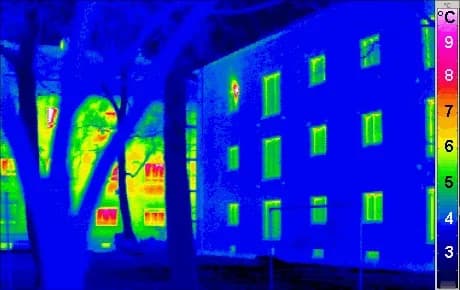
A body both emits and absorbs radiation. Its net energy gain or loss by radiation depends on its temperature relative to its surroundings. The surface also matters:
Dark, matt surfaces are good absorbers and good emitters of thermal radiation.
Light, shiny surfaces are poor absorbers (they reflect most of the radiation) and poor emitters.
This is why a vacuum flask has silvered walls (to reduce radiation), a vacuum between them (no conduction or convection) and a stopper (to stop convection and evaporation from the top), and why emergency blankets are made of shiny metallised film.
Mechanism | Needs a medium? | Where it happens | How energy moves |
|---|---|---|---|
Conduction | Yes | Mainly solids (metals best) | Particle collisions and free electrons; no bulk movement |
Convection | Yes, a fluid | Liquids and gases only | Bulk movement of fluid driven by density differences |
Thermal radiation | No | Everywhere, including a vacuum | Electromagnetic waves, mainly infrared |
To describe radiation quantitatively, physicists use an idealised emitter called a black body.
No real object is a perfect black body, but many come close. A small hole in a hollow box is an excellent example: radiation that enters bounces around inside and is almost all absorbed before it can escape. Stars, including the Sun, are good approximations, and so to a lesser extent is the Earth's surface. Real surfaces emit less than a black body at the same temperature; the ratio of the two powers is called the emissivity of the surface, a number between 0 and 1.
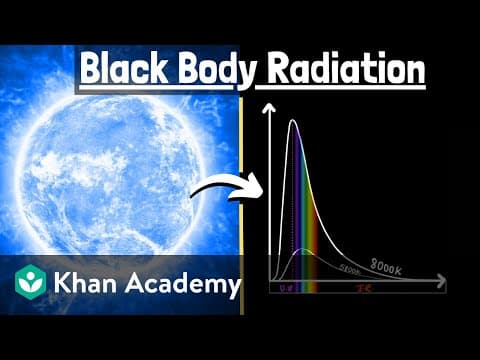
A black body emits a continuous spectrum: a range of wavelengths with a smooth peak. The shape of the spectrum depends only on the temperature.
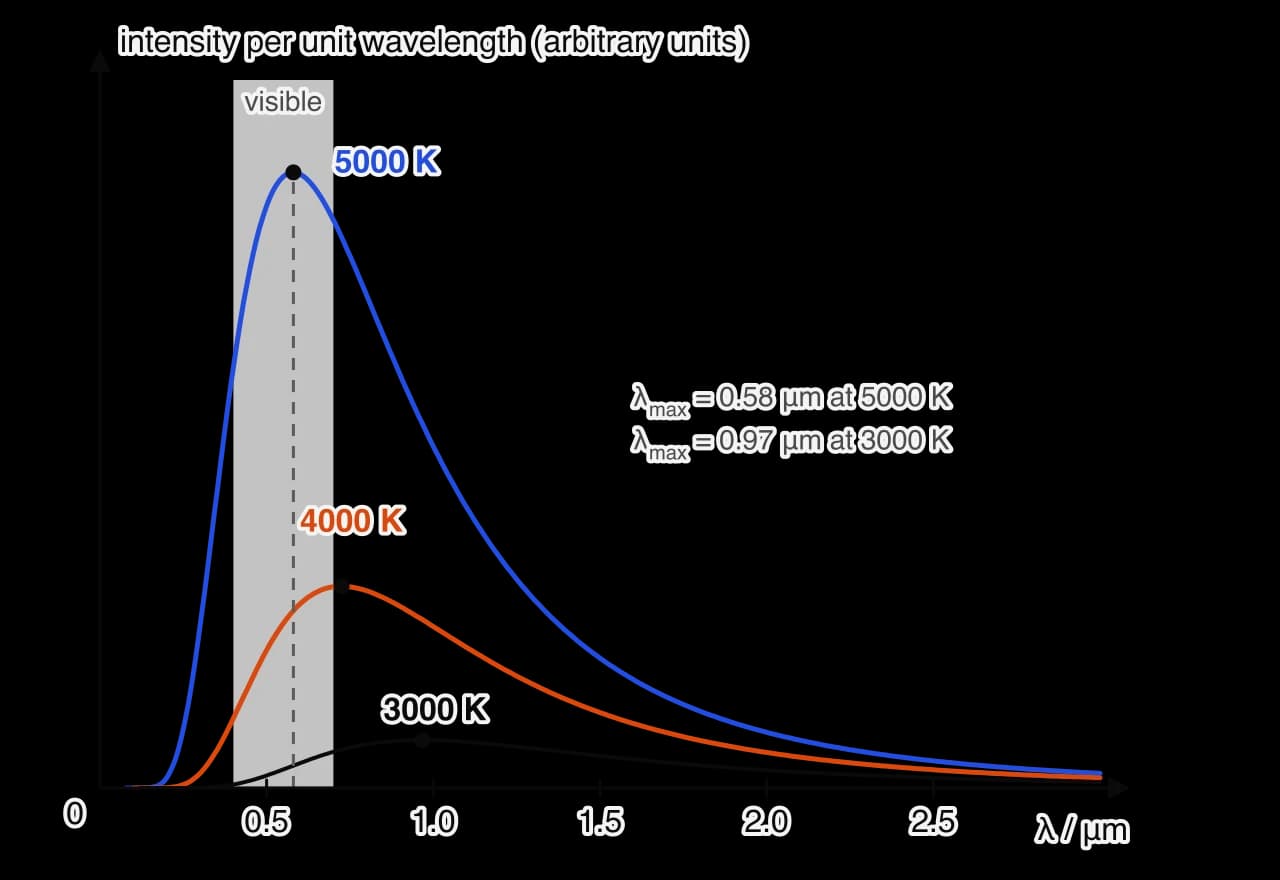
The black-body spectra at three temperatures show three features:
At every wavelength, a hotter body emits more intensely than a cooler one: the curves never cross.
The total power emitted per unit area, the area under the curve, increases very steeply with temperature, as .
The wavelength of peak emission, , gets shorter as the temperature rises. A body glows first dull red, then orange, yellow and white as it is heated, because the peak moves from the infrared towards the visible.
 YouTube
The peak wavelength is inversely proportional to the kelvin temperature. This is Wien's displacement law:
A hotter body therefore has its peak at a shorter wavelength. A body at room temperature, about 300 K, peaks near , deep in the infrared, while the filament of an incandescent lamp at about 2900 K peaks near .
Used in reverse, the law gives the surface temperature of a body that behaves like a black body from the measured peak of its spectrum. This is how the surface temperatures of stars are found.
The total power radiated by a black body is called its luminosity . It depends on the surface area and on the fourth power of the kelvin temperature. This is the Stefan–Boltzmann law:
where is the Stefan–Boltzmann constant. Because of the fourth power, a small change in temperature has a large effect: doubling the temperature multiplies the power by . For a star, which is a sphere of radius , the area is , so .
The law also applies, approximately, to everyday objects. A person with skin at about 306 K and a surface area of about 1.8 m² radiates roughly 900 W, but also absorbs radiation from the surroundings at room temperature, so the net loss is only about 100–150 W.
Luminosity is a property of the star itself. Apparent brightness depends also on how far away the observer is. Radiation leaves the star equally in all directions, so at a distance the power is spread over the surface of a sphere of area .
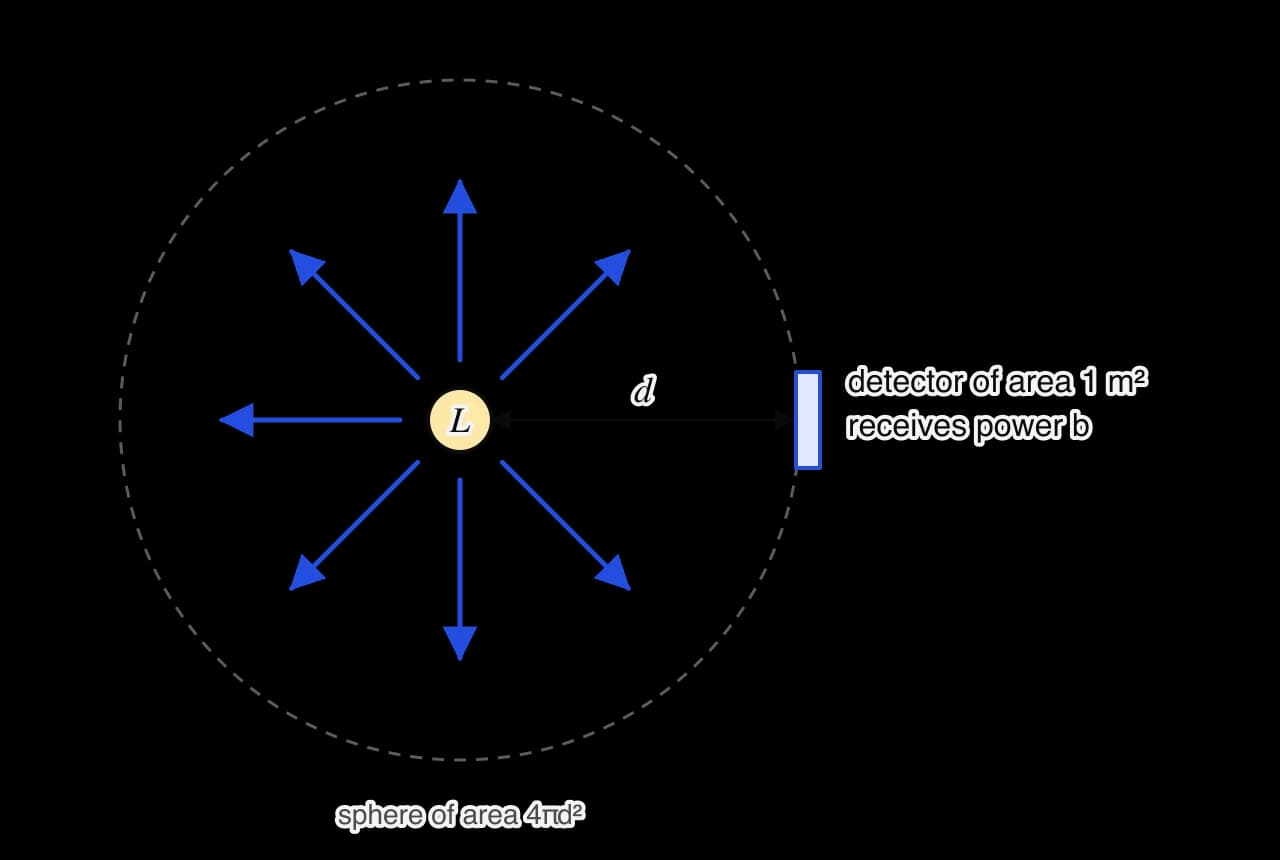
Apparent brightness obeys an inverse-square law: doubling the distance spreads the same power over four times the area, so falls to a quarter. Two stars can look equally bright if the more distant one is the more luminous. The surface area of a sphere, , is used both here and in the Stefan–Boltzmann law.
Combining the two laws lets astronomers find the size of a star they cannot resolve. Wien's law gives from the spectrum; the apparent brightness and the distance give ; then gives the radius.
The inverse-square law also compares stars directly. When two stars appear equally bright, the more luminous one must be further away, by the square root of the ratio of their luminosities.
A group of students heats of an oil in an insulated beaker with an immersion heater of constant power . They record the temperature every 60 s.
t / s ± 1 | θ / °C ± 0.5 |
|---|---|
0 | 20.0 |
60 | 25.2 |
120 | 30.6 |
180 | 35.8 |
240 | 40.9 |
300 | 46.1 |
I can describe and explain the arrangement, motion and forces of particles in solids, liquids and gases.
I can calculate density with , converting volumes to .
I can convert between Celsius and kelvin, and explain why a temperature change has the same value on both scales.
I can use and explain what temperature means on the particle model.
I can define internal energy and compare it across the phases of a substance.
I can explain why thermal energy flows from a higher to a lower temperature and what thermal equilibrium means.
I can use and , including in method-of-mixtures problems with a phase change.
I can describe an electrical method for measuring a specific heat capacity and explain the effect of energy losses.
I can interpret a heating curve, finding a specific heat capacity from a gradient and a latent heat from a plateau.
I can explain why evaporation cools a liquid and the factors that affect its rate.
I can explain conduction in terms of particles and free electrons, and use .
I can describe convection in terms of density differences in a fluid.
I can describe thermal radiation and the black-body spectrum and how it changes with temperature.
I can use Wien's law and the Stefan–Boltzmann law
I can use to find the luminosity, distance or radius of a star, including with luminosities in multiples of .
The motor has an efficiency of 75 % and is supplied at a potential difference of 600 V. Calculate the current in the motor.
2 marks
input power = «» «W» ✓
«» 150 A ✓
Accept 152 A. Allow ECF from (a)(i). Award [1] max for 85 A «efficiency multiplied».
Calculate the speed of the gondola at the end of the free fall.
2 marks
✓
✓
Accept 27.3 m s-1.
Calculate the time taken for the free fall.
1 mark
« OR » 2.8 s ✓
Outline why the seat exerts no force on a rider during the free fall.
2 marks
the rider and the seat both accelerate downwards at ✓
the weight alone provides the rider's acceleration, so no other «contact» force is needed ✓
OWTTE
Show that the deceleration of the gondola during braking is about .
2 marks
✓
«» 2.38 ✓
Must see the working AND an answer to at least 3 s.f.
Determine the force exerted by the seat on a rider of mass 70 kg during braking.
2 marks
OR ✓
«upwards» ✓
Accept 2320 N OR 2330 N from . Award [1] max for 1600 N «weight ignored».
Sketch a graph to show the variation with time of the speed of the gondola from its release until it comes to rest. Add values to the axes.
2 marks
straight line from the origin to 27 m s-1 at 2.8 s ✓
steeper straight line from there down to zero at about 4.0 s «braking time 1.2 s» ✓
Allow ECF from (b).
The brakes transfer energy to copper fins of total mass 320 kg. The specific heat capacity of copper is . Determine the rise in temperature of the fins during one ride, assuming that all the energy removed by the brakes is transferred to the fins.
3 marks
energy removed by brakes = gravitational potential energy lost over the whole 54 m drop «or kinetic energy at the start of braking + potential energy lost during braking» ✓
«» «J» ✓
«» 21 K ✓
Award [2] max for 14–15 K «kinetic energy at the start of braking only».
In practice air resistance acts on the gondola during the fall. Outline the effect of this on the speed of the gondola when braking starts and on the braking distance needed for the same deceleration.
2 marks
the speed when braking starts is less «than 27 m s-1» ✓
so a shorter braking distance is needed «» ✓
Three statements about the molecules of a liquid are:
I. The molecules vibrate about fixed positions and cannot move past one another.
II. The mean separation of the molecules is similar to that in the solid phase.
III. The attractive forces between the molecules are significant.
Which statements are correct?
At 100 °C and atmospheric pressure, liquid water has a density of and water vapour has a density of .
What is, approximately, ?
And 1 more in the data booklet.
The value agrees with the accepted density of aluminium, which is a useful check on the measurements.
Time. Power is energy per unit time, so .
This is a minimum: some energy also warms the kettle itself and escapes to the air, so the real time is a little longer.
(b) The value is slightly higher than the accepted one. Some of the energy supplied heated the heater, the thermometer and the surrounding air, or was lost to the surroundings, so the temperature rise was smaller than if all 7680 J had gone into the block. A smaller in the denominator gives a larger .
The final temperature is much closer to the water's starting temperature, because the water has far the larger heat capacity ( against ).
Equate the two. , about 59 g.
Most of the cooling comes from melting the ice rather than from warming the meltwater, which is why ice cools a drink so much better than the same mass of cold water.
About 2 kW flows through a single window, as much as a large electric heater supplies. In reality a thin layer of still air clings to each side of the glass and reduces the temperature difference across the glass itself, so the real loss is smaller, but single glazing is still a major route for energy loss from buildings.
This is over a hundred times smaller than the through the single pane with the same temperature difference. The estimate ignores convection in the gap and radiation across it, which raise the real figure, but the comparison shows why trapped air is such an effective insulator.
This agrees with the value from the Stefan–Boltzmann law to within 1%, a good check that the Sun behaves like a black body at about 5800 K.
The star is hotter than the Sun, so each square metre radiates about seven times more power; to be forty times more luminous it must also be larger, with about 5.6 times the Sun’s surface area.
C is the simple average, which ignores the different masses. D comes from giving the larger mass to the hot water. B comes from dividing the 60 °C difference by 3 instead of by 4.
D ignores the change in radius. C uses instead of (). A comes from squaring the temperature instead of raising it to the fourth power and also using rather than .
(b) OR ✓
«» ✓
Allow ECF from (a). Accept 2.2–2.3 × 10³.
(c) , so the percentage uncertainty is «%» ✓
Accept 3.8%. The uncertainties of the two readings are added.
(d) energy losses make the measured temperature rise smaller than it should be ✓
so they make the experimental larger than the true value, which is consistent with the result being larger than ✓
OWTTE. Do not award MP2 without the direction of the effect.
«W» ✓
Must see full substitution OR answer to at least 3 s.f.
(c) energy needed: «J» ✓
«s», about 46 minutes ✓
Allow use of 179 W. Allow ECF from (b).
(d) the temperature difference across the foam decreases, so the rate of conduction «and of cooling» decreases ✓
Answer must be shown to at least 3 s.f., or with full substitution.
(b) «W» ✓
✓
«m» ✓
Accept – m (using 3600 K gives m). Award [2 max] for using .
(c) «m» ✓
«ly» ✓