5.4 Drama
How plays make meaning through performance, stage space, dialogue and subtext, irony, soliloquy and structure, what tragedy and comedy are, and how to read an unseen drama extract as a script for the stage.
- IB English A: Literature
- Part of 5 Literary forms
- SL and HL
Notes on 5.4 Drama
A play is written to be performed. Its words are spoken by actors to an audience in a shared room, at a shared time, and much of its meaning lies in what the audience sees: where people stand, what they hold, who enters and who leaves. Susan Glaspell’s one-act play Trifles, first staged in Provincetown, Massachusetts, in August 1916, shows how much a script can say before anyone explains anything. Two men investigate a murder in a farmhouse kitchen, and two women wait.
A script waiting for a stage
Drama differs from the other forms in one basic way: there is no narrator. A novel can tell the reader what Mrs Peters feels as she enters; a play can only show her, and an actor must decide how. The opening of Trifles gives that decision to its first stage direction. The men are “much bundled up and go at once to the stove”, while the women “have come in slowly, and stand close together near the door”. Before a word is spoken, the stage has divided the room into two groups.
The first lines confirm the division:
COUNTY ATTORNEY: [Rubbing his hands.] This feels good. Come up to the fire, ladies.
MRS. PETERS: [After taking a step forward.] I’m not—cold.Trifles, the first two speeches
The County Attorney’s invitation sounds polite, but it also asks the women to cross into the men’s space. Mrs Peters takes one step and stops. The dash is a pause that only performance can fill. It might be shyness, or fear of the room, or a refusal to join the men; the line on the page holds all three, and an actress must choose one. A reader of a play does this choosing in the head, as a director would, so reading drama is always partly imagining performance.
Drama is a form of the present tense as well. Fiction usually reports what happened; a play makes it happen again each night, in front of people who cannot turn back a page. The audience of Trifles waits with the women while the men search upstairs, and the waiting is real time in the theater. That shared time is drama’s particular power, and many of its conventions exist to manage it.
The text and the performance
A script fixes some things and leaves others open. It fixes the words, the order of events and the characters who speak; it usually leaves open how the characters look, how fast they talk, where they stand at each moment, and what the stage looks like. A stage direction is the playwright’s way of fixing more. Glaspell’s directions are long and detailed, and they often judge as well as instruct. When the Sheriff begins the inquiry, he is told how to move:
SHERIFF: [Unbuttoning his overcoat and stepping away from the stove as if to mark the beginning of official business.]
Susan Glaspell, Trifles (1916)
The phrase “as if to mark the beginning of official business” does more than describe an action. It tells the actor, and the reader, that the Sheriff treats the step as a ceremony, and the slight irony of “as if” suggests that Glaspell finds the ceremony a little absurd. Stage directions are a second text running beside the dialogue, often in a narrator’s voice that the audience never hears. A reader of a play has access to this voice; an audience receives it only through the production.
Playwrights have used directions in opposite ways. Henrik Ibsen opens A Doll’s House (1879) with a long description of a comfortable, tastefully furnished room, the realist stage in full detail, because the room is part of his argument about a marriage. Shakespeare’s texts have few directions, mostly entrances and exits, and the most famous of them is five words long: “Exit, pursued by a bear” (The Winter’s Tale, 3.3). In Shakespeare the dialogue carries the information. Characters tell the audience where they are, what time it is and what the weather is doing, because the open daylight stage could not show it.

The photograph shows the point at which a play changes hands. The writer reads; the actors and the director listen, and from then on the production is theirs to make. Chekhov later complained that the Moscow Art Theatre staged his plays as heavier and sadder than he meant them, which shows how far a production can move from its script. When a play is analyzed in writing, the analysis is usually of the script, with an eye on the range of performances it allows.
Setting and the stage space
Every play has a setting, but the theater shows only part of it. The stage is the visible space, and what lies beyond it, offstage, can be as important. In Trifles the most important room is one the audience never sees. Hale reports what happened when he asked Mrs Wright where her husband was:
She just pointed upstairs—like that [himself pointing to the room above].
Trifles, Hale’s account
Hale’s gesture makes the room above the kitchen a presence in the play. The body is there, the men go up to examine it, and the audience hears their footsteps overhead. Keeping the crime offstage keeps attention on the kitchen, the women’s space, where the real evidence is. A realist setting like this one imitates a real room in detail, so the audience reads its objects as clues: the “unwashed pans”, the “loaf of bread outside the bread-box”, the towel half wiped across the table.
The floor plan sets out the kitchen as the stage directions place it. The men gather at the stove in the middle of the stage, the women stay near the door, and the objects that will matter (the quilt pieces, the birdcage, the sewing basket) wait on the tables and in the cupboard. The stairs lead up to the offstage crime, and the outer door leads to the barn where the men search for a motive they never find.


Other plays reject the realist room. Shakespeare’s company played on a bare platform jutting into an open yard, and a single line could turn it into a battlefield or a bedroom. Thornton Wilder’s Our Town (1938) asks for almost no scenery at all: a Stage Manager tells the audience what they are looking at, and the empty stage invites them to imagine a whole American town. A bare stage puts the weight on language and the audience’s imagination; a full one puts it on objects and on what they say about the people who own them.

The sketch shows why Shakespeare’s plays work as they do. The stage has no scenery, only two doors at the back, and the audience surrounds it on three sides in daylight. Actors on such a stage are close to the spectators and can speak to them directly, which helps explain why Shakespeare’s characters so often speak straight to the audience. The kitchen of Trifles, by contrast, assumes an audience watching through an invisible wall.
Dialogue and subtext
In a play, dialogue does almost all the work a narrator does in fiction: it moves the plot, builds character and sets the tone. But characters in plays, like people, rarely say exactly what they mean. Early in Trifles, when the Sheriff mocks Mrs Wright for worrying about her frozen jars of fruit, Hale adds a remark that gives the play its title:
HALE: Well, women are used to worrying over trifles.
(The two women move a little closer together.)Trifles
Neither woman answers, and the stage direction gives their reply instead. Moving closer together is a silent statement of loyalty and of resentment, and an audience reads it as clearly as a line. What a character means or feels beneath the words, or instead of them, is subtext. Much of the drama of Trifles lies in the gap between the men’s confident talk and the women’s careful silences.
Anton Chekhov built whole plays on subtext. The Cherry Orchard (1904) follows an aristocratic family that cannot bring itself to save its estate. Lopakhin, a merchant whose father and grandfather were serfs on the estate, has urged them for months to sell the land for summer houses. At the end of Act III he returns from the auction:
The news itself takes four short lines, from “Is the cherry orchard sold?” to “I bought it.” The exchange is flat because the meaning is too large for speech, and the actions carry it. Lubov Andreyevna nearly falls; Varya, who keeps the house, throws her keys into the middle of the floor and walks out without a word. Her gesture hands over the house, and her silence is an accusation.
Saying one thing and feeling two
Lopakhin’s long speech mixes feelings that he cannot separate. His first direction is “Confused, afraid to show his pleasure”, and the speech swings between triumph (“The cherry orchard is mine now, mine!”) and something close to shame (“Don’t laugh at me!”), although nobody is laughing. His memory of the estate “where they weren’t even allowed into the kitchen” turns a business deal into revenge for generations of servitude. Then, seeing Lubov weep, he speaks “reproachfully” and weeps himself, wishing “our uneven, unhappy life were changed”. The audience sees a man who has won what he wanted and finds that winning hurts.
Small details carry subtext too. Gaev enters crying, carrying the “anchovies, herrings from Kertch” he bought in town, and stops crying the moment he hears the click of billiard balls from the next room. His grief is real and also shallow; he can be distracted from losing his family’s land by a game. Harold Pinter, whose plays from the late 1950s are known for their pauses and silences, wrote dialogue in the same tradition: what characters avoid saying is often the center of the scene.
Dramatic irony
An audience often knows more than the characters on stage. When this happens, a character’s words carry a second meaning that the character cannot hear, and the result is dramatic irony. Shakespeare’s Othello (about 1603) sets it up in its first scene, when Iago tells Roderigo, and the audience, “I am not what I am” (1.1). From then on every character who trusts Iago speaks a line the audience knows to be false. Othello, leaving for war, puts his wife in Iago’s care:
My life upon her faith! Honest Iago,
My Desdemona must I leave to thee.William Shakespeare, Othello (about 1603), 1.3
Othello means honest as praise; the audience hears it as a sign of how completely he has been deceived. The word returns again and again through the play, applied to Iago by nearly everyone, and each repetition tightens the irony. In the last scene Emilia insists that Iago has lied, and Othello answers her by repeating the word: “My friend, thy husband, honest, honest Iago” (5.2). By then the audience hears in it the full cost of the deception.
Dramatic irony in Trifles works on a smaller scale and is turned against the men. After the women find a dead canary in Mrs Wright’s sewing box, its neck wrung, the County Attorney comes in and notices the empty cage. He asks lightly, “Has the bird flown?”, and Mrs Hale answers, “We think the—cat got it.” Earlier the audience heard Mrs Peters say there was no cat in the house. The men laugh at the women’s interest in trifles, and the audience now knows that the trifles hold the motive the men are searching for.
In tragedy this kind of knowledge can be unbearable. Sophocles’ Oedipus the King depends on the audience knowing from the start what Oedipus learns only at the end, so his determination to find the killer becomes a search for himself. Dramatic irony makes the audience a kind of witness: it cannot warn the character, and it must watch the gap between what he says and what is true.
Soliloquy and aside
Drama has no narrator, so it needs other ways to let the audience into a character’s mind. The oldest is the soliloquy, a speech by a character alone on stage, thinking aloud. By convention a soliloquy is sincere: the character may be wrong, but is not lying. In Hamlet (about 1600) the prince, left alone after watching an actor weep while performing a speech, turns on himself:
O what a rogue and peasant slave am I!
Is it not monstrous that this player here,
But in a fiction, in a dream of passion,
Could force his soul so to his own conceitWilliam Shakespeare, Hamlet (about 1600), 2.2
Hamlet is ashamed that an actor can produce real tears for an imaginary queen while he, whose father has been murdered in fact, has done nothing. The soliloquy moves as a mind moves. It begins in self-disgust, builds into a storm of insults against the king, then stops itself (“Why, what an ass am I!”) and turns, with “About, my brain!”, to a plan. It ends on a decision in a rhymed couplet: “The play’s the thing / Wherein I’ll catch the conscience of the King.” The audience has watched Hamlet think his way from paralysis to action, and it alone knows his plan.
The aside
An aside is shorter: a remark that a character makes to the audience, or to himself, while other characters are on stage and are understood not to hear. Iago uses asides to make the audience his partner. Watching Cassio greet Desdemona politely, he comments:
[Aside.] He takes her by the palm. Ay, well said, whisper. With as little a web as this will I ensnare as great a fly as Cassio.
Othello, 2.1
The aside turns an innocent courtesy into evidence before the audience’s eyes. Iago describes the scene as it happens and shows how he will use it, and the image of the web makes him a spider and Cassio his prey. Because only the audience hears him, it shares his secret whether it wants to or not. This uncomfortable closeness to a villain is one reason Othello is so hard to watch: the asides make the audience complicit in a plot it cannot stop.
Acts, scenes and the shape of a plot
Plays are divided into acts and scenes, and within them the basic unit of movement is the entrance and the exit. Each arrival or departure changes who is on stage and therefore what can be said. Trifles has no acts or scenes, only one continuous action in one room, yet its structure is clear, and it is made of exits. Every time the men leave the kitchen, the women talk more freely. The first time, Mrs Hale asks the question the men never ask aloud:
MRS HALE: Mrs Peters?
MRS PETERS: Yes, Mrs Hale?
MRS HALE: Do you think she did it?
MRS PETERS: (in a frightened voice) Oh, I don’t know.Trifles
The exchange is four lines of almost nothing, and it changes the play. Mrs Hale’s formal “Mrs Peters?” marks a step into dangerous ground, and the repetition of names on both sides shows two women testing each other before they speak. Each later exit of the men allows a further step: the uneven stitching, the broken cage, the dead bird, the memories of loneliness and loss. Each return of the men forces the women to hide what they have found. The rhythm of exits and entrances is the play’s structure.
Freytag’s pyramid
In Die Technik des Dramas (1863) the German novelist Gustav Freytag described the plot of a five-act tragedy as a pyramid. The exposition sets out the situation; a rising action builds the conflict; the climax is the turning point at the top; a falling action follows; and the denouement, or catastrophe in tragedy, settles the outcome. Freytag drew his model from Greek and Shakespearean tragedy, but it can be laid over many later plays. The diagram maps it onto Henrik Ibsen’s A Doll’s House (1879), whose three acts follow it closely until the last scene.


In the first act Nora tells her friend Mrs Linde that she secretly borrowed money years ago to save her husband’s life. Krogstad, the lender, holds a bond that Nora signed with her dying father’s forged signature, and he threatens to expose her, and his letter lies in Helmer’s locked letterbox through the second act. Helmer reads it in the third. The climax is his rage, and the falling action is his relief when Krogstad returns the bond. A conventional play would end with the couple reconciled. Instead Nora sits her husband down for a serious conversation, the first of their marriage, and then leaves him and her children.
George Bernard Shaw argued in The Quintessence of Ibsenism (revised in 1913) that this final discussion was Ibsen’s great technical innovation: the play stops resolving its plot and begins to argue about it. The pyramid has no place for such an ending. Freytag’s model also fits Trifles poorly, since the climax there is a silent look between two women, and it fits Chekhov hardly at all, since his decisive events (the auction, a duel, a death) often happen offstage. The pyramid is a useful first map of a plot, and its failures are often the most interesting thing about a modern play.
The audience: the fourth wall and the chorus
Every play decides how it will treat its audience. Realist plays such as Trifles and A Doll’s House pretend that the audience is not there: the stage is a room with one wall removed, and the characters behave as if no one were watching. This convention is the fourth wall. It lets the audience feel that it is overhearing real lives, and it makes any moment that breaks it (a character turning to speak to the spectators) a shock.
Older and newer theaters break the wall openly. The asides of Shakespeare’s villains speak straight to the audience, and the twentieth-century German playwright Bertolt Brecht broke it deliberately so that spectators would think critically instead of losing themselves in the story, a method he called the alienation effect. The oldest way of addressing the audience is the chorus. In Greek tragedy a group of performers sang and danced between the episodes of the action, commenting on events, warning the characters and drawing lessons. Sophocles’ Antigone (about 441 BCE) ends with the chorus speaking directly to the audience:
Of happiness the chiefest part
Is a wise heart:
And to defraud the gods in aught
With peril’s fraught.
Swelling words of high-flown might
Mightily the gods do smite.Sophocles, Antigone, translated by F. Storr (1912), the final chorus
The chorus turns the catastrophe into a lesson in a few rhymed lines, and the change of voice from the suffering king to the calm group tells the audience how to leave the theater. A chorus often speaks for the community, the citizens who watch their rulers fall. Its distance from the action is part of its meaning: it reminds the audience that what it has seen will be remembered and judged.
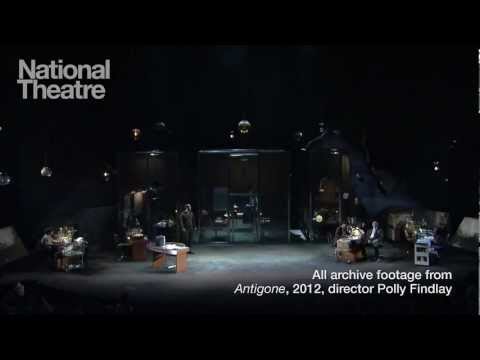 YouTube
In performance a chorus speaks and moves as one body, which is hard to imagine from the page, where its lines look like any other character’s. Seeing it staged shows how a group of voices can feel like the city itself watching.
Modern plays have kept the chorus in new forms. In Thornton Wilder’s Our Town a single Stage Manager stands at the side of the stage, introduces the townspeople, tells the audience what will happen to them years later, and even plays small parts. He is a chorus of one, and his calm foreknowledge turns ordinary days into something the audience watches with the knowledge that they will end.
Tragedy
Tragedy is the oldest named kind of drama, and the first account of it is Aristotle’s Poetics (about 335 BCE). Aristotle describes a serious action that arouses pity and fear in the audience and ends in their catharsis. He also gives the terms in which tragedy has been analyzed ever since. Sophocles’ Antigone shows them at work in its king, Creon. Creon has forbidden anyone to bury Polyneices, a rebel against Thebes, and Antigone, the dead man’s sister, defies him. When his son Haemon pleads for her, Creon answers with a claim to absolute power:
HAEMON: A State for one man is no State at all.
CREON: The State is his who rules it, so ’tis held.Sophocles, Antigone, translated by F. Storr (1912)
The line-by-line exchange of a dispute like this is a Greek convention, stichomythia, and it makes the argument sound like a duel. Creon’s answer shows hubris, a pride that refuses limits, whether set by the gods, the law or other people. He will not be taught by his son, by the citizens or, at first, by the blind prophet Teiresias, who warns him that the gods are offended. Only when Teiresias predicts the death of his own son does Creon give way.
Reversal and recognition
Creon’s decision to free Antigone comes too late. She has hanged herself in the tomb where he shut her, Haemon kills himself beside her, and Creon’s wife, hearing the news, kills herself too. His attempt to put things right produces the opposite of what he intends, and this sudden reversal is peripeteia. It is followed by anagnorisis, the recognition of the truth, when Creon returns carrying his son’s body:
CREON: The fault was mine, mine only, O my son!
CHORUS: Too late thou seemest to perceive the truth.Sophocles, Antigone, translated by F. Storr (1912), the last scene
Aristotle valued plots in which reversal and recognition come together, as they do here. Creon’s understanding arrives at the moment it can no longer help anyone, and the chorus states the cruelty plainly in one line. The audience feels pity for a man who has lost everything and fear at how quickly certainty turned to ruin.
The tragic hero and the tragic error
Creon fits the shape Aristotle describes for a tragic hero: a person of high standing, neither wholly good nor wicked, whose own error brings his fall. The error is named before it destroys him. Teiresias tells Creon exactly what he has done wrong:
For that thou hast entombed a living soul,
And sent below a denizen of earth,
And wronged the nether gods by leaving here
A corpse unlaved, unwept, unsepulchered.Sophocles, Antigone, translated by F. Storr (1912), Teiresias to Creon
The prophet’s charge is a double reversal of the natural order: the living Antigone is shut in a tomb, and the dead Polyneices is left above ground. The rhythm of the last line, three words of denial built on the same prefix, makes the offense sound like a ritual curse. Creon has confused the realms of the living and the dead, and the gods of the underworld are the ones he has wronged.
Creon’s hamartia is a misjudgment: he places the law of the city above the claims of family and the gods. Whose tragedy the play is remains disputed. In his Lectures on Aesthetics (published 1835) the philosopher G. W. F. Hegel read Antigone as a collision between two justified claims, the state’s and the family’s, each partly right. Against that reading, the play itself takes sides: Teiresias says the gods reject Creon’s decree, and the play ends on Creon’s guilt, not on Antigone’s. A student can argue either position, using the ending as evidence.
Later tragedy
Shakespeare’s tragedies keep the fall of a great figure but add what Greek tragedy rarely shows: the inner life, through soliloquy, of the hero who falls. The critic A. C. Bradley, in Shakespearean Tragedy (1904), read these plays as tragedies of character, in which a great nature is ruined by one weakness, such as Othello’s jealousy. In his essay “Tragedy and the Common Man” (1949) the American playwright Arthur Miller argued that ordinary people could be tragic heroes. His Death of a Salesman, staged the same year, gives the fall to a failing traveling salesman. Tragedy has moved from kings to salesmen, but it keeps its center: a person whose choices destroy what he values.
Comedy, farce and tragicomedy
Comedy moves in the opposite direction from tragedy: from confusion and disorder to a restored, usually happier order. Shakespeare’s romantic comedies send lovers into a forest or a disguise, tangle their identities and affections, and bring them back to society to marry; Twelfth Night ends with three couples married or promised. The ending matters because it is social as well as personal. A comedy closes by repairing the community that its opening disrupted.
Comedy takes many forms. The comedy of manners, from the Restoration stage to Oscar Wilde’s The Importance of Being Earnest (1895), laughs at the codes of a social class through wit. Farce is comedy at its most physical: improbable situations, mistaken identities, slammed doors and rising speed, in which characters are trapped by events faster than they can think. Farce asks the audience to laugh at what happens to people, not to understand them.
Tragicomedy
Some plays refuse to be either tragedy or comedy. Chekhov called The Cherry Orchard a comedy in four acts, and complained when its first production in 1904 played it as a solemn tragedy. The end of Act III shows why both labels fit. At the height of his triumph, as he leaves the room, Lopakhin stumbles:
LOPAKHIN: What’s that? Bandsmen, play nicely! Go on, do just as I want you to! [Ironically] The new owner, the owner of the cherry orchard is coming! [He accidentally knocks up against a little table and nearly upsets the candelabra] I can pay for everything now!
Anton Chekhov, The Cherry Orchard, Act III, translated by Julius West (1916)
The clumsy collision is close to farce, and it comes seconds after Lubov Andreyevna has collapsed weeping. The new owner of the estate cannot yet move through its rooms without knocking things over, and his boast that he “can pay for everything” is undercut by the candelabra he nearly breaks. The scene invites laughter and grief at once, and neither cancels the other. This mixture is tragicomedy.
In the twentieth century the mixture became a mode of its own. Samuel Beckett subtitled the English version of Waiting for Godot (1954) “a tragicomedy in two acts”: its tramps clown with hats and boots while waiting for someone who never comes. The plays of the theater of the absurd use the timing of comedy to show a world without meaning, so the laughter itself becomes uneasy.
Stagecraft as meaning
A play speaks through objects, light, sound and music as well as words. In a performance these elements are as deliberate as dialogue, and many of them are written into the script. In Trifles the broken birdcage becomes evidence through a gesture the stage directions specify:
(She reaches over and swings the broken door, swings it again, both women watch it.)
Trifles
Nobody speaks. The repeated swing of the broken door shows the violence done to it, and the women’s silent watching lets the audience realize, a moment before they do, what it means. A prop like this is a symbol in motion. A few lines later Mrs Hale says that Minnie Foster was “kind of like a bird herself”, so the cage can be read as her marriage and the silenced bird as the girl who once sang in the choir. A reader of the script sees only a direction; an audience watches two actresses stare at a swinging door, and the silence carries the meaning.
Light, sound and props
Other playwrights use light and sound in the same way. In Tennessee Williams’s A Streetcar Named Desire (1947) Blanche DuBois covers a bare light bulb with a paper lantern, because she cannot bear to be seen in harsh light. Later Mitch tears the lantern off to look at her plainly, and the bulb becomes the play’s image of truth as an assault. A polka tune plays whenever Blanche remembers her young husband’s death, so the audience hears her memory as she does. In A Doll’s House Nora eats macaroons her husband has forbidden and lies about them in the first act, a small deceit that foreshadows the larger one.
Chekhov used sound to say what no one in his plays will say. In Act II of The Cherry Orchard a distant, unexplained sound like a breaking string interrupts a conversation and leaves the characters uneasy. At the end of the play, after the family has left, the audience hears the sound of axes cutting down the trees. These sounds do not advance the plot; they make the loss audible.
Traditions of the stage
Theater has served different purposes in different places, and each tradition has its own idea of what a stage should show. Hamlet, advising a company of actors on how to perform, states one idea that has shaped Western drama ever since:
…the purpose of playing, whose end, both at the first and now, was and is, to hold as ’twere the mirror up to nature;
William Shakespeare, Hamlet, 3.2
Hamlet’s mirror is an image of theater as imitation: the stage should show human beings as they are. The realist drama of the late nineteenth century took this idea to its limit, with real furniture, everyday speech and the fourth wall. But many traditions never aimed at a mirror. Greek actors wore masks and the chorus sang. The Noh theater of Japan, from around 1400, uses masks, slow stylized movement and a bare roofed stage. Sanskrit drama such as Kalidasa’s Shakuntala mixes prose and verse and aims to call up a particular emotional flavor (rasa) more than to imitate life.
The timeline sets out the main traditions in order, without a scale, since they span two and a half thousand years. Western theater moved from Greek tragedy through the religious mystery and morality plays of the Middle Ages to the commercial playhouses of Shakespeare’s London. After the theaters reopened in 1660, Restoration comedy brought witty, worldly plays about manners and money. Realism followed with Ibsen and Chekhov, then the experiments of the twentieth century: Brecht’s epic theater, Beckett’s absurd.


Postcolonial and contemporary theater has joined these traditions together. Wole Soyinka’s Death and the King’s Horseman (1975) builds a tragedy from Yoruba ritual, song and dance, in which performance traditions of masquerade and praise-singing carry meaning beside the dialogue. Athol Fugard in South Africa, Caryl Churchill in Britain and August Wilson in the United States have each bent realism to show history pressing on private lives. The tradition a play belongs to tells a reader what kind of truth it is aiming at.
Reading an unseen drama extract
An unseen extract from a play is a script without a production, and the reader has to stage it. The opening of Trifles shows the questions that do this. In the order they are most useful, they ask who is on stage and where, what each character wants, where power lies and how it shifts, what the stage directions add, and what the scene is about beneath its action.
Who is on stage, and where
The first stage direction (line 1) sets a “gloomy kitchen” left “without having been put in order”, with “other signs of incompleted work”. A house where work has stopped halfway suggests a life interrupted. Five people enter, and the direction divides them at once: three men go “at once to the stove”, two women “stand close together near the door”. The men are named by office (the Sheriff, the County Attorney) or by surname, and the women by their husbands: “the Sheriff’s wife”, “Mrs. Hale”. Before anyone speaks, the stage shows who has authority and who is there as company.
What each character wants
The dialogue shows three men with three aims. The Sheriff wants to defend his handling of the case: “I want you to know I had my hands full yesterday” (line 8). The County Attorney wants a clear account and asks twice for it: “tell just what happened” (line 9). Hale wants to tell the story in his own way, and his way includes details the Attorney does not want. When Hale remarks that he “didn’t know as what his wife wanted made much difference to John” (line 10), the Attorney cuts him off: “Let’s talk about that later, Mr. Hale” (line 11).
That interruption is the first clue in the play, and the men pass over it. Hale has touched on the marriage, the motive the case needs, and the official in charge sets it aside to hear about the morning. The audience does not yet know this matters, but the play has already shown what kind of evidence these investigators will ignore.
Where power lies, and how it shifts
The men hold the floor; the women say nothing after Mrs Peters’s first line, and the direction at line 12 notes that they are “still standing” by the door. Yet one moment shifts the stage’s attention away from the men. When Hale says that Mrs Wright sat “in that rocker”, the direction reads “[They all look at the rocker.]” (line 13). For a moment everyone, characters and audience alike, stares at an empty chair. The absent woman controls the stage through an object, a choice the play will repeat with the quilt, the cage and the box.
Hale’s account of Mrs Wright adds the play’s most disturbing image: a woman rocking and “pleating” her apron while she says, “He died of a rope round his neck” (line 21). Her flat replies (“Is it?”, “’Cause he’s dead”) and the domestic action of pleating make a frightening contrast. The County Attorney’s questions are broken by dashes, “And how did she—look?” (line 16), which an actor might play as a lawyer choosing his words, or as a young man uneasy about describing a woman’s state of mind. Either way, the men are trying to read a woman and failing.
From reading to thesis
These observations add up to a thesis about the scene. The opening of Trifles gives the men the words and the women the silence. Its stage directions, though, keep the audience’s eyes on the women and on Mrs Wright’s empty rocker, so that the scene quietly asks who is able to read this kitchen. The thesis names a pattern (talk against silence), the method that creates it (stage directions, the rocker) and the question it raises, which the rest of the play will answer.
Try it
Why might Glaspell have the County Attorney cut Hale off at line 11? What does the interruption tell an audience about him, and about the play to come?
The interruption shows the Attorney deciding what counts as evidence. Hale was about to talk about the Wrights’ marriage, which is in fact where the motive lies, and the Attorney postpones it in favor of a timeline of the morning. An audience may not notice at first, but the moment sets up the play’s irony: the men’s method keeps them from seeing what the women will find. It also characterizes the Attorney as efficient, impatient and confident that he already knows how to look.
Trifles from opening to verdict
Followed through to its end, Trifles shows how a play builds meaning from small objects and silences. Each time the men leave, the women find another sign of Minnie Wright’s life. There are the jars of fruit that froze, the quilt with one block sewn “all over the place”, the birdcage with its door “broke”, and finally, in a pretty box in the sewing basket, the canary with its neck wrung. Each object is a “trifle” to the men, and each moves the women closer to understanding what happened and why.
The women act as well as notice. Mrs Hale pulls out the uneven stitching, so the evidence of Minnie’s nervousness disappears. Mrs Peters, the Sheriff’s wife, has insisted that “the law is the law”. Now she remembers a boy who killed her kitten with a hatchet and says, “If they hadn’t held me back I would have—hurt him.” The dash marks the moment she understands Minnie from the inside. Mrs Hale turns the understanding into guilt, crying that her own failure to visit her neighbor “was a crime! That was a crime! Who’s going to punish that?”
The last minute of the play is almost wordless. Mrs Peters tries to hide the box in her bag and cannot; Mrs Hale snatches it and puts it in her coat pocket as the men return. The County Attorney makes a last joke about the quilt:
COUNTY ATTORNEY: (facetiously) Well, Henry, at least we found out that she was not going to quilt it. She was going to—what is it you call it, ladies?
MRS HALE: (her hand against her pocket) We call it—knot it, Mr Henderson.Trifles, the last lines
The final line is dramatic irony at its sharpest. To the Attorney knot it is quilting jargon; to the audience it recalls the knot of the rope around John Wright’s neck, and Mrs Hale’s hand on her pocket shows the evidence she is keeping from him. The women have tried the case and reached a verdict the men will never hear. Glaspell made the point explicit in the title of her short story version, “A Jury of Her Peers” (1917). In 1916 women in most American states could not sit on juries, so the only jury of Minnie’s peers is the one the audience has just watched.
Where drama’s edges blur
Not every text in dialogue is meant for a stage, and not every play is written for one. Much of the world’s drama is written in verse, from Greek tragedy to Shakespeare, and verse drama brings poetry’s compression and rhythm to speech. The radio play, such as Dylan Thomas’s Under Milk Wood (1954), which he called a play for voices, works only through sound. The closet drama, such as Percy Bysshe Shelley’s Prometheus Unbound (1820), is written in dramatic form to be read rather than performed. Whether a screenplay counts as drama for a reading list depends on how it is published and on the school’s decision.
From the other side, poetry can borrow the stage. Browning’s “My Last Duchess” opens like a scene, with a speaker, a listener, a curtain and a portrait:
That’s my last Duchess painted on the wall,
Looking as if she were alive. I call
That piece a wonder, now: Fra Pandolf’s hands
Worked busily a day, and there she stands.
Will’t please you sit and look at her?Robert Browning, “My Last Duchess” (1842), lines 1–5
The lines include a gesture toward the painting, an invitation to sit and, a few lines later, a curtain the Duke draws back. A reader stages them in the head exactly as a reader stages Trifles. The dramatic monologue is a play with one speaking part, and reading it well uses the same questions: who is present, what the speaker wants, and what he gives away. The border between the forms shows what drama most depends on: a voice placed before someone who watches and judges.
Writing about a play
Writing about drama goes wrong most often when it forgets the stage. The two versions that follow are about the same moment in Trifles, the discovery of the canary.
Weak: In Trifles the women find a dead bird. This shows that Mrs Wright killed her husband because he killed her bird.note 1 The bird is a symbol of Mrs Wright.note 2
Strong: Glaspell never lets the women say what the canary means.note 3 After Mrs Peters whispers that someone “wrung—its—neck”, the direction gives only “Their eyes meet. A look of growing comprehension, of horror”,note 4 and when Mrs Hale slips the box under the quilt pieces as the men come in, the audience watches evidence turn into a secret.note 5
Plot as analysis. The sentence retells the event and states the motive. It says nothing about how the play presents the discovery.
An assertion, not an argument. The symbol is named but not explained, and the sentence ignores what the audience sees on stage.
A claim about method. The sentence identifies a choice the playwright made: the meaning is never spoken.
Stage directions as evidence. The broken speech and the silent look are quoted as part of the text.
The audience’s position. The analysis ends with what the audience experiences, which is where a play’s meaning is made.
The strong version treats the play as a performance. It quotes a stage direction as readily as a line, notices what is not said, and describes what the audience sees and knows. These are the habits that separate an essay on a play from an essay on a story.
Applying it in Paper 2
Paper 2 asks for a comparative essay on two works studied, written without the texts, and plays raise a particular problem: the essay must remember a performance as well as words. The strongest essays on drama use staging, structure and the audience as evidence. They recall a stage direction (Mrs Hale’s hand on her pocket), a pattern of entrances and exits, or a moment of dramatic irony, and say what it does, alongside a few exact short quotations.
Comparing a play with a novel makes the form itself a point of comparison. A sentence such as the following does this. Kate Chopin’s narrator in The Awakening can tell the reader what Edna feels as she walks into the sea. Ibsen must show Nora’s decision through action, an argument and a door closing offstage, so the audience of A Doll’s House has to supply the feeling that the novel states. The comparison is about method as well as about two women leaving their lives.
The commonest way to lose marks is to discuss a play as if it were a novel. Characters “think” and “feel”, the plot is retold, and the stage disappears, so the essay has nothing to say about how the playwright made the work.
Drama’s building blocks return in the chapters on structure, on narrative voice (where the play’s lack of a narrator is set beside fiction’s), and in the questions about how conventions such as tragedy are kept and broken. A play is also the clearest case of a text whose meaning changes with every audience and every production.
Self-check
- To do:
I can explain what drama can do that other forms cannot, and read a script as a performance waiting to happen.
- To do:
I can analyze what stage directions, setting and offstage space contribute to a scene.
- To do:
I can distinguish dialogue from subtext and show how silence and action carry meaning.
- To do:
I can explain dramatic irony, the soliloquy and the aside, and what each lets an audience know.
- To do:
I can map a plot onto Freytag’s pyramid and say where a modern play departs from it.
- To do:
I can use Aristotle’s terms for tragedy on a real play, and distinguish comedy, farce and tragicomedy.
- To do:
I can outline the main traditions of theater history and place a play within them.
- To do:
I can read an unseen drama extract from first impressions to a thesis, and write about plays from memory with staging as evidence.
Key terms
Each is also in the Literary forms glossary for IB English A Lit, beside the other terms of its topic.
- Anagnorisis
The moment in a drama when a character passes from ignorance to knowledge, recognizing the truth about a person, a situation or himself or herself. In tragedy it often comes too late to prevent the fall.
- Aside
A short remark that a character speaks to the audience, or to himself or herself, which other characters on stage are understood not to hear. It shares a secret with the audience in the middle of a scene.
- Chorus
In Greek drama, a group of performers who sing, dance and comment on the action between and during episodes; more broadly, any character or group that stands partly outside a play's action and comments on it for the audience.
- Climax
The point of highest tension in a plot, where the central conflict reaches its turning point and the outcome is decided. In five-act tragedy it traditionally falls near the middle of the play.
- Comedy
A drama that moves from confusion or disorder to a happy resolution and a restored social order, traditionally ending in marriage or reconciliation. Its humor ranges from gentle romance to sharp satire of manners and types.
- Denouement
The final part of a plot, after the climax, in which the conflict is resolved and loose ends are tied up. Its name comes from the French for "untying".
- Dialogue
Conversation between characters in a work of literature. In drama it is the main means by which the story moves forward and characters are built, since there is usually no narrator to explain them.
- Drama
Literature written to be performed by actors before an audience, in which a story is shown through characters' speech and action rather than told by a narrator. A play's text is a script that is completed in performance.
- Dramatic irony
The situation in which the audience knows something that a character on stage does not, so that the character's words or actions carry a meaning he or she cannot see. It can produce tension, pity or comedy.
- Farce
A kind of comedy built on improbable situations, physical action, mistaken identity and fast timing, in which characters are pushed into absurd predicaments. It asks the audience to laugh at what happens to people rather than to think about who they are.
- Fourth wall
The imaginary wall between the stage and the audience in realist theater, through which the audience watches characters who behave as if no one were there. Breaking the fourth wall means addressing or acknowledging the audience directly.
- Hamartia
Aristotle's word for the error or misjudgment by which a tragic hero brings about his or her own fall. It is often translated as "tragic flaw", but it names a mistaken act or judgment more than a fixed defect of character.
- Hubris
Excessive pride or self-confidence that leads a person to defy the limits set by gods, laws or other people. In tragedy it often drives the hero toward the error that ruins him or her.
- Peripeteia
A sudden reversal in a tragic hero's situation, in which an action produces the opposite of what was intended or expected. Aristotle counted it, with recognition, among the parts of a tragic plot that move an audience most.
- Soliloquy
A speech in which a character alone on stage speaks his or her thoughts aloud, heard by the audience but by no other character. It gives the audience direct access to a mind, as a narrator does in fiction.
- Stage direction
The written instructions in a play, outside the dialogue, that describe setting, entrances and exits, actions, gestures and how lines are spoken. They are part of the playwright's text and can carry tone and judgment as well as instructions.
- Subtext
What a character thinks, feels or means beneath the surface of what he or she says. The audience infers it from context, timing, silence and action, and it often contradicts the words spoken.
- Tragedy
A serious drama in which a central figure, usually of high standing, falls from good fortune to suffering and often death, partly through his or her own actions. The fall usually brings a recognition of the truth, and it is meant to move the audience to pity and fear.
- Tragic hero
The central figure of a tragedy, admirable enough for the fall to matter, whose own error, choice or quality helps bring that fall about. The audience feels both sympathy for the hero and recognition that the suffering was in part self-made.
- Tragicomedy
Drama that mixes tragic and comic elements, so that suffering and absurdity sit side by side without the play resolving into either. In modern theater it often leaves the audience unsure whether to laugh or grieve.
Practice questions on 5.4 Drama
Augment’s own questions, written in the style of IB exam papers. Here is how a few of them start.
Practice all 45 questions on 5.4 Drama
Free with an account. Write your answer, open the markscheme beside it and mark yourself. Augment keeps the ones you got wrong for another go.
More in 5 Literary forms
The whole topic is on its own page.
- 5.1Prose: fiction
- 5.2Prose: non-fiction
- 5.3Poetry
- 5.4DramaThis page
Carry on with 5.4 Drama in Augment
With a free account, Augment remembers where you stopped in the notes and which questions you have marked.