A.3 Work, energy and power questions for IB Physics
213 questions on Work, energy and power, written by Augment in the style of IB exam papers. Six of them are below in full, to answer on paper.
- IB Physics
- Part of A Space, time and motion
- SL and HL
Questions by paper and level
SL and HL questions are for students at either level. HL only questions cover what only HL students study.
| Paper | SL and HL | HL only | All |
|---|---|---|---|
| Paper 1A | 50 | 12 | 62 |
| Paper 1B | 8 | 1 | 9 |
| Paper 2 | 77 | 65 | 142 |
| Every paper | 135 | 78 | 213 |
Counted on
Questions to try
Written by Augment in the style of IB exams, not past papers. Answer them on paper, then check each one against its markscheme with a free account.
Two identical stones are thrown with the same speed from the same point at the top of a sea cliff. Stone P is thrown horizontally. Stone Q is thrown at above the horizontal. Air resistance is negligible. Which quantity is the same for both stones?
A student investigates her power output when she runs up a flight of stairs at school. She measures the vertical height of the flight with a tape measure and her mass with a digital bathroom scale:
A friend times five runs with a stopwatch that reads to 0.01 s. In each run the student starts from rest at the bottom step.
Run | / s |
|---|---|
1 | 2.84 |
2 | 2.91 |
3 | 3.62 |
4 | 2.78 |
5 | 2.87 |
In run 3 the student slipped on a step.
- (a)(i)
Calculate the mean time for the student to run up the stairs. Give your answer to an appropriate number of decimal places.
2 marks
- (a)(ii)
Estimate the absolute uncertainty in the mean time.
1 mark
- (b)
Show that the average useful power developed by the student is about 600 W.
2 marks
- (c)(i)
Calculate the percentage uncertainty in the power.
2 marks
- (c)(ii)
Hence state the power with its absolute uncertainty.
1 mark
- (d)
The friend's reaction time causes him to start the stopwatch late but stop it on time in every run. Explain the effect of this on the calculated power.
2 marks
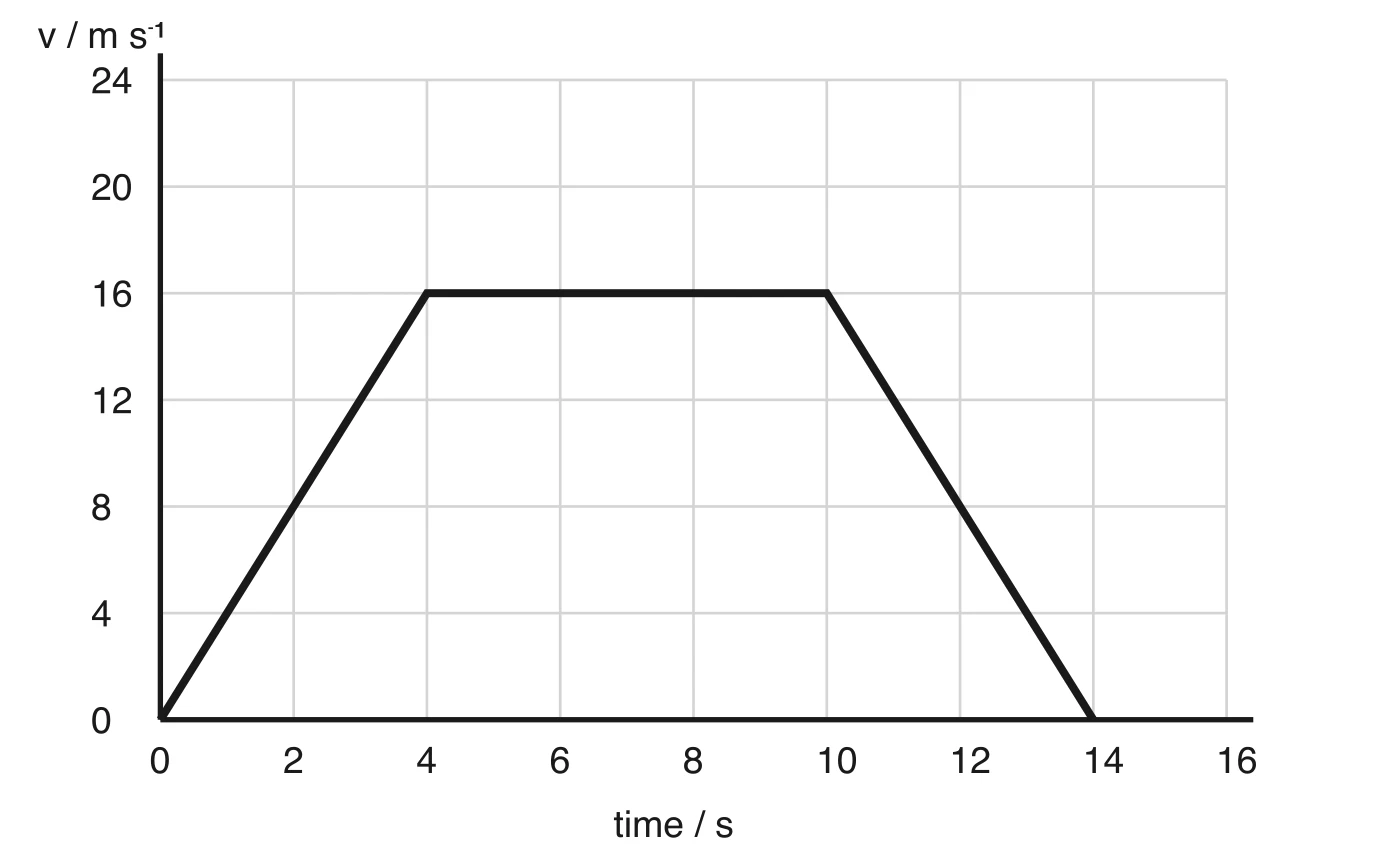
A cyclist of total mass 80 kg rides along a straight, level road. The graph shows how her velocity changes with time .
- (a)
Calculate her acceleration during the first 4.0 s.
2 marks
- (b)
Determine the total distance travelled.
2 marks
- (c)(i)
Calculate her maximum kinetic energy.
1 mark
- (c)(ii)
Calculate the average power with which she gains kinetic energy in the first 4.0 s.
2 marks
A pendulum bob is held at X with its string taut and is then released from rest. When the string becomes vertical it catches on a fixed peg P directly below the point of suspension O. Air resistance is negligible.
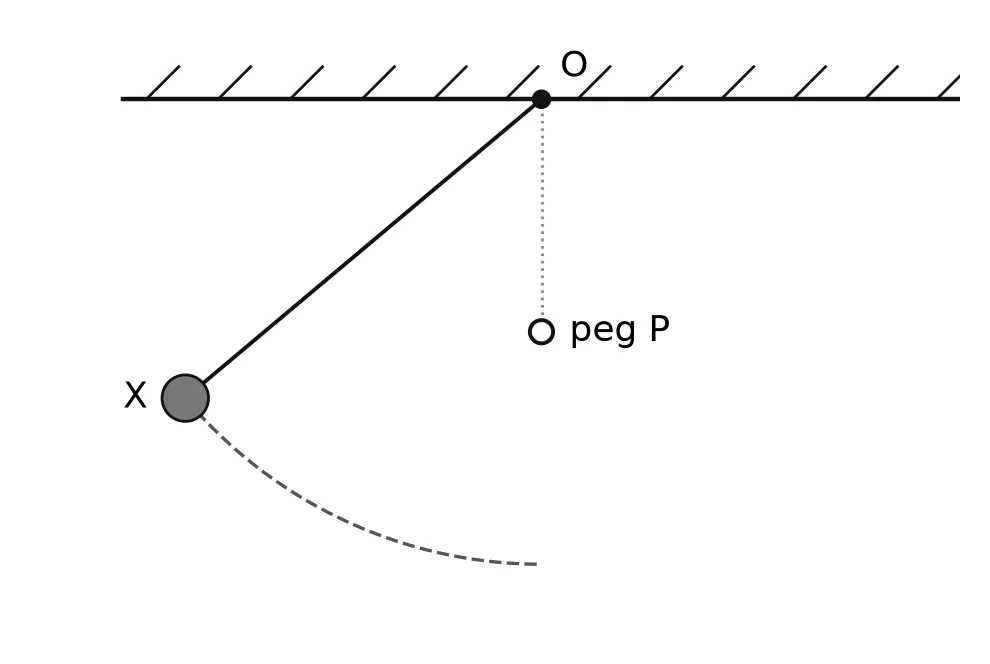
On the other side of the peg, the bob rises
A group of students investigates a spring-loaded launcher that fires a small plastic ball of mass 15.0 g vertically upwards. The spring is compressed by a distance and released. The students use a video recording against a vertical scale to find the maximum height that the ball rises above its release point.
The students predict that all the elastic potential energy stored in the spring is transferred to the gravitational potential energy of the ball at its highest point.
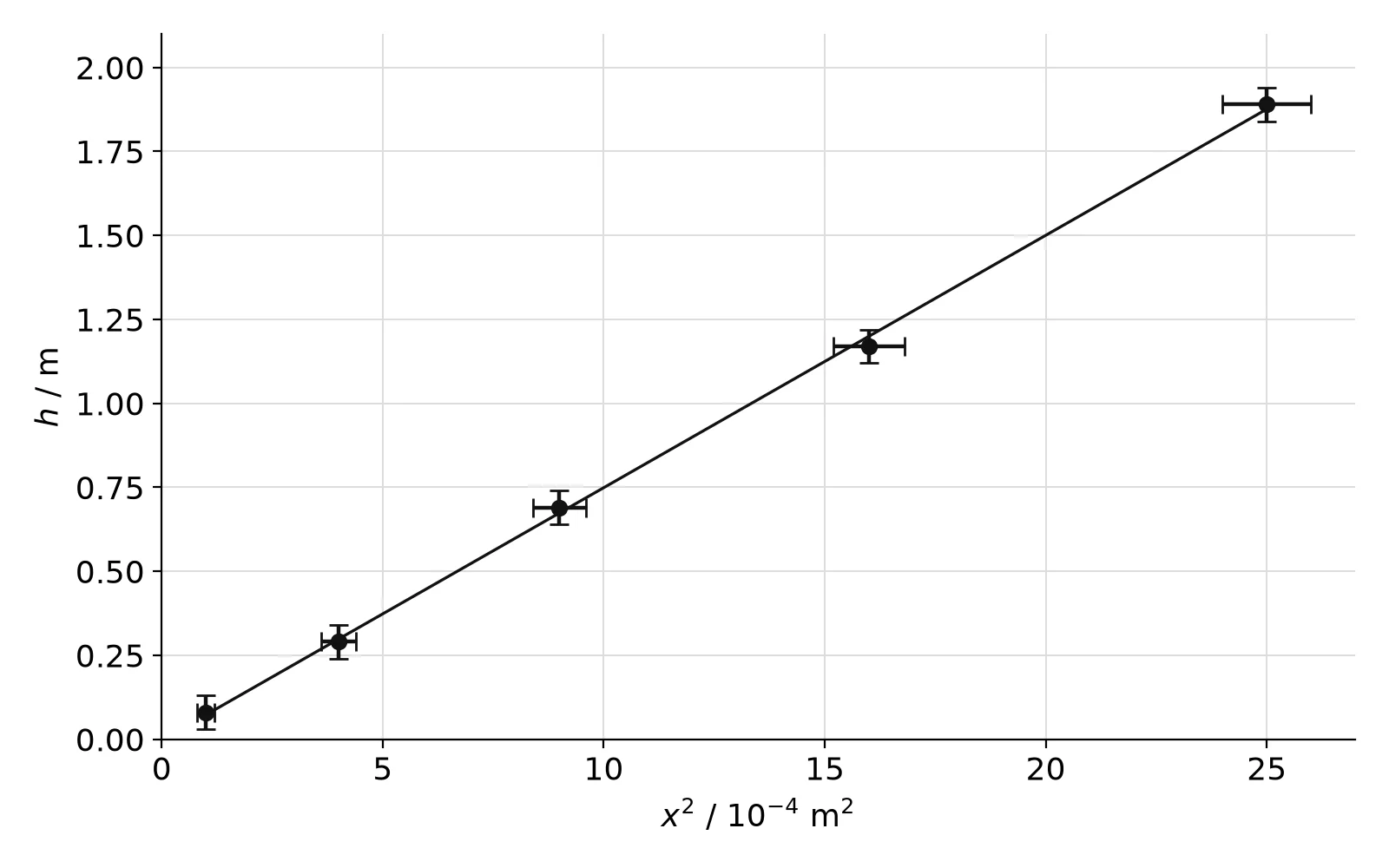
The graph shows the variation of with , with error bars and the line of best fit.
- (a)
Explain why the students expect the graph of against to be a straight line through the origin.
2 marks
- (b)(i)
The compression is measured with an uncertainty of . Calculate the absolute uncertainty in when .
2 marks
- (b)(ii)
Outline why the horizontal error bars become longer as increases.
1 mark
- (c)(i)
Determine, using the graph, the spring constant of the spring.
3 marks
- (c)(ii)
State the unit of the gradient of the graph.
1 mark
- (d)
The manufacturer states that . Suggest why the value obtained from the graph is smaller than this.
2 marks
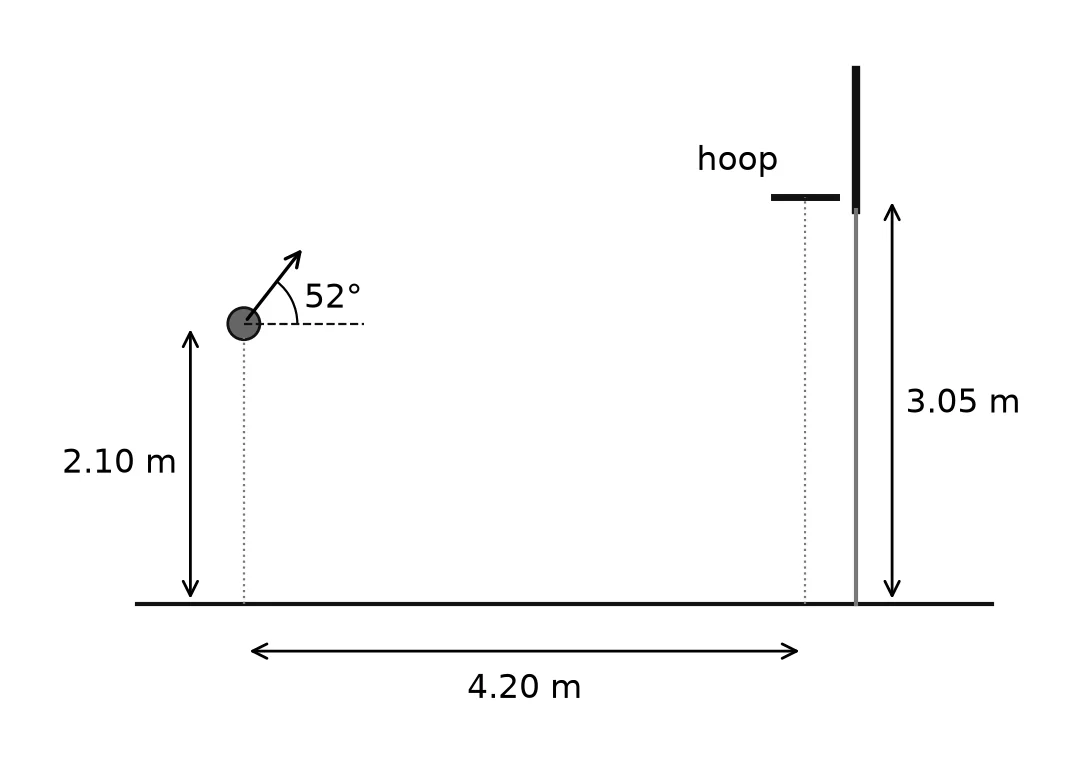
A basketball player takes a free throw. The ball leaves her hands at a height of 2.10 m above the floor with a speed of at an angle of above the horizontal. The centre of the hoop is 3.05 m above the floor and a horizontal distance of 4.20 m from the point of release. Treat the ball as a point and ignore air resistance.
- (a)
Show that the horizontal component of the initial velocity of the ball is about .
1 mark
- (b)
Calculate the time taken for the ball to travel a horizontal distance of 4.20 m.
1 mark
- (c)
Determine whether the ball is moving upwards or downwards when it reaches the hoop.
2 marks
- (d)
Calculate the height of the ball above the floor when it has travelled a horizontal distance of 4.20 m.
2 marks
- (e)
Calculate the maximum height of the ball above the floor.
2 marks
- (f)
Determine, using conservation of energy, the speed of the ball when it reaches the hoop.
2 marks
- (g)
In practice air resistance acts on the ball. Outline how the player must change the speed of release, at the same angle, for the ball to reach the hoop.
1 mark
Practice all 213 in Augment
Free with an account. Every question has its markscheme, and Augment keeps the ones you got wrong so you can come back to them.
More questions in Space, time and motion
- A.1Kinematics
- A.2Forces and momentum
- A.3Work, energy and powerThis page
- A.4Rigid body mechanicsHL only
- A.5Galilean and special relativityHL only
Check your answers in Augment
A free account opens all 213 questions on Work, energy and power with their markschemes, and keeps a record of what you have marked.