The energy stored in a body because it is deformed. For a spring obeying Hooke's law, EH=21kΔx2
Notes on A.3 Work, energy and power
46 min readLast reviewed
Questions on A.3
213 exam-style questions on this subtopic, written in the style of the IB papers. The first has its markscheme open. Counted on
Question 1 · PHY-000047 marks
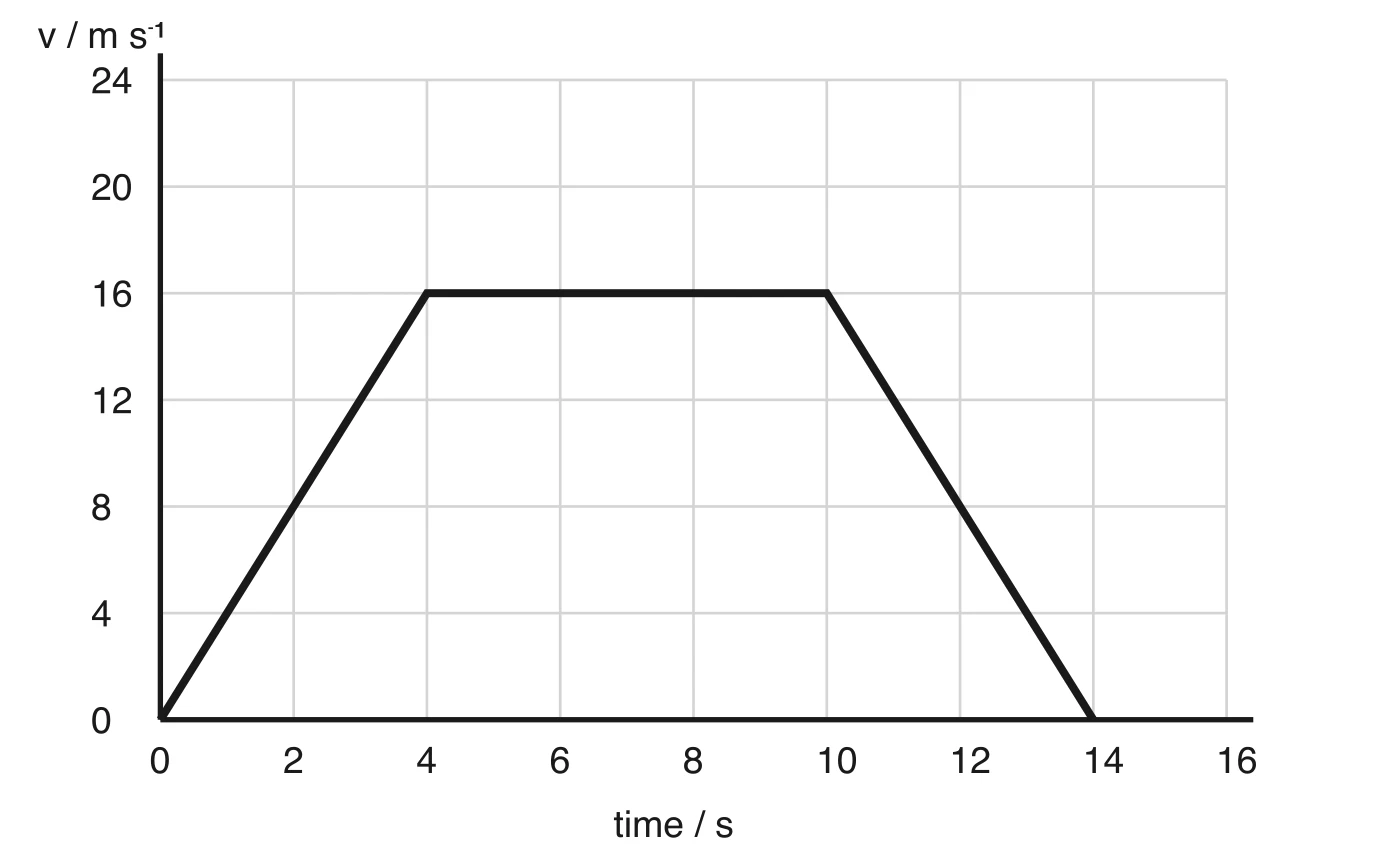
A cyclist of total mass 80 kg rides along a straight, level road. The graph shows how her velocity v changes with time t.
Velocity–time graph for the cyclist.
(a)
Calculate her acceleration during the first 4.0 s.
[2]2 marks
Markscheme (a)
a=4.016−0
Try a quick-fire question
One of 75 short multiple-choice questions on A.3. Pick an answer to see why it's right or wrong.
A pendulum of length 1.0m is released from rest with its bob 0.20m above its lowest point. Fluid resistance is negligible; take g=10m s−2. What is the speed of the bob at its lowest point?
Flashcards for A.3
The official deck for this part of the syllabus.
A.3 Work, energy and power · front
What is energy, and is it a scalar or a vector?
A.3 Work, energy and power · front
State the principle of conservation of energy.
A.3 Work, energy and power219 cards
From the data booklet
The entries of the physics data booklet that A.3 uses. Each opens in the explained booklet.
The sum of the kinetic, gravitational potential and elastic potential energy of a system. It is conserved when no friction or other resistive force does work.
A diagram of energy transfers in which the width of each arrow is proportional to the energy or power it represents; useful output runs straight on and wasted energy branches away.
The energy transferred when a force moves its point of application: W=Fscosθ for a constant force, where θ is the angle between the force and the displacement. Measured in joules.
The work done by the resultant force on a body equals the change in its kinetic energy.
.
Efficiency compares the useful energy (or power) out with the total energy (or power) in.
The energy density of a fuel is the energy it releases per unit volume.
Energy is the quantity that links every part of physics. A car accelerating, a pendulum swinging, a power station supplying a city and a star shining all transfer energy from one form to another, and in every case the total amount stays the same. Bookkeeping of energy is often the quickest way to solve a mechanics problem: it gives a speed or a height without any need to know how the forces varied along the way.
Work, energy and power also describe how useful a machine is. Engineers compare engines, motors, lamps and fuels by how much energy they deliver, how quickly, and how much they waste. Those comparisons drive decisions from the design of a phone charger to the choice of fuel for an aircraft.
Energy and the principle of conservation
Energy is the capacity of a system to do work. It is a scalar quantity measured in joules (J). Energy is not a substance, although it can be moved from one body to another and changed in form while the total amount stays the same.
An isolated system is a collection of bodies that exchanges no energy with its surroundings. In practice no real system is perfectly isolated, so physicists draw a boundary around the bodies of interest and track the energy that crosses it. When a ball is thrown upwards, for example, the system "ball and Earth" can be treated as isolated if fluid resistance from the air is negligible: kinetic energy becomes gravitational potential energy and back again, and nothing leaves.
The principle of conservation of energy is one of the most thoroughly tested ideas in science. No experiment has ever found it violated. When measurements of beta decay in the 1920s seemed to break it, some physicists, Niels Bohr among them, considered giving it up. In 1930 Wolfgang Pauli kept the principle by proposing a new, almost undetectable particle, later named the neutrino, to carry the missing energy; it was detected in 1956.
Forms of energy
Energy is stored and carried in many forms. The forms that appear most often in mechanics are listed with the others met elsewhere in physics.
Form
Associated with
Example
Kinetic energy
Motion of a body
A moving car or a falling stone
Gravitational potential energy
Position of a mass in a gravitational field
Water held behind a dam
Elastic potential energy
Deformation (stretch, compression, bending)
A compressed spring or a drawn bow
Chemical energy
Arrangement of atoms in molecules
Petrol, food, a battery
Internal energy
Random kinetic and potential energy of particles
Hot water, warm brakes
Electrical energy
Charges moving through a potential difference
Current in a heater
Nuclear energy
Binding of nucleons
Uranium fuel in a reactor
Radiant energy
Electromagnetic waves
Sunlight
When friction acts, or a ball hits the ground, the ordered kinetic energy of a body becomes the disordered random motion of its particles. This is internal energy, often described in everyday language as "heat". Energy that ends up spread out as internal energy of the surroundings is said to be dissipated: it still exists, but it can no longer do useful work. Internal energy and heating are studied further in thermal physics.
Work done by a force
A force does work on a body when the body moves in the direction of the force (or has a component of its motion in that direction). Pushing hard against a wall that does not move does no work on the wall, however tiring it feels. Lifting a box onto a shelf does work, because the lifting force moves its point of application upwards.
W=Fscosθ
One joule is the work done when a force of 1 N moves its point of application through 1 m in the direction of the force: 1J=1N m=1kg m2s−2. A joule is a small amount of energy: lifting an apple (about 1 N) from the floor to a table (about 1 m) takes roughly 1 J.
Forces at an angle to the motion
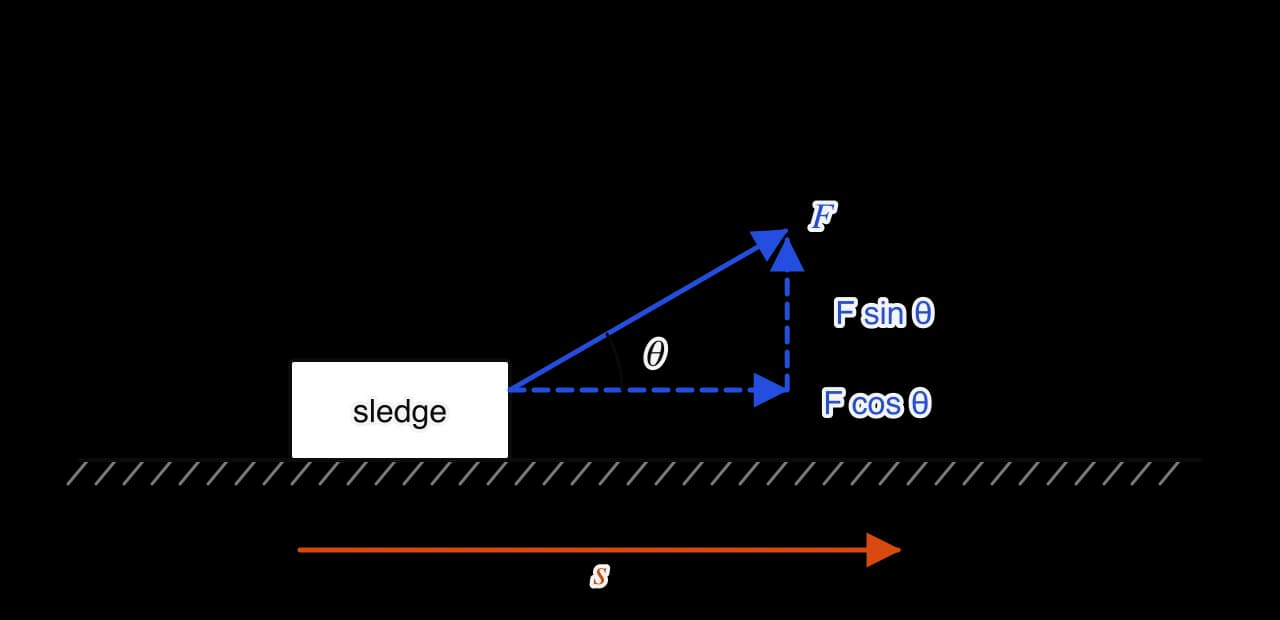
When a force acts at an angle to the direction of motion, only its component along the displacement does work. A sledge pulled by a rope at an angle θ above the ground moves horizontally, so the horizontal component Fcosθ does work and the vertical component Fsinθ does none.
Only the component of the force along the displacement, F cos θ, does work on the sledge. The vertical component F sin θ is perpendicular to the motion. Forces are blue; the displacement is orange.
The two ways of reading W=Fscosθ give the same answer: either the component of the force along the displacement (Fcosθ) multiplied by s, or the force F multiplied by the component of the displacement along the force (scosθ).
Positive, negative and zero work
The sign of the work depends on the angle θ between the force and the displacement. Because cosθ is positive for angles below 90°, zero at 90° and negative above 90°, a force can transfer energy to a body, take energy from it, or do nothing to its energy.
Angle θ
cos θ
Work done by the force
Example
0°
1
Positive, W=Fs: energy transferred to the body
An engine pushing a car forwards
90°
0
Zero: no energy transferred
The normal force on a car on level road; the tension in a string whirling a ball in a circle
180°
−1
Negative, W=−Fs: energy transferred from the body
Friction on a sliding box; gravity on a rising ball
A force perpendicular to the velocity changes the direction of motion but not the speed. That is why the centripetal force in uniform circular motion does no work: a satellite in a circular orbit keeps a constant kinetic energy even though gravity pulls on it all the time.
Work done by a varying force
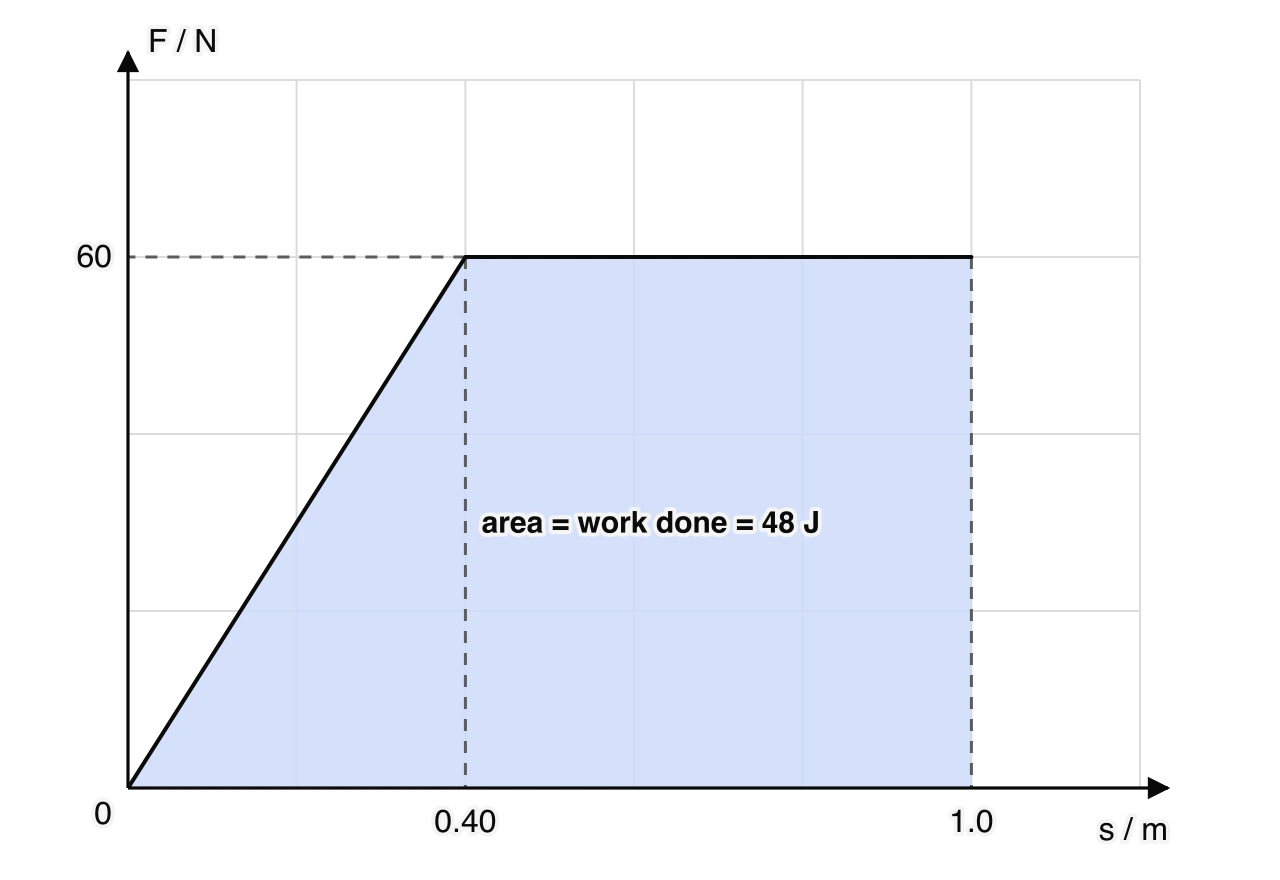
W=Fscosθ applies only when the force is constant. When the force changes as the body moves, the displacement is split into small steps, each with an almost constant force. The work in each step is a thin strip of area FΔs under the force–displacement graph, and adding all the strips gives the total area.
The work done by a varying force is the area under its force–displacement graph: here a triangle of 12 J plus a rectangle of 36 J.
Work as a transfer of energy
Doing work is one of the main ways of transferring energy. When a force does positive work on a body, energy is transferred to the body; when it does negative work, energy is transferred out. The other main way, heating, transfers energy because of a temperature difference and is treated in thermal physics.
This equivalence is the reason work and energy share the joule. It also gives a practical way to measure energy: the energy stored in a stretched spring is the work done stretching it, and the energy a lift motor supplies is the work it does raising the lift.
Three kinds of work appear again and again in mechanics, each matched to a form of energy:
work done by the resultant force changes the kinetic energy of a body;
work done against gravity is stored as gravitational potential energy;
work done stretching or compressing an elastic body is stored as elastic potential energy.
Work done against friction or fluid resistance is not stored in a way that can be recovered: it becomes internal energy of the surfaces and the surrounding air.
Kinetic energy
Ek=21mv2=2mp2
Kinetic energy is a scalar and is never negative, because v2 is positive whichever way the body moves. It depends on the square of the speed, so doubling the speed of a car multiplies its kinetic energy by four, and the brakes must do four times as much work to stop it.
Where ½mv² comes from
A resultant force F accelerates a body of mass m from rest through a displacement s. The work done is W=Fs. Newton's second law gives F=ma, and the kinematic equation v2=u2+2as with u=0 gives s=v2/2a. So
W=Fs=ma×2av2=21mv2
The work done by the resultant force is the kinetic energy gained, which is why the kinetic energy has this form.
Ek of a 1000 kg car
Kinetic energy rises with the square of the speed: from 10 to 20 m s⁻¹ it rises fourfold, from 50 kJ to 200 kJ; at 30 m s⁻¹ it is nine times the value at 10 m s⁻¹.
Kinetic energy and momentum
Because momentum is p=mv, the speed is v=p/m, and substituting into 21mv2 gives Ek=p2/2m. This form is useful in collisions and explosions, where momentum is conserved and the question is how the kinetic energy is shared.
Gravitational potential energy
Lifting a mass m through a height Δh at constant speed needs an upward force equal to its weight mg. The work done is mgΔh, and this energy is stored as gravitational potential energy of the mass and the Earth.
ΔEp=mgΔh
Only changes in gravitational potential energy have physical meaning. Any convenient level, such as the floor, the ground or the lowest point of a swing, can be chosen as zero, and the answer to a problem does not depend on the choice. The same body could be said to have positive potential energy on a table measured from the floor, and negative potential energy measured from the ceiling.
Only the change in height matters
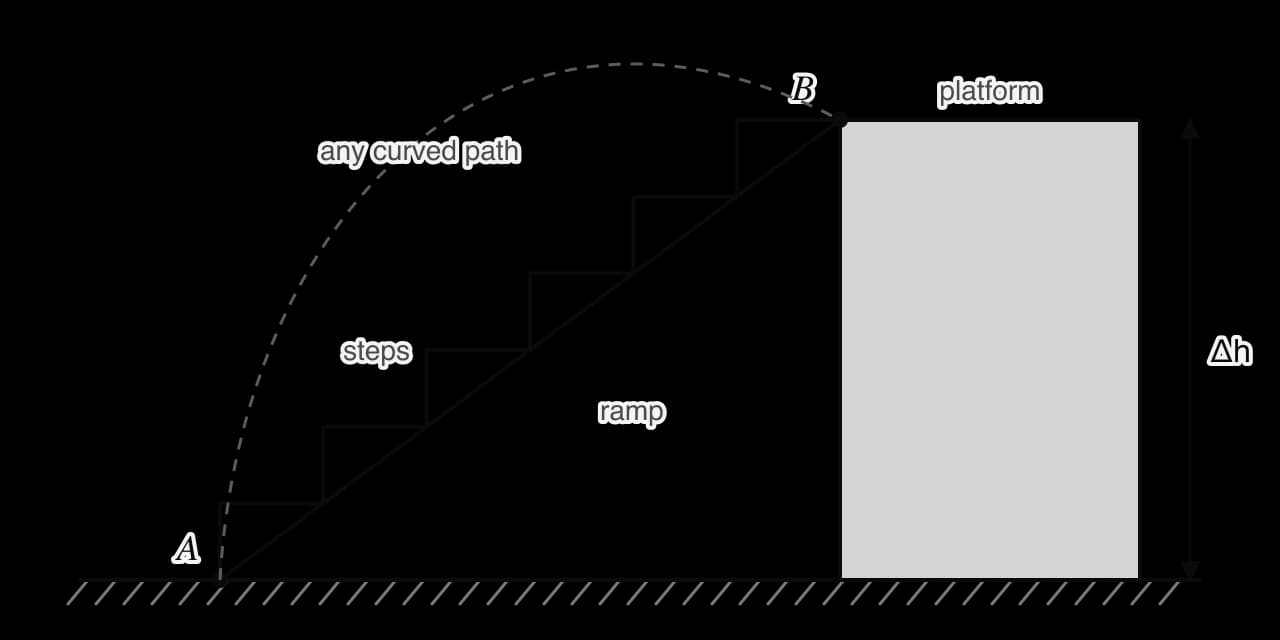
Gravity is a conservative force: the work it does on a body moving between two points depends only on the start and end points, not on the route. Raising a box from the ground to a platform by a ramp, a staircase or a winding path always increases its gravitational potential energy by the same mgΔh.
Whichever route is taken from A to B, the gravitational potential energy increases by the same amount, mgΔh, because only the change in height matters.
A ramp does not reduce the energy needed. A shallow ramp needs a smaller force, but the force acts over a longer distance, so the product, the work done, is the same (if friction is negligible). This trade of force for distance is the principle behind ramps, levers and pulley systems.
Elastic potential energy
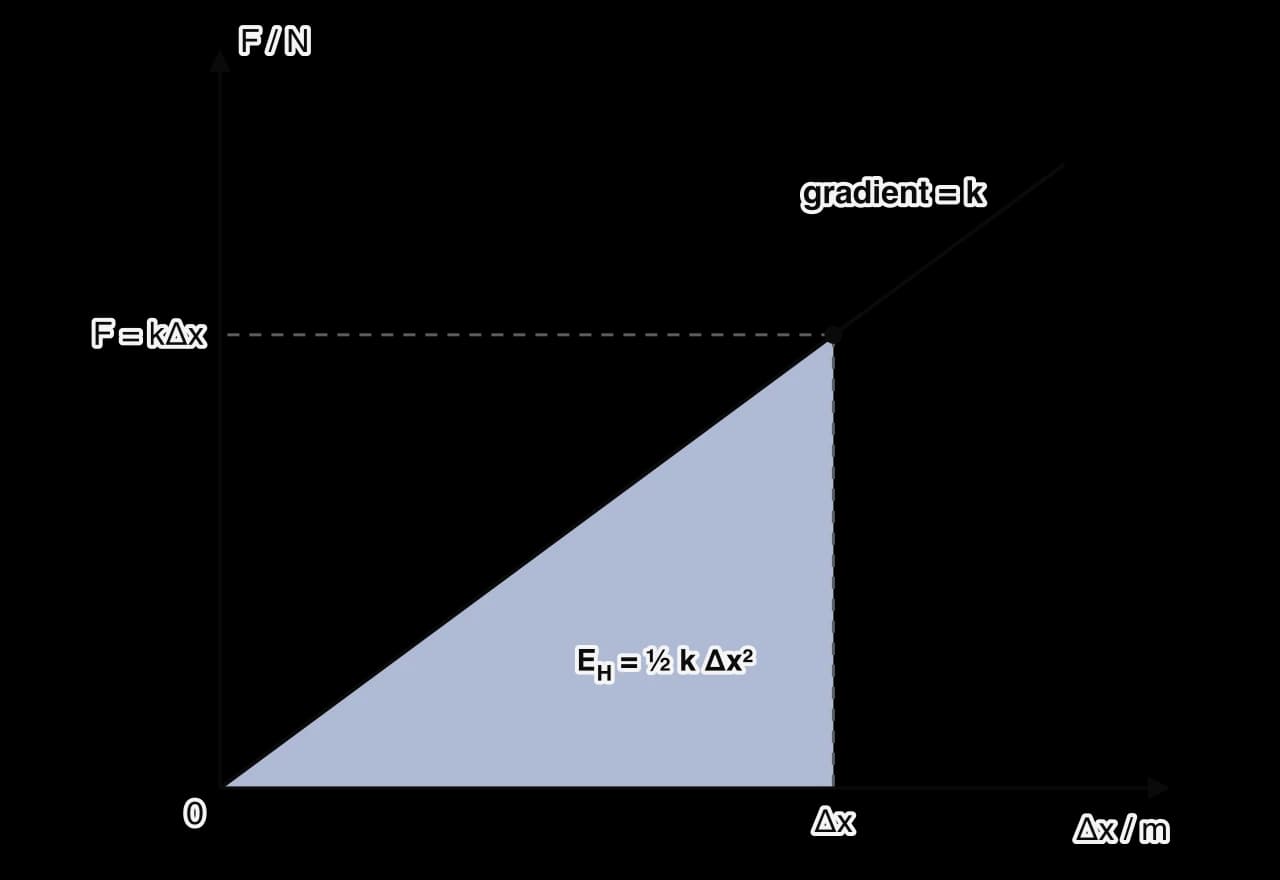
A spring, a rubber band or a diving board stores energy when it is deformed. For a spring that obeys Hooke's law, the force needed to stretch it is proportional to the extension, F=kΔx, where k is the spring constant in N m−1. A stiff spring has a large k.
As the spring is stretched, the force grows from zero to kΔx. The work done is therefore the area under the force–extension graph, a triangle of base Δx and height kΔx.
For a spring that obeys Hooke’s law, the work done stretching it is the triangular area ½ × Δx × kΔx, which is the elastic potential energy stored.
EH=21×Δx×kΔx=21kΔx2
Elastic potential energy depends on the square of the deformation: compressing a spring twice as far stores four times the energy. The same equation applies to compression and extension, as long as the spring stays within its limit of proportionality. Beyond that limit the graph curves and the area must be found from the graph itself; if the material is permanently deformed, not all the work done can be recovered.
YouTube
Chris Doner: IB Physics: Kinetic, Gravitational and Elastic Potential Energies, covering the three forms of mechanical energy.
The work–energy theorem
Several forces may act on a body at once. Each does its own work, positive or negative, and the sum of all of them is the work done by the resultant force. That total decides what happens to the kinetic energy.
Wnet=Fnets=21mv2−21mu2
The work–energy theorem links forces to speeds without time. It solves problems where kinematics would need the acceleration and the time: stopping distances, the speed at the end of a push, the force needed to stop a bullet in a block. When the resultant force is zero, the net work is zero and the speed stays the same, which agrees with Newton's first law.
Conservation of mechanical energy
When the only forces doing work are gravity and elastic forces, which are both conservative, energy moves between the three forms but none leaves them. The mechanical energy is then constant. This is a special case of the conservation of energy: no energy is dissipated, so all of it stays in forms that can be converted back.
For a body falling freely from rest through a height h, the potential energy lost becomes kinetic energy: mgh=21mv2, so v=2gh. The mass cancels, which is why all bodies fall at the same rate when fluid resistance is negligible. Any normal force from a smooth surface is perpendicular to the motion and does no work, so the same result holds for a body sliding down a smooth slope or a smooth curved track: the speed at the bottom depends only on the drop in height, not on the shape of the slope.
The pendulum
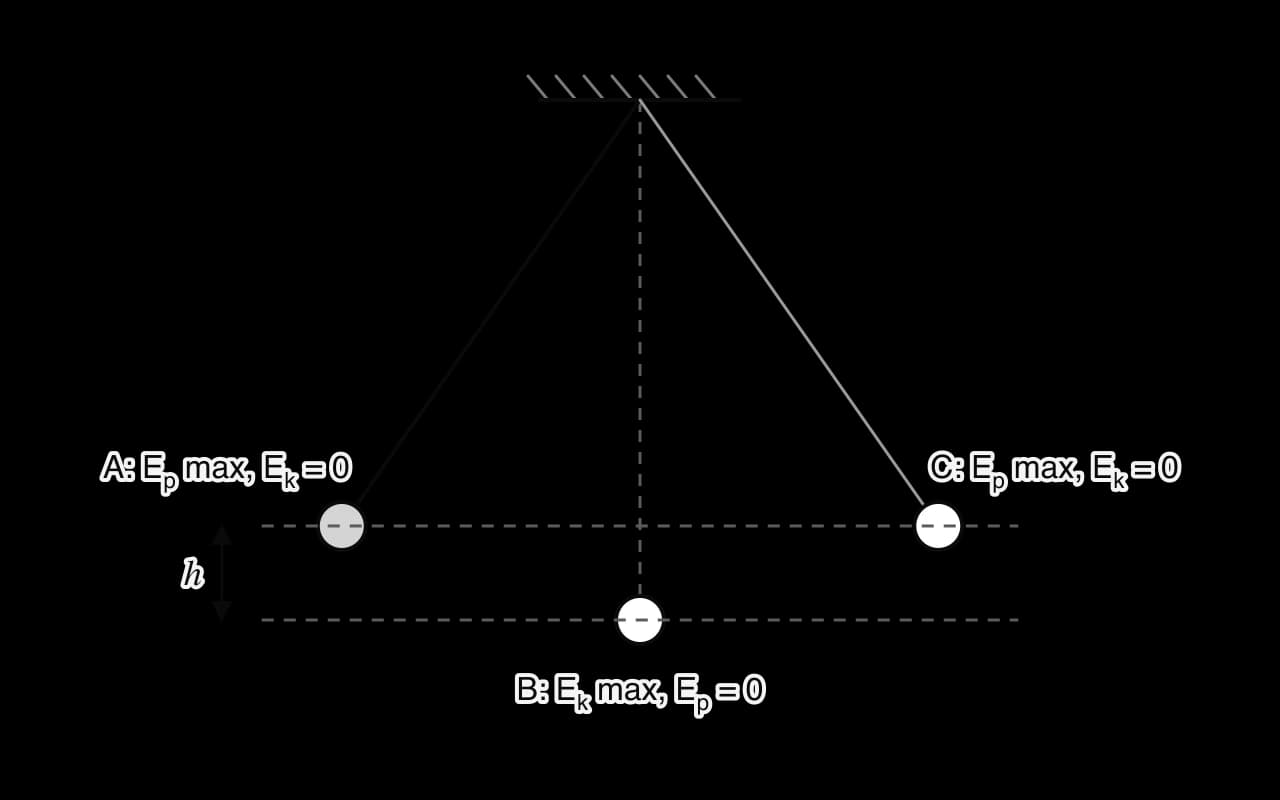
A pendulum bob released from rest at A swings through the lowest point B and rises to C on the other side. The tension in the string is always perpendicular to the bob's motion, so it does no work, and gravity alone changes the bob's energy.
With fluid resistance negligible, the bob swings back to the same height h on each side: the energy moves between gravitational potential and kinetic forms while the total stays constant.
At A and C the bob is momentarily at rest: Ek=0 and the potential energy is a maximum.
At B the bob is at its lowest point and fastest: all of the energy is kinetic, 21mvmax2=mgh.
In between, the energy is partly kinetic and partly potential, with a constant total.
Energy–height and energy–time graphs
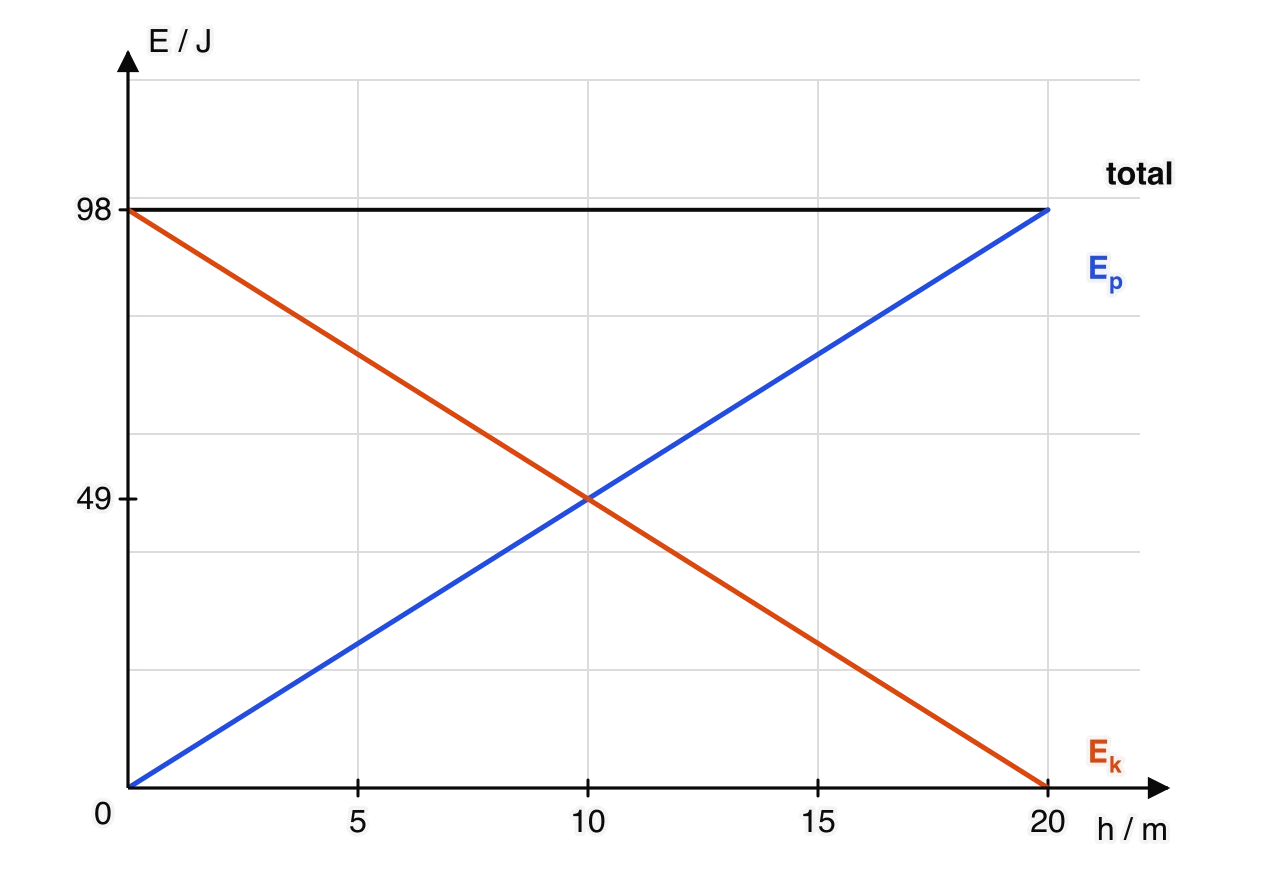
Energy graphs show conservation at a glance. For a ball falling freely, Ep=mgh is proportional to the height, so it is a straight line on an energy–height graph. The kinetic energy is the total minus Ep, which is another straight line with the opposite gradient, and the total is a horizontal line.
A 0.50 kg ball dropped from 20 m with fluid resistance negligible. Ep (blue) and Ek (orange) are straight lines against height, and they add to a constant total of 98 J at every height.
Plotted against time instead, the shapes change, because the ball covers more height in each second as it speeds up. For a swinging pendulum, the kinetic and potential energies rise and fall twice in each period, always adding to the same total.
Ep
Ek
Energy against time for a pendulum of period 2.0 s released at t = 0. Ep and Ek each reach a maximum twice per period and always add to 0.20 J.
Solving energy problems
Energy methods follow the same steps for slopes, roller coasters, pendulums and springs:
Identify the system and the two states to compare (for example, release and the lowest point).
Choose a zero level for gravitational potential energy.
List the energy in each form in each state.
Decide whether any resistive force does work. If not, set the totals equal; if so, add the work done against it to the final state.
Solve, then check the answer is reasonable (the speed cannot exceed that of free fall through the same height).
Springs bring elastic potential energy into the same bookkeeping. In a spring launcher, the energy stored in the compressed spring becomes kinetic energy of the projectile and then gravitational potential energy as it rises.
Friction, resistive forces and mechanical energy
Friction and fluid resistance are non-conservative forces: the work done against them depends on the length of the path, and the energy they transfer becomes internal energy that cannot be returned to mechanical forms. Whenever they act, the mechanical energy of the system decreases.
For a constant friction force Ff acting over a path of length d, the work done against friction is Ffd, and the mechanical energy falls by this amount. Total energy is still conserved: the surfaces and the air warm up by exactly the amount of mechanical energy lost.
Rough sections of a track
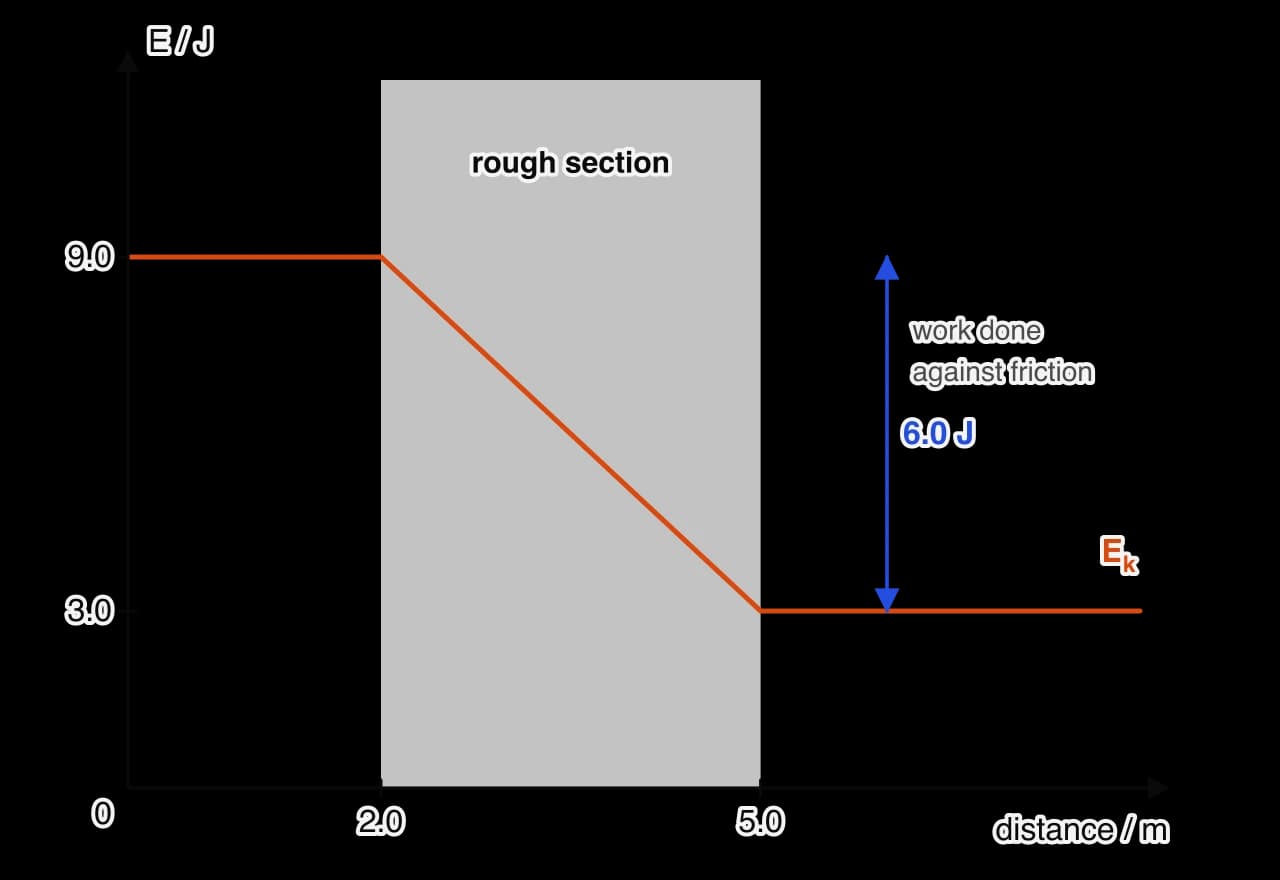
A puck sliding along a level track keeps a constant kinetic energy while the track is smooth. On a rough section a constant friction force does negative work, and the kinetic energy falls steadily with distance. Back on a smooth section, it stays constant again at its lower value.
On the smooth parts the kinetic energy is constant. Across the rough section it falls at a steady rate: the gradient is the friction force (2.0 N) and the total fall is the work done against friction.
The gradient of the kinetic energy–distance graph is the resistive force, since ΔEk=−FfΔd. A fall of 6.0 J over 3.0 m means a friction force of 2.0 N. This makes energy–distance graphs a convenient way to measure friction forces in the laboratory.
Energy in collisions and bouncing
A ball dropped onto a hard floor never bounces back to its starting height. During the impact part of the kinetic energy becomes internal energy of the ball and floor and some becomes sound. Comparing the heights before and after gives the fraction of mechanical energy kept: a ball that rebounds to 64 % of its drop height keeps 64 % of its energy in each bounce, and its rebound speed is 0.64=0.80 of its impact speed. Collisions in which kinetic energy is conserved are called elastic; in all other collisions some kinetic energy is transferred to other forms.
Power
Two cranes can lift the same load to the same height, transferring the same energy, but one may do it in half the time. The quantity that measures how quickly energy is transferred is power.
P=ΔtΔW
One watt is a transfer of one joule every second. Typical powers range from a few watts for a phone charger to 2–3 kW for a kettle, about 100 kW for a family car's engine and around 1 GW for a large power station. A person climbing stairs briskly develops a few hundred watts.
Electricity suppliers bill energy in kilowatt-hours. One kilowatt-hour is the energy transferred at a power of 1 kW for one hour: 1kWh=1000W×3600s=3.60×10⁶J. The kilowatt-hour is a unit of energy, not of power.
Power and velocity
When a constant force F moves its point of application at a constant velocity v in the direction of the force, it does work FΔs in a time Δt. Dividing by the time gives
P=ΔtFΔs=Fv
P=Fv gives the power delivered by a force at any instant, from the force and the velocity at that instant. It is the natural equation for vehicles, lifts, conveyor belts and anything else that moves steadily against a resistance.
Vehicles at constant speed
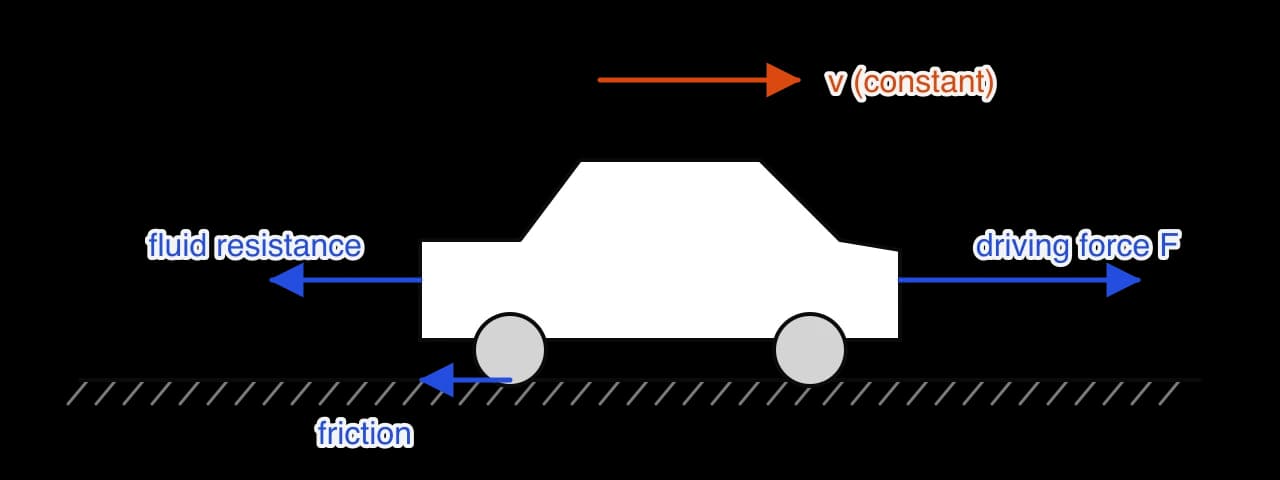
A car on a level road at constant speed is not accelerating, so the resultant force on it is zero. The driving force from the road on the tyres exactly balances the resistive forces: fluid resistance on the body and rolling friction at the tyres. The engine's useful output therefore goes entirely into doing work against these resistive forces, and it ends up as internal energy of the air, the tyres and the road.
At constant speed the driving force (blue, forwards) balances the total resistive force (blue, backwards), so the power the engine delivers to the wheels is P = Fv. Velocity is orange.
At a given speed, the power needed is P=Fresistivev. At motorway speeds, where fluid resistance is the largest resistive force, the resistance grows roughly with the square of the speed, so the power needed grows roughly with its cube. Driving 20 % faster then needs about 70 % more power and uses noticeably more fuel per kilometre. When the car climbs a hill, the driving force must also supply the component of the weight along the slope, mgsinθ.
Efficiency
No real machine transfers all of its input energy into the form wanted. A motor warms up, a gearbox is noisy, a lamp gets hot. Efficiency measures what fraction of the input ends up as useful output.
η=total work inuseful work out=total power inuseful power out
Because energy is conserved, the useful output can never exceed the input, so η≤1 (100 %). The wasted energy, input minus useful output, nearly always ends up as internal energy of the machine and its surroundings. Some processes come close to 100 %: large electrical transformers and generators exceed 95 %. Others are limited by physics rather than engineering: any engine that turns thermal energy into work must reject part of it, as explained in thermodynamics.
Efficiency of a chain of devices
When energy passes through several devices in turn, each passes on a fraction of what it receives, so the efficiency of the whole chain is the product of the separate efficiencies. A power station with a boiler of efficiency 0.88, a turbine of 0.45 and a generator of 0.98 has a combined efficiency of 0.88×0.45×0.98=0.39. The turbine has the lowest efficiency, so it has the most room for improvement; raising the generator's 0.98 can change the total only slightly.
Case study: a pumped-storage power station
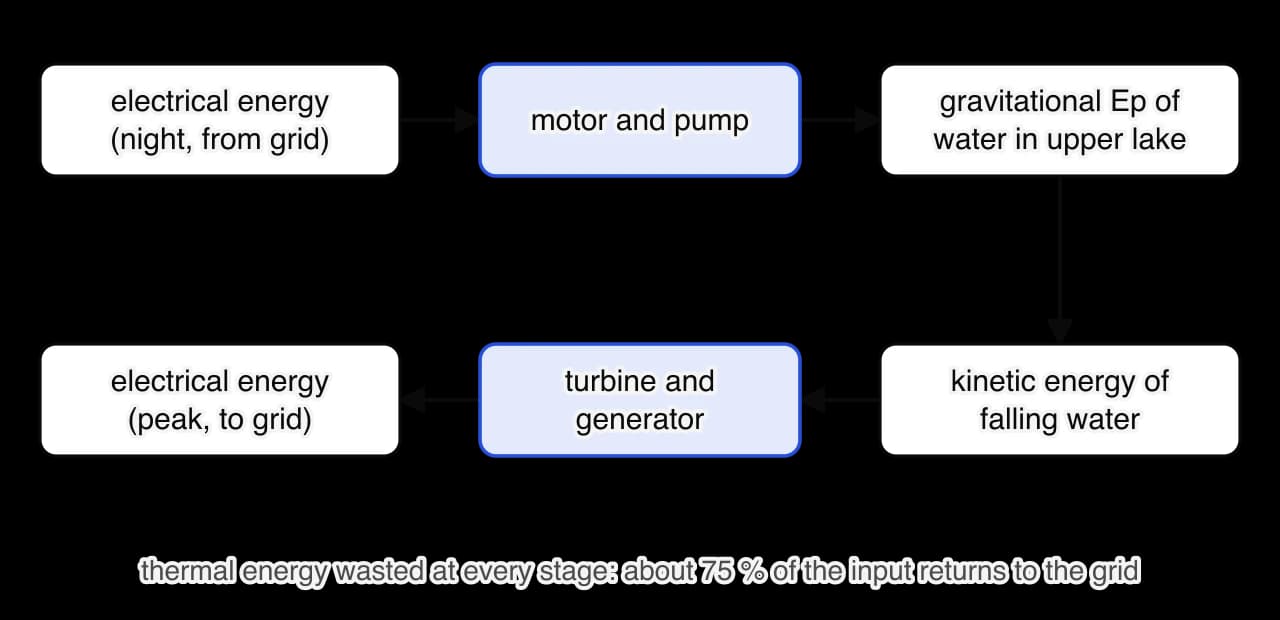
Dinorwig power station in north Wales, opened in 1984, stores energy as gravitational potential energy of water. At night, when demand is low, its six reversible turbines run as pumps and lift water from the lower lake, Llyn Peris, to the upper lake, Marchlyn Mawr, about 500 m higher. When demand peaks, the water flows back down through the same machines, which now act as turbines driving generators.
Each transfer wastes some energy as thermal energy, so the station returns less energy than it stores; its value lies in releasing it within seconds when demand peaks.
The station can store about 9.1 GWh of energy and deliver up to about 1.7 GW. Its most valuable property is the speed of its response. With its units already spinning, it can go from zero to full output in about 16 s, far faster than a coal or nuclear plant can respond. The cost of this flexibility is lost energy. Each transfer in the chain wastes energy in the motors, pumps, pipes, turbines and generators, and only about three-quarters of the electrical energy used for pumping returns to the grid.
Sankey diagrams
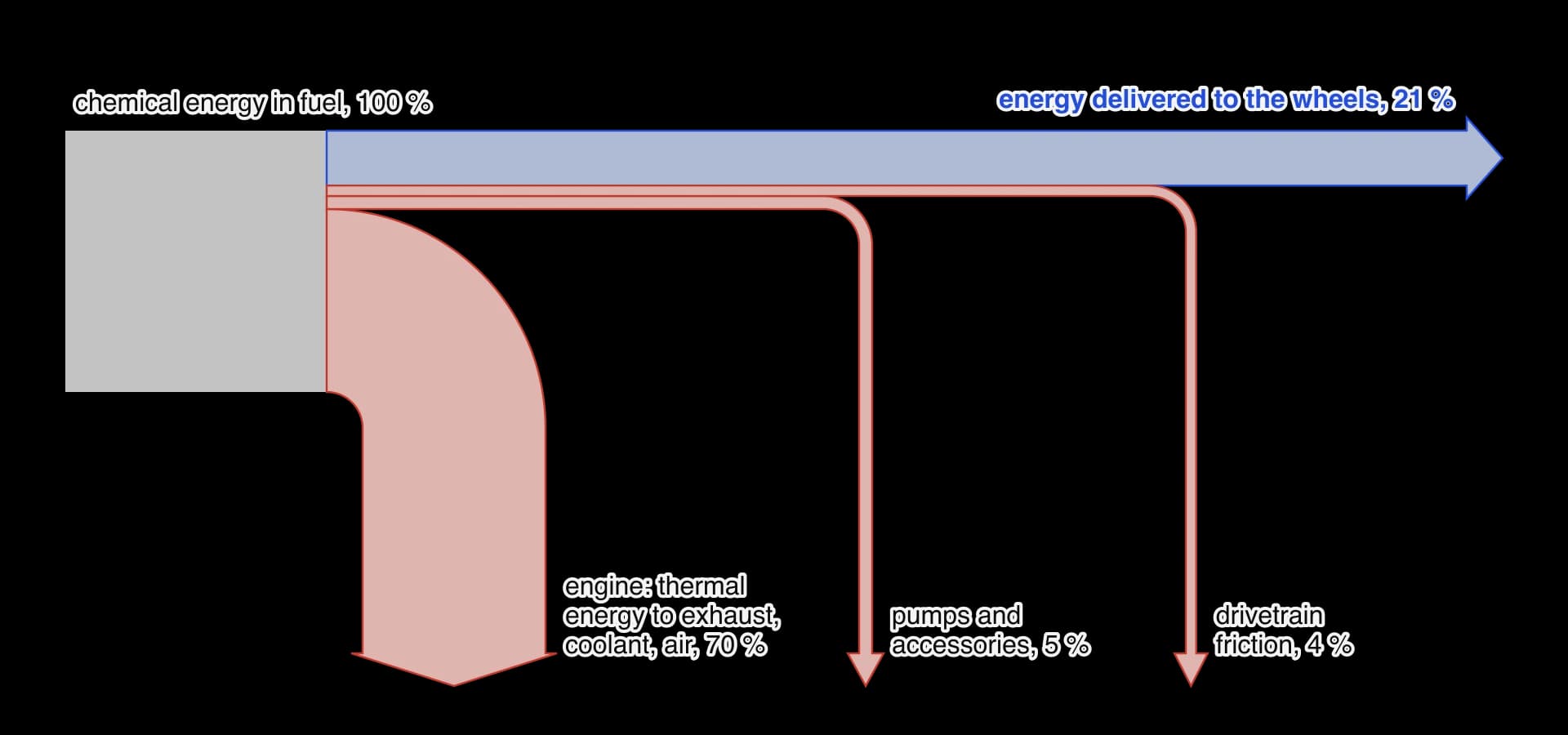
A Sankey diagram shows the energy transfers in a device or a process as arrows whose widths are proportional to the amount of energy (or power) they carry. The input enters from the left, the useful output usually continues straight on, and the wasted energy branches off, conventionally bending downwards.
The width of each arrow is proportional to the energy it carries. Useful energy runs straight on (blue); wasted energy bends away (red). Typical values for combined city and highway driving, taken from within the published ranges and rounded to add to 100 %. Data: US Department of Energy, fueleconomy.gov, “Where the energy goes”, accessed 2026.
The Sankey diagram of a petrol car shows why cars are inefficient. Most of the chemical energy released in the engine leaves as thermal energy in the exhaust gases and the cooling system; only about a fifth reaches the wheels. That share then does work against fluid resistance and rolling friction, so at constant speed it too ends up as internal energy of the air and the road.
Drawing a Sankey diagram
Choose a scale (for example 1 mm per 10 J, or one grid square per 5 %) and keep it the same for every arrow.
Draw the input arrow on the left with a width equal to the total input.
Split the arrow so that the widths of the outputs add up to the width of the input: energy is conserved.
Draw the useful output straight on and each wasted output curving away, each labelled with the form of energy and its value.
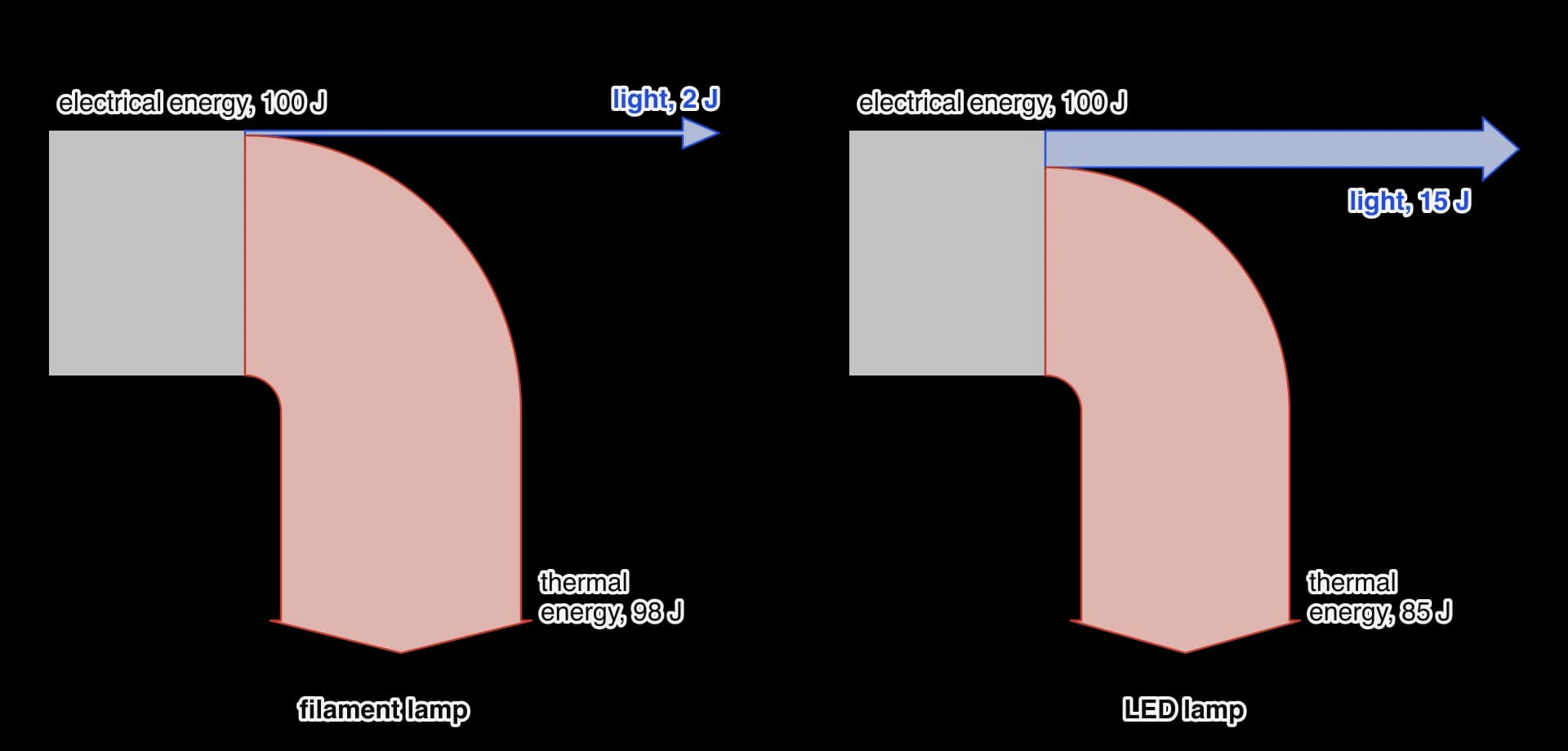
Comparing the diagrams of two devices that do the same job shows at a glance which is more efficient. A filament lamp produces light by heating a tungsten wire until it glows, so almost all of its input becomes thermal energy. An LED produces light directly when charge carriers recombine in a semiconductor, and wastes much less.
A 100 W, 230 V filament lamp (13.8 lm W⁻¹) has a luminous efficiency of about 2 %; a typical LED lamp (about 100 lm W⁻¹) about 15 %, and the best about 30 %. Useful light is blue, wasted thermal energy red. Data: Wikipedia, “Luminous efficacy”, accessed 2026.
YouTube
Chris Doner: IB Physics: Power & Efficiency, covering power, efficiency and their calculations.
Energy density of fuels
A fuel is a substance that releases energy in a controlled way, usually by burning (chemical energy) or by nuclear reactions. For a vehicle, an aircraft or a ship, the space the fuel takes up matters as much as its mass, so fuels are compared by how much energy each cubic metre releases.
energy density=volume of fuelenergy released
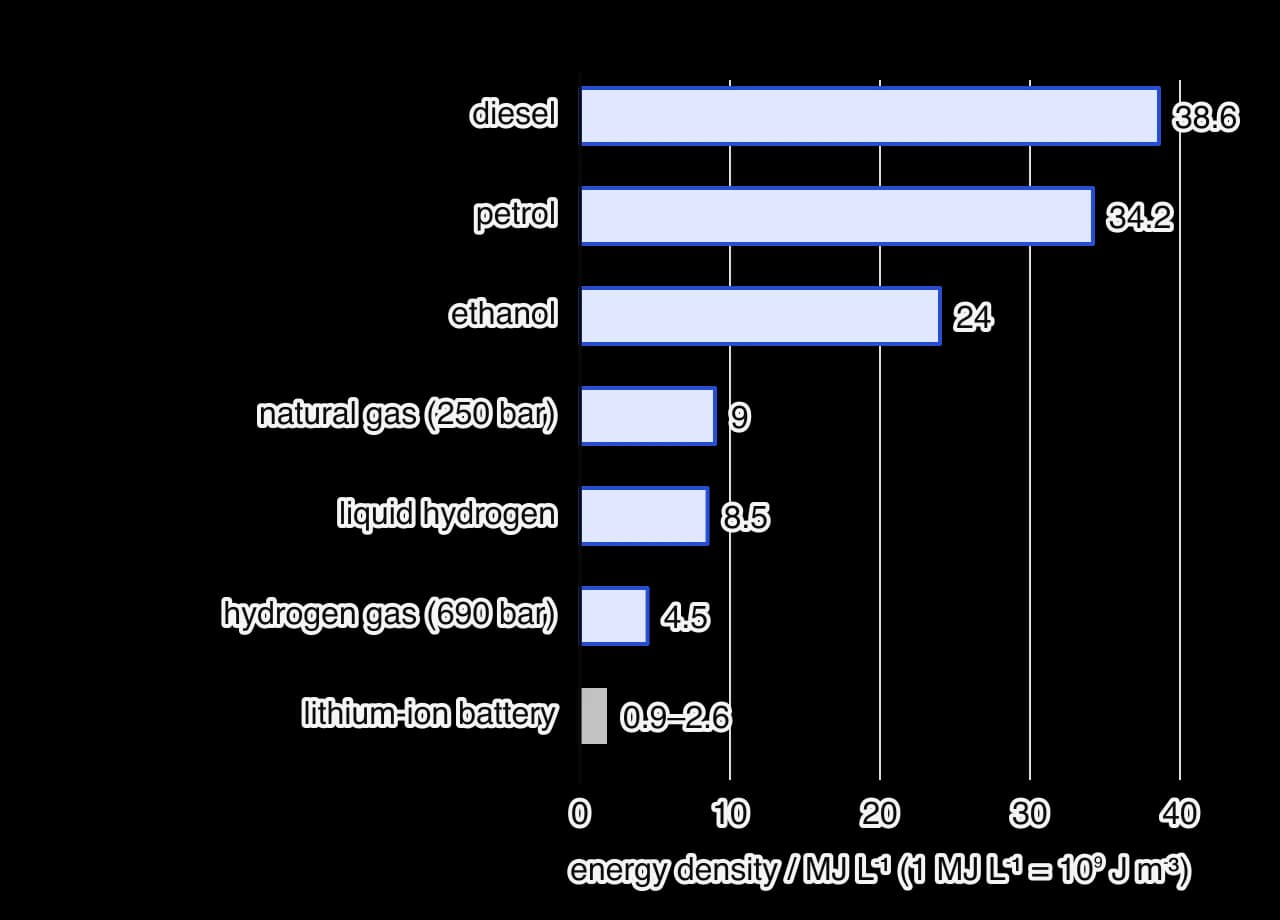
A related quantity, specific energy, is the energy released per unit mass, in J kg−1. Energy density matters most when space is limited, as in a car's tank or an aircraft's wings; specific energy matters most when mass is limited, as in a rocket. Hydrogen has the highest specific energy of any chemical fuel, about 120 MJ kg⁻¹, but a very low energy density, because even as a liquid it is about ten times less dense than petrol.
Liquid hydrocarbon fuels store far more energy per unit volume than hydrogen or batteries. The battery bar shows the middle of its range. Data: Wikipedia, “Energy density” (lower heating values), accessed 2026.
Fuel data are often quoted in megajoules per litre. Since 1L=10−3m3, an energy density of 1MJ L−1 equals 109J m−3. Petrol, at 34.2MJ L−1, has an energy density of 3.42×10¹⁰J m−3.
Batteries have much lower energy densities still, yet electric cars travel comparable distances on a full charge. The reason is efficiency. An electric car delivers more than three-quarters of the electrical energy it takes from the grid to its wheels, while a petrol car delivers only about a fifth of the chemical energy in its fuel. Comparing fuels properly therefore needs both their energy density and the efficiency of the machine that uses them.
Applying the ideas in exam questions
Energy questions reward a clear statement of the principle before any algebra. A line such as "Ep lost = Ek gained, as there is no friction" often earns a mark on its own, and it lets an examiner award error-carried-forward marks for later working.
Paper 1A: energy of a falling ball
Paper 1A: power of a car at constant speed
Paper 1A: work done by a force at an angle
Paper 1B: energy stored in a stretched spring
A group of students hangs masses from a spring and measures the extension Δx for each load F. The extension is measured with a metre rule to ± 0.2 cm. Their results are:
F / N ± 0.01
Δx / cm ± 0.2
1.00
2.1
2.00
4.0
3.00
6.1
4.00
8.0
5.00
10.0
6.00
13.5
Paper 2: a skier on a slope
Paper 2: fuels and an electric pump
Self-check
To do:
I can state the principle of conservation of energy and describe energy transfers in terms of it.
To do:
I can calculate the work done by a constant force with W=Fscosθ, including forces at an angle and negative work.
To do:
I can find the work done by a varying force from the area under a force–displacement graph.
To do:
I can explain why work done is equal to energy transferred.
To do:
I can calculate kinetic energy with 21mv2 and p2/2m.
To do:
I can calculate changes in gravitational potential energy with mgΔh and state when this equation is valid.
To do:
I can derive and use EH=21kΔx2 for a spring.
To do:
I can apply the work–energy theorem to find stopping distances and speeds.
To do:
I can use conservation of mechanical energy for falling bodies, slopes, pendulums, roller coasters and spring launchers.
To do:
I can sketch and interpret energy–height and energy–time graphs.
To do:
I can account for the work done by friction and resistive forces as a change in mechanical energy.
To do:
I can calculate power from ΔW/Δt and Fv, including vehicles at constant speed on the level and on slopes.
To do:
I can calculate efficiency from energies or powers, and the combined efficiency of devices in series.
To do:
I can draw and interpret Sankey diagrams.
To do:
I can define energy density and use it to compare fuels.
M1
=4.0ms−2A1
(b)
Determine the total distance travelled.
[2]2 marks
Markscheme (b)
Area under the graph: 21(6+14)×16M1
=160mA1
(c)(i)
Calculate her maximum kinetic energy.
[1]1 mark
Markscheme (c)(i)
Ek=21×80×162=10240JA1
(c)(ii)
Calculate the average power with which she gains kinetic energy in the first 4.0 s.
[2]2 marks
Markscheme (c)(ii)
P=4.010240M1
=2560W (2.6 kW) A1
Question 2 · PHY-000381 mark
Two identical stones are thrown with the same speed from the same point at the top of a sea cliff. Stone P is thrown horizontally. Stone Q is thrown at 60° above the horizontal. Air resistance is negligible. Which quantity is the same for both stones?
A
the time taken to reach the sea
B
the horizontal component of velocity on reaching the sea
C
the angle to the horizontal at which the stone reaches the sea
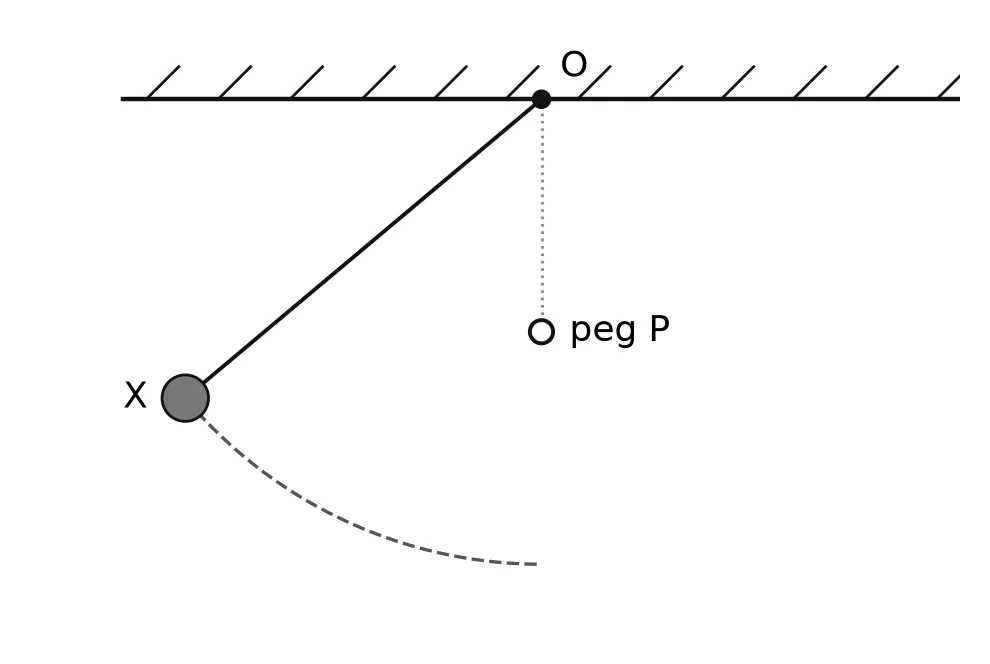
A pendulum bob is held at X with its string taut and is then released from rest. When the string becomes vertical it catches on a fixed peg P directly below the point of suspension O. Air resistance is negligible.
On the other side of the peg, the bob rises
A
to the same height as X.
B
higher than X, because the swinging part of the string is shorter.
C
lower than X, because the peg does work against the motion of the bob.
D
lower than X, because the bob moves through a shorter arc.
. This is one reason the stopping distance rises so steeply with speed.
gives the same answer.
(b)
V=energy densityE=8.5×1091.71×109=0.20m3=200L
A liquid-hydrogen tank would need four times the volume of the petrol tank, before allowing for the thick insulation needed to keep hydrogen below about 20 K. This is one of the main obstacles to hydrogen as a vehicle fuel.
, e.g.
0.1005.00
(with
Δx
in metres) ✓
k=50N m−1 ✓ (accept 48–52)
(c)EH=21FΔx=21×4.00×0.080 OR 21×50×0.0802 ✓
=0.16J ✓ (allow ECF from (b))
(d) the extension is larger than proportional / the spring has passed its limit of proportionality «so Hooke's law no longer applies» ✓
find the area under the force–extension graph up to 13.5 cm «not 21kΔx2» ✓