A.2 Forces and momentum questions for IB Physics
244 questions on Forces and momentum, written by Augment in the style of IB exam papers. Six of them are below in full, to answer on paper.
- IB Physics
- Part of A Space, time and motion
- SL and HL
Questions by paper and level
SL and HL questions are for students at either level. HL only questions cover what only HL students study.
| Paper | SL and HL | HL only | All |
|---|---|---|---|
| Paper 1A | 49 | 24 | 73 |
| Paper 1B | 17 | 0 | 17 |
| Paper 2 | 95 | 59 | 154 |
| Every paper | 161 | 83 | 244 |
Counted on
Questions to try
Written by Augment in the style of IB exams, not past papers. Answer them on paper, then check each one against its markscheme with a free account.
A trolley of mass 2.0 kg moving at collides with a stationary trolley of mass 1.0 kg. They stick together. What is their speed after the collision?
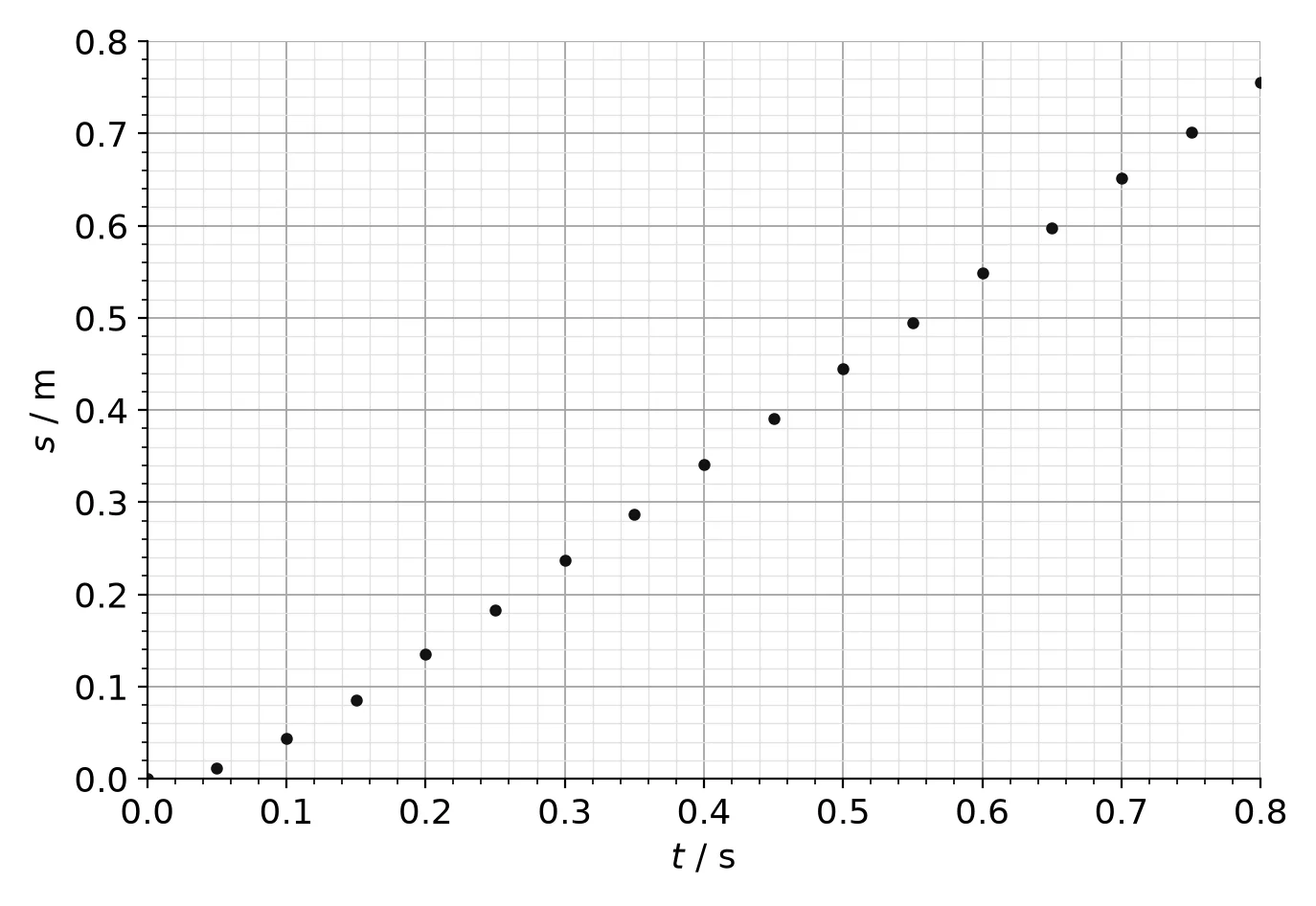
A group of students drop paper cupcake cases, open side up, from rest. They film each fall against a vertical metre rule with a camera that records 50 frames per second, and use video analysis software to find the distance fallen at time .
The graph shows the variation of with for a single case.
- (a)
State the time interval between consecutive frames of the video.
1 mark
- (b)
Determine the terminal speed of the case.
2 marks
- (c)
Explain the shape of the graph from to .
2 marks
- (d)
The students stack cases inside each other and measure the terminal speed for each value of . They suggest that is proportional to .
/ m s-1 ± 0.06 m s-1
/ m2 s-2
1
1.04
1.08
2
1.49
2.22
3
1.80
3.24
4
2.08
4.33
5
2.36
5.57
Calculate the absolute uncertainty in for .
2 marks
- (e)
The graph shows the variation of with , with error bars.
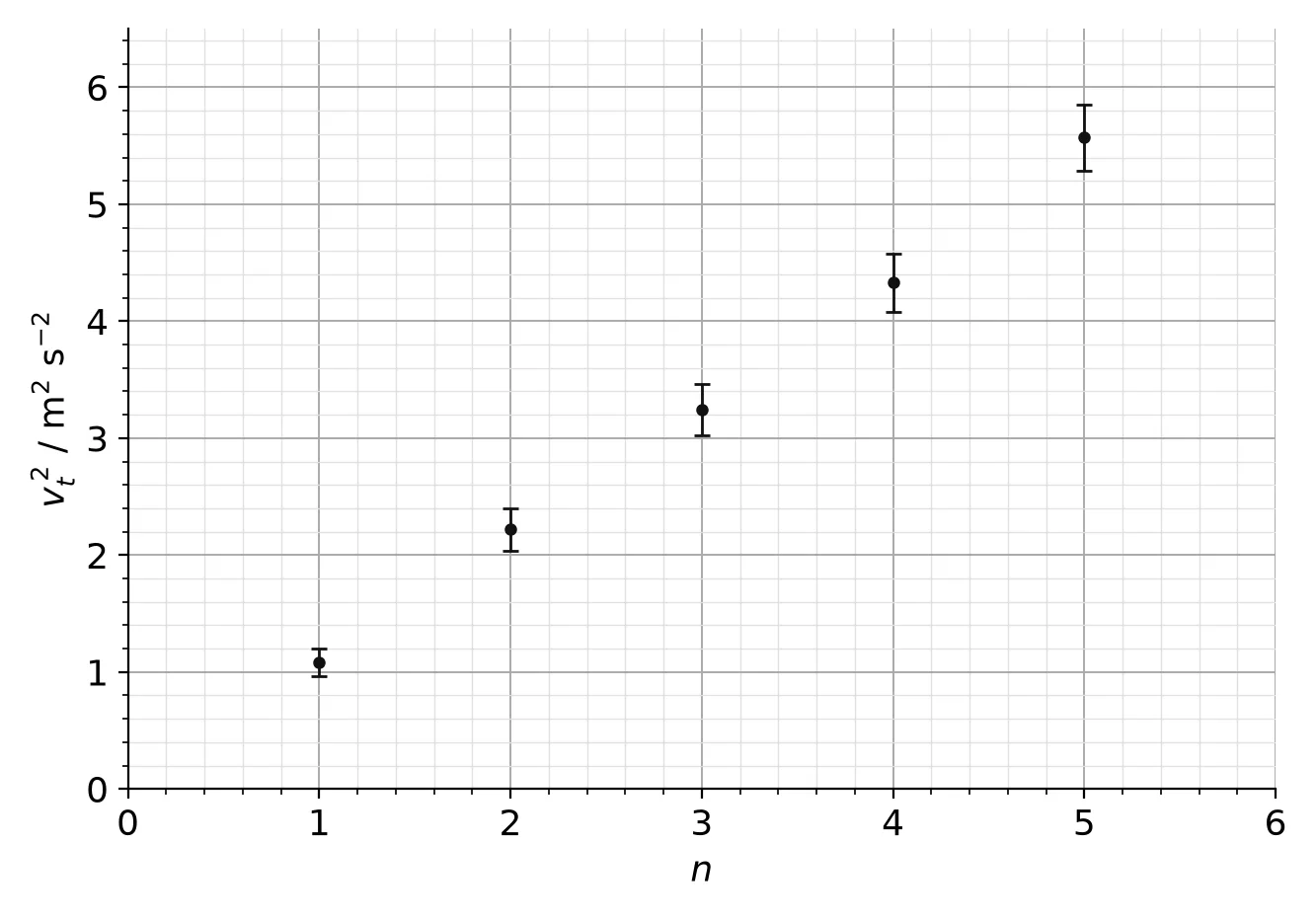
Deduce whether the data support the students' suggestion.
2 marks
- (f)
Suggest one change to the method that would improve the reliability of the measured terminal speeds.
1 mark
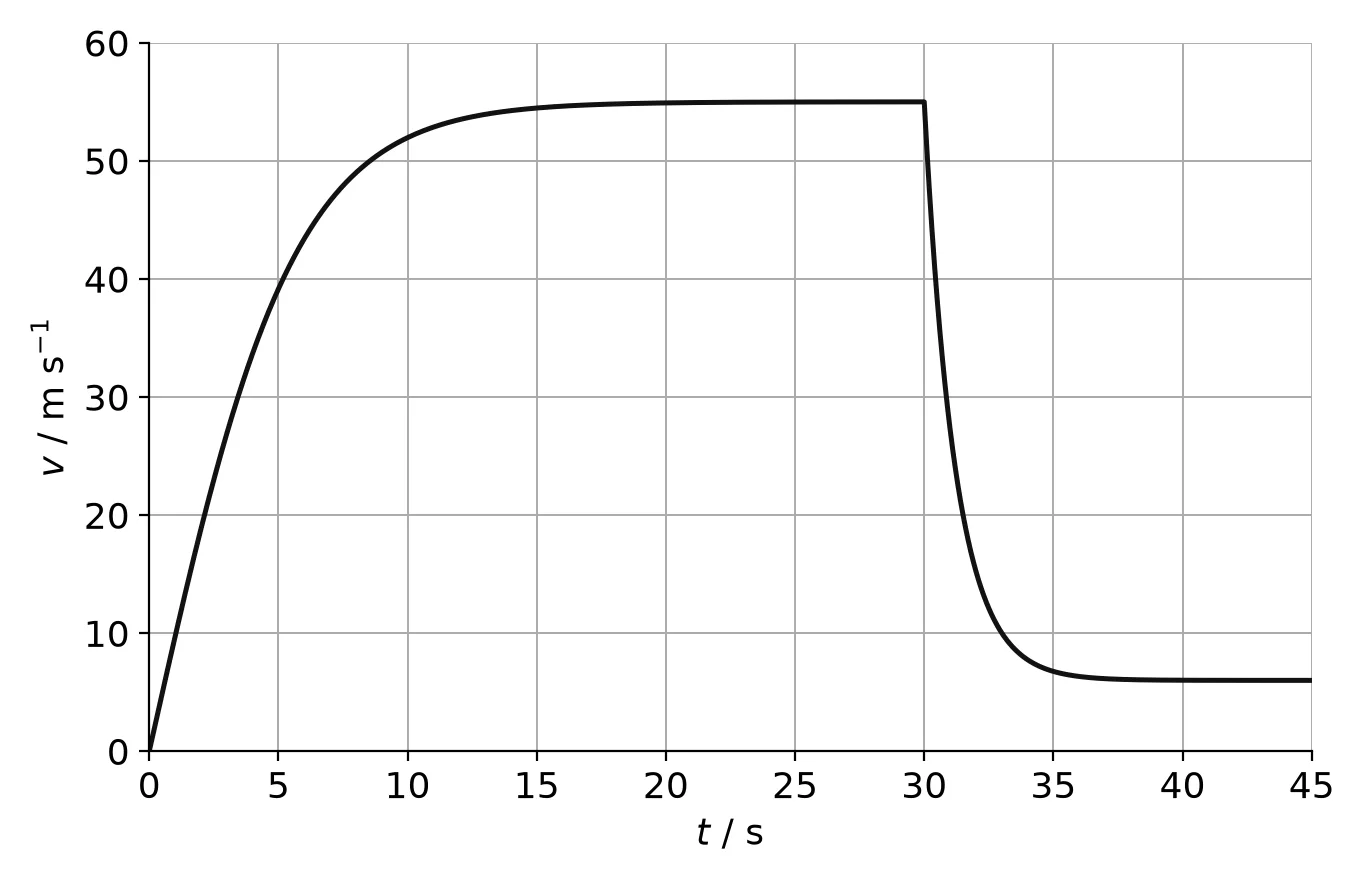
A skydiver steps out of a hovering helicopter and falls vertically. She opens her parachute at . The graph shows the variation with time of her speed .
- (a)
State the magnitude of the acceleration of the skydiver at .
1 mark
- (b)
Explain, with reference to the forces acting on the skydiver, why her speed is constant between and .
2 marks
- (c)
State the direction of the acceleration of the skydiver at .
1 mark
- (d)
Explain why the skydiver reaches a lower constant speed after the parachute opens.
2 marks
A ball is thrown vertically upwards and is caught when it comes back down. Air resistance is negligible. What is the direction of the acceleration of the ball while it is rising and while it is falling?
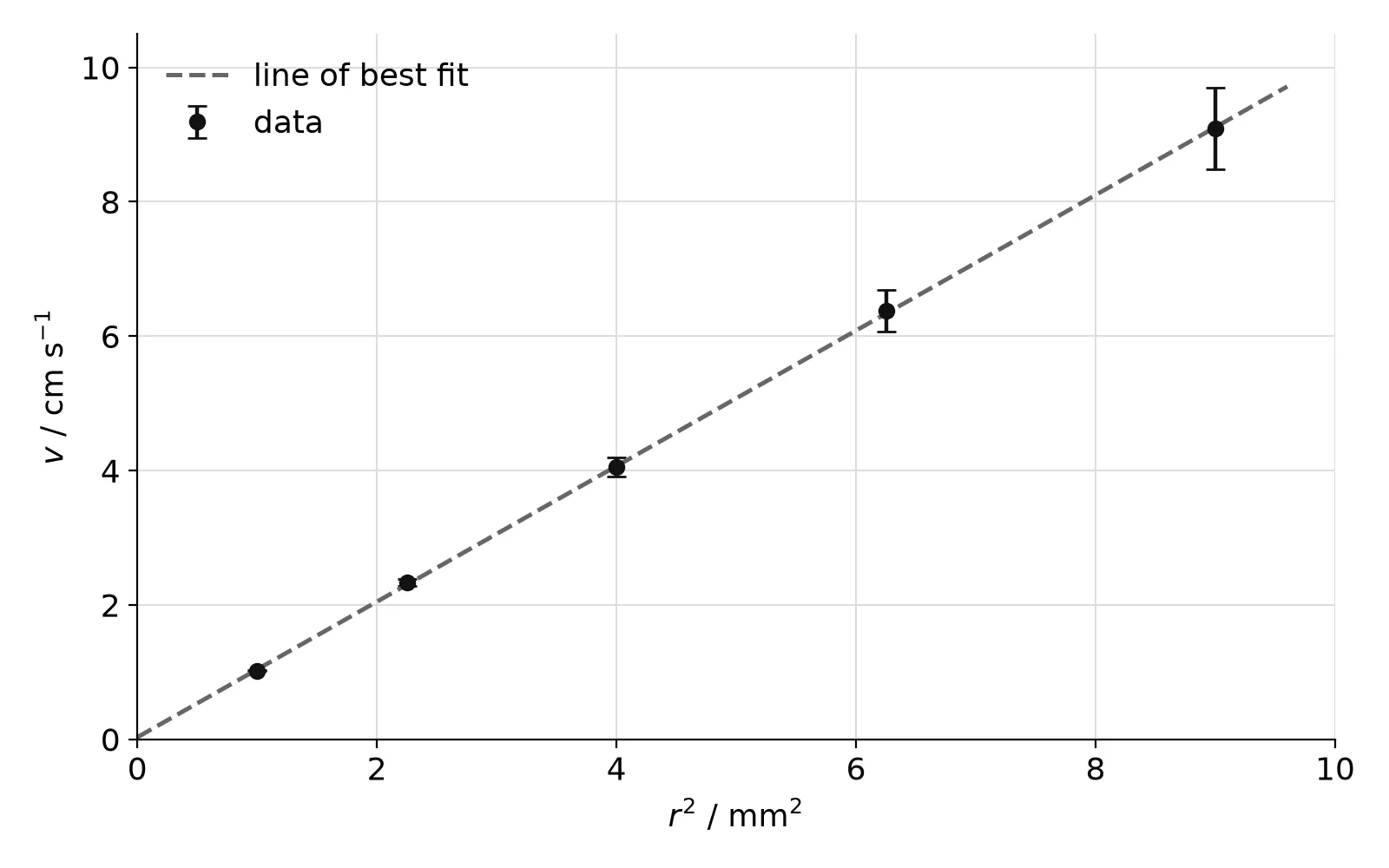
A group of students investigate the motion of steel balls falling through glycerol in a tall glass tube. Two rubber bands are placed around the tube apart. The upper band is well below the surface of the glycerol. Each ball is released at the surface, and the time for the ball to fall from the upper band to the lower band is measured with a stopwatch.
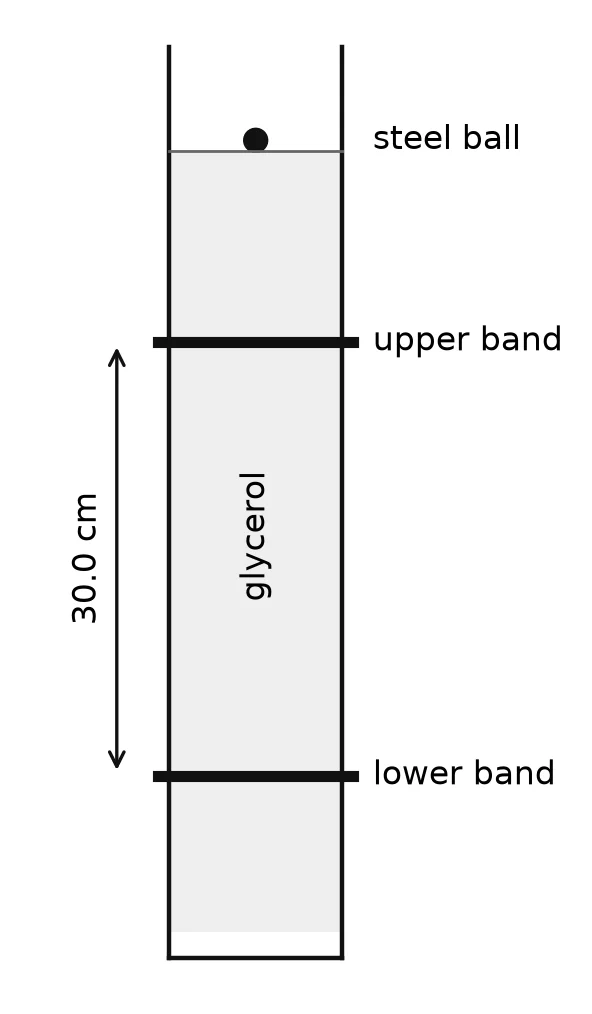
The diameter of each ball is measured with a micrometer screw gauge. The table shows the mean value of for each ball.
/ mm ± 0.01 | / s ± 0.2 |
|---|---|
2.00 | 29.5 |
3.00 | 12.9 |
4.00 | 7.4 |
5.00 | 4.7 |
6.00 | 3.3 |
The students calculate the terminal speed of each ball. The graph shows the variation of with , where is the radius of the ball. Error bars for and the line of best fit are shown.
- (a)
Suggest why the upper band is placed well below the surface of the glycerol.
1 mark
- (b)
Calculate the percentage uncertainty in for the ball of diameter 6.00 mm.
2 marks
- (c)
The density of steel is and the density of glycerol is . The viscosity of glycerol is .
Show that, according to Stokes's law, the terminal speed of a ball of radius is
where is the density of steel and is the density of glycerol.
2 marks
- (d)
Determine, using the graph, the viscosity of glycerol.
3 marks
- (e)
Outline why no error bars are shown for .
1 mark
- (f)
The students extend the experiment to a ball of diameter 12.0 mm in the same tube. Suggest why its measured terminal speed is likely to be less than the value predicted by the line.
1 mark
A stunt rider plans to jump a motorcycle across a canal. The take-off ramp is inclined at to the horizontal. The top of the landing ramp is at the same height as the top of the take-off ramp and a horizontal distance of 32 m from it. Treat the motorcycle and rider as a point and ignore air resistance.

- (a)
Show that the minimum take-off speed needed to reach the landing ramp is about .
3 marks
- (b)
Calculate the maximum height of the motorcycle above the top of the take-off ramp when it leaves the ramp at this minimum speed.
2 marks
- (c)
State the speed of the motorcycle as it reaches the landing ramp.
1 mark
- (d)
After landing, the motorcycle runs onto horizontal ground with a speed of . The rider brakes, and a constant frictional force of 1.8 kN acts on the motorcycle. The combined mass of the motorcycle and rider is 240 kg. Calculate the stopping distance.
3 marks
- (e)
Explain why, in practice, the rider must leave the ramp at a speed greater than the value in (a).
2 marks
Practice all 244 in Augment
Free with an account. Every question has its markscheme, and Augment keeps the ones you got wrong so you can come back to them.
More questions in Space, time and motion
- A.1Kinematics
- A.2Forces and momentumThis page
- A.3Work, energy and power
- A.4Rigid body mechanicsHL only
- A.5Galilean and special relativityHL only
Check your answers in Augment
A free account opens all 244 questions on Forces and momentum with their markschemes, and keeps a record of what you have marked.