A.1 Kinematics questions for IB Physics
122 questions on Kinematics, written by Augment in the style of IB exam papers. Six of them are below in full, to answer on paper.
- IB Physics
- Part of A Space, time and motion
- SL and HL
Questions by paper and level
SL and HL questions are for students at either level. HL only questions cover what only HL students study.
| Paper | SL and HL | HL only | All |
|---|---|---|---|
| Paper 1A | 37 | 2 | 39 |
| Paper 1B | 8 | 1 | 9 |
| Paper 2 | 53 | 21 | 74 |
| Every paper | 98 | 24 | 122 |
Counted on
Questions to try
Written by Augment in the style of IB exams, not past papers. Answer them on paper, then check each one against its markscheme with a free account.
A ball is thrown vertically upwards. Air resistance is negligible. Which is correct about the ball at its highest point?
A group of students investigate the motion of a steel ball that leaves the edge of a horizontal bench. The ball is released from different points on a short ramp, so that it leaves the edge horizontally with different speeds . Just before the edge the ball passes through a light gate, which records the time for which the ball blocks the beam. The ball lands on carbon paper on the floor, and the students measure the horizontal distance from the point on the floor vertically below the edge of the bench to the mark made by the ball.
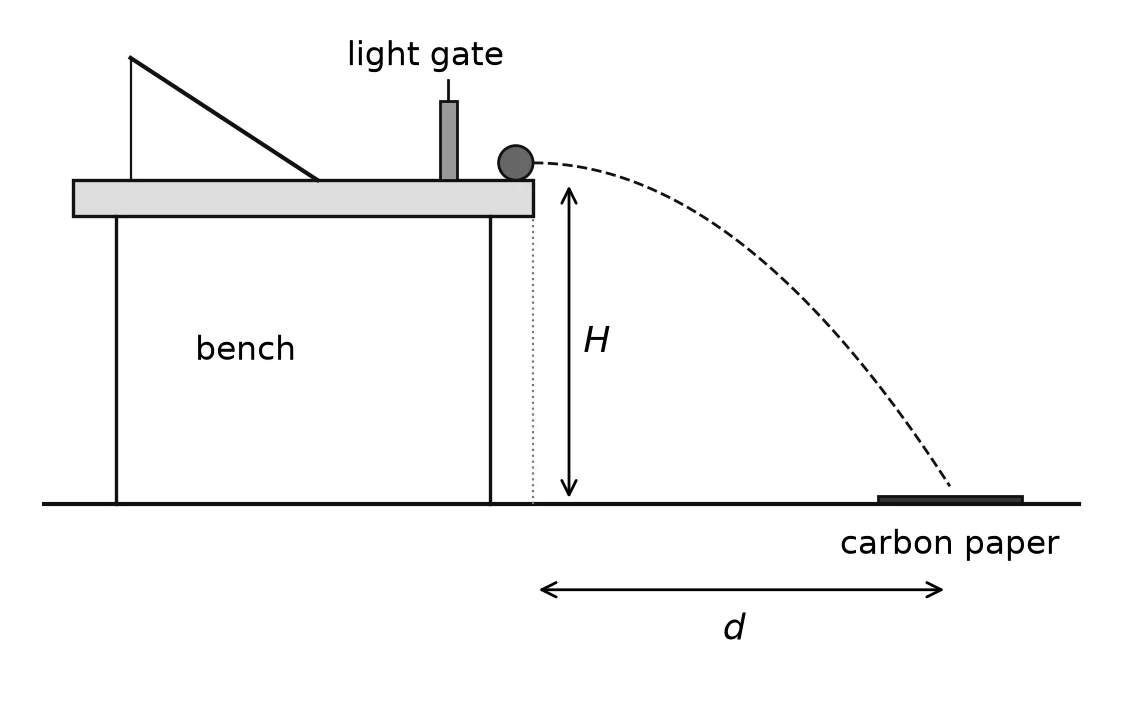
The ball falls through a vertical height . The diameter of the ball is , and the students calculate from .
/ ms ± 0.1 ms | / m s-1 | / m ± 0.02 m |
|---|---|---|
30.5 | 0.82 | 0.36 |
23.8 | 1.05 | 0.45 |
19.1 | 1.31 | 0.56 |
15.6 | 1.60 | 0.69 |
13.4 | 1.87 | 0.79 |
11.8 | 2.12 | 0.91 |
- (a)(i)
Calculate the absolute uncertainty in for the reading .
2 marks
- (a)(ii)
Explain why the students expect to be proportional to .
2 marks
- (b)(i)
The graph shows the variation of with . A line of best fit through the origin has been drawn.
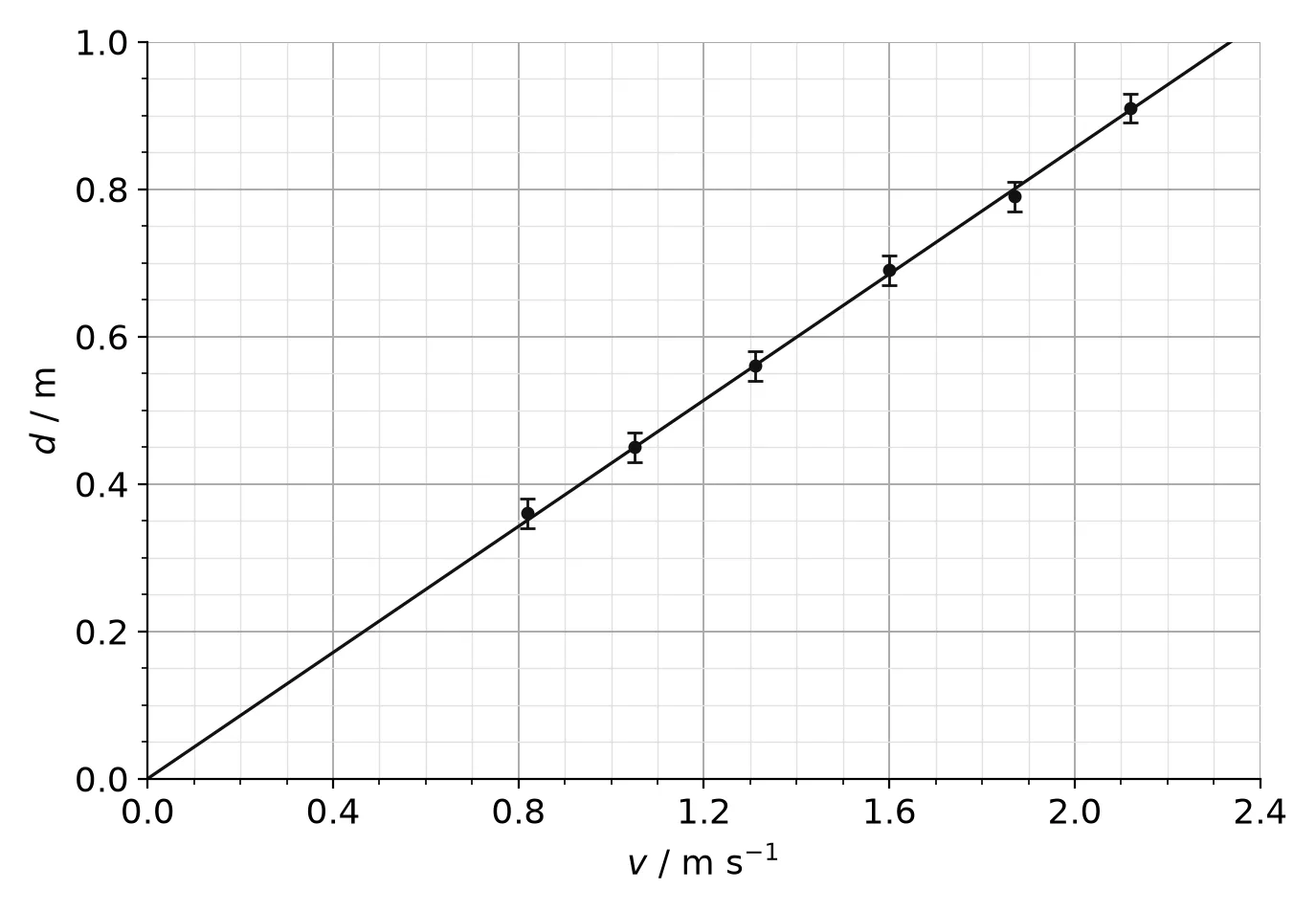
Determine, using the graph, the time of flight of the ball.
2 marks
- (b)(ii)
Hence determine a value for the acceleration of free fall .
2 marks
- (c)
The students estimate that the percentage uncertainty in the gradient of the graph is 3 %. Deduce whether their value of is consistent with the accepted value of .
2 marks
- (d)
Suggest one improvement to the method, with a reason.
2 marks
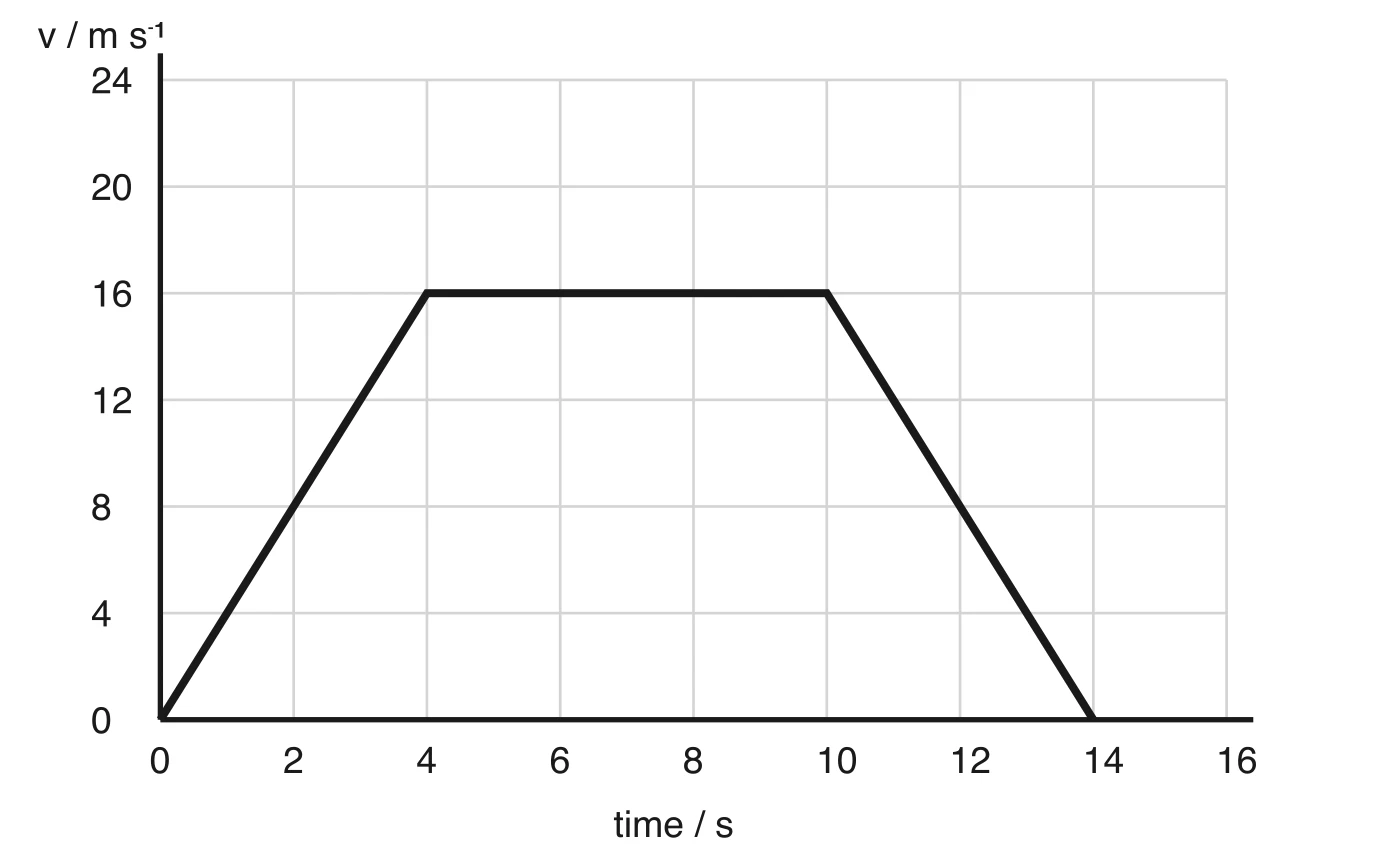
A cyclist of total mass 80 kg rides along a straight, level road. The graph shows how her velocity changes with time .
- (a)
Calculate her acceleration during the first 4.0 s.
2 marks
- (b)
Determine the total distance travelled.
2 marks
- (c)(i)
Calculate her maximum kinetic energy.
1 mark
- (c)(ii)
Calculate the average power with which she gains kinetic energy in the first 4.0 s.
2 marks
A delivery robot in a warehouse moves 30 m due east along a straight aisle. It then moves 40 m due west along the same aisle. What are the distance travelled by the robot and its displacement from its starting point?
A group of students measure the acceleration of free fall. A small steel ball is held by an electromagnet at a height above a hinged trapdoor. When the electromagnet is switched off, an electronic timer starts. The timer stops when the ball hits the trapdoor.
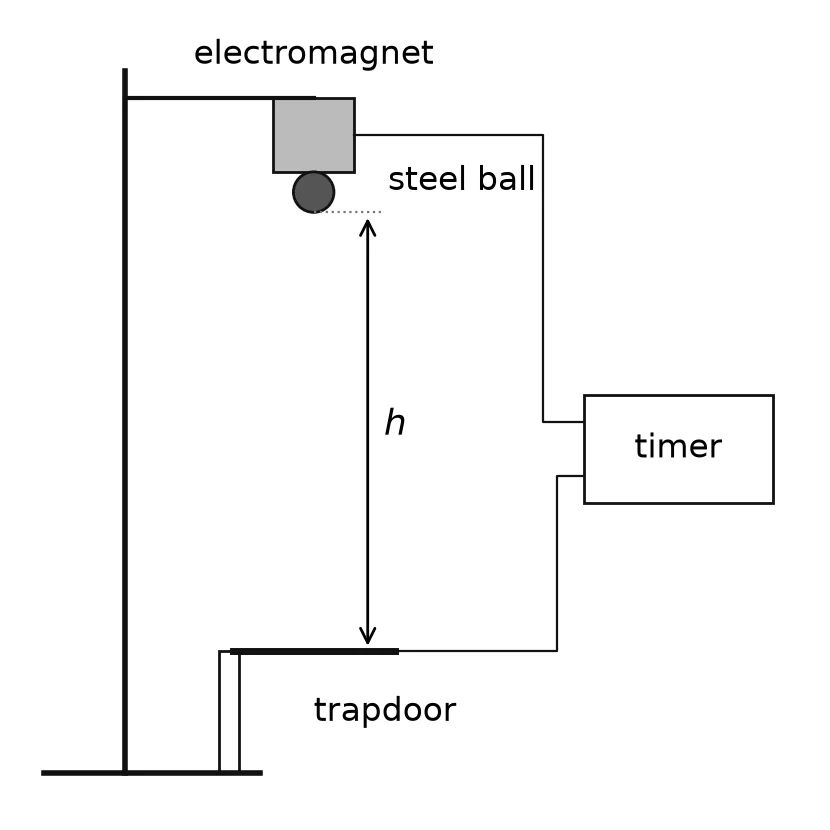
The height is measured with a metre rule to ± 0.002 m. The time for each height is measured three times. For the three readings are 0.362 s, 0.367 s and 0.359 s.
- (a)
Calculate the mean time for and its absolute uncertainty.
2 marks
- (b)
The students expect that . They plot a graph of the mean time against . The error bars show the uncertainty in ; the uncertainty in is too small to show.
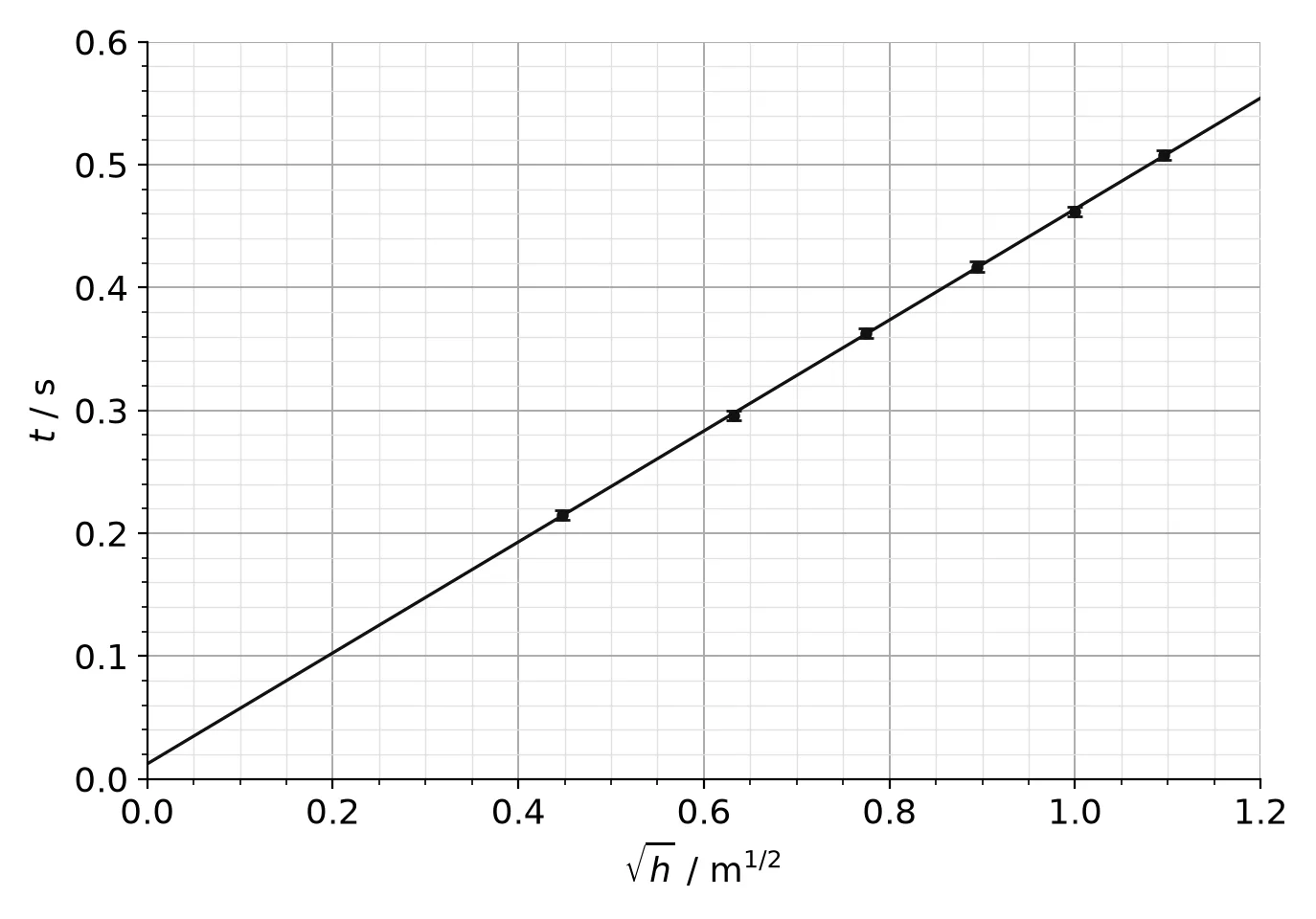
Outline why the students plotted against .
2 marks
- (c)(i)
State the unit of the gradient of the graph.
1 mark
- (c)(ii)
Determine, using the graph, a value for .
3 marks
- (d)
The line of best fit does not pass through the origin. State the value of the intercept on the axis and suggest a reason for it.
2 marks
- (e)
Explain why the effect in (d) does not change the value of obtained from the graph.
1 mark
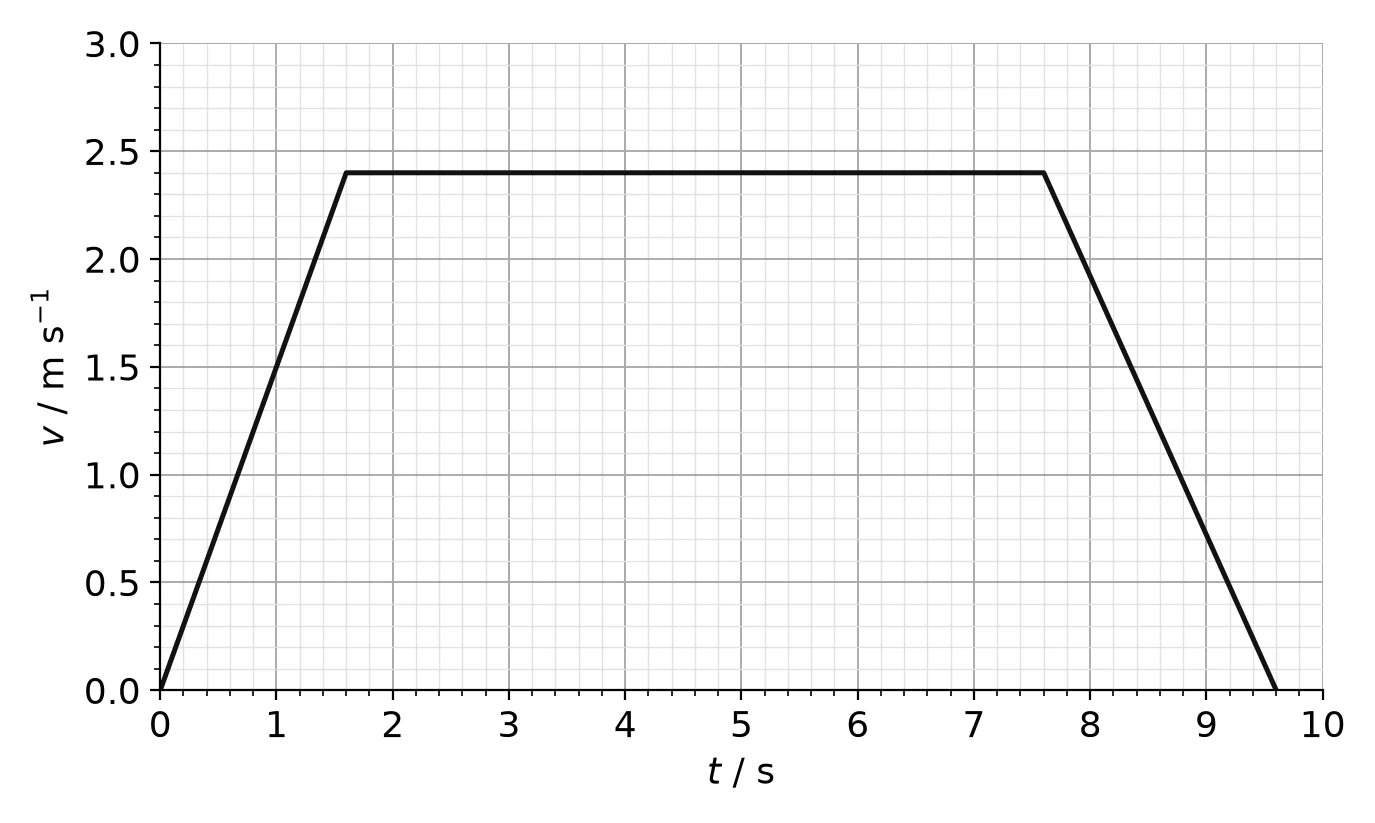
A lift (elevator) carries passengers upwards from the ground floor of a building. The graph shows the variation with time of the velocity of the lift.
- (a)
Calculate the acceleration of the lift during the first 1.6 s.
1 mark
- (b)(i)
Determine the distance travelled by the lift.
2 marks
- (b)(ii)
The floors of the building are 3.12 m apart. Deduce the floor at which the lift stops.
1 mark
- (c)
Sketch a graph to show the variation with of the acceleration of the lift from to . Take upwards as positive.
2 marks
Practice all 122 in Augment
Free with an account. Every question has its markscheme, and Augment keeps the ones you got wrong so you can come back to them.
More questions in Space, time and motion
- A.1KinematicsThis page
- A.2Forces and momentum
- A.3Work, energy and power
- A.4Rigid body mechanicsHL only
- A.5Galilean and special relativityHL only
Check your answers in Augment
A free account opens all 122 questions on Kinematics with their markschemes, and keeps a record of what you have marked.