
Use Newton's laws, free-body diagrams and the common forces to predict motion, and apply momentum, impulse and centripetal force to collisions, explosions and circular motion.
Each is in the Physics glossary, with every other term in the subject.
The angle swept out by the radius per unit time for a body moving in a circle, , measured in ; it is related to the speed by
Kinematics describes motion without asking what causes it. Dynamics is the study of how forces change motion. Newton's three laws connect the forces on a body to the way its velocity changes, and the same three laws lead to the idea of momentum, a quantity that stays constant when bodies collide, push apart or explode. Together they explain how a lift presses on its passengers, why airbags save lives, how a rocket accelerates in empty space and what keeps a car on a curved road.
244 exam-style questions on this subtopic, written in the style of the IB papers. The first has its markscheme open. Counted on
A trolley of mass 2.0 kg moving at collides with a stationary trolley of mass 1.0 kg. They stick together. What is their speed after the collision?
One of 95 short multiple-choice questions on A.2. Pick an answer to see why it's right or wrong.
Two trolleys on a horizontal track collide and stick together. What happens to their total momentum?
The official deck for this part of the syllabus.
What is a force?
What is dynamics, and how does it differ from kinematics?
The entries of the physics data booklet that A.2 uses. Each opens in the explained booklet.
With a free account, Augment remembers where you stopped and what you have practiced.
The force with which a support (such as bathroom scales) pushes up on a body; it differs from the true weight when the support accelerates vertically.
A body wholly or partly submerged in a fluid experiences an upward buoyancy force equal to the weight of the fluid it displaces, .
The upward force of a fluid on a body in it, equal to the weight of fluid displaced: .
The point at which the whole mass of a body can be treated as concentrated; the weight of a body acts through it.
The acceleration of a body moving in a circle, directed towards the centre: .
The resultant force on a body moving in a circle, directed towards the centre and perpendicular to the velocity: . It is provided by real forces such as tension, friction or gravity.
The ratio of the friction force to the normal force for two surfaces: for the maximum static friction, while sliding. It has no unit.
The total momentum of a system stays constant provided no resultant external force acts on it.
A force that acts only while two bodies touch, such as the normal force, friction, tension, an elastic force, fluid resistance or buoyancy.
A part of a vehicle designed to fold up in a controlled way in a collision, lengthening the stopping time and so reducing the average force on the occupants.
Friction between surfaces that are sliding over each other, ; usually less than the maximum static friction.
A collision in which both momentum and the total kinetic energy of the bodies are conserved.
An interaction in which bodies fly apart from rest or from each other; momentum is conserved while kinetic energy increases at the expense of another store.
A force that acts across a distance without contact, even through a vacuum: gravitational, electric and magnetic forces.
A push or a pull exerted by one body on another; a vector quantity measured in newtons (N).
A diagram of one body on its own showing every force that acts on it as a labelled arrow, with lengths roughly in proportion to the forces.
The component of the contact force parallel to two surfaces, which opposes their relative sliding or their tendency to slide.
The gravitational force per unit mass at a point, in ; near the Earth's surface.
The elastic restoring force of a spring is proportional to its extension and opposite in direction, , up to the limit of proportionality.
The product of the average resultant force on a body and the time it acts, ; it equals the change in momentum and the area under a force–time graph.
A collision in which momentum is conserved but kinetic energy decreases; in a perfectly inelastic collision the bodies stick together.
The tendency of a body to resist changes to its velocity; the mass of a body is a measure of its inertia.
A system on which no resultant external force acts, so its total momentum stays constant.
The largest extension (or force) up to which the force on a spring or wire is proportional to its extension.
The product of the mass and the velocity of a body, ; a vector measured in or N s.
The mass of matter passing a point per unit time, , in ; the force needed to change the velocity of a stream of matter by is .
The SI unit of force: the resultant force that gives a mass of 1 kg an acceleration of , so .
A body stays at rest or moves with constant velocity in a straight line unless a resultant external force acts on it.
The resultant force on a body equals its rate of change of momentum, ; for constant mass, .
When body A exerts a force on body B, B exerts a force of the same type on A that is equal in size and opposite in direction.
The component of the contact force between two surfaces that is perpendicular to them, .
A collision in which the bodies stick together and move off with a common velocity; the loss of kinetic energy is the largest that momentum conservation allows.
The time for one complete cycle of a repeating motion, such as one revolution in circular motion, in seconds.
The angle at the centre of a circle subtended by an arc equal in length to the radius; a full circle is rad.
The vector sum of all the forces acting on a body: the single force that would have the same effect as all of them together.
The force per unit extension of a spring obeying Hooke's law, , measured in ; a stiffer spring has a larger .
Friction between surfaces that are not sliding; it matches the applied force up to a maximum value, .
The viscous drag on a small sphere moving slowly through a fluid in laminar flow, , proportional to the radius, the speed and the viscosity.
The pulling force exerted by a stretched string, rope, cable or chain, acting along it and away from the body it is attached to.
Two forces of the same type that two bodies exert on each other, equal in size and opposite in direction, acting on different bodies.
The forward force on a rocket or jet engine from expelling gas backwards, approximately the mass flow rate times the exhaust speed, .
The state of a body on which the resultant force is zero, so that it is at rest or moves with constant velocity.
Motion in a circle at constant speed; the velocity changes direction continuously, so the body accelerates towards the centre.
A measure of how strongly a fluid resists flowing, symbol , measured in Pa s.
The resistive force on a small sphere moving slowly through a fluid in laminar flow, given by Stokes' law ; a special case of fluid resistance.
The gravitational force on a body, , measured in newtons and acting at its centre of mass.
A force is a push or a pull that one body exerts on another. It is a vector quantity: it has a size and a direction, and forces add by vector addition. The SI unit of force is the newton (N). Holding an apple of mass 0.1 kg against gravity needs a force of about 1 N.
Forces always come from an interaction between two bodies. A hand pushes a door, the Earth pulls a falling ball, a rope pulls a sledge. A force never exists on its own: wherever one body exerts a force on a second body, the second body exerts a force back on the first.
Forces fall into two broad groups. Contact forces act only when the bodies touch: the normal force, friction, tension, the elastic force of a spring, and the forces exerted by a fluid (fluid resistance, of which viscous drag is a special case, and buoyancy). Field forces act across a distance, even through a vacuum: gravitational, electric and magnetic forces. At the scale of atoms every contact force is electromagnetic in origin, arising from the forces between the charged particles of the two surfaces, but treating them as contact forces is a useful model for everyday bodies.
Force | Symbol | Type | Equation or rule |
|---|---|---|---|
Weight (gravitational) | Field | ||
Electric force | Field | Acts on charged bodies (Theme D) | |
Magnetic force | Field | Acts on moving charges and currents (Theme D) | |
Normal force | Contact | Perpendicular to the surface; as large as needed | |
Friction | Contact | ||
Tension | Contact | Along a string, rope or cable, pulling | |
Elastic restoring force | Contact | ||
Viscous drag on a sphere | Contact | ||
Buoyancy | Contact |
The two forces described by Newton's third law form a third-law pair. A pair always has these features:
the two forces act on different bodies (one on A, one on B);
they are the same type of force (both gravitational, both normal contact forces, both friction);
they are equal in size, opposite in direction and act along the same line;
they act at the same time, for as long as the interaction lasts.
A book resting on a table has two forces on it: its weight (the Earth pulls it down) and the normal force (the table pushes it up). These two forces are equal and opposite, but they are not a third-law pair: they act on the same body and are different types of force. They are equal only because the book is in equilibrium; in a lift accelerating upwards they would not be equal at all. The partner of the weight is the gravitational pull of the book on the Earth, and the partner of the normal force is the push of the book on the table.
Third-law pairs explain how anything starts moving. A walker pushes backwards on the ground with friction, and the ground pushes the walker forwards with an equal friction force. Swimmers push water backwards and the water pushes them forwards. In the same way, a rocket pushes exhaust gas backwards and the gas pushes the rocket forwards, with no need for air or ground to push against.
 YouTube
The resultant force is the single force that has the same effect as all the forces acting on a body together: their vector sum. Newton's first law says that a resultant force is needed to change the velocity, not to keep a body moving. A puck sliding on smooth ice keeps going for a long distance because almost no resultant force acts on it; a book pushed across a desk stops because friction acts against its motion.
The tendency of a body to keep its velocity is called inertia, and the mass of a body measures it. A loaded supermarket trolley is harder to start and harder to stop than an empty one because it has more mass. Passengers in a car that brakes suddenly continue forwards until a seat belt exerts a force on them.
Translational equilibrium does not mean that no forces act, only that they cancel. A skydiver falling at constant speed is in equilibrium, with fluid resistance balancing the weight, just as a book resting on a table is.
Forces in two dimensions are easiest to handle by splitting each one into two perpendicular components, usually horizontal and vertical, or along and perpendicular to a slope. A force at angle to the horizontal has components
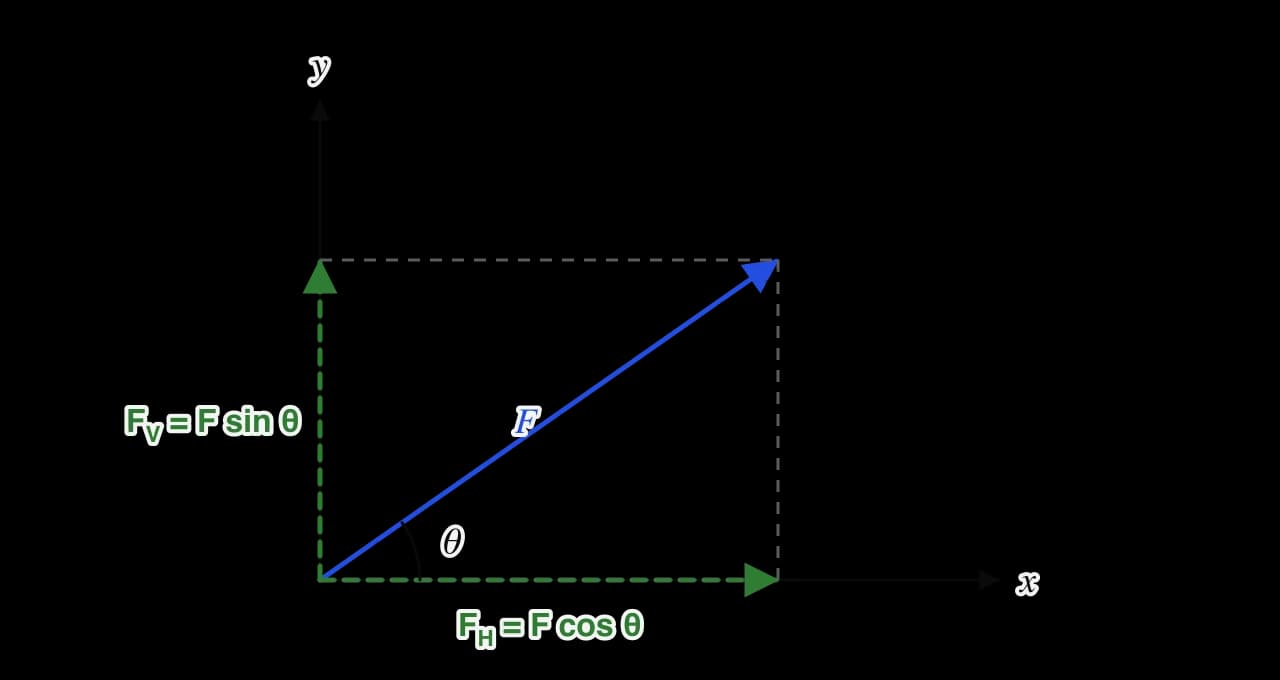
The components are found with the same rule for any vector (the data booklet gives it as , ). To find a resultant, resolve every force in the two directions, add the components in each direction (with signs), then combine the two totals with Pythagoras' theorem. For a body in equilibrium, the components in each direction add up to zero.
A wire or rope that sags only slightly must carry a very large tension. If a lamp hangs from the middle of a wire whose two halves are each at a small angle below the horizontal, the vertical components of the two tensions must together support the weight: . As gets smaller, approaches zero and grows without limit. A washing line or an overhead cable can therefore never be pulled perfectly straight.
Newton's second law defines the newton: 1 N is the resultant force that gives a mass of 1 kg an acceleration of 1 m s⁻², so . The in the equation is always the resultant force, never just one of the forces. If several forces act, they are first added as vectors, and the acceleration follows from their sum.
The second law contains the first. If the resultant force is zero, the acceleration is zero and the velocity stays constant. The more general form in terms of momentum, , also applies when the mass of the body changes.
A free-body diagram shows one body on its own, with every force that acts on it drawn as an arrow. It leaves out the forces the body exerts on other things. Drawing one is the first step in almost every dynamics problem, because it makes sure no force is missed and none is counted twice.
Choose the body (or system) and draw it simply, as a box or a dot.
Draw each force as an arrow starting from the body, pointing in the direction of the force, with its length roughly in proportion to its size.
Label every arrow with an accepted name or symbol: weight , normal force , friction , tension , and so on.
Draw the acceleration, if there is one, as a separate arrow beside the diagram, not attached to the body.
A sledge pulled across snow by a rope at an angle shows all of the common forces at once. The weight acts downwards from the centre of mass; the normal force acts upwards from the snow; friction acts backwards along the surface, opposing the sliding; and the tension acts along the rope.

When two surfaces press together, each pushes on the other. The component of this contact force perpendicular to the surfaces is the normal force ("normal" means perpendicular). It is caused by the tiny compression of the surfaces, which push back like very stiff springs.
The normal force is not fixed: it takes whatever value is needed to stop the bodies moving into each other. For a book resting on a level table it equals the weight. If someone presses down on the book, it increases; on a slope it is smaller than the weight; in a lift accelerating downwards it is smaller again. It becomes zero when the surfaces separate.
Friction is the component of the contact force parallel to the surfaces. It opposes the relative sliding of the surfaces, or the tendency of them to slide. Microscopically, even polished surfaces touch only at the tips of tiny bumps, where the atoms bond briefly and must be torn apart for the surfaces to slide.
While the surfaces do not slide, the force is static friction. It matches the applied force exactly, up to a maximum value. Once the surfaces slide, the force is dynamic friction (also called kinetic friction), which is roughly constant and usually smaller than the maximum static friction.
and are the coefficients of static and dynamic friction. They have no unit and depend on the two materials and the state of the surfaces (dry, wet, oily); they are almost independent of the area of contact and of the sliding speed. For rubber tyres on dry asphalt the coefficient is typically between about 0.7 and 1, while for steel on ice it is only a few hundredths or less.
Static friction and dynamic friction together explain a familiar effect. A heavy box needs a hard push to start it moving, then less force to keep it moving. The graph of friction against the applied force shows both regions.
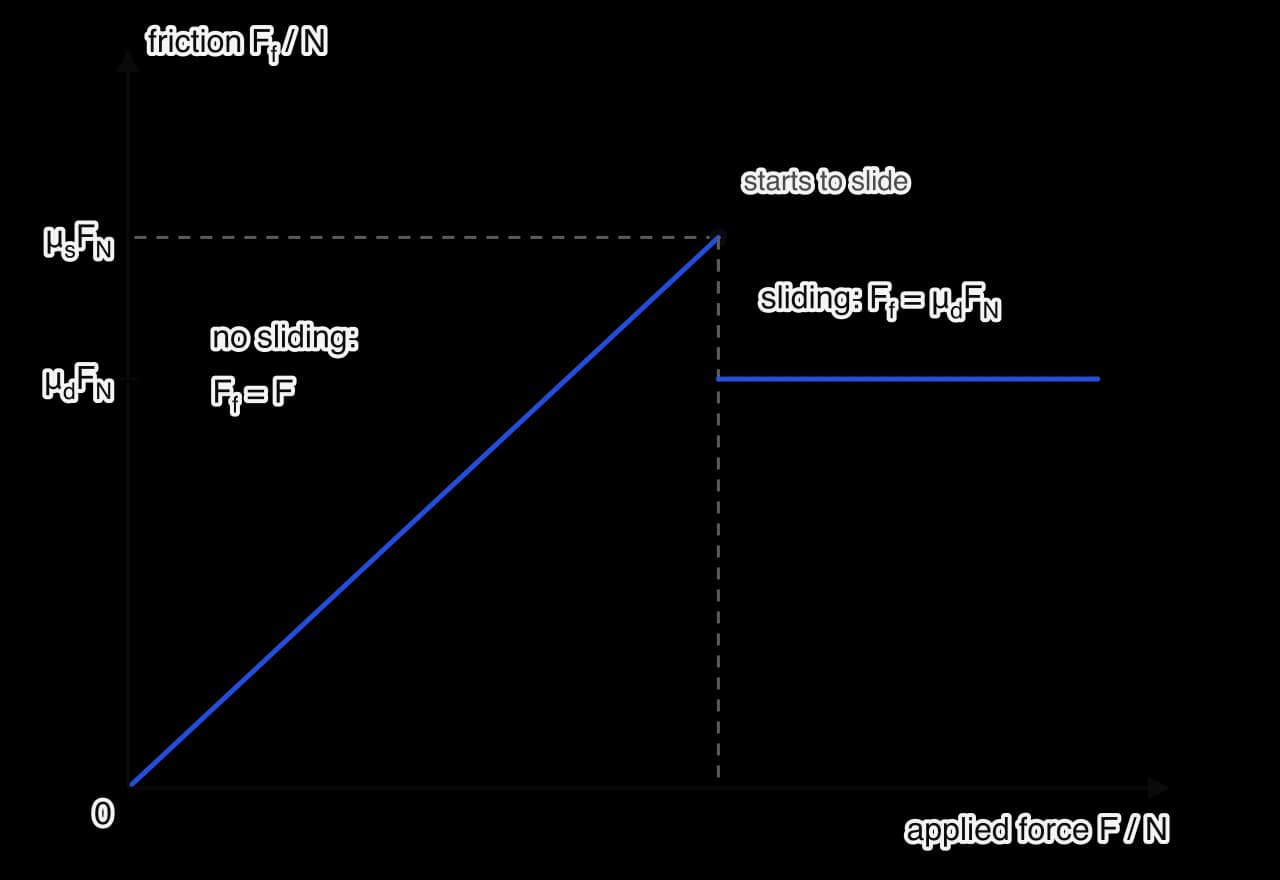
The coefficient of friction is a model: real surfaces show small changes with speed, temperature and wear. Treating as a constant still gives useful estimates for most everyday surfaces, which is why it is used throughout engineering.
Friction is often the force that causes motion rather than resisting it. When a car accelerates, static friction from the road pushes the tyres forwards. When a box sits on the flat bed of an accelerating truck, static friction from the truck bed is the only horizontal force on the box, so it is the force that accelerates the box with the truck.
Tension is the pulling force exerted by a stretched string, rope, cable or chain. It always acts along the string and away from the body it is attached to: a string can pull but never push. In problems the string is usually light (its mass is negligible) and inextensible (it does not stretch). The tension is then the same all along the string, and the bodies joined by it move with the same speed and the same size of acceleration.
A light string passing over a smooth pulley changes direction but keeps the same tension on both sides. A pulley therefore lets a hanging weight pull a body sideways across a table, or lets a crane lift a load with a cable that runs over a wheel.
A spring, a rubber band or a steel wire that is stretched or compressed pulls or pushes back towards its natural length. This elastic restoring force is described by Hooke's law:
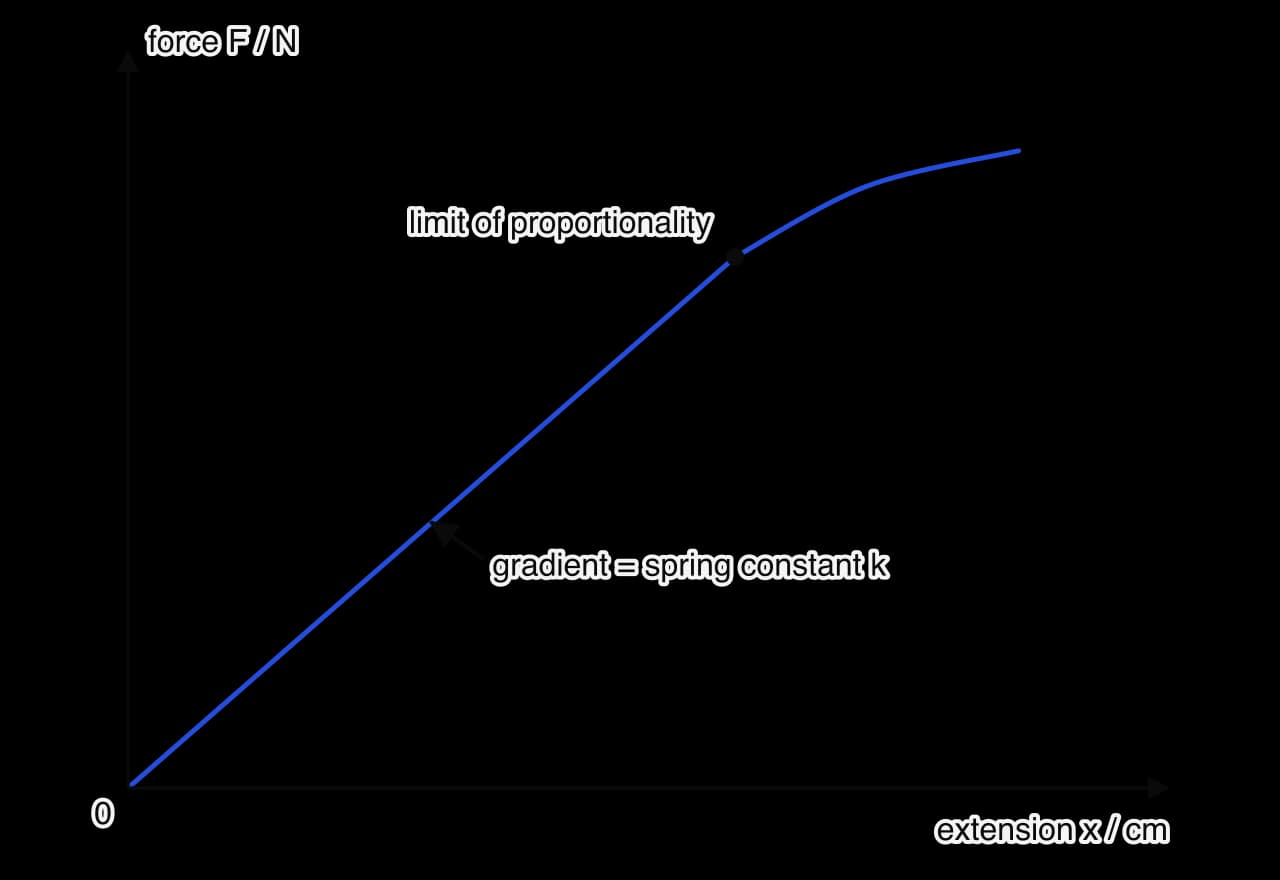
is the extension (or compression), the change in length from the natural length, and is the spring constant, measured in . A stiff spring has a large . The minus sign shows that the force acts opposite to the extension: stretch the spring to the right and it pulls to the left. When only the size is needed, .
Hooke's law holds only up to the limit of proportionality. Up to this point the force–extension graph is a straight line through the origin and its gradient is . Beyond it the graph curves, and further on the material may be permanently deformed (it passes its elastic limit) and will not return to its original length.
A body moving through a gas or a liquid experiences fluid resistance, a force that opposes its motion relative to the fluid. Air resistance is the everyday example: it is fluid resistance in air. Fluid resistance increases with speed, with the cross-sectional area of the body and with the density of the fluid, and it depends strongly on shape. For large, fast bodies such as cyclists, cars and skydivers, it is roughly proportional to the square of the speed.
For a small sphere moving slowly through a fluid, the flow around it is smooth (laminar, with no eddies), and the resistive force is given by Stokes' law:
is the radius of the sphere, its speed relative to the fluid, and (eta) is the viscosity of the fluid, a measure of how strongly it resists flowing, in pascal seconds (Pa s). Water at room temperature has , while glycerol at 20 °C has about 1.4 Pa s. Viscosity depends strongly on temperature: most liquids flow much more easily when warm. The force in Stokes' law is called viscous drag.
Viscous drag is a special case of fluid resistance. It applies only when the sphere is small, the speed low and the flow laminar, and in that case the force is proportional to . At higher speeds the flow becomes turbulent, eddies form behind the body, and the resistive force rises more steeply than Stokes' law predicts.
A body that is wholly or partly submerged in a fluid feels an upward force, buoyancy , also called upthrust. The pressure in a fluid increases with depth, so the fluid pushes up on the bottom of the body harder than it pushes down on the top. The result is described by Archimedes' principle: the buoyancy force equals the weight of the fluid displaced.
Here is the density of the fluid (not of the body) and is the volume of fluid displaced, which equals the submerged volume of the body. A body floats when the buoyancy on its submerged part equals its weight; a ship floats low in fresh water and slightly higher in denser sea water. A helium balloon rises because the weight of the air it displaces is greater than its own weight.
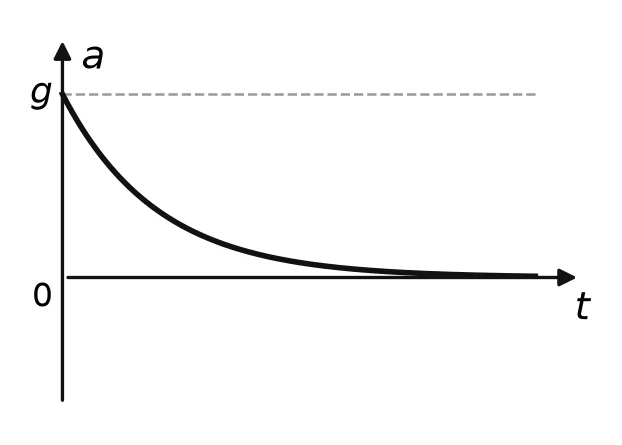
When a body falls through a fluid, the resistive force grows with its speed. A sphere released from rest in a tall tube of oil starts with only its weight and the buoyancy acting, so it accelerates downwards. As it speeds up, viscous drag increases, the resultant force falls and so does the acceleration. Eventually the upward forces balance the weight and the sphere falls at a constant speed, its terminal velocity.
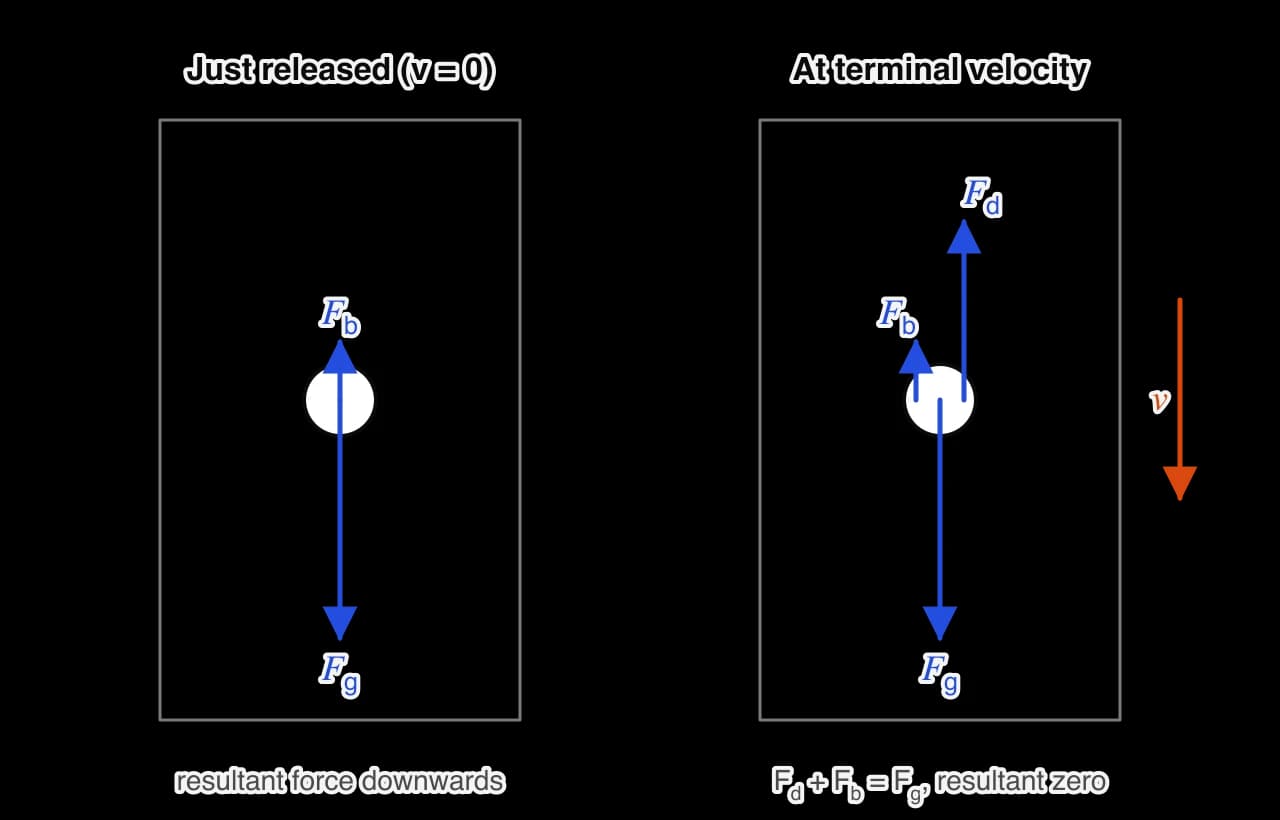
At terminal velocity the resultant force is zero, so
For a sphere of radius and density in a fluid of density , the weight is and the buoyancy is . Substituting Stokes' law shows that the terminal velocity is proportional to : a sphere with twice the radius falls four times as fast. The velocity–time graph of the falling sphere starts with a gradient of , less than because buoyancy opposes the weight, and levels off. With linear drag the approach is very fast: a millimetre-sized steel ball in glycerol reaches its terminal velocity within a few milliseconds.
The same balance of weight, buoyancy and viscous drag on tiny charged oil drops, with an electric force added, was the basis of Millikan's measurement of the charge of the electron (Theme D).
The Red Bull Stratos jump of 14 October 2012 shows how the forces on a falling body change during a fall, and that a resultant force can point upwards while the body moves downwards. Felix Baumgartner left a capsule about 39 km above New Mexico, where the air is a few hundred times less dense than at sea level. Buoyancy in such thin air is negligible, and fluid resistance was very small at first, so his free-body diagram was almost a single weight arrow and his acceleration was close to .
As his speed rose, fluid resistance grew until, within the first minute, it equalled his weight. At that instant the resultant force was zero and his speed reached its maximum, 1357.6 km h⁻¹ (377 m s⁻¹). He then fell into steadily denser air, so fluid resistance became larger than his weight. The resultant force pointed upwards and he decelerated, still moving down, long before he opened his parachute after about 4 min 20 s of free fall.
A skydiver who opens a parachute goes through the same sequence: the resistive force suddenly exceeds the weight, the resultant force points upwards, and the speed falls until the forces balance again at a much lower speed.
The weight of a body is the gravitational force that the Earth (or another planet) exerts on it:
is the gravitational field strength, the gravitational force per unit mass, in . Near the Earth's surface , which is the same number as the free-fall acceleration in . Mass is a property of the body and is the same everywhere; weight depends on where the body is. An astronaut of mass 80 kg has a weight of 780 N on Earth and only about 130 N on the Moon, where is about .
Weight acts at the body's centre of mass, so in a free-body diagram it is drawn from the centre of the body. Two other field forces act on charged bodies: the electric force between charges, and the magnetic force on moving charges and electric currents. Their equations belong to Theme D, but in a free-body diagram they are handled in exactly the same way as any other force.
Most dynamics problems follow the same method:
Draw a free-body diagram for each body in the problem.
Choose a positive direction for each body, usually the direction in which it accelerates.
Resolve the forces along and perpendicular to the acceleration.
Perpendicular to the acceleration the forces balance; along it, apply to the resultant force.
Solve, then check the answer has a sensible size and sign.
Bathroom scales do not measure weight directly. They measure the normal force with which they push up on the person standing on them. In a lift moving at constant velocity this equals the weight; in an accelerating lift it does not. The scale reading is the apparent weight.
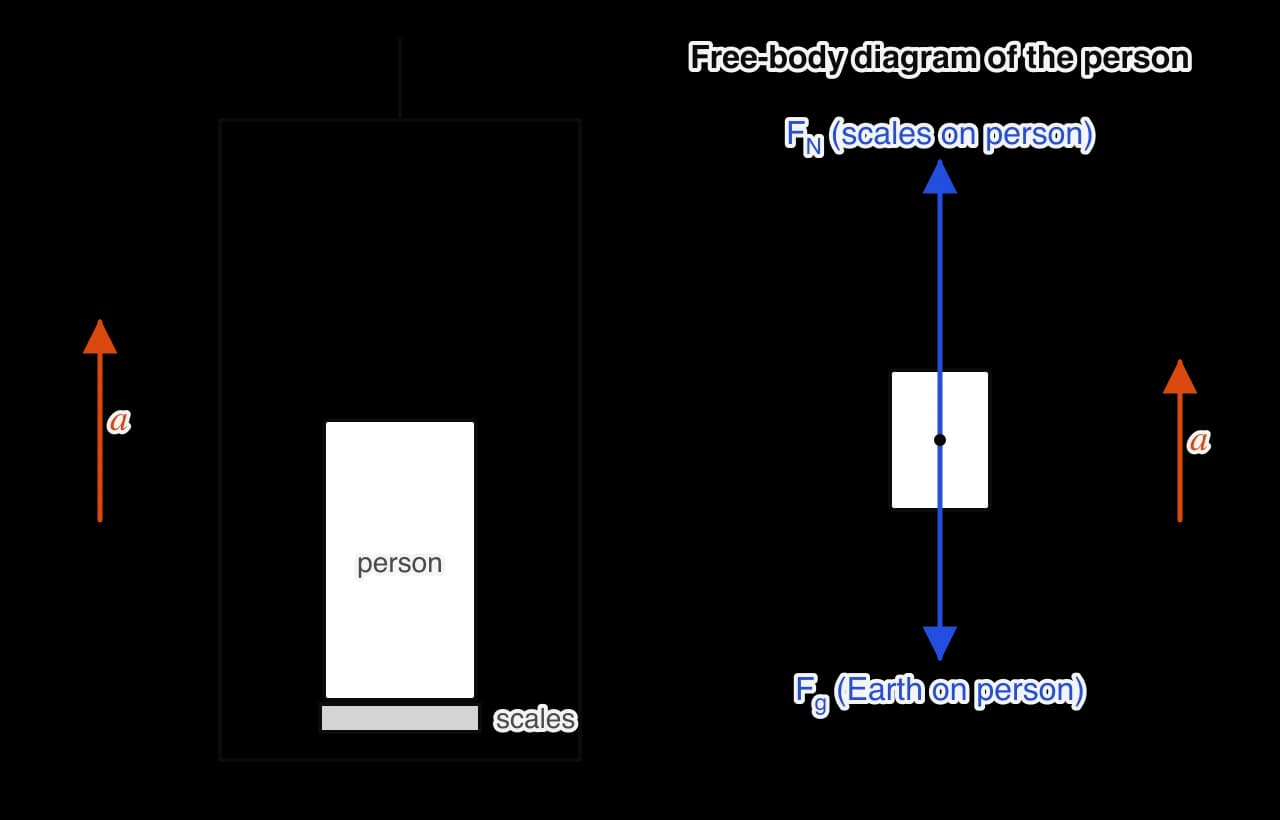
Taking upwards as positive and the lift's acceleration as , the second law for the person is , so
When the lift accelerates upwards (, speeding up on the way up or slowing down on the way down), the person feels heavier. When it accelerates downwards (), they feel lighter. If the cable broke and the lift fell freely, and : the person would feel weightless, although their weight would be unchanged. Astronauts in orbit feel weightless for the same reason; they and their spacecraft are in free fall together.
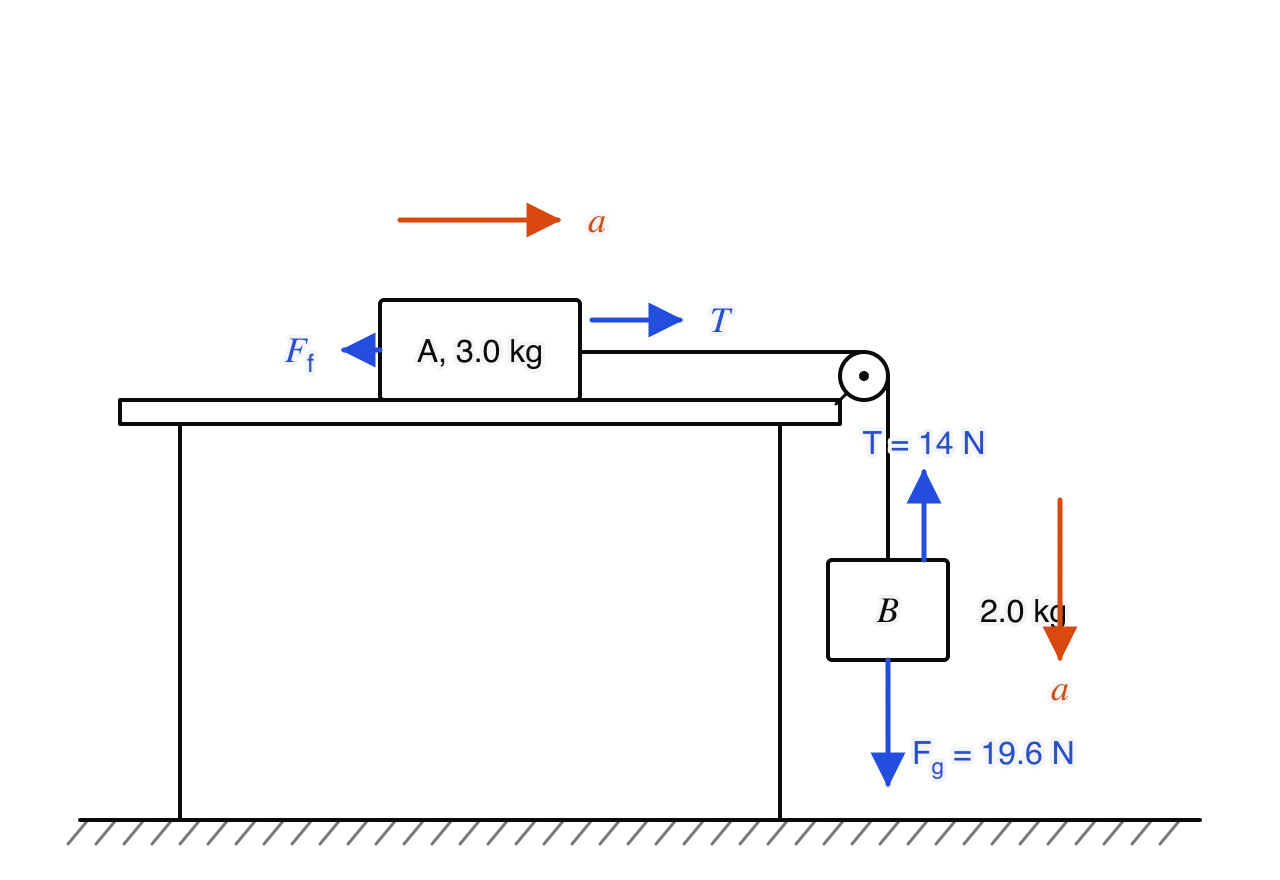
When bodies are joined by a light, inextensible string, they move together with the same size of acceleration. There are two ways to analyse them. The bodies can be treated together as one system, in which the tension is an internal force and cancels out; this quickly gives the acceleration. Each body can also be treated separately, with its own free-body diagram; this is needed to find the tension.
For a body on a slope at angle to the horizontal, it is easiest to resolve the forces along and perpendicular to the slope, because the acceleration is along the slope. The normal force and friction already point in these directions; only the weight has to be resolved.
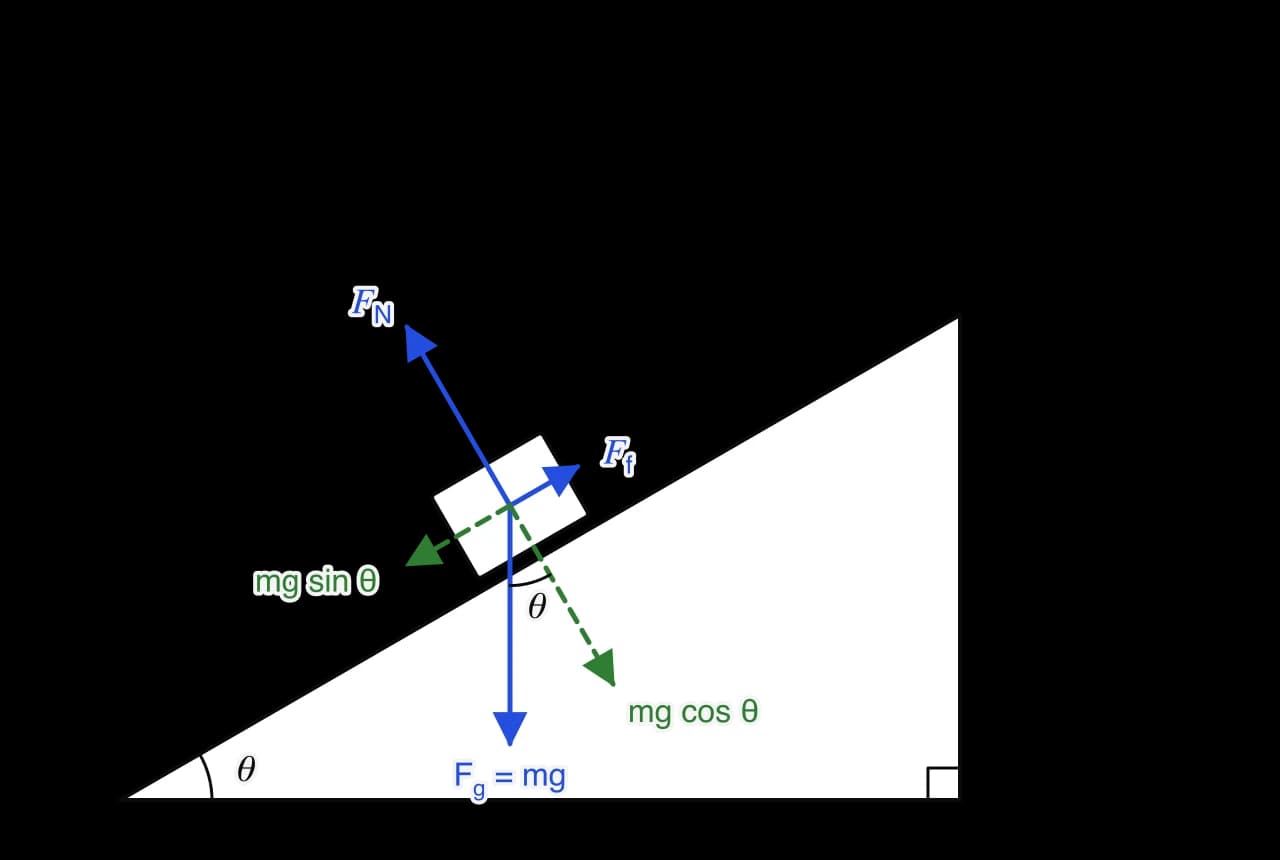
Perpendicular to the slope there is no acceleration, so . Along the slope, the component pulls the body down, and friction opposes the motion. A body stays at rest on a slope as long as , that is, as long as . Gradually tilting a board until a block starts to slide is a simple way to measure .
Linear momentum combines how much matter is moving with how fast it moves. A 1500 kg car at 20 m s⁻¹ has a momentum of ; a 0.010 kg bullet at 400 m s⁻¹ has only 4.0 kg m s⁻¹. Because momentum is a vector, a direction must be chosen as positive and a body moving the other way has negative momentum.
Newton stated his second law in terms of momentum: the resultant force on a body equals its rate of change of momentum.
For a body of constant mass, , so . The momentum form is more general: it also applies when the mass changes, as for a rocket burning fuel or a conveyor belt collecting sand.
A system with no resultant external force on it is an isolated system. Conservation of momentum follows from Newton's second and third laws. When two bodies A and B collide, A pushes on B and B pushes on A with equal and opposite forces, for the same time. Each force changes the momentum of the body it acts on by , so the momentum gained by one body is exactly the momentum lost by the other, and the total does not change.
Conservation of momentum has been tested in collisions from snooker balls to subatomic particles, and no exception has ever been found. It is one of the most general laws in physics. In beta decay, the energy and momentum of the emitted particles did not seem to balance, and keeping the conservation laws led to the prediction of a then unknown particle, the neutrino (Theme E).
Impulse follows directly from . A large force acting for a short time can give the same impulse, and so the same change in momentum, as a small force acting for a long time. Like momentum, impulse is a vector, in the direction of the resultant force.
When the force changes during the interaction, as it does in every real collision, the impulse is the area under the force–time graph. The average force is the impulse divided by the contact time.
The direction of the momentum matters when a body bounces. A ball that hits a wall at 20 m s⁻¹ and rebounds at 15 m s⁻¹ has changed its velocity by 35 m s⁻¹, not 5 m s⁻¹, because it has reversed direction.
To bring a moving body to rest, its momentum must be reduced to zero, so the impulse needed is fixed by its mass and initial speed. The only way to reduce the force is to make the stopping time longer. Two pulses with the same area on a force–time graph show the effect: four times the stopping time means a quarter of the average force.
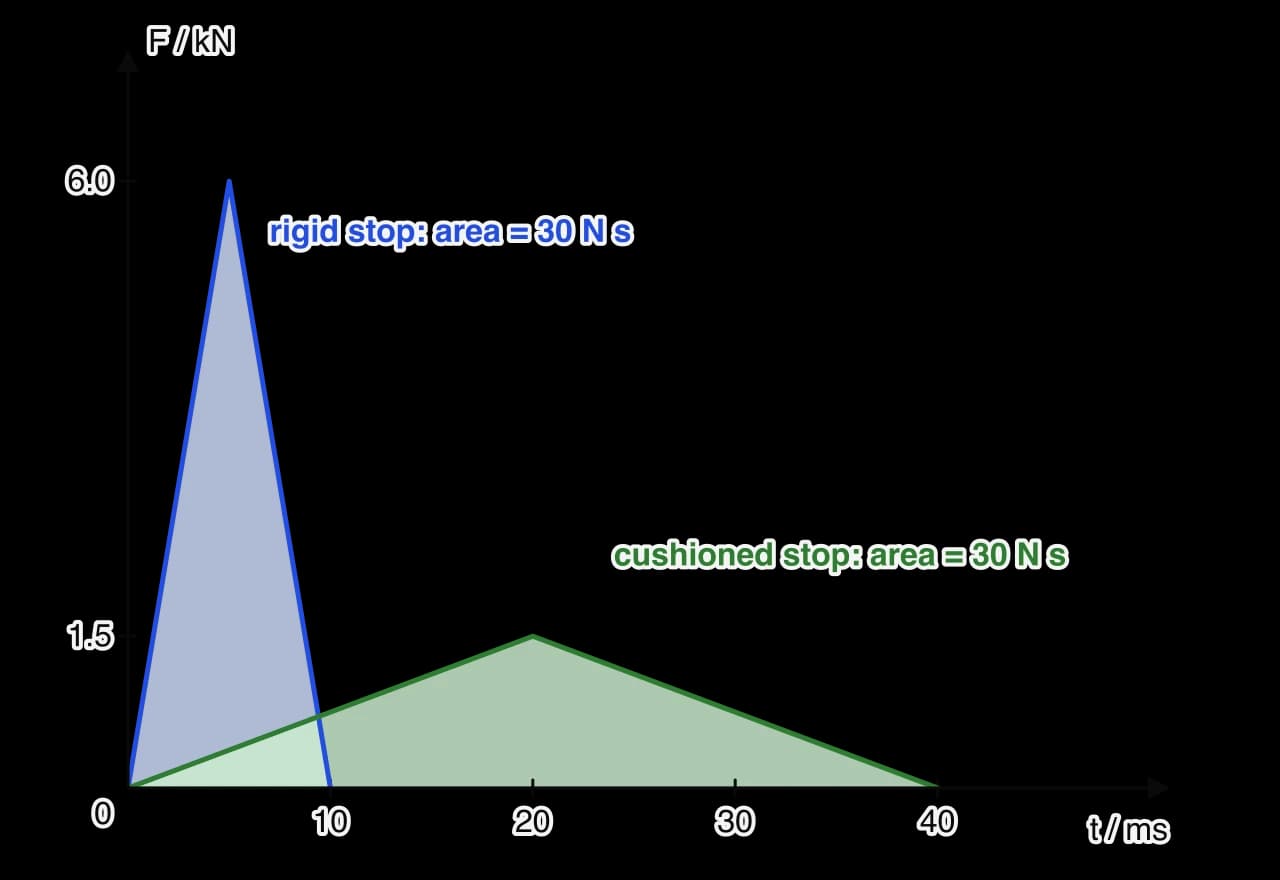
Car safety design uses this idea throughout. The front and rear of a modern car are crumple zones, built to fold up in a controlled way during a crash. Crumpling over several tenths of a metre makes the car stop over a longer time than a rigid frame would, which lowers the deceleration of the passenger compartment. Inside, a seat belt stretches slightly and an airbag inflates within a few hundredths of a second, so the occupant's head is brought to rest over a longer time and over a larger area than by hitting the steering wheel.
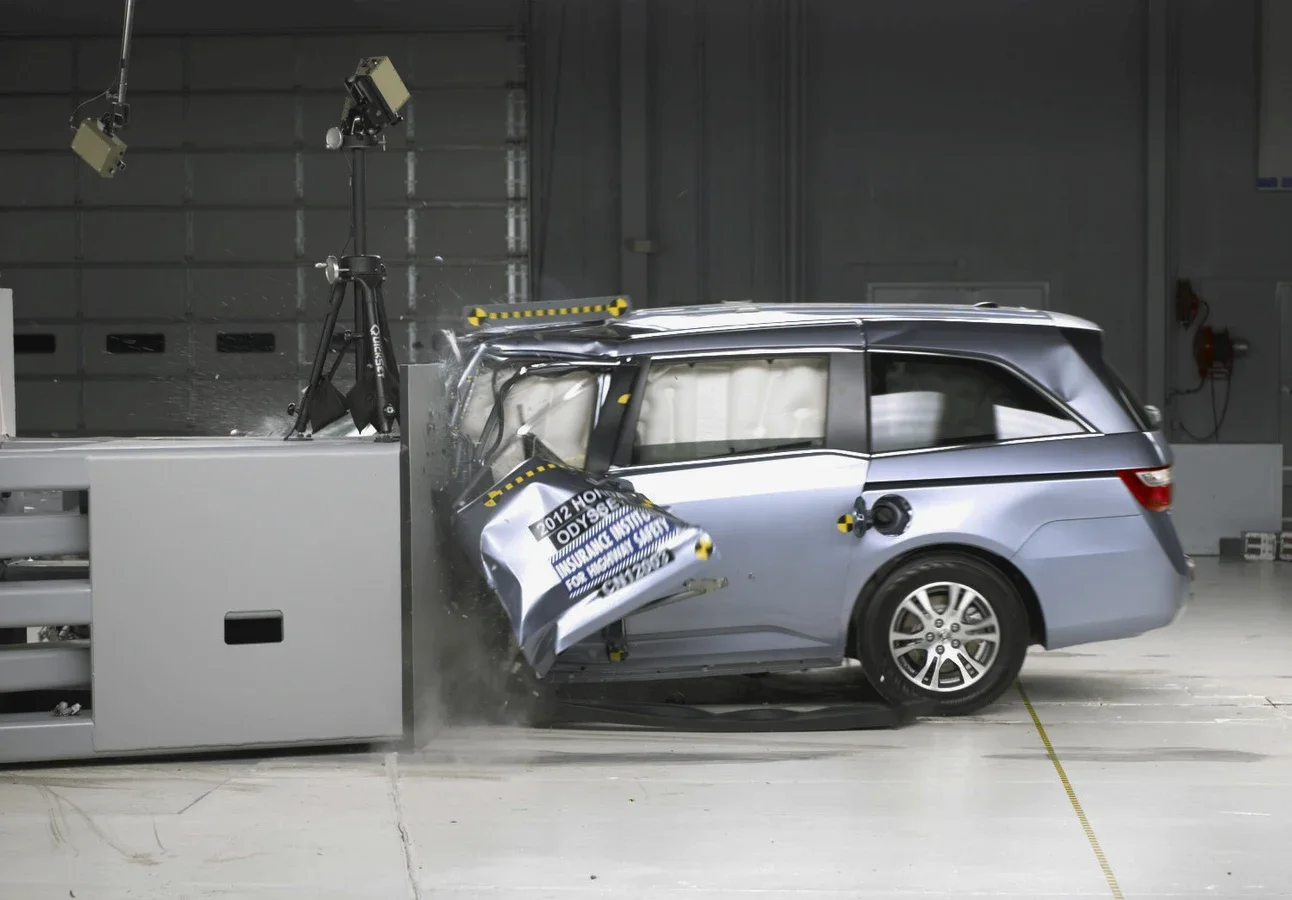
The same physics explains why a high jumper lands on a deep mat, why a cricketer draws the hands back when catching a ball, and why bicycle helmets contain crushable foam rather than hard plastic alone.
When the mass of a system changes, cannot be used directly, but still applies. In many situations matter flows at a steady mass flow rate (in ) and its velocity changes by . The force needed to change its momentum is then
A rocket engine burns propellant and pushes the hot exhaust gas backwards at high speed. The force on the gas, by the third law, is matched by an equal forward force on the rocket, the thrust. If gas leaves at a mass flow rate with a speed relative to the rocket, the thrust is approximately . The rocket does not need air to push against; it works best in a vacuum.
A jet of water from a hose that hits a wall and stops has its momentum destroyed at a steady rate. If 0.50 kg of water arrives every second at 12 m s⁻¹, the wall must exert a force of on the water, and the water pushes the wall with 6.0 N. If the water bounced straight back, the change in velocity would be larger and so would the force.
In every collision between two bodies in an isolated system, momentum is conserved. Kinetic energy, however, is not always conserved: some of it may be transferred to internal energy (the bodies warm up), to sound, or to the work done in deforming them permanently. Total energy is always conserved; the question is only whether the kinetic energy store keeps all of it.
Type | Momentum | Kinetic energy | Example |
|---|---|---|---|
Elastic collision | Conserved | Conserved | Collisions of gas molecules; nearly so for snooker balls |
Inelastic collision | Conserved | Decreases | A football hitting a wall; a car crash |
Perfectly inelastic collision | Conserved | Largest possible decrease; bodies stick together | Railway wagons coupling |
Explosion | Conserved (often zero total) | Increases, from chemical or elastic energy | A gun firing; skaters pushing apart |
For calculations it helps to have the kinetic energy in terms of momentum. Since and ,
This shows that when two bodies have momenta of equal size, as after an explosion from rest, the lighter body has the larger kinetic energy.
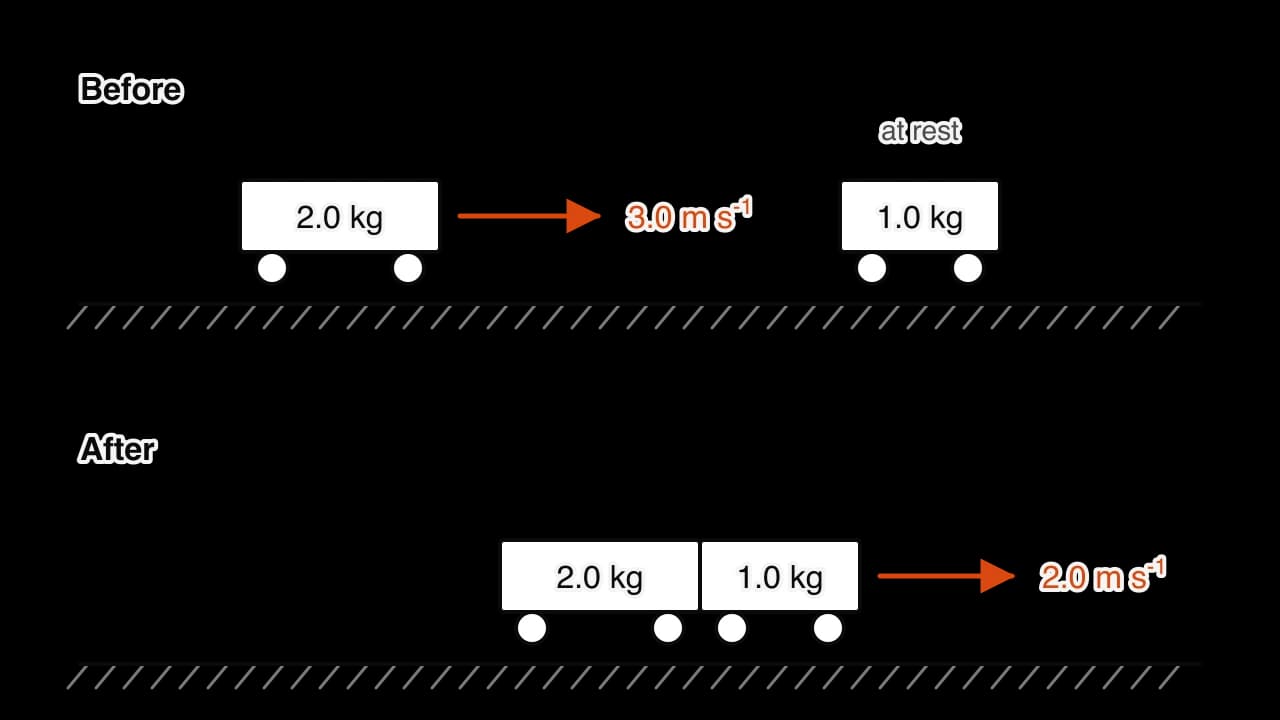
In a perfectly inelastic collision the bodies stick together and move off with a common velocity. The trolley collision shows a 2.0 kg trolley at 3.0 m s⁻¹ hitting a 1.0 kg trolley at rest: the total momentum, 6.0 kg m s⁻¹, is shared by 3.0 kg, so the joined trolleys move at 2.0 m s⁻¹.
 YouTube
In an elastic collision both momentum and kinetic energy are conserved. Truly elastic collisions happen between molecules of a gas and between subatomic particles; collisions of hard steel or snooker balls come close. To find out whether a collision is elastic, calculate the total kinetic energy before and after and compare.
In an explosion, a body or a group of bodies at rest flies apart. The total momentum before is zero, so the total momentum afterwards is also zero: the pieces move off with equal and opposite momenta. Kinetic energy increases, supplied from a chemical store (gunpowder, fuel, muscles) or an elastic store (a compressed spring). A rifle recoils when it fires, and a person stepping off a small boat pushes the boat away.
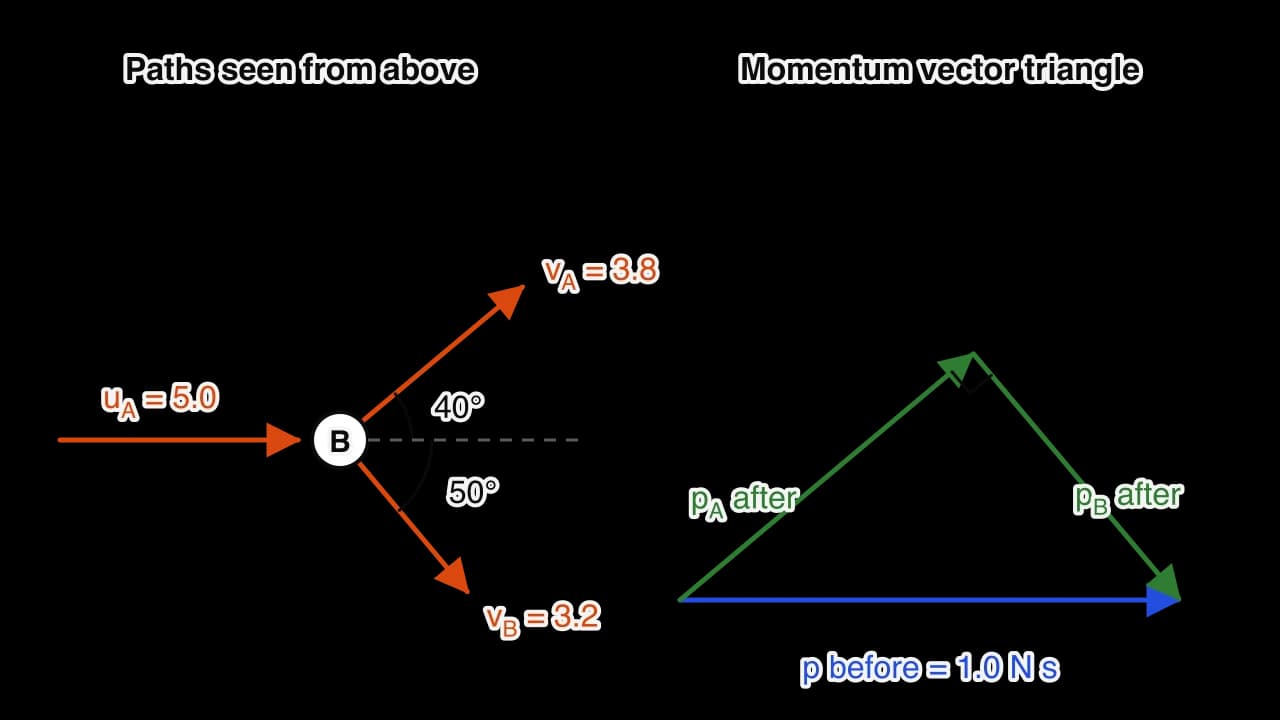
Momentum is a vector, so its conservation holds separately for each perpendicular direction. For a collision in a plane, the total -component of momentum and the total -component are both unchanged:
An equivalent picture is a vector triangle: the momentum vectors after the collision, added head to tail, must give the momentum vector before. When a puck slides into an identical puck at rest and the collision is elastic (and not head-on), the two pucks always move off at right angles to each other, so the vector triangle has a right angle.
The same method handles explosions into several pieces. If a body at rest breaks into three fragments, the total momentum is zero in every direction, so the momentum of the third fragment must be equal and opposite to the vector sum of the other two.
A body moving in a circle at constant speed is in uniform circular motion. Its speed is constant, but its velocity is not, because the direction of motion changes all the time. A changing velocity means an acceleration, and by Newton's second law an acceleration needs a resultant force.
Angles in circular motion are measured in radians. One radian is the angle at the centre of a circle subtended by an arc equal in length to the radius, so a full circle is rad (and ).
One revolution sweeps out rad in one period, so . In the same time the body travels the circumference , so its speed is
All points on a rotating rigid body share the same angular velocity, but points further from the axis move faster. A point on the Earth's equator, 6400 km from the axis, moves at about 465 m s⁻¹ as the Earth turns, while a point near the poles hardly moves at all.
In uniform circular motion the acceleration points towards the centre of the circle. It is called centripetal acceleration ("centre-seeking"). Its size is

The direction makes sense from the velocity. As the body moves a short way round the circle, its velocity vector turns. The change in velocity, , the vector from the old velocity to the new one, points towards the centre of the circle, so the acceleration does too. The three forms of the equation are linked by and .
Over a short time the body moves through a small angle . Its velocity vector, of constant size , turns through the same angle. The two velocity vectors and the change form a thin isosceles triangle, so for a small angle .
As shrinks, becomes perpendicular to the velocity, pointing exactly at the centre.
By Newton's second law, the resultant force on a body in uniform circular motion also points to the centre. This resultant is the centripetal force:
A force perpendicular to the velocity does no work on the body, so it changes the direction of motion without changing the speed. If the force disappears, the body continues in a straight line along the tangent, as a stone does when it is released from a sling.
The centripetal force is the name for the resultant of the real forces acting on the body, rather than an extra kind of force. It is always provided by one or more of these real forces:
Situation | What provides the centripetal force |
|---|---|
A ball whirled on a string in a horizontal circle | Tension in the string |
A car going round a flat bend | Static friction between the tyres and the road |
The Moon orbiting the Earth | The gravitational force of the Earth |
A conical pendulum | The horizontal component of the tension |
An electron in a magnetic field | The magnetic force on the moving charge |
A car rounding a flat bend relies entirely on friction. If the road is wet or icy, the maximum friction may be less than , and the car slides outwards along a path closer to the tangent. Roads and race tracks are sometimes banked (tilted towards the centre of the bend) so that a component of the normal force also points towards the centre and less friction is needed.
A mass on a string that moves in a horizontal circle, with the string sweeping out a cone, is a conical pendulum. Only two forces act on the bob: its weight and the tension. Resolving the tension shows how they combine to give a horizontal resultant towards the centre of the circle.
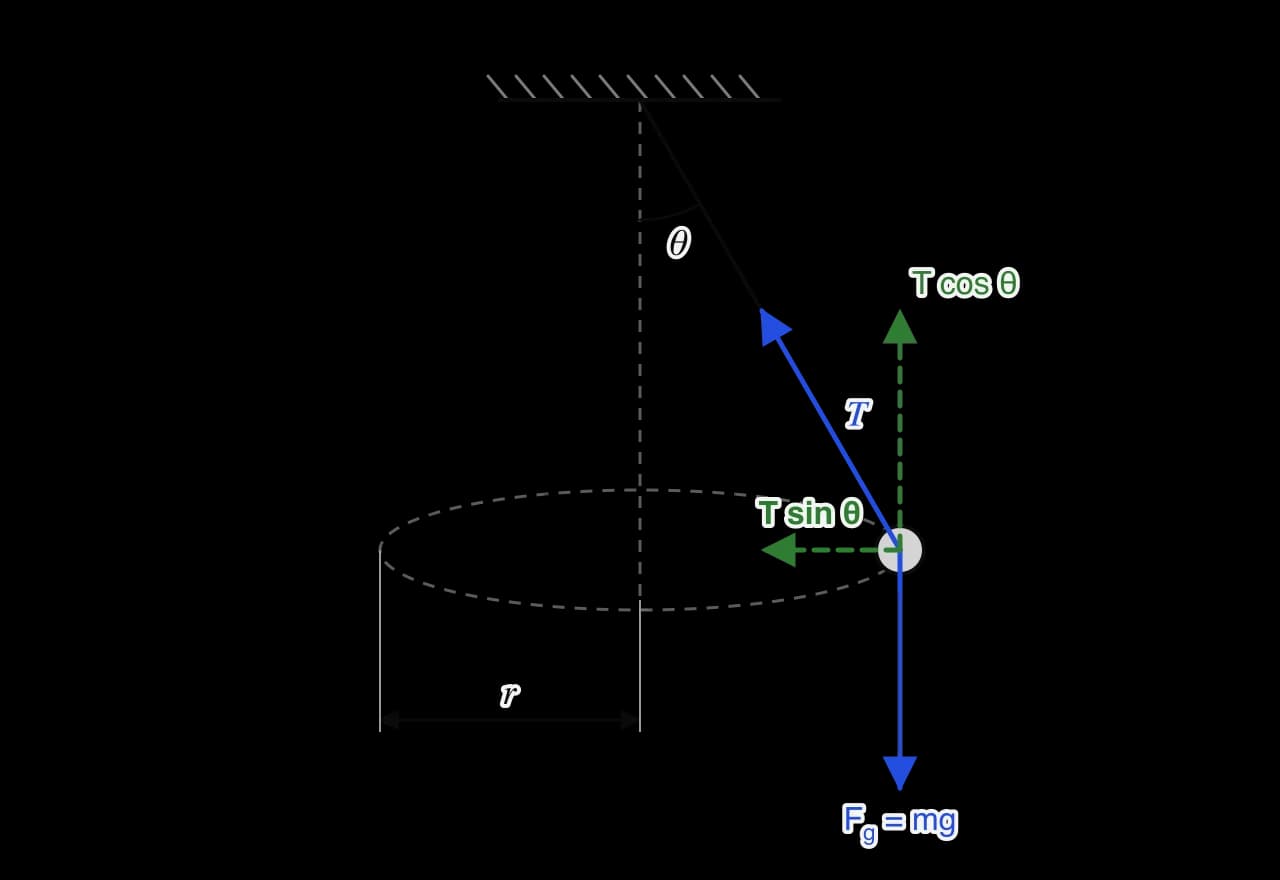
Dividing the second equation by the first gives : the faster the bob moves, the larger the angle. The string can never be horizontal, because some vertical component of tension is always needed to support the weight.
A ball whirled on a string in a vertical circle, a roller-coaster car in a loop and a bucket of water swung over the head all move in vertical circles. Their speed is not constant: the body slows down as it rises and speeds up as it falls, because its weight has a component along the path. This is non-uniform circular motion, but at each instant the component of the resultant force towards the centre is still for the speed at that point.
The analysis is simplest at the top and bottom of the circle, where the weight points along the radius:
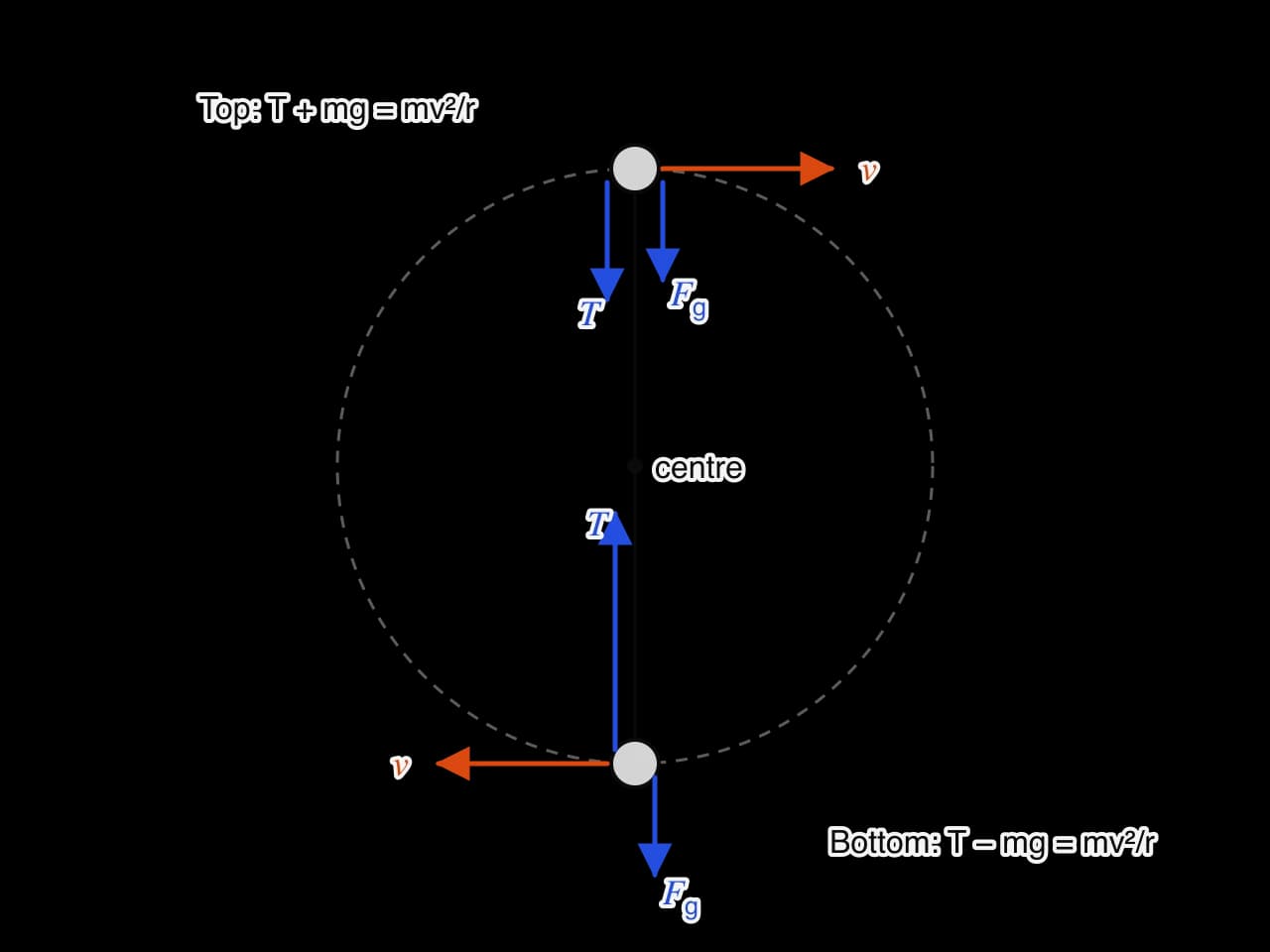
At the top, tension and weight both point down, towards the centre: .
At the bottom, tension points up, towards the centre, and weight points down: .
The tension is therefore greatest at the bottom, which is where a string is most likely to break. At the top, the tension falls as the speed falls. The smallest possible speed at the top is reached when the tension is zero and the weight alone provides the centripetal force: , so . Below this speed the string goes slack and the body leaves the circle. The same condition applies to a roller-coaster car at the top of a loop, with the normal force from the track in place of the tension.
Calculations on this content are marked step by step, so the method needs to be visible.
A group of students drops steel ball bearings of different radii into a tall cylinder of oil. For each ball they time its fall between two marks 0.200 m apart, the upper mark being 15 cm below the surface. The density of steel is and the density of the oil is . Theory predicts that the terminal velocity is .
r / mm ± 0.01 | r² / mm² | v / mm s⁻¹ |
|---|---|---|
0.50 | 0.25 | 4.1 |
0.75 | 0.56 | 8.7 |
1.00 | 1.00 | 16.0 |
1.25 | 1.56 | 24.5 |
1.50 | 2.25 | 35.8 |
I can state Newton's three laws and use each one to explain everyday motion.
I can identify the third-law partner of a force by its type, the body it acts on and its direction, and tell it apart from a balanced force.
I can draw a labelled free-body diagram with arrows in proportion, and find the resultant force by resolving in two directions.
I can solve equilibrium problems with up to three forces, including the tension in a sagging wire.
I can use and , and decide whether a body slides.
I can use Hooke's law and find a spring constant from a force–extension graph.
I can use Stokes' law and , and explain terminal velocity with
I can distinguish mass from weight and calculate weight with .
I can analyse lifts (apparent weight), connected bodies over pulleys and bodies on inclined planes with friction.
I can calculate momentum and use its conservation in collisions, explosions and recoil.
I can find an impulse from or from the area under a force–time graph, and explain how crumple zones and airbags reduce forces.
I can use when mass changes, for rockets, water jets and conveyor belts.
I can decide whether a collision is elastic or inelastic by comparing kinetic energies.
I can use , and
I can identify the force that provides the centripetal force, and analyse a flat bend, a conical pendulum and the top and bottom of a vertical circle.
I can solve two-dimensional collisions and explosions by conserving each component of momentum (HL).
Momentum is conserved: , so .
The answer is C.
A ball is thrown vertically upwards and is caught when it comes back down. Air resistance is negligible. What is the direction of the acceleration of the ball while it is rising and while it is falling?
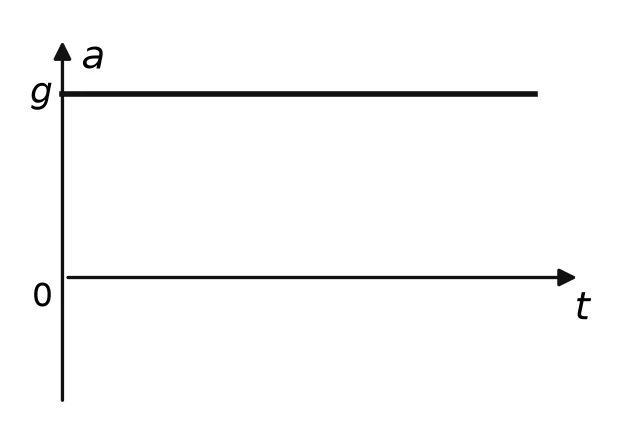
A small polystyrene ball is dropped from rest from a great height. Air resistance on the ball increases as its speed increases, and the ball reaches a terminal speed. Which graph shows the variation with time of the downward acceleration of the ball?
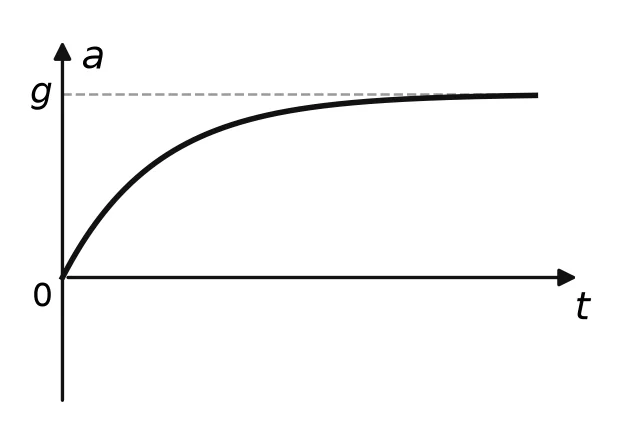
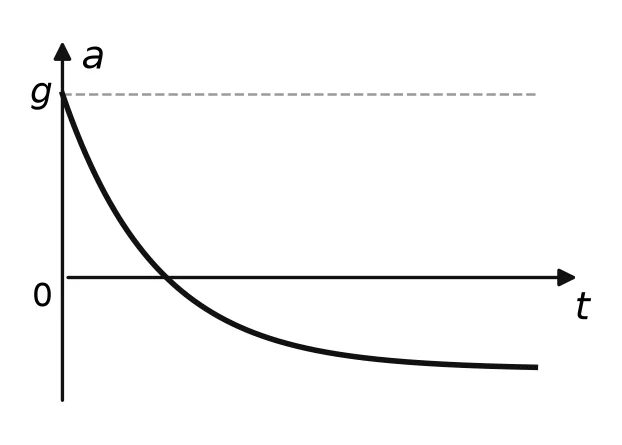
And 3 more in the data booklet.
(a) 150 N is less than 196 N, so the crate does not move. Static friction matches the push: and . (Using here would give a resultant force backwards, which is impossible for a crate at rest.)
(b) 250 N is more than 196 N, so the crate slides and friction becomes dynamic:
The rock seems lighter in water by the weight of the water it displaces, 3.9 N, which is why heavy stones are easier to lift under water.
(b) : .
(c) Slowing down while moving up means the acceleration is downwards, : .
(b) Resultant force at lift-off. The weight is , acting down.
The actual thrust soon after lift-off was about 34 MN, close to this estimate. As propellant burns, the mass falls while the thrust stays about the same (it even rises a little as the air thins), so the acceleration increases steadily during the burn.
(b) Kinetic energy before and after.
About 40 % of the kinetic energy is transferred, mainly to internal energy in the couplings and buffers and to sound.
«Pa s» ✓
Allow ECF from an incorrect density difference. Accept 0.90–1.0 Pa s.
(d) ✓