3.3 Applications of trigonometry questions for IB Maths AI
53 questions on Applications of trigonometry, written by Augment in the style of IB exam papers. Six of them are below in full, to answer on paper.
- IB Mathematics: Applications and Interpretation
- Part of 3 Geometry and trigonometry
- SL and HL
Questions by paper and level
SL and HL questions are for students at either level. HL only questions cover what only HL students study.
| Paper | SL and HL | HL only | All |
|---|---|---|---|
| Paper 1 | 15 | 3 | 18 |
| Paper 2 | 19 | 14 | 33 |
| Paper 3HL only | 0 | 2 | 2 |
| Every paper | 34 | 19 | 53 |
Counted on
Questions to try
Written by Augment in the style of IB exams, not past papers. Answer them on paper, then check each one against its markscheme with a free account.
A kayaker sets off at 13:00 and paddles at constant velocity. Her position vector relative to a port, P, hours after 13:00 is
where distances are in kilometres, the first component is the distance east of P and the second is the distance north of P.
- (a)
Find the kayaker's speed.
2 marks
- (b)
Find the time, to the nearest minute, at which the bearing of the kayaker from P is 045°.
4 marks
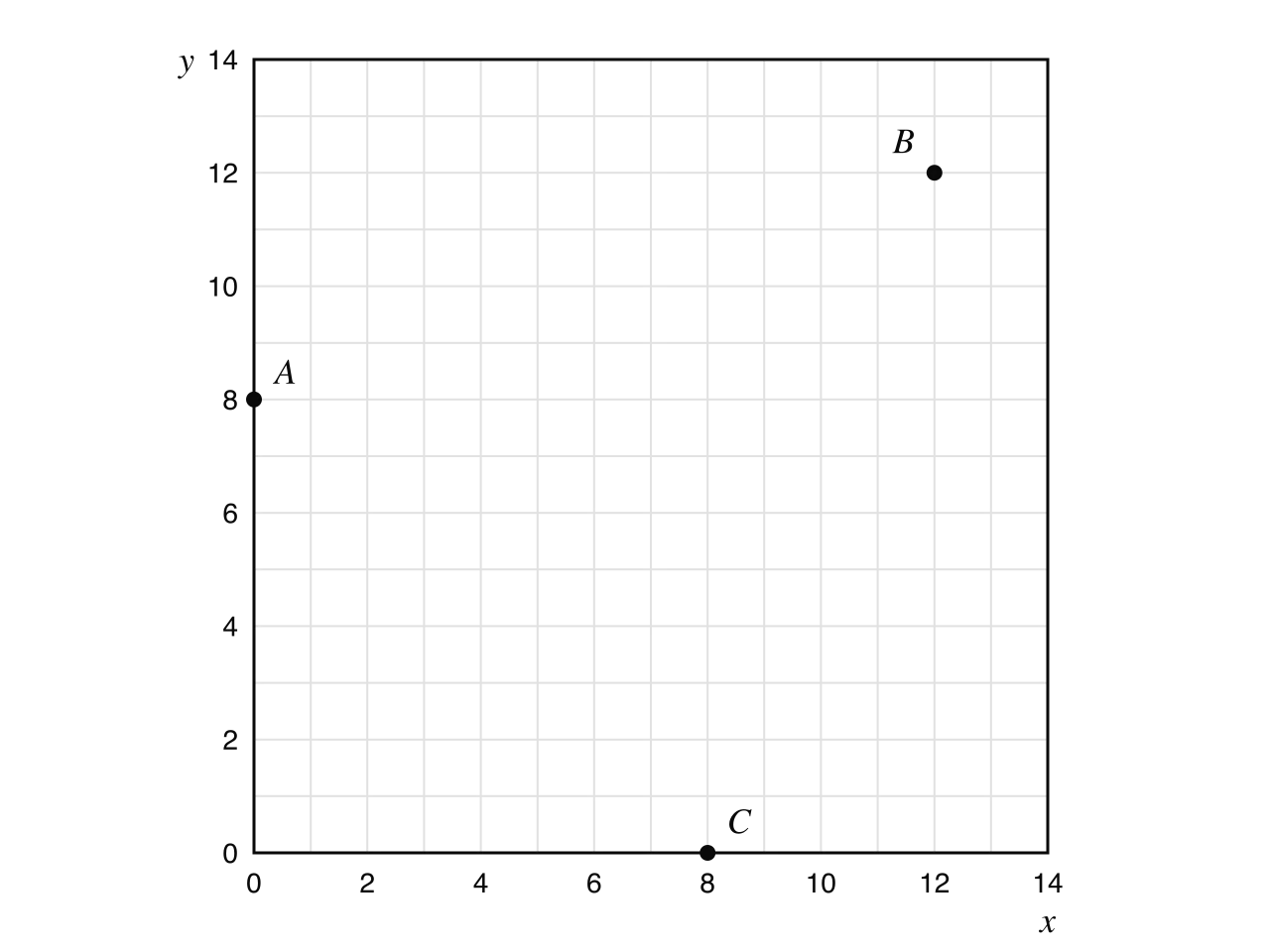
The diagram shows the positions of three attractions in a theme park on a coordinate grid. The attractions are the Ark at A(0, 8), the Big Wheel at B(12, 12) and the Coaster at C(8, 0). The -axis points north and one unit represents 10 metres.
- (a)
Find the distance, in metres, between the Ark and the Big Wheel.
2 marks
- (b)
Find the bearing of the Big Wheel from the Coaster.
3 marks
- (c)
(i) Write down the coordinates of the midpoint of [AC].
(ii) Find the gradient of [AC].
(iii) Hence find the equation of the perpendicular bisector of [AC].
4 marks
- (d)
The perpendicular bisector of [AB] has equation .
A fountain F is to be built at the point that is equidistant from all three attractions. Find the coordinates of F.
2 marks
- (e)
Find the distance, in metres, from the fountain to each attraction.
2 marks
- (f)
Find the size of angle ABC.
3 marks
In this question you will use vectors to decide how a research vessel can get close to a migrating whale.
Marine biologists at a research station in Hermanus, South Africa, are tracking a humpback whale that has been fitted with a satellite tag. Positions are given relative to the harbour, , with the -axis pointing east and the -axis pointing north. Distances are in kilometres and is the time in hours after 06:00.
The position vector of the whale at time is modelled by
- (a)(i)
Find the speed of the whale.
1 mark
- (a)(ii)
Find the bearing on which the whale is travelling.
2 marks
- (b)
Find the shortest distance between the whale and the harbour, and the time at which this occurs.
3 marks
- (c)
At 06:00 the research vessel leaves the harbour with velocity km h−1.
Write down the position vector, , of the vessel at time .
1 mark
- (d)
Show that the displacement vector from the vessel to the whale at time is .
2 marks
- (e)
Find the minimum distance between the vessel and the whale, and the time at which it occurs.
4 marks
- (f)
The vessel's sonar can detect the whale when the distance between them is 10 km or less.
Find, to the nearest minute, the length of time for which the sonar can detect the whale.
3 marks
- (g)(i)
On another day the whale follows the same path at the same times. This time the captain wants to meet the whale. The vessel leaves the harbour at 06:00 and travels in a straight line at a constant speed of 15 km h−1.
The vessel meets the whale at time .
Explain why , and hence show that .
3 marks
- (g)(ii)
Hence find the time at which the vessel meets the whale.
2 marks
- (g)(iii)
Find the bearing on which the vessel must travel.
3 marks
- (h)
Find the acute angle between the vessel's path in part (g) and the whale's path.
2 marks
- (i)
State two assumptions made in modelling the motion of the whale and the vessel.
2 marks
A yacht leaves a marina at the point and sails at a constant speed of 7.5 km h on a bearing of 120°. Distances are in kilometres, with a unit vector due east and a unit vector due north.
- (a)
Find the velocity vector of the yacht, giving your answer in the form .
3 marks
- (b)
Find the distance of the yacht from the origin after 2.4 hours.
2 marks
Two harbours are at P(0, 0) and Q(12, 8) on a chart where the -axis points north and one unit represents one kilometre. The coastguard divides the sea between the two harbours along the perpendicular bisector of [PQ]: ships on P's side of this line are controlled by harbour P.
- (a)
Calculate the distance PQ.
2 marks
- (b)
Find the bearing of Q from P.
2 marks
- (c)
Find the equation of the perpendicular bisector of [PQ]. Give your answer in the form .
4 marks
- (d)
A ship leaves harbour P and sails in a straight line on a bearing of 060°. Show that the path of the ship lies on the line .
2 marks
- (e)
Find the coordinates of the point where the ship leaves the area controlled by harbour P.
2 marks
- (f)
The ship sails at a constant speed of 18 km h−1. Find the time, in minutes, that the ship spends in the area controlled by harbour P.
3 marks
In this question you will use three-dimensional geometry and vectors to design the roof of a house.
Haruto is an architect designing a house in Sapporo, Japan. The house has a rectangular base , with m and m. Its roof is a hipped roof: four sloping faces meet at a horizontal ridge , as shown in the following diagram.
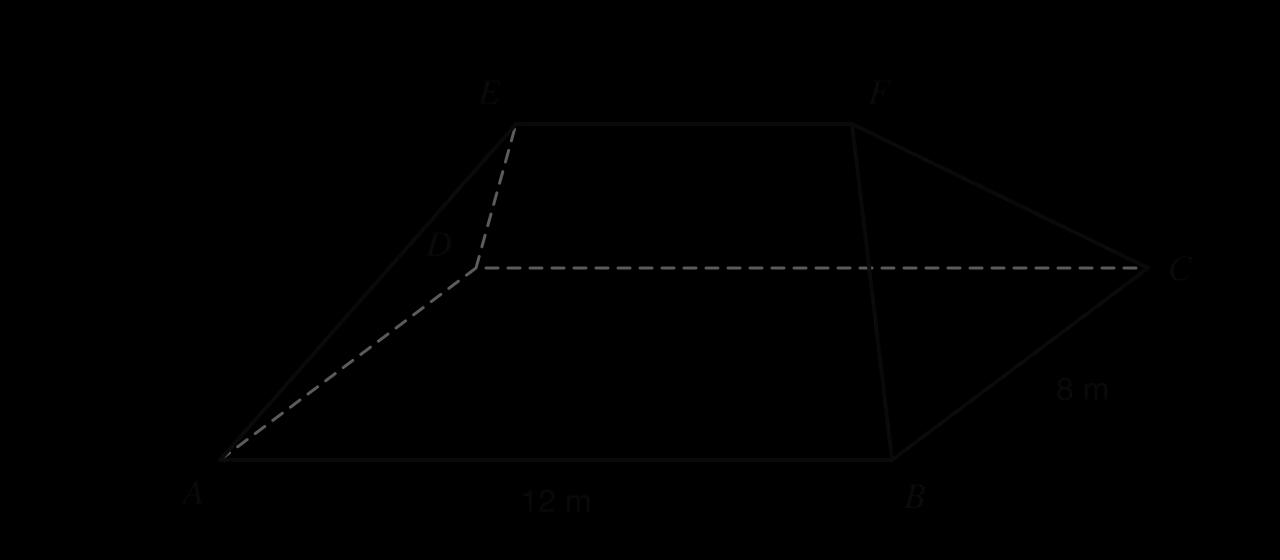
Haruto sets up coordinates in metres with at the origin, the -axis along , the -axis along and the -axis vertically upwards. The base is horizontal, so , and . The ridge is at height metres, with and .
In his first design, .
- (a)
Write down the vector .
1 mark
- (b)
Find the length of the edge .
2 marks
- (c)
Find the angle between the edge and the horizontal base.
3 marks
- (d)
The roof covering must be laid at a pitch of at least 30°, where the pitch of a face is the angle between that face and the horizontal.
Show that the face meets this requirement.
3 marks
- (e)
Use a vector product to find the area of the triangular face .
4 marks
- (f)
Find the total area of the four faces of the roof.
3 marks
- (g)
The space under the roof is divided into a triangular prism, between the vertical planes and , and two pyramids, one at each end.
Show that the volume of the space under the roof is m³.
3 marks
- (h)
Show that the total area of the roof, m², is given by .
2 marks
- (i)
The owners ask for 160 m³ of space under the roof.
Find the percentage increase in the area of the roof compared with the first design.
3 marks
- (j)
Because of heavy snowfall in Sapporo, the pitch of the faces and must be between 30° and 45° inclusive. Find the range of possible volumes of the space under the roof.
3 marks
- (k)
State one assumption Haruto has made in calculating the volume of the space under the roof.
1 mark
Practice all 53 in Augment
Free with an account. Every question has its markscheme, and Augment keeps the ones you got wrong so you can come back to them.
More questions in Geometry and trigonometry
- 3.1Volume and surface area in three dimensions
- 3.2Trigonometry in triangles
- 3.3Applications of trigonometryThis page
- 3.4Arcs and sectors
- 3.5Perpendicular bisectors
- 3.6Voronoi diagrams
- 3.7Radian measureHL only
- 3.8The unit circle and trigonometric equationsHL only
- 3.9Matrix transformationsHL only
- 3.10VectorsHL only
- 3.11Vector equations of linesHL only
- 3.12Vectors in kinematicsHL only
- 3.13Scalar and vector productsHL only
- 3.14Graph theoryHL only
- 3.15Adjacency matricesHL only
- 3.16Tree and cycle algorithmsHL only
Check your answers in Augment
A free account opens all 53 questions on Applications of trigonometry with their markschemes, and keeps a record of what you have marked.