3.13 Scalar and vector products questions for IB Maths AI
47 questions on Scalar and vector products, written by Augment in the style of IB exam papers. Six of them are below in full, to answer on paper.
- IB Mathematics: Applications and Interpretation
- Part of 3 Geometry and trigonometry
- HL only
Questions by paper and level
| Paper | Questions |
|---|---|
| Paper 1 | 17 |
| Paper 2 | 28 |
| Paper 3 | 2 |
| Every paper | 47 |
Counted on
Questions to try
Written by Augment in the style of IB exams, not past papers. Answer them on paper, then check each one against its markscheme with a free account.
A cargo ship moves with constant velocity. Its position vector hours after midnight is
where distances are in kilometres, relative to a harbour master's office. A lighthouse stands on a rock at L. Ships are advised to stay more than 0.5 km from the lighthouse because of submerged rocks.
- (a)
Find the value of when the ship is closest to the lighthouse.
5 marks
- (b)
Determine whether the ship follows the advice.
3 marks
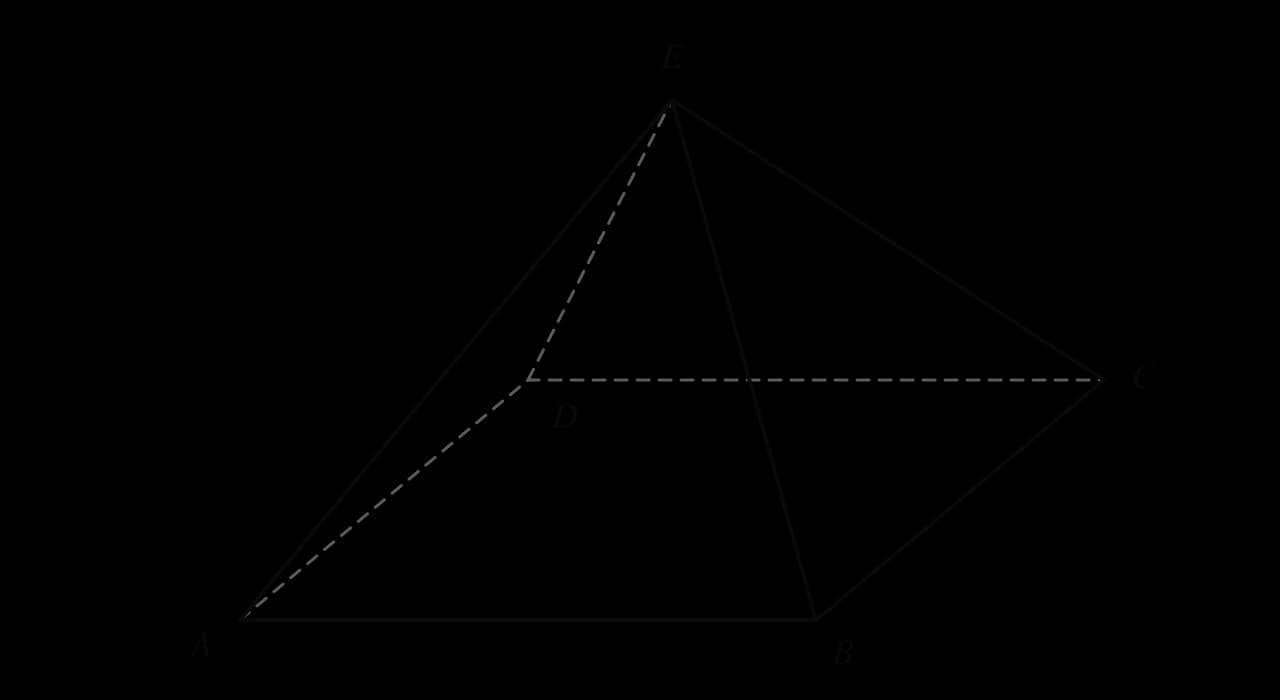
The glass roof of a museum entrance is a square-based pyramid with horizontal base and apex , as shown in the diagram. Relative to an origin at ground level, the coordinates of the vertices, in metres, are , , , and .
- (a)
(i) Find .
(ii) Find the length of the edge .
3 marks
- (b)
Write down the total length of the four sloping edges of the roof.
2 marks
- (c)
A decorative cable runs from , the midpoint of , to , the midpoint of . Show that the cable is parallel to and half its length.
3 marks
- (d)
A light is fixed at the point on such that . Find the coordinates of .
3 marks
- (e)
Find the angle between the edge and the diagonal of the base.
3 marks
- (f)
The glass for the four triangular faces costs euros (EUR) per square metre. Find the total cost of the glass. Give your answer to the nearest euro.
4 marks
In this question you will use vectors to decide how a research vessel can get close to a migrating whale.
Marine biologists at a research station in Hermanus, South Africa, are tracking a humpback whale that has been fitted with a satellite tag. Positions are given relative to the harbour, , with the -axis pointing east and the -axis pointing north. Distances are in kilometres and is the time in hours after 06:00.
The position vector of the whale at time is modelled by
- (a)(i)
Find the speed of the whale.
1 mark
- (a)(ii)
Find the bearing on which the whale is travelling.
2 marks
- (b)
Find the shortest distance between the whale and the harbour, and the time at which this occurs.
3 marks
- (c)
At 06:00 the research vessel leaves the harbour with velocity km h−1.
Write down the position vector, , of the vessel at time .
1 mark
- (d)
Show that the displacement vector from the vessel to the whale at time is .
2 marks
- (e)
Find the minimum distance between the vessel and the whale, and the time at which it occurs.
4 marks
- (f)
The vessel's sonar can detect the whale when the distance between them is 10 km or less.
Find, to the nearest minute, the length of time for which the sonar can detect the whale.
3 marks
- (g)(i)
On another day the whale follows the same path at the same times. This time the captain wants to meet the whale. The vessel leaves the harbour at 06:00 and travels in a straight line at a constant speed of 15 km h−1.
The vessel meets the whale at time .
Explain why , and hence show that .
3 marks
- (g)(ii)
Hence find the time at which the vessel meets the whale.
2 marks
- (g)(iii)
Find the bearing on which the vessel must travel.
3 marks
- (h)
Find the acute angle between the vessel's path in part (g) and the whale's path.
2 marks
- (i)
State two assumptions made in modelling the motion of the whale and the vessel.
2 marks
Two straight beams in the frame of a roof lie along the lines
where distances are in metres. The beams are joined at the point where the lines intersect.
- (a)
Find the coordinates of .
4 marks
- (b)
Find the acute angle between the beams.
3 marks
A mountain rescue team is based at a camp , which is taken as the origin. The -axis points east, the -axis points north and the -axis points vertically upwards, with distances in kilometres. The summit of a mountain is at and the rescue helicopter is kept at .
An injured climber is at the point on the straight ridge such that .
- (a)
Find the coordinates of .
2 marks
- (b)
(i) Find .
(ii) Find the distance from the helicopter base to the climber.
3 marks
- (c)
The helicopter flies in a straight line from to at a constant speed of . Find its velocity vector in kilometres per minute.
3 marks
- (d)
Find the time, in seconds, that the helicopter takes to reach the climber.
2 marks
- (e)
Find the angle .
4 marks
- (f)
Find the area of the triangle .
2 marks
In this question you will use three-dimensional geometry and vectors to design the roof of a house.
Haruto is an architect designing a house in Sapporo, Japan. The house has a rectangular base , with m and m. Its roof is a hipped roof: four sloping faces meet at a horizontal ridge , as shown in the following diagram.
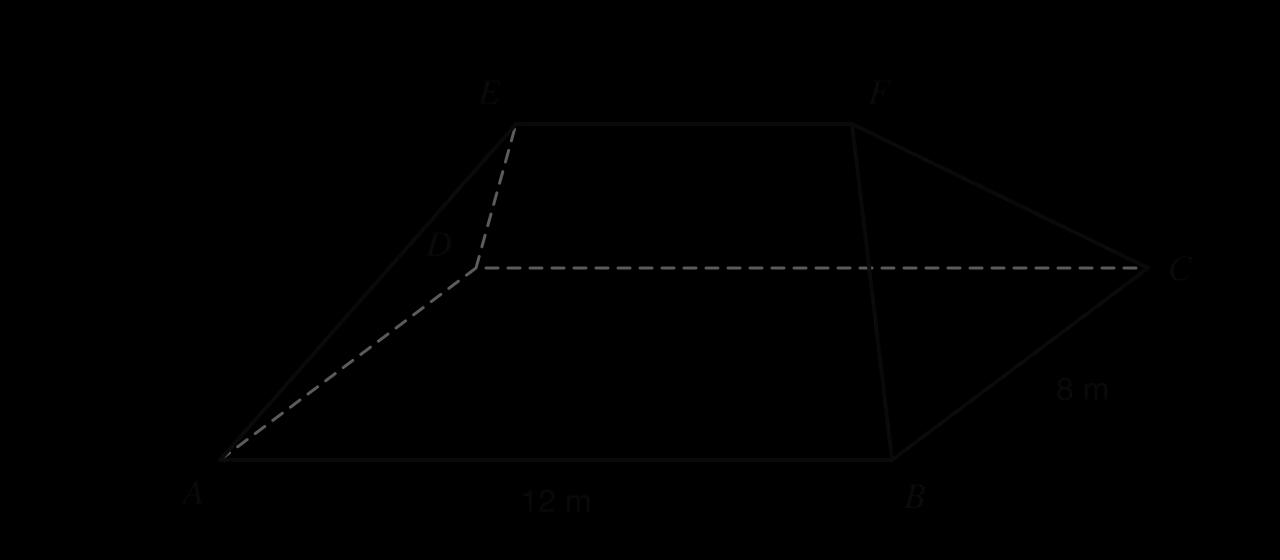
Haruto sets up coordinates in metres with at the origin, the -axis along , the -axis along and the -axis vertically upwards. The base is horizontal, so , and . The ridge is at height metres, with and .
In his first design, .
- (a)
Write down the vector .
1 mark
- (b)
Find the length of the edge .
2 marks
- (c)
Find the angle between the edge and the horizontal base.
3 marks
- (d)
The roof covering must be laid at a pitch of at least 30°, where the pitch of a face is the angle between that face and the horizontal.
Show that the face meets this requirement.
3 marks
- (e)
Use a vector product to find the area of the triangular face .
4 marks
- (f)
Find the total area of the four faces of the roof.
3 marks
- (g)
The space under the roof is divided into a triangular prism, between the vertical planes and , and two pyramids, one at each end.
Show that the volume of the space under the roof is m³.
3 marks
- (h)
Show that the total area of the roof, m², is given by .
2 marks
- (i)
The owners ask for 160 m³ of space under the roof.
Find the percentage increase in the area of the roof compared with the first design.
3 marks
- (j)
Because of heavy snowfall in Sapporo, the pitch of the faces and must be between 30° and 45° inclusive. Find the range of possible volumes of the space under the roof.
3 marks
- (k)
State one assumption Haruto has made in calculating the volume of the space under the roof.
1 mark
Practice all 47 in Augment
Free with an account. Every question has its markscheme, and Augment keeps the ones you got wrong so you can come back to them.
More questions in Geometry and trigonometry
- 3.1Volume and surface area in three dimensions
- 3.2Trigonometry in triangles
- 3.3Applications of trigonometry
- 3.4Arcs and sectors
- 3.5Perpendicular bisectors
- 3.6Voronoi diagrams
- 3.7Radian measure
- 3.8The unit circle and trigonometric equations
- 3.9Matrix transformations
- 3.10Vectors
- 3.11Vector equations of lines
- 3.12Vectors in kinematics
- 3.13Scalar and vector productsThis page
- 3.14Graph theory
- 3.15Adjacency matrices
- 3.16Tree and cycle algorithms
Check your answers in Augment
A free account opens all 47 questions on Scalar and vector products with their markschemes, and keeps a record of what you have marked.