3.1 Volume and surface area in three dimensions questions for IB Maths AI
104 questions on Volume and surface area in three dimensions, written by Augment in the style of IB exam papers. Six of them are below in full, to answer on paper.
- IB Mathematics: Applications and Interpretation
- Part of 3 Geometry and trigonometry
- SL and HL
Questions by paper and level
SL and HL questions are for students at either level. HL only questions cover what only HL students study.
| Paper | SL and HL | HL only | All |
|---|---|---|---|
| Paper 1 | 37 | 4 | 41 |
| Paper 2 | 51 | 9 | 60 |
| Paper 3HL only | 0 | 3 | 3 |
| Every paper | 88 | 16 | 104 |
Counted on
Questions to try
Written by Augment in the style of IB exams, not past papers. Answer them on paper, then check each one against its markscheme with a free account.
The planet Mars can be modelled as a sphere with radius 3389.5 km.
- (a)
Calculate the volume of Mars, in km³. Give your answer in the form , where and .
3 marks
- (b)
Write down the volume of Mars in m³.
2 marks
- (c)
The mass of Mars is kg.
Calculate the mean density of Mars, in kg m⁻³.
2 marks
The town of Brennick stores its drinking water in a tank in the shape of a cylinder. The radius of the tank is 42 m and its depth is 18 m.
- (a)
Calculate the volume of the tank, in m³.
2 marks
- (b)
Given that 1 m³ 1000 litres, write down the volume of the tank in litres. Give your answer in the form , where and .
2 marks
- (c)
The town uses litres of water each day. No water enters the tank.
Find the number of complete days that a full tank can supply the town.
2 marks
- (d)
The radius and the depth of the tank were each measured correct to the nearest metre.
Find the upper bound of the volume of the tank.
3 marks
- (e)
The lower bound of the volume of the tank is 94 685.6 m³, correct to one decimal place.
Find the largest possible percentage error in using your answer to part (a) as the volume of the tank.
3 marks
- (f)
During one storm, 12 mm of rain fell on the area that drains into the tank. This area is 3.6 km².
(i) Find the volume of rain, in m³, that fell on this area. Give your answer in the form , where and .
(ii) Find this volume as a percentage of the volume of the tank found in part (a).
4 marks
The purpose of this question is to find the cheapest design for a grain silo, first without and then with a planning restriction.
A farming cooperative plans to build a grain silo in the shape of a cylinder of radius metres and height metres, with a hemispherical roof of radius metres, as shown in the following diagram.
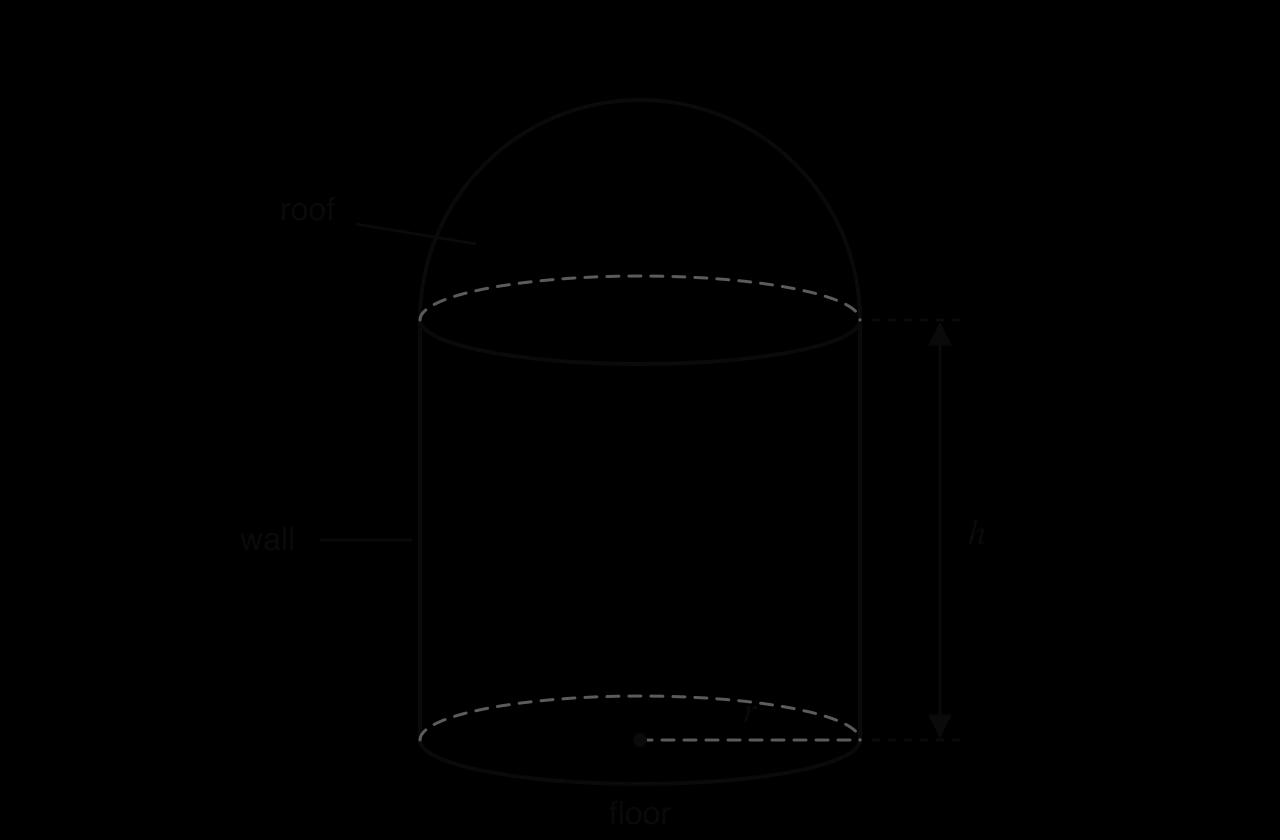
The silo must hold of grain. The building costs are 40 US dollars (USD) per m² for the circular floor, 60 USD per m² for the curved wall and 90 USD per m² for the hemispherical roof.
- (a)
Show that .
3 marks
- (b)
Show that the total cost, USD, of building the silo is given by
3 marks
- (c)
Explain why the model is only valid for .
2 marks
- (d)
Find .
2 marks
- (e)
Find the value of and the value of that minimize the cost, and find this minimum cost to the nearest dollar.
4 marks
- (f)
Use the second derivative to justify that this value of gives a minimum cost.
2 marks
- (g)(i)
A local planning regulation states that the total height of the silo, including the roof, must not exceed 9 m.
Show that the radius must satisfy .
1 mark
- (g)(ii)
Find the least value of that satisfies the regulation.
2 marks
- (g)(iii)
Explain why the cheapest silo that satisfies the regulation has the radius found in part (g)(ii), and find its cost to the nearest dollar.
3 marks
- (g)(iv)
Find the percentage increase in the minimum cost caused by the regulation.
2 marks
- (h)
Suggest one further cost that the cooperative should include in the model before deciding on the radius of the silo.
1 mark
Mei makes open-top trays from rectangular sheets of card measuring 40 cm by 25 cm. She cuts a square of side cm from each corner of a sheet and folds up the sides.
The volume of the tray, , is given by .
- (a)
Write down the set of possible values of for this context.
1 mark
- (b)
Find the possible values of for which the volume of the tray is .
3 marks
- (c)
The equation in part (b) has a third solution. Explain why it is not a possible value of .
1 mark
A biology student, Ingrid, models a human red blood cell as a cylinder with diameter m and height m.
- (a)
Calculate the volume of one red blood cell, in m³, according to Ingrid's model. Give your answer in the form , where and .
3 marks
- (b)
An adult has 5.0 litres of blood, and 45% of the volume of the blood is made up of red blood cells. 1 litre m³.
Estimate the number of red blood cells in the adult's body. Give your answer in the form , where and .
3 marks
- (c)
A medical textbook states that the adult has red blood cells.
Taking the textbook value as exact, calculate the percentage error in Ingrid's estimate.
2 marks
- (d)
Each red blood cell contains haemoglobin molecules.
Using your answer to part (b), find the total number of haemoglobin molecules in the adult's red blood cells.
2 marks
- (e)
Oxygen is absorbed through the surface of the red blood cells.
Calculate the total surface area of one red blood cell according to Ingrid's model.
3 marks
- (f)
Real red blood cells are thinner in the middle than at the edge.
State whether Ingrid's model is likely to overestimate or underestimate the volume of one red blood cell.
1 mark
This question investigates the capacity of a glass decanter designed from a fitted curve.
Lucía is a glassmaker. She designs a decanter whose inside is formed by rotating the curve , , through radians about the -axis, where cm is the height above the base and cm is the internal radius at that height.
She chooses , so that the curve passes through the points , , and , as shown in the following graph.
- r = f(x)
- r = −f(x)
- (a)
Write down the value of and a system of three equations satisfied by , and .
3 marks
- (b)
Find the values of , and .
2 marks
- (c)
Use calculus to find the maximum internal radius of the decanter and the height at which it occurs.
3 marks
- (d)
Find the internal radius at the narrowest point of the neck.
2 marks
- (e)
Find the capacity of the decanter, in litres.
3 marks
- (f)(i)
Before fitting the curve, Lucía measured the internal radius of a prototype every 4 cm.
(cm)
0
4
8
12
16
20
24
28
(cm)
5.0
7.7
8.0
6.7
4.8
3.0
2.3
3.5
Use the trapezoidal rule with the cross-sectional areas at these heights to estimate the capacity of the prototype, in cm³.
3 marks
- (f)(ii)
Find the percentage difference between your answers to parts (e) and (f)(i), taking the answer to part (e) as the true value.
2 marks
- (g)
The decanter stands upright and 1 litre of wine is poured into it.
Find the depth of the wine.
3 marks
- (h)
Wine is poured into the empty decanter at a constant rate of .
Find the rate at which the depth of the wine is increasing when the depth is 10 cm.
3 marks
- (i)
Lucía also makes a larger version of the decanter in which every length is multiplied by 1.2.
Find the capacity of the larger decanter, in litres.
2 marks
- (j)
Give one reason why the capacity found in part (e) may be different from the volume of wine the decanter actually holds.
1 mark
Practice all 104 in Augment
Free with an account. Every question has its markscheme, and Augment keeps the ones you got wrong so you can come back to them.
The notes on 3.1 Volume and surface area in three dimensions
More questions in Geometry and trigonometry
- 3.1Volume and surface area in three dimensionsThis page
- 3.2Trigonometry in triangles
- 3.3Applications of trigonometry
- 3.4Arcs and sectors
- 3.5Perpendicular bisectors
- 3.6Voronoi diagrams
- 3.7Radian measureHL only
- 3.8The unit circle and trigonometric equationsHL only
- 3.9Matrix transformationsHL only
- 3.10VectorsHL only
- 3.11Vector equations of linesHL only
- 3.12Vectors in kinematicsHL only
- 3.13Scalar and vector productsHL only
- 3.14Graph theoryHL only
- 3.15Adjacency matricesHL only
- 3.16Tree and cycle algorithmsHL only
Check your answers in Augment
A free account opens all 104 questions on Volume and surface area in three dimensions with their markschemes, and keeps a record of what you have marked.