7.4 Art, creativity and the imagination
How to turn the field of art, creativity and the imagination into a specific global issue that a literary work and a body of work both present, from state patronage to censorship and the art market.
- IB English A: Language and Literature
- Part of 7 Global issues
- SL and HL
Notes on 7.4 Art, creativity and the imagination
The field of art, creativity and the imagination asks what art is for, who pays for it, who decides what may be seen, and what it is worth. A global issue from this field joins a literary work and a non-literary body of work through one question about making, owning or judging art. A screen-printed poster made in Chicago for the libraries of Illinois, between 1936 and 1941, puts the first of those questions in ten words. Its picture shows a young woman leaning into the March wind while novels by Scott, Dickens, Austen and six others fly around her. Its lettered band reads:
In MARCH
READ THE BOOKS YOU’VE
ALWAYS MEANT TO READThe WPA reading poster, Illinois WPA Art Project, Chicago, 1936–1941: the slogan band
What the field covers
The slogan is an instruction, opening on the imperative “READ”, and the picture exists to carry it. The wind that blows the books off the shelf is a visual joke about March, but the joke has a job: to send the viewer to the library. Art made to change what people do has a long history, from church paintings that taught scripture to people who could not read, to the public health posters of every modern state. The WPA reading poster belongs to that history, and so it raises the field’s oldest question in a plain form: is art for something, or is it for itself?
Oscar Wilde gave the second answer at the start of The Picture of Dorian Gray, in a preface written for the book edition of 1891. His novel had been attacked as immoral when it first appeared in a magazine the year before, and the preface is his reply:
There is no such thing as a moral or an immoral book. Books are well written, or badly written. That is all.
…
All art is quite useless.Oscar Wilde, “The Preface”, The Picture of Dorian Gray (1891)
Wilde’s short, flat sentences sound like rules, and their confidence is part of the argument. “That is all” closes the question before an opponent can open it again. The final line is a paradox, since Wilde spent his life making art and plainly valued it; “useless” here means free of any duty to teach or improve. The position became known as art for art’s sake. The WPA poster stands at the other pole, a work judged by whether it fills a library. Neither text is an issue. Each is an answer, and the issue is the argument between them. Societies have held that argument in courtrooms. Four years after the preface, passages of the novel were read against Wilde when he was cross-examined at the first of his trials in 1895.
The hands an artwork passes through
A work of art rarely goes straight from its maker to its audience. Someone usually pays for it: a ruler, a church, a family, a company, a state, or many small buyers. The support of art by someone who is not its maker, in money, materials or a place to work, is patronage. Patronage makes much art possible, and it gives the patron a voice in what is made. The poster’s credit line, “MADE FOR STATEWIDE LIBRARY PROJECT”, names the patron and not the painter. The WPA paid artists a wage when work was scarce, and in return the program chose the subjects, the purposes and the credit line.
Between the patron and the public stand gatekeepers: editors, publishers, curators, prize committees and censors, who decide what is shown and where. In 1917 a mass-produced urinal, signed “R. Mutt” and titled Fountain, was entered for an exhibition in New York that promised to hang any work whose fee was paid. It was not displayed. Marcel Duchamp, who had submitted it, used the refusal to ask who has the right to call an object art. The short film from Smarthistory follows that argument.
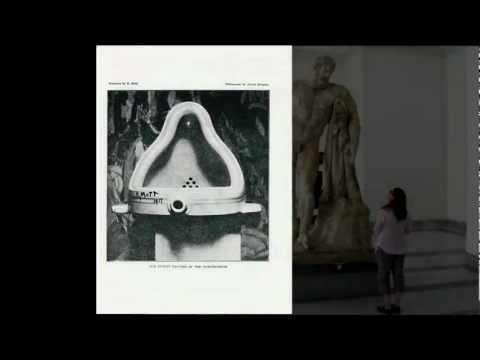 YouTube
The diagram sets out the hands a work passes through, from maker to market, and names the issue that arises at each, so it works as a map for finding where an issue lives.


From field to issue, step by step
A field is a place to start looking, not an issue. “Art” names every link in the chain from maker to market, so it gives a comparison nothing to argue. A global issue has three marks: it matters on a wide scale, it crosses national borders, and it can be felt in everyday local life. It is also a question that societies argue about, which is what lets two works present it differently. A student reaches such a question in steps, keeping what interests them and cutting away what their two works cannot carry.
The four drafts that follow come from one student. The literary work was Chaim Potok’s novel My Name Is Asher Lev (1972). The non-literary body of work was the murals Diego Rivera painted for American patrons in the early 1930s, with the photographs, letters and press reports that record them.
Field: Art, creativity and the imaginationnote 1
Topic: Artists and their communitiesnote 2
Issue: The cost to an artist of making work that their community does not wantnote 3
Issue, tested: The price an artist pays for making work that the people who support them do not wantnote 4
A field. Everything from the maker to the market fits here, so nothing has been chosen yet.
A topic. One part of the field is chosen, the maker and the public. A topic names something to talk about, not a question to answer.
An issue. The draft names a conflict and a cost, so it opens an argument: some will say the cost is worth paying and others will not.
An issue tested against both works. After checking the works, “community” widened to “the people who support them”, a phrase that holds a faith community and a paying patron.
The third draft reads well, and only a test against both works finds that it fits one of them. In Potok’s novel, Asher Lev grows up in a Hasidic community in Brooklyn in the 1950s, among people for whom his gift for drawing is at best a distraction. As a young painter he makes two crucifixion paintings that express his mother’s anguish, and when they are exhibited in New York they wound his parents and his community. The Rebbe, the community’s leader, asks him to leave. The cost is exile, and the novel presents it through Asher’s own first-person narration, so the reader feels both his loyalty and his need to paint.
Rivera fits the draft only after a change. In 1933 he painted Man at the Crossroads in the lobby of the RCA Building at Rockefeller Center in New York. When a portrait of Lenin appeared in it, Nelson Rockefeller asked him to replace the face. Rivera refused, was paid his fee in full and was dismissed, and the mural was covered and then destroyed in February 1934. The people who rejected the work were his patrons, not his community. The tested wording, “the people who support them”, holds both cases, and the difference between a faith and a fee becomes what the comparison explores.
Testing whether it is global
The tested issue passes all three marks of a global issue. It matters wherever art depends on support from someone else: a religious community, a government, a company, a family. It crosses borders, as the cases themselves do: Rivera, a Mexican painter, worked for an American family in New York and repainted the destroyed mural in Mexico City in 1934, and Asher’s career carries him from Brooklyn to Europe. It is felt locally whenever a school mural is painted over after a complaint, or a young writer’s family objects to a story about them.
Try it
A student proposes the destruction of Rivera’s mural at Rockefeller Center as a global issue. Which mark of a global issue does it fail, and how could it be repaired?
It is an event, not an issue, and it is far too narrow to fit a second work: no novel presents the destruction of that particular mural. It also takes no position a society could argue about. Repaired, it becomes a question about the event’s kind, such as the right of a patron to change or destroy work it has paid for. That question is global, since patrons from governments to companies face it, and it lets Rivera’s case sit beside a literary work in which an artist’s work is altered or suppressed by the person who paid for it.
Four more issues from the field
Each issue in this field is a question, and each can be presented by a literary work and by a body of work in quite different ways. A novel usually presents an issue through one person’s experience over time, while a body of work presents it through many items, often made for a public and a purpose. The four that follow sit at different points of the chain from maker to market; with the issue of support worked through for Asher Lev and Rivera, they make five.
What may a state ask of the artists it pays?
Governments have paid artists for posters, monuments, films and festivals, and the issue is what they may ask in return. Kazuo Ishiguro’s novel An Artist of the Floating World (1986) presents it through Masuji Ono, a painter who turned his talent to nationalist propaganda in the years before the Second World War. After Japan’s defeat he narrates his life while his family arranges his younger daughter’s marriage, and the reader learns his part in the past mainly from what he leaves out. Ono once informed on a pupil, Kuroda, whose paintings were then burned, so the novel holds censorship inside the story of patronage. The “floating world” of the title, the pleasure quarters his first master painted, stands for art that served no cause at all.
A body of work such as the WPA posters presents the same issue from the other side: dozens of designs for libraries, health and travel, each carrying a program’s message and no artist’s name. Read together, the items show what one patron asked for across many subjects, which a single novel cannot show.
When may a society stop art from being seen?
The deliberate suppression or alteration of a work by an authority that judges it harmful is censorship, and the issue is when, if ever, it is justified. Azar Nafisi’s memoir Reading Lolita in Tehran (2003) presents it from inside a reading group. From 1995 to 1997 seven of her former students met at her home to read Nabokov, Fitzgerald, James and Austen, novels whose place in the universities of the Islamic Republic had narrowed. The memoir recalls a class trial of The Great Gatsby, in which a student accused the novel of condoning adultery, so the argument Wilde answered in 1891 is staged again in a Tehran classroom.
A non-literary body of work can present censorship from the artist’s side. Ai Weiwei’s blog, written from 2005 until the authorities closed it in 2009, included his lists of the names of schoolchildren killed when their schools collapsed in the Sichuan earthquake of 2008.
What happens to art’s meaning when it is sold?
The turning of something into a product whose value is measured by its price is commodification. In Donna Tartt’s novel The Goldfinch (2013), a small painting of a chained bird, made by Carel Fabritius in 1654, is taken by a boy from a museum after an explosion that kills his mother. It becomes his secret comfort and, later, an object of criminal trade, so the novel follows one artwork through love, guilt and the market at once. Ai Weiwei’s Sunflower Seeds (Tate Modern, London, 2010) puts the issue in a work made of about 100 million porcelain seeds, each shaped and painted by hand by craftspeople in Jingdezhen. Spread across the floor of a vast gallery, the seeds look mass-produced; up close, each records one person’s labor.
Who may sell a tradition?
Some art belongs first to a community, as worship, ceremony or shared memory, and the issue is who may decide what part of it is sold. In 1971, at Papunya in central Australia, senior Aboriginal men began painting the designs of their Dreaming stories on boards, encouraged by a local schoolteacher, and the paintings soon found buyers. Then some members of their communities objected that sacred designs, meant to be seen only by the initiated, had been shown to strangers. Artists began to leave out or change sacred symbols, and to cover dangerous designs under layers of dots. The famous dotted surface of Western Desert painting is partly the record of a community setting limits on a market.
A literary work can present the same issue through one writer’s choices. Rabindranath Tagore’s Gitanjali began as Bengali songs of worship, and in his own English prose it became, in 1912, a book for readers in London who knew nothing of the tradition behind it. Its fourth paragraph shows what traveled and what did not:
The sky is overcast with clouds and the rain is ceaseless. I know not what this is that stirs in me,—I know not its meaning.
Rabindranath Tagore, Gitanjali 27, paragraph 4
The speaker’s confession of not knowing is the line most open to new readers. The love-tryst of the previous paragraph comes from the devotional poetry Tagore drew on, so the line’s uncertainty can sit inside a tradition that supplies an answer. In London the same words read as a private, timeless mystery, needing no tradition at all.
The English book won Tagore the Nobel Prize in Literature in 1913, and many of the readers who admired it in Europe met it as the work of a mystic rather than of a tradition. In Bengal the songs are still sung, and two of Tagore’s other songs became the national anthems of India and Bangladesh. One body of art lives as worship and as national song at home, and as world literature abroad. How Tagore built the English version is studied in the chapter on creativity; the issue here is what a tradition gains and loses when it is read by people who cannot hear it as song.
The state as patron in one poster
An issue is at work in a text when the text’s choices, not only its subject, take a position in the argument. The WPA reading poster carries the issue of state patronage in its smallest line of type, along the bottom edge:
MADE FOR STATEWIDE LIBRARY PROJECT BY ILL. ART PROJ.- W.P.A - CHICAGO
The WPA reading poster, credit line
Two prepositions divide the work between payer and maker. “MADE FOR” names the client, a library program for the whole state; “BY” names the maker, and the maker is an institution, the Illinois Art Project of the WPA. The chapter on the work of art reads this line as the state becoming the author. For the issue of patronage, the line asks a different question: what did the artist give, and what did the state buy? The artist gave a name and the choice of subject. The state bought a design to fill its libraries.
The rest of the poster complicates the bargain. Nothing in the instruction “READ THE BOOKS” required a March wind, a streaming red scarf or nine novels tumbling through the air like leaves. The program fixed the message and left the means to the designer, so the poster presents state patronage as a contract that still leaves room for invention. Ishiguro’s novel presents the opposite case. Ono’s patrons asked for a belief as well as a picture, and his country’s defeat later judged his art by the cause it served. Set side by side, the poster and the novel turn the issue into a sharper question: is state patronage dangerous because of what it pays for, or because of what artists are willing to give it?
How an issue goes wrong
Issues in this field fail in four common ways, and each can be heard in a single sentence. The four drafts that follow were written by students with real works in mind, and each fails for a different reason.
Art is important to society.note 1
Rivera’s quarrel with the Rockefellers in 1933.note 2
Censorship in Reading Lolita in Tehran.note 3
Artists should be free to make whatever they want.note 4
Too broad. True of every work ever made, so it cannot be presented differently by two works, and nobody disagrees with it.
Too narrow. One event in one artist’s life. No literary work can present it, so the second work has nothing to say about it.
A topic, not an issue. It names a subject and a work but asks nothing. A comparison built on it becomes a list of places where censorship appears.
A slogan. It states a position instead of a question, so the argument can only agree with itself. Two works that disagree become a problem rather than the point.
Each fault has a matching repair. A broad claim is narrowed by naming who acts and who pays, and a narrow event is widened to the kind of event it is. A topic is turned into a question, and a slogan is turned back into the argument it takes a side in. The table sets out a repaired version of each draft.
Fault | Draft | Repaired as a global issue |
|---|---|---|
Too broad | Art is important to society. | Whether a community should pay for art that criticizes it |
Too narrow | Rivera’s quarrel with the Rockefellers in 1933 | The right of a patron to change or destroy work it has paid for |
A topic | Censorship in Reading Lolita in Tehran | What readers lose, and what they find, when the books they may read are limited by the state |
A slogan | Artists should be free to make whatever they want. | How far an artist’s freedom should yield to the beliefs of the people who support them |
Writing about it
An issue does its work in a talk when every claim about a text returns to it. The pair that follows comes from two students speaking about the same poster under the issue what a state may ask of the artists it pays. The first describes the poster and mentions the issue; the second analyzes how the poster’s choices present it.
Weak: The poster was made by the WPA, which was a government program in the 1930s. It tells people to read books and has a woman and some flying books on it, so it is about art and the state.note 1
Strong: The poster’s credit line divides the work in two: the art is “MADE FOR” a library program and “BY” the Illinois Art Project, and no artist is named.note 2 That is the state’s side of the bargain: it owns the message and the credit.note 3 But the image keeps the artist’s side. The instruction to read needed none of the March wind or the nine flying novels, so the design shows how much invention a patron with a modest message leaves free.note 4 Ono’s propaganda paintings, as Ishiguro presents them, are the case where the patron asked for more.note 5
Description with the issue attached. Every sentence is accurate, but none analyzes a choice, and the issue appears only as a label at the end.
A choice, quoted. The student points to two words on the poster and says what each records.
The issue named through the evidence. The claim about patronage comes out of the quoted words, not before them.
Evaluation. The student weighs what the patron controlled against what it left free, which is the poster’s position in the argument.
A bridge to the other work. The last sentence connects the two works on the issue, ready for the second half of the talk.
Applying it in the individual oral
The individual oral asks how a global issue of the student’s choice is presented in one literary work and one non-literary body of work, through one extract from each and the works around them. It lasts 15 minutes: about ten of prepared talk, then about five of the teacher’s questions. The field gives the oral its axis. Every point about an extract returns to one question, so the two works stop being two separate readings and become two positions in one argument.
An opening sentence names the issue, both works and the angle each takes, so the teacher hears the axis in the first ten seconds:
My global issue is the price an artist pays for making work that the people who support them do not want. Potok’s My Name Is Asher Lev presents that price as exile from a faith, and Rivera’s murals of the early 1930s present it as a commission paid for and then destroyed.
A model opening for an oral on My Name Is Asher Lev and Rivera’s murals
The sentence states a question, not a verdict, and gives each work a different answer to it. The first extract might be the scene in which Asher’s crucifixion paintings are first seen by his parents. The second might be one photograph of Man at the Crossroads before it was covered, read alongside the press reports of the dispute. Extracts are usually expected to run to about 40 lines of print, or one item from a body of work, but the exact rules are worth checking with a teacher. What matters for this field is that each extract shows the issue in its choices: the novel through Asher’s narration and what it leaves him unable to say, the mural through what Rivera placed at its center.
The commonest way to lose marks in this field is to tell an artist’s story instead of analyzing a text. Rivera’s quarrel with his patrons and Asher’s exile are both dramatic, and a talk can spend three minutes on either without analyzing a single choice. The story belongs in one sentence of context; the minutes belong to the extract.
The concepts that suit this field
Two concepts open issues in this field most often. Creativity asks what a work is made from and under what limits, and a patron’s demand or a censor’s rule is one of those limits: the WPA poster’s invention lives inside a fixed message. Transformation asks what happens to a work as it moves, which is the story of Gitanjali from Bengali song to English prose and of Rivera’s mural from a New York lobby to a wall in Mexico City. Naming one concept in the outline, and using it in both halves of the talk, helps the comparison stay about how the works present the issue rather than what happened to the artists.
The concept pages on creativity and transformation take those two concepts back to single texts, and the text type page on the work of art reads a poster and a painting closely. The Internal assessment pages on choosing a global issue and extracts turn a tested issue into a plan for the oral.
Self-check
- To do:
I can say what the field of art, creativity and the imagination covers, from making to patronage, censorship and the market.
- To do:
I can explain the three marks of a global issue and test a draft issue against them.
- To do:
I can narrow the field step by step to a specific issue, and revise its wording after testing it against two works.
- To do:
I can describe several issues in the field and how a literary work and a body of work might each present them.
- To do:
I can analyze how a text’s choices, such as a credit line or a narrator’s silences, present an issue.
- To do:
I can recognize an issue that is too broad, too narrow, a topic or a slogan, and repair it.
- To do:
I can open an oral with a sentence that names the issue and the angle each work takes on it.
Key terms
Each is also in the Global issues glossary for IB English A Lang & Lit, beside the other terms of its topic.
- Censorship
Censorship is the suppression or alteration of a work, or of parts of it, by an authority that judges it harmful, offensive or dangerous. It can be carried out by a state, a religious body, an owner, a publisher or the maker, who in self-censorship changes the work in advance.
- Commodification
Commodification is the turning of something into a product that is bought and sold, so that its value comes to be measured by its price. Applied to art, it describes a work or a tradition made, judged or changed for a market rather than for the purpose or community it first served.
- Patronage
Patronage is the support of art by someone other than its maker, such as a ruler, a church, a company or a state, in money, materials or a place to work. It makes much art possible and usually gives the patron some say in what is made and how it is shown.
Practice questions on 7.4 Art, creativity and the imagination
Augment’s own questions, written in the style of IB exam papers. Here is how a few of them start.


Practice all 16 questions on 7.4 Art, creativity and the imagination
Free with an account. Write your answer, open the markscheme beside it and mark yourself. Augment keeps the ones you got wrong for another go.
7.4 Art, creativity and the imagination questions by paper, with 6 in full
More in 7 Global issues
The whole topic is on its own page.
- 7.1Culture, identity and community
- 7.2Beliefs, values and education
- 7.3Politics, power and justice
- 7.4Art, creativity and the imaginationThis page
- 7.5Science, technology and the environment
Carry on with 7.4 Art, creativity and the imagination in Augment
With a free account, Augment remembers where you stopped in the notes and which questions you have marked.