Augment Education
    • Question bank
    • Quick fire
    • Worksheets
    • Flashcards
    • Notes
    • Try a quick-fire round
    • All features
    • Business
    • Digital Society
    • Economics
    • Geography
    • Global Politics
    • History
    • Philosophy
    • Psychology
    • Anthropology
    • World Religions
    • Biology
    • Chemistry
    • Physics
    • Computer Science
    • Design Technology
    • ESS
    • SEHS
    • Language and literature
    • Language acquisition
    • Maths AA
    • Maths AI
    • Dance
    • Film
    • Music
    • Theatre
    • Visual Arts
    • Grade calculator
    • Grade boundaries
    • Subject checker
    • Focus timer
    • Exam countdown
    • All free tools
    • IB guide
    • All subjects
  • Blog

Search

Search subjects, the syllabus, glossary terms, the booklets, the IB guide, help and the blog

Log inStart free
augment

Augment Education

IB Diploma revision built around the syllabus.

contact@augment-education.com

Product

  • Features
  • Question bank
  • Quick fire
  • Worksheets
  • Flashcards
  • Notes
  • Subjects
  • What's new

Learn

  • IB guide
  • Booklets, explained
  • Glossary
  • Blog
  • Free tools
  • Grade calculator
  • Subject checker

Company

  • About
  • Help
  • For parents
  • For teachers
  • Comparisons

Subjects

  • English A Lit
  • English A Lang & Lit
  • Chinese A Lit
  • Chinese A Lang & Lit
  • Spanish A Lit
  • Spanish A Lang & Lit
  • English Lit & Perf
  • Spanish Lit & Perf
  • English B
  • Mandarin B
  • Spanish B
  • English ab initio
  • Mandarin ab initio
  • Spanish ab initio
  • Business
  • Digital Society
  • Economics
  • Geography
  • Global Politics
  • History
  • Philosophy
  • Psychology
  • Anthropology
  • World Religions
  • Biology
  • Chemistry
  • Physics
  • Computer Science
  • Design Technology
  • ESS
  • SEHS
  • Maths AA
  • Maths AI
  • Dance
  • Film
  • Music
  • Theatre
  • Visual Arts

Augment Education is developed independently of the International Baccalaureate Organization and is not endorsed by it. “IB” and “International Baccalaureate” are its trademarks.

© 2026 Augment Education. All rights reserved.

  • Privacy
  • Terms
  1. Subjects
  2. SEHS
  3. Paper 1A: multiple-choice questions

Paper 1A: multiple-choice questions

Understand how Paper 1A works, use reliable strategies for stems, NOT questions, units, graphs and quick calculations, and practise invented questions across all three themes, with HL questions.

  • IB Sports, Exercise and Health Science
  • Exam skills
  • SL and HL

24 min readLast reviewed 15 Oct 2026

How Paper 1A works

Paper 1A is the multiple-choice part of Paper 1. At SL it has 30 questions on SL material; at HL it has 40 questions on SL and additional higher level material. Each question is worth one mark, and no marks are deducted for wrong answers, so every question should be answered. Paper 1A is taken together with Paper 1B, the data-based questions, without a break, and the two parts share one block of time.

Every question has a stem (the question itself, sometimes with a diagram, graph or table) and four options, A to D. One option is the correct answer, called the key. The other three are distractors: answers designed to look right to a student who has a specific misunderstanding or who reads carelessly.

Definition

Distractor: an incorrect option in a multiple-choice question, written to attract candidates who hold a common misconception, misread the stem or make a predictable calculation error.

Multiple-choice questions cover the whole course, so Paper 1A rewards breadth. A topic that is unlikely to carry a full extended response, such as the classification of joints or the names of planes and axes, can still appear in two or three multiple-choice questions. The questions test all three assessment objectives: recall (which structure, which term), application (which lever class, which training principle fits a case) and analysis (which conclusion follows from the graph, which option explains the result).

Question type

What it tests

Example of a stem

Recall

Terms, structures, definitions, facts

“Which structure initiates the heartbeat?”

Application

Using a concept on a new case

“A gymnast performs a cartwheel. In which plane does the movement occur?”

Calculation

Equations from the data booklet, percentages, unit handling

“What is the cardiac output of an athlete with…?”

Graph or diagram

Reading axes, gradients, areas, labelled points

“What does area X represent?”

Negative (NOT, LEAST, EXCEPT)

Careful reading as much as knowledge

“Which is not a function of the oxidative system?”

Data and method

Variables, controls, correlation and causation, validity

“What is the dependent variable in this study?”

Timing

Paper 1 at SL lasts 90 minutes for 55 marks (30 in Paper 1A and 25 in Paper 1B); at HL it lasts 1 hour 45 minutes for 65 marks (40 and 25). The time is not split for you. A sensible plan is to spend about one minute per multiple-choice question: roughly 30 minutes on Paper 1A at SL and 40 minutes at HL. That leaves more time per mark for Paper 1B, where reading the study and the data takes longer.

Some questions take ten seconds and some, especially calculations and graphs, take two minutes. Work at a steady pace, and if a question is taking more than about two minutes, choose your best answer, mark the question number on the paper and return to it at the end. A random guess scores one time in four, and far more often after one or two options have been eliminated.

Exam tip

Never leave a Paper 1A answer blank. With no penalty for wrong answers, a guess between two remaining options has a 50% chance of a mark, and a blank has none.

Strategies that work

Read the whole stem, then predict

Read the stem to the end before looking at the options, and underline the key words: the structure or variable asked about, the direction (increase or decrease), the time point (during or after exercise), and any qualifier such as "main", "first" or "most likely". Then try to answer in your head. If your predicted answer is among the options, it is very likely to be the key, and the distractors are less likely to pull you away from it.

Many distractors are true statements that do not answer the question. In a question about what happens during recovery, an option describing what happens during exercise may be correct physiology and still be wrong. The stem decides which true statement is the answer.

Eliminate

If you cannot predict the answer, work through the options and cross out those that are definitely wrong. Distractors often fall into recognisable groups:

  • Opposites: two options that say opposite things (increases / decreases; shifts left / shifts right). Often one of them is the key.

  • Half-right options: the first half correct and the second half wrong, such as "shifts right, so haemoglobin has a higher affinity for oxygen".

  • Wrong level or wrong system: a correct fact about the wrong structure, such as the AV node when the question is about what initiates the beat.

  • Unit and magnitude traps: the right digits with the wrong unit or a factor of 1,000 or 60 out.

  • Absolute words: "always", "never", "only", "all". Biology rarely works in absolutes, so these options are often wrong (but not always).

Tip

Write on the question paper. Cross out each eliminated letter and circle your choice before transferring it to the answer sheet. It makes revisiting a question at the end much faster, because the reasoning is still visible.

Watch for NOT, LEAST and EXCEPT

A negative stem turns the question round: three options are true and the key is the false one. Under time pressure it is easy to choose the first true statement out of habit. When a stem contains NOT, LEAST, EXCEPT or INCORRECT (usually printed in bold or capitals), underline the word, and then test each option with "true or false?" The key is the only false one.

Common mistake

Choosing the first correct statement in a NOT question. Students who know the content well often lose these marks through reading speed. Mark each option T or F next to its letter, then choose the single F.

Units and quick calculations

Calculations in Paper 1A are short, and you do not need to show working, but you do need to be accurate. Use the data booklet equation, convert units first and check the order of magnitude of the answer. A cardiac output of 18,000 L min⁻¹ or a sprinter’s velocity of 0.1 m s⁻¹ cannot be right, and checking the size of the answer removes most unit traps.

Estimation saves time. If the options are 0.47, 2.1, 10.6 and 53 m s⁻², rounding 10.6 ÷ 5 to "about 2" is enough to choose. A calculator is allowed, but a rough estimate first protects against keying errors.

Exam tip

In calculation questions, the distractors are usually the answers produced by the most common mistakes: dividing the wrong way round, forgetting to convert minutes to seconds or mL to L, or leaving out g. If your answer matches an option, still check that you did not make one of those mistakes.

Graph and diagram questions

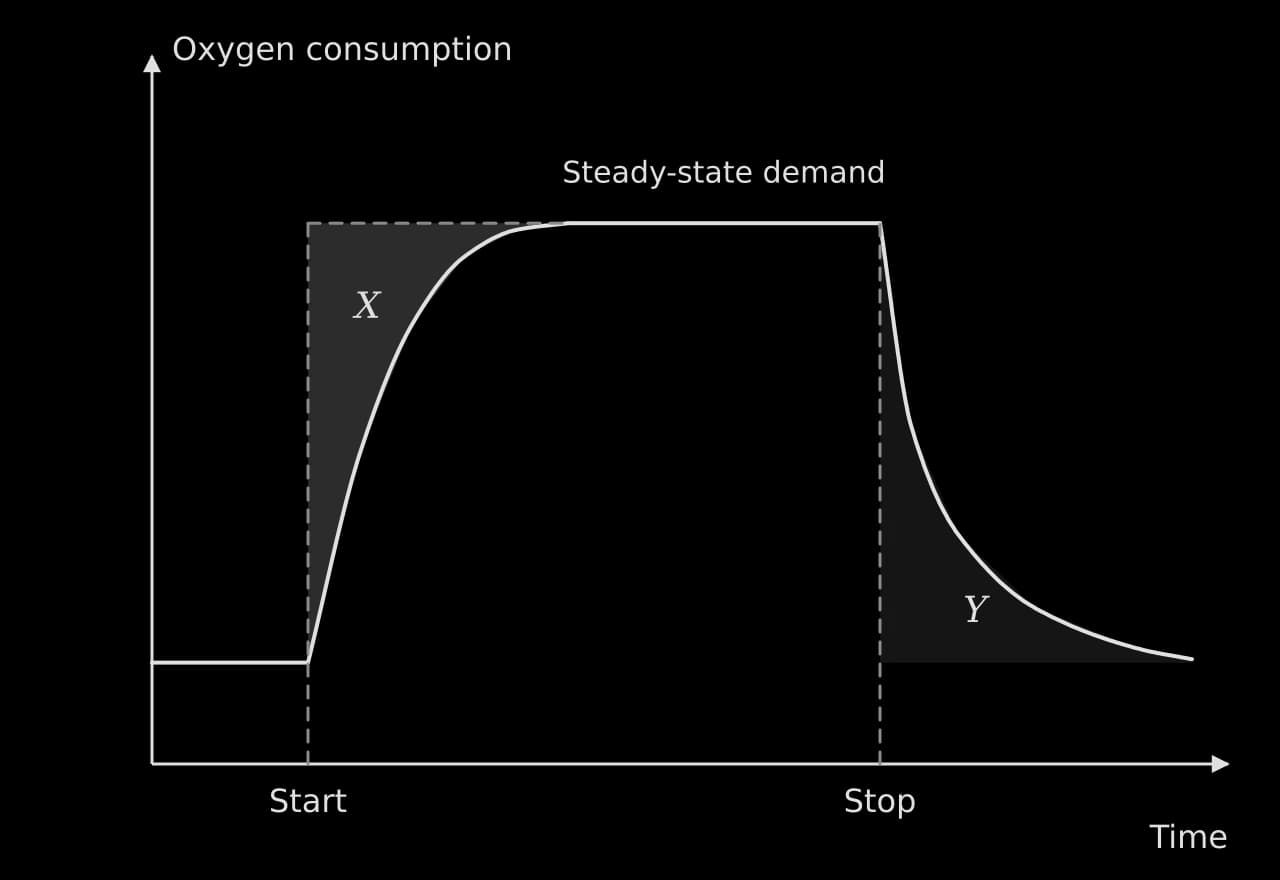
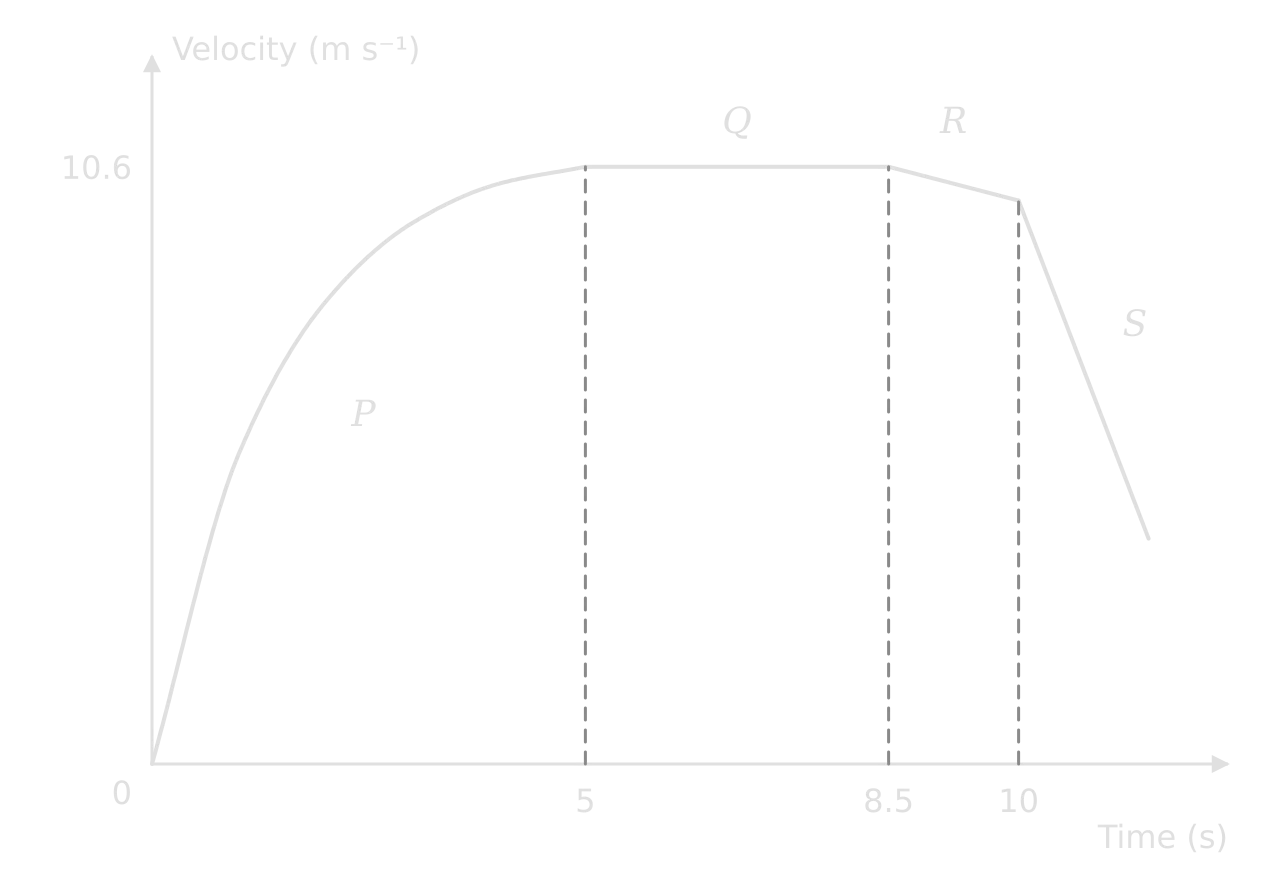
Read the axes before the curve: the variables, the units and whether the scale starts at zero. Then identify what the question needs: a value read from the graph, a gradient (rate of change, such as acceleration on a velocity–time graph) or an area (a quantity accumulated over time, such as oxygen deficit on an oxygen consumption graph). Labelled points and regions (P, Q, X, Y) are there to be matched to concepts, so name each one in your head before reading the options.

When two options both look right

Choose the option that answers the stem most completely and most precisely. If one option says "heart rate increases" and another says "cardiac output increases because heart rate and stroke volume increase", and the stem asks why more oxygen reaches the muscles, the second is better because it links the change to the outcome. If two options are genuinely equivalent, you have probably misread the stem; reread it.

Practice questions

The following questions are invented in the style of Paper 1A and cover all three themes. Try each one before opening the answer, and use the explanation of why each distractor is wrong to identify what kind of mistake you are prone to.

Theme A: exercise physiology and nutrition

Worked example

1. Which structure initiates each heartbeat?

  • A. Atrioventricular (AV) node

  • B. Sinoatrial (SA) node

  • C. Bundle of His

  • D. Purkinje fibres

Show the answer and reasoning

Answer: B. The sinoatrial node in the wall of the right atrium is the heart’s pacemaker: it generates the impulse that starts each beat. A is wrong because the AV node delays and passes on the impulse from the atria to the ventricles. C and D conduct the impulse through the septum and the ventricle walls but do not initiate it.

The next question tests a half-right distractor: two options mention the correct shift, but only one gives the correct consequence.

Worked example

2. During intense exercise, the temperature and carbon dioxide concentration in working muscles rise. What is the effect on the oxygen–haemoglobin dissociation curve?

  • A. It shifts to the left, so more oxygen is released to the muscles.

  • B. It shifts to the right, so more oxygen is released to the muscles.

  • C. It shifts to the right, so haemoglobin has a higher affinity for oxygen.

  • D. It does not change, because haemoglobin saturation is fixed.

Show the answer and reasoning

Answer: B. Higher temperature, higher carbon dioxide and lower pH shift the curve to the right (the Bohr effect). At any partial pressure of oxygen, haemoglobin is less saturated, so it releases more oxygen to the muscle. A gives the wrong direction. C gives the right direction with the wrong consequence: a right shift means lower affinity. D is wrong because saturation depends on conditions.

Question 3 is a negative question. Mark each option true or false before choosing.

Worked example

3. Which is not a characteristic of the oxidative system?

  • A. It resynthesises ATP in the mitochondria.

  • B. It can use both fats and carbohydrates as fuel.

  • C. Its main by-product is lactate.

  • D. It requires oxygen.

Show the answer and reasoning

Answer: C. The by-products of the oxidative system are carbon dioxide and water. Lactate is produced by the glycolytic system when pyruvate is not oxidised in the mitochondria. A, B and D are all true statements about the oxidative system, so they are not the key in a NOT question.

Question 4 is a calculation with a unit trap. Check the size of the answer.

Worked example

4. During a training run, an athlete has a heart rate of 150 beats min⁻¹ and a stroke volume of 120 mL. What is the athlete’s cardiac output?

  • A. 1.25 L min⁻¹

  • B. 18 L min⁻¹

  • C. 270 L min⁻¹

  • D. 18,000 L min⁻¹

Show the answer and reasoning

Answer: B.

Q˙=HR×SV=150 beats min−1×120 mL=18,000 mL min−1=18 L min−1Q˙​=HR×SV=150 beats min−1×120 mL=18,000 mL min−1=18 L min−1

D is the right number in mL min⁻¹ with the wrong unit. A comes from dividing HR by SV, and C from adding them. A cardiac output of 18 L min⁻¹ is a realistic value for a trained athlete during hard exercise, which is a useful check.

Questions 5 and 6 use a graph. Read the axes first, then name each labelled region in your head.
Oxygen consumption against time. From resting level it rises along a curve after exercise starts to a steady state on a dashed demand line; shaded area X lies between the demand line and the curve. After exercise stops it falls along a curve; shaded area Y lies under it, above resting level.Oxygen consumption against time. From resting level it rises along a curve after exercise starts to a steady state on a dashed demand line; shaded area X lies between the demand line and the curve. After exercise stops it falls along a curve; shaded area Y lies under it, above resting level.
Oxygen consumption of a student before, during and after 20 minutes of steady submaximal exercise. Area X and area Y are used in question 5 and in an HL question.

Worked example

5. What does area X represent?

  • A. Excess post-exercise oxygen consumption

  • B. Oxygen deficit

  • C. Steady state

  • D. VO₂ max

Show the answer and reasoning

Answer: B. At the start of exercise, oxygen consumption rises more slowly than the oxygen demand (the dashed line), so for the first minutes some of the ATP is resynthesised anaerobically. Area X, between the demand and the actual consumption, is the oxygen deficit. A describes the area after exercise (Y). C is the flat section where consumption meets demand. D is wrong because the exercise is submaximal and the graph shows no maximum.

Question 6 asks for an application of the steady-state idea to the same graph.

Worked example

6. Between the end of the oxygen deficit and the end of exercise, which statement is correct?

  • A. ATP is resynthesised entirely by the phosphagen system.

  • B. Oxygen supply meets the oxygen demand, so ATP is resynthesised mainly by the oxidative system.

  • C. Oxygen consumption is at its maximum value for this student.

  • D. Blood lactate concentration rises continuously.

Show the answer and reasoning

Answer: B. The plateau is the steady state: oxygen supply matches demand, so the oxidative system supplies almost all of the ATP. A is wrong because phosphocreatine stores would be exhausted within seconds. C is wrong because steady-state consumption during submaximal exercise is below VO₂ max. D is wrong because at steady state, lactate production and removal are roughly balanced.

Questions 7 and 8 apply concepts to sporting cases.

Worked example

7. A marathon runner drinks large volumes of plain water at every drink station and develops headache, confusion and nausea late in the race. Which condition is the most likely cause?

  • A. Hypernatraemia

  • B. Hyponatraemia

  • C. Hypoglycaemia

  • D. Heat stroke

Show the answer and reasoning

Answer: B. Drinking much more plain water than is lost in sweat dilutes the sodium in the blood, causing hyponatraemia (low blood sodium). A is the opposite (high blood sodium, linked to dehydration). C and D can produce similar symptoms, but the stem points to the cause: large volumes of plain water. The stem’s details are there to separate options that would otherwise all be possible.

Question 8 checks a training principle against a description.

Worked example

8. A swimmer stops training for six weeks because of illness, and her VO₂ max falls. Which training principle explains this?

  • A. Specificity

  • B. Progressive overload

  • C. Reversibility

  • D. Variety

Show the answer and reasoning

Answer: C. Reversibility means that adaptations to training are lost when training stops or is reduced. A concerns matching training to the demands of the activity, B gradually increasing the load, and D changing the training to keep it effective and interesting. None of them describes a loss of fitness.

Theme B: biomechanics

Questions 9 and 10 use the velocity–time graph of a sprinter.
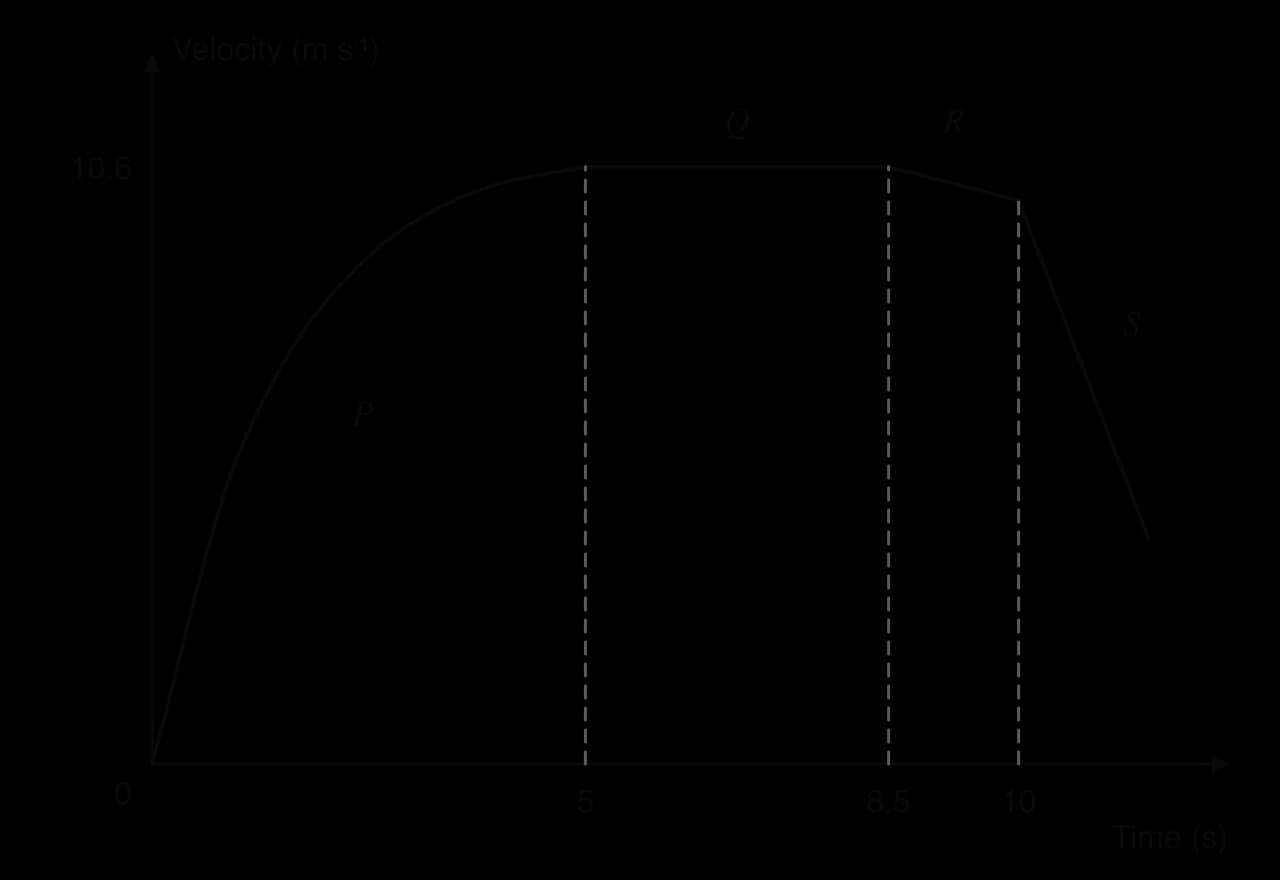
Velocity–time graph of a sprinter. Section P: velocity rises from 0 at 0 s along a curve to 10.6 m/s at 5 s, getting less steep. Section Q: horizontal at 10.6 m/s from 5 s to 8.5 s. Section R: falls gently to 10.0 m/s at 10 s. Section S: falls steeply after 10 s.Velocity–time graph of a sprinter. Section P: velocity rises from 0 at 0 s along a curve to 10.6 m/s at 5 s, getting less steep. Section Q: horizontal at 10.6 m/s from 5 s to 8.5 s. Section R: falls gently to 10.0 m/s at 10 s. Section S: falls steeply after 10 s.
Velocity–time graph of a sprinter during and just after a sprint, divided into sections P, Q, R and S. The gradient of each section is the acceleration.

Worked example

9. In which section is the sprinter’s acceleration zero?

  • A. P

  • B. Q

  • C. R

  • D. S

Show the answer and reasoning

Answer: B. On a velocity–time graph, acceleration is the gradient. Section Q is horizontal, so velocity is constant and acceleration is zero. A is the section of positive acceleration. C and D both slope downwards, so the acceleration is negative (deceleration), more gently in R and more steeply in S. A student who reads the graph as a distance–time graph might choose a different answer, which is why the axes come first.

Question 10 asks for an average from the same graph; an estimate is enough to choose.

Worked example

10. What is the sprinter’s average acceleration during section P?

  • A. 0.47 m s⁻²

  • B. 2.1 m s⁻²

  • C. 10.6 m s⁻²

  • D. 53 m s⁻²

Show the answer and reasoning

Answer: B. Using the data booklet equation:

a=(v−u)t=(10.6−0) m s−15 s=2.12 m s−2≈2.1 m s−2a=t(v−u)​=5 s(10.6−0) m s−1​=2.12 m s−2≈2.1 m s−2

A is t ÷ v (the division upside down). C is the final velocity, not the acceleration. D is v × t. Rounding to "about 10 ÷ 5 = 2" is enough to choose B without a calculator.

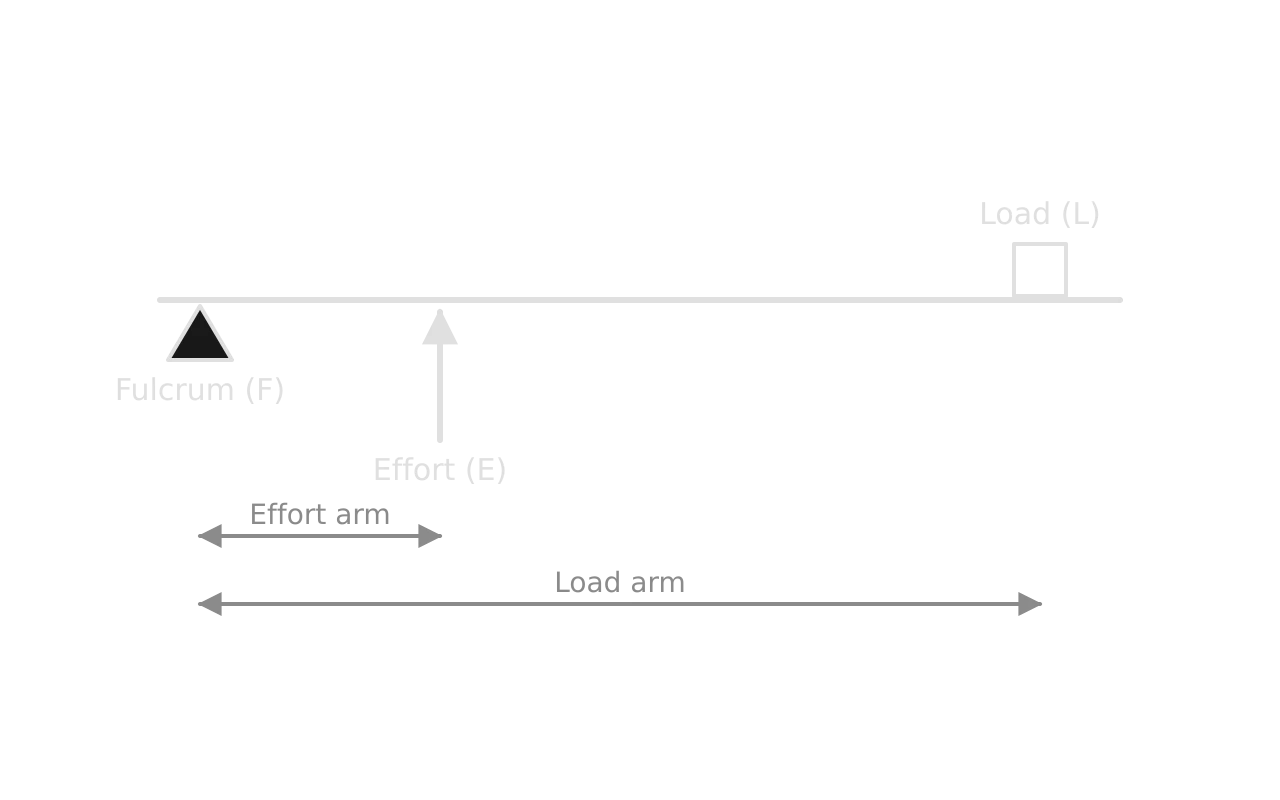
Question 11 uses a lever diagram. Identify the middle component first.
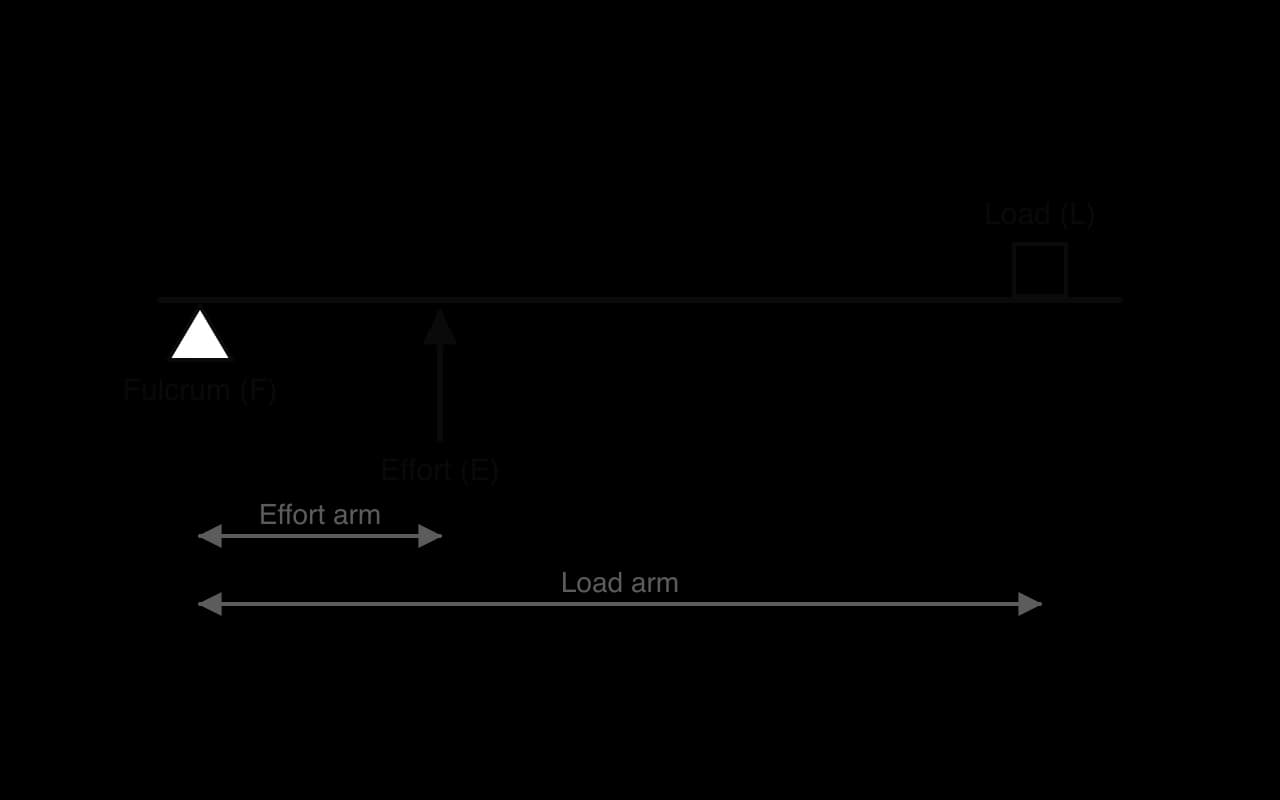
Lever diagram: a horizontal bar with the fulcrum (F) at the left end, the effort (E) acting upwards a short distance from the fulcrum and the load (L) at the far right end. The effort arm is short and the load arm is long.Lever diagram: a horizontal bar with the fulcrum (F) at the left end, the effort (E) acting upwards a short distance from the fulcrum and the load (L) at the far right end. The effort arm is short and the load arm is long.
A lever with the fulcrum at one end, the effort close to the fulcrum and the load at the far end. Compare the effort arm with the load arm.

Worked example

11. Which statement describes the lever shown?

  • A. First-class lever with a mechanical advantage greater than 1

  • B. Second-class lever with a mechanical advantage greater than 1

  • C. Third-class lever with a mechanical advantage less than 1

  • D. Third-class lever with a mechanical advantage greater than 1

Show the answer and reasoning

Answer: C. The effort lies between the fulcrum and the load, so this is a third-class lever (the arrangement at the elbow during a biceps curl). Its effort arm is shorter than its load arm, so its mechanical advantage (effort arm ÷ load arm) is less than 1. A needs the fulcrum in the middle, B the load in the middle. D has the right class but the wrong mechanical advantage: a short effort arm gives a mechanical disadvantage, traded for a large range and speed of movement at the load.

Tip

The middle component names the class: fulcrum in the middle is first class, load in the middle is second class, effort in the middle is third class. “F-L-E: 1-2-3” is a common memory aid.

Question 12 tests the pairing of planes with axes.

Worked example

12. A gymnast performs a cartwheel. In which plane and about which axis does the movement occur?

  • A. Sagittal plane, frontal axis

  • B. Frontal plane, sagittal axis

  • C. Transverse plane, longitudinal axis

  • D. Frontal plane, frontal axis

Show the answer and reasoning

Answer: B. A cartwheel moves the body sideways, in the frontal plane, rotating about an axis that runs from front to back, the sagittal axis. A describes a somersault. C describes a pirouette or a discus turn. D pairs a plane with an axis that lies in that plane, which is impossible: the axis of rotation is always at right angles to the plane of movement.

Question 13 is an impulse question set in a sporting context.

Worked example

13. A cricketer “gives” with the hands, drawing them back while catching a fast ball. Why does this reduce the risk of injury?

  • A. It reduces the change in the ball’s momentum.

  • B. It increases the time over which the ball is stopped, so the average force on the hands is smaller.

  • C. It increases the impulse applied to the ball.

  • D. It reduces the ball’s mass.

Show the answer and reasoning

Answer: B. The ball must lose all its momentum whichever way it is caught, so the impulse (force × time) is fixed. Increasing the time of contact therefore reduces the average force. A and C are wrong because the change in momentum, and so the impulse, is the same in both catches. D is not possible. This idea also explains crash mats, running shoes and bending the knees on landing.

Question 14 concerns projectiles. Picture the event before reading the options.

Worked example

14. A shot putter releases the shot about 2 m above the ground. Ignoring air resistance, how does the optimum angle of release compare with 45°?

  • A. It is less than 45°.

  • B. It is exactly 45°.

  • C. It is greater than 45°.

  • D. It depends only on the mass of the shot.

Show the answer and reasoning

Answer: A. An angle of 45° gives the greatest horizontal distance only when the release and landing heights are equal. When the height of release is above the landing height, the projectile already has extra time in the air, so a lower angle that gives more horizontal velocity travels further. B applies only to equal heights. C would apply if landing were above the release point. D is wrong: mass does not change the flight path of a projectile when air resistance is ignored.

Theme C: sports psychology and motor learning

Question 15 asks you to identify a phase from a description.

Worked example

15. A beginner learning a tennis serve makes many errors, performs inconsistently and needs to think about every part of the movement. Which phase of learning is the player in?

  • A. Autonomous

  • B. Associative

  • C. Cognitive

  • D. Mastery

Show the answer and reasoning

Answer: C. In Fitts and Posner’s model, the cognitive phase is the first: the learner is working out what to do, attention is fully on the movement and errors are large and frequent. B is the middle phase, with fewer errors and growing consistency. A is the final phase, in which the skill is largely automatic. D is not one of the three phases.

Question 16 is a classification question. Each option has three parts, and all three must be right.

Worked example

16. Which classification best describes a tennis serve?

  • A. Open, externally paced, continuous

  • B. Closed, self-paced, discrete

  • C. Open, self-paced, serial

  • D. Closed, externally paced, discrete

Show the answer and reasoning

Answer: B. The serve is performed in a stable environment (closed skill), the player decides when to start it (self-paced skill) and it has a clear beginning and end (discrete skill). A describes a skill such as dribbling past defenders. C has two wrong parts and D has one, which is enough to make each of them wrong. In multi-part options, check each part separately.

Question 17 uses a graph of the inverted U. Match each point to a level of arousal before reading the options.

0123456789100510152025ArousalPerformanceABCD
  • Performance
The inverted U, with four points marked. Points A and C give the same performance at different levels of arousal.

Worked example

17. A basketball player, very tense before a final, misses several free throws but still performs reasonably well overall. Which point best represents the player?

  • A. A

  • B. B

  • C. C

  • D. D

Show the answer and reasoning

Answer: C. The player is over-aroused (very tense), so the point must be to the right of the optimum, and performance is reduced but still reasonable, so it is not at the far end of the curve. A gives the same performance but at low arousal (under-aroused). B is the optimal point. D is over-aroused with very poor performance, which does not fit "reasonably well".

Question 18 tests goal types. Ask what the athlete controls in each option.

Worked example

18. Which is a process goal for a 400 m runner?

  • A. Win the regional final

  • B. Run under 50 seconds

  • C. Keep driving the arms through the final bend

  • D. Finish in the top three

Show the answer and reasoning

Answer: C. A process goal concerns the technique or strategy used during performance, which the athlete fully controls. A and D are outcome goals, which depend on other competitors. B is a performance goal, a personal standard independent of others.

Question 19 is a negative question on self-determination theory.

Worked example

19. Which is not one of the basic psychological needs in self-determination theory?

  • A. Autonomy

  • B. Competence

  • C. Relatedness

  • D. Extraversion

Show the answer and reasoning

Answer: D. The three basic psychological needs are autonomy, competence and relatedness. Extraversion is one of the Big Five personality traits, a correct term from a different topic. Distractors are often borrowed from neighbouring topics in this way.

Question 20 combines a research design with psychology content. It tests variables, which also appear in Paper 1B.

Worked example

20. A researcher compares the free-throw accuracy of 20 players after 10 minutes of motivational self-talk with their accuracy after 10 minutes of rest. What is the dependent variable?

  • A. The type of self-talk

  • B. The number of players

  • C. Free-throw accuracy

  • D. The 10-minute duration

Show the answer and reasoning

Answer: C. The dependent variable is what is measured: free-throw accuracy. A is the independent variable, the condition the researcher changes. D is a controlled variable, kept the same in both conditions. B is the sample size.

HL questions (HL only)

HL only

HL candidates answer 40 questions, including questions on the additional higher level content. The following questions cover HL topics from all three themes.

Worked example

H1. A ball is dropped vertically onto a stationary floor. It strikes the floor at 6.0 m s⁻¹ and rebounds at 4.2 m s⁻¹. What is the coefficient of restitution between the ball and the floor?

  • A. 0.30

  • B. 0.70

  • C. 1.43

  • D. 10.2

Show the answer and reasoning

Answer: B. For a ball (a) hitting a floor (b) that does not move, the coefficient of restitution is the speed of separation divided by the speed of approach:

CR=vb−vaua−ub=0−(−4.2)6.0−0=4.26.0=0.70CR​=ua​−ub​vb​−va​​=6.0−00−(−4.2)​=6.04.2​=0.70

(taking downwards as positive, so the rebound velocity is −4.2 m s⁻¹). C is the fraction upside down, which gives a value above 1, impossible for a real bounce. A is 1 − 0.70. D adds the speeds.

H2 returns to the oxygen consumption graph used in question 5.

Worked example

H2. In the oxygen consumption graph used for question 5, which process is mainly supported by the fast component of area Y?

  • A. Removal of lactate

  • B. Resynthesis of phosphocreatine and reloading of myoglobin with oxygen

  • C. Repair of damaged muscle tissue

  • D. Replenishment of muscle glycogen stores

Show the answer and reasoning

Answer: B. Area Y is excess post-exercise oxygen consumption (EPOC). Its fast component, in the first few minutes, supports the resynthesis of phosphocreatine and the reloading of myoglobin with oxygen. A is part of the slow component, as is the cost of an elevated temperature and heart rate. C and D take hours to days and are not covered by the EPOC curve shown.

H3 is a sliding filament question from theme B.

Worked example

H3. During muscle contraction, which ions bind to troponin, causing tropomyosin to move and expose the binding sites on actin?

  • A. Sodium

  • B. Potassium

  • C. Calcium

  • D. Hydrogen

Show the answer and reasoning

Answer: C. Calcium ions released from the sarcoplasmic reticulum bind to troponin, which moves tropomyosin away from the binding sites on actin so that myosin heads can form cross-bridges. A and B are involved in the nerve impulse and action potential, not in uncovering the binding sites. D accumulates during intense exercise and interferes with contraction.

H4 is a power calculation. It has four terms, the HL maximum.

Worked example

H4. A weightlifter lifts a 100 kg barbell vertically through 2.0 m in 1.5 s. What is the average power developed? (g = 9.81 m s⁻²)

  • A. 133 W

  • B. 1308 W

  • C. 1962 W

  • D. 2943 W

Show the answer and reasoning

Answer: B.

W=Fd=mgd=100 kg×9.81 m s−2×2.0 m=1962 JW=Fd=mgd=100 kg×9.81 m s−2×2.0 m=1962 J
P=ΔWΔt=1962 J1.5 s=1308 WP=ΔtΔW​=1.5 s1962 J​=1308 W

C is the work done, not the power. D multiplies by the time instead of dividing. A leaves out g, treating the mass as the force.

H5 applies attribution theory to an athlete’s explanation.

Worked example

H5. After losing a match, a squash player says, “My opponent is simply a better player than me.” How is this attribution classified in Weiner’s model?

  • A. Internal and stable

  • B. Internal and unstable

  • C. External and stable

  • D. External and unstable

Show the answer and reasoning

Answer: C. The cause is placed outside the player (the opponent’s ability), so it is external, and an opponent’s ability is unlikely to change quickly, so it is stable. A would be "I lack ability". B would be "I did not try hard enough". D would be "the ball bounced unluckily". In attribution theory, stable attributions for failure predict lower expectations of future success.

H6 is a training question on the lactate inflection point.

Worked example

H6. After a season of endurance training, a cyclist’s lactate inflection point moves from 65% to 80% of VO₂ max. What is the most likely effect on performance?

  • A. She can sustain a higher intensity before lactate accumulates rapidly.

  • B. Her VO₂ max must have fallen.

  • C. Her muscles now produce no lactate below 80% of VO₂ max.

  • D. Her phosphagen system capacity has increased.

Show the answer and reasoning

Answer: A. A higher LIP means a higher intensity can be sustained with lactate production still matched by removal, so she can ride faster for longer. B does not follow: the LIP is expressed as a percentage of VO₂ max, which may have stayed the same or risen. C is a common misconception: lactate is produced at all intensities. D is unrelated to the LIP.

Learning from your mistakes

Practice questions are most useful when every wrong answer is diagnosed. A wrong answer has one of a few causes, and each needs a different fix.

Cause of the error

Sign

Fix

Gap in knowledge

You did not know the fact or concept at all

Revise the topic; make a flashcard

Confused pair of terms

You chose the “neighbour” (AV for SA node, sagittal for frontal)

Make a two-column table of the pair

Misread the stem

You answered a different question (missed NOT, during/after, main)

Underline key words every time

Calculation or unit slip

Right method, wrong number

Write units at each step; estimate first

Half-right option

You stopped reading halfway through the option

Read every option to the end

Add to your notes: a "multiple-choice error log": for every question you get wrong in practice, write the topic, the option you chose, the correct option and the cause of the error from the table. After two or three papers, the log shows which kind of mistake costs you most marks.

Common mistake

Changing an answer at the end on a vague feeling, or refusing to change one out of loyalty to a first instinct. Change an answer when you find a specific reason, such as a misread stem, a unit slip or a fact you have now remembered; changes made for a clear reason are usually improvements.

Before you start Paper 1A

  • To do:

    Plan about one minute per question: about 30 minutes at SL and 40 minutes at HL.

  • To do:

    Read each stem to the end and predict the answer before reading the options.

  • To do:

    Underline NOT, LEAST, EXCEPT and mark each option true or false.

  • To do:

    Read the axes before the curve in every graph question.

  • To do:

    Convert units first and check the size of every calculated answer.

  • To do:

    Eliminate, then choose; flag slow questions and come back to them.

  • To do:

    Transfer answers to the answer sheet carefully, and leave no question blank.

Many questions that look like pure recall are in fact testing a distinction between two related ideas: SA node or AV node, oxygen deficit or EPOC, outcome or performance goal. Revising concepts in contrasting pairs prepares for Paper 1A better than revising each concept on its own.

Summary

  • Paper 1A has 30 one-mark questions at SL and 40 at HL, with no penalty for wrong answers; answer every question.

  • Allow about one minute per question, and use the time saved for Paper 1B.

  • Read the whole stem and predict the answer; then eliminate distractors (opposites, half-right options, wrong system, unit traps, absolute words).

  • In NOT questions, mark each option true or false and choose the false one.

  • For calculations, use the data booklet equation, convert units first and check the size of the answer.

  • For graphs, read the axes first; gradients give rates and areas give accumulated quantities.

  • Diagnose every wrong answer by its cause and fix that cause.

Keep your place

In Augment the notes remember where you stopped and which pages you have finished.

Open in Augment

More IB SEHS notes

  • Command terms and answer techniqueThe page before this.
  • Paper 1B: data-based questionsThe next page.
  • SEHS assessmentEach SEHS paper, the internal assessment and grade boundaries.
  • IB SEHSThe SEHS syllabus, how it is assessed and every notes page.

Carry on with SEHS in Augment

With a free account, Augment remembers where you stopped in the notes and which questions you have marked.

Start free