Command terms and answer technique
Use the assessment objectives and every SEHS command term to judge the depth an answer needs, write answers that earn each mark, sketch and annotate graphs, and plan your time per mark.
- IB Sports, Exercise and Health Science
- Exam skills
- SL and HL
Why command terms matter
Every written question in Sports, Exercise and Health Science (SEHS) opens with a verb such as state, describe, explain or evaluate. These verbs are the command terms, and each one has a fixed meaning. The command term tells you what kind of answer is wanted and how deep it must go. The number of marks in square brackets tells you how many separate creditworthy points the examiner expects.
Many marks are lost by answering a different question from the one set: describing when the question says explain, listing when it says discuss, or drawing a graph with no labels when it says sketch. Learning the command terms is therefore one of the quickest ways to raise a grade, because it improves answers on every topic at once.
Each command term belongs to one of the assessment objectives, the broad skills the course assesses. Knowing which objective a term belongs to tells you whether the examiner wants recall, application or analysis and judgment. The same skills apply in Paper 1A, Paper 1B and Paper 2, and in the internal assessment.
The assessment objectives
An assessment objective (AO) is a broad skill that the course sets out to assess. SEHS has four. The written papers test the first three; the scientific investigation (the internal assessment) tests all four.
Objective | What it means in practice | Where it is assessed |
|---|---|---|
AO1 Demonstrate knowledge | Recall terminology, facts and concepts (the four chambers of the heart, the Big Five traits, Newton’s laws), and skills, techniques and methods (how a multistage fitness test is run). | Paper 1, Paper 2, internal assessment |
AO2 Understand and apply knowledge | Use what you know in a new context: apply a lever class to a movement, calculate momentum, describe a response, outline how a coach could use a model. | Paper 1, Paper 2, internal assessment |
AO3 Analyse, evaluate and synthesise | Work with experimental procedures, primary and secondary data, trends, patterns and predictions; explain mechanisms; weigh strengths against limitations; reach a judgment. | Paper 1, Paper 2, internal assessment |
AO4 Apply the skills of investigation | Plan and carry out an insightful and ethical investigation of your own research question. | Internal assessment only |
In both Paper 1 and Paper 2, roughly half of the marks are for AO1 and AO2 together and roughly half are for AO3. A student who can recall and describe accurately but never explains, interprets or evaluates is therefore limited to about half the available marks.
A question can use a command term from a lower objective than the content it is about, but never a higher one. A topic that you understand at AO3 depth, such as the mechanism that raises heart rate during exercise, can still be examined with "state" or "outline". It cannot be examined at a depth beyond what the course teaches. This is why the same idea can appear as a one-mark question in one year and a four-mark question in another, and why revision has to reach the deepest level.
Every SEHS command term
The following tables group every command term by its assessment objective. The first column gives the term, the second its meaning in plain words, and the third what an answer to it looks like on the page. The meanings follow the IB’s own definitions closely, so learn them as written.
AO1 command terms: label, list, state
Command term | Meaning | What a good answer looks like |
|---|---|---|
Label | Add labels to a diagram. | A clear line from each structure to its name, spelled correctly. No extra notes. Diagrams in the data booklet (the heart, the sarcomere, planes and axes) are common sources. |
List | Give a sequence of brief answers with no explanation. | Separate items, one per line or separated by semicolons, as many as the marks. "List three components of skill-related fitness [3]": agility; balance; reaction time. |
State | Give a specific name, value or other brief answer without explanation or calculation. | A word, a phrase or a number with its unit. "State the class of lever at the ankle during plantarflexion [1]": second-class lever. |
AO1 questions are usually worth one to three marks and should take very little time. The danger is writing too much. Extra explanation earns nothing, and if it contains an error it can contradict an otherwise correct answer.
AO2 command terms: annotate, apply, calculate, describe, distinguish, estimate, outline
Command term | Meaning | What a good answer looks like |
|---|---|---|
Annotate | Add brief notes to a diagram or graph. | Short notes placed next to the feature they explain, with a line or arrow to it: "anticipatory rise: epinephrine released before exercise". |
Apply | Use an idea, equation, principle, theory or law in relation to a given problem or issue. | The idea named and then used on the specific case in the question. "Apply Newton’s third law to a swimmer’s tumble turn": the swimmer pushes on the wall; the wall pushes back on the swimmer with an equal and opposite force, which drives the swimmer away from the wall. |
Calculate | Obtain a numerical answer showing the relevant stages in the working. | The equation, the substituted values with units, and the answer with its unit and a sensible number of significant figures. |
Describe | Give a detailed account. | What happens, in order, with detail and data where there are data. No reasons are needed, although a brief reason does no harm. |
Distinguish | Make clear the differences between two or more concepts or items. | Paired statements, each one about both items: "a tendon joins muscle to bone, whereas a ligament joins bone to bone". |
Estimate | Obtain an approximate value. | A rounded value, often read from a graph or worked out with simple numbers, with its unit. |
Outline | Give a brief account or summary. | Two or three linked points in one or two sentences. Less than a description, more than a statement. |
Describe and outline are the AO2 terms that cause most trouble. An outline is a short summary of the main points, usually worth two marks. A description is a fuller account that covers each stage or feature in detail, usually worth two to four marks. Neither needs reasons, but both need precise terminology.
AO3 command terms
Command term | Meaning | What a good answer looks like |
|---|---|---|
Analyse | Break down in order to bring out the essential elements or structure. | The parts named and the role of each shown: the phases of a movement, the stages of a model, the components of a data set. |
Compare | Give an account of the similarities between two (or more) items or situations, referring to both (all) of them throughout. | Statements of what the items have in common, each one about both: "both the phosphagen and glycolytic systems resynthesise ATP without oxygen". |
Contrast | Give an account of the differences between two (or more) items or situations, referring to both (all) of them throughout. | Paired differences: "the oxidative system uses fat and carbohydrate as fuel, whereas the phosphagen system uses phosphocreatine". |
Deduce | Reach a conclusion from the information given. | A conclusion that follows from the data or statement in the question, with the step that links them. |
Determine | Obtain the only possible answer. | One answer, usually numerical or read from a graph, with working where it helps. |
Discuss | Offer a considered and balanced review that includes a range of arguments, factors or hypotheses; opinions or conclusions are presented clearly and supported by evidence. | Several points on more than one side, each developed and supported, ending with a conclusion that follows from the arguments. |
Evaluate | Make an appraisal by weighing up the strengths and limitations. | Strengths and limitations, each explained, then a judgment of how useful, valid or effective the item is, and for whom. |
Explain | Give a detailed account including reasons or causes. | Cause-and-effect chains: what happens because of what, and so what results. Each link in the chain is a potential mark. |
Interpret | Use knowledge and understanding to recognise trends and draw conclusions from given information. | The trend in the data stated with values, then what it means in terms of the science. |
Predict | Give an expected result. | A specific outcome, often with a short reason. "Heart rate at minute 25 will be about 150 beats min⁻¹ if intensity stays the same." |
Sketch | Represent by means of a diagram or graph (labelled as appropriate), giving a general idea of the required shape or relationship and including relevant features. | Labelled axes (no scale needed), the correct shape, and the key features marked: a peak, a plateau, an intersection. |
Suggest | Propose a solution, hypothesis or other possible answer. | A reasonable answer that fits the context, even if it is not the only possible one. Brief justification helps. |
Compare and contrast both demand that each sentence refers to both items. Two separate paragraphs, one on each item, leave the similarities or differences unstated, and the examiner does not credit links the answer does not make. "Compare and contrast" asks for both similarities and differences.
Discuss and evaluate are both judgment terms, and they differ in emphasis. Evaluate is centred on strengths and limitations of one thing (a method, a model, an intervention). Discuss is broader: a range of arguments, factors or viewpoints, which may include strengths and limitations but can also include alternative explanations, the conditions under which something works and the views of different groups. Both need a conclusion. Two further phrases are used in questions in the same way: "to what extent" asks for a discussion that ends with a judgment of degree, and "justify" asks for reasons or evidence that support an answer or conclusion.
One topic at five depths
The clearest way to see how command terms change an answer is to answer questions on one topic at each depth. The following questions are all about heart rate and exercise. Each model answer is complete for its marks; the ticks (✓) show where marks are earned.
State [1]
A state question checks recall. A number with its unit, or a name, is enough.
Outline [2]
An outline gives the main points without development. Two marks usually means a definition plus one key detail.
Describe [3]
A describe answer needs one detailed point per mark. Where the question gives data, the description quotes it: values, units and the times at which changes happen.
Explain [4]
An explanation is a chain of causes. Words such as "because", "so", "which causes" and "as a result" are signs that the answer is giving reasons rather than describing.
Evaluate [5]
The five questions draw on the same knowledge, and only the depth of processing changes: recall, summarise, give detail, give reasons, weigh up and judge. Revision notes that stop at the describe level do not prepare for the AO3 half of each paper.
Applying command terms across the three themes
Command terms work the same way in every theme, but the shape of a good answer differs slightly. Physiology answers are usually mechanism chains. Biomechanics answers usually name a law or principle and apply it with a direction and, where possible, a calculation. Psychology answers usually define the construct, apply it to the athlete and refer to evidence or a theory.
Distinguish (physiology)
Calculate and apply (biomechanics)
An apply question then asks you to use the result. A follow-up such as "Apply the concept of momentum to explain why this player is difficult to tackle [2]" needs the idea and the case: momentum is the product of mass and velocity, so a heavy player running fast has a large momentum ✓, and a tackler must apply a large impulse (force × time) to change it, so the player is difficult to stop ✓.
Contrast (psychology)
Deduce and predict (data)
Deduce, predict, interpret and determine are often attached to a table or graph in data-based questions. They expect the answer to come from the information given, so the examiner looks for a reference to that information.
How marks are awarded
Short-answer questions in SEHS are marked with a markscheme that lists creditworthy points, each worth one mark, often with more acceptable points than marks available. Extended responses are also marked mainly for the valid points they contain, and a judgment term such as evaluate or discuss needs a supported conclusion for full marks. Knowing how this works changes how you write.
One mark per valid, distinct point
Each mark is for one separate, correct idea. Repeating an idea in different words does not earn a second mark. A [3] question needs three different points; a [6] question needs six. When a markscheme lists eight possible points for a [4] question, any four correct ones earn full marks, so it pays to make several short, precise points rather than one long one.
Precise language matters because markschemes credit specific terms. "The heart beats faster" is weaker than "heart rate increases"; "the muscle gets bigger" is weaker than "muscle hypertrophy (an increase in cross-sectional area)". The more exact term is less likely to be judged vague.
Vague (often not credited) | Precise (creditworthy) |
|---|---|
The heart works harder | Heart rate and stroke volume increase, so cardiac output rises |
The muscles get more oxygen | Blood is redistributed to the working muscles by vasodilation of their arterioles |
The ball goes further because of the angle | A release angle closer to the optimum gives a better balance of horizontal and vertical velocity, so horizontal distance increases |
The athlete is more motivated | The athlete’s intrinsic motivation increases because the task satisfies the need for competence |
It is less tiring | It relies more on the oxidative system, so less lactate and fewer hydrogen ions accumulate |
Linking mechanism to outcome
In explain, discuss and evaluate questions, the marks are often for the links rather than for the facts in isolation. "Stroke volume increases" is a fact. "Stroke volume increases because a greater venous return stretches the ventricle walls, so they contract more forcefully" is a link that shows understanding, and it usually earns more. Ending a physiology explanation with the outcome for the athlete (more oxygen delivered, fatigue delayed, faster time) shows that you can connect the science to sport and health, which SEHS rewards throughout.
Units, significant figures and working
Calculations earn marks for the working as well as the answer. Write the equation, substitute the values with their units, and give the final answer with its unit. A wrong final answer can still earn a mark for correct working, but an answer with no working earns nothing if it is wrong. Give answers to a sensible number of significant figures, usually the same as the least precise value in the question; 2.333333 m s⁻² from values given to two significant figures should be written as 2.3 m s⁻².
The data booklet gives the equations of motion and mechanics, the uncertainty rules, the coefficient of variation, the SI multipliers, unit conversions and the value of g (9.81 m s⁻²). Use its symbols and its form of each equation, because markschemes are written in the same form.
Labelled diagrams
A diagram in an answer earns marks only if it is labelled. Label lines should touch the structure they name, and each label should be the IB term (sagittal plane, not "side plane"; fulcrum, not "pivot"). Where a question says "with the aid of a diagram", the diagram is part of the expected answer and the text should refer to it. A diagram can also save time in a describe or explain question: a labelled sketch of a lever class or a force arrow often communicates more than a paragraph.
Using the stimulus
Many questions begin with a stimulus: a graph, a table, a photograph of a movement or a short description of an athlete. When a question says "using the data" or "with reference to the graph", marks are reserved for answers that quote it. Give values with units, name the groups or conditions, and describe the size of differences ("the trained group’s steady-state heart rate was about 45 beats min⁻¹ lower"). An answer that ignores the stimulus and writes general knowledge can lose most of the marks even when the science is correct.
What does not earn marks
Repeating or rephrasing the question before answering it.
Vague words: "it helps", "it affects", "better", "more efficient" without saying how or in what way.
Correct facts that do not answer the question set (for example, a full account of the energy systems when the question asked only about the oxidative system).
Contradictions: if two answers are given and one is wrong, the correct one may not be credited.
Answers outside the space without a note saying where the rest of the answer is.
The sketch-and-annotate skill
Sketch and annotate are command terms in their own right, and sketches appear throughout SEHS: heart rate and oxygen consumption during exercise, the energy continuum, the inverted U theory, catastrophe theory, force–time curves, projectile paths and more. A sketch is not a plotted graph. It has no scale and no data points; it shows the general shape and the features that matter.
What every sketch needs
Axes drawn with a ruler, with an arrow or origin, and labelled with the variables (and units, where the variable has one): "Time (min)", "Heart rate (beats min⁻¹)". An unlabelled sketch often earns no marks at all.
The correct shape: a plateau where there should be a plateau, a symmetrical peak for the inverted U, a sudden drop for catastrophe theory.
The key features marked and labelled: the optimal point, the start and end of exercise, a threshold, the area that represents a quantity.
Where two lines are compared, each line labelled (trained / untrained, low / high cognitive anxiety).
If the command term is annotate, brief notes beside each feature saying what it shows or why it happens.
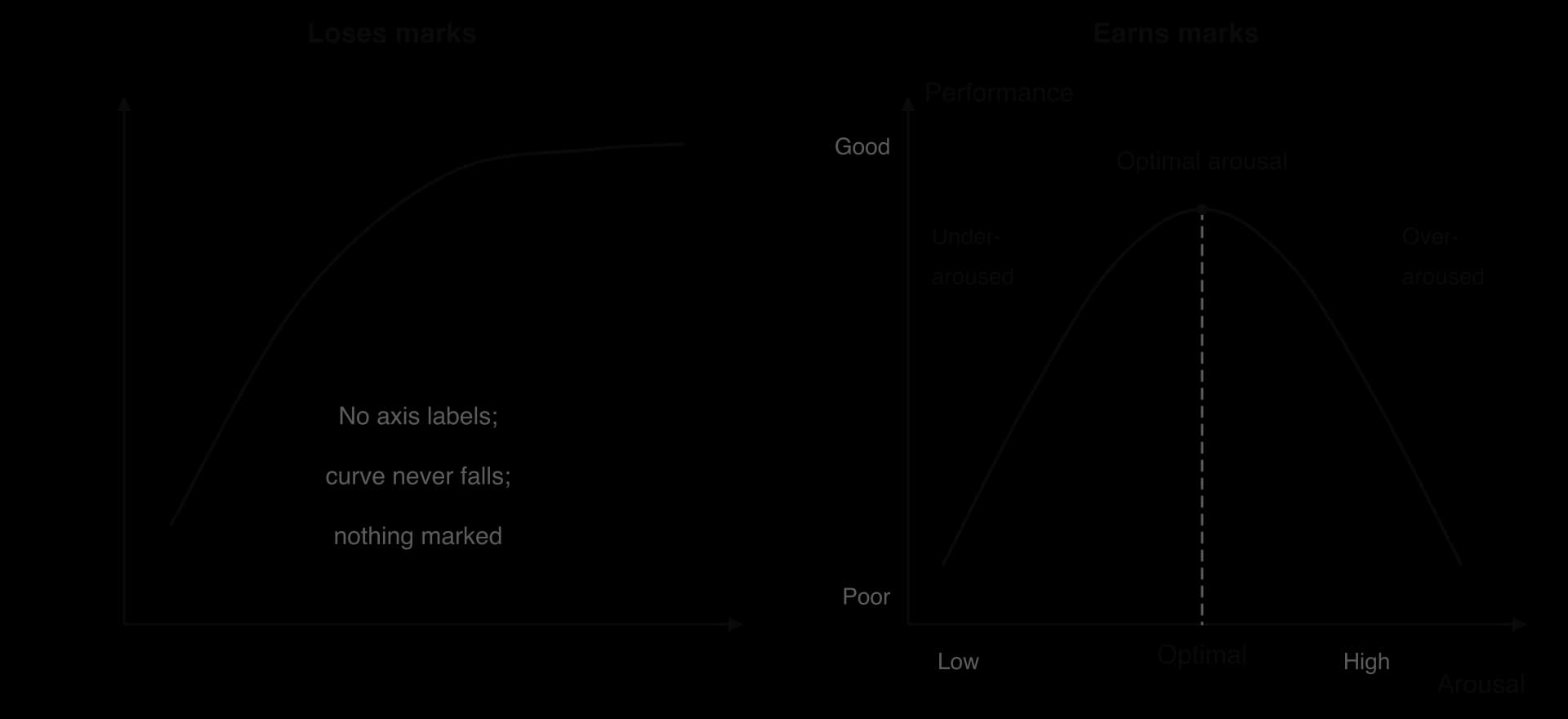
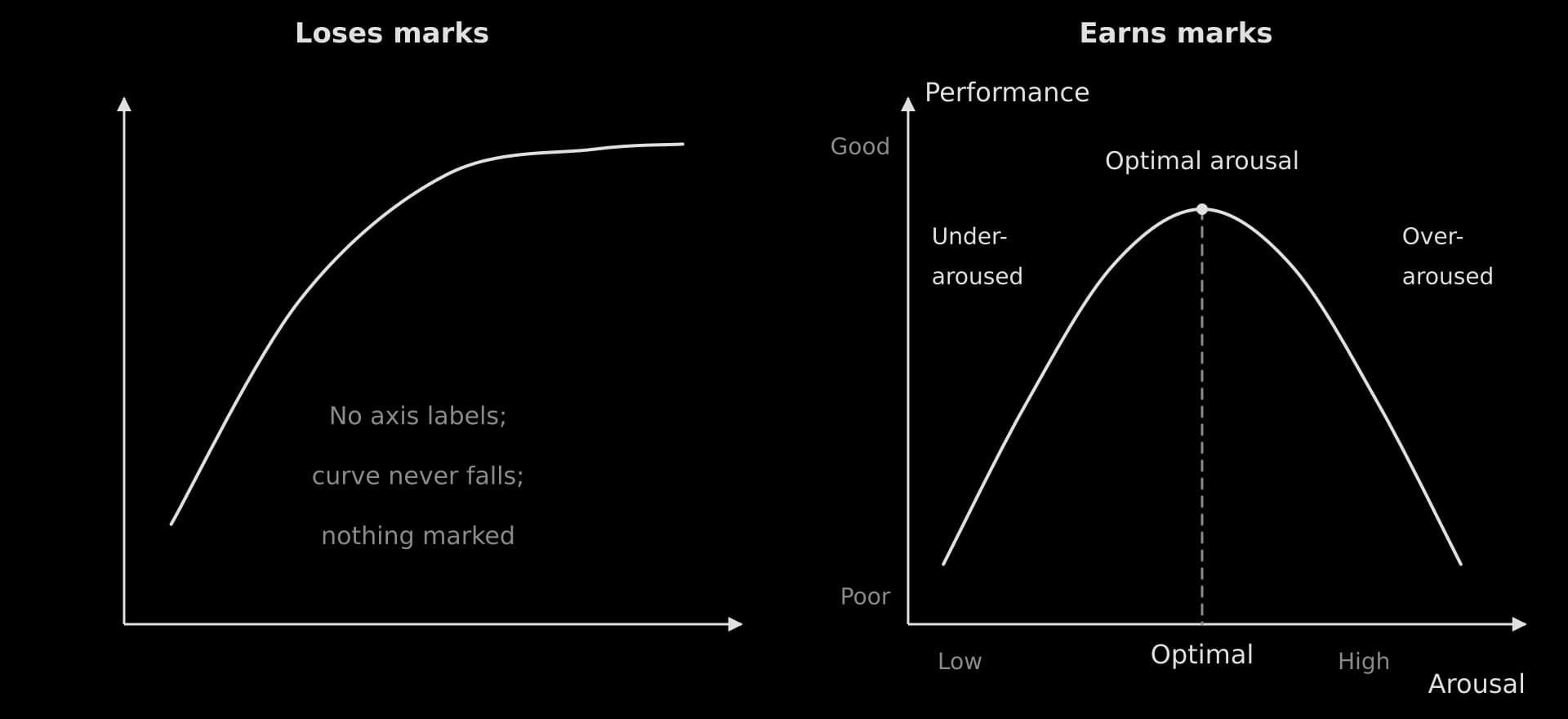
The left-hand sketch is a common response. It may come from a student who understands the theory, but nothing on the page shows it. The right-hand sketch takes about a minute longer and secures the marks for the axes, the shape and the optimal point.
Time per mark
Marks are a guide to time as well as to depth. At SL, Paper 1 gives 90 minutes for 55 marks and Paper 2 gives 90 minutes for 50 marks, which is a little under two minutes per mark in each. At HL the ratio is almost the same. A rule of thumb that fits every paper is therefore about 1.5–2 minutes per mark, including reading time.
Question | Marks | Time to aim for | What that time allows |
|---|---|---|---|
State / list / label | 1–3 | 1–3 minutes | Read, answer in a few words, move on |
Outline / distinguish | 2–3 | 3–5 minutes | Two or three precise, linked points |
Describe / calculate | 2–4 | 4–7 minutes | Ordered detail with data; working with units |
Explain / sketch and annotate | 3–4 | 5–8 minutes | A cause-and-effect chain; a labelled sketch |
Extended response (discuss, evaluate, explain) | 6–9 | 12–17 minutes | Two minutes of planning, then a structured answer |
The commonest timing failure is spending eight minutes on a two-mark question because the topic is familiar, then having too little time for the extended response at the end. If a question is taking much longer than its marks justify, write what you have, leave space and come back to it.
A routine for every written question
A short, fixed routine avoids the most common errors in written answers. It takes a few seconds per question and becomes automatic with practice.
- To do:
Underline the command term and decide its depth (state, outline, describe, explain, evaluate).
- To do:
Circle the marks and decide how many separate points you need.
- To do:
Underline the context (the athlete, the sport, the group, the data) and make sure every point refers to it.
- To do:
For explain, discuss and evaluate, jot the chain or the two sides in a few words before writing.
- To do:
Use the IB terms, and give values with units when there are data.
- To do:
For sketches, label both axes, mark the key features and label every line.
- To do:
For judgment terms, finish with a conclusion that answers the question.
- To do:
Reread the question once more before moving on: have you answered what was asked?
In an extended response the same steps scale up: the plan becomes a short outline of the mechanism, the application, the evidence and the two sides of the argument, and the conclusion becomes a justified judgment.
Practice: choose the depth
Each of the following questions is on a topic from a different theme. Before opening the answer, decide what the command term requires and how many points the marks suggest.
The next question asks for the same topic at a higher depth, so a longer chain is needed.
A psychology question at the evaluate depth follows.
Summary
Command terms have fixed meanings and set the depth of the answer; the marks set the number of separate points.
AO1 terms (state, list, label) ask for recall; AO2 terms (outline, describe, distinguish, calculate, apply, annotate, estimate) ask for understanding and application; AO3 terms (explain, analyse, compare, contrast, deduce, determine, discuss, evaluate, interpret, predict, sketch, suggest) ask for reasons, analysis and judgment.
In SEHS, explain is AO3 and needs reasons or causes; describe is AO2 and needs detail.
About half of the marks in each paper are for AO3, so revision must reach the explain and evaluate level.
Marks come from distinct, precise points; from links between mechanism and outcome; from units and working; from labels; and from using the stimulus.
A sketch needs labelled axes, the correct shape and labelled key features, but no scale.
Allow about 1.5–2 minutes per mark, and keep time for the extended response.
Self-check
- To do:
I can state the four assessment objectives and which papers test each.
- To do:
I can give the meaning of every SEHS command term and the AO it belongs to.
- To do:
I can write answers to one topic at state, outline, describe, explain and evaluate depth.
- To do:
I can distinguish describe from explain, and compare from contrast, in my own answers.
- To do:
I can show working with units and significant figures in a calculation.
- To do:
I can sketch and annotate a graph so that it earns every mark.
- To do:
I can use the data in a stimulus by quoting values with units.
- To do:
I can plan my time at about 1.5–2 minutes per mark.
Carry on with SEHS in Augment
With a free account, Augment remembers where you stopped in the notes and which questions you have marked.