4 Sociocultural approach
An overview of the sociocultural approach: how social influence, group membership and culture shape behaviour, how its ten subtopics connect, and how the approach is used in the four contexts and assessed.
- IB Psychology
- SL and HL
What 4 covers
From the subject guide: what you need to know and be able to do.
How social and cultural factors influence behaviour.
10 subtopics in Sociocultural approach
Each one has its own page once something is published for it.
- 4.1Cognitive dissonancenotes
- 4.2Compliance techniquesnotes
- 4.3Conformitynotes
- 4.4Cultural dimensionsnotes
- 4.5Emic approachnotes
- 4.6Enculturationnotes
- 4.7Etic approachnotes
- 4.8Models of acculturationnotes
- 4.9Social identity theorynotes
- 4.10Social learning theorynotes
Key terms introduced here
Each is in the Psychology glossary, with every other term in the subject.
- Culture
The shared beliefs, values, norms, practices and symbols of a group, passed from one generation to the next and shaping the identity and behaviour of its members.
- Social influence
The process by which the real or imagined presence, actions or expectations of other people change an individual’s thoughts, feelings or behaviour, as in conformity, compliance and obedience.
- Social norm
An unwritten rule shared by members of a group about how people should behave in a particular situation, which guides behaviour and is enforced through approval and disapproval.
- Sociocultural approach
A perspective in psychology that explains behaviour and mental processes through the social groups, relationships and cultures people belong to, including social influence, norms and cultural values.
An overview of 4 Sociocultural approach
The sociocultural approach explains behaviour through the people and cultures that surround each individual. It studies how others change what a person thinks and does, how group membership shapes identity, and how culture is learned, carried and changed when people move between cultures.
The approach has two roots. Social psychology, from the 1950s onwards, used experiments to study social influence: how real or imagined others change an individual’s behaviour. Cross-cultural psychology then compared behaviour across societies, at first with measures developed in Western countries and later with methods that study each culture on its own terms, including Indigenous psychologies. Environmental factors such as poverty, pollution and social isolation are also part of the social world the approach studies.
The questions the sociocultural approach asks
Why do people change their behaviour, and sometimes their beliefs, when others are present, make a request or set an example?
How does belonging to a group affect how people see themselves and treat members of other groups?
How do people learn the behaviour, values and social norms of their own culture, and what happens when they live in another one?
How far are psychological findings universal, and how far do they depend on culture?
How can researchers study culture without imposing the assumptions of their own?
Two ideas run through all of these questions. The first is the social norm, the shared expectation that guides behaviour in a group. Conformity, compliance, social learning and enculturation are all, in different ways, about how norms are followed, transmitted or changed. The second is culture, which provides the norms and shapes how strongly each social process operates.
The subtopics
Subtopic | What it covers |
|---|---|
4.1 Cognitive dissonance | Why inconsistency between beliefs and behaviour is uncomfortable, and how people change their minds or their behaviour to reduce it |
4.2 Compliance techniques | How the way a request is made, such as foot-in-the-door or door-in-the-face, changes whether people agree |
4.3 Conformity | Why people match the behaviour of a group, through normative and informational influence |
4.4 Cultural dimensions | How Hofstede’s dimensions, such as individualism–collectivism and power distance, and other models such as tightness–looseness are used to compare cultures and explain similarities and differences in behaviour, and why national scores cannot describe individuals |
4.5 Emic approach | The value of studying a culture from the inside, through its own concepts and meanings, as in ethnography, idioms of distress and Indigenous psychologies |
4.6 Enculturation | How people learn the norms and values of their own culture, explained by social learning theory, Vygotsky’s sociocultural theory and Bronfenbrenner’s ecological systems theory |
4.7 Etic approach | The limitations of comparing cultures from the outside with supposedly universal measures: imposed etic bias, non-equivalent measures and ethnocentrism, and how a derived etic reduces them |
4.8 Models of acculturation | Unidimensional and bidimensional models, including Berry’s four strategies and the Interactive Acculturation Model, of how immigrants and others adapt to a new culture |
4.9 Social identity theory | How group membership becomes part of the self and leads to in-group favouritism, developed further by self-categorisation theory |
4.10 Social learning theory | How people learn by observing models, through four mediational processes and self-efficacy, and how this can be used to change behaviour |
How the subtopics connect
The ten subtopics form four connected groups. Social influence (cognitive dissonance, compliance techniques, conformity) explains how other people change behaviour in a particular situation. Groups and learning (social identity theory, social learning theory) explains how lasting identities and behaviours are formed through group membership and observation. Culture (cultural dimensions, enculturation, acculturation) explains where norms come from and how they are passed on and changed. Studying culture (the emic and etic approaches) concerns how researchers can know any of this.
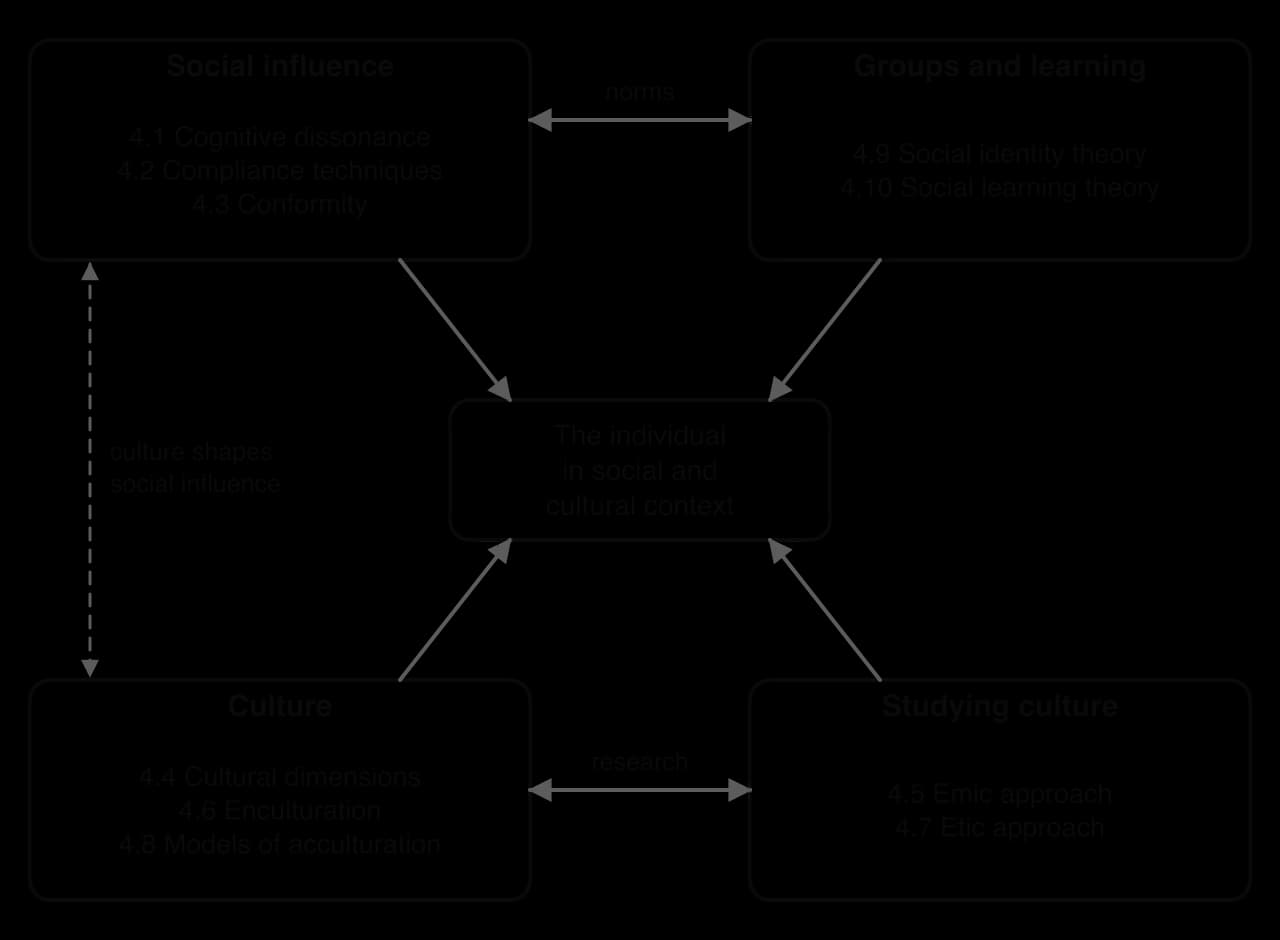
The groups overlap in many places. Compliance techniques that rely on consistency work partly through cognitive dissonance. Conformity is stronger when the majority belongs to a person’s in-group, which links it to social identity theory. Enculturation happens largely through social learning, and the cultural dimensions that summarise its results were mostly derived with etic methods, which the emic approach criticises. Cross-cultural studies of conformity, compliance and dissonance all show the same pattern: the social process is found across cultures, but its strength and triggers vary.
Links to the concepts and the contexts
All six concepts apply to the approach, but four are especially prominent.
Concept | How it applies in the sociocultural approach |
|---|---|
Perspective | The approach is more holistic than the biological approach and uses both emic and etic research; it values Indigenous and non-Western perspectives |
Bias | Much classic research used WEIRD samples, and imposed etic measures can produce cultural bias; national averages risk the ecological fallacy |
Responsibility | Classic social influence experiments relied on deception and stress; applying influence techniques raises the question of manipulation |
Measurement | Constructs such as conformity, identity and culture must be operationalised, and measures may not mean the same thing in every culture |
Causality and change also matter. Field and laboratory experiments on social influence support causal claims, while research on culture is mostly correlational. Several subtopics are about deliberate change: compliance techniques, social learning interventions and dissonance-based programmes are all used to change behaviour.
The approach supplies more content to the contexts than any other. The human relationships context reuses six of its terms as areas of study in group behaviour: acculturation, compliance techniques, conformity, cultural dimensions, social identity theory and social learning. In health and well-being, culture shapes how mental health disorders are expressed and treated, and social learning explains health behaviours. In human development, enculturation and peer influence shape the developing self. In learning and cognition, social learning theory explains learning by observation and culture shapes cognitive processes.
How SL and HL differ
SL and HL students study exactly the same ten subtopics of the sociocultural approach, at the same depth, and sit the same Papers 1 and 2. HL students build on this content in the HL extensions. The extension on the role of culture develops the cultural subtopics most directly, with research on how culture shapes behaviour in the four contexts and on the challenges of researching culture, such as imposed etic measures and the ecological fallacy. The extensions on motivation and technology also draw on sociocultural ideas, for example social norms in online behaviour. HL students are assessed on the extensions in Paper 3.
Assessment
The sociocultural approach is assessed mainly in Paper 1. In Section A, a question may ask for an explanation or description of any of the ten terms with reference to an example. In Section B, a term is applied to an unseen scenario in one of the four contexts, for example how a compliance technique could change a group’s behaviour or how social learning theory could promote prosocial behaviour. In Section C, the concept-based essays on the contexts often draw on sociocultural content, particularly in human relationships, where six areas of study are sociocultural terms.
In Paper 2, sociocultural research may appear as the unseen study in Section B, and some class practicals investigate sociocultural topics, although conformity and obedience studies may not be used as class practicals. At HL, Paper 3 sources on the role of culture draw directly on the sociocultural approach.
Carry on with 4 in Augment
With a free account, Augment remembers where you stopped and what you have practiced.