4.5 Emic approach
Explain what the emic approach is, describe the methods emic researchers use, and evaluate the value of emic approaches in researching behaviour, using research from China, India, Japan, Zimbabwe and Aotearoa New Zealand.
- IB Psychology
- Part of 4 Sociocultural approach
- SL and HL
Key terms introduced here
Each is in the Psychology glossary, with every other term in the subject.
- Cultural relativism
The principle that behaviour and beliefs should be understood and judged in relation to the culture in which they occur, rather than by the standards of the researcher’s own culture.
- Emic approach
An approach to research that studies behaviour from inside one culture, using the concepts, categories and meanings of its members, usually through qualitative methods such as interviews and participant observation.
- Ethnography
A qualitative research approach in which a researcher studies a cultural group in its natural setting over a long period, mainly through participant observation and interviews, to describe its way of life from the inside.
- Te Whare Tapa Whā
A Māori model of health developed by Mason Durie in 1984 that represents well-being as a meeting house with four walls: spiritual, mental and emotional, physical, and family well-being, standing on the land.
Notes on 4.5 Emic approach
Learning objectives
Describe the emic approach and explain how it differs from the etic approach.
Describe the research methods typically used in emic research, including ethnography and explanatory-model interviews.
Explain how emic research has identified culture-specific concepts, such as idioms of distress and amae.
Describe one Indigenous model, Te Whare Tapa Whā, and explain why it is an example of an emic approach.
Describe the aim, method, results and conclusions of Kleinman’s study of neurasthenia in China.
Evaluate the value of emic approaches with reference to measurement, bias, perspective and responsibility.
Discuss how emic and etic approaches can be combined.
Apply the emic approach to an unfamiliar research situation in one of the contexts.
Introduction
The emic approach studies behaviour from inside a culture, using the concepts, categories and meanings that members of that culture use themselves. It matters because many ideas in psychology, such as “depression”, “intelligence” or “a good relationship”, were developed in Western societies and may not mean the same thing, or may not exist in the same form, elsewhere.
The emic approach is part of the sociocultural approach to research and is closely tied to the concept of perspective: whose understanding of behaviour a study represents. It also raises questions of bias, because the researcher’s own culture can shape what is seen, and of responsibility, because research with communities, including Indigenous peoples, depends on trust and benefits the community only if its own understanding is respected.
What the emic approach is
An emic study tries to understand a behaviour as the people who perform it understand it. The researcher does not start with a fixed list of categories but learns what categories the community uses, what they mean, and how they fit into everyday life. The aim is a description that a member of the culture would recognise as accurate.
Where the terms come from
The linguist Kenneth Pike coined the terms “emic” and “etic” in 1954, from the words phonemic and phonetic. Phonetics describes every speech sound that humans can make, using one system for all languages. Phonemics describes which differences in sound change meaning in one particular language. For example, English speakers hear “l” and “r” as different sounds because “light” and “right” are different words, while Japanese does not use this difference to separate words, so Japanese speakers often find it hard to hear.
Pike argued that the same distinction applies to all social behaviour. An outsider can describe what people do in neutral, universal terms (the etic description), but understanding what the behaviour means requires knowing which differences matter to the people involved (the emic description). The cross-cultural psychologist John Berry later brought the distinction into psychology and showed how emic and etic research can be combined.
Feature | Emic approach | Etic approach |
|---|---|---|
Viewpoint | Insider: the culture’s own meanings | Outsider: categories assumed to apply everywhere |
Number of cultures | Usually one, studied in depth | Usually several, compared |
Concepts | Discovered during the research | Defined before the research |
Typical methods | Ethnography, participant observation, open interviews | Standardised questionnaires, experiments, structured diagnostic interviews |
Typical data | Qualitative | Quantitative |
Main question | What does this behaviour mean here? | How does this behaviour vary across cultures? |
Main risk | Findings may not transfer to other cultures | Imposing one culture’s concepts on another |
The two approaches answer different questions, so neither is “better” in general. The etic approach allows comparison, which the emic approach cannot easily provide; the emic approach checks whether the things being compared actually mean the same in each culture.
Cultural relativism
Emic research rests on cultural relativism: the principle that behaviour should be understood in relation to the culture in which it occurs, not judged by the researcher’s own standards. Hearing the voice of a dead ancestor, for example, may be a sign of illness in one culture and a normal part of mourning in another. A researcher who treats their own culture’s norms as the standard falls into ethnocentrism.
Cultural relativism in research is a method, not a claim that every practice is morally acceptable. A researcher can describe what a practice means to its participants, such as the reasons a community gives for a harsh initiation rite, while still recognising that it causes harm. Understanding a practice from the inside is often the first step in changing it in a way the community accepts.
Methods of emic research
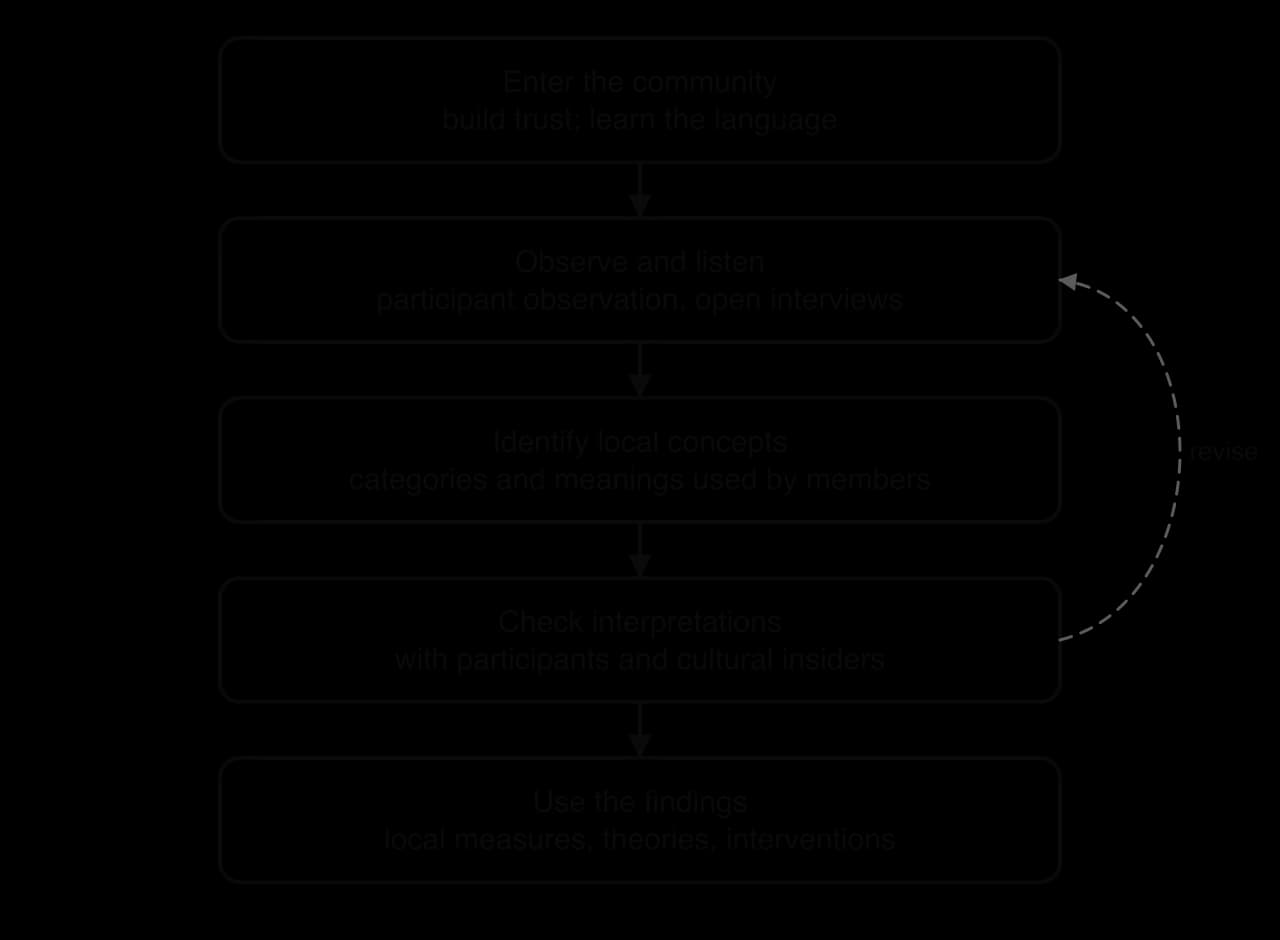
Because the aim is to discover meanings rather than test predefined categories, emic researchers mainly use qualitative methods that let participants describe their experience in their own words. The researcher’s understanding grows over time, so the design is usually flexible and inductive: concepts emerge from the data rather than being fixed in advance.
Ethnography and participant observation
Ethnography is the classic emic method, developed in anthropology. The researcher lives in or spends a long time with a community, learns its language, takes part in everyday activities and records what people do and say. Participant observation lets the researcher see behaviour in its natural setting and ask people what it means to them as it happens.
Barbara Rogoff’s long-term work with Mayan families in Guatemala, for example, described children learning by watching and joining in with adult work, a pattern classroom-based theories had overlooked. Ethnographic findings are rich and detailed, but they depend heavily on the researcher’s interpretation, which is why reflexivity (critical awareness of how the researcher’s own background shapes what they see) is central to emic research.
Open interviews and explanatory models
Semi-structured and unstructured interviews let participants explain their experiences in their own terms. In health research, a widely used emic tool is the explanatory model interview, developed by the psychiatrist and anthropologist Arthur Kleinman and colleagues in the late 1970s. Instead of asking about symptoms on a checklist, the interviewer asks how the person understands their illness.
The interview typically explores six areas, each phrased in everyday language:
what the person calls the problem;
what they believe caused it, and why it started when it did;
what it does to them and how severe it is;
what they fear most about it;
what problems it has caused in their life;
what kind of treatment they think they should receive.
The answers show the person’s own model of illness, which may differ greatly from the clinician’s: a person may see their problem as a weakness of the nerves, a spiritual disturbance or a family conflict, and may expect herbal medicine, prayer or a change at work rather than psychotherapy.
 YouTube
Working with insiders
Emic studies often involve members of the community as co-researchers, translators or advisers. Interpretations are checked with participants, a process related to member checking, and research questions may be set together with the community. This improves credibility and makes it more likely that findings will be useful to the people studied.
What emic research has found
Emic research has repeatedly found concepts that Western psychology did not have, or that it had described only in its own terms. These discoveries show the main value of the approach: it can find what an imposed set of categories would miss.
Idioms of distress
The anthropologist Mark Nichter (1981) studied Havik Brahmin women in South India and described how these women, who had few chances to share their feelings or seek advice outside the household, expressed psychological and social distress through culturally accepted channels, above all bodily complaints, rather than by talking about their feelings. He called these culturally specific ways of expressing suffering idioms of distress. The concept shows that the form of distress, not just its causes, is shaped by culture.
Idioms of distress have since been found worldwide. In Zimbabwe, kufungisisa (“thinking too much”) is a Shona idiom for distress. The Friendship Bench programme, tested in a trial by Chibanda et al. (2016), built its problem-solving therapy around this local concept and measured outcomes with a symptom questionnaire developed locally in the Shona language.
Amae
The Japanese psychiatrist Takeo Doi, in The Anatomy of Dependence (published in Japanese in 1971 and in English in 1973), described amae: the wish to depend on and be indulged by another person, as a child depends on a parent. Doi argued that amae is a normal and valued part of adult relationships in Japan, for example between an employee and a senior colleague, whereas Western psychology tended to see dependence in adults as a weakness. The concept had no single English word, which itself shows how an emic approach can uncover a psychological concept that an outsider’s vocabulary hides.
Personality: interpersonal relatedness
Fanny Cheung and colleagues developed the Chinese Personality Assessment Inventory (CPAI) from Chinese everyday concepts, proverbs and descriptions of people, rather than translating a Western test. Cheung et al. (2001) found a factor they called Interpersonal Relatedness, covering harmony, face, relationship orientation and traditionalism, that could not be explained by the five factors of the main Western personality model. The factor also appeared in a sample of Hawaiian students, which suggests that an emic discovery can later turn out to apply more widely.
Indigenous psychologies
Indigenous psychologies are approaches to psychology developed within a culture, by and for its people, using its own concepts and values rather than those imported from Western psychology. Kim and Berry described indigenous psychology as the scientific study of human behaviour or mind that is native, not transported from other regions, and designed for its people. In this sense indigenous psychologies are emic by design.
The movement grew in many regions, including the Philippines, India, Mexico, China and among Indigenous peoples in Australia, Canada and Aotearoa New Zealand, partly from dissatisfaction with Western theories that did not help to solve local problems. It emphasises that psychology’s mainstream is itself one cultural tradition, built largely from research on Western, educated samples.
Te Whare Tapa Whā
Te Whare Tapa Whā, developed by the Māori health advocate Mason Durie in 1984, represents health and well-being as a wharenui (meeting house) with four walls. Each wall is a dimension of health: taha wairua (spiritual well-being), taha hinengaro (mental and emotional well-being), taha tinana (physical well-being) and taha whānau (family and social well-being). The house stands on whenua, the land, which represents a person’s connection to their place of belonging.
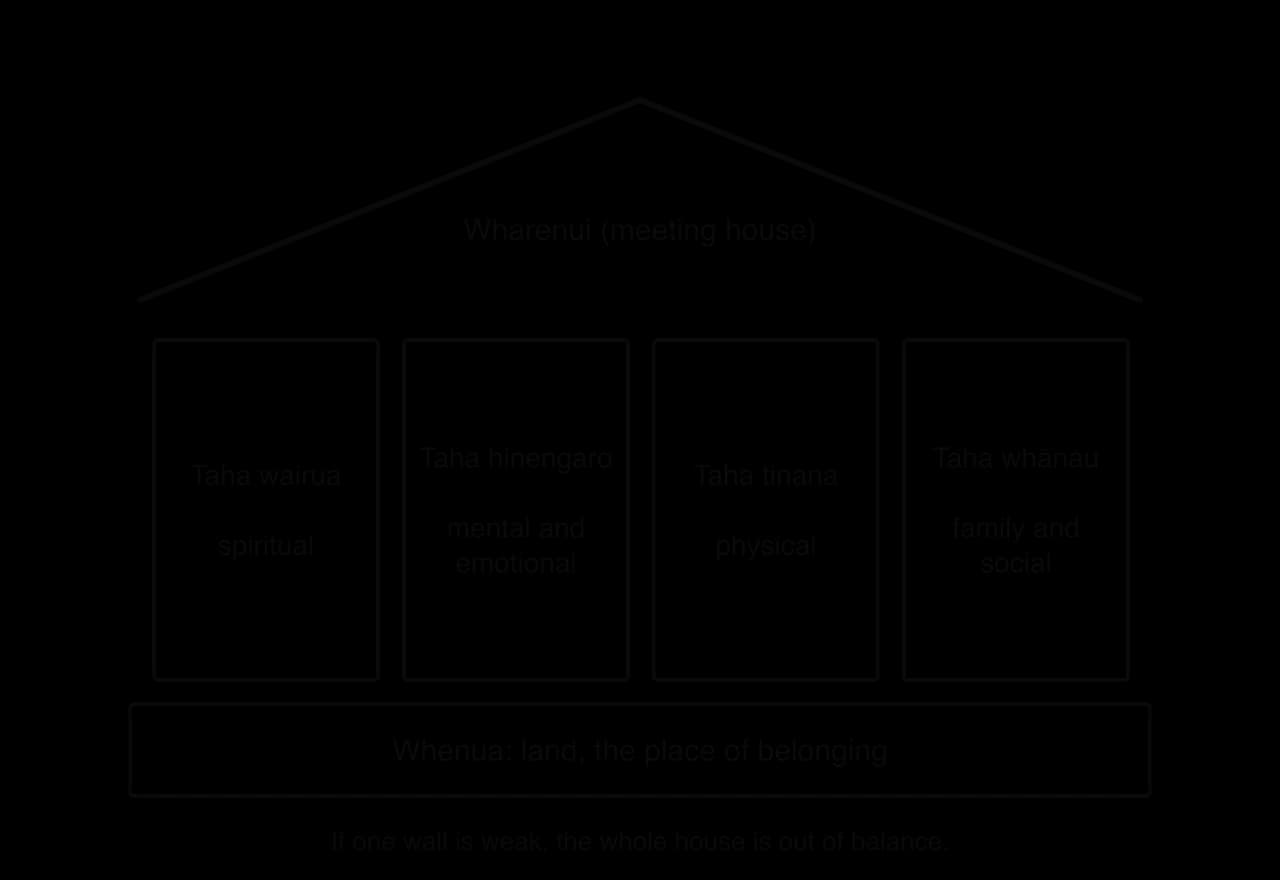
The model is emic because its categories come from Māori understanding of health. It changes what counts as a symptom and as recovery: a person whose mood has improved but whose relationships with whānau are still broken would not be considered well. It has been used in New Zealand health services, schools and mental health campaigns, which shows how an emic model can shape practice for the whole population, not only for Māori.
 YouTube
The value of emic approaches
The value of the emic approach lies in what it allows researchers to see and do that an outsider’s standardised method cannot. The strongest arguments for emic research concern four concepts: measurement, bias, perspective and responsibility.
Measurement: valid concepts before valid scores
A measure is only valid if it captures the construct as it exists in the culture being studied. Emic research finds out what the construct is locally before anyone tries to measure it. The CPAI and the locally developed Shona questionnaire used in the Friendship Bench trial were built from local concepts, so their scores are more likely to mean what researchers think they mean than scores from a translated Western test.
Bias: avoiding imposed etic
Applying a concept from one culture to another as if it were universal is imposed etic bias. Emic research protects against it by not assuming in advance which categories apply. Kleinman’s study of neurasthenia in China showed that a diagnosis based only on what Western psychiatry expected to find, sadness and low mood, would have missed how depression was experienced and expressed by many Chinese patients.
Perspective: discovering new constructs and questioning old ones
Emic research does more than check Western findings; it adds constructs such as amae, idioms of distress and interpersonal relatedness that Western theories lacked. These discoveries challenge the assumption that mainstream psychology is culture-free and show that its theories are themselves products of particular cultures. In this way the emic approach broadens psychology’s perspective and supports a more holistic understanding of behaviour.
Responsibility: research that helps the community
Interventions designed from a community’s own understanding are more acceptable and more likely to be used. The Friendship Bench used a local idiom of distress and lay health workers from the community, and Te Whare Tapa Whā has shaped health services in New Zealand. Emic research that involves the community in setting questions and interpreting results also reduces the risk of research that describes a group without benefiting it, or that reinforces stigma by labelling local practices as abnormal.
Concept | Value of the emic approach | Example |
|---|---|---|
Measurement | Defines constructs as they exist locally before measuring them | CPAI built from Chinese concepts |
Bias | Avoids imposed etic bias and ethnocentric interpretation | Somatic expression of depression in Hunan |
Perspective | Finds constructs missing from Western theories | Amae; idioms of distress |
Responsibility | Produces culturally acceptable interventions and gives communities a voice | Friendship Bench; Te Whare Tapa Whā |
Causality | Generates hypotheses about local causes that later research can test | Neurasthenia linked to problems at work |
Limitations of emic approaches
The strengths of emic research come with costs. Most of its limitations follow from the same features that give it value: depth in one culture, flexible qualitative methods and reliance on the researcher’s interpretation.
Transferability and comparison
Emic findings describe one culture, often one community, so their transferability to other settings is limited. An idiom of distress from South India cannot be assumed to exist in North India, let alone in Brazil. Because each culture is described in its own terms, emic studies of different cultures are hard to compare: if each uses different categories, there is no common scale on which to say that one culture shows more of a behaviour than another.
Researcher bias and interpretation
The emic researcher is the main instrument of data collection, so findings depend on what they notice and how they interpret it. An outsider may misunderstand meanings, while an insider may take important features for granted because they seem normal. Participants may also present their culture in an idealised way to a visiting researcher. Reflexivity, member checking and working with several researchers from different backgrounds reduce, but do not remove, this researcher bias.
Time, cost and practical demands
Ethnography can take months or years, requires learning a language and building trust, and produces large amounts of qualitative data that are slow to analyse. Small samples are typical. These demands mean emic research is less common than questionnaire studies, and its findings are slower to reach practitioners.
The risk of exaggerating difference
By focusing on what is distinctive in one culture, emic research can overlook what is shared with others and present cultures as more different, fixed and uniform than they are. Many people now live across several cultural worlds, through migration, education and the internet, so a single “insider view” may not exist. Cultural relativism can also be stretched too far, making it difficult to identify a genuine disorder or harm when it is described in local terms.
Combining emic and etic approaches
Most researchers now see the emic and etic approaches as complementary. Emic work in each culture shows which features of a concept the cultures genuinely share, and comparison can then be limited to those features, a strategy Berry called a derived etic. Two other ways of combining the approaches are common: an emic stage that shapes a measure before it is used across cultures, and a single study that uses both kinds of method side by side.
Kleinman’s study is itself an example of a combined design. He used a structured Western diagnostic interview, which allowed his patients to be compared with patients elsewhere, together with open interviews about the meaning of their illness, which showed how the same disorder was experienced locally. Each method answered a question the other could not.
Key study: Kleinman’s study of neurasthenia and depression in China
Aim
Arthur Kleinman, a psychiatrist and medical anthropologist, aimed to understand how patients in China who had been diagnosed with neurasthenia (shenjing shuairuo, “weakness of the nerves”) experienced and explained their illness, and how this local diagnosis related to the Western diagnosis of major depressive disorder. In the early 1980s neurasthenia was one of the most common diagnoses in Chinese psychiatry, while depression was rarely diagnosed.
Method
The study was a combined clinical and anthropological field study of 100 patients diagnosed with neurasthenia at the psychiatry outpatient clinic of Hunan Medical College in Changsha. Each patient took part in a structured clinical interview based on the criteria of the third edition of the DSM (DSM-III), which allowed Kleinman to see whether they met Western criteria for depression and other disorders. This part of the design was etic.
Each patient also took part in open-ended interviews about the meaning of the illness: what they called it, what they believed caused it, how it affected their family and work, and what treatment they expected. These explanatory-model interviews were the emic part of the design. Patients who met criteria for major depressive disorder were then treated with antidepressant medication, and their symptoms, help-seeking and social problems were followed up.
Results
Of the 100 patients, 87 met DSM-III criteria for major depressive disorder, and anxiety disorders were also common. Forty-four had chronic pain conditions that had not been diagnosed, and some cases of culture-bound syndromes were also found. Patients mainly described bodily complaints, such as headaches, dizziness, insomnia, weakness and tiredness, rather than sadness, a pattern of expressing distress through the body known as somatisation.
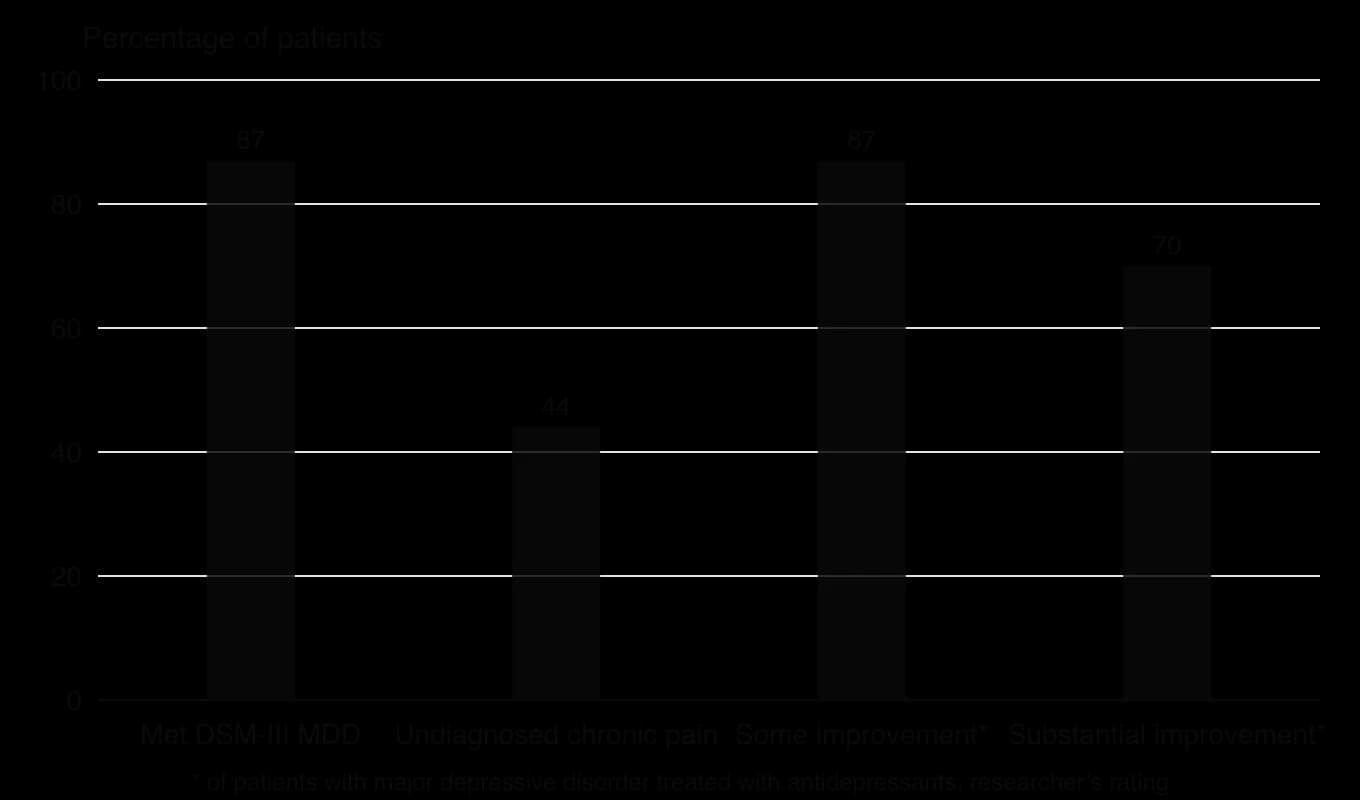
For about three-quarters of the patients, the social significance and uses of their illness were mainly related to work, for example as a recognised reason for difficulties at work or for requesting a transfer. After antidepressant treatment, Kleinman judged that 87% of the depressed patients had some improvement in symptoms and 70% had substantial improvement. Fewer patients, however, reduced their help-seeking, and a much smaller number reported less social impairment or improvement in their wider problems at work, in the family or at school.
Sources: Kleinman, A. (1982). Neurasthenia and depression: a study of somatization and culture in China. _Culture, Medicine and Psychiatry, 6(2), 117–190._
Conclusions
Kleinman concluded that neurasthenia in China was best understood as a culturally patterned way of experiencing illness: a form of somatisation linked either to depression and other diseases or to culturally accepted idioms of distress and ways of coping. A bodily illness was more socially acceptable than a mental one, carried less stigma, and could be used to negotiate problems at work and in the family. In a later book, Kleinman (1986) developed these findings into an account of the social origins of depression, neurasthenia and pain in modern China.
The study also showed the limits of a purely biomedical approach. Medication reduced symptoms, but the social problems that patients themselves saw as the core of their illness often remained, because the treatment addressed the Western category, depression, rather than the patients’ own understanding of what was wrong.
Evaluation
Perspective and bias: what the emic interviews added
Without the emic interviews, the study would have concluded only that most “neurasthenia” was really depression, which would be an imposed etic reading that treats the Western category as the true one. The explanatory-model interviews showed why patients presented bodily symptoms, what the diagnosis allowed them to do socially, and why symptom relief did not solve their problems. The emic data changed the interpretation of the etic data, which is the strongest argument for combining the approaches.
Measurement: comparing a local and a Western diagnosis
DSM-III criteria were developed mainly from Western patients. Applying them in Hunan assumes that depression has the same core features everywhere, which is the question under study. Kleinman’s rating of improvement was also his own, not a blind rating, so expectations could have influenced it. On the other hand, the structured interview made the results comparable with studies elsewhere, and the high rate of DSM depression is itself informative.
Generalisability and credibility
All the patients came from one clinic in one province, at a time of rapid political and social change, and all had already sought psychiatric help. The findings may not transfer to people in the community, to other regions or to China today, where depression is now diagnosed much more often. The detailed interviews and long engagement support the credibility of the findings, but the interpretation of meaning depended mainly on one researcher, so reflexivity about his perspective as an American psychiatrist is important.
Exam practice
The emic approach is an approach term, so it can be asked about directly in Paper 1 Section A (for example, why psychologists use it) and applied in Section B to a research scenario in any context. In Section C essays and Paper 2, the contrast between emic and etic research supports discussion of perspective, bias and measurement, especially in research on mental health across cultures.
Summary
The emic approach studies behaviour from inside a culture, using its members’ own concepts and meanings; the etic approach uses categories assumed to apply everywhere so that cultures can be compared.
Pike coined the terms from phonemic and phonetic; Berry brought them into cross-cultural psychology.
Emic research uses qualitative, flexible and inductive methods such as ethnography, participant observation and explanatory-model interviews, and relies on cultural relativism and reflexivity.
Emic research has found idioms of distress (Nichter), amae (Doi) and interpersonal relatedness (Cheung), and has shaped interventions such as the Friendship Bench.
Indigenous psychologies are emic by design; Te Whare Tapa Whā represents health as four walls (spiritual, mental and emotional, physical, family) on the land.
Kleinman (1982) found that 87 of 100 neurasthenia patients in Hunan met DSM-III criteria for depression, but their emic accounts showed somatic expression and social uses of the illness that medication did not resolve.
The value of emic approaches lies in valid local constructs, avoiding imposed etic bias, broadening psychology’s perspective and producing acceptable interventions.
Limitations include low transferability, difficulty of comparison, researcher bias, time and cost, and the risk of exaggerating differences; combining emic and etic approaches (derived etic) addresses several of them.
Self-check
- To do:
I can describe the emic approach and explain how it differs from the etic approach.
- To do:
I can describe ethnography and explanatory-model interviews as emic methods.
- To do:
I can explain how emic research identified idioms of distress, amae and interpersonal relatedness.
- To do:
I can describe Te Whare Tapa Whā and explain why it is emic.
- To do:
I can describe the aim, method, results and conclusions of Kleinman (1982).
- To do:
I can evaluate the value of emic approaches with reference to measurement, bias, perspective and responsibility.
- To do:
I can explain how emic and etic approaches are combined to produce a derived etic.
- To do:
I can apply the emic approach to a research scenario in one of the contexts.
Carry on with 4.5 in Augment
With a free account, Augment remembers where you stopped and what you have practiced.