Explain how people learn by observing models, the four mediational processes and self-efficacy, evaluate the Bobo doll research, and apply social learning theory to explain and change behaviour.
Each is in the Psychology glossary, with every other term in the subject.
The idea that acquiring a behaviour through observation is separate from carrying it out, so a behaviour can be learned but only performed later, when the expected consequences make it worthwhile.
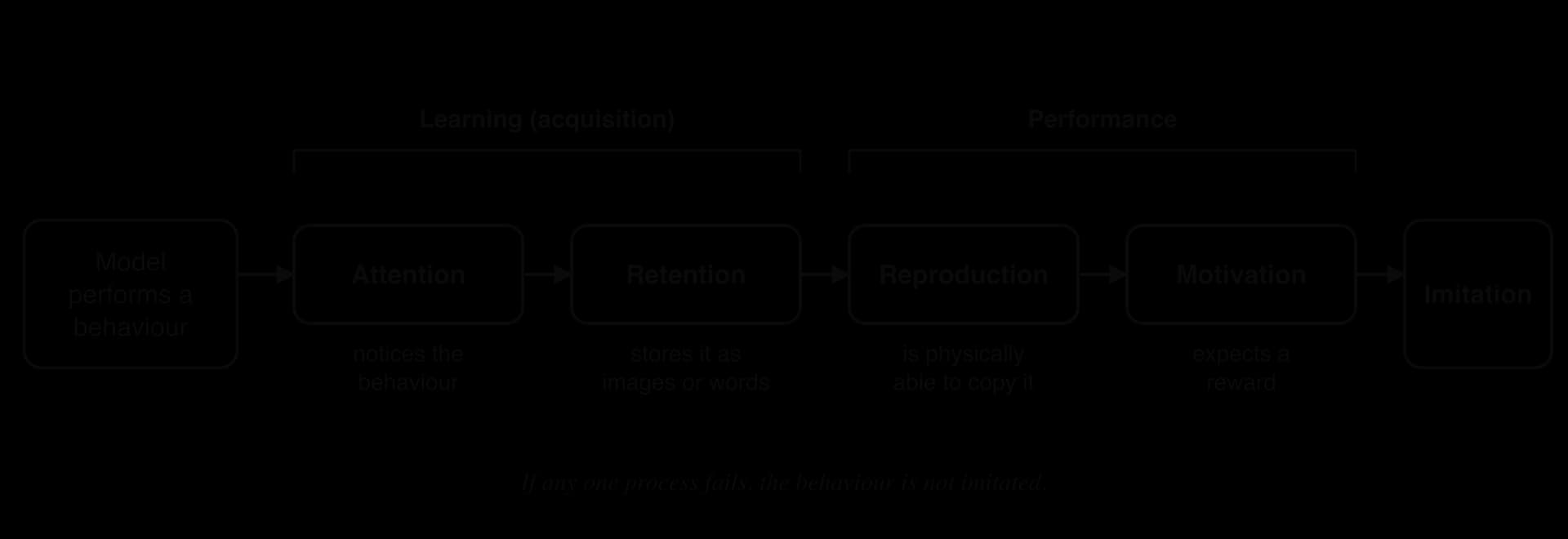
The four processes (attention, retention, reproduction and motivation) that Bandura proposed take place between observing a model and imitating the model’s behaviour.
The demonstration of a behaviour by a model (a live person, a media character or a verbal description) that an observer may learn and later imitate.
Learning that takes place by watching the behaviour of others and its consequences, without the learner having to perform the behaviour or be reinforced directly.
A person’s belief in their capability to organise and carry out the actions needed to succeed in a specific task or situation.
Bandura’s extension of social learning theory, in which behaviour results from the continuous interaction of personal factors (such as self-efficacy), behaviour and the environment, with an emphasis on self-regulation and agency.
A theory, developed by Albert Bandura, that people learn new behaviour by observing and imitating models, and that whether they perform it depends on the consequences they expect, including those they have seen others receive.
Describe social learning theory and explain how it differs from learning through direct reinforcement.
Explain the four mediational processes (attention, retention, reproduction and motivation) and the model characteristics that affect imitation.
Explain vicarious reinforcement, vicarious punishment and the distinction between learning and performance.
Explain self-efficacy and its four sources, and how social cognitive theory extends social learning theory.
Describe the aim, method, results and conclusions of Bandura, Ross and Ross (1961).
Apply social learning theory to explain behaviour in health, development, relationships and learning.
Explain how social learning theory can be used to change behaviour, with examples of interventions.
Evaluate social learning theory and its research with reference to causality, measurement, bias, perspective and responsibility.
Social learning theory explains how people learn new behaviour by watching other people and the consequences those people experience. It accounts for a large share of everyday learning, from how a child learns to use chopsticks or greet an elder to how a teenager picks up the habits of friends, and it is one of the most widely used theories for designing programmes that change behaviour.
The theory belongs to the sociocultural approach, because it locates the source of behaviour in other people, but it also relies on mental processes such as attention and memory, which link it to the cognitive approach. It is applied in all four contexts: to health behaviours such as smoking and eating, to the enculturation of children, to aggression and helping in groups, and to learning in classrooms. Research on it raises questions of
With a free account, Augment remembers where you stopped and what you have practiced.
A decrease in the likelihood of a behaviour in an observer that results from seeing a model punished for that behaviour.
An increase in the likelihood of a behaviour in an observer that results from seeing a model rewarded for that behaviour.
Before the 1960s, the dominant explanation of learning in American psychology was behaviourism. In operant conditioning, a behaviour becomes more likely when it is followed by reinforcement and less likely when it is followed by punishment. Learning, on this view, happens only when the learner acts and then experiences the consequence directly.
Albert Bandura, a Canadian-American psychologist at Stanford University, argued that this could not be the whole story. If people learned only by trial and error, every child would have to touch a hot stove to learn that stoves burn, and every new driver would crash before learning to brake. Complex behaviours, such as speaking a language or performing a religious ritual, are learned far faster than reinforcing each step separately could explain. Bandura proposed that most human learning is indirect: people watch others, remember what they did and what happened to them, and use this information to guide their own behaviour.
Two terms sit at the centre of the theory. Observational learning is the acquisition of a behaviour, or of information about it, by watching someone else perform it. Modelling is the process through which a person (the model) demonstrates a behaviour that others may copy. The person who watches is called the observer.
Bandura distinguished between three kinds of model. A live model is a real person who performs the behaviour in front of the observer, such as a parent cooking or a classmate solving a problem on the board. A symbolic model is a person or character shown through a medium, such as a film, a video game, a social-media post or a character in a radio drama. A verbal model is a description or instruction that tells the observer how to behave, as in a recipe or a set of safety instructions.
Symbolic models matter because they reach very large audiences. A single television character can model a behaviour to millions of viewers, which is why social learning theory became the basis of research on media effects and of large health and education campaigns.
Social learning theory keeps the behaviourist idea that consequences matter, but it changes where they act and how. In operant conditioning, consequences shape behaviour automatically. In social learning theory, people form expectations about consequences, and these expectations, which are cognitive, decide whether a learned behaviour is used.
Feature | Operant conditioning | Social learning theory |
|---|---|---|
How a behaviour is acquired | By performing it and experiencing its consequences | By observing a model, without performing the behaviour |
Role of mental processes | Not needed to explain learning | Central: attention, memory and expectations mediate learning |
Type of reinforcement | Direct reinforcement of the learner | Direct, vicarious and self-reinforcement |
Learning and performance | Treated as the same thing | Kept separate: a behaviour can be learned but not performed |
Speed | Gradual, over many trials | Can be immediate, after a single observation |
Bandura argued that observing a model does not automatically lead to imitation. Between the observation and the behaviour there are four mediational processes, mental and physical steps that must all take place for the behaviour to be imitated. The first two determine whether the behaviour is learned; the last two determine whether it is performed.
An observer can only learn a behaviour that they notice. Attention is selective, so models and behaviours compete for it. Bandura and later researchers identified several features of a model that make it more likely to be attended to and copied.
Similarity: models who resemble the observer in age, gender or background are imitated more, because the observer judges that what works for the model will also work for them.
Status and power: high-status models, such as older peers, celebrities, teachers or leaders, attract more attention.
Competence: models who appear skilled at the task are more likely to be copied.
Warmth: nurturing, friendly models are attended to more, especially by children.
Distinctiveness of the behaviour: unusual, vivid or emotional acts are more noticeable than routine ones.
Characteristics of the observer also matter. A person who is uncertain, low in confidence or dependent on others tends to rely more on models, and an observer who has been rewarded for imitating in the past is more likely to watch closely.
A behaviour that is noticed must then be stored. Bandura proposed that people encode modelled behaviour in two ways: as mental images (a visual record of what the model did) and as verbal descriptions (“first hit it with the hammer, then kick it”). Mental and physical rehearsal make the memory more durable. This is the most clearly cognitive part of the theory, and it links social learning to research on encoding and memory.
Retention explains why imitation can be delayed. A child may watch a parent change a bicycle tyre and reproduce the steps months later, because the sequence has been stored. Infants show the same ability very early: deferred imitation, copying an action after a delay, has been found in children in their second year of life.
The observer must be physically and mentally able to perform the behaviour. A child can attend to a gymnast and remember every step of a back somersault, yet be unable to do it. Reproduction depends on strength, coordination, prior skills and practice, and it improves with feedback, as when a learner compares their own movements with the remembered model and corrects them.
Finally, the observer must want to perform the behaviour. Motivation depends on the consequences the observer expects, and these come from three sources:
Direct reinforcement: the observer is rewarded for imitating, for example praised for sharing a toy.
Vicarious reinforcement: the observer sees the model rewarded, so they expect a reward for the same behaviour.
Self-reinforcement: the observer evaluates their own behaviour against personal standards and feels satisfaction or pride when they meet them.
The most original idea in social learning theory is that consequences can work at second hand. People learn not only what a model does but also what happens to the model, and they adjust their own behaviour accordingly.
Vicarious punishment works in the opposite direction. When an observer sees a model punished, for example a classmate given detention for cheating, the observer becomes less likely to perform that behaviour. Vicarious punishment does not erase the learning: the observer still knows how to cheat, but expects that doing so would be costly.
Because consequences affect motivation rather than attention and retention, a behaviour can be learned without ever being performed. Bandura called this the learning–performance distinction. A person may have watched hundreds of car chases in films and know exactly how a getaway driver behaves, but never drive dangerously, because they expect serious consequences.
Bandura (1965) tested this directly. Children watched a film of an adult attacking a Bobo doll, and the film ended in one of three ways: the model was rewarded, the model was punished, or there were no consequences. Children who saw the model punished imitated fewer aggressive acts in a later free-play session. When all the children were then offered attractive rewards for reproducing as many of the model’s actions as they could, the differences between the groups largely disappeared. The children in the punished-model group had learned the behaviour as well as the others; vicarious punishment had only suppressed its performance.
 YouTube
The learning–performance distinction has a practical consequence. Measuring only what people do can underestimate what they have learned, because some learned behaviour stays hidden until the situation changes. A teenager who never smokes at home may still have learned how to light and hold a cigarette from watching others, and may perform the behaviour as soon as friends who smoke approve of it.
In the 1970s and 1980s Bandura extended social learning theory to give a larger role to people’s beliefs about themselves. The most influential of these beliefs is self-efficacy, a person’s belief in their own ability to carry out the actions needed to reach a goal. Self-efficacy is specific to a task: a student can have high self-efficacy in mathematics and low self-efficacy in public speaking.
Self-efficacy is a belief about ability, not ability itself, and it is different from self-esteem, which is a general evaluation of one’s worth. Bandura (1977) argued that self-efficacy affects which tasks a person attempts, how much effort they invest and how long they persist when they meet difficulties. People with low self-efficacy for a behaviour tend to avoid it, even when they have the skills to perform it.
Bandura proposed that self-efficacy beliefs come from four sources. They run from the strongest to the weakest.
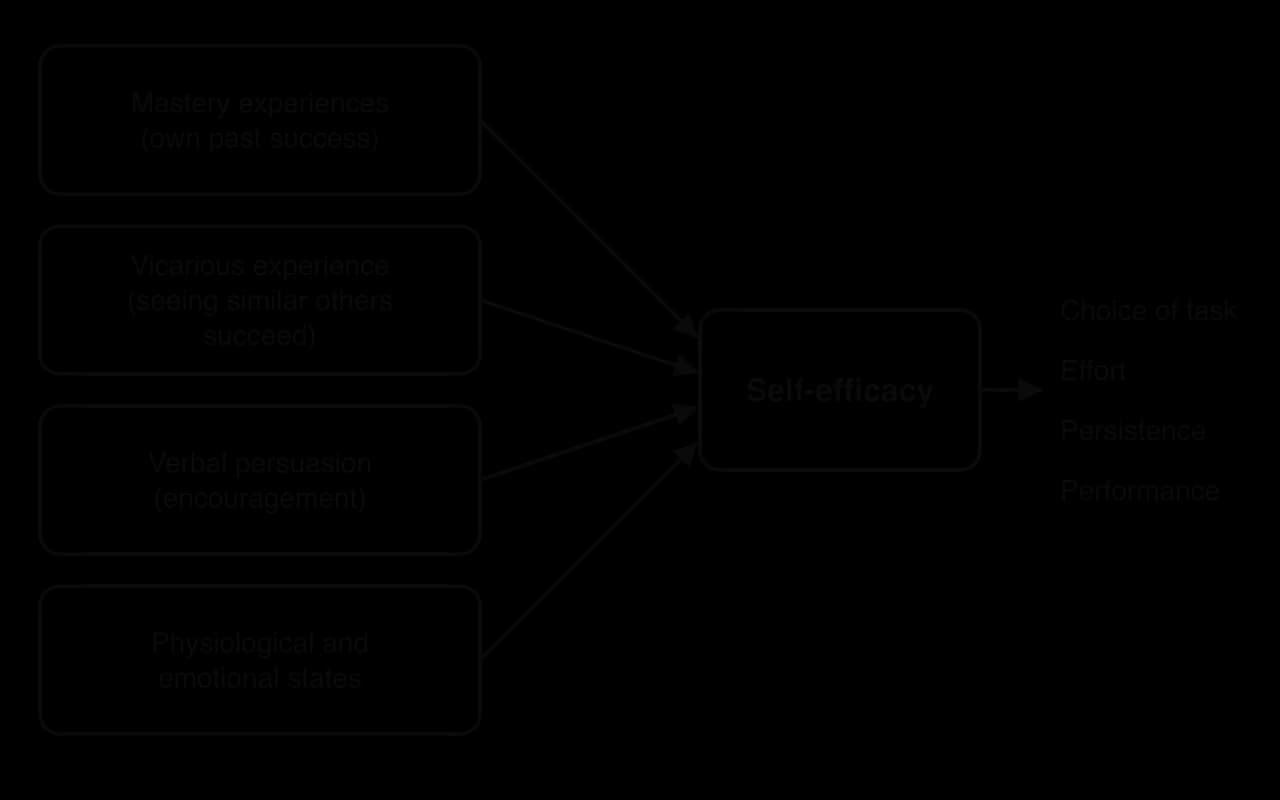
Mastery experiences: succeeding at the task oneself. Repeated success raises self-efficacy; repeated failure lowers it.
Vicarious experience: seeing similar others succeed. This is where modelling feeds into self-efficacy: watching a peer of the same age and ability succeed suggests “I could do that too”.
Verbal persuasion: being told by others that one is capable, as when a coach or teacher expresses confidence.
Physiological and emotional states: interpreting one’s own bodily signals. A racing heart before a test can be read as a sign of incapacity, lowering self-efficacy.
Bandura, Adams and Beyer (1977) tested the role of self-efficacy in adults with a phobia of snakes. Participants who handled a snake themselves with a therapist’s guidance (mastery) developed stronger self-efficacy than those who only watched a therapist handle it (vicarious experience), but in both groups self-efficacy accurately predicted how far each person would go in approaching a snake afterwards. The study suggested that therapies may work partly by changing people’s beliefs about what they can do.
In 1986 Bandura renamed his framework social cognitive theory to stress that people are active agents who think about, plan and regulate their own behaviour rather than responding passively to models. Its central idea is reciprocal determinism: personal factors (beliefs, expectations, self-efficacy and biological characteristics), behaviour and the environment each influence the other two.
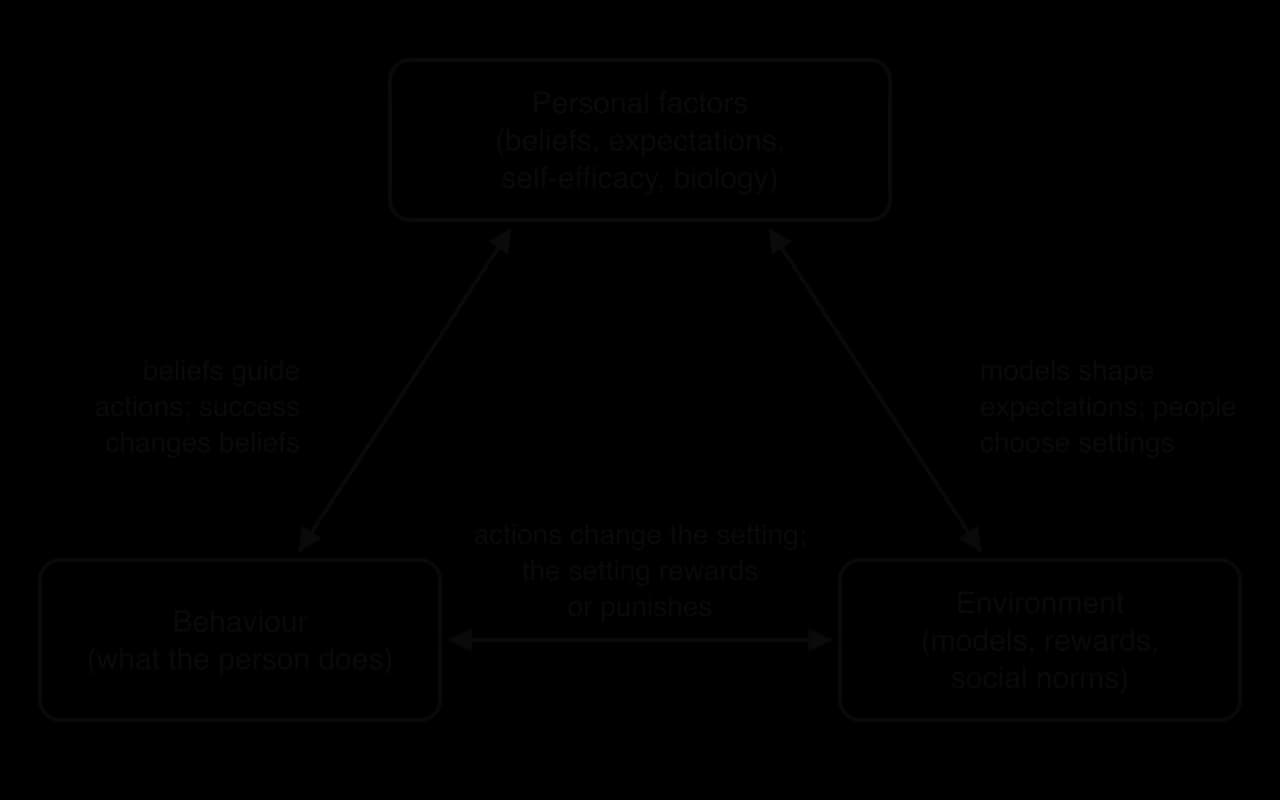
Reciprocal determinism makes the theory less one-directional than early behaviourism. The environment shapes people, but people also choose and change their environments: a teenager who enjoys sport seeks out athletic friends, who then model and reward more sporting behaviour. This is why social learning is often described as an interaction between the individual and the group rather than a one-way influence of the group on the individual.
Bandura, Ross and Ross aimed to find out whether children would imitate aggression they had seen an adult perform, in a new setting and with the adult no longer present. They also tested whether the sex of the model and the sex of the child affected imitation, predicting that children would copy same-sex models more and that boys would imitate physical aggression more than girls, because physical aggression was seen as typically masculine behaviour.
The study was a laboratory experiment with 72 children (36 boys and 36 girls) aged between 37 and 69 months (mean age 52 months), all from the Stanford University Nursery School in California. Before the experiment, the experimenter and a nursery teacher who knew the children well rated each child’s everyday aggression on four five-point scales. Their ratings agreed closely (inter-rater reliability r = 0.89). Children were placed in groups of three with similar aggression scores and then randomly assigned from each group to the conditions, so that the conditions started with equally aggressive children, a matched pairs design extended to triplets.
There were three conditions. Twenty-four children watched an aggressive model, 24 watched a non-aggressive model and 24 formed a control group who saw no model. Within the two model conditions, half of the children saw a model of their own sex and half saw a model of the other sex, giving eight experimental subgroups of six children each.
Exposure (about 10 minutes): each child sat in a corner of a playroom doing a picture activity while an adult model played in another corner. In the aggressive condition the model, after about a minute, attacked an inflatable Bobo doll in distinctive ways: sitting on it and punching it on the nose, hitting it on the head with a wooden mallet, throwing it in the air and kicking it around the room, while saying phrases such as “Sock him in the nose” and “Pow”. In the non-aggressive condition the model assembled toys quietly and ignored the doll.
Mild frustration: each child was then taken to another room, allowed to start playing with very attractive toys, and after about two minutes told that these toys were reserved for other children. This was intended to make an aggressive response more likely in every condition, including the control.
Test (20 minutes): the child was then taken to a third room containing aggressive toys (a smaller Bobo doll, a mallet, dart guns, a tetherball) and non-aggressive toys (crayons, a tea set, dolls, cars, plastic farm animals). The experimenter stayed in the room but kept busy and did not interact.
Behaviour in the test room was recorded through a one-way mirror in a controlled observation.
The 20-minute session was divided into 240 five-second intervals, and in each one the observer recorded which of a set of predefined behavioural categories occurred. The dependent variable was operationalised through these categories, including imitative physical aggression (acts copied exactly from the model, such as hitting the doll with the mallet), imitative verbal aggression (repeating the model’s phrases), partial imitation and non-imitative aggression (aggressive acts the model had not shown, such as shooting the dart guns). A second observer scored about half of the children independently, and agreement between observers was above 0.90 for the categories.
Children who had watched the aggressive model reproduced many of the model’s physical and verbal attacks on the doll, while children in the non-aggressive and control conditions almost never did. About a third of the children who saw the aggressive model also repeated the model’s non-aggressive remarks, which no child in the other groups did, showing that they had copied the model’s behaviour in detail rather than simply becoming more active.
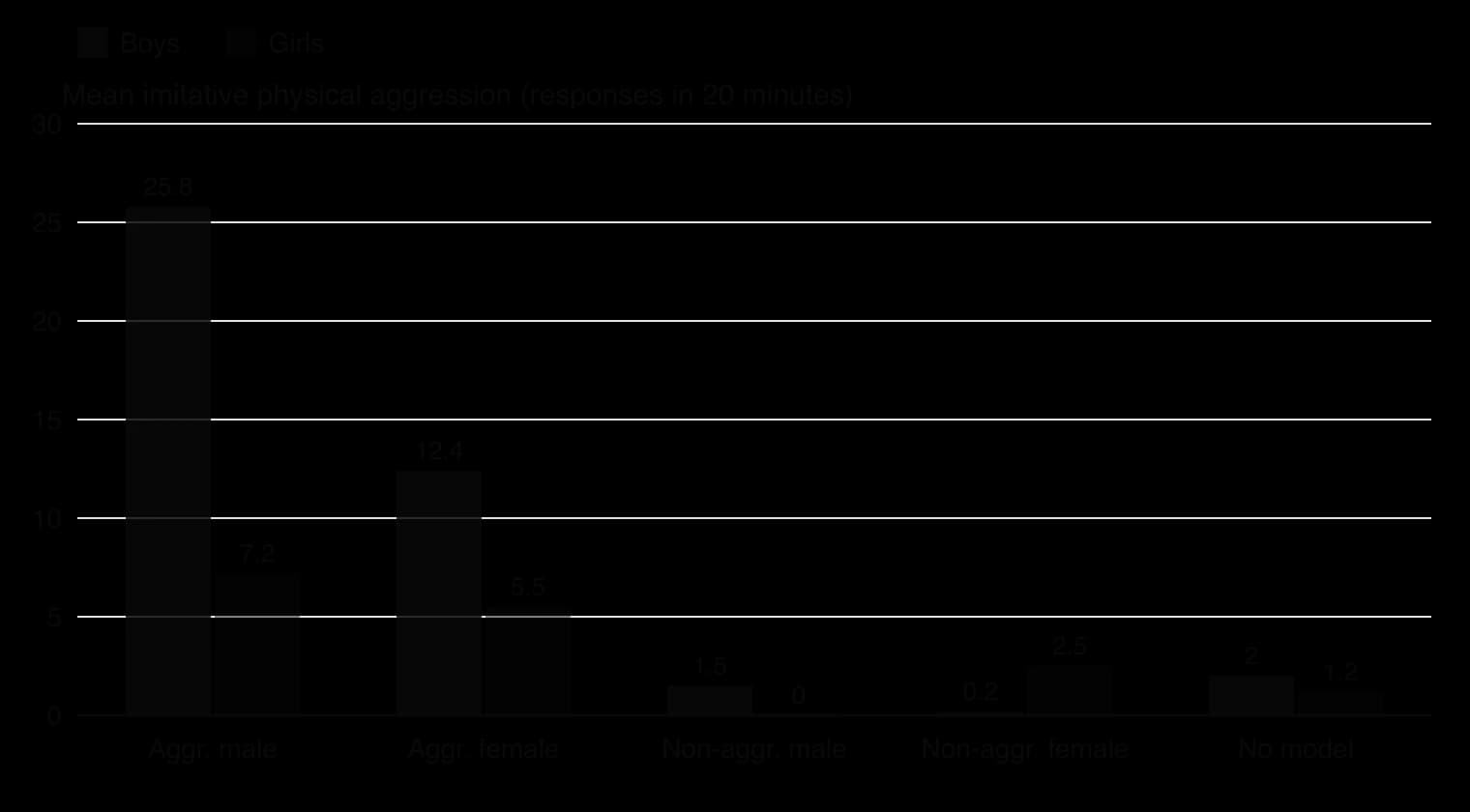
The sex of the model and the child also mattered. Boys showed more imitative physical aggression than girls, and boys who watched the aggressive male model produced on average more than twice as many imitative physical acts as boys who watched the aggressive female model (25.8 against 12.4). For verbal aggression the same-sex effect appeared in both sexes, as the table shows.
Mean imitative verbal aggression | Aggressive male model | Aggressive female model | Non-aggressive male model | Non-aggressive female model | No model (control) |
|---|---|---|---|---|---|
Boys | 12.7 | 4.3 | 0.0 | 1.1 | 1.7 |
Girls | 2.0 | 13.7 | 0.0 | 0.3 | 0.7 |
Sources: Bandura, Ross & Ross (1961), Table 1. Means are numbers of five-second intervals in which the behaviour occurred during the 20-minute test.
Watching a calm model also had an effect. Children who had seen the non-aggressive model spent more than twice as long sitting quietly as children who had seen the aggressive model, and children who saw the non-aggressive male model were less aggressive on several measures than the control group, which suggests that models can inhibit behaviour as well as encourage it.
The researchers concluded that children can learn new aggressive behaviours simply by observing an adult, without being reinforced themselves, and that they will reproduce these behaviours in a different setting when the model is absent. The detailed copying of the model’s specific acts and words supports observational learning rather than a general increase in arousal. The stronger imitation of same-sex models, particularly for physical aggression by boys, suggests that the observer’s identification with the model and the sex-typing of the behaviour affect whether it is imitated, which is consistent with the role of similarity in the attention process.
 YouTube
Because the children were matched on prior aggression and randomly allocated to conditions, and because the control group experienced the same frustration without a model, differences between the groups can be attributed to the independent variable, the model’s behaviour. The study therefore supports a causal claim that observing aggression increases imitative aggression in the short term. Later variations by Bandura, Ross and Ross (1963) found similar increases when the model was shown on film or as a cartoon character, which extended the conclusion to symbolic models.
The coding scheme, with clearly defined categories and high agreement between observers, is a strength of the measurement. However, the measure was aggression towards an inflatable doll that is designed to be hit and bounces back up. Hitting a Bobo doll may be play rather than aggression intended to harm, so the operationalisation may lack construct validity as a measure of real aggression towards people. The test also took place minutes after the model was seen, so it shows short-term imitation, not lasting change.
All participants came from one university nursery in California in the early 1960s, so they were likely to be children of academic staff and graduate students. This sample reflects the sampling bias typical of WEIRD samples, and the gender norms of 1960s America may have shaped which behaviours boys and girls thought acceptable. The model was also an unfamiliar adult in an unfamiliar laboratory, which limits ecological validity: children usually learn from people they know and in relationships that continue over time.
Young children were deliberately exposed to aggressive behaviour, made frustrated and given the opportunity to behave aggressively. Consent came from parents, the children could not meaningfully withdraw, and there is no record of any debriefing or follow-up. Under current ethical standards, the protection from harm of vulnerable participants would require a strong justification for this design, and many ethics committees would not approve it.
Social learning theory is a general account of learning, so it can be applied to behaviour in each of the contexts. In every case the same questions apply: who is the model, why does the observer attend to them, what consequences does the observer see, and does the observer believe they could perform the behaviour?
Many health behaviours, including smoking, drinking, eating and exercise, are first learned by observing family members, friends and media figures. Social learning theory has also been used to reduce fears. Bandura and Menlove (1968) showed young children who were afraid of dogs short films in which other children played happily with dogs; afterwards these children approached and handled a real dog more than children who saw films without dogs. Watching models cope safely acted as vicarious experience that reduced avoidance, an early example of using modelling to change a health-related behaviour.
Children acquire many of their culture’s social norms by watching the people around them, which makes observational learning one mechanism of enculturation. The greater imitation of same-sex models in the Bobo doll study suggests one way in which gender roles may be learned: children attend more to models they see as similar to themselves, and they see which behaviours are rewarded for boys and girls.
Social learning theory explains how both aggression and prosocial behaviour can spread within groups, through the models people see at home, among peers and in the media. Huesmann et al. (2003) found that heavy viewing of violent television at ages 6–10 predicted more aggressive behaviour in early adulthood, although a longitudinal design of this kind shows prediction over time rather than proven cause.
In classrooms, teachers model skills when they solve a problem aloud, and students model for one another when they explain their methods. Social learning theory predicts that peer models who are similar to the learner will raise self-efficacy more than an expert whose success seems out of reach, and that seeing a classmate praised for effort will encourage others to try. Modelling is also the basis of video-based training in schools, sport and the workplace.
Context | Example of behaviour | Model | Process emphasised |
|---|---|---|---|
Health and well-being | A child’s fear of dogs reduced by films of children playing with dogs | Symbolic peer models | Vicarious experience raises self-efficacy and reduces avoidance |
Human development | Children learning gender-typed play | Same-sex parents, peers, media figures | Attention to similar models; vicarious reinforcement |
Human relationships | Aggression in adulthood after childhood exposure to violent television | Television characters | Retention of aggressive scripts; identification with the model |
Learning and cognition | Students learning a method by watching a classmate solve a problem | Peer models, teachers | Self-efficacy through vicarious experience |
Social learning theory explains not only how behaviour is learned but also how it can be deliberately changed. If behaviour depends on models, on the consequences people see and on their self-efficacy, then changing any of these should change behaviour. This makes the theory a practical tool for change in health, education and community settings.
Choose models the audience will attend to: people who are similar to the audience, liked or respected.
Show the behaviour clearly and in steps so that it can be retained, using memorable images and simple verbal labels.
Make sure the audience can reproduce it: provide practice, equipment or simpler versions of the behaviour.
Show the model being rewarded (vicarious reinforcement), and avoid showing an unwanted behaviour being rewarded.
Build self-efficacy, preferably with models who struggle at first and then succeed, so that the audience believes it can succeed as well.
The largest application of the theory is entertainment-education, in which television or radio dramas include characters who model a desired behaviour and are rewarded for it, characters who model the opposite and suffer for it, and characters who change during the story. The Mexican television producer Miguel Sabido developed this method in the 1970s, drawing on Bandura’s work. His telenovela Ven conmigo (“Come with me”) followed characters who joined adult literacy classes, and after its one-year run around a million people reportedly enrolled in Mexico’s adult education programme. Sabido’s method has since been used in many countries for family planning, HIV prevention and reconciliation after conflict.
Sources: Wikipedia, “Miguel Sabido”.
The theory is supported by a large body of controlled experimental evidence, beginning with the Bobo doll studies, showing that observation alone can produce new behaviour. It explains rapid learning, delayed imitation and the learning of complex behaviour, which operant conditioning struggles with. By adding attention, memory, expectations and self-efficacy, it brought cognitive processes into learning theory and made it possible to study how people think about consequences.
The theory has also proved useful. Modelling-based treatments for fears, video modelling to teach social skills, peer-led health programmes and entertainment-education dramas are all built on it, and several have been tested in randomised field experiments.
Laboratory experiments establish that observation can cause imitation in the short term, but they cannot show that the same process produces lasting behaviour in real life. Field studies give a more mixed picture. When satellite television reached the remote island of St Helena in the 1990s, researchers found little increase in children’s antisocial behaviour, and attributed this to the island’s close-knit community and adult supervision. Correlational and longitudinal studies such as Huesmann et al. (2003) are open to third variables, such as family conflict, that may cause both violent viewing and aggression.
Attention, retention and motivation cannot be observed directly. Researchers infer them from what people do, or ask people to report them, for example by rating self-efficacy on a scale from 0 to 100. Self-reported data about confidence may be shaped by social desirability, and the learning–performance distinction means that measuring behaviour alone can miss what has been learned. This makes the theory hard to test in every part: it is easier to show that imitation occurs than to show that each mediational process caused it.
Social learning theory explains behaviour mainly through the social environment and the observer’s thoughts. It gives little weight to biological factors, such as testosterone and temperament, that may explain why boys in the Bobo doll studies imitated physical aggression more, or why some children imitate aggression and others with the same experience do not. Twin studies of aggression suggest a genetic contribution as well. A full explanation of behaviour such as aggression combines biological predispositions, cognitive processes and social learning, an interactionism that Bandura’s later idea of reciprocal determinism partly allows for.
Most of the foundational research was carried out with middle-class American children in the 1960s and 1970s. The basic capacity to learn by observation appears to be universal, but cultures differ in how much learning is organised around observation, in which models are respected and in which behaviours are rewarded. The theory itself is flexible enough to include these differences, since culture determines the models and the consequences, but the experimental evidence for it comes from a narrow range of populations.
Concept | How it applies to social learning theory |
|---|---|
Causality | Laboratory experiments with random allocation support causal claims about short-term imitation; real-world effects rely mostly on correlational and natural-experiment evidence. |
Measurement | Mediational processes are inferred, not observed; aggression towards a doll may not measure real aggression; self-efficacy relies on self-report. |
Perspective | Mainly sociocultural and cognitive; neglects biological factors, so on its own it is reductionist. |
Bias | Classic studies used narrow WEIRD samples, mostly American children of the 1960s. |
Responsibility | Exposing children to aggressive models raises protection-from-harm issues; applying the theory in mass media raises questions about who decides which behaviours to promote. |
Change | The theory has been used to design interventions that change behaviour, from treating fears to entertainment-education. |
Social learning theory is an approach term, so it can appear in Paper 1 Section A as a question about the theory with an example, and in Paper 1 Section B applied to an unseen scenario from any context. Because it returns as an area of study in health, relationships and learning, it can also be the focus of a Section C essay in those contexts.
Social learning theory, developed by Bandura, states that people learn new behaviour by observing models, without direct reinforcement.
Four mediational processes stand between observation and imitation: attention, retention, reproduction and motivation.
Models who are similar, high-status, competent and warm are imitated more.
Vicarious reinforcement and vicarious punishment change the likelihood of performing a behaviour; they affect performance more than learning.
Bandura (1965) showed that children who saw a model punished had still learned the behaviour and performed it when offered a reward.
Self-efficacy, the belief in one’s ability to succeed at a specific task, comes from mastery, vicarious experience, persuasion and physiological states.
Bandura, Ross and Ross (1961) found high imitative aggression after an aggressive model (boys 25.8 acts after a male model, 2.0 with no model).
The theory is used to change behaviour through modelling-based therapy, peer programmes and entertainment-education.
Evaluation: strong experimental support for short-term imitation, but weaker evidence for real-world causation, indirect measurement of mental processes, neglect of biology and narrow early samples.
I can describe social learning theory and explain how it differs from operant conditioning.
I can explain the four mediational processes and the model characteristics that affect attention.
I can explain vicarious reinforcement, vicarious punishment and the learning–performance distinction.
I can explain self-efficacy, its four sources and how social cognitive theory extends the theory.
I can describe the aim, method, results and conclusions of Bandura, Ross and Ross (1961).
I can apply social learning theory to an example from each of the four contexts.
I can explain how the theory is used to design interventions that change behaviour.
I can evaluate social learning theory with reference to causality, measurement, bias, perspective and responsibility.