Explain unidimensional and bidimensional models of acculturation, including Berry’s four strategies and the Interactive Acculturation Model, apply them to migrants’ experiences and evaluate the research behind them.
Each is in the Psychology glossary, with every other term in the subject.
The cultural and psychological change that follows continuous first-hand contact between two or more cultural groups, such as when immigrants settle in a new society.
An acculturation strategy in which a person gives up their heritage culture and takes on the culture of the host society.
A bidimensional model of acculturation that crosses two questions, whether to keep one’s heritage culture and whether to seek contact with the host culture, to give four strategies: integration, assimilation, separation and marginalisation.
Identification with, and competent participation in, two cultures, usually a heritage culture and a host culture; the individual-level outcome of the integration strategy.
The culture of the larger society in which immigrants, refugees or sojourners settle, also called the host society or receiving society.
An acculturation strategy in which a person keeps their heritage culture while also taking part in the host culture and seeking contact with its members.
A model of acculturation proposed by Bourhis and colleagues (1997) in which relations between immigrants and the host community depend on how well the acculturation orientations of both groups match, shaped by state integration policies.
Describe acculturation and explain who acculturates and why it affects both migrants and the host society.
Compare and contrast unidimensional and bidimensional models of acculturation.
Describe Berry’s model of acculturation and its four strategies.
Explain the difference between psychological and sociocultural adaptation and how each changes over time.
Describe the Interactive Acculturation Model and explain what it adds to Berry’s model.
Apply models of acculturation to explain the experience of immigrants, refugees and international students.
Describe and evaluate the International Comparative Study of Ethnocultural Youth by Berry, Phinney, Sam and Vedder (2006).
Evaluate models of acculturation with reference to measurement, causality, bias and perspective.
Acculturation is the change that people and groups go through when they live in continuous contact with another culture. More than 280 million people live outside the country where they were born, and many more live in societies with several cultural groups, so the way people combine an old culture with a new one affects their mental health, their school and work success and the relations between communities.
Models of acculturation belong to the sociocultural approach. They describe the options open to people in contact with a new culture and predict which options lead to the best outcomes. Testing those predictions raises problems of measurement, because acculturation has to be captured with questionnaires, and of causality, because almost all the research is correlational.
Sources: UN DESA, International Migrant Stock (2020).
With a free account, Augment remembers where you stopped and what you have practiced.
An acculturation strategy, often not freely chosen, in which a person has little involvement with either their heritage culture or the host culture.
The emotional side of adapting to a new culture: a person’s well-being, self-esteem and mental health, including the absence of depression and anxiety, during acculturation.
An acculturation strategy in which a person keeps their heritage culture and avoids contact with, or adoption of, the host culture.
The behavioural side of adapting to a new culture: how well a person learns the skills, language and social rules needed to manage daily life, school or work in the host society.
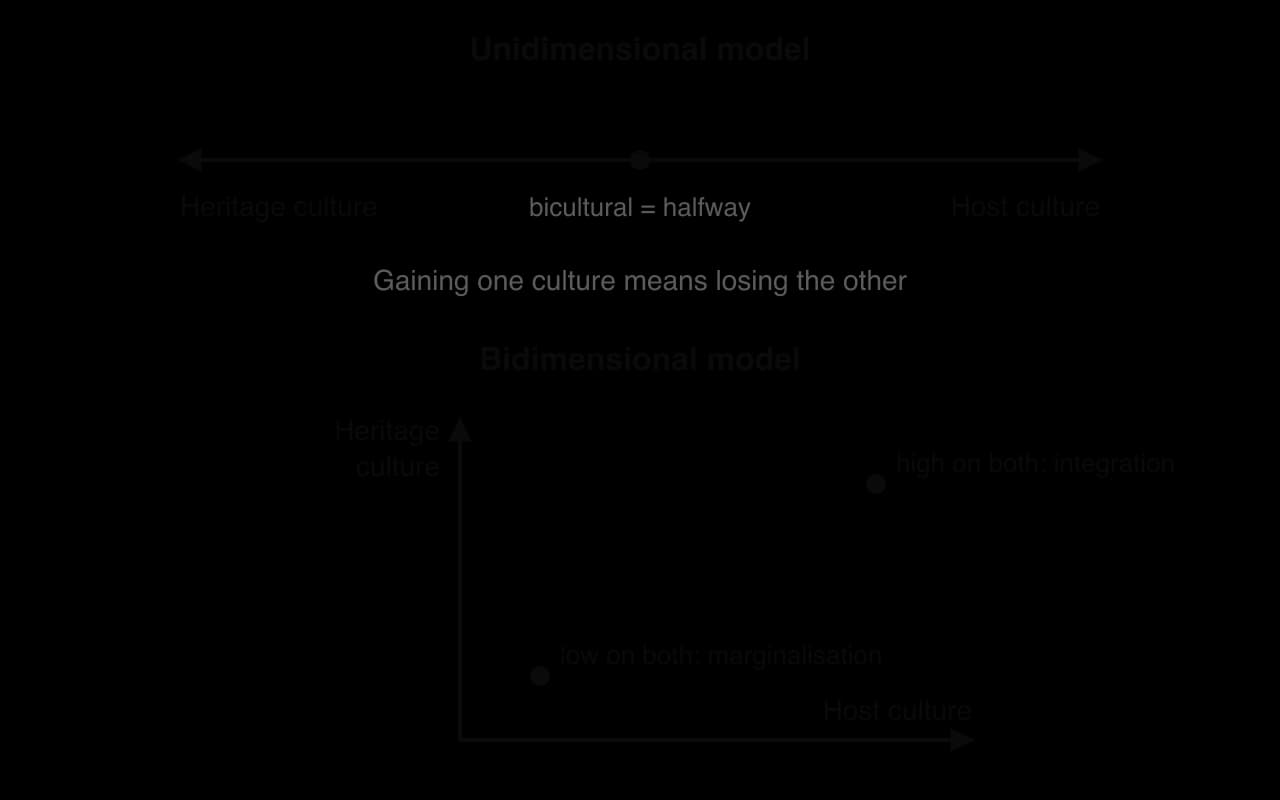
A model that places acculturation on a single line running from the heritage culture to the host culture, so that gaining the new culture means losing the old one.
In the 1930s anthropologists defined acculturation as the changes that occur in the original culture of either or both groups when groups with different cultures come into continuous first-hand contact. Two parts of this definition still matter. First, the contact is continuous: a two-week holiday does not produce acculturation, but years of living, studying or working in another culture do. Second, change can happen in both groups, although the less powerful group usually changes more.
Psychologists distinguish acculturation at the level of the group (changes in a community’s economy, language, religion or institutions) from psychological acculturation, the changes in an individual’s identity, values, behaviour and well-being. Models of acculturation are mainly about the second. They try to describe how individuals respond to living between a heritage culture and a host culture, the culture of the larger society in which they now live.
Acculturation is often discussed as an immigrant experience, but it affects several kinds of group, and the differences between them change what models predict. The groups differ in whether they chose to move, whether they expect to stay and how much power they hold in the new society.
Group | Voluntary? | Permanent? | Example |
|---|---|---|---|
Immigrants | Usually yes | Usually yes | A nurse from the Philippines who settles in Canada |
Refugees and asylum seekers | No: forced to leave | Often uncertain | A Syrian family resettled in Germany |
Sojourners | Yes | No: a fixed period | International students; expatriate workers |
Indigenous peoples | No: the dominant culture arrived | Yes | Māori in Aotearoa New Zealand; Sámi in Norway |
Established ethnocultural groups | Born in the society | Yes | Second-generation British Bangladeshis |
Members of the host majority | Not chosen | Yes | Long-term residents of a city that becomes multicultural |
Refugees usually face the hardest acculturation. They did not choose to move, often arrive after trauma and loss, may not know how long they will stay, and frequently meet suspicion from the host society. Sojourners, by contrast, chose to come and know they will leave, so they may invest less in learning the host culture.
The earliest models treated acculturation as a single process with a single end point. Milton Gordon’s analysis of American society, Assimilation in American Life (1964), described immigrants moving through stages, from adopting the host culture’s language and customs to entering its institutions, marrying into it and finally identifying with it. The expected end point was assimilation into the majority culture.
In a unidimensional model, a person can sit anywhere on the line, but moving towards the host culture always means moving away from the heritage culture. Someone halfway along is described as “bicultural”, but in this model being bicultural only means being incompletely assimilated. The model fitted the “melting pot” ideal of the early twentieth-century United States, in which newcomers were expected to blend into a single national culture.
Research soon showed the limits of a single line. Many people become fluent in a new language and comfortable with a new culture while keeping their heritage language, religion and family values just as strongly as before. A single scale cannot describe them, and it cannot distinguish a person who has kept neither culture from one who has kept both, since both may score “in the middle”.
John Berry, a Canadian cross-cultural psychologist, proposed that acculturating individuals and groups answer two questions that are independent of each other. The first is whether it is of value to keep one’s heritage culture and identity. The second is whether it is of value to seek contact with, and take part in, the larger society. Crossing the two answers gives four acculturation strategies.
 YouTube
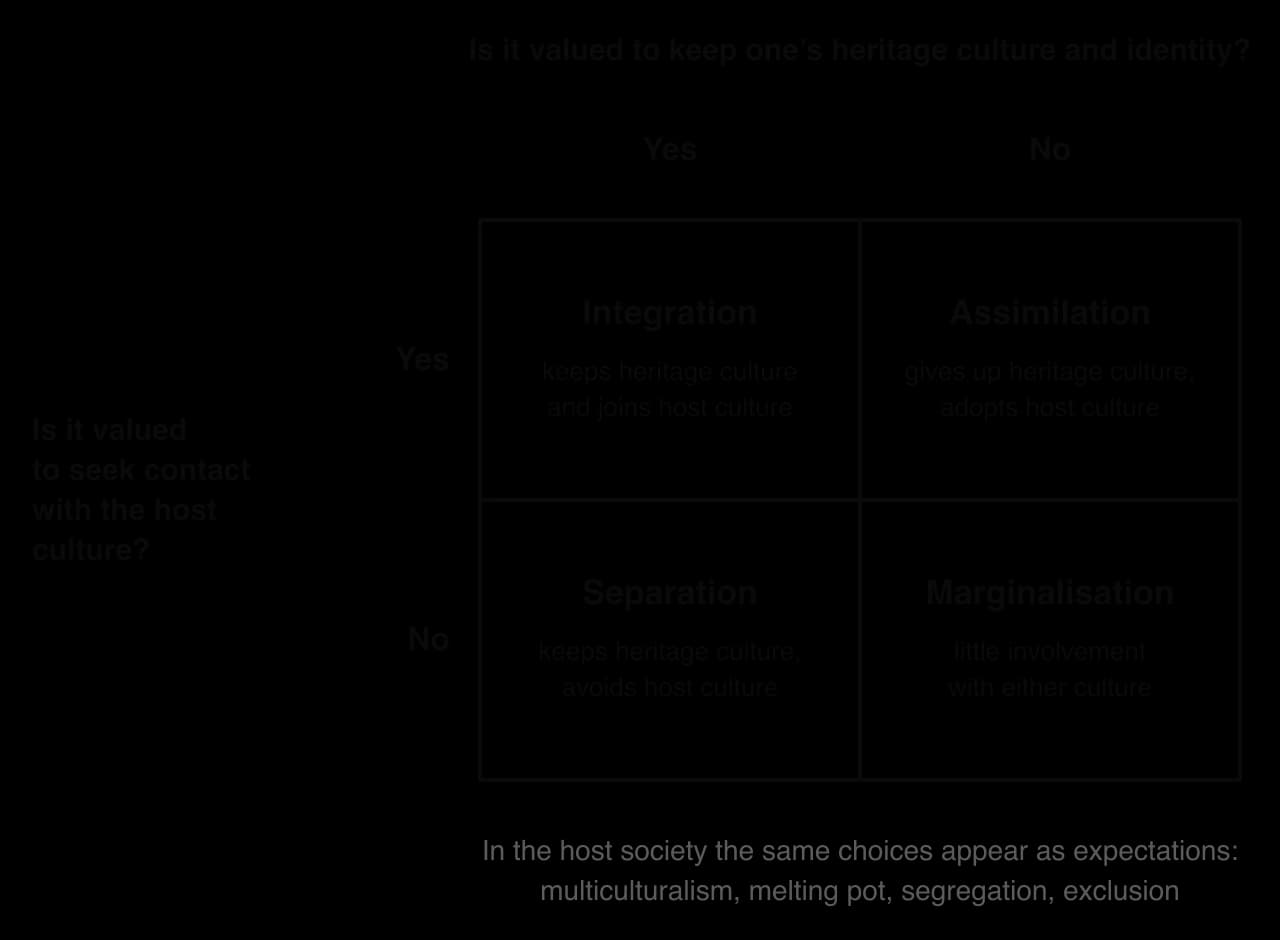
Integration means keeping the heritage culture while also taking part in the host society. An integrated person might speak Turkish at home and German at work, celebrate both Eid and Christmas with friends, and feel both Turkish and German. Integration is only possible where the host society is open to cultural diversity.
Assimilation means giving up the heritage culture and taking on the host culture. A person following this strategy might stop speaking their parents’ language, change their name and seek friends only from the majority group. When the host society demands assimilation, Berry calls the policy a “melting pot”.
Separation means keeping the heritage culture and avoiding contact with the host culture. A person might live in a neighbourhood with others from the same background, work in a family business and rarely use the host language. When the host society imposes separation, it is called segregation.
Marginalisation means having little involvement with either culture. It is rarely chosen: it usually results from losing the heritage culture, for example through enforced cultural loss, while being excluded by the host society through discrimination. Berry calls the matching host-society policy exclusion. Marginalised individuals lack the support of either group and, as later research shows, tend to have the worst outcomes.
Berry distinguished three things that are often confused. Acculturation attitudes are what people prefer; acculturation behaviours are what they actually do; and acculturation strategies combine the two. A refugee may prefer integration but be pushed into separation because employers will not hire them. A model that looked only at preferences would misread the situation.
The host society holds parallel expectations. Where it values diversity and equal participation, Berry calls its orientation multiculturalism; where it expects newcomers to give up their culture, a melting pot; where it keeps groups apart, segregation; and where it excludes them altogether, exclusion. Integration requires a multicultural host society, because a person can only take part in a society that lets them in. Berry therefore described integration as a mutual accommodation that migrants cannot achieve on their own.
People can also use different strategies in different areas of life. Arends-Tóth and van de Vijver (2003) surveyed 185 Turkish-Dutch and 1,565 Dutch adults in the Netherlands. Turkish-Dutch participants preferred integration in public areas of life, such as work and school, but separation in private areas, such as family life, while Dutch participants preferred assimilation in every area. A person therefore cannot always be placed in a single box of the model, and the two groups may disagree about which box is right.
 YouTube
A model of acculturation is tested by whether it predicts how well people fare in the new culture. Colleen Ward and her colleagues in New Zealand showed that “doing well” in a new culture has two separate parts, which follow different courses and have different causes.
Psychological adaptation is the emotional side: a person’s well-being, self-esteem and life satisfaction, and the absence of depression and anxiety. It depends mainly on personality, life changes, social support and how stressful the person finds the transition. Sociocultural adaptation is the behavioural side: how well a person learns the language, skills and social rules needed to manage everyday life, such as using public transport, making friends at school or dealing with officials. It depends mainly on culture learning: time in the country, language ability, contact with members of the host culture and how different the two cultures are.
The two kinds of adaptation are related but can come apart. An international student may quickly master the host culture’s practical demands (good sociocultural adaptation) while feeling lonely and depressed (poor psychological adaptation). Equally, someone living in a close heritage-culture community may feel secure and content while having few of the skills needed to deal with the wider society.
When the demands of acculturation exceed a person’s resources, the result is acculturative stress: anxiety, depression, feelings of marginality and identity confusion caused by problems such as language barriers, discrimination, loss of status and conflict between the values of home and the new society. Berry’s framework predicts that the strategy followed affects how much acculturative stress a person experiences, with integration linked to the least and marginalisation to the most. How acculturative stress affects mental health and group relations is developed in research on acculturation in human relationships.
A popular idea, the U-curve of culture shock, holds that newcomers start with a “honeymoon” of excitement, fall into a crisis after some months and then recover. Ward, Okura, Kennedy and Kojima (1998) tested this by following Japanese students in New Zealand over their first year. Adjustment problems were greatest soon after arrival and then decreased, so the students showed no early honeymoon and no U-shape. Sociocultural difficulties in particular fell steadily as the students learned the culture, which fits a culture-learning account better than a fixed sequence of emotional stages.
Berry’s model describes the choices of the acculturating group and notes that the host society holds parallel expectations. Richard Bourhis and colleagues (1997) argued that this was not enough: the outcome of acculturation depends on the interaction between what immigrants want and what the host majority wants for them, and both are shaped by the state’s integration policies.
The model has three parts. First, state policies range from pluralist (supporting cultural diversity) through civic and assimilationist to ethnist (defining who belongs by ancestry). Second, members of the host community hold their own orientations towards immigrants: integration, assimilation, segregation, exclusion, or individualism, in which people are judged as individuals rather than as members of groups. Third, immigrants hold the orientations described by Berry. Where the two groups’ orientations match, for example when both favour integration, relations are predicted to be consensual; where they partly match, problematic; where they clash, for example when immigrants want integration but the majority wants exclusion, conflictual.
The model shifts attention from the individual migrant to the relationship between groups. It predicts that the same person, with the same preferences, will fare very differently in a welcoming and in a hostile host society. It is therefore particularly useful for explaining prejudice, discrimination and intergroup conflict, which is how it is used in research on acculturation as group behaviour.
Integration at the level of the individual is often described as biculturalism: identifying with and being competent in two cultures. Early sociologists described bicultural people as “marginal”, torn between two worlds and belonging to neither. Psychological research has largely reversed this view.
Nguyen and Benet-Martínez (2013) combined the results of 83 studies with 23,197 participants in a meta-analysis. Biculturalism had a significant, strong and positive association with both psychological and sociocultural adjustment, and this association was stronger than the association between adjustment and identifying with only one culture, whether heritage or host. The size of the link depended on how acculturation was measured, so different measures of the same strategy can lead to different conclusions.
Bicultural people also show a skill called cultural frame switching: they shift between the ways of thinking and behaving of each culture depending on the situation. A Chinese-Canadian student may be quiet and deferential with grandparents and outspoken in a seminar, without feeling that either behaviour is false. This flexibility is one explanation for the better adjustment associated with integration.
Models of acculturation explain behaviour in each of the four contexts. The same two dimensions, heritage-culture maintenance and host-culture contact, help explain mental health, development, relationships and learning.
Health and well-being. Marginalisation and separation in a hostile host society are linked to more acculturative stress, which is a risk factor for depression and anxiety. Integration provides two sources of social support, one from each community.
Human development. Adolescents of immigrant families build an identity from two cultures at once. Conflict can arise when parents favour separation and children favour assimilation, a gap sometimes called an acculturation gap within the family.
Human relationships. Relations between immigrant and majority groups are best when their preferred strategies match, as the Interactive Acculturation Model predicts; mismatches are linked to prejudice and conflict.
Learning and cognition. Learning the host language is a central part of sociocultural adaptation, and bilingual children who keep the heritage language while learning the host language show the integration pattern in their schooling.
The International Comparative Study of Ethnocultural Youth (ICSEY) aimed to answer three questions about young immigrants: how they deal with acculturation, how well they adapt, and whether there are important relationships between how they acculturate and how well they adapt. It was designed to test Berry’s prediction that integration leads to the best outcomes, across many host societies at once.
Using a cross-cultural research design, researchers in 13 host societies (Australia, Canada, Finland, France, Germany, Israel, the Netherlands, New Zealand, Norway, Portugal, Sweden, the United Kingdom and the United States) gave a questionnaire to 5,366 immigrant adolescents aged 13 to 18 from many ethnic backgrounds, together with a comparison sample of 2,631 national youth from the host majority. It was a cross-sectional design using a questionnaire: each young person was surveyed once.
The questionnaire measured the acculturation process through acculturation attitudes (agreement with statements reflecting each of Berry’s four strategies), ethnic and national identity, heritage and host language proficiency and use, and the number of friends and contacts from the young person’s own group and from the national group. Adaptation was measured with five variables: life satisfaction, self-esteem and psychological problems (symptoms such as depression and anxiety), and school adjustment and behaviour problems.
Rather than assigning each person to a strategy from a single question, the researchers used cluster analysis, a statistical technique that groups people with similar patterns of answers across all the acculturation measures. A factor analysis of the five adaptation variables tested whether they formed separate kinds of adaptation.
Cluster analysis produced four acculturation profiles that closely matched Berry’s strategies. The integration profile combined strong ethnic and national identities, use of both languages and friends from both groups. The ethnic profile (separation) showed strong ethnic identity and friends mainly from the heritage group. The national profile (assimilation) showed strong national identity and little ethnic identity. The diffuse profile (marginalisation) showed weak identities with both groups and an uncertain place in the society.
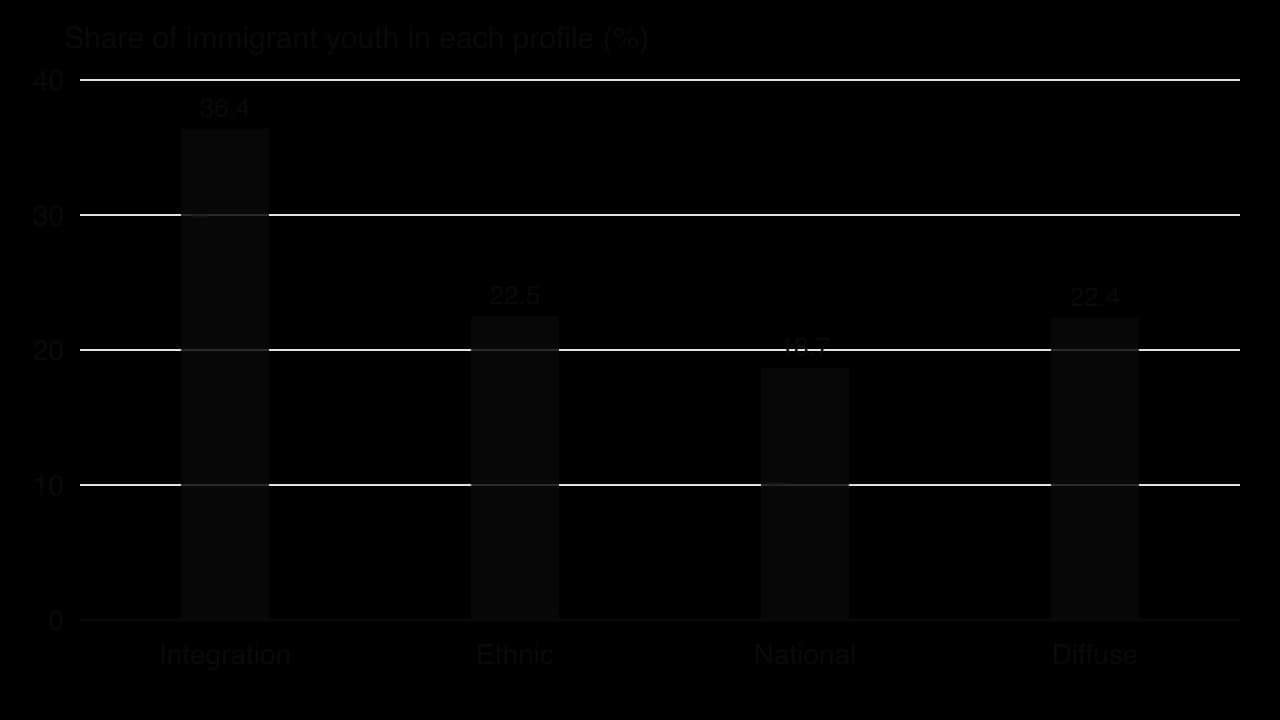
The factor analysis confirmed two kinds of adaptation, psychological (life satisfaction, self-esteem, few psychological problems) and sociocultural (school adjustment, few behaviour problems). Adaptation differed sharply between profiles, and the pattern was largely replicated with a second statistical method, structural equation modelling.
Profile (Berry’s strategy) | Psychological adaptation | Sociocultural adaptation |
|---|---|---|
Integration | Best | Best |
Ethnic (separation) | Moderately good | Poorer |
National (assimilation) | Moderately poor | Slightly negative |
Diffuse (marginalisation) | Worst | Worst |
Sources: Berry, J. W., Phinney, J. S., Sam, D. L., & Vedder, P. (2006). Immigrant youth: Acculturation, identity, and adaptation. _Applied Psychology: An International Review, 55(3), 303–332._
The study supported Berry’s bidimensional model in two ways. First, the patterns of attitudes, identities, languages and friendships that young immigrants actually showed fell into four groups resembling the four strategies. Second, young people who were engaged with both cultures adapted best, and those engaged with neither adapted worst. The researchers concluded that young immigrants should be encouraged to keep a sense of their heritage cultural identity while also establishing close ties with the larger national society.
The data are cross-sectional and correlational. Young people with an integration profile adapted better, but the direction of the relationship is unknown. Integration may improve well-being by giving two sources of support; equally, confident, well-adjusted young people may find it easier to make friends in the majority group and so become integrated. A third variable, such as family income or the welcome offered by a particular school, could produce both. Longitudinal research following the same young people over time would be needed to test the causal claim.
Acculturation and adaptation were measured by self-report questionnaires translated into many languages, so measurement equivalence is a concern: a statement about “keeping one’s culture” may be understood differently by a Vietnamese teenager in Finland and a Turkish teenager in Germany. Self-report is also open to social desirability bias, for example in reporting psychological problems. A strength is that the profiles were built from several measures (attitudes, identities, language and friendships) rather than a single question, which gives a more valid picture than asking young people to pick a strategy.
All 13 host societies were relatively wealthy, and most were Western democracies with at least some multicultural policies. Integration may be most beneficial where it is welcomed; in societies that demand assimilation or exclude migrants, the pattern could differ. The research team also included the originator of the model being tested, which raises a risk of confirmation in how profiles were defined and named. A later re-analysis of the ICSEY data by Abu-Rayya, Berry, Sam and Grigoryev (2023), using two new methods of measuring integration, again supported the integration hypothesis, although it was stronger for positive indicators of adaptation, such as life satisfaction, than for negative ones.
Berry’s model is the most widely used framework in acculturation research, and its main prediction, that integration is linked to the best adaptation, has support from large international studies and meta-analyses. The model has also attracted strong criticism, mainly about how its strategies are measured and about what it leaves out.
It captures what unidimensional models miss. Treating heritage and host culture as separate dimensions allows people to be high on both, which matches the experience of many bicultural people and the evidence that biculturalism is linked to good adjustment.
It has wide empirical support. The ICSEY profiles in 13 societies, the Nguyen and Benet-Martínez meta-analysis of 83 studies and the 2023 re-analysis all point in the same direction.
It is applicable. The model gives schools, health services and governments a framework for policy. Programmes that support heritage languages while teaching the host language, or that bring migrant and majority families together, put the integration prediction into practice.
It includes the host society. Berry’s parallel host-society orientations, and their development in the Interactive Acculturation Model, recognise that acculturation is shaped by power and policy, not only by individual choice.
Floyd Rudmin (2003) reviewed 68 theories of acculturation published between 1918 and 1984 and criticised the fourfold model’s logic and measurement. He argued that two cultures in contact allow many more than four combinations, and that the common method of measuring strategies, asking people to agree or disagree with four separate statements, produces confusing results: people who favour integration often also agree with statements reflecting other strategies, which should be impossible. He concluded that there was no robust evidence that biculturalism is the most adaptive strategy.
Marginalisation is a particular problem. Very few people agree with statements such as “I don’t want to belong to either culture”, so in many studies the marginalised group is tiny or does not appear at all. The ICSEY team avoided part of this problem by building profiles from several measures, and found a substantial “diffuse” group, but that group was defined by statistics rather than by participants’ own choices. Nguyen and Benet-Martínez also found that the strength of the link between biculturalism and adjustment depended on how biculturalism was measured, which suggests that measurement decisions shape the conclusions.
Almost all evidence that integration produces good adaptation is correlational and cross-sectional. Better-adjusted people may be more able to integrate, rather than integration making them better adjusted, and factors such as education, income and the warmth of the host society could produce both. Longitudinal studies, which measure strategy and adaptation repeatedly over time, are rarer but are needed to support a causal claim.
A longitudinal design would measure the same immigrant young people’s acculturation profile and adaptation soon after arrival and again one, two and three years later. If integration at the first measurement predicted improvements in well-being at later measurements, even after controlling for initial well-being, family income and language level, the claim that integration causes better adaptation would be much stronger. If instead early well-being predicted later integration, the direction would be reversed. Such studies are expensive and lose participants over time, which is one reason cross-sectional designs dominate.
Berry’s model is often applied as though migrants freely choose a strategy. Critics argue that this places too much weight on individual attitudes and too little on discrimination, poverty, legal status and housing, which limit the options available. The Interactive Acculturation Model goes some way to correcting this by making the host society’s orientations part of the explanation. Seth Schwartz and colleagues have also argued that acculturation should be broken into separate parts (cultural practices, values and identifications) because a person may adopt the host culture’s practices, such as language and food, while keeping heritage values and identity.
The model was developed and mostly tested in Western societies that receive migrants, which limits its generalisability. Its relevance to other situations, such as Indigenous peoples whose land was colonised, internal migration within China or India, or movement between non-Western societies, is less well studied. From the perspective of Indigenous psychologies, “assimilation” has often meant forced policies such as removing children from their families, so the language of individual strategy can hide a history of coercion.
Concept | Strength of acculturation models | Limitation |
|---|---|---|
Measurement | Profiles built from several measures (ICSEY) give a fuller picture than one question | Four-statement measures are logically confused; marginalisation is rarely endorsed; results depend on the measure |
Causality | Consistent correlations across many countries and a meta-analysis | Mostly cross-sectional: integration may follow good adaptation, not cause it |
Perspective | Bidimensional view fits the experience of bicultural people | Emphasises individual choice over discrimination and power; tested mostly in Western host societies |
Bias | Recent re-analyses with new methods support the integration hypothesis | Originators of the model ran much of the research testing it |
Change | Strategies can shift with time, domain and policy | Static, one-time measures miss how acculturation unfolds |
Models of acculturation can appear in Paper 1 Section A, where a question asks for one model of acculturation to be explained with an example, and in Paper 1 Section B, where a model must be applied to an unseen scenario such as a newly arrived family. Acculturation as an area of study in human relationships can also be the basis of a Section C essay.
Acculturation is the cultural and psychological change that follows continuous contact with another culture; it affects immigrants, refugees, sojourners, Indigenous peoples and the host majority.
Unidimensional models, such as Gordon’s (1964), place a person on one line from heritage to host culture, so gaining one culture means losing the other.
Berry’s bidimensional model crosses heritage-culture maintenance with host-culture contact to give four strategies: integration, assimilation, separation and marginalisation.
Host societies hold matching orientations (multiculturalism, melting pot, segregation, exclusion), and integration needs a multicultural host society.
Psychological adaptation (well-being) and sociocultural adaptation (practical skills) are separate outcomes with different causes and courses.
The Interactive Acculturation Model predicts consensual, problematic or conflictual relations depending on how immigrant and host orientations match.
The ICSEY study of 5,366 immigrant youth in 13 societies found four profiles; the integration profile (36.4%) had the best adaptation and the diffuse profile the worst.
Criticisms concern measurement (four-statement methods, marginalisation), causality (mostly correlational data) and perspective (individual choice versus discrimination and power).
I can describe acculturation and explain who acculturates.
I can compare and contrast unidimensional and bidimensional models of acculturation.
I can draw Berry’s model from memory and explain each of the four strategies.
I can explain the difference between psychological and sociocultural adaptation.
I can describe the Interactive Acculturation Model and what it adds to Berry’s model.
I can apply a model of acculturation to an immigrant, refugee or international student in a scenario.
I can describe the aim, method, results and conclusions of the ICSEY study and evaluate it.
I can evaluate models of acculturation with reference to measurement, causality and perspective.