Explain social identity theory and self-categorisation theory, describe and evaluate the minimal group research behind them, and apply them to explain and change behaviour in each context.
Each is in the Psychology glossary, with every other term in the subject.
The tendency to display one's connection with a successful group, such as a winning team, in order to raise one's own social identity and self-esteem.
A social group to which a person feels they belong and with which they identify.
The tendency to evaluate, reward and treat members of one's own group more favourably than members of other groups.
A research method in which participants are divided into groups on a trivial or random basis, with no contact, history or conflict, to test whether categorisation alone produces in-group favouritism.
A social group to which a person feels they do not belong and against which their own group is compared.
The motivation to see one's in-group as different from and better than relevant out-groups, which social identity theory proposes maintains a positive social identity.
An extension of social identity theory proposing that people define themselves at different levels (personal or group) depending on context, and conform to the norms of the group they categorise themselves into.
The cognitive process of sorting people, including oneself, into social groups, which exaggerates differences between groups and similarities within them.
Describe social identity theory, including social categorisation, social identification, social comparison and positive distinctiveness.
Explain how social identity theory accounts for in-group favouritism and discrimination against out-groups.
Describe the aim, method, results and conclusions of Tajfel et al.’s minimal group experiments.
Explain how members of low-status groups respond to a negative social identity (social mobility, social creativity and social competition).
Explain self-categorisation theory and how it extends social identity theory.
Compare and contrast social identity theory with realistic conflict theory.
Evaluate social identity theory and its research with reference to measurement, causality, bias and perspective.
Apply social identity theory to explain and change behaviour in each of the four contexts.
Social identity theory explains why people treat members of their own groups differently from members of other groups. Part of how people see themselves comes from the groups they belong to, such as a nationality, a religion, a school or a football club, and the wish to feel good about those groups can lead to favouritism, rivalry and, in some conditions, prejudice.
The theory belongs to the sociocultural approach, but it is built on a cognitive process (sorting people into categories) and a motive (maintaining self-esteem), so it shows how the approaches combine. It has practical value because it suggests how conflict between groups can be reduced, for example by changing which group identity is most important in a situation. Research on it raises questions of measurement (how to measure favouritism in artificial groups),
With a free account, Augment remembers where you stopped and what you have practiced.
The process of evaluating one's own group against other groups, usually on dimensions that allow the in-group to appear better.
The process of adopting the identity, norms and values of a group one has categorised oneself into, so that the group's status affects one's self-esteem.
The part of a person's self-concept that comes from their membership of social groups, together with the value and emotional significance attached to that membership.
A theory proposing that part of a person's self-concept comes from the groups they belong to, and that the wish for a positive social identity leads to in-group favouritism and comparison with out-groups.
Tajfel and Turner (1979) proposed that a person’s self-concept has two parts. Personal identity is made up of individual characteristics, such as being patient, musical or good at chess. Social identity is the part of the self-concept that comes from membership of social groups, together with the value and feeling attached to that membership. A student can think of herself as “Amira, who loves drawing” (personal identity) or as “one of the Year 12 students at Riverside School” (social identity).
Which identity guides behaviour depends on the situation. At home a person may act mainly as an individual; at an international football match the same person may act almost entirely as a national fan. When a social identity is salient, people see themselves and others as representatives of groups rather than as individuals, and their behaviour changes accordingly.
The groups a person belongs to and identifies with are their in-groups; groups they do not belong to and compare themselves against are out-groups. These are not fixed categories: a student’s in-group can be her class when classes compete in a quiz, and her whole school when the school plays a rival school.
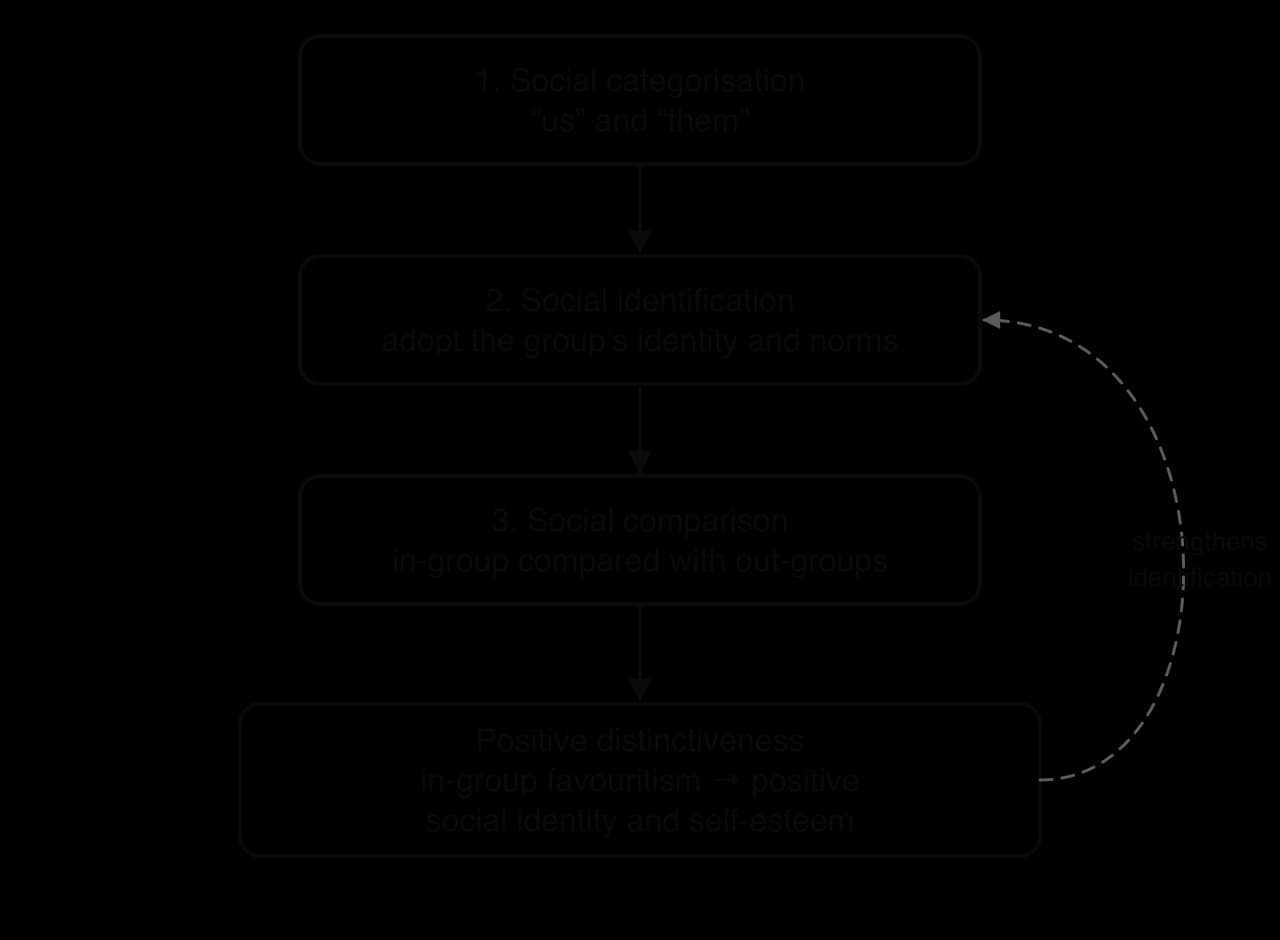
Social identity theory describes three linked processes, followed by the motive that gives them their effect on behaviour. They are usually presented as stages, but in practice they happen quickly and often together.
Social categorisation is the cognitive process of sorting people, including oneself, into groups. Categories make a complex social world simpler to deal with, in the same way that categories help with objects. A side effect is accentuation: differences between groups are exaggerated and differences within groups are underestimated, so out-group members are seen as “all the same” and in-group members as varied individuals.
Categorisation has measurable cognitive effects. Bernstein, Young and Hugenberg (2007) found that university students recognised faces better when the faces were labelled as belonging to their own university, or even to a randomly assigned group, than when the same faces were labelled as out-group members. Because the faces were the same in both conditions, the difference could only come from the category label.
In social identification the person adopts the identity of the group they have categorised themselves into. They take on its norms, values and ways of behaving, and they become emotionally involved in its fortunes. Its successes feel like personal successes and its failures like personal failures, so the group’s status starts to affect the person’s self-esteem.
Cialdini et al. (1976) showed this in a field study at several large American universities with major football teams. Students were more likely to wear clothing showing their university’s name or logo on the Monday after their team had won than after it had lost, and they more often described a win with “we won” and a loss with “they lost”. Cialdini called this basking in reflected glory: people publicly display their link with a successful group to enhance their own image.
Once people identify with a group, they evaluate it by social comparison with other groups. Because the in-group’s value now affects their self-esteem, they are motivated to make comparisons that favour the in-group. They do this by choosing dimensions on which the in-group does well, by seeing in-group members more positively and, in some conditions, by treating out-group members less well.
The motive behind the comparison is positive distinctiveness: the wish to see one’s own group as different from and better than relevant out-groups. When comparison succeeds, the person has a positive social identity and higher self-esteem. The visible result is in-group favouritism, the tendency to evaluate, reward and help in-group members more than out-group members.
In-group favouritism is not the same as hostility. In most everyday settings it takes the form of liking, trusting and helping in-group members more, not of harming out-group members. Social identity theory explains how favouritism can grow into discrimination and prejudice when groups compete or when one group feels threatened, but it does not claim that every group identity leads to hostility.
 YouTube
Earlier research, especially Sherif’s summer-camp studies, had explained hostility between groups by competition for resources. Henri Tajfel set out to find the minimum conditions under which people favour their own group, so his research began by removing everything that might cause favouritism: competition, contact, history and personal gain.
Tajfel, Billig, Bundy and Flament (1971) aimed to find out whether simply being categorised into a group, with no competition, no contact and no history between the groups, is enough to produce discrimination in favour of the in-group.
The participants were schoolboys aged 14–15 from a state secondary school in Bristol, England, who knew one another before the study. In the first experiment, boys estimated the number of dots flashed on a screen and were told they had been grouped as “over-estimators” or “under-estimators”. In the second experiment, 48 boys, tested in three groups of 16, were shown slides of abstract paintings by Paul Klee and Wassily Kandinsky and were told they had been grouped by their preference for one painter. In both experiments the allocation to groups was in fact random.
Each boy then worked alone in a cubicle. Using booklets of reward matrices, he decided how many points (each worth a small amount of money) to give to two other boys, who were identified only by a code number and by group (for example, “member number 74 of the Klee group”). A boy never allocated points to himself, so his choices could not bring him any personal gain. This design is now known as the minimal group paradigm.
Each matrix offered a row of choices. In each choice, the upper number went to a member of one group and the lower number to a member of the other. The matrices were designed so that the researchers could tell which strategy a boy was using from the choice he picked.
Points to a member of the Klee group (in-group) | 7 | 8 | 9 | 10 | 11 | 12 | 13 | 14 | 15 | 16 | 17 | 18 | 19 |
Points to a member of the Kandinsky group (out-group) | 1 | 3 | 5 | 7 | 9 | 11 | 13 | 15 | 17 | 19 | 21 | 23 | 25 |
This is an illustrative matrix of the type used, set out for a boy in the Klee group. The far right gives the most points to both boys together (maximum joint profit: 19 + 25) and also the most to the in-group member (maximum in-group profit: 19). The far left gives the in-group member fewer points (7) but creates the largest gap in the in-group’s favour (7 against 1), which is maximum difference. A boy who chooses towards the left is giving up points for his own group in order to beat the other group.
Most boys gave more points to members of their own group than to members of the other group, even though the groups were meaningless and the boys gained nothing personally. Fairness also influenced choices, so allocations were often a compromise between fairness and favouritism. The most striking result was that boys often chose options close to maximum difference rather than maximum joint profit or even maximum in-group profit: they preferred their group to get less in absolute terms, provided it got more than the out-group.
Sources: Tajfel, H., Billig, M. G., Bundy, R. P. and Flament, C. (1971). Social categorization and intergroup behaviour. _European Journal of Social Psychology, 1(2), 149–178._
Being categorised into a group, even on a trivial basis, was enough to produce in-group favouritism. Competition for resources, personal self-interest and previous hostility were not necessary. The preference for maximum difference suggested that what mattered to the boys was their group’s position relative to the other group, which Tajfel and Turner (1979) later explained through the need for positive distinctiveness.
Because allocation to the groups was random and the boys never allocated points to themselves, the design rules out several alternative explanations: personal gain, existing friendships within groups, real differences between the groups and any history of conflict. The favouritism can therefore be attributed to categorisation. The design is so simple that it has been repeated many times, in different countries and with adults, and in-group favouritism is a reliable finding, although its size varies.
Point allocation is a precise, quantitative measure, but it is also artificial. The boys had been put into groups by the experimenters and then given a task in which the only thing to do was to allocate points between groups, so they may have inferred that the researchers expected them to use the groups. This possibility of demand characteristics means the paradigm may overestimate how much people favour trivial groups in everyday life. Later studies in which people believed their choices were private still found favouritism, which reduces but does not remove this concern.
The participants were adolescent boys in one British city, an age and sex often associated with competitiveness, so the sample limits generalisability. Cross-cultural studies suggest that favouritism is not universal in strength. Wetherell (1982) found that Polynesian children in New Zealand were more generous to the out-group in minimal group tasks than Pākehā (New Zealand European) children, which suggests that cultural norms about sharing shape how categorisation is turned into behaviour.
The boys were misled about how the groups had been formed, which is a mild form of deception, and they were children whose parents and school gave permission. The risk of harm was low and the groups were never used again, so the study is usually judged acceptable, though researchers today would need to consider whether being placed in an “out-group”, even briefly, could affect relationships between classmates.
Not every group can come out ahead in comparisons. Members of groups with low status in a society, such as an ethnic minority facing discrimination or the supporters of a struggling club, may have a negative social identity. Tajfel and Turner (1979) proposed that people respond in different ways, depending on how they see the boundaries between groups and the status difference itself.
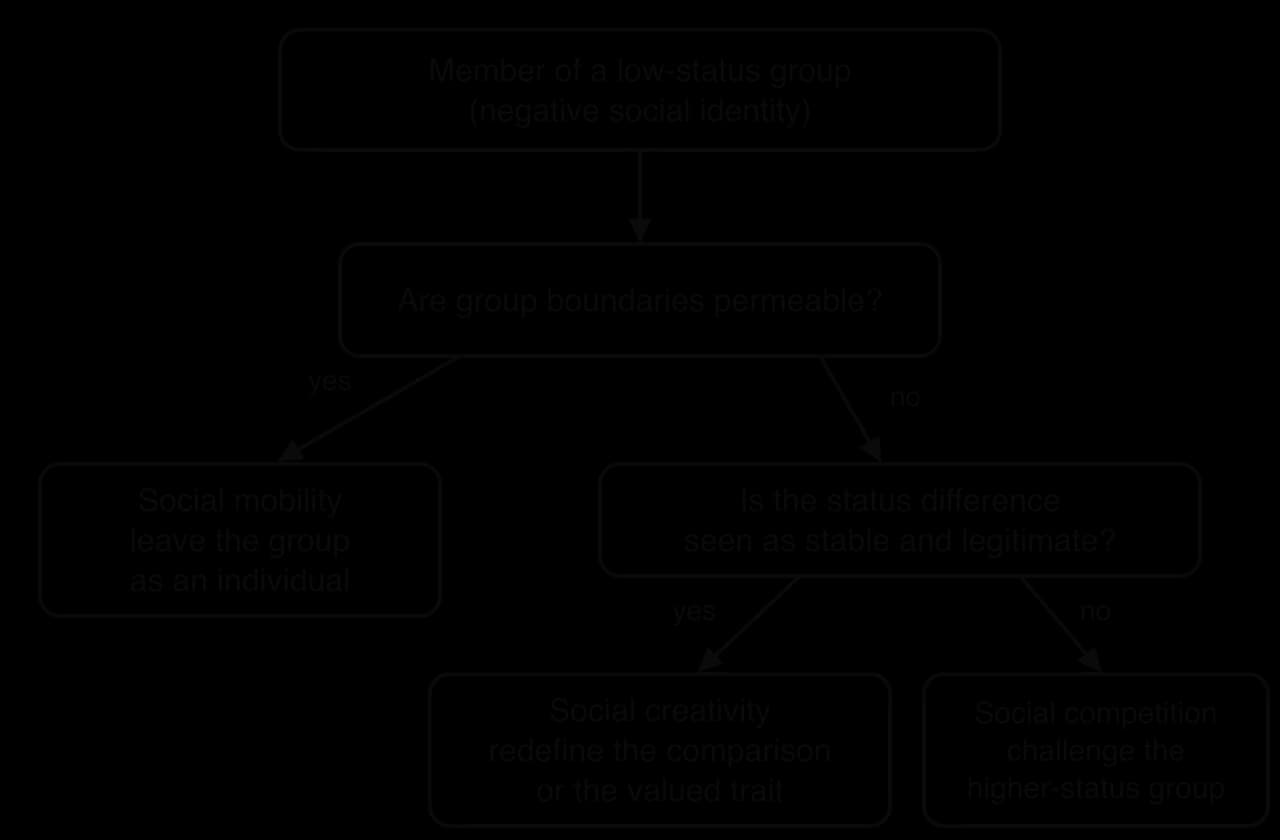
Social mobility: if group boundaries are seen as permeable, individuals try to leave the low-status group and join a higher-status one, for example by changing career, accent or neighbourhood. This improves the individual’s position but leaves the group’s status unchanged.
Social creativity: if boundaries are impermeable and the status difference is seen as stable, members change the comparison instead. They may compare their group with a different, lower-status group; choose a new dimension on which their group does well; or redefine a trait that was seen as negative as positive, as in movements that reclaimed terms once used as insults.
Social competition: if the status difference is seen as unstable or illegitimate, members may challenge the higher-status group directly, through protest, political action or, in extreme cases, conflict. Social movements for civil rights are examples.
This part of the theory explains how social identity can drive change in a society as well as rivalry. It predicts that the same group may stay quiet for long periods and then mobilise quickly when its members come to see their low status as unfair and changeable.
Self-categorisation theory, developed by Turner and colleagues in 1987, extends social identity theory by explaining *when* a social identity guides behaviour. It proposes that people can categorise themselves at different levels: as unique individuals, as members of a group, or as members of a very broad category such as “human beings”. Which level is salient depends on the situation, including who is present and what comparison is being made.
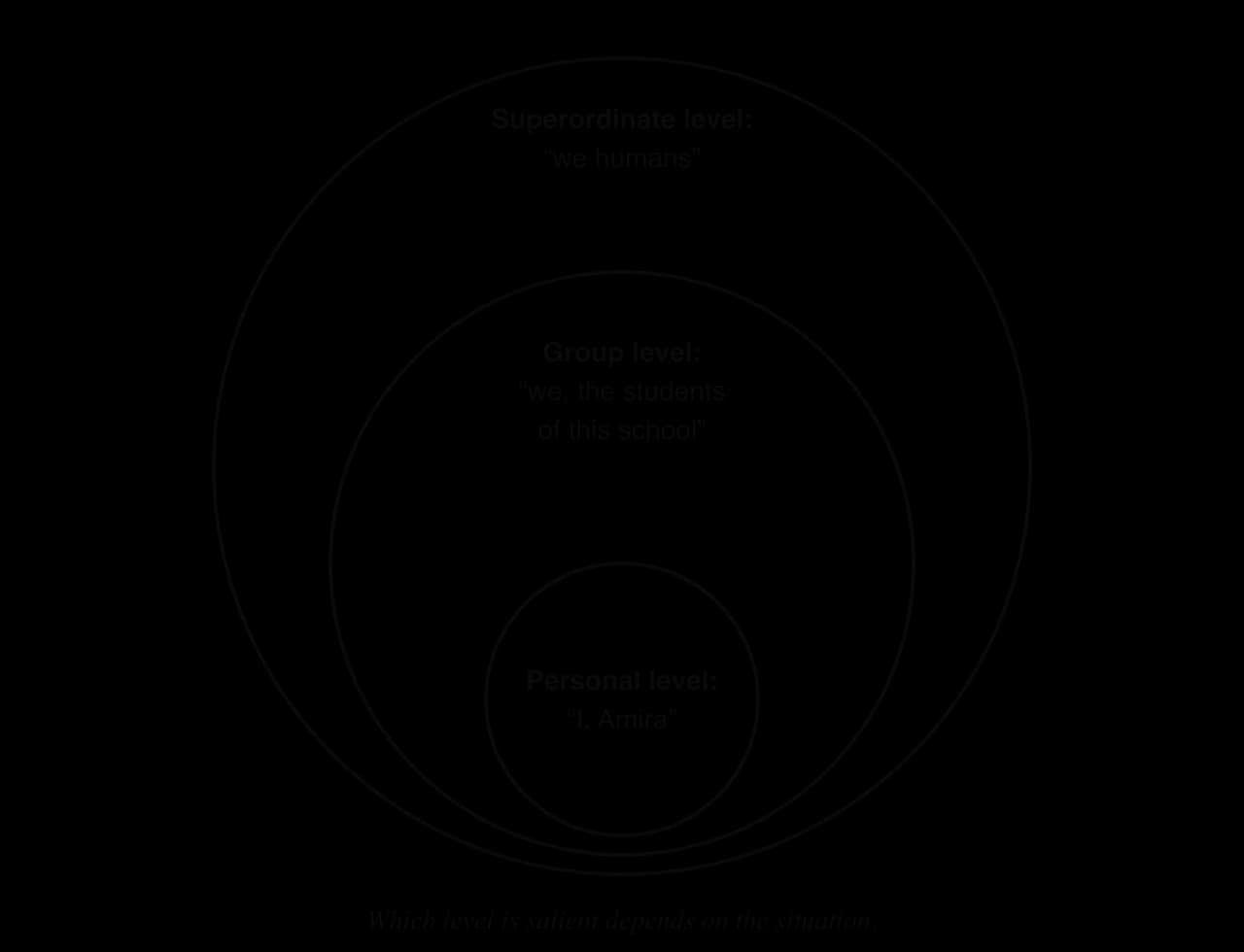
When people categorise themselves as group members, they see themselves as similar to a group prototype, the shared picture of what a typical member is like, and they adopt its norms. This process is called depersonalisation. It refers to acting from the group identity instead of the personal one, which is different from losing a sense of self. It explains why people conform more to in-groups than to out-groups: Abrams et al. (1990) found that participants conformed far more in a line-judgement task when the other group members were presented as part of their own category. Self-categorisation theory therefore connects social identity to conformity.
The levels also explain how prejudice between groups can be reduced. If members of two groups can be led to categorise themselves at a higher, shared level, former out-group members become in-group members. This idea is the basis of the common in-group identity model, developed by Gaertner, Dovidio and colleagues.
Before social identity theory, the main explanation of hostility between groups was realistic conflict theory, based on Sherif’s summer-camp studies in the 1950s, including the Robbers Cave experiment of 1954. Boys aged about 11–12 were divided into two groups at a camp; when the groups competed for prizes, they became hostile to each other, and hostility fell when they had to cooperate on goals that neither could achieve alone. Realistic conflict theory concludes that conflict comes from competition for limited resources.
Realistic conflict theory | Social identity theory | |
|---|---|---|
Cause of intergroup bias | Competition between groups for limited resources (prizes, land, jobs) | Categorisation and the wish for a positive social identity |
Is competition necessary? | Yes: no competition, no hostility | No: categorisation alone produces favouritism (minimal groups) |
Main level of explanation | Group interests and the situation | Cognitive process (categorisation) plus a motive (self-esteem) |
Key evidence | Sherif’s summer-camp studies | Tajfel et al.’s minimal group experiments |
The two theories are better seen as complementary than as rivals. Competition for real resources makes group boundaries more salient and gives comparison a concrete outcome, so it intensifies the processes social identity theory describes. In the Robbers Cave study the boys showed signs of in-group favouritism as soon as they learned that the other group existed, before any competition had started, which fits social identity theory. Equally, realistic conflict theory explains why bias becomes much more intense when groups really do compete.
 YouTube
Reicher and Haslam (2006) randomly assigned 15 men to be guards or prisoners in a simulated prison built for a television documentary, and observed them for eight days. The guards did not identify with their role and were reluctant to use their authority, while the prisoners developed a shared identity and eventually challenged and overcame the guards. The participants then set up an equal “commune”, which broke down, and some began to support a much harsher regime.
The study was designed to test a claim from Zimbardo’s Stanford prison experiment of 1971: that people placed in roles naturally conform to them and become brutal. The BBC study did not reproduce that pattern. Archive research by Le Texier (2019) also found that Zimbardo’s guards had been encouraged by the researchers to be tough, so the Stanford study cannot be taken as evidence that roles alone produce cruelty. Reicher and Haslam concluded that behaviour depends on whether people identify with a group, and that tyranny becomes acceptable when groups fail and people feel powerless, which is a social identity explanation rather than a role explanation.
The BBC study has its own limitations. It was filmed for television, which may have changed the behaviour of participants who knew they would be broadcast, and the researchers intervened in the study at several points, so it is better described as an experimental case study than a controlled experiment.
Van Bavel, Packer and Cunningham (2008) randomly assigned participants to one of two mixed-race teams and then showed them faces of their new team-mates and of members of the other team while scanning their brains with functional magnetic resonance imaging. In-group faces produced greater activity than out-group faces in the amygdala, the fusiform gyri, the orbitofrontal cortex and the dorsal striatum, regardless of the faces’ race. Activity in the orbitofrontal cortex was linked to how much participants said they liked in-group members.
The finding shows that a new and arbitrary group membership can change how the brain responds to faces within minutes, which supports the claim that categorisation alone has powerful effects. It also shows that brain responses linked to race are not fixed, since team membership overrode race. As with all imaging studies, the meaning of activity in a particular region has to be inferred, so the study shows a biological correlate of in-group bias rather than its cause.
If in-group favouritism depends on how people categorise themselves and others, then changing the categories should change the behaviour. Research on reducing bias between groups has tested three strategies that follow from social identity theory and self-categorisation theory.
Decategorisation: encouraging people to see out-group members as individuals rather than as group members, so that group labels lose their importance.
Recategorisation: leading members of two groups to see themselves as one larger group, so that former out-group members become in-group members. This is the strategy of the common in-group identity model.
Dual identity: keeping the original groups but placing them inside a shared identity, for example “Muslim and Christian members of the same team”.
Gaertner et al. (1989) tested these ideas in a laboratory. Two small groups of students were brought together, and the seating arrangement and a shared group name were varied. When members came to see themselves as one larger group, bias between the two original groups was lower than when they still saw themselves as two separate groups. The finding supports the claim of self-categorisation theory that bias follows the category boundary, so moving the boundary changes who is favoured.
Each strategy has limits. Decategorised impressions may not generalise, because a liked individual can be seen as an exception to the group. A single shared identity may be resisted by people who identify strongly with their original group, and members of minority groups may experience it as pressure to give up their identity, which is why a dual identity is often more acceptable. Laboratory groups are also far easier to recategorise than communities with a history of conflict, so the strategies need testing in real settings, where they are applied to intergroup conflict in human relationships.
Because almost everyone belongs to several groups, social identity theory can be applied wherever group membership affects behaviour. In each context it can be used both to explain behaviour and to suggest how to change it.
Context | Explaining behaviour | Changing behaviour |
|---|---|---|
Health and well-being | Strong identification with valued groups (a sports team, a religious community) is linked to better well-being; people also follow health norms of groups they identify with, such as drinking norms in a university club. | Health messages framed as “what people like us do” use group norms; support groups give people facing an illness a new, positive shared identity. |
Human development | In adolescence, identity is built partly through peer groups; teenagers adopt the styles and attitudes of the groups they identify with and may contrast themselves with other groups. | Schools can create shared identities (houses, teams, year groups) that cut across divisions such as ethnicity or neighbourhood. |
Human relationships | Rivalry between sports fans, nations or religious groups; favouritism in hiring; hostility between groups competing for status. | Recategorising groups into a shared identity, cooperative contact and shared goals reduce bias between groups. |
Learning and cognition | Categorising people affects memory and perception (better recognition of in-group faces); group stereotypes can affect test performance. | Teachers can emphasise shared class identity in mixed groups, and group work can be structured so that success depends on cooperation. |
The table shows that the theory is not only about conflict. The same processes that create favouritism can be used to build cooperation and well-being, because they depend on which categories are made salient.
The theory is supported by a large body of research, especially the minimal group studies, which have been repeated in many countries. It explains a wide range of behaviour, from basking in reflected glory to conformity to in-groups and prejudice, with a small number of processes. It also generates practical interventions: if bias depends on categories, changing the categories that are salient should reduce bias, a prediction that research on recategorisation has supported.
The theory also combines perspectives. It joins a cognitive process (categorisation), a motivational process (self-esteem) and a sociocultural factor (group norms and status), which makes it less reductionist than explanations based on personality or on competition alone.
Causality and self-esteem. The claim that the need for self-esteem drives favouritism has mixed support, so one of the theory’s central links is uncertain.
Measurement and artificial groups. Much of the evidence comes from minimal groups, which have no history, no emotion and no real stakes. Behaviour towards real groups, such as ethnic or national groups, involves history, power and emotion that minimal groups cannot capture.
Individual differences. The theory says little about why some people identify more strongly with groups or show more prejudice than others in the same situation.
Prediction. The theory is better at explaining behaviour after it has happened than at predicting which strategy a group will choose or when favouritism will turn into hostility.
Cultural bias. The theory was developed in Europe and tested mostly in Western samples. Studies such as Wetherell (1982) suggest that the link between categorisation and favouritism is shaped by cultural norms, so the processes may not operate in the same way everywhere.
Concept | Application to social identity theory |
|---|---|
Causality | Random allocation in minimal group experiments shows that categorisation causes favouritism; whether self-esteem is the cause of discrimination is less certain. |
Measurement | In-group favouritism is operationalised as point allocation, ratings of groups or brain responses; each captures part of a complex social identity, and artificial tasks may invite demand characteristics. |
Bias | Early samples were Western, often male and adolescent; cross-cultural research shows variation in favouritism. |
Perspective | The theory combines cognitive (categorisation), motivational and sociocultural perspectives; biological evidence shows neural correlates of in-group bias. |
Change | Social creativity and social competition explain how groups change their status; recategorisation offers a way to change intergroup behaviour. |
Responsibility | Applications to conflict and prejudice carry a responsibility to avoid presenting prejudice as inevitable, which could be used to excuse it. |
Social identity theory is an approach term, so it can appear in Paper 1 Section A without a context and in Section B inside a scenario from any context, often with the command to explain how it could account for a behaviour or how it could be used to change one. It can also be used as an explanation in concept-based essays on group behaviour.
Social identity theory, proposed by Tajfel and Turner in 1979, holds that part of the self-concept comes from group membership, and that people want this social identity to be positive.
Social categorisation, social identification and social comparison lead to positive distinctiveness and in-group favouritism.
Tajfel et al.’s (1971) minimal group experiments showed that random, trivial groups were enough for boys to favour their in-group, often choosing maximum difference over maximum gain.
Members of low-status groups may respond with social mobility, social creativity or social competition, depending on whether boundaries are permeable and status differences legitimate and stable.
Self-categorisation theory explains when a group identity is salient and why people conform to in-group norms.
Realistic conflict theory explains intergroup hostility by competition for resources; social identity theory shows that categorisation alone produces favouritism. The two are complementary.
Evidence from real groups (basking in reflected glory, the BBC Prison Study, brain imaging of new teams) supports the importance of social identity, but the self-esteem hypothesis has mixed support.
The theory is evaluated through causality, measurement (artificial groups, demand characteristics), bias (Western samples, cultural variation) and perspective.
I can describe social identity theory and its processes: categorisation, identification, comparison and positive distinctiveness.
I can explain how the theory accounts for in-group favouritism and discrimination.
I can describe the aim, method, results and conclusions of Tajfel et al.’s minimal group experiments.
I can explain social mobility, social creativity and social competition.
I can explain self-categorisation theory and its link to conformity.
I can compare and contrast social identity theory with realistic conflict theory.
I can evaluate social identity theory with reference to measurement, causality, bias and perspective.
I can apply social identity theory to explain and change behaviour in an unfamiliar scenario.