Explain conformity through normative and informational influence, describe and evaluate Asch’s research and the factors that change conformity, and apply it to behaviour in each context.
Each is in the Psychology glossary, with every other term in the subject.
A visual illusion in which a stationary point of light in a completely dark room appears to move, used to study how group norms form in ambiguous situations.
A change in behaviour or belief that brings a person into line with a group, as a result of real or imagined group pressure rather than a direct request or order.
Conformity motivated by the wish to be correct, in which a person who is uncertain treats the group as a source of information, so that private belief changes as well as public behaviour.
The deepest level of conformity, in which a person privately accepts the group's view as correct, so the change in belief and behaviour lasts when the group is absent.
Conformity motivated by the wish to be liked and accepted by a group and to avoid rejection, which usually produces public agreement without private acceptance.
A change in behaviour in response to a direct order from a person who is seen as having legitimate authority.
A theory proposing that social influence depends on the strength, immediacy and number of the people exerting it, with each extra person adding less influence than the one before.
Describe conformity and explain how it differs from compliance and obedience.
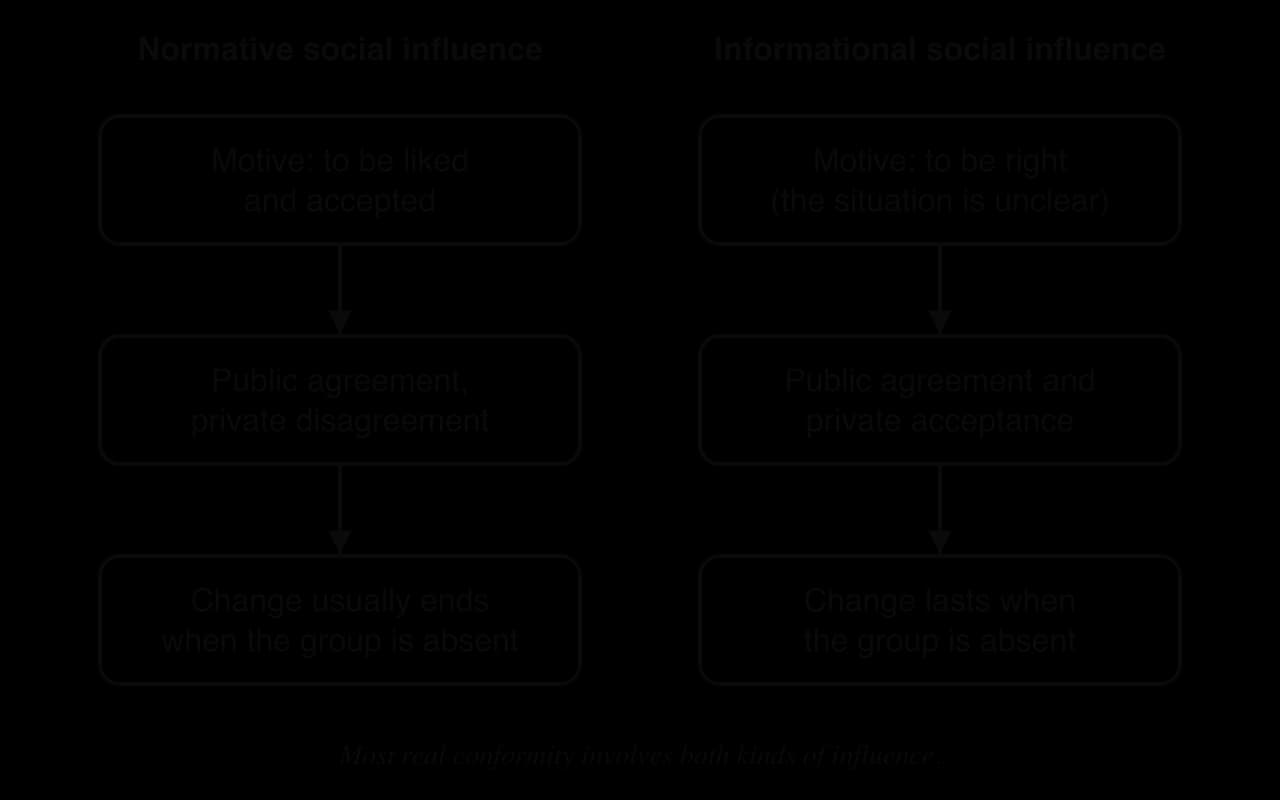
Explain the process of conformity through normative and informational social influence, and the levels of conformity they produce.
Describe the aim, method, results and conclusions of Asch’s line-judgement experiments.
Explain how situational factors (group size, unanimity, task difficulty, public responding and group membership) affect conformity.
Discuss cultural, historical and individual differences in conformity.
Explain how a consistent minority can influence a majority.
Evaluate research on conformity with reference to measurement, bias, causality and responsibility.
Apply conformity to examples of behaviour in health, development, relationships and learning.
Conformity is a change in a person’s behaviour or beliefs so that they match those of a group. It helps to explain behaviour as ordinary as clapping when an audience starts to clap and as serious as a teenager starting to smoke because their friends smoke, or a member of a committee staying silent about a decision they privately think is wrong.
Conformity is a central idea of the sociocultural approach, which explains behaviour through the groups and cultures people belong to. It is one form of social influence, and it shows how strongly behaviour depends on social norms, the shared and often unwritten rules of a group. Research on conformity raises questions of measurement (a laboratory task must stand in for real group pressure), bias (most classic studies used American students in the 1950s) and responsibility (studying group pressure usually means deceiving participants).
With a free account, Augment remembers where you stopped and what you have practiced.
People conform when they act or think differently because of real or imagined pressure from a group. The pressure does not have to be stated. In most situations nobody asks the person to agree; the influence comes from the person’s own reading of what the group expects or believes. A new employee who starts arriving early because everyone else does is conforming, even though no colleague has said a word about it.
Conformity is one of several forms of social influence, and the differences between them lie in where the pressure comes from. Compliance is a change in behaviour in response to a direct request, often from someone with no special status, such as a salesperson. Obedience is a change in behaviour in response to an order from a person seen as having legitimate authority, such as a police officer or a teacher. In conformity there is neither a request nor an order, only the example of the group, usually made up of people of similar status.
Form of social influence | Source of pressure | Status of the source | Example |
|---|---|---|---|
Conformity | The behaviour or opinions of a group | Usually equals (peers) | Wearing the same style of clothes as classmates |
Compliance | A direct request | Anyone; often a stranger | Signing a petition when a stranger asks |
Obedience | A direct order | An authority figure | Leaving a building when a fire officer tells people to |
Conformity can be shallow or deep. Kelman (1958) described three levels that differ in how far the person’s private beliefs change. The shallowest level is often called compliance in textbooks. Because that use of the word differs from compliance with a request, the shallowest level is referred to as public compliance.
Public compliance: the person goes along with the group in public but privately disagrees. The behaviour usually stops when the group is no longer watching.
Identification: the person adopts the group’s behaviour and views because they value the group and want to be a member of it. The change lasts as long as the person wants to belong.
Internalisation: the person comes to accept the group’s view as genuinely correct. Belief and behaviour both change, and the change lasts when the group is absent.
The levels matter because the same visible behaviour can hide very different inner states. Two students who both laugh at a teacher’s joke may be conforming at different levels: one finds it funny because the class does (internalisation), the other laughs only to avoid standing out (public compliance). Researchers who want to know which level has occurred have to compare what people do in public with what they say or do in private.
Deutsch and Gerard (1955) proposed that people conform for two different reasons. Their distinction, often called the dual-process explanation of conformity, is still the most widely used account of the process. Both kinds of influence often operate at the same time, but they lead to different levels of conformity.
In normative social influence the person wants to be liked and accepted by the group and to avoid rejection, ridicule or conflict. Humans are a social species, and exclusion from a group is unpleasant; going along with the group is a way to keep a place in it. Because the motive is acceptance rather than accuracy, normative influence usually produces public compliance: the person agrees in public while privately keeping their own view.
Normative influence is strongest when the person’s response is public, when the group matters to them, and when the group can see and judge them. It is weaker when responses are anonymous, for example in a secret ballot or an anonymous online survey.
In informational social influence the person is unsure of the right answer and treats the group as a source of information. Other people’s views are often good evidence about reality: if everyone in a building runs towards the exits, there is probably a fire. Because the person comes to believe the group is right, their private opinion changes as well as their public behaviour, which is internalisation.
Informational influence is strongest when a situation is ambiguous, when a task is difficult, in a crisis where there is no time to think, and when others seem to be experts. Using other people as a guide is usually an efficient mental shortcut, which explains why informational influence is so common. When the whole group is wrong, however, the same shortcut spreads the error.
Sherif (1935) used the autokinetic effect: in a completely dark room, a stationary point of light appears to move. Participants estimated how far the light moved, first alone and then in groups of two or three who called out their estimates. Individual estimates varied widely at first, but in groups they quickly converged on a shared group norm. When participants were later tested alone again, they kept to the group norm.
Because there was no correct answer, participants could only use one another as a guide, which is informational influence. The persistence of the norm when the group had gone shows that private judgement had changed, not just public answers. Critics pointed out, however, that agreeing with others on an impossible task may simply be sensible, and Asch designed his own research partly to test whether people would conform when the right answer was obvious.
 YouTube
Solomon Asch ran a series of experiments in the early 1950s, reported in a book chapter in 1951, a magazine article in 1955 and a long monograph in 1956. They are the best-known demonstration that people will publicly deny the evidence of their own eyes to agree with a unanimous group.
Asch aimed to find out whether people would give an answer they could see was wrong in order to agree with a unanimous majority, on a task where the right answer was obvious. He chose an unambiguous task deliberately, so that any agreement with the group could not be explained by informational influence in the way Sherif’s results could.
The research was a laboratory experiment. In the first study, 50 male college students each took part in a group of eight people. All the other group members were confederates, people working for the researcher and following a script. Later reports (Asch, 1955, 1956) describe a larger series of 123 male students from three American institutions of higher education.
On each trial the group saw two cards: a standard line and three comparison lines of clearly different lengths. Each person said aloud, in turn, which comparison line matched the standard. The real participant was seated so that he answered last or second to last, after hearing most of the confederates.
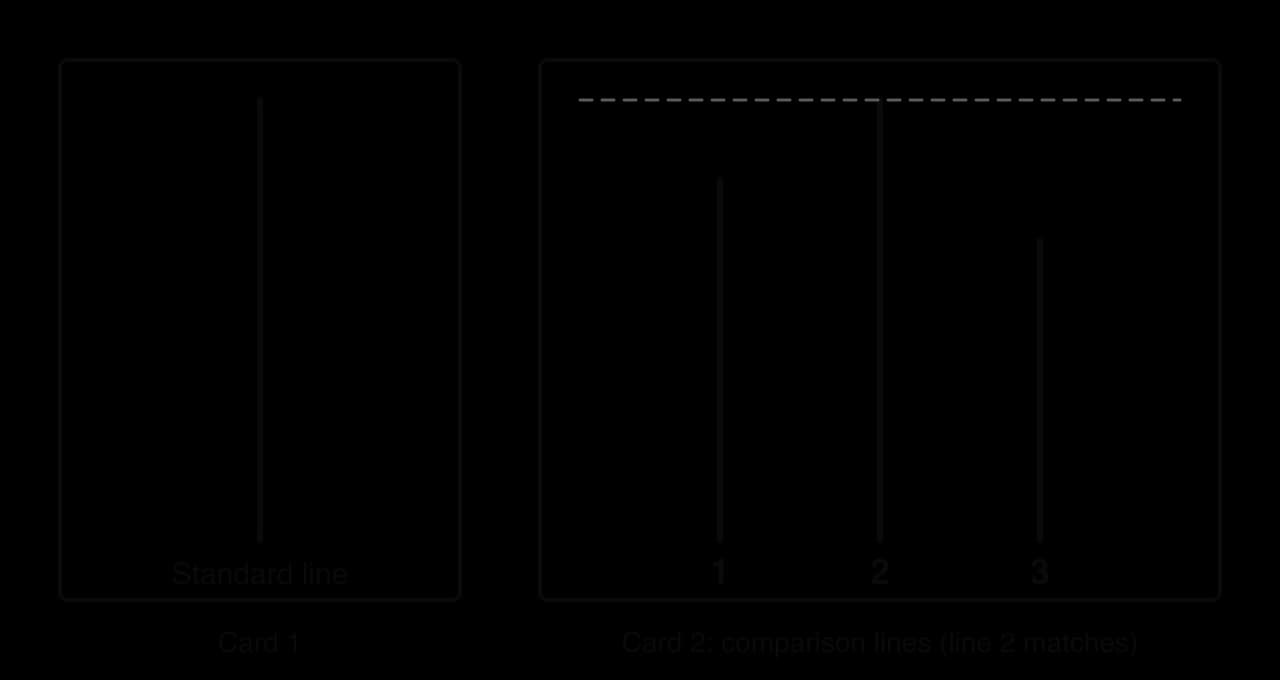
There were 18 trials. On 6 neutral trials the confederates gave the right answer; on 12 critical trials they all gave the same wrong answer. Conformity was operationalised as the percentage of critical trials on which the participant gave the majority’s wrong answer. A control group of 37 people made the same judgements alone, with no confederates. After the experiment Asch interviewed participants about their experience and then told them the purpose of the study.
Measure | Result |
|---|---|
Errors when judging alone (control group) | under 1% of judgements |
Conforming answers on critical trials, unanimous majority | about one third (36.8% in the series of 123 participants) |
Participants who conformed at least once | about 75% |
Participants who never conformed | about 25% |
Participants who conformed on nearly every critical trial | a small minority (about 5% on all 12) |
Sources: Asch, S. E. (1951), in H. Guetzkow (Ed.), _Groups, Leadership and Men; Asch, S. E. (1955), Opinions and social pressure, Scientific American, 193(5), 31–35; Asch, S. E. (1956), Studies of independence and conformity: a minority of one against a unanimous majority, Psychological Monographs, 70(9)._
Almost no errors were made when participants judged alone, which shows the task was easy. With a unanimous majority, about a third of answers on critical trials followed the group. Individual differences were large: about a quarter of participants stayed independent throughout, while a few went along with the group almost every time. Asch himself stressed that most answers, about two thirds, were independent.
The interviews helped to explain why people conformed. Asch described three kinds of yielding. A very small number reported distortion of perception: they said they had seen the lines as the majority did. More reported distortion of judgement: they saw the lines correctly but decided their own perception must be faulty. The largest group reported distortion of action: they knew the majority was wrong but went along with it so as not to stand out. Independent participants also described doubt and tension, and many said they felt relieved when the experiment ended.
Even when the correct answer is obvious, a unanimous majority produces a substantial amount of conformity. Because the task was unambiguous, most of this conformity is explained by normative social influence: participants gave wrong answers in public while privately keeping their own view, which is public compliance. The small number who doubted their own perception show that informational influence played some part even on an easy task.
The procedure was standardised: the confederates’ answers were scripted, the order of trials was fixed, and the only thing that differed between the experimental and control conditions was the presence of the wrong-answering majority. The control group’s near-perfect accuracy rules out the explanation that the lines were hard to judge, so the majority can be identified as the cause of the errors. Asch’s later variations, each changing one feature of the situation, strengthen this causal reasoning.
Conformity was operationalised as public wrong answers on critical trials. This is a clear and reliable measure, but it captures public behaviour, not private belief, so on its own it cannot separate public compliance from internalisation. The interviews added qualitative data on participants’ reasons, but they were collected after the participants knew they had been deceived, which may have shaped how they explained themselves. Judging lines in front of strangers also has low ecological validity: real conformity usually happens with friends, about things that matter and over long periods.
All participants were young American men, mostly students, tested in the early 1950s, a period of strong social pressure to conform in the United States. This is a sampling bias and a possible gender bias and cultural bias. Perrin and Spencer (1981) repeated the procedure with British science and engineering students and found only one conforming answer in 396 critical trials. When they tested young men on probation, with probation officers as confederates, conformity rose to levels similar to Asch’s. The size of the effect therefore depends on who is tested and on what it costs them to disagree.
Participants were deceived about the purpose of the study and about the confederates, so they could not give fully informed consent. Many showed signs of stress, such as sweating, nervous laughter and fidgeting. Asch did interview and inform participants afterwards (debriefing), and the stress was brief, but the study would need strong justification before an ethics committee today. Because of these risks, conformity studies are not suitable as class practicals in schools.
 YouTube
Asch’s variations each changed one feature of the situation and measured the effect on conformity. Later research added further factors. Together they show that the level of conformity depends heavily on the situation, in line with the sociocultural approach’s emphasis on social context.
With only one confederate giving the wrong answer, participants erred on just 3.6% of critical trials. Errors rose to 13.6% with two confederates and 31.8% with three, and larger majorities, up to 15 people, made little further difference, as the chart shows. A single opponent is easy to dismiss as odd; three people agreeing look like a real group with a shared view, and each extra person after that adds less new pressure.
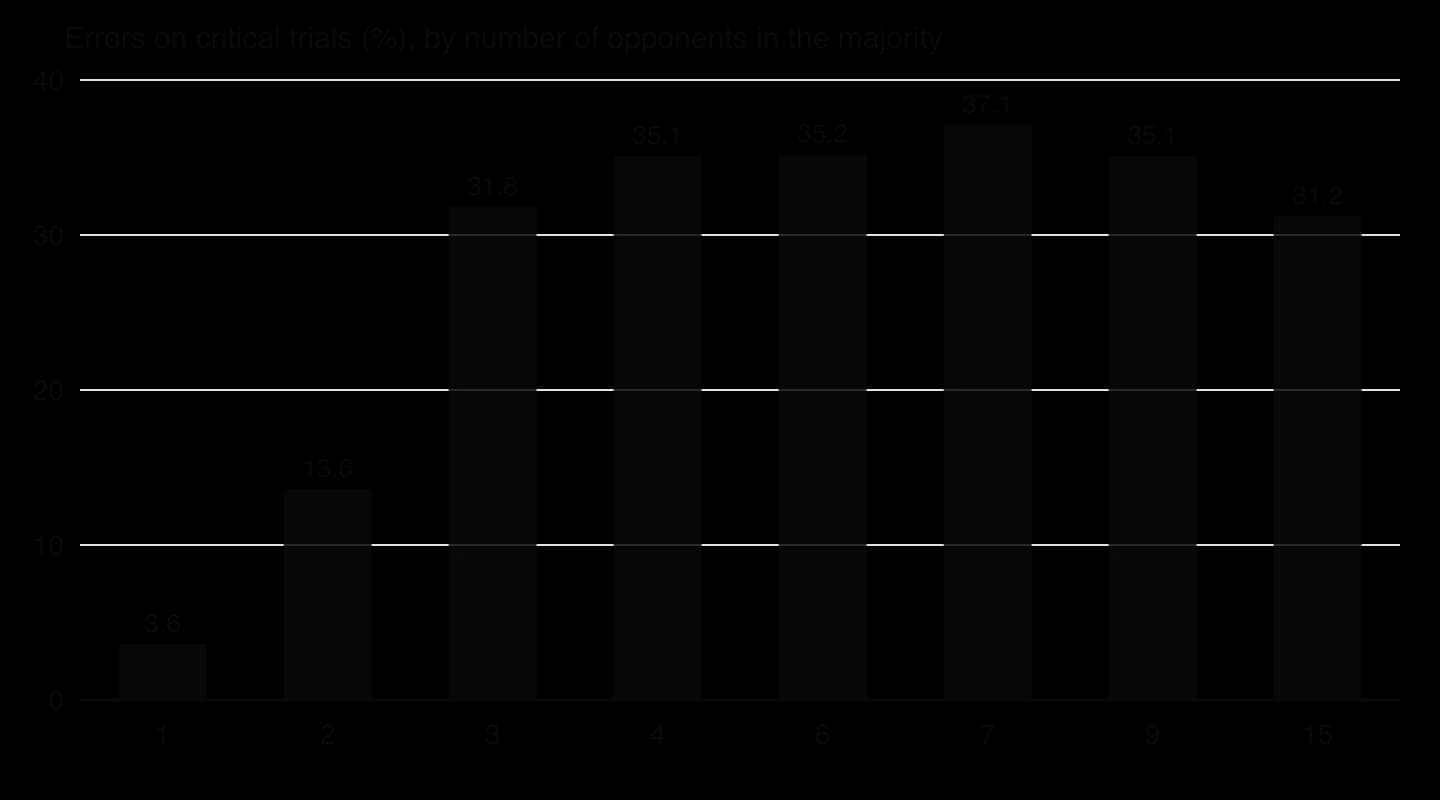
Social impact theory, proposed by Latané (1981), explains this pattern. It states that the impact of a group on a person depends on three things: the strength of the sources (their status or importance to the person), their immediacy (how close they are in space and time) and their number. The effect of number follows a curve of diminishing returns: the first few people have a large effect and each additional person adds less than the one before.
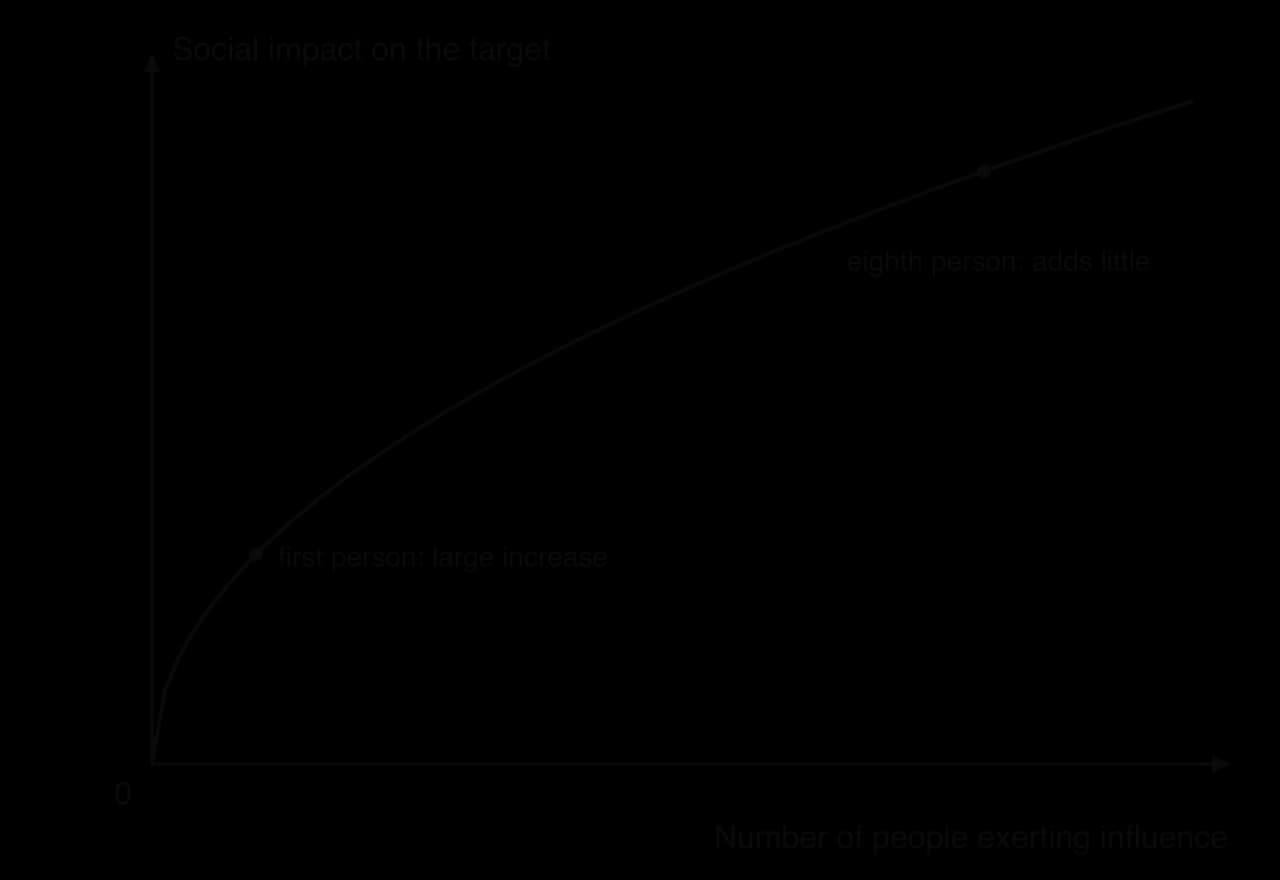
Social impact theory is useful because it makes precise, testable predictions from three simple factors, and it applies to many kinds of social influence, not only conformity. Its main limitation is that it treats the target as passive. It predicts how much pressure a person receives, but not how the person interprets that pressure, so it cannot easily explain why a single ally, who barely changes the number of sources, has such a large effect. It also says little about whether the influence at work is normative or informational.
When one other group member gave the correct answer throughout, errors fell to about a quarter of their level with a unanimous majority. Even a dissenter who gave a *different*, more extreme wrong answer reduced errors to 9%, which shows that breaking the group’s unanimity matters more than supporting the participant’s view. When the ally “deserted” halfway through and joined the majority, conformity rose again. A single dissenter seems to give others permission to disagree, and it removes the fear of being the only one to stand out.
When Asch made the comparison lines closer in length, so that the task was harder, conformity increased. Uncertainty makes the group’s answer more useful as information, so informational influence adds to normative influence. The same pattern appears in Sherif’s ambiguous task, and in everyday life: people are most likely to follow others when they are unsure, for example when choosing a restaurant in an unfamiliar city.
When participants could write their answers privately instead of saying them aloud, conformity fell sharply. Deutsch and Gerard (1955) found the same pattern: participants who answered anonymously conformed much less than those who answered face to face. Because a change in how visible the answer is should not affect the wish to be right, this finding is strong evidence that much of the conformity in Asch-type tasks is normative.
People conform more to groups they belong to. Abrams et al. (1990) found that psychology students conformed far more in an Asch-type task when the confederates were presented as fellow psychology students (an in-group) than when they were presented as students from another discipline, especially when answers were public. When answers were private, conformity to the in-group fell.
Self-categorisation theory, an extension of social identity theory, explains this. People learn what to think by working out who they are: when they categorise themselves as members of a group, the group’s norms become their own standard of what is correct. Influence from people outside the group carries much less weight. On this view, conformity partly expresses group identity, as well as responding to the number of people in the majority.
Bond and Smith (1996) carried out a meta-analysis of 133 Asch-type studies from 17 countries. Conformity was higher in countries scoring high on collectivism, which values group harmony and interdependence, than in countries scoring high on individualism, which values independence and self-expression. The cultural dimension explained more of the variation between studies than most features of the procedure.
One explanation is that in collectivist cultures the self is defined through relationships, so disagreeing with the group threatens something important and normative influence is stronger. Another is that agreeing with others is valued differently. In many cultures, going along with the group in public is seen as tact or sensitivity rather than weakness, so labelling it as “conformity”, a word with negative overtones in English, imposes a Western value judgement on the behaviour. This is an example of an imposed etic.
The meta-analysis measured culture with national scores, so it cannot show that the individuals in each study were more collectivist. Treating a national average as a description of individuals is the ecological fallacy. The finding is also correlational at the level of countries, so other national differences, such as education systems, could explain part of the pattern.
Bond and Smith also found that conformity in American studies had declined steadily since the 1950s. Together with Perrin and Spencer’s British results, this suggests that Asch’s figure was partly a product of its time and place. Conformity has not disappeared, however. Franzen and Mader (2023) repeated the procedure with 202 university students and found conformity on about a third of trials, close to Asch’s rate, when there was no reward for correct answers; when correct answers earned money, conformity fell to about a quarter.
Some studies found that women conformed slightly more than men, but the difference is small and depends on the situation. It is larger in face-to-face groups where answers are public, and smaller or absent when answers are private, which suggests that it reflects social roles and expectations about agreeableness rather than a fixed sex difference. Mori and Arai (2010) avoided confederates altogether in a Japanese replication: participants wore glasses with filters that made one person see a different line as correct. Women conformed at levels similar to Asch’s, while men did not.
Individual characteristics also matter. People who are confident in their ability on the task, or who have expertise in it, conform less; people with a strong need for social approval conform more. Asch’s large individual differences, with a quarter never conforming, show that the situation shapes behaviour without fully determining it.
Asch’s research focused on a majority influencing an individual, yet many changes in society began with a small group whose views were rejected at first. Minority influence is the process by which a smaller group changes the views of a majority. It works mainly through informational influence: a minority that keeps to its position makes the majority think about why, and this can lead to conversion, a private change of view that may not show in public at first.
Moscovici, Lage and Naffrechoux (1969) tested this with groups of six female students in France, four real participants and two confederates. Each group named the colour of 36 slides that were all blue but varied in brightness. When the two confederates consistently called every slide “green”, 8.42% of the real participants’ answers were also “green”, and about a third of participants said “green” at least once. When the confederates were inconsistent, calling 24 slides green and 12 blue, only 1.25% of answers were “green”.
The study shows that consistency is central to minority influence, because an inconsistent minority had almost no effect. The effect is much smaller than majority influence in Asch’s studies, since the minority lacks the numbers that create normative pressure. How minorities influence groups over time, and what makes them succeed, is developed further in research on group behaviour.
Moscovici’s study shares the strengths and weaknesses of Asch’s research: a controlled, standardised procedure, but a trivial task, deception about the confederates and a narrow sample, in this case female students only. The effect was also small, since more than 90% of answers in the consistent condition were still “blue”.
Wood et al. (1994) carried out a meta-analysis of 97 minority influence experiments. Minorities had their greatest effect on measures that were private and only indirectly related to their message, and less effect on public measures. This supports Moscovici’s idea of private conversion: people avoid being publicly linked with a deviant minority while still being changed by its arguments. Minorities seen as especially consistent were the most influential.
Asch’s interviews suggested that a few participants actually saw the lines differently. Berns et al. (2005) used functional magnetic resonance imaging to test whether social pressure can alter perception itself. Participants judged whether two rotated three-dimensional shapes were the same, after seeing the answers of four peers who were in fact controlled by the researchers. When participants conformed to wrong answers, the changes in brain activity were found mainly in occipital and parietal areas involved in visual and spatial perception, rather than in frontal areas linked to deliberate decisions. When participants went against the group, there was increased activity in the amygdala, a structure linked to emotional responses.
The authors concluded that conformity may involve a change in perception, and that independence carries an emotional cost. These conclusions are contested. fMRI measures changes in blood oxygen rather than thoughts, and inferring a mental process such as “seeing differently” from activity in an area is uncertain. The mental-rotation task was also much harder than Asch’s lines, so informational influence was more likely. The study is still useful because it shows how a sociocultural process can be studied with biological measures, and it supports an interactionist account in which social, cognitive and biological factors work together.
Conformity is a general process, so it appears wherever people live and work in groups. Short examples from each context show how the same two kinds of influence explain different behaviours.
Context | Example of conformity | Main kind of influence |
|---|---|---|
Health and well-being | Adolescents overestimate how many of their peers drink alcohol or smoke and adjust their own behaviour towards this imagined norm. Health campaigns based on the social norms approach correct the misperception by publicising the real figures. | Normative (fitting in), based on a mistaken belief about the norm |
Human development | Children and adolescents adopt the clothing, slang and attitudes of their peer group; peer influence on risk taking is stronger in adolescence than in adulthood. | Mainly normative, with identification with the peer group |
Human relationships | Members of a close-knit team stop questioning a leader’s plan, and a committee reaches a poor decision that no one privately supported. | Normative pressure for agreement within a cohesive group |
Learning and cognition | Witnesses who discuss a crime with each other later report details they did not see themselves but heard from a co-witness (memory conformity). | Informational: another person’s account is treated as evidence |
The examples also show that conformity is not simply bad. Following others is often an efficient way to learn what is safe, polite or correct, and shared norms let groups coordinate without constant negotiation. Conformity becomes harmful when the group norm is wrong, as in the spread of unhealthy habits, or when it stops members from voicing information the group needs.
Research on conformity is among the most replicated in social psychology, but most of it comes from a narrow range of laboratory tasks. The six concepts give a structure for weighing its strengths and limitations.
Concept | How it applies to conformity research |
|---|---|
Causality | Asch’s standardised procedure, control group and one-at-a-time variations identify the majority, its size and its unanimity as causes of conformity. Cultural comparisons such as Bond and Smith (1996) are correlational, so culture cannot be shown to be the cause. |
Measurement | Conformity is usually operationalised as public wrong answers on a simple task, which measures public behaviour, not private belief. Private-response conditions, interviews and brain imaging are attempts to measure the deeper levels of conformity. |
Bias | Classic samples were American, young and often all of one sex (Asch: men; Moscovici: women). Labelling agreement with the group as “conformity” can reflect a Western, individualist value judgement. |
Change | Conformity levels have changed over time and differ between cultures, and minority influence explains how group norms themselves change. |
Perspective | Sociocultural (norms, culture, identity), cognitive (use of others as information, self-categorisation) and biological (perceptual and emotional brain activity) perspectives each explain part of conformity. |
Responsibility | Studying group pressure usually requires deception and causes brief stress; research findings also carry responsibility when they are used in campaigns that try to change behaviour. |
Conformity in Asch-type tasks has been found in many countries and decades, and the factors that increase or reduce it (unanimity, group size, public responding, task difficulty, in-group membership) are well established. Franzen and Mader’s (2023) results show that the basic effect still appears today. This replication across time and place gives confidence that conformity is a real and general process, even though its size varies. The knowledge has practical uses: it explains why one dissenting voice on a jury or a board can matter, and why anonymous voting produces more honest judgements.
Most studies use trivial tasks, such as judging lines or colours, with strangers whom participants will never meet again. Conformity among friends, about political or moral issues and over months or years may work differently. The direction of the error is not clear: real groups that people care about may produce more conformity than a laboratory, because the costs of disagreeing are higher, or less, because people have more confidence in their views on issues that matter to them.
Because participants who know they are in a conformity study would behave differently, deception is almost unavoidable, a clear case of demand characteristics being controlled at an ethical cost. Researchers have tried to reduce the costs by using brief tasks, debriefing fully and, as Mori and Arai did, removing confederates altogether. These constraints also explain why conformity research relies so heavily on short laboratory tasks.
Conformity is an approach term, so it can be examined in Paper 1 Section A without a context (“Explain conformity with reference to one example of human behaviour”) and in Section B inside an unseen scenario from any of the four contexts. Research on conformity can also be used as evidence in a concept-based essay on group behaviour, and Asch-type studies are useful material for evaluating an unseen study in Paper 2.
Conformity is a change in behaviour or belief to match a group because of real or imagined group pressure, without a request (compliance) or an order (obedience).
Normative social influence (the wish to be accepted) usually produces public compliance; informational social influence (the wish to be right) produces internalisation.
Sherif’s autokinetic studies show informational influence on an ambiguous task; Asch’s line studies show mainly normative influence on an obvious one.
Asch found about a third of answers conformed to a unanimous wrong majority, against under 1% errors alone; about 75% of participants conformed at least once and about 25% never did.
Conformity rises with group size up to about three, falls sharply when one person dissents, rises with task difficulty and falls with private responding; people conform more to in-groups.
Conformity is higher in collectivist countries and has declined in the US since the 1950s, but the basic effect still replicates today.
A consistent minority can change the majority’s views through informational influence and private conversion.
Conformity research is evaluated through causality (controlled variations), measurement (public answers only), bias (narrow samples, Western framing) and responsibility (deception and stress).
I can describe conformity and explain how it differs from compliance and obedience.
I can explain normative and informational social influence and the levels of conformity they produce.
I can describe the aim, method, results and conclusions of Asch’s line-judgement experiments.
I can explain how group size, unanimity, task difficulty, public responding and group membership affect conformity.
I can discuss cultural, historical and individual differences in conformity, with their limitations.
I can explain how a consistent minority influences a majority.
I can evaluate conformity research with reference to measurement, bias, causality and responsibility.
I can apply conformity to an unfamiliar scenario in any of the four contexts.