 YouTube
Explain what the etic approach is and why researchers use it, and evaluate its limitations, including imposed etic bias, measurement non-equivalence and ethnocentrism, using Buss’s 37-culture study and other cross-cultural research.
Each is in the Psychology glossary, with every other term in the subject.
Research that compares behaviour or mental processes in two or more cultures, using the same method or measure in each, to find out which findings are universal and which are culturally specific.
A cross-cultural comparison built from the features that several emic studies show to be genuinely shared by the cultures being compared, rather than imposed from one culture.
The tendency to judge other cultures by the standards and values of one’s own culture, often treating one’s own way of thinking or behaving as normal or superior.
An approach to research that studies behaviour from outside a culture, using concepts and standardised measures assumed to apply to all cultures, so that different cultures can be compared.
The error of applying a concept or measure developed in one culture to another culture as if it were universal, without checking whether it has the same meaning or relevance there.
The degree to which a measure, such as a translated questionnaire, assesses the same construct in the same way in different cultures, so that scores can be fairly compared.
Describe the etic approach and explain why researchers use it in cross-cultural research.
Explain the difference between imposed etic and derived etic.
Explain the limitations of etic approaches, including imposed etic bias, measurement non-equivalence, ethnocentrism and unrepresentative samples.
Describe the aim, method, results and conclusions of Buss’s study of mate preferences in 37 cultures.
Evaluate etic research with reference to measurement, bias, perspective and causality.
Explain how researchers can reduce the limitations of etic approaches.
Apply the limitations of the etic approach to an unfamiliar research scenario in one of the contexts.
The etic approach studies behaviour from outside a culture, using concepts and standardised measures that are assumed to apply to all cultures so that different cultures can be compared. Most large cross-cultural studies in the sociocultural approach are etic, and they are the main way of finding out whether a finding is universal or culturally specific.
The approach has important limitations, because the concepts and measures usually come from one culture, most often a Western one, and may not mean the same thing elsewhere. These limitations connect the etic approach to the concepts of measurement, bias and perspective, and to the complementary emic approach, which studies a culture from the inside.
With a free account, Augment remembers where you stopped and what you have practiced.
An etic researcher begins with a concept and a measure, such as a definition of depression and a diagnostic interview, or a list of mate preferences and a rating scale, and applies the same concept and measure in several cultures. Because every participant answers the same questions or performs the same task, the results can be placed on a common scale and compared.
The terms “emic” and “etic” come from the linguist Kenneth Pike, who based them on the difference between phonemics (the sound differences that matter in one language) and phonetics (a single system for describing all human speech sounds). An etic description, like a phonetic one, uses one set of categories for everyone. Its value depends on whether those categories really fit every culture to which they are applied.
The etic approach is the basis of most cross-cultural research. A cross-cultural study compares two or more cultures on the same variable, often as a quasi-experiment in which culture acts as the independent variable. If a behaviour appears in the same form in all the cultures studied, it may be universal; if it varies, the variation can be linked to features of the cultures, such as their values or their ecology.
Study | What was compared | Etic features |
|---|---|---|
Hofstede (1980): IBM survey | Work-related values in 40, later 50, countries | One questionnaire, translated; country scores on shared dimensions |
Buss (1989): mate preferences | Ratings of qualities in a partner in 37 samples | One rating scale and ranking task, translated and back-translated |
Weissman et al. (1996): depression rates | Lifetime rates of major depression in 10 countries | One structured diagnostic interview based on Western diagnostic criteria |
Segall, Campbell and Herskovits (1963): visual illusions | Susceptibility to illusions in 16 cultural samples | The same line drawings shown to every group |
Comparison. Only a shared measure allows the question “Is this behaviour more common in culture A than in culture B?” to be answered.
Testing universality. Theories that claim to describe human nature, such as evolutionary theories of mate choice, can be tested only by applying the same measure across many cultures.
Large samples and statistics. Standardised questionnaires can be given to thousands of people, producing quantitative data that can be analysed statistically and replicated.
Efficiency. An etic study of 37 cultures can be done with one instrument, whereas emic study of each culture would take years.
These strengths explain why etic research dominates the field. Its limitations all arise because comparison requires an assumption that the concepts and measures mean the same thing everywhere.
The most important limitation of the etic approach is that the “universal” concepts it applies are rarely universal in origin. They are usually developed in one culture, studied emically there, and then assumed to fit everywhere. John Berry (1969) called this an imposed etic: a concept or measure from one culture imposed on another without checking that it has the same meaning or relevance there.
Imposed etic bias leads to two kinds of error. A behaviour may be misread, because it is interpreted through categories that do not fit, or it may be missed, because the measure contains no category for it. In both cases the comparison produces numbers that look objective but describe the researcher’s culture as much as the participants’.
The Strange Situation was developed in the United States to classify infants’ attachment by observing their reactions to brief separations from, and reunions with, their mother. Studies in Japan found more infants classified as insecure-resistant than the international average.
Takahashi (1990) tested 60 Japanese infants at 12 months and followed them to 42 months. She argued that the procedure’s key assumptions are not universal: the separations caused these infants far more than the moderate stress the procedure assumes, pushing some from secure to resistant behaviour; none showed the avoidant pattern; and the resistant infants had caught up with the others by 32 months at the latest. She linked these findings to Japanese child-rearing, in which infants were rarely separated from their mothers.
The classification system treated a reaction shaped by a different childcare practice as a sign of poorer attachment. This is a typical imposed etic error: the same procedure was used, but the situation did not have the same meaning for the participants, so the scores were not comparable and the measure lacked validity in the new setting.
Weissman et al. (1996) used the same structured diagnostic interview in population surveys of about 38,000 adults in 10 countries. Lifetime rates of major depression ranged from 1.5 per 100 adults in Taiwan to 19.0 per 100 in Beirut, although in every country rates were higher in women, and insomnia and loss of energy were common symptoms everywhere. The authors suggested that cultural differences or different risk factors affect the expression of the disorder.
The etic design makes the comparison possible but also makes it hard to interpret. If people in Taiwan express distress mainly through bodily complaints, as emic research in Chinese communities has found, an interview built around Western symptoms such as sadness and guilt may under-count depression there. The low rate could reflect a real difference, a difference in expression, or a difference in willingness to report emotional symptoms to an interviewer.
YouTubeEven when a concept exists in every culture, the measure used to capture it may not work the same way. Measurement equivalence is the degree to which a measure assesses the same construct in the same way in different cultures, so that scores can be fairly compared. It has several parts, and a study can fail on any of them.
Type of equivalence | Question it asks | How it can fail |
|---|---|---|
Conceptual | Does the construct exist and mean the same here? | A concept such as “self-esteem” or “romantic love” plays a different role in the culture |
Linguistic | Do the translated words mean the same? | A word has no exact translation or carries a different emotional tone |
Functional | Does the behaviour serve the same purpose? | Eye contact shows honesty in one culture and disrespect to elders in another |
Metric | Do the scale points mean the same? | People in some cultures avoid extreme answers or tend to agree with every statement |
Procedural | Is the testing situation equally familiar? | Questionnaires, timed tests or laboratory rooms are unfamiliar to some participants |
Translation is the most obvious problem for any translated questionnaire. A common solution is back-translation: one bilingual speaker translates the measure into the target language, a second translates it back into the original language without seeing the original, and differences between the two versions show where the meaning has changed. Buss (1989) used this method with three bilingual speakers. Back-translation shows whether the words match, but it cannot show whether the concept matters in the same way, so linguistic equivalence does not guarantee conceptual equivalence.
People in different cultures use rating scales, such as a Likert scale, differently. Some groups more often choose the middle of a scale, others more often choose the extremes, and some tend to agree with statements regardless of content (acquiescence bias). These response styles can create or hide differences between cultures. Tests can also be unequally familiar: a timed pencil-and-paper test is routine for students in some countries and strange for adults with little formal schooling, so lower scores may reflect unfamiliarity with the test rather than lower ability.
Ethnocentrism is the tendency to judge other cultures by the standards of one’s own and to treat one’s own way of thinking or behaving as normal. In etic research it appears when the researcher’s culture provides the standard against which others are measured, so that differences from it are described as deficits rather than as differences.
Ethnocentrism is strengthened by the samples on which psychological theories are built. Henrich, Heine and Norenzayan (2010) argued that most participants in psychology come from WEIRD societies (Western, Educated, Industrialised, Rich and Democratic) and that these are among the least typical populations in the world. Findings from WEIRD samples are then used as the baseline for “human” behaviour, and other cultures are compared with them.
Even simple perception was once assumed to be the same everywhere. Segall, Campbell and Herskovits (1963) showed the same line drawings, including the Müller-Lyer illusion, to 16 samples: three of European origin, twelve from Africa and one from the Philippines. The three European-derived samples were the most susceptible to the illusion and San foragers in the Kalahari the least.
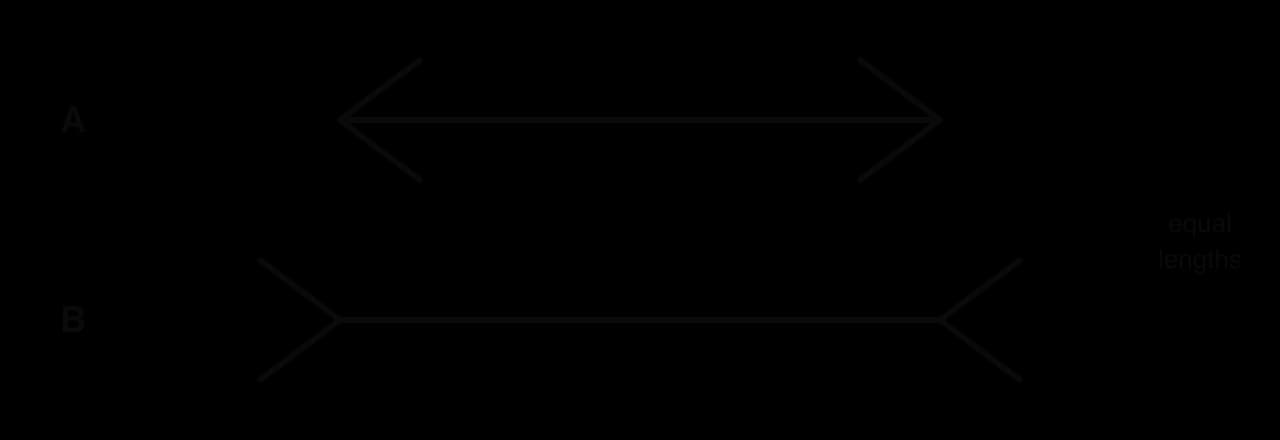
The researchers proposed the carpentered world hypothesis: people who grow up surrounded by rectangular buildings learn to read angles as cues to depth, which makes them more susceptible to the illusion. Later research, such as Jahoda’s comparison of rural and urban members of the same African group, did not always support this explanation. The study shows both sides of the etic approach: a standard test found a real cultural difference in a process assumed to be universal, but the cause of the difference remained uncertain.
 YouTube
Etic studies often compare one convenient sample from each country, usually university students, and treat it as representing the whole culture. This adds two problems: the students may differ from their own population in education, wealth and urban life, and the national samples may differ from each other in ways other than culture. When conclusions about a whole nation are drawn from such samples, and then applied to individuals, the research also risks the ecological fallacy.
An etic study can show that a difference or a similarity exists, but explaining it depends on the researcher’s theory, which is itself a product of a culture and a discipline. The same cross-cultural data can be interpreted in very different ways. When sex differences in mate preferences are found across cultures, an evolutionary psychologist may explain them as evolved adaptations, while a social role theorist may explain them as responses to the different economic positions of men and women in most societies. Buss’s study of mate preferences in 37 cultures is the classic case of this debate.
Because culture is not randomly assigned, cross-cultural comparisons are correlational in nature. Countries differ in wealth, religion, education, climate, political history and language at the same time, so any of these could explain a difference attributed to “culture”. This limits the causal conclusions that etic research can support.
Berry (1969) proposed a way of keeping the benefits of comparison while reducing imposed etic bias. The researcher starts with a concept from their own culture, accepts that applying it elsewhere is at first an imposed etic, and then studies the concept emically in each culture to learn how it is understood there. Comparison is then made only on the features that the cultures genuinely share. Berry called the result a derived etic.
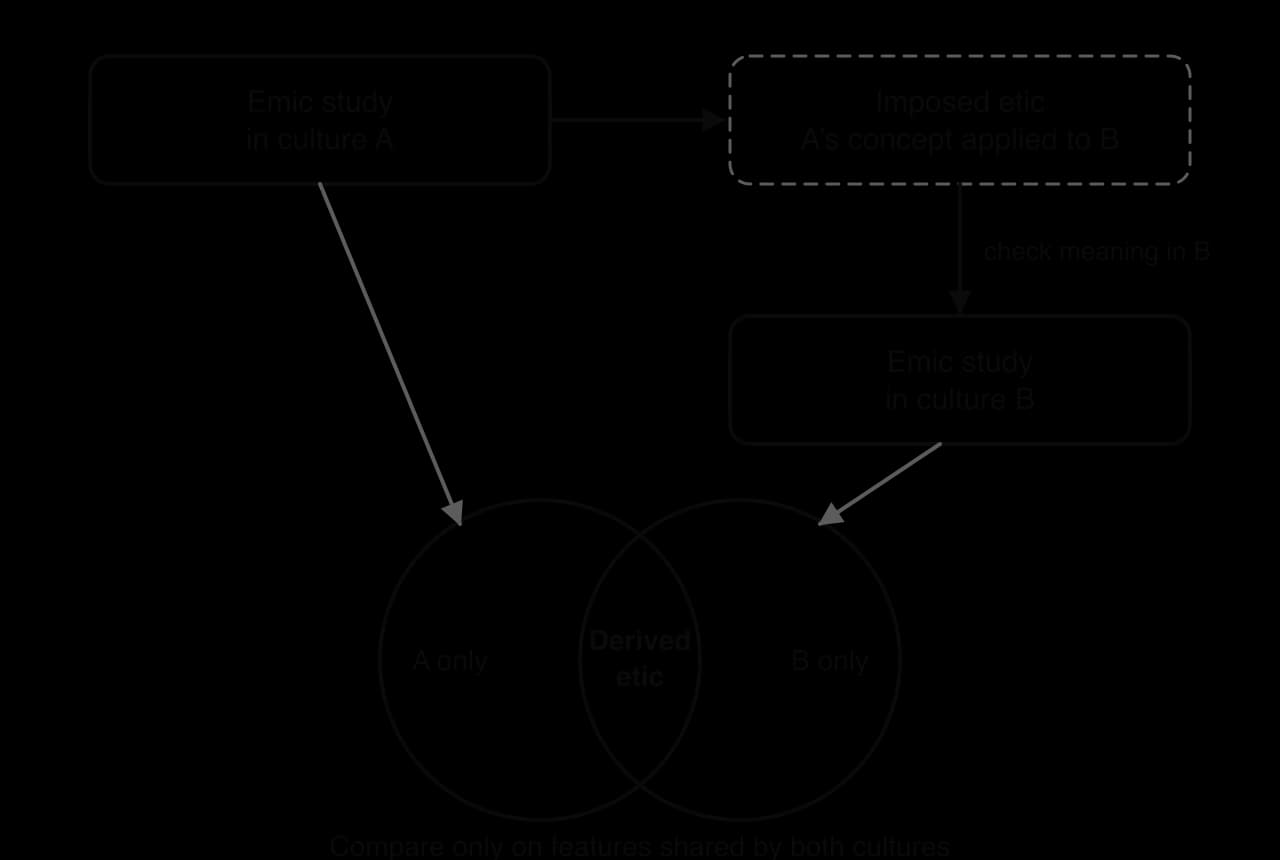
Hofstede’s dimensions illustrate both sides. The IBM questionnaire was an imposed etic instrument written by Western researchers, but the dimensions were derived statistically from the answers in many countries, and the Chinese Value Survey, written from Chinese values, added a dimension the Western questionnaire had missed. The combination moved the model closer to a derived etic.
Strategy | What it does | Limitation it addresses |
|---|---|---|
Emic pilot work (interviews, focus groups) in each culture | Finds out how the concept is understood locally before measuring it | Imposed etic; conceptual equivalence |
Back-translation by bilingual speakers | Checks that translated items match the original wording | Linguistic equivalence |
Multicultural research teams | Researchers from each culture help design and interpret the study | Ethnocentrism; interpretation |
Statistical tests of measurement invariance | Checks that items relate to each other in the same way in each culture | Metric equivalence |
Several methods (triangulation) | Combines questionnaires with observation or behavioural data | Response styles; self-report bias |
Measuring values in each participant | Tests whether individuals who hold a value behave differently | Ecological fallacy; confounds between countries |
These strategies reduce the limitations but cannot remove them entirely. Testing whether a measure is equivalent across 37 cultures, for instance, would require emic work in each, which few studies can afford. For this reason many researchers see the emic and etic approaches as two stages of the same process rather than as rivals.
David Buss aimed to test five predictions about sex differences in mate preferences derived from evolutionary theory. He predicted that women would value cues to a partner’s ability to acquire resources (good earning capacity, ambition and industriousness) more than men would, and that men would value cues to reproductive capacity (youth and physical attractiveness) and chastity more than women would. Testing whether these differences appear across very different cultures required an etic design.
Collaborators in 33 countries on six continents and five islands collected data from 37 samples, with a total of 10,047 participants (4,601 men and 5,446 women). Sample sizes ranged from 55 in Iran to 1,491 in the mainland United States, and mean ages from about 17 in New Zealand to about 29 in West Germany. Sampling methods varied: some samples were university students, while others included couples applying for a marriage licence in Estonia, households visited door to door in Venezuela and rural Zulu participants in South Africa, some of whom had the questions read aloud.
Participants completed two instruments. In the first, they rated 18 characteristics, including “good financial prospect”, “good looks”, “chastity: no previous experience in sexual intercourse” and “ambition and industriousness”, on a scale from 0 (irrelevant or unimportant) to 3 (indispensable), and gave their preferred age at marriage and preferred age difference from a spouse. In the second, they ranked 13 characteristics from most to least desirable. The instruments were translated by one bilingual speaker, back-translated by a second and checked by a third, and the collaborators did not know the hypotheses.
Some instruments had to be adapted: questions about marriage were changed in Sweden, where many couples live together without marrying, and questions about multiple wives were added in Nigeria, where polygyny is practised. As a check on validity, the preferred age differences were compared with official statistics on the actual ages of brides and grooms in 27 countries.
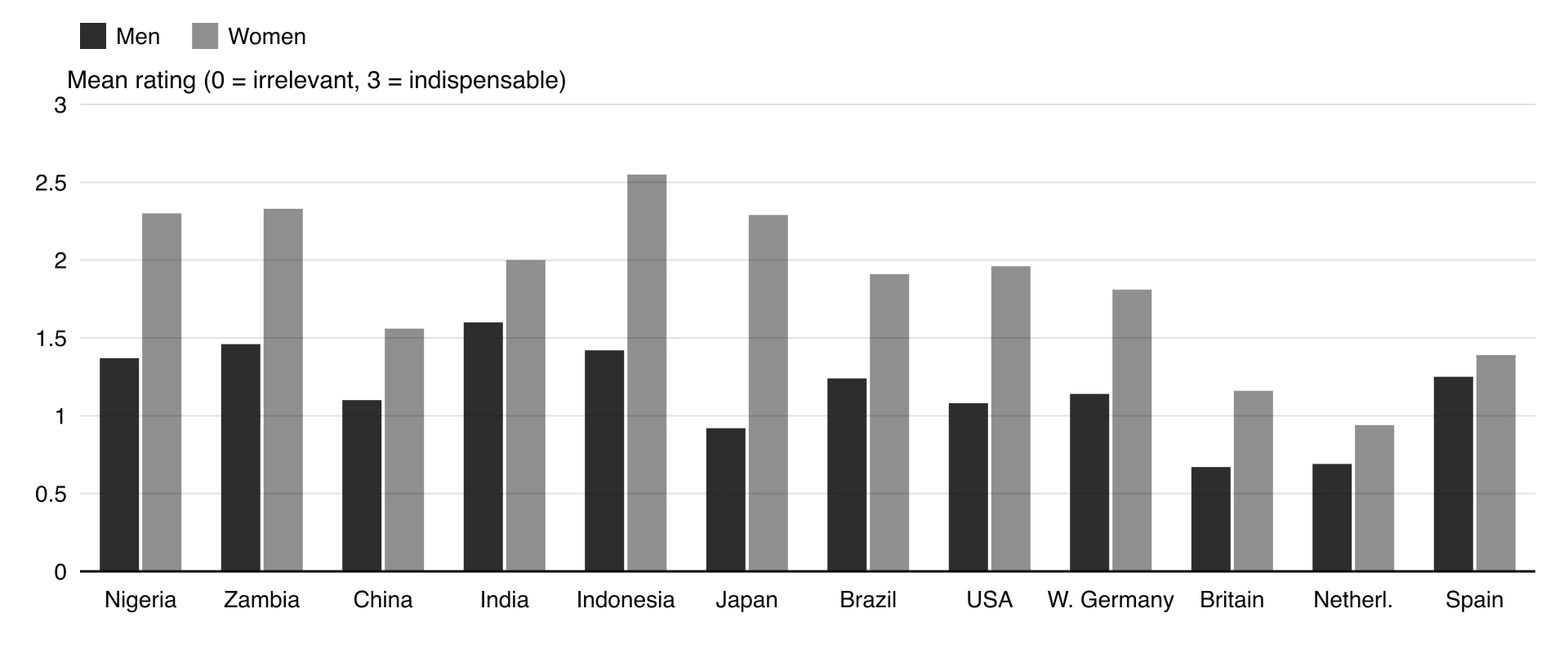
Women rated good financial prospect more highly than men did in 36 of the 37 samples; the only exception was Spain, where the difference was in the same direction but not statistically significant. Women also valued ambition and industriousness more in 29 samples. Men rated good looks more highly than women in all 37 samples (significantly in 34), and in every sample men preferred younger partners and women preferred older partners. On average men preferred a wife about 2.7 years younger, and women a husband about 3.4 years older, close to the actual average age gap at marriage of about 3 years.
Chastity showed the most cultural variation. Men valued it significantly more than women in 23 of the 37 samples (62%). In samples from China, India, Indonesia, Iran and Taiwan both sexes rated it as very important, while in samples from northern Europe, such as Sweden, Norway, Finland and the Netherlands, both sexes rated it as almost irrelevant.
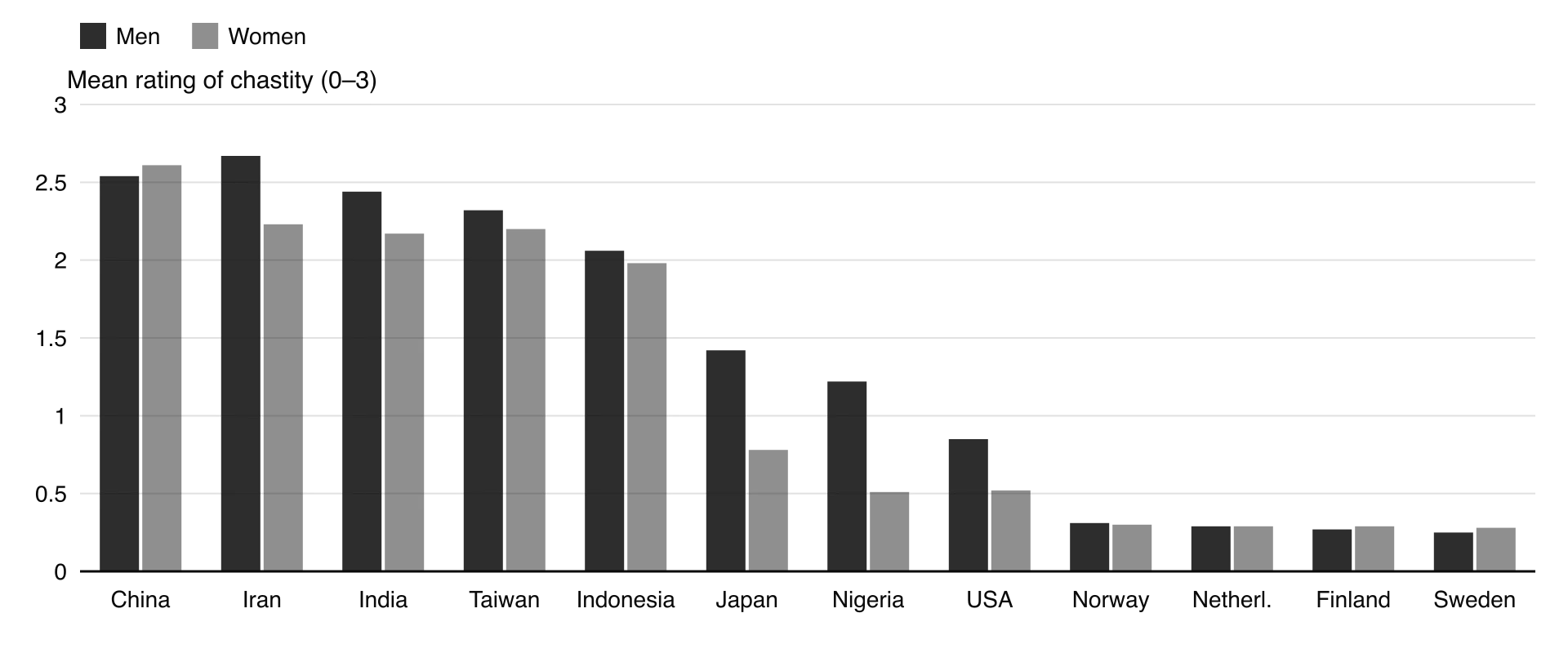
Sources: Buss, D. M. (1989). Sex differences in human mate preferences: evolutionary hypotheses tested in 37 cultures. _Behavioral and Brain Sciences, 12(1), 1–49._
Buss concluded that the sex differences in preferences for resources, youth and attractiveness were found across cultures that differed widely in ecology, religion, politics and marriage systems, and were therefore likely to reflect different evolutionary pressures on men and women. Preferences for chastity, by contrast, were strongly shaped by culture. The close match between preferred and actual age differences suggested that the self-reported preferences were reflected in real marriage decisions.
Buss himself stated that the samples could not be viewed as representative of their countries: rural, less educated and lower-income people were under-represented, and many samples were opportunity samples of university students. Educated urban young people in different countries may be more similar to each other than their countries are, which could make sex differences look more universal than they are and limits the study’s generalisability. The 37 samples were also unevenly spread, with 12 from Western Europe and 4 from Africa.
The 18 characteristics came from an instrument developed in the United States over the previous fifty years. The idea of individuals freely choosing a marriage partner on the basis of personal preferences fits societies where people choose their own spouses; in societies where families arrange marriages, the questions may have measured ideals rather than the factors that actually decide who marries whom. Back-translation and adaptations (for Sweden and Nigeria) improved linguistic equivalence, but conceptual equivalence was not tested emically. The comparison with real marriage ages is a strength, because it checks self-report against behaviour.
Eagly and Wood (1999) reanalysed Buss’s data and argued that the sex differences were smaller in countries where women had more economic and political power, which supports a social role explanation: women value a partner’s resources more where their own access to resources is limited. Walter et al. (2020) replicated the study with 14,399 participants in 45 countries. The main sex differences were found again. As gender equality increased, both sexes had partners closer to their own age, but beyond age neither gender equality nor pathogen prevalence robustly predicted sex differences or preferences. The etic data show that the differences are widespread; they cannot by themselves show why.
Bringing the limitations together through the concepts shows that they are connected. A measurement problem (non-equivalence) produces a bias (an ethnocentric picture), which limits the conclusions that can be drawn about causes, and reflects the perspective of the researchers who built the measure.
Concept | Limitation of the etic approach | Example |
|---|---|---|
Measurement | Measures may lack conceptual, linguistic or metric equivalence | Strange Situation separations in Japan; self-esteem scales |
Bias | Imposed etic and ethnocentric baselines; unrepresentative samples | WEIRD samples as the norm; Buss’s educated urban samples |
Perspective | One culture’s concepts define what is studied and how it is explained | Evolutionary vs social role readings of Buss’s data |
Causality | Culture is not randomly assigned; countries differ in many ways at once | Depression rates from 1.5 to 19.0 per 100 adults |
Responsibility | Differences may be reported as deficits, stigmatising groups | Lower test scores interpreted as lower ability |
The strengths of the approach should still be weighed against these limitations. Without etic comparison, psychology could not test whether its theories apply beyond the cultures in which they were developed. Etic studies such as Segall’s illusion research and Weissman’s cross-national survey are what first showed that “universal” processes vary, which in turn prompted emic research. The most defensible conclusion is that etic research is necessary for comparison but trustworthy only when its concepts and measures have been checked emically.
The etic approach is an approach term, so it can appear in Paper 1 Section A (explaining a limitation with an example) and Section B (applying it to a research scenario in a context). It is also useful in essays on the concepts of bias, measurement and perspective, for example in research on mental health across cultures or on attachment.
The etic approach studies behaviour from outside a culture, applying the same concepts and standardised measures in several cultures so they can be compared; it is the basis of most cross-cultural research.
It allows comparison, tests of universality, large samples and statistical analysis, which emic research cannot provide.
Its main limitation is imposed etic bias: concepts from one culture are applied elsewhere without checking their meaning, as when the Strange Situation was used in Japan.
Measures may lack conceptual, linguistic, functional, metric or procedural equivalence; back-translation checks words but not concepts.
Ethnocentrism and WEIRD samples make one culture the baseline, and cultural differences such as those in the Müller-Lyer illusion show that even “basic” processes vary.
Cross-cultural comparisons are correlational, and the same data can be explained by different theories.
Buss (1989) found consistent sex differences in mate preferences across 37 samples (10,047 participants), but large cultural variation, especially for chastity; samples, an imposed etic instrument and competing interpretations limit the conclusions.
A derived etic, built from emic study of each culture, together with multicultural teams and checks of equivalence, reduces but does not remove these limitations.
I can describe the etic approach and explain why researchers use it.
I can explain the difference between imposed etic and derived etic.
I can explain imposed etic bias with an example such as the Strange Situation in Japan.
I can explain the types of measurement equivalence and why back-translation is not enough.
I can explain ethnocentrism and the problem of WEIRD samples in etic research.
I can describe the aim, method, results and conclusions of Buss (1989).
I can evaluate etic research with reference to measurement, bias, perspective and causality.
I can apply a limitation of the etic approach to a research scenario.