Explain what cultural dimensions are, describe Hofstede’s six dimensions and other models, and evaluate how far they explain cross-cultural similarities and differences in behaviour.
Each is in the Psychology glossary, with every other term in the subject.
A cultural orientation in which people see themselves mainly as members of close in-groups, such as the extended family, and give priority to group goals, loyalty and harmony over personal goals.
A measurable aspect of a culture’s shared values on which whole cultures can be placed and compared, such as individualism–collectivism or power distance, used to explain cross-cultural similarities and differences in behaviour.
The error of drawing conclusions about individuals from data that describe groups, such as assuming that a person holds the values indicated by their country’s average cultural dimension score.
A culture in which much of the meaning of a message is carried by the situation, the relationship and non-verbal cues rather than the explicit words, so communication tends to be indirect.
A cultural orientation in which people see themselves mainly as independent individuals, give priority to personal goals and rights, and have relatively loose ties beyond the immediate family.
A culture in which most of the meaning of a message is carried by explicit words, so communication tends to be direct and relies little on shared context or non-verbal cues.
A cultural dimension contrasting societies that value achievement, competition and distinct gender roles (masculine) with societies that value caring, cooperation, quality of life and overlapping gender roles (feminine).
Describe what a cultural dimension is and how dimensions are measured.
Describe Hofstede’s six cultural dimensions, with an example of a high-scoring and a low-scoring country for each.
Explain how individualism–collectivism helps to explain cross-cultural differences and similarities in behaviour in several contexts.
Describe other dimension models, including Hall’s high- and low-context cultures and Gelfand’s tightness–looseness.
Describe the aim, method, results and conclusions of Hofstede’s IBM survey.
Explain the ecological fallacy and why national scores cannot describe individuals.
Evaluate the use of cultural dimensions with reference to measurement, bias, perspective and change.
Apply one or more cultural dimensions to explain an unfamiliar example of behaviour.
A cultural dimension is a measurable aspect of the values a culture shares, on which whole cultures can be placed and compared. The best-known example is individualism–collectivism: the degree to which people see themselves as independent individuals or as members of close groups. Dimensions are used to explain why the same situation, such as working in a team or being asked a favour by a manager, leads to different behaviour in different parts of the world, and why some behaviour is shared by cultures that are far apart but score alike.
Cultural dimensions belong to the sociocultural approach, which explains behaviour through the groups and culture people belong to. They raise questions of measurement, because values cannot be observed directly and must be inferred from questionnaire answers, and of
With a free account, Augment remembers where you stopped and what you have practiced.
A cultural dimension describing how far the less powerful members of a society accept and expect that power is distributed unequally, for example between parents and children or managers and employees.
A cultural dimension describing how strong a society’s social norms are and how far deviation from them is tolerated: tight cultures have many strict norms and punish deviance; loose cultures have weaker norms and tolerate it.
A cultural dimension describing how far members of a society feel threatened by ambiguous or unknown situations and try to reduce uncertainty through rules, structure and planning.
Culture is the set of beliefs, values, social norms and behaviours shared by a group and passed from one generation to the next through enculturation. Because a culture contains thousands of beliefs and practices, comparing two cultures directly is difficult. Researchers therefore look for a small number of underlying values that differ systematically between cultures and that can be scored on a scale.
A dimension is a continuum with two poles, not a pair of boxes. A country’s score places it somewhere along the line, and the score only has meaning in relation to other countries’ scores. Calling Japan “collectivist” means that Japan scores towards the collectivist end compared with many other countries; it does not mean that every person in Japan holds collectivist values.
Dimension scores are usually calculated from questionnaires. Large numbers of people in each country answer items about what matters to them at work or in life, and the average answers for each country are compared. Statistical techniques such as factor analysis then show which items cluster together across countries, and each cluster becomes a dimension. The scores therefore describe countries, built from the averages of many individuals.
A dimension describes values, and values are linked to behaviour through norms. A collectivist value such as “family needs come before my own” is expressed in norms, such as adult children living near their parents, and those norms make some behaviours more likely, such as consulting relatives before a major decision. The link from value to behaviour is a probability, not a rule: other factors, including the situation, personality and economic pressure, also shape what people do.
Dimensions also explain similarities. Two cultures far apart in geography, such as Guatemala and Indonesia, may share a behaviour, such as strong obligations to the extended family, because both score towards the collectivist end. In the same way, many behaviours that differ between cultures are variations on shared human concerns: every society has to manage inequality, uncertainty and the relationship between the individual and the group. Hofstede described these as universal problems that each society solves in its own way.
The most widely used dimension model comes from the Dutch social psychologist Geert Hofstede, who analysed a worldwide attitude survey of employees of the multinational company IBM (described in the key study). His first analysis produced four dimensions. A fifth, long-term orientation, was added from research using a questionnaire written by Chinese researchers, and a sixth, indulgence–restraint, from an analysis of the World Values Survey.
Dimension | What it describes | Higher end | Lower end | Example scores (0–100) |
|---|---|---|---|---|
Power distance | How far less powerful people accept that power is distributed unequally | Hierarchy is accepted; people defer to elders and superiors | People expect to be consulted; power is shared | Malaysia 104, Guatemala 95; Austria 11, Denmark 18 |
Individualism (vs collectivism) | Whether people define themselves as “I” or as “we” | Personal goals, independence, loose ties beyond the immediate family | Group goals, loyalty to close in-groups in return for protection | United States 91, Australia 90; Guatemala 6, Indonesia 14 |
Masculinity (vs femininity) | Whether achievement and competition or care and quality of life are valued more, and how distinct gender roles are | Success, assertiveness, clearly separate gender roles | Modesty, caring, overlapping gender roles | Japan 95; Sweden 5, Netherlands 14 |
Uncertainty avoidance | How threatened people feel by ambiguous or unknown situations | Rules, structure, planning, anxiety about the unknown | Tolerance of ambiguity, flexibility, few rules | Greece 112, Russia 95; Singapore 8, Denmark 23 |
Long-term orientation | Whether people focus on future rewards or on the past and present | Saving, persistence, adapting traditions | Respect for tradition, quick results, social obligations now | South Korea 100, China 87; Ghana 4, Nigeria 13 |
Indulgence (vs restraint) | How freely people satisfy desires to enjoy life | Leisure and having fun are valued | Gratification controlled by strict norms | Venezuela 100, Mexico 97; Pakistan 0, Russia 20 |
Sources: Hofstede, G., dimension data matrix, “6 dimensions for website” data file (2015), geerthofstede.com. A few scores exceed 100 because new countries were added after the original 0–100 scale was set.
The opposite pole is collectivism. In a collectivist culture people see themselves first as members of in-groups, such as the extended family, the village or the company, and they owe loyalty to those groups in return for protection and support. Personal goals usually give way to group goals when the two conflict, and harmony within the group is valued more than self-expression.
Power distance describes how a society handles inequality. In a high power-distance culture, a student does not question a teacher in class, an employee waits for instructions rather than suggesting changes, and older family members make decisions for younger ones. In a low power-distance culture, people expect to be consulted, managers are approachable, and status differences are played down.
Uncertainty avoidance describes how a society handles the unknown. High-scoring cultures prefer detailed rules, clear procedures and experts who give definite answers, and people may feel anxious when the situation is unclear. Low-scoring cultures tolerate ambiguity, accept that rules can be broken when they do not work, and are more comfortable with change and risk.
Masculinity–femininity contrasts societies that value achievement, competition and material success with societies that value cooperation, modesty and quality of life. Hofstede also found that in “masculine” societies the values of men and women differ more, while in “feminine” societies they overlap. The name has been criticised for treating gender in a binary way, and some later presentations of the model rename it “motivation towards achievement and success”.
Long-term orientation came from the Chinese Value Survey, a questionnaire designed by Michael Bond and Chinese colleagues and given to students in 23 countries. It was first called “Confucian dynamism” because its items reflected values such as persistence and thrift. Indulgence–restraint was added in 2010 after Michael Minkov analysed World Values Survey data from representative national samples. Both later dimensions have scores for fewer countries than the original four.
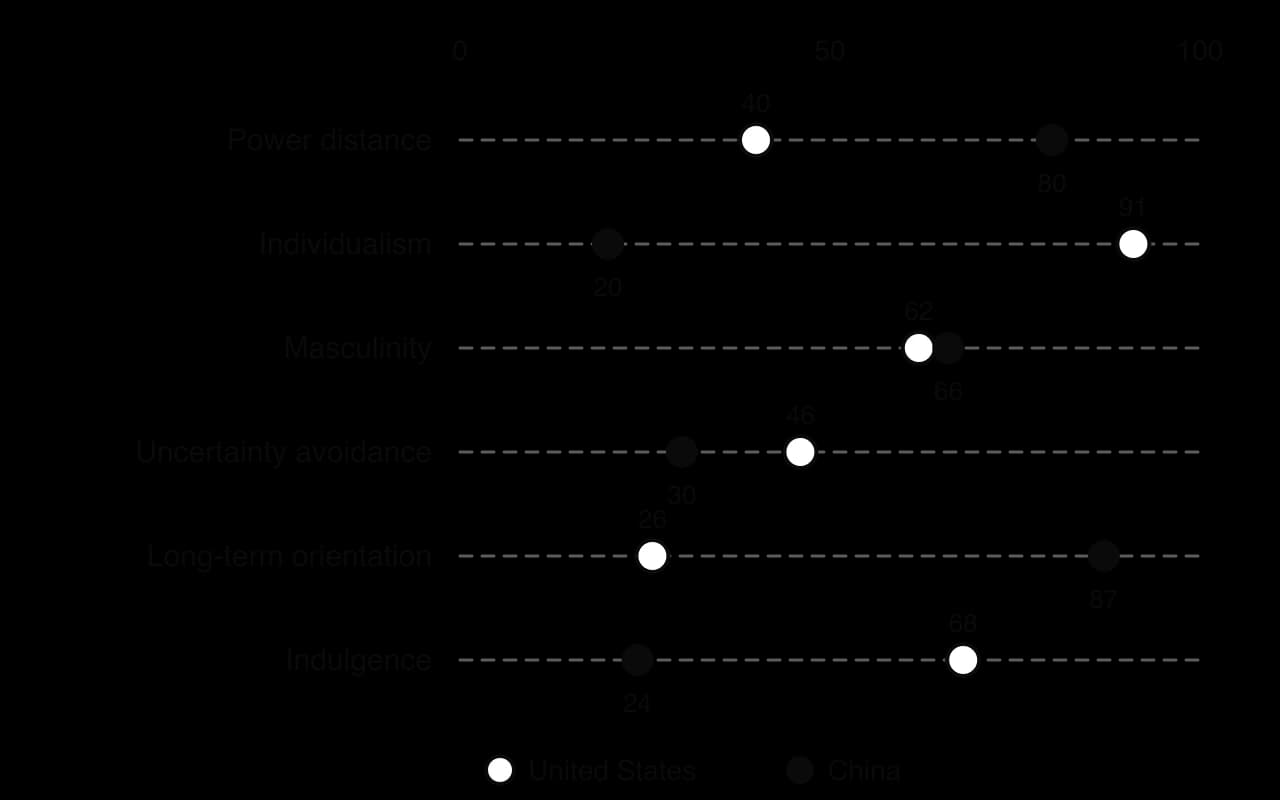
The profile shows why a single label such as “Western” or “Eastern” is too crude. China and the United States are far apart on individualism and power distance, yet close on masculinity, so a behaviour linked mainly to masculinity, such as the value placed on competitive success at work, would not be expected to differ much between them.
 YouTube
Individualism–collectivism is the most researched dimension because it connects national values to how individuals think about themselves. Markus and Kitayama (1991) argued that people in individualist cultures tend to develop an independent self-construal, seeing the self as a set of personal traits that stay the same across situations, while people in collectivist cultures tend to develop an interdependent self-construal, seeing the self as defined by relationships and roles. This individual-level concept gives the national dimension a psychological mechanism: values shape how the self is understood, and the self-construal shapes behaviour.
The dimension has been used to explain behaviour in each of the four contexts. In each example, research found a difference in the direction the dimension predicts.
 YouTube
Taylor et al. (2004) found that Korean participants in Korea, and Asian and Asian American students in the United States, reported using social support to cope with stress less than European Americans did. A further study showed that concern for relationships accounted for the difference: asking for support may burden others or disturb group harmony. A review by Kim, Sherman and Taylor (2008) concluded that people from Asian backgrounds are more likely to use and benefit from “implicit” support, such as spending time with close others without discussing the problem, than from explicit requests for help.
People from collectivist cultures tend to think more holistically, paying attention to relationships and context, while people from individualist cultures tend to think more analytically, focusing on objects and categories. Talhelm et al. (2014) tested 1,162 Han Chinese participants in six sites and found that people from rice-growing southern provinces thought more holistically and were more interdependent than people from wheat-growing northern provinces. Differences were just as large between neighbouring counties on either side of the rice–wheat border, which share a climate, so climate cannot explain them.
Talhelm’s “rice theory” proposes an origin for the dimension: rice farming needs shared irrigation and exchange of labour, so it rewards cooperation, while wheat can be farmed by a single family. The finding also matters for evaluation, because it shows large cultural differences within one country, which national scores hide.
Collectivism predicts more conformity to a group, because agreeing with others maintains harmony and expresses loyalty. Bond and Smith (1996) combined 133 studies using Asch’s line-judgement task in 17 countries and found that conformity was higher in countries with more collectivist values.
Parents pass on the values of their culture through everyday practices. In more collectivist settings, children are more often given responsibilities for siblings and household tasks and are praised for helping the family; in more individualist settings, they are more often encouraged to express personal preferences and make their own choices. These enculturation practices are one route by which a national dimension is reproduced in each new generation.
Hofstede’s model is not the only way to describe cultures along dimensions. Other researchers have proposed dimensions that focus on communication, on the strength of social norms, or on values measured in different populations. Knowing at least one alternative helps in evaluating Hofstede, because the models agree on some points and disagree on others.
The anthropologist Edward Hall introduced the idea of context in communication in 1959 and developed it in Beyond Culture (1976). In a high-context culture, much of the meaning of a message is carried by the setting, the relationship between the speakers, tone of voice and what is left unsaid. In a low-context culture, meaning is carried mainly by the explicit words, so people say directly what they mean and rely on written agreements.
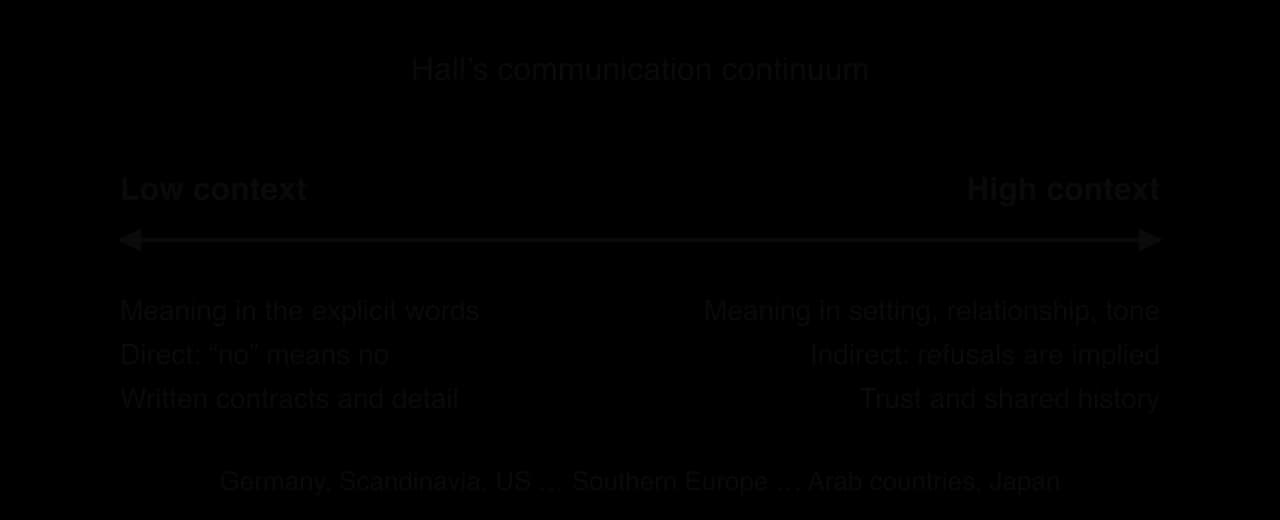
Context overlaps with individualism–collectivism: high-context cultures tend to be collectivist, because people who share long relationships and close in-groups can rely on shared knowledge. A refusal in a high-context culture may be expressed as “That will be difficult”, which a listener from a low-context culture might take as a possible yes. Hall’s model was built from observation and fieldwork rather than surveys, so the countries have no numerical scores, which makes it harder to test.
Michele Gelfand and colleagues proposed tightness–looseness: how strong a society’s social norms are and how much deviation from them is tolerated. Gelfand et al. (2011) collected survey data in 33 nations and found that the tighter nations had experienced more ecological and historical threats, such as high population density, scarce resources, a history of territorial conflict, and disease and environmental threats. Tightness was also linked to more autocratic institutions and stricter regulation of the media, and to individual tendencies such as a stronger need for structure.
Tightness explains why people follow norms, rather than which values they hold. The explanation is functional: when a society faces frequent threats, strong norms help people coordinate, so the society survives better if deviance is discouraged. Tightness is related to collectivism but is not the same thing. Collectivism concerns the content of values (the group before the self), while tightness concerns the strength of norms, whatever those norms are, so a society’s position on one dimension does not fix its position on the other.
Dimensions play three main roles in understanding behaviour across cultures, and a fourth follows from them. They describe cultures in a common language, so that researchers in different countries can compare their findings. They explain differences by linking a behaviour to an underlying value. They predict behaviour in cultures that have not yet been studied, which allows the dimension to be tested. They also show similarities between distant cultures that score alike.
Role | What the dimension does | Example |
|---|---|---|
Describe | Places cultures on shared scales | China and the United States are 71 points apart on individualism |
Explain | Links a behaviour to a value | Higher conformity in collectivist countries is explained by the value placed on group harmony |
Predict | Forecasts behaviour in an untested culture from its score | A country with high power distance is predicted to show more deference to doctors and teachers |
Find similarities | Groups distant cultures that score alike | Guatemala and Indonesia both score low on individualism and share strong family obligations |
Prediction is the strongest test. If a dimension only redescribes differences already known, it adds little. If it correctly predicts differences in data that played no part in building it, such as the higher conformity that Bond and Smith (1996) found in collectivist samples, it shows real explanatory value. Researchers increasingly test predictions at two levels: whether countries with a high score show more of a behaviour, and whether individuals who personally hold the value show more of it.
Cultural dimensions are among the most cited ideas in cross-cultural psychology, and also among the most criticised. Their strengths and limitations are best organised through the concepts, because each criticism concerns how culture is measured, whose perspective the model reflects, or what conclusions the scores can support.
Comparison on a common scale. Dimensions allow cultures to be compared with numbers, which makes cross-cultural differences testable rather than anecdotal.
Prediction. Dimension scores have predicted differences that were later confirmed, such as higher conformity in collectivist samples and smaller social loafing in collectivist groups.
Robustness of the core dimensions. Dimensions resembling individualism–collectivism and power distance appear in the models of Hofstede, Schwartz and GLOBE, which used different instruments and samples.
Practical use. The dimensions are used in intercultural training, international business and health communication to anticipate misunderstandings.
The most serious problem in using dimensions is the ecological fallacy: drawing conclusions about individuals from data that describe groups. A national score is an average of many individuals whose values vary widely. Knowing that a country scores low on individualism does not show that any particular person from that country is collectivist, just as knowing a country’s average height does not tell anyone how tall a particular citizen is.
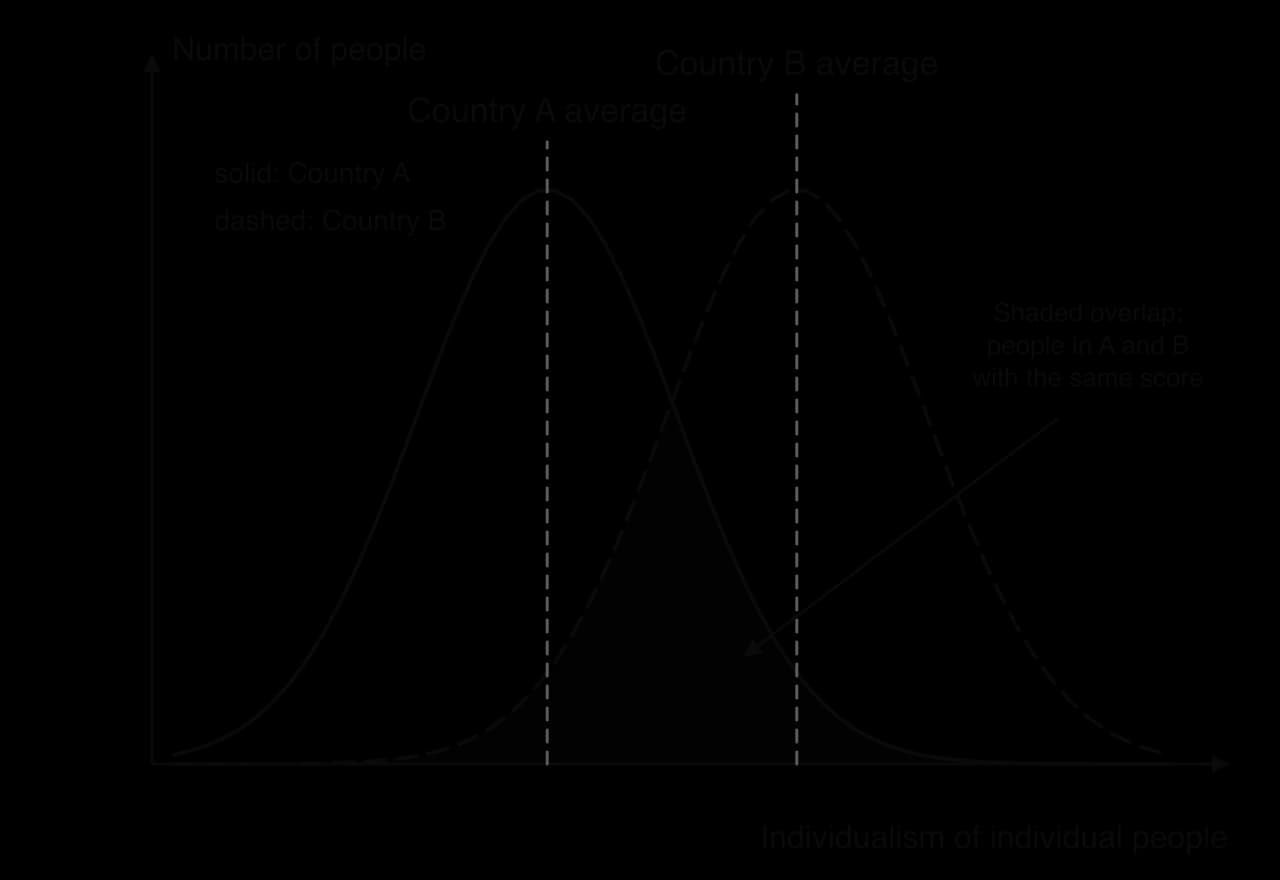
Hofstede himself warned that his scores should not be applied to individuals. The fallacy matters in practice. A manager who treats every employee from a high power-distance country as unwilling to speak up is stereotyping, and a clinician who assumes a patient will not want to discuss feelings because of their nationality may provide worse care. Research that measures values in each participant, such as Earley’s studies of social loafing, avoids the problem by testing whether the individuals who hold a value behave differently.
Many dimension studies rely on Likert-scale questionnaires, and these may not be comparable across cultures. Heine et al. (2002) found that, although cultural experts agreed that East Asians are more collectivist than North Americans, trait and attitude questionnaires often failed to show this difference. They explained it through the reference-group effect: people rate themselves in comparison with those around them, so a Japanese student compares herself with other Japanese, and an American with other Americans, which cancels out real differences.
Oyserman, Coon and Kemmelmeier (2002) carried out a meta-analysis of studies measuring individualism and collectivism in individuals. European Americans were more individualist and less collectivist than other groups overall, but they were not more individualist than African Americans or Latinos, and not less collectivist than Japanese or Koreans. Among Asian groups, only Chinese participants showed large differences. These results suggest that the familiar “individualist West, collectivist East” picture is less consistent at the individual level than national scores imply.
Most dimension models were designed by Western researchers, and their items reflect what Western psychology considered important. Applying them everywhere risks imposed etic bias: assuming that a concept means the same thing in every culture. The Chinese Value Survey showed that starting from another culture’s values finds a dimension the Western instrument missed. Researchers working in Indigenous psychologies argue that cultures should first be studied in their own terms, using an emic approach, before they are compared.
Nations are also not the same as cultures. Many countries contain several language, religious and ethnic groups, and Talhelm et al. (2014) showed large differences between regions within China. A single national score can hide the culture of minority groups, which is a form of cultural bias.
Dimension scores are snapshots. Individualism has risen in most countries over the last half-century, especially as they have become wealthier and more urban, although the differences between countries have remained. Treating scores as permanent features of a nation risks determinism and stereotyping, and ignores that people can hold several cultural identities, for example as immigrants or bicultural individuals who switch between frames depending on the situation.
Most evidence linking dimensions to behaviour is correlational. When collectivist countries show more conformity, other national differences, such as wealth, education, political systems or the strictness of norms, could explain the link. The relationship can also run both ways: cultural values shape behaviour, but changes in economic life (for example, moving from farming to city jobs) shape values. Natural comparisons such as Talhelm’s rice–wheat border, where neighbouring counties differ in farming history but little else, are one way of strengthening causal claims.
Concept | How it applies to cultural dimensions |
|---|---|
Measurement | Values are inferred from questionnaires; national averages; the reference-group effect; translation |
Bias | Western-designed instruments; one company’s mainly male, middle-class employees; stereotyping individuals |
Perspective | Etic comparison versus emic and Indigenous understanding; nations are not cultures |
Change | Scores date from the 1960s–1970s; individualism has risen worldwide |
Causality | Correlational links between national scores and behaviour; wealth and other confounds |
Responsibility | Scores used to stereotype individuals or groups in business, education or health care |
Hofstede aimed to identify the main ways in which national cultures differ in their values, using a very large set of survey data collected in one organisation so that differences between countries could be attributed to national culture rather than to differences in occupation or employer.
Between 1967 and 1973, IBM employees in its subsidiaries around the world completed a standardised attitude survey about their work goals and values, translated into local languages. About 117,000 questionnaires were collected. Because the respondents worked for the same company in matched occupations, Hofstede argued that their occupation, education and company culture were broadly similar, leaving nationality as the main difference.
Hofstede first analysed the 40 countries with the largest samples and later extended the analysis to 50 countries and 3 regions. He calculated the average answer to each question in each country and used factor analysis on these country averages to find questions whose answers rose and fell together. Each cluster of questions became a dimension, and each country received a score on it. This is an etic approach: one instrument was applied in every country to allow comparison. The results were published in Culture’s Consequences (1980) and in a revised edition in 2001.
Four dimensions emerged: power distance, individualism–collectivism, masculinity–femininity and uncertainty avoidance. Countries were spread widely along each. Individualism showed the clearest geographical pattern: English-speaking and northern European countries scored highest, while Latin American and East Asian countries scored lowest.
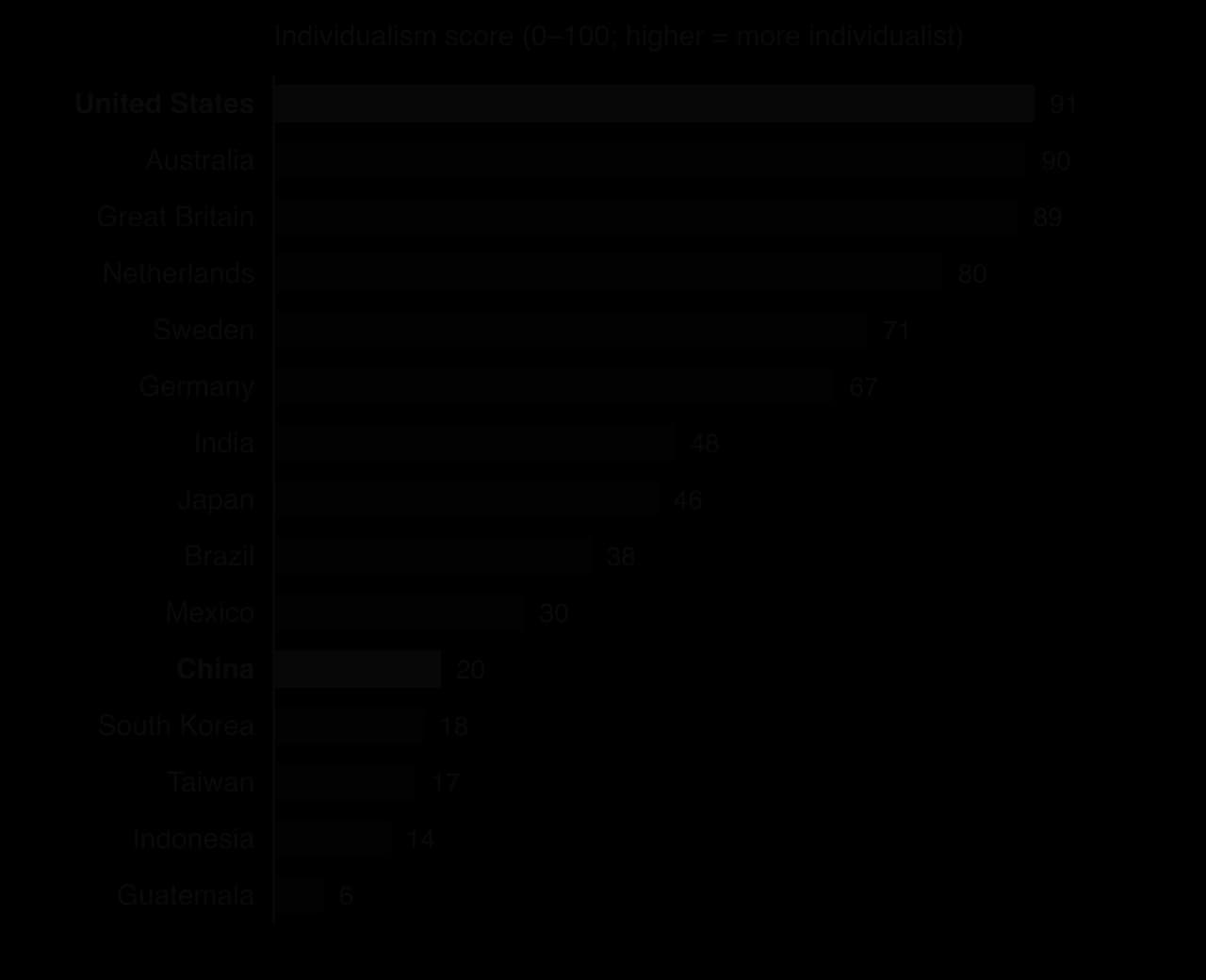
Individualism scores were strongly correlated with national wealth: richer countries were more individualist. Power distance was correlated with individualism in the opposite direction, so many countries that scored high on power distance also scored low on individualism. Between 1990 and 2002 six further studies in 14 to 28 countries each, with samples such as airline pilots, students, civil service managers and consumers, broadly reproduced the country rankings and extended the scores to 76 countries and regions.
Sources: Hofstede, G. (1980). _Culture’s Consequences: International Differences in Work-Related Values. Sage; Hofstede, G. (2001). Culture’s Consequences (2nd ed.). Sage; Hofstede, G., Hofstede, G. J. and Minkov, M. (2010). Cultures and Organizations (3rd ed.). McGraw-Hill._
Hofstede concluded that national cultures differ systematically on a small number of value dimensions, and that these dimensions reflect the ways each society has learned to deal with basic problems: inequality, uncertainty, the relationship between the individual and the group, and the roles of men and women. Because the dimensions were stable across later samples, he argued that national cultures change slowly.
The survey asked about work goals, such as the importance of earnings, cooperation or freedom at work, and these answers were used to infer broad cultural values. This is an indirect measure of a construct, and its validity depends on the assumption that work values reflect values in the rest of life. The replications with pilots, students and civil servants support the assumption, because the country rankings were broadly similar. However, factor analysis of country averages produces dimensions that describe countries, not individuals, so the same items do not form the same dimensions when individuals are analysed.
IBM employees were mostly middle-class, educated and, at the time, mainly men, so the sample was not representative of any national population. The questionnaire was written by Western researchers, so values that matter in other cultures may have been missed. This criticism led to the Chinese Value Survey, which deliberately started from Chinese values and found long-term orientation, a dimension the IBM survey had not detected. The episode shows how an imposed etic instrument can produce a culturally biased picture.
The original data are more than fifty years old. Santos, Varnum and Grossmann (2017) examined 51 years of data on individualist practices and values in 78 countries and found that individualism had risen in most of them, mainly with socioeconomic development, although differences between countries remained large. Scores from the IBM survey may therefore no longer describe the countries accurately, especially those that have developed rapidly, such as China and South Korea.
Cultural dimensions are an approach term, so they can appear in Paper 1 Section A as a short explanation with an example, and in Section B applied to a scenario in any context. In Section C essays they provide evidence on cultural variation in areas such as group behaviour or mental health, usually through the concepts of perspective, bias or measurement. Studies such as Hofstede’s survey make good examples, but the details of their samples are not rewarded in Section A: the explanation of how the dimension accounts for the behaviour is.
A cultural dimension is a measurable aspect of shared values on which whole cultures can be placed and compared; it is a continuum, and scores are relative.
Hofstede’s six dimensions are power distance, individualism–collectivism, masculinity–femininity, uncertainty avoidance, long-term orientation and indulgence–restraint.
Hofstede derived the first four from about 117,000 IBM questionnaires (1967–1973) using factor analysis of country averages; the Chinese Value Survey and the World Values Survey added the other two.
Individualism–collectivism helps to explain differences in support-seeking, thinking style, conformity and children’s responsibilities, and similarities between distant cultures with similar scores.
Hall’s high- and low-context cultures describe communication; Gelfand’s tightness–looseness describes how strongly norms are enforced, linked to ecological and historical threats.
National scores describe averages, so applying them to individuals commits the ecological fallacy.
Questionnaire comparisons across cultures face measurement problems such as the reference-group effect, and individual-level differences are smaller and less uniform than national scores suggest.
Western-designed instruments risk imposed etic bias, nations are not cultures, and individualism has risen in most countries since the original data were collected.
I can describe what a cultural dimension is and how dimension scores are calculated.
I can describe Hofstede’s six dimensions with a high- and a low-scoring country for each.
I can explain how individualism–collectivism accounts for differences in behaviour in at least two contexts.
I can describe Hall’s high- and low-context cultures and Gelfand’s tightness–looseness.
I can describe the aim, method, results and conclusions of Hofstede’s IBM survey.
I can explain the ecological fallacy with an example.
I can evaluate cultural dimensions with reference to measurement, bias, perspective and change.
I can apply a cultural dimension to an unfamiliar scenario and qualify the explanation.