Explain how people learn their own culture’s norms through agents and mechanisms of enculturation, apply theories of enculturation to behaviour in any context, and evaluate the research behind them.
Each is in the Psychology glossary, with every other term in the subject.
The process by which a person learns the norms, values, beliefs and behaviours of their own culture, mostly in childhood, through family, peers, school, media and everyday practices.
A process of enculturation in which children learn by taking part in real community activities alongside more experienced people, who adjust their support as the child’s skill grows.
The lifelong process by which people learn the skills, norms and roles needed to take part in social groups; enculturation is the part of socialisation that transmits one’s own culture.
Describe enculturation and explain how it differs from socialisation and acculturation.
Describe the main agents of enculturation and the norms each one passes on.
Explain how social learning theory, operant conditioning and Vygotsky’s sociocultural theory account for enculturation.
Explain how Bronfenbrenner’s ecological systems theory shows the way culture reaches a child.
Apply enculturation to behaviour in health, development, relationships, and learning and cognition.
Describe and evaluate the study of moral judgements by Shweder, Mahapatra and Miller (1987).
Evaluate theories and research on enculturation with reference to causality, measurement, bias and perspective.
Enculturation is the process by which people learn the norms, values, beliefs and behaviours of the culture they grow up in. It explains why behaviour that feels natural in one community, such as bowing to a teacher, eating with the right hand only or calling adults by their first names, can feel strange or rude in another.
Enculturation is a central idea of the sociocultural approach, which explains behaviour through the groups and culture a person belongs to. Because culture cannot be manipulated in a laboratory, research on enculturation raises questions of causality and measurement, and because researchers are themselves enculturated, it raises questions of bias and perspective.
With a free account, Augment remembers where you stopped and what you have practiced.
Every human group shares a culture: a set of beliefs, values, social norms and practices that its members take for granted and pass to the next generation. Newborn infants share none of it. Within a few years, however, a child knows which language to speak, how to greet an older relative, what counts as food, when to stay quiet and which actions bring shame. Enculturation is the name for this learning.
Three features of enculturation matter for explaining behaviour. First, it is learned: a child of Korean parents who is adopted at birth by a family in Sweden is enculturated into Swedish norms, so the content of culture is not inherited. Second, it is mostly implicit: much of it happens through watching, joining in and being corrected, and adults are often unable to say why a norm exists. Third, it is lifelong: early childhood lays down language, basic values and a sense of self, while school, work, religion and online communities keep adding to it.
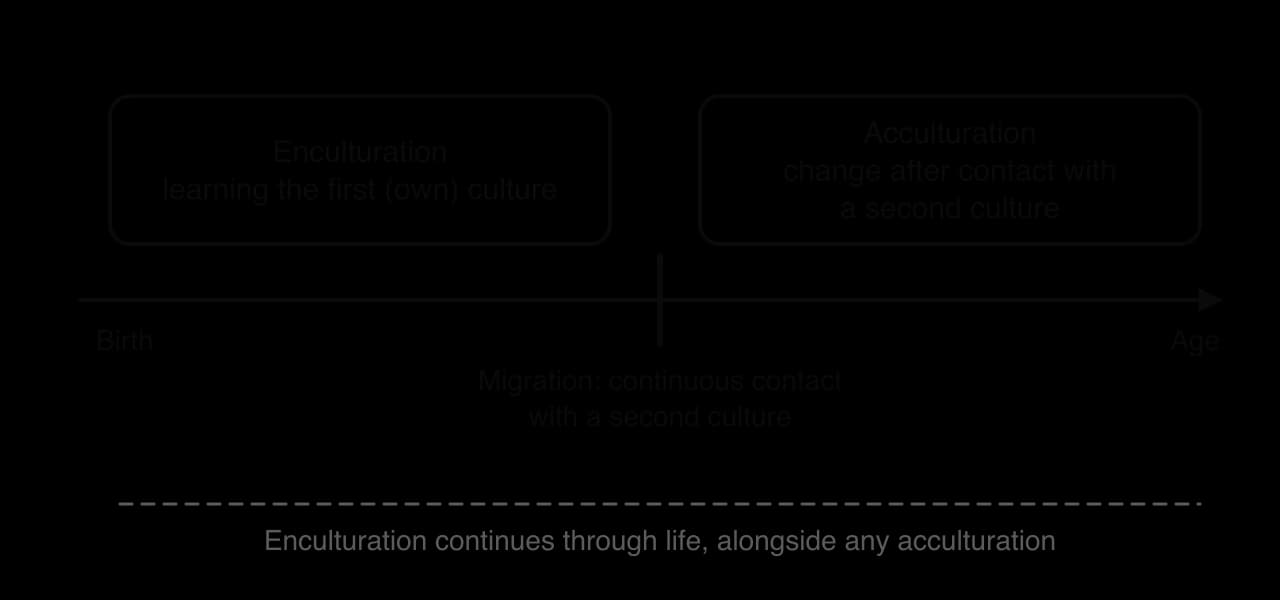
Three related terms describe how people come to behave like the groups around them. Socialisation is the broadest: it is the lifelong process of learning the skills, roles and norms needed to take part in any social group, from a football team to a workplace. Enculturation is the part of socialisation that passes on the culture a person is born into. Acculturation is different again: it is the change that follows continuous contact with a second culture, for example after migration.
The timeline shows why the two processes are often confused. A teenager who moves from Syria to Germany is still being enculturated into Syrian family norms at home while acculturating to German classroom norms at school. What separates the two processes is which culture is being learned; the age of the learner does not decide it.
Enculturation is often described as learning customs such as food, dress and festivals, but research shows that it reaches much deeper. It shapes the way people think about themselves, express emotion, judge right and wrong, and even how they pay attention and remember. The table gives the main areas, each with an example.
Area | What is learned | Example |
|---|---|---|
Social norms and customs | Expected behaviour in everyday situations | Removing shoes before entering a home in Japan; queuing in the UK |
Self-concept | Whether the self is defined by personal traits or by relationships and roles | An independent self-construal is more typical in individualist cultures and an interdependent self-construal in collectivist ones |
Emotion | Display rules: which emotions may be shown, how strongly and to whom | Masking disappointment in front of a teacher or an older relative |
Morality | Which rules are seen as universal moral duties and which as local customs | Oriya Hindu and American judgements of a widow eating fish |
Gender | Gender roles: what a culture links with being male or female | Parents responding differently to boys’ and girls’ play |
Ways of learning | Whether to learn by watching and joining in or by asking and being told | Mexican-heritage children’s attention to demonstrations |
Health behaviour | What, when and how much to eat or drink; how distress is expressed and whether help is sought | Family meal routines; whether adults talk openly about feeling low |
Because so much behaviour falls into these areas, enculturation is one of the most widely used explanations in the sociocultural approach. It also sets a limit on any claim that a behaviour is universal: a finding from one culture describes what that culture’s members have learned, and may not describe people raised elsewhere.
Culture is not learned from “society” in the abstract. It is passed on by particular people and institutions, called agents of enculturation, who model the culture’s behaviour, reward and correct the child, and arrange the settings in which the child spends time. The relative weight of each agent changes with age.
Family. Parents and older relatives are the first and, in early childhood, the most powerful agents. They choose what the child eats, wears, hears and plays with, and they talk about events in culturally typical ways. In many communities grandparents and older siblings do as much of this as parents.
Peers. From middle childhood, friends and classmates enforce norms quickly through acceptance, teasing and exclusion. Adolescents often follow peer norms on clothes, music and language over those of their parents, a process studied under peer influence.
School. Schools teach explicit knowledge and also a hidden set of norms: punctuality, raising a hand, working alone or in groups, competing or cooperating, and how to address adults.
Media and technology. Television, games and social media show children many models and many examples of what others do. They now carry norms across national borders, so a teenager in Lagos and one in Seoul may share slang, fashion and body ideals.
Religious and community institutions. Rituals, festivals and moral teaching mark membership of the group and give reasons for its norms.
 YouTube
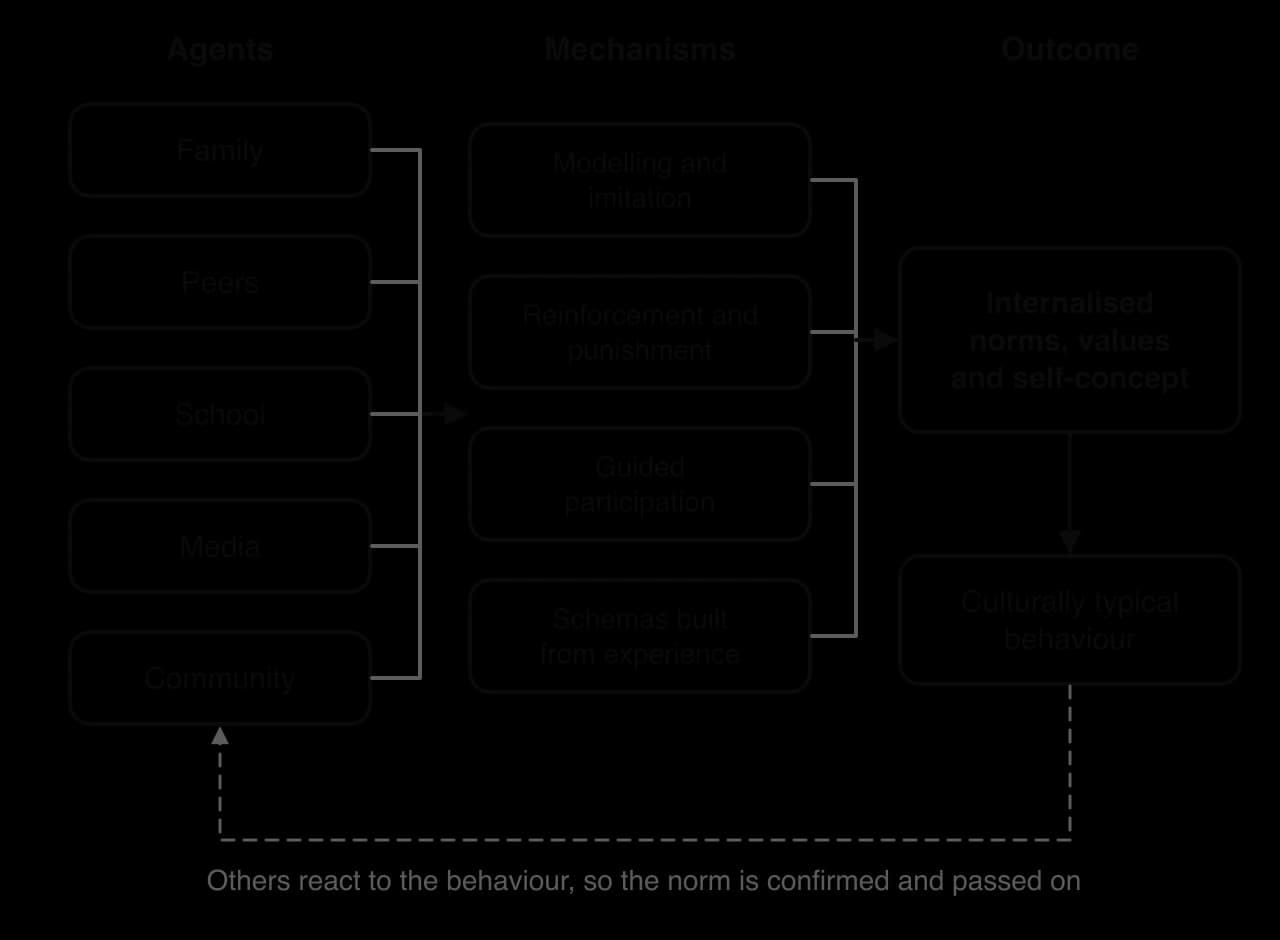
The diagram separates who passes on culture (the agents) from how it is passed on (the mechanisms). A full explanation of any enculturated behaviour names both. For example, a mother (agent) who praises her daughter for sharing (reinforcement) passes on a norm of generosity. Theories of enculturation are, in effect, accounts of the mechanisms.
 YouTube
No single theory owns enculturation. Several theories, developed for other purposes, explain parts of it, and each emphasises a different mechanism. Four are especially useful: social learning theory, operant conditioning, Vygotsky’s sociocultural theory and Bronfenbrenner’s ecological systems theory. Gender schema theory adds a cognitive mechanism and is developed in research on the enculturation of social norms.
Social learning theory, proposed by Albert Bandura, holds that people learn new behaviour by observing others, a process called observational learning. A child pays attention to a model, remembers what the model did, is able to reproduce it, and is motivated to do so, especially if the model was rewarded (vicarious reinforcement). Children are most likely to imitate models who are similar to them, warm, powerful or high in status, which describes parents, older siblings and admired peers well.
Social learning theory fits enculturation because most cultural behaviour is never formally taught but is visible every day. Greeting rituals, table manners, the tone used with elders and the way adults react to illness are all modelled thousands of times. A boy in a family where men cook watches his father and uncles prepare food at festivals and hears them praised for it; he stores the sequence, practises it with toy pans and later cooks for guests himself, although no one has ever stated the norm aloud.
Bandura, Ross and Ross (1961) showed that children who watched an adult behave aggressively towards an inflatable doll later copied many of the adult’s specific actions, while children who watched a calm adult did not. The study is usually used to show modelling of aggression, but it also shows the basic mechanism of enculturation: a single exposure to a model can transfer a new pattern of behaviour.
Operant conditioning explains how the consequences of behaviour change how often it occurs. Behaviour followed by reinforcement (praise, a smile, approval) becomes more frequent; behaviour followed by punishment (a frown, ridicule, exclusion) becomes less frequent. Parents, teachers and peers rarely think of themselves as conditioning a child, yet they constantly react to whether the child’s behaviour fits the culture’s expectations.
Fagot (1978) observed toddlers and their parents at home, using a checklist of 46 child behaviours and 19 parental reactions. Parents reacted more favourably when a child played in a way considered typical of the child’s sex and more negatively to play considered typical of the other sex; girls received more negative responses for running and climbing and more positive ones for asking adults for help. Parents’ own reports of how they treated their children did not match what observers recorded, which suggests that this reinforcement of gender norms was largely unaware.
Lev Vygotsky argued that higher mental functions such as language, reasoning and memory strategies first appear between people, in shared activity, and only later within the individual. On this view culture is not just the content of thinking but its toolkit. Children take over the cultural tools of their community, such as a language, a number system or a way of telling stories, by using them with more skilled partners.
Two ideas from Vygotsky’s sociocultural theory explain how this happens. The zone of proximal development is the gap between what a child can do alone and what the child can do with help from a more knowledgeable other. Scaffolding is the support that partner gives, adjusted to the child’s level and withdrawn as the child improves. Both ideas are developed further in research on sociocultural factors in development. For enculturation, their importance is that they make it an active, shared process in which the child takes part, instead of a one-way transfer from adult to passive child.
Barbara Rogoff extended Vygotsky’s ideas into the concept of guided participation. Children learn their culture by joining real community activities, such as cooking, farming, selling in a market or caring for younger children, alongside experienced adults. In many Indigenous communities of the Americas, Rogoff and colleagues describe this as learning by observing and pitching in: adults assume that children will watch closely and contribute when they can, rather than being taught in separate lessons.
Mejía-Arauz, Rogoff and Paradise (2005) asked first- to third-grade children in the United States to watch an adult demonstrate how to fold origami figures. Ten Mexican-heritage children whose mothers had a basic level of schooling observed the demonstration without asking for more information to a greater extent than ten European-heritage children. Eleven Mexican-heritage children whose mothers had extensive schooling behaved more like the European-heritage group, which suggests that the habit of learning by watching is enculturated through family practices that formal schooling changes.
Urie Bronfenbrenner’s ecological systems theory (1979) describes the environment of a developing child as a set of nested systems. Culture does not usually act on a child directly; it reaches the child through the people and settings closest to them. The theory therefore explains where the influences studied by the other theories come from and why they sometimes conflict.
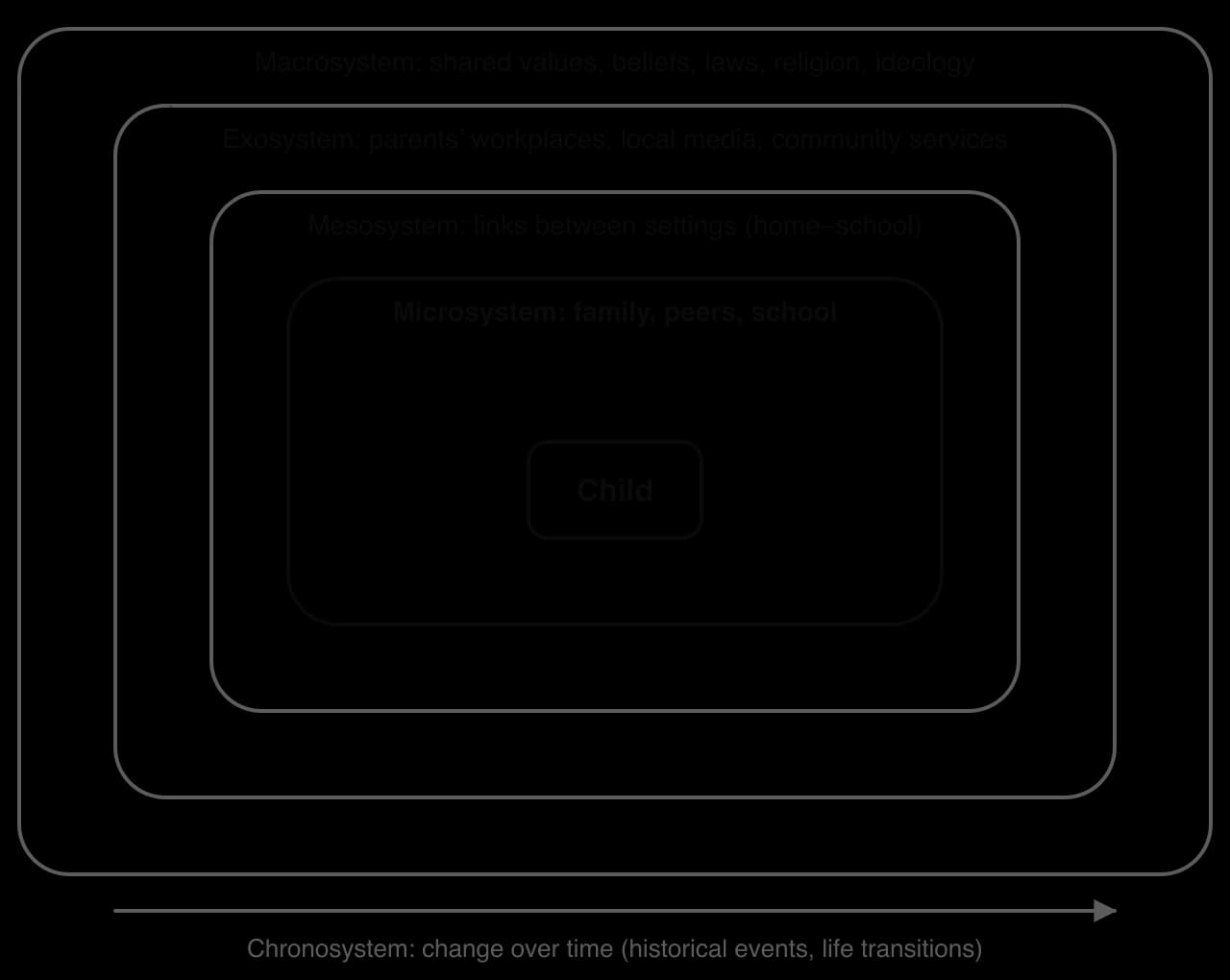
System | What it is | Example of enculturation |
|---|---|---|
Microsystem | Settings with direct, face-to-face contact | A father praising his son for not crying |
Mesosystem | Links between microsystems | Home and school agree, or clash, about whether children may question adults |
Exosystem | Settings the child is not in but that affect them | A parent’s long working hours shaping who looks after the child and which norms that person passes on |
Macrosystem | The broad culture: values, laws, ideology | National beliefs about individual achievement or family duty |
Chronosystem | Change over time | Smartphones introducing new peer norms to one generation |
The four theories are complementary rather than rival accounts. Ecological systems theory shows where cultural influence comes from, social learning theory and operant conditioning explain how particular behaviours are acquired and maintained, and Vygotsky’s theory explains how ways of thinking are taken over through shared activity. Gender schema theory adds that once children know their own gender they actively look for, and remember, information about what their culture expects of it, which helps explain why norms persist even without reinforcement.
Theory | Mechanism | Role of the child | Best at explaining | Main limitation |
|---|---|---|---|---|
Social learning theory | Observation, imitation, vicarious reinforcement | Active observer who chooses whether to perform | Visible behaviours: manners, aggression, gender roles | Says little about why some models are chosen over others in different cultures |
Operant conditioning | Direct reward and punishment | Mostly passive | Why norm-consistent behaviour becomes frequent | Cannot explain norms that are never rewarded or behaviour learned without reinforcement |
Vygotsky’s sociocultural theory and guided participation | Joint activity, scaffolding, cultural tools | Active participant with a skilled partner | Ways of thinking, learning and skills | Hard to test experimentally; concepts such as the zone of proximal development are difficult to measure |
Ecological systems theory | Interacting layers of the environment | At the centre, influenced and influencing | How wider culture reaches the child; why influences conflict | Describes where influence comes from more than how learning happens |
Because enculturation shapes so many areas of life, it can explain behaviour in each of the four contexts of the course. In each context the same few mechanisms are at work on very different behaviours.
Children’s ideas about what boys and girls do, and about which acts are seriously wrong, are among the earliest products of enculturation. Fagot’s home observations show parents reinforcing gender-typed play in toddlers, and modelling by same-sex adults adds to it. By school age children have also learned which of their community’s rules are matters of right and wrong and which are customs, and Shweder and colleagues showed that where this line falls depends on the culture. The way these norms become part of a child’s sense of self is the focus of research on the enculturation of social norms in the development of self.
Relationships depend on shared expectations about how to express feelings and show respect. Friesen (1972) filmed the faces of Japanese and American students while they watched unpleasant film clips. When participants watched alone their expressions of disgust and distress were similar, but when an experimenter was present the Japanese students more often masked negative expressions with polite smiles. Friesen explained the difference through display rules: culturally learned norms about which emotions may be shown, and to whom, which children acquire by watching adults and being corrected.
Norms about respect, such as how to address an older person, whether to make eye contact with someone of higher status, or how directly to disagree, are learned in the same way. When two people enculturated into different norms meet, each may read the other’s behaviour as rude or cold, which is one reason intercultural relationships can involve misunderstanding.
Enculturation shapes not only what children learn but how they learn. The Mejía-Arauz, Rogoff and Paradise (2005) origami study shows that whether a child learns by watching closely or by asking questions is itself a cultural habit. Cross-cultural research on attention suggests that people raised in East Asian cultures attend more to context and relationships and those raised in Western cultures more to central objects, a difference studied as holistic cognition and analytic cognition.
Even remembering is enculturated. Families differ in how they talk about past events with young children: some ask detailed questions about the child’s own feelings, while others stress the lessons an event teaches about behaving well with others. Children take on the style they hear, so the content of autobiographical memory differs between cultures, a link developed in research on the enculturation of the self.
Many health behaviours are enculturated before a child can make choices of their own. What counts as a proper meal, how often a family eats together, how much a child is encouraged to eat and which foods are given as rewards are all set by family and community norms. Children also learn whether it is acceptable to talk about feeling sad or anxious, whether distress is expressed through bodily complaints or emotional words, and whether problems are taken to a doctor, a religious leader or kept within the family. These enculturated norms help explain cultural differences in the presentation of mental health problems and in help-seeking.
Whiting and Whiting’s observations of children in six cultures add a final point that applies in every context: children who are given real responsibilities, such as caring for younger siblings, become more nurturant and responsible, so the tasks a culture assigns children are themselves a powerful channel of enculturation.
Richard Shweder and his colleagues aimed to test whether the distinction between moral rules and social conventions is universal. The psychologist Elliot Turiel had proposed that children everywhere treat rules about harm, justice and rights as moral (wrong everywhere, whatever an authority says) and treat other rules as conventions (local customs that could be changed). Shweder’s team asked whether children and adults from a very different culture would draw the line in the same place.
The researchers interviewed children and adults in two communities: orthodox Hindu families living around an eleventh- and twelfth-century temple in the city of Bhubaneswar in Orissa (now Odisha), India, and Christian and Jewish families from Hyde Park, a middle-class neighbourhood near the University of Chicago. The Indian sample included Brahman families, the highest caste, and families from castes then called “Untouchable”.
Each participant heard a series of short cases describing a practice or a breach of a rule. The cases covered forms of address, sleeping arrangements, food, dress, begging, monogamy, wife beating, protection from harm and funeral rites. For each case the interviewer asked questions modelled on Turiel’s own criteria: whether the act was wrong, how serious it was, whether it would be acceptable if most people in the society agreed to change the rule, whether it would be wrong in another country, and whether the person should be stopped or punished.
Case | Hyde Park (American) participants | Bhubaneswar (Oriya Hindu) participants |
|---|---|---|
A man kicks a dog sleeping on the road | Wrong; a moral matter | Wrong; a moral matter |
The eldest son gets a haircut and eats chicken the day after his father’s death | Not wrong | Seriously wrong; a moral matter, wrong everywhere |
A widow eats fish two or three times a week | Not wrong | Seriously wrong; a moral matter |
Overall pattern | Moral rules mainly concern harm, rights and justice; many other rules are changeable conventions or personal choices | Many food, dress, ritual and family practices are moral obligations; very few rules are treated as mere convention |
Sources: Shweder, R. A., Mahapatra, M., & Miller, J. G. (1987). Culture and moral development. In J. Kagan & S. Lamb (Eds.), _The emergence of morality in young children. University of Chicago Press. Summary of cases and findings from the Stanford Encyclopedia of Philosophy, “The moral/conventional distinction”._
Both groups agreed that acts causing obvious harm, such as kicking a dog, were moral wrongs. The difference lay in the many practices that Americans saw as harmless matters of custom or personal choice. Oriya Hindu participants judged many of these as serious moral wrongs that would be wrong in any society, even if everyone agreed to change the rule. Shweder and colleagues concluded that, for these participants, the class of merely conventional rules was very small.
The pattern appeared in children as well as adults in each community. This matters for enculturation: children had already learned not only their community’s rules but its way of classifying them, which supports the claim that moral frameworks are acquired early through participation in family and religious life.
Shweder argued that what counts as “moral” is itself enculturated. Children learn their community’s moral framework through everyday practices and through the way adults talk about them, which he called moral discourse. The distinction Turiel proposed may describe the moral thinking of secular Western communities rather than a universal stage of development. Shweder later proposed three “ethics” that cultures weight differently: an ethic of autonomy (harm, rights, justice), an ethic of community (duty, hierarchy, loyalty) and an ethic of divinity (purity and sanctity).
The study’s main strength is that it took a theory built on Western samples and tested it in a culture with a very different religious and social life. By listening to how Oriya participants themselves explained their judgements, it used an emic approach alongside a standard interview, and it showed that a supposedly universal distinction depended on the culture of the people studied. This makes it a classic example of how cross-cultural research can expose cultural bias in psychology.
Turiel, Killen and Helwig (1987) replied that the study had not shown different definitions of morality. Oriya participants held different factual beliefs about harm: they believed that eating chicken soon after a father’s death would prevent his soul from reaching salvation, and that eating fish would stir a widow’s desire and cause suffering to her husband’s spirit. If so, Indian participants moralised more acts because they believed more acts cause harm, which fits Turiel’s theory. Shweder’s team had not asked participants directly whether anyone was harmed, so the two explanations cannot be separated with the original data.
Later research suggests both sides were partly right. Haidt, Koller and Dias (1993) presented harmless but offensive acts to adults and children in two Brazilian cities and in Philadelphia, and asked directly about harm. Many participants condemned acts they agreed were harmless. Lower-status groups moralised more than higher-status groups in all three cities, and the effect of social class was much larger than the effect of city. This supports the idea that moral frameworks are enculturated, but within as well as between nations.
Moral cases had to be translated, and the same act can carry very different meanings in each culture. Eating beef, for example, is ordinary for most Americans but deeply offensive to many Hindus, so equivalent questions may not measure the same thing. The interview format also depends on what participants are willing to say to researchers from outside their community, which raises the risk of social desirability bias.
Critics of the study have also questioned whether asking if an act should be punished is a fair test of whether it is moral, since conventional breaches are often punished too. Finally, the samples were two specific communities; treating them as representative of “India” and “the United States” would be an ecological fallacy.
Enculturation is supported by a wide range of evidence: home observations, cross-cultural observations of children, interviews about moral rules, laboratory studies of imitation and studies of how children learn from demonstrations. The theory is hard to dispute in general terms, since no one argues that children are born knowing their culture. The difficulties lie in showing exactly which experiences produce which behaviour, and in studying culture without distorting it.
It explains differences that universal theories miss. Moral judgements, emotional expression, ways of learning and self-descriptions differ systematically between communities in ways that biological or general cognitive theories alone cannot predict.
Converging methods point the same way. Naturalistic observation (Fagot), cross-cultural interviews (Shweder), structured tasks (Mejía-Arauz and colleagues) and laboratory studies of modelling (Bandura) each show culture-specific learning from a different angle, which is a form of triangulation.
It is useful. Because enculturated norms are learned, they can in principle be changed. Teachers who understand that some children learn by watching can adapt lessons; health programmes that work through families and community leaders use the same agents that passed the original norms on.
Most research on enculturation compares existing groups, so culture is a quasi-independent variable. Groups that differ in culture usually differ in other ways too: income, schooling, family size, religion and language. In the origami study, for instance, Mexican-heritage and European-heritage families also differed in mothers’ years of schooling; the researchers added a third group partly to separate these factors. Without random allocation, a difference between groups cannot be attributed with confidence to enculturation alone.
Direction of influence is a second problem. In Fagot’s observations parents reacted differently to boys’ and girls’ play, but children may already have preferred certain toys, partly for biological reasons, and parents may have been responding to those preferences. This is bidirectional ambiguity: the child shapes the parent as well as the parent shaping the child.
Researchers usually operationalise culture by nationality, ethnicity or place of residence. These are rough proxies. People within a nation differ widely, and Haidt, Koller and Dias found that social class predicted moral judgements more strongly than city. Assuming that every member of a group holds the group’s typical values is the ecological fallacy. Some researchers instead measure the values or self-construals of individual participants, which links behaviour to culture more directly but depends on self-report.
A second problem is measurement equivalence. A question, a moral case or a learning task may not mean the same thing in two cultures, even after careful translation. An origami demonstration may feel like schoolwork to one group of children and like a new game to another, so differences in behaviour could reflect how the task was understood rather than an enculturated learning style.
Researchers are themselves products of enculturation. Much of the theory in this area was built by Western researchers using Western categories, such as the moral–conventional distinction or the idea that asking questions shows engagement. Even cross-cultural studies can impose those categories on other cultures, a problem known as the imposed etic. Shweder’s study is an example of research that exposed such a bias; the origami study avoided a deficit reading by treating close observation as a skill rather than as a lack of curiosity. Most of the samples in this research also come from Western, educated, industrialised, rich and democratic societies (WEIRD samples), which limits how far conclusions generalise.
Enculturation is a sociocultural explanation, but it always works through biological and cognitive processes. The capacity to imitate, to learn language and to form attachments is shared by all human infants; culture supplies the content. Temperament also affects how children respond: a highly anxious child may be more sensitive to disapproval and learn norms faster. An explanation of behaviour by enculturation alone therefore risks reductionism and environmental determinism.
Older accounts of enculturation also pictured the child as a blank page that culture writes on. Social learning theory, gender schema theory and Vygotsky’s theory all describe a more active child who chooses models, looks for information about the culture’s rules and takes part in shared activity. Children also resist and reinterpret norms, which is one way cultures change from generation to generation.
Siblings share parents, home and community, yet often hold different values as adults. Birth order and gender change how parents treat each child; each sibling has different friends, teachers and media; and children differ in temperament, which affects how they react to the same correction. Behavioural genetic research also finds that much of the environment that matters is not shared by siblings. Enculturation is therefore better described as a set of individual experiences inside a shared culture.
Indigenous psychologies add a further perspective. Rogoff’s work on learning by observing and pitching in describes ways of raising children that were for a long time read as unusual or deficient by Western researchers. Treating them as valid systems of enculturation in their own right changes both the questions researchers ask and the conclusions they draw.
Cultures are not fixed. Migration, urbanisation, schooling and social media mean that many young people are enculturated into several cultures at once: a family culture, a national culture and a global youth culture. Studies from the 1970s, such as Fagot’s observations of gender norms, may describe norms that have since changed, even if the mechanism they show still operates.
Research on cultural differences also carries a social responsibility. Findings can be misused to stereotype groups or to present one culture’s norms as the standard against which others are judged. Researchers have a duty to describe differences as learned and variable, to avoid deficit language, and to involve members of the communities studied in interpreting the results.
Concept | How it applies to enculturation | Example |
|---|---|---|
Causality | Culture is a quasi-independent variable; groups differ in many ways; children also influence parents | Fagot’s parents may have responded to existing toy preferences |
Measurement | Culture is operationalised by rough proxies; tasks and questions may not be equivalent across cultures | Translated moral cases in Shweder’s interviews |
Bias | Researchers are enculturated too; Western categories may be imposed; WEIRD samples dominate | Turiel’s moral–conventional distinction tested in Odisha |
Perspective | Biological, cognitive and sociocultural factors interact; Indigenous perspectives offer other frameworks | Display rules: universal expressions, learned rules |
Change | Norms change across generations and can be deliberately changed | Social media as a new agent of enculturation |
Responsibility | Risk of stereotyping and deficit framing | Observing as a skill, not a lack of curiosity |
Enculturation is an approach term, so it can be asked about directly in Paper 1 Section A, where the question names the term and asks for an explanation with an example, and in Paper 1 Section B, where it must be applied to an unseen scenario in one of the four contexts. It also supports Section C essays on the enculturation of social norms in human development and on cultural factors in other contexts.
Enculturation is the learning of one’s own culture’s norms, values, beliefs and behaviours; acculturation is change after contact with a second culture.
Agents of enculturation include family, peers, school, media and community institutions; their influence changes with age.
Social learning theory explains enculturation through modelling and vicarious reinforcement; operant conditioning through direct reward and punishment.
Vygotsky’s sociocultural theory and Rogoff’s guided participation explain how ways of thinking and learning are taken over through shared activity.
Ecological systems theory shows that wider culture reaches the child through nested systems, from family to society.
Enculturation shapes self-concept, display rules, moral judgements, gender roles, ways of learning and health behaviour.
Shweder, Mahapatra and Miller (1987) found that Oriya Hindu participants treated many practices as moral obligations that Americans saw as conventions, suggesting that moral frameworks are enculturated.
Research faces problems of causality (culture cannot be assigned), measurement (rough proxies and non-equivalent tasks) and bias (Western categories and samples).
I can describe enculturation and explain how it differs from socialisation and acculturation.
I can describe the main agents of enculturation and the norms each passes on.
I can explain enculturation using social learning theory, operant conditioning and Vygotsky’s sociocultural theory.
I can draw Bronfenbrenner’s ecological systems and give an enculturation example for each system.
I can apply enculturation to a behaviour in each of the four contexts.
I can describe the aim, method, results and conclusions of Shweder, Mahapatra and Miller (1987) and the debate with Turiel.
I can evaluate enculturation research with reference to causality, measurement, bias and perspective.
I can explain enculturation with an example in a Section A answer and apply it to an unseen scenario.