9 Learning and cognition
Learning and cognition studies how people learn, think and decide, and how cognitive processes such as memory and attention work, what influences them and how they can be improved.
- IB Psychology
- SL and HL
What 9 covers
From the subject guide: what you need to know and be able to do.
Thinking and learning, and cognitive processes such as attention, memory, perception and language.
10 subtopics in Learning and cognition
Each one has its own page once something is published for it.
- 9.1Cognitive biasesnotes
- 9.2Classical and operant conditioningnotes
- 9.3Dual processing theorynotes
- 9.4Schema theorynotes
- 9.5Social learning theorynotes
- 9.6Biological factors in cognitive processesnotes
- 9.7Cognitive modelsnotes
- 9.8Cultural factors in cognitive processesnotes
- 9.9Environmental influences on cognitive processesnotes
- 9.10Improving a cognitive processnotes
Key terms introduced here
Each is in the Psychology glossary, with every other term in the subject.
- Attention
A cognitive process that selects some information from the environment or from memory for further processing while other information is ignored.
- Memory
A cognitive process by which information is encoded, stored and later retrieved, allowing past experience to affect present behaviour and thought.
- Metacognition
Knowledge about one’s own thinking and the ability to monitor and control it, such as judging how well something has been learned and choosing a strategy to learn it.
- Perception
A cognitive process that organises and interprets information from the senses, so that sensations are experienced as meaningful objects and events.
An overview of 9 Learning and cognition
Learning and cognition is the context in which psychology studies how people acquire new behaviour and knowledge, how they think and make decisions, and how cognitive processes such as memory, attention and perception work in everyday life, especially in education. It applies theories from all three approaches to real questions: why some students remember more than others, why sensible people make predictable errors of judgement, and which ways of studying actually work.
Humans are born with only a few fixed behaviours, so most of what people do is learned. Learning ranges from simple associations formed by conditioning, which need little or no thought, through learning by watching others, to learning shaped by existing knowledge. Thinking and decision-making then depend on how this knowledge is used, often quickly and intuitively, sometimes slowly and deliberately.
Humans can also think about their own thinking. This capacity, metacognition, allows learners to judge how well they know something and to choose how to study, and it is what makes deliberate improvement of cognitive processes possible.
Questions the context tries to answer
How do people learn new behaviour through association, consequences and observation of others?
How does what a person already knows shape what they learn, perceive and remember?
Why do people usually think quickly and intuitively, and when does this lead to biased decisions?
How do cognitive processes such as memory and attention work, and how useful are the models that describe them?
How do biological, cultural and environmental factors influence these processes?
Which strategies improve learning and memory, and how strong is the evidence for them?
The subtopics
Subtopic | What it covers |
|---|---|
9.1 Cognitive biases | How heuristics produce systematic biases in decision-making, and whether biases can be reduced |
9.2 Classical and operant conditioning | Conditioning as a way of learning, and operant conditioning applied to change behaviour in classrooms and apps |
9.3 Dual processing theory | The value of the model of fast, intuitive and slow, deliberate thinking for understanding decisions |
9.4 Schema theory | How schemas shape learning, expertise, cultural understanding and eyewitness memory |
9.5 Social learning theory | How observation, modelling and self-efficacy contribute to learning, and how social learning is applied to change learning behaviour |
9.6 Biological factors in cognitive processes | How brain structures, neurotransmitters, hormones, sleep and ageing affect memory |
9.7 Cognitive models | The value of models of memory and attention, and how two models of one process compare |
9.8 Cultural factors in cognitive processes | How cognitive style, language and ecology shape attention, perception and memory |
9.9 Environmental influences on cognitive processes | How the learning context, noise, lead, poverty and technology influence memory and attention |
9.10 Improving a cognitive process | Evidence-based strategies such as retrieval practice and spacing, and claims such as brain training |
How the subtopics connect
The context has two halves. The first five subtopics concern thinking and learning: how people learn through conditioning and observation, how schemas shape what is learned, and how dual processing and cognitive biases explain decisions. The second five concern cognitive processes, with memory as the main example: models describe how the process works, research on biological, cultural and environmental factors explains why it works differently in different people and situations, and this knowledge is used to design ways of improving it.
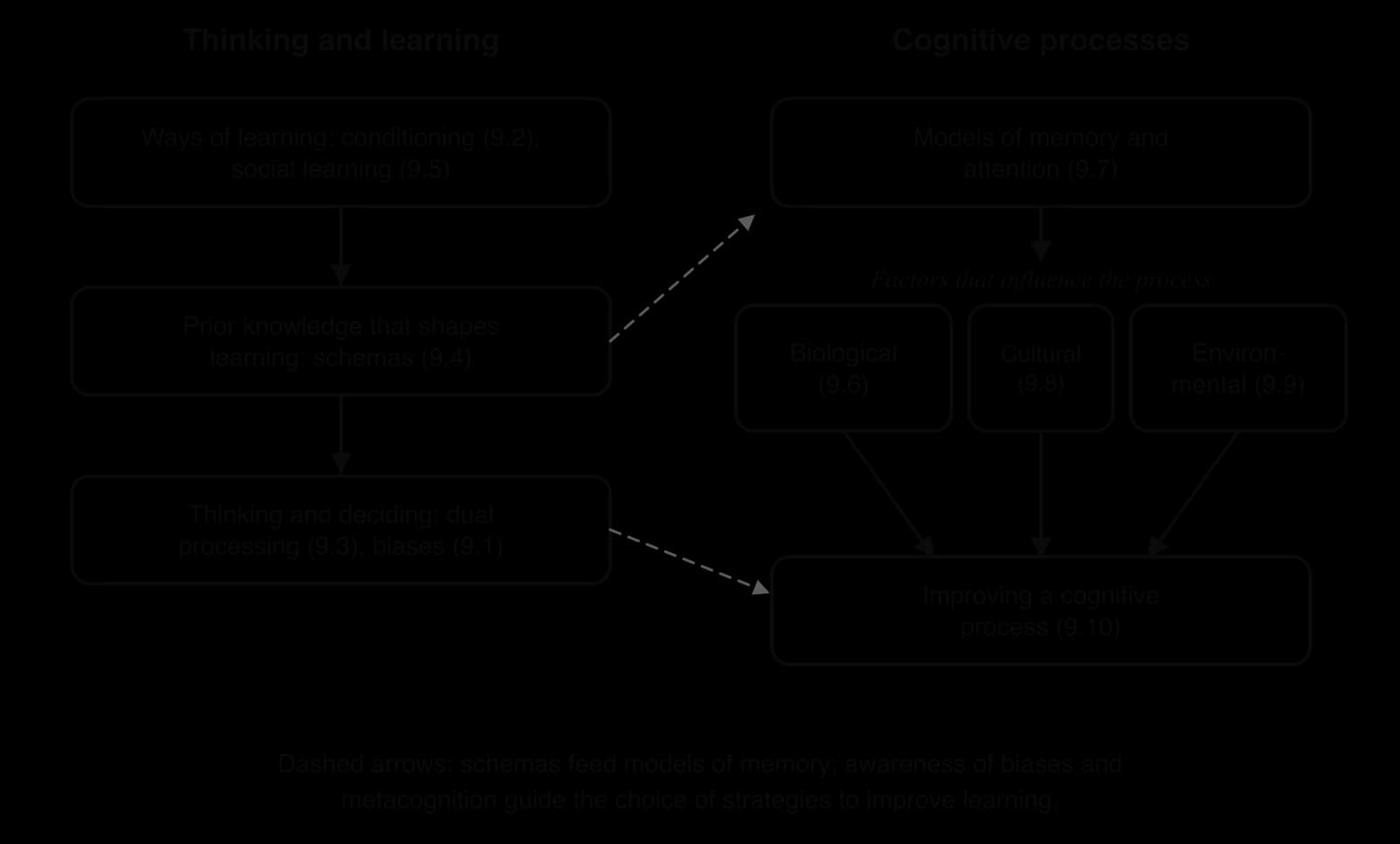
The two halves meet at many points. Schemas explain both how expertise speeds learning and why memories are reconstructed. The fast, intuitive thinking described by dual processing theory is also why learners trust the feeling of familiarity after rereading, a metacognitive error that research on retrieval practice corrects. Social learning theory explains how study habits and beliefs about ability are passed on, and conditioning explains why reward systems in classrooms and learning apps change behaviour.
Links to the concepts and to the approaches
Learning and cognition draws on all three approaches, and its best explanations combine them. From the cognitive approach come cognitive models, schema theory, dual processing and cognitive biases. From the biological approach come brain structures such as the hippocampus, neurotransmitters and hormones. From the sociocultural approach come social learning, enculturation and the cultural factors that shape attention and memory. Memory, for example, is explained by a model, depends on the hippocampus and sleep, and is shaped by what a culture teaches people to attend to.
Concept | How it applies in learning and cognition |
|---|---|
Measurement | Memory, attention and decision-making are inferred from recall, reaction times and choices; whether memory is tested after minutes or after a week can reverse a conclusion. |
Causality | Laboratory experiments give strong causal evidence about strategies and biases; natural experiments are used for noise, poverty and other factors that cannot be manipulated. |
Bias | Cognitive biases are a central topic, and much research relies on WEIRD student samples; cross-cultural studies show that attention and memory vary. |
Perspective | Single-approach explanations of learning are reductionist; biological, cognitive and sociocultural accounts each explain part of a process. |
Change | The context is directly concerned with change: reward systems, modelling, debiasing and study strategies are all deliberate attempts to improve learning. |
Responsibility | Research on children and students needs care, and claims about learning products such as brain training must be communicated honestly. |
The context also has its own research method. The class practical linked to learning and cognition is the experiment, because many questions about learning and memory can be tested by manipulating one variable, such as the way material is studied, and measuring its effect on recall. Many of the studies in the context, from conditioning experiments to research on retrieval practice, show the strengths and limits of this method.
How SL and HL differ
SL and HL students study exactly the same learning and cognition content, including all ten areas of study, and sit the same Papers 1 and 2. HL students extend the context through the HL extensions. Motivation is linked closely to learning, for example in how intrinsic and extrinsic rewards affect what students learn and how long they persist, and technology raises questions about the effects of devices, the internet and artificial intelligence on attention, memory and study. Culture extends the research on cultural factors in cognition.
HL students then apply this understanding to unseen sources in Paper 3, which may set a claim about motivation, technology or culture in the learning and cognition context.
Assessment
Paper 1 Section A: short-answer questions on approach terms, such as schema theory, operant conditioning or cognitive models, may be answered with examples from learning and cognition, although no context is named in the question.
Paper 1 Section B: a short unseen scenario may be set in learning and cognition, asking how an approach term, such as social learning theory or a cognitive model, applies to it.
Paper 1 Section C: one of the two concept-based essays may be on an area of study in learning and cognition, such as cognitive biases, biological factors in cognitive processes or improving a cognitive process, with reference to a named concept.
Paper 2 Section A: the questions on the experiment draw on the class practical carried out in this context; the focus is on the method rather than the topic.
Paper 2 Section B: the unseen study may be a learning and cognition study, discussed through two or more of the concepts.
Paper 3 (HL): sources may test a claim about motivation, technology or culture in learning and cognition.
Carry on with 9 in Augment
With a free account, Augment remembers where you stopped and what you have practiced.