9.5 Social learning theory
Explain how observation, modelling and self-efficacy shape learning, evaluate research from infancy to the classroom, and apply social learning theory to change how people learn.
- IB Psychology
- Part of 9 Learning and cognition
- SL and HL
Key terms introduced here
Each is in the Psychology glossary, with every other term in the subject.
- Coping model
A model who at first shows difficulty, errors or doubt and then gradually overcomes them, demonstrating both a skill and how to deal with setbacks.
- Deferred imitation
The reproduction of an observed action after a delay, without the model being present, which shows that the action has been stored in long-term memory.
- Mastery model
A model who performs a task correctly and confidently from the start, demonstrating the finished skill without errors or doubt.
- Overimitation
The tendency of human children to copy all of an adult’s demonstrated actions, including steps that are clearly unnecessary for reaching the goal.
- Peer tutoring
A teaching arrangement in which learners of similar age or ability teach one another, so that the tutor acts as a similar model and both tutor and tutee can benefit.
- Video modelling
A teaching method in which the learner watches a recorded demonstration of a target skill, which can be paused and repeated, before practising it.
Notes on 9.5 Social learning theory
Learning objectives
Explain the role of social learning theory in learning, including what can be learned by observation and how it differs from other forms of learning.
Describe evidence for observational learning in infancy and across cultures, including deferred imitation and overimitation.
Explain how modelling is used in classrooms, including cognitive modelling, mastery and coping models, peer tutoring and video modelling.
Explain the role of self-efficacy in learning and how observing peers can raise it.
Describe and evaluate Schunk and Hanson (1985) on peer models, self-efficacy and achievement.
Apply social learning theory to design a change in learning behaviour.
Evaluate social learning theory as an explanation of learning with reference to causality, measurement, bias and perspective.
Introduction
Much of what people know how to do was learned by watching someone else do it first: how to hold a pencil, how to solve a quadratic equation, how to behave in a library, how to prepare for a test. Social learning theory explains this kind of learning and shows how teachers, parents and designers of learning materials can use it to help people learn faster and with more confidence.
In the learning and cognition context, social learning sits between learning that needs little thought, such as classical conditioning, and learning that depends on reasoning and knowledge, such as building schemas. It draws on the sociocultural approach (learning comes from other people) and the cognitive approach (it depends on attention, memory and beliefs), and its evidence raises questions of causality, measurement and cultural bias.
Social learning theory: a recap
Social learning theory, proposed by Albert Bandura, holds that people learn new behaviour through observational learning: by watching a model and the consequences the model receives, without being reinforced themselves. Four mediational processes stand between observation and imitation: attention to the model, retention of the behaviour in memory, the ability to reproduce it, and the motivation to perform it. Motivation depends on the consequences the observer expects, including vicarious reinforcement from seeing a model rewarded.
Two further ideas from the theory are central to learning. The learning–performance distinction states that a behaviour can be learned without being performed. Self-efficacy, a person’s belief that they can succeed at a specific task, decides whether learners attempt and persist with what they have learned, and it is raised by watching similar others succeed.
The role of observation in learning
Learning is a relatively lasting change in knowledge or behaviour that results from experience. Social learning theory claims that experience does not have to be one’s own: it can be borrowed from others. This makes observation one of the most efficient ways to learn, because the learner avoids the time, errors and risks of trial and error.
What can be learned by observation
Observation can transmit far more than simple motor actions. It is useful to separate four kinds of learning that can come from watching a model.
What is learned | Example in learning and cognition | Mediational process most involved |
|---|---|---|
Motor skills | Handwriting, using a microscope, a swimming stroke | Retention and reproduction |
Cognitive strategies | How to break down a long-division problem; how to plan an essay | Attention to the model’s reasoning (think-aloud); retention |
Rules and norms of learning | Raising a hand before speaking; checking work before handing it in | Vicarious reinforcement and punishment |
Beliefs about oneself | “Someone like me can learn this” | Self-efficacy through vicarious experience |
Beliefs about oneself are the kind of observational learning most often overlooked. A learner who watches a classmate struggle and then succeed learns a method, but also learns that success is possible for someone like them. That belief influences effort and persistence long after the specific lesson.
Learning without performance
The learning–performance distinction comes from Bandura (1965). Children who had watched a filmed model being punished for attacking a Bobo doll imitated fewer of the model’s acts than children who saw the model rewarded or receive no consequences. When every child was then offered an attractive reward for copying the model, the differences between the groups largely disappeared, which shows that observational learning is a cognitive process rather than the strengthening of a response.
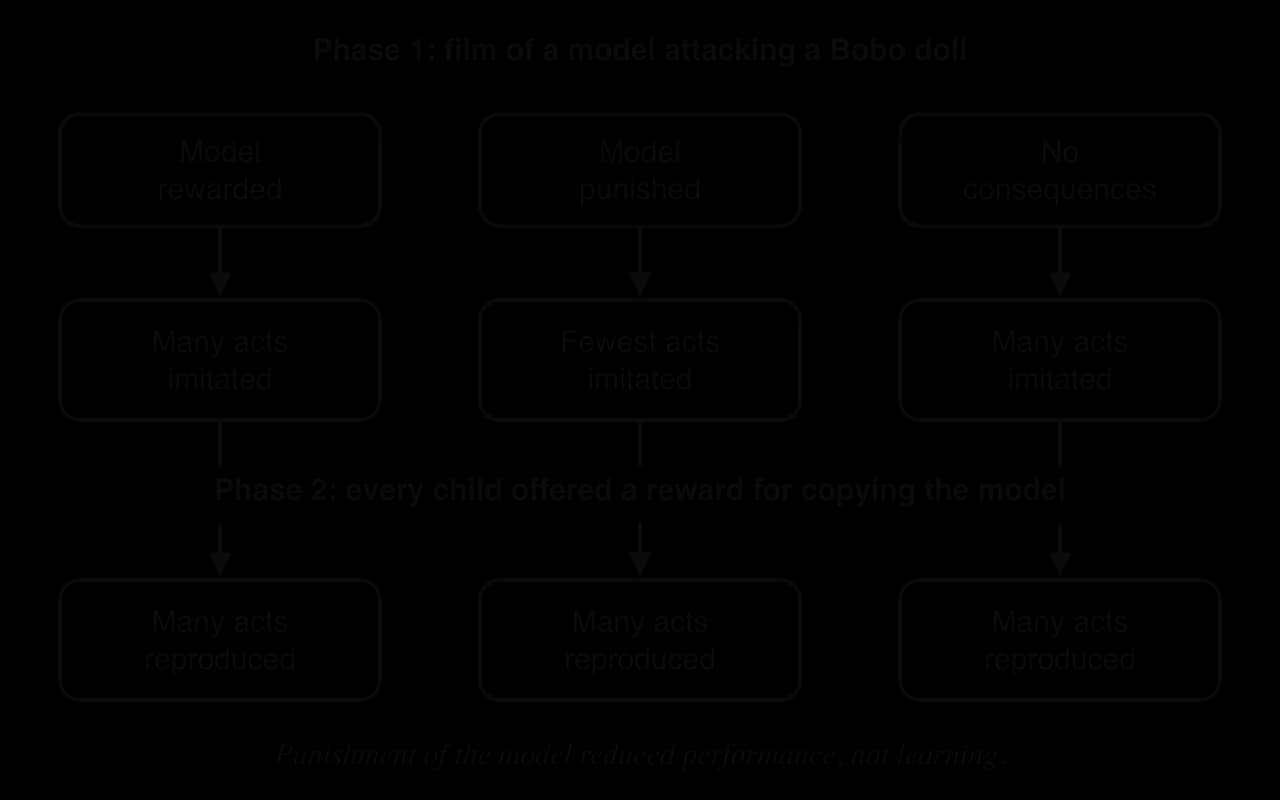
For learning and cognition the significance of this study is that knowledge can be acquired and stored without any sign in behaviour. What a teacher sees a learner do is therefore an incomplete measure of what the learner has learned; changing the expected consequences can make hidden learning visible. This is the same distinction that teachers rely on when they set a low-stakes quiz to find out what students have picked up from watching a demonstration.
Observational learning from infancy and across cultures
Deferred imitation in infants
If observational learning depends on retention, infants should be able to imitate actions after a delay as soon as they can store them in memory. Meltzoff (1988) showed 14-month-old infants an adult performing six actions on six different objects, including one novel act that infants never produce in spontaneous play: leaning forward to touch a box with the forehead so that its top lit up.
The infants watched but were not allowed to touch the objects, so they could not imitate immediately. When they returned to the laboratory a week later, they produced significantly more of the target actions than control infants who had not seen the demonstrations, including the novel act.
Deferred imitation shows that the retention process of social learning is available very early in life, long before children can describe what they have seen in words. It also gives developmental psychologists a way to measure memory in infants who cannot yet talk, which links social learning to research on the development of memory.
Overimitation: copying more than is needed
Human children often copy actions that are clearly unnecessary. When an adult shows a child how to open a box but includes irrelevant steps, such as tapping the lid with a stick before opening it, children tend to reproduce the irrelevant steps as well. This is called overimitation. Chimpanzees given the same demonstration usually skip the unnecessary actions and go straight to the goal.
Nielsen and Tomaselli (2010) tested whether overimitation is a product of Western schooling and parenting. They compared children from a large industrialised city in Australia with children from remote Bushman communities in the Kalahari Desert of southern Africa, whose daily life and schooling differ greatly from those of a Western city. Children in both groups copied the irrelevant actions at similar rates, and overimitation did not depend on age, the testing setting or familiarity with the adult demonstrator. The authors argued that faithful copying, even of steps whose purpose is unclear, is a universal human trait that helps children acquire cultural practices whose reasons they do not yet understand.
Learning by observing in Indigenous communities
Cultures differ in how much children’s learning is organised around observation rather than direct instruction. Barbara Rogoff and colleagues have described a pattern common in many Indigenous communities of the Americas, in which children learn by observing ongoing adult activities closely and joining in when they are ready, rather than through lessons addressed to them.
Correa-Chávez and Rogoff (2009) tested this in a quasi-experiment. Children aged 5–11 waited with a distracting toy while an adult showed their sibling how to make a novel toy. Children from Guatemalan Mayan families with little involvement in Western schooling (n = 40) paid more sustained attention to the demonstration that was not addressed to them, and learned more from it, than Mayan children from families with extensive schooling (n = 40), who in turn attended more than European American children (n = 40).
The findings suggest that the attention process in social learning is itself shaped by culture: some children are enculturated to learn from everything happening around them, while others learn to wait until instruction is directed at them.
Modelling in the classroom
Teachers model all the time, whether they intend to or not. Social learning theory turns this into deliberate practice: if learners copy models, then the choice of model, what the model shows and what happens to the model can all be planned.
Cognitive modelling: making thinking visible
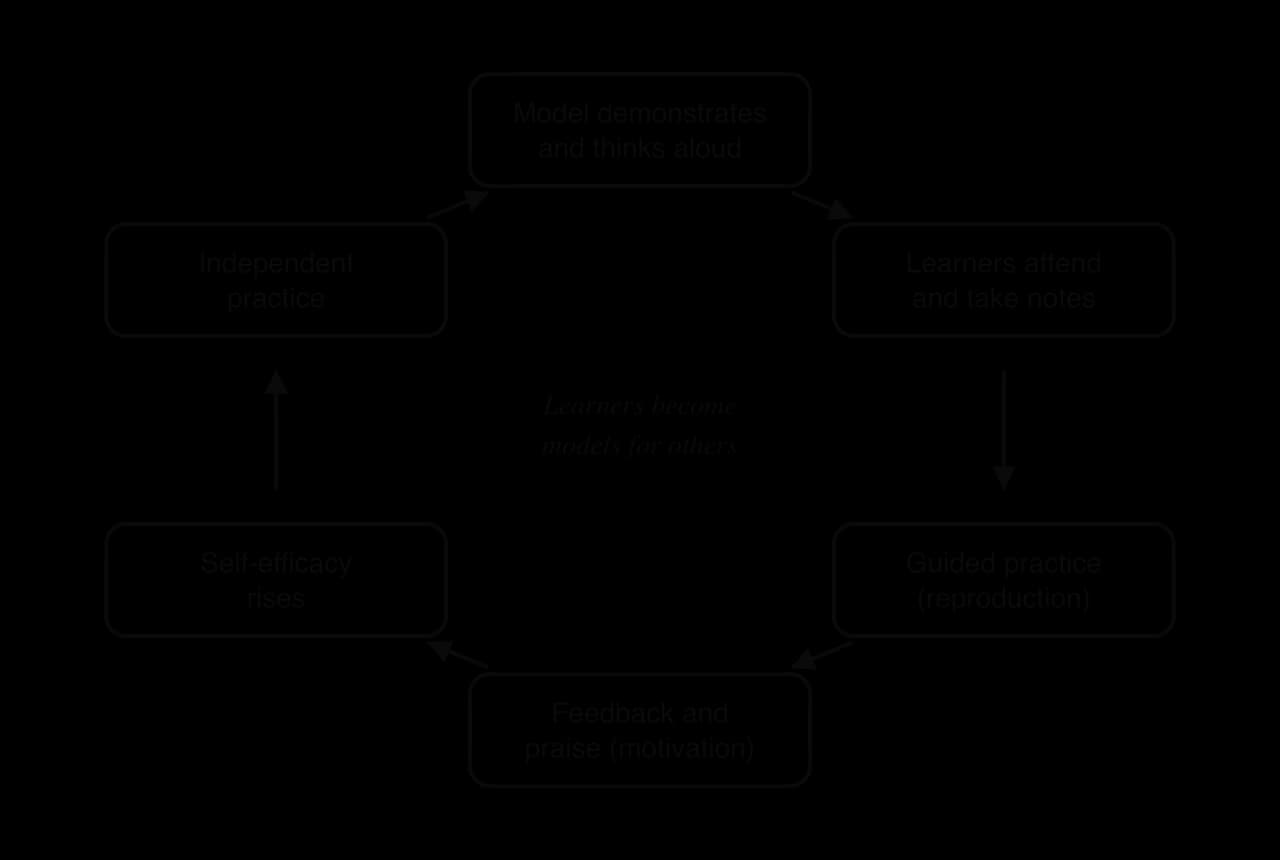
Many academic skills are mental, so watching someone perform them shows only the result. In cognitive modelling, the teacher solves a problem while explaining each decision aloud (“I notice the units are different, so I will convert them first”). The think-aloud turns invisible reasoning into something learners can attend to and retain. Worked examples on paper do a similar job, and research on the worked-example effect shows that studying worked solutions helps novices more than solving problems unaided.
Mastery models and coping models
A mastery model performs the task without errors from the start and expresses confidence throughout. A coping model at first hesitates, makes mistakes and expresses doubts, then gradually corrects them and succeeds, often saying aloud how they are dealing with the difficulty (“I need to slow down and check this step”). Coping models were first used in therapy for fears, where clients watched a model overcome anxiety step by step.
Social learning theory predicts that coping models should help learners who are struggling, because a learner who has had difficulties sees the coping model as more similar to themselves. Similarity increases attention and makes the model’s eventual success more relevant to the learner’s own expectations. The prediction has had mixed support in classrooms: Schunk and Hanson (1985) found no difference between coping and mastery peers, but in a later experiment Schunk and colleagues (1987) found that a single coping model raised children’s self-efficacy and skill more than a single mastery model.
Peer tutoring
In peer tutoring, one learner teaches another of similar age or slightly older. From the point of view of social learning theory, the tutor acts as a model who is similar to the learner, so the learner is likely to attend and to believe that the skill is attainable. Cohen, Kulik and Kulik (1982) combined the results of 65 evaluations of school tutoring programmes in a meta-analysis and found that tutored students performed better on tests than control students and developed more positive attitudes to the subject, and that the tutors also gained in understanding.
Video modelling
Video modelling uses recorded demonstrations of a target skill, which the learner watches before practising. Because the recording is identical every time, it controls exactly what the learner sees and can be paused and repeated, which supports attention and retention.
Bellini and Akullian (2007) analysed 23 single-case studies of video modelling and video self-modelling (watching an edited video of oneself performing successfully) with children and adolescents on the autism spectrum. They found the interventions effective for social-communication and functional skills, and the skills were maintained over time and transferred to new people and settings. When Williamson and colleagues (2019) re-examined the same studies against stricter quality standards for special education research, however, they concluded that video modelling would not have qualified as an evidence-based practice.
Learning from educational television
Educational television applies the same idea to whole populations of young children. Programmes such as Sesame Street use likeable characters who count, read, share and solve problems on screen, so that viewers can attend to, retain and later reproduce what the characters model. Unlike a classroom video, the models are chosen and written to be similar to the audience, and international versions use local characters and languages.
Mares and Pan (2013) combined 24 studies of international co-productions of Sesame Street, with over 10,000 children in 15 countries, in a meta-analysis. Viewing was linked to significant gains in literacy and numeracy, in knowledge about the world such as health and safety, and in social reasoning and attitudes towards out-groups, in low- and middle-income as well as high-income countries. Many of the studies were evaluations commissioned by the programme’s producer, which raises a possible problem of bias.
Kearney and Levine (2019) used a natural experiment in the United States. When Sesame Street began in 1969, some areas could not receive it because of the type of signal their local station used. Children who were of preschool age in areas with good reception were later more likely to be in the right school grade for their age, especially boys, although effects on adult education and earnings were too imprecise to judge.
Self-efficacy and learning
Self-efficacy is the part of social learning theory that has had the largest influence on educational psychology. A learner’s self-efficacy for a subject affects which tasks they choose, how much effort they make, how long they persist after failure and how anxious they feel. Multon, Brown and Lent (1991) combined the results of studies of students of different ages and found that self-efficacy beliefs were positively and significantly related to both academic performance and persistence, although the strength of the relationship varied between studies.
The four sources of self-efficacy each have a classroom form. Mastery experiences come from tasks that are challenging but achievable, so that success is frequent. Vicarious experience comes from watching classmates who are similar succeed. Verbal persuasion comes from credible encouragement linked to specific evidence (“The last two answers used the method correctly”). Physiological states matter when anxiety before tests is interpreted as a sign of inability rather than as normal arousal.
 YouTube
Self-efficacy and achievement influence each other. Success raises self-efficacy, and higher self-efficacy leads to more effort and further success. This makes it difficult to tell from correlational data whether self-efficacy causes achievement or only reflects it, a problem of bidirectional ambiguity. Experiments that manipulate self-efficacy, for example by changing the model learners watch, are needed to show its causal role.
 YouTube
Key study: Schunk and Hanson (1985), peer models and self-efficacy
Aim
Schunk and Hanson aimed to find out whether children who had difficulty learning a mathematical skill would develop higher self-efficacy and achievement after watching a peer model learn the skill than after watching a teacher demonstrate it or watching no model. They also tested whether a coping peer model would raise self-efficacy more than a mastery peer model.
Method
The participants were 72 children (36 girls and 36 boys) aged between 8 years 6 months and 10 years 10 months (mean 10.1 years) from eight classes in two schools in Houston, Texas, described as mainly middle class. Their teachers selected children who could solve no more than about 25% of subtraction problems that required regrouping (“borrowing”), a skill the children had found difficult in class but for which they were not receiving remedial help.
After a pretest of self-efficacy, skill and persistence, the children were randomly assigned, within gender and school, to one of six conditions of 12 children each. This was a true experiment with an independent samples design.
Peer mastery model (boys watched a boy, girls watched a girl): videotapes showed a teacher explaining subtraction and then a 10-year-old peer solving problems quickly and correctly while saying positive statements such as “I can do that one”.
Peer coping model (same-sex): the peer at first hesitated, made errors and said things like “I’m not sure I can do that one”, then gradually improved, used coping statements (“I’ll have to work hard on this one”) and finally performed like the mastery model.
Teacher model: the videotapes showed only the teacher explaining and solving the same number of problems.
No model: children did not watch any videotape.
Videotapes were used rather than live models so that every child in a condition saw exactly the same demonstration. After the videos, the children rated their self-efficacy for learning to solve 25 types of problem on a scale from 10 (not sure) to 100 (really sure). All 72 children then received the same training programme: five 40-minute sessions of worked examples and practice problems. A posttest measured self-efficacy and skill (the number of 25 test problems solved correctly).
Results
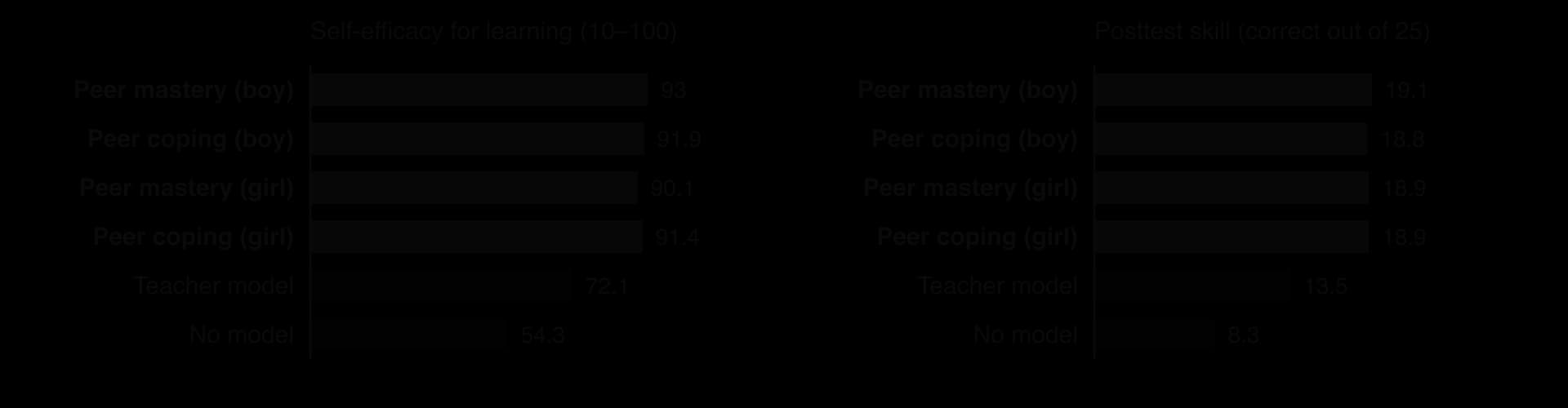
Before the study, skill was low and similar in every condition (about 4.5–4.9 problems correct out of 25). After watching the videotapes, children in the peer-model conditions judged their self-efficacy for learning at around 90–93, compared with 72.1 in the teacher-model condition and 54.3 in the no-model condition. On the posttest, the peer-model groups solved about 19 problems correctly, the teacher-model group 13.5 and the no-model group 8.3. The peer conditions differed significantly from the teacher-model condition, which in turn differed significantly from the no-model condition. Contrary to the prediction, the mastery and coping peer models did not differ on any measure.
Condition (n = 12 each) | Self-efficacy for learning (10–100) | Skill pretest (/25) | Skill posttest (/25) |
|---|---|---|---|
Peer mastery, boy | 93.0 | 4.8 | 19.1 |
Peer coping, boy | 91.9 | 4.6 | 18.8 |
Peer mastery, girl | 90.1 | 4.5 | 18.9 |
Peer coping, girl | 91.4 | 4.6 | 18.9 |
Teacher model | 72.1 | 4.9 | 13.5 |
No model | 54.3 | 4.6 | 8.3 |
Sources: Schunk, D. H., & Hanson, A. R. (1985). Peer models: Influence on children’s self-efficacy and achievement. _Journal of Educational Psychology, 77(3), 313–322. Means from the authors’ report of the same experiment (ERIC ED254397)._
Self-efficacy for learning, measured before the training began, was positively correlated with posttest skill, which is consistent with the claim that self-efficacy influences how much children go on to learn.
Conclusions
Observing a similar peer learn a skill raised children’s belief that they could learn it and improved how much they actually learned during later training. Because the teacher-model group saw the same explanations and the same number of solved problems as the peer groups, the advantage of the peer models cannot be explained by the instruction they contained. The authors concluded that similarity to the model, in age and gender, conveyed to the children that they too were capable, which supports the role of vicarious experience as a source of self-efficacy.
Evaluation
Causality
Random allocation to conditions, identical videotapes within each condition and identical training afterwards allow the differences between groups to be attributed to the type of model. The teacher-model condition is a strong control, since it held the instructional content constant and varied only whether a peer was shown. The study therefore supports a causal effect of peer modelling on self-efficacy and achievement in this setting. However, the evidence that self-efficacy itself caused the higher achievement comes from correlations, so self-efficacy may be one pathway among several, such as attention to a more engaging video.
Measurement
Skill was measured objectively as the number of problems solved, but self-efficacy was a self-report on a numerical scale. The researchers trained children to use the scale with a practice task about jumping distances, which improves the construct validity of the measure for young children. Even so, children who had just watched an encouraging video may have given high ratings partly because they thought this was expected, a possible demand characteristics effect. The posttest followed the training within days, so the study shows short-term learning, not lasting change.
Bias and generalisability
The sample was small (12 children per condition), drawn from two schools in one American city, and limited to children who were struggling with one specific skill. The peer models were scripted to succeed, whereas real classmates sometimes fail, and watching a similar peer fail could lower an observer’s self-efficacy rather than raise it. The generalisability of the findings to other subjects, to high-achieving learners and to cultures where teachers hold higher status or where peer comparison is discouraged remains uncertain.
Applying social learning theory to change learning behaviour
Social learning theory suggests several ways to change how people learn, from individual study habits to whole-school routines. Each works through one or more of the mediational processes or through self-efficacy.
Strategy | How it works according to social learning theory |
|---|---|
Teacher think-aloud and worked examples | Makes reasoning observable so it can be attended to and retained |
Peer models of a similar ability | Similarity raises attention and self-efficacy through vicarious experience |
Coping models | Shows how to recover from errors, useful for anxious or struggling learners |
Public praise for effective study behaviour | Vicarious reinforcement for the whole class |
Peer tutoring and study partners | Tutees gain a similar model; tutors gain mastery experience |
Video modelling | Standardised, repeatable demonstrations that support retention |
Evaluating social learning theory as an explanation of learning
Causality: experiments in the classroom
Unlike much research on media and behaviour, research on modelling in learning includes many true experiments with random allocation, such as Schunk and Hanson (1985), that support causal claims. Most of these experiments are short, however, and test one skill over a few days. Whether modelling changes long-term achievement is harder to show, because real classrooms contain many models at once and achievement has many interacting causes, including prior knowledge, motivation, family support and teaching quality.
Measurement: what counts as learning?
The learning–performance distinction creates a measurement problem: if learning can be hidden, then any measure of performance may underestimate it. Researchers have to create conditions, such as incentives or tests, in which learners are motivated to show what they know. Self-efficacy, the theory’s key cognitive variable, is measured by self-report and can be influenced by social desirability, especially in children who want to please adults.
Perspective: what else is involved in learning
Social learning theory explains how learning spreads from person to person, but not how learners make sense of what they see. A learner who watches a demonstration still has to fit it into existing schemas, and learning is limited by the capacity of working memory and by biological factors such as attention span and brain maturation. Explanations that combine social learning with cognitive and biological factors are more complete than any single approach.
Bias: whose learning?
Much of the evidence comes from American children in classroom settings that rely on direct instruction. Cross-cultural research, such as the studies of Mayan children and of overimitation in the Kalahari, suggests that the capacity for observational learning is universal but that its use is shaped by culture. Applying classroom findings from one culture to another without testing them risks an imposed etic view of how children ought to learn.
Concept | Strength | Limitation |
|---|---|---|
Causality | Classroom experiments with random allocation show that peer models raise self-efficacy and skill | Short studies of single skills; long-term effects in real classrooms are hard to isolate |
Measurement | Skill can be measured objectively, for example problems solved | Learning can be hidden; self-efficacy relies on self-report |
Perspective | Combines social and cognitive factors in learning | Says little about how new information is understood or about biological limits |
Bias | Cross-cultural studies (Kalahari, Guatemala) support a universal capacity for imitation | Classroom evidence comes mostly from WEIRD samples |
Exam practice
In the learning and cognition context, social learning theory can appear in Paper 1 Section B as an unseen scenario about learning, and in Section C as a concept-based essay on the role of social learning theory in learning. Section A can also ask about the theory itself, without a context.
Summary
Social learning theory explains learning through observation of models, mediated by attention, retention, reproduction and motivation.
Observation can teach motor skills, cognitive strategies, classroom norms and beliefs about one’s own ability.
Bandura (1965) showed that learning can be hidden: vicarious punishment reduced performance, but rewards made the learned behaviour appear.
Meltzoff (1988) found deferred imitation of a novel act after a week in 14-month-olds, showing early retention of observed actions.
Overimitation appears in both industrialised and Kalahari Bushman children, but cultures differ in how much children learn by observing (Correa-Chávez & Rogoff, 2009).
Classroom applications include cognitive modelling, coping models, peer tutoring and video modelling.
Schunk and Hanson (1985): peer models raised self-efficacy (about 90 against 54 with no model) and skill (about 19 against 8 correct), more than a teacher model.
Evaluation: strong experimental support for short-term effects, but hidden learning, self-report measures of self-efficacy and mostly WEIRD samples limit conclusions.
Self-check
- To do:
I can explain the role of social learning theory in learning and what can be learned by observation.
- To do:
I can describe evidence for deferred imitation and overimitation, and cultural differences in learning by observing.
- To do:
I can explain cognitive modelling, mastery and coping models, peer tutoring and video modelling.
- To do:
I can explain how self-efficacy affects learning and how peer models raise it.
- To do:
I can describe and evaluate Schunk and Hanson (1985).
- To do:
I can apply social learning theory to design a change in learning behaviour.
- To do:
I can evaluate social learning theory as an explanation of learning with reference to causality, measurement, bias and perspective.
Carry on with 9.5 in Augment
With a free account, Augment remembers where you stopped and what you have practiced.