9.1 Cognitive biases
Explain how heuristics produce cognitive biases in decision-making, describe availability, representativeness, framing, overconfidence and optimism biases, and evaluate research on them and on strategies that reduce them.
- IB Psychology
- Part of 9 Learning and cognition
- SL and HL
Key terms introduced here
Each is in the Psychology glossary, with every other term in the subject.
- Availability heuristic
A mental shortcut in which the frequency or probability of an event is judged by how easily examples of it come to mind.
- Cognitive error
An error in a cognitive process such as memory, attention or perception, often caused by a lack of information or by the use of a heuristic.
- Conjunction fallacy
The error of judging that a combination of two events or characteristics is more probable than one of them alone, which is logically impossible.
- Consider-the-opposite strategy
A debiasing strategy in which people deliberately generate reasons why their initial judgement or an anchor might be wrong before making a final decision.
- Debiasing
Any strategy that reduces the effect of a cognitive bias on judgement, either by changing how the person thinks or by changing the situation in which the decision is made.
- Framing effect
The tendency for choices between options with identical outcomes to change depending on how the options are described, for example as gains or as losses.
- Hindsight bias
The tendency, after an outcome is known, to overestimate how predictable it was and how well one would have predicted it beforehand.
- Loss aversion
The tendency for losses to have a greater psychological impact than gains of the same size, so that people take risks to avoid a loss that they would not take to secure an equal gain.
- Optimism bias
The tendency to believe that one is more likely than other people to experience good events and less likely to experience bad ones.
- Overconfidence bias
The tendency for people’s confidence in their judgements, knowledge or abilities to be greater than the accuracy of those judgements justifies.
- Representativeness heuristic
A mental shortcut in which the probability that something belongs to a category is judged by how closely it resembles a typical member of that category, neglecting base rates.
Notes on 9.1 Cognitive biases
Learning objectives
Explain why cognitive biases arise, with reference to heuristics, bounded rationality and dual processing.
Describe the availability and representativeness heuristics and the biases they produce, with research evidence.
Describe the framing effect and the aim, method, results and conclusions of Tversky and Kahneman (1981).
Explain overconfidence, optimism and hindsight biases and their effects on learning and decision-making.
Explain how biological, cognitive and sociocultural factors interact in producing biased decisions.
Evaluate strategies for debiasing decisions.
Discuss research on cognitive biases with reference to measurement, bias, perspective and change.
Introduction
Cognitive biases are systematic errors in judgement that occur because people use mental shortcuts when they decide. They influence what students choose to revise, how patients weigh the risks of a treatment, how voters judge a policy and how investors react to news, so understanding them is central to understanding decision-making as a cognitive process.
In the learning and cognition context, cognitive biases are studied as part of thinking: how people reason, estimate probabilities and choose between options. The topic draws on several approach terms, above all anchoring bias, confirmation bias, dual-processing theory and schema theory, and it shows how biological, cognitive and sociocultural factors combine to produce a single biased decision.
Anchoring and confirmation bias as cognitive biases
Two biases are approach terms in their own right. In anchoring bias, an initial value that a person has considered pulls a later numerical estimate towards it, either because people adjust too little from a starting point or because considering the anchor makes anchor-consistent knowledge more accessible. Experienced judges, for example, have been shown to give longer sentences after rolling loaded dice that showed a high number.
In confirmation bias, an existing belief steers the search for, interpretation of and memory for evidence, so that supporting information is favoured and contradicting information is discounted. Both biases matter in learning and cognition: a student’s first estimate of how long an essay will take can anchor the plan, and a student who believes they are “bad at maths” may notice every mistake and forget every success. Both belong to a wider family of biases that share causes and can be reduced in similar ways.
Why cognitive biases arise
Classical economic theory assumed that people decide rationally: they consider all the options, weigh every outcome by its probability and choose the one with the best expected value. Herbert Simon argued in the 1950s that real people cannot do this, because their time, information and mental capacity are limited. He called the result bounded rationality: people make decisions that are good enough rather than optimal.
A heuristic is a mental shortcut that replaces a hard question with an easier one. “How likely is a plane crash?” is hard; “how easily can I think of plane crashes?” is easy. Heuristics are fast and usually give acceptable answers, which is why they are used. In some situations, however, the easy question gives a systematically wrong answer to the hard one, and the result is a cognitive bias. Tversky and Kahneman’s research programme in the 1970s, known as the heuristics-and-biases approach, identified the main shortcuts by finding the situations in which they fail.
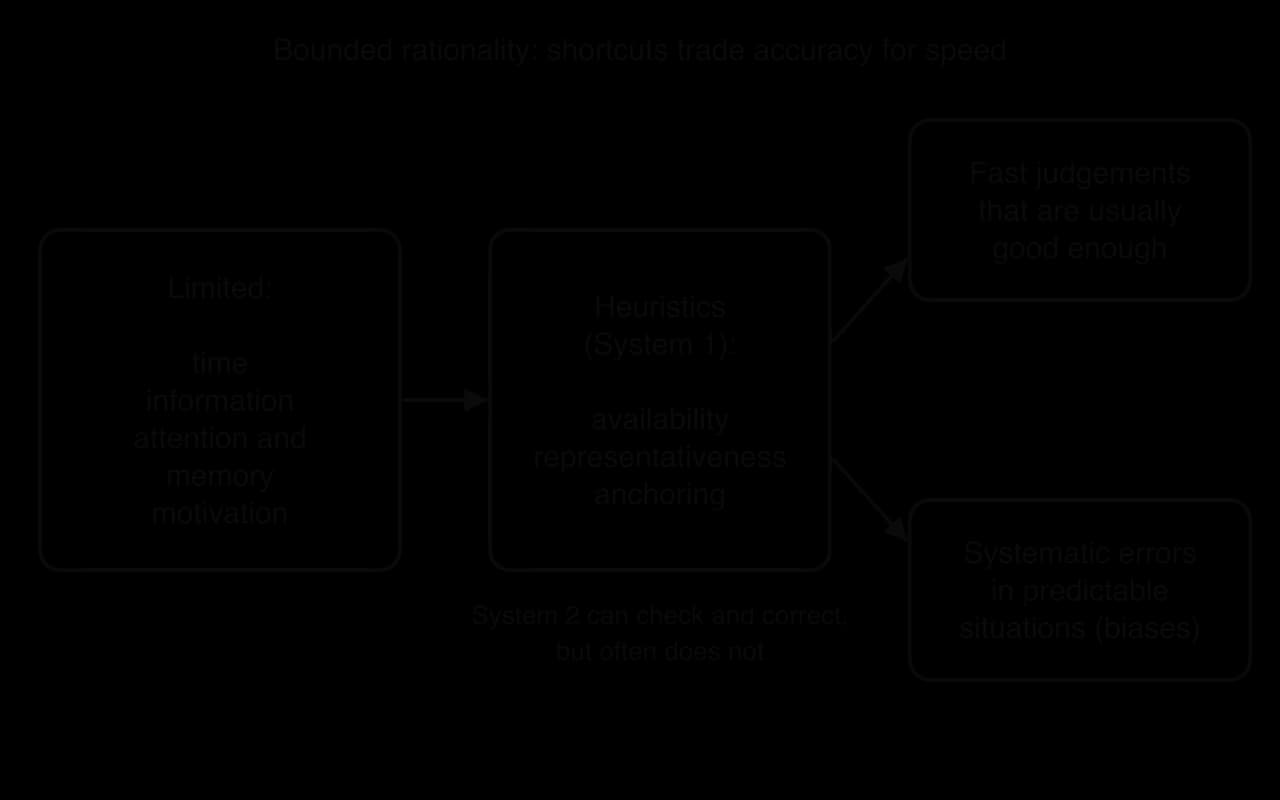
Dual-processing theory explains where heuristics sit in the mind. System 1, which is fast, automatic and effortless, generates intuitive answers using heuristics. System 2, which is slow, deliberate and effortful, can check those answers and correct them, but it is lazy: it often accepts System 1’s answer without checking. Biases are most likely when System 2 is not engaged, for example under time pressure, when tired or distracted, or when the intuitive answer feels obviously right. The idea of the cognitive miser sums this up: people save mental effort wherever they can.
Cognitive biases arise particularly when one of three resources is short:
Time: a doctor in an emergency department or a student finishing a timed test has no time to consider every possibility.
Information: when key facts, such as how common an illness really is, are unknown, people fall back on what comes to mind.
Motivation and capacity: when a decision seems unimportant, or working memory is already loaded, people do not invest the effort that checking requires.
 YouTube
The availability heuristic
People often judge how frequent or likely something is by how easily examples come to mind. Usually this works, because common events are encountered more often and so are easier to recall. It fails when something other than frequency makes examples easy to recall, such as vivid media coverage, recent personal experience or the way memory is organised.
Tversky and Kahneman (1973) asked participants whether the letter K is more likely to appear as the first letter of an English word or as the third letter. Most judged the first position more likely, although in typical English text K appears as the third letter about twice as often. Words are organised in memory by their first letter, so words beginning with K are easy to retrieve, while words with K in the third position are not. Ease of retrieval was mistaken for frequency.
Lichtenstein and colleagues (1978) asked people to judge how often various causes of death occur in the United States. Judgements were consistently biased: dramatic, well-publicised causes such as tornadoes, floods and homicide were overestimated, while common but less newsworthy causes such as diabetes and stroke were underestimated. The biases matched how memorable and how widely reported the events were, and participants could not correct for them even when told to.
Schwarz and colleagues (1991) showed that it is the ease of recall, not the number of examples, that drives the judgement. Participants who recalled six examples of their own assertive behaviour rated themselves as more assertive than those who recalled twelve. Recalling twelve examples is difficult, and the difficulty itself was taken as evidence that assertive behaviour is rare.
In learning and cognition, the availability heuristic affects how students judge their own preparation. A student who has just reread a chapter finds its content easy to bring to mind and may judge that they know it well, although ease of recall immediately after rereading is a poor guide to recall a week later. Availability also explains why a single vivid story, such as a friend who failed after following a revision technique, can outweigh evidence from many students for whom it worked.
The representativeness heuristic
People often judge the probability that something belongs to a category by how much it resembles a typical member of that category. A quiet person who likes books seems more likely to be a librarian than a salesperson, because they fit the stereotype. The heuristic draws on schemas and stereotypes stored in memory. It fails because resemblance ignores other information that matters for probability, especially how common each category is.
The conjunction fallacy: the Linda problem
Tversky and Kahneman (1983) described a woman called Linda: 31 years old, single, outspoken and very bright, who had studied philosophy and been deeply concerned with discrimination and social justice as a student. Participants were asked which was more probable: that Linda is a bank teller, or that Linda is a bank teller and active in the feminist movement. About 85% of undergraduates in one version chose the second option.
The second option cannot be more probable than the first, because every feminist bank teller is also a bank teller. Adding a detail can only make a description less likely. Participants judged by resemblance: “feminist bank teller” fits the description of Linda better than “bank teller”, so it felt more probable. This error is called the conjunction fallacy.
 YouTube
Base-rate neglect
Representativeness also leads people to neglect base rates: how common each category is in the population. In a study by Kahneman and Tversky (1973), participants read short personality descriptions said to be drawn at random from a group of engineers and lawyers. Their judgements of whether a person was an engineer depended almost entirely on how much the description sounded like an engineer, and hardly at all on whether they were told the group contained 70% or 30% engineers. In medicine, base-rate neglect leads to overestimating the chance that a positive test result means a person has a rare disease, because the rarity of the disease is ignored.
Is the conjunction fallacy a real error?
Gerd Gigerenzer and colleagues argued that some of these errors partly reflect how the problems are worded. In everyday conversation, “probable” can mean “plausible”, and listeners assume that a speaker who adds “and is active in the feminist movement” is giving relevant information. When the Linda problem is rewritten in terms of frequencies (“of 100 people who fit this description, how many are bank tellers? How many are bank tellers and feminists?”), the error rate falls sharply, to about 20% in some studies.
This supports an ecological view: people reason better when information is presented in the natural frequencies they meet in real life. Tversky and Kahneman accepted that frequency formats reduce the error, but argued that the fallacy is still common in many formats and among experts.
Framing and loss aversion
The framing effect shows that people’s choices depend on how options are described, even when the outcomes are identical. A treatment described as having a “90% survival rate” is more attractive than one with a “10% mortality rate”, although the two descriptions give the same information.
Kahneman and Tversky explained framing with prospect theory. People evaluate outcomes as gains or losses relative to a reference point rather than as final states, and they feel losses more strongly than equivalent gains: losing £50 is more unpleasant than winning £50 is pleasant. This loss aversion makes people cautious (risk averse) when choices are framed as gains, because they want to secure the gain, and willing to gamble (risk seeking) when choices are framed as losses, because they want to avoid a certain loss.
Overconfidence, optimism and hindsight
A further group of biases concerns how people judge their own knowledge, abilities and futures. They matter in learning because they affect how students plan, revise and respond to feedback.
Overconfidence bias
Kruger and Dunning (1999) gave Cornell University students tests of logical reasoning, grammar and humour and then asked them to estimate how well they had done compared with other students. Across four studies, participants who scored in the bottom quarter greatly overestimated their performance. The researchers argued that the skills needed to perform a task are the same skills needed to recognise good performance, so people with low skill lack the metacognition to see their own errors. When the low scorers were given training in logic, their estimates became more accurate.
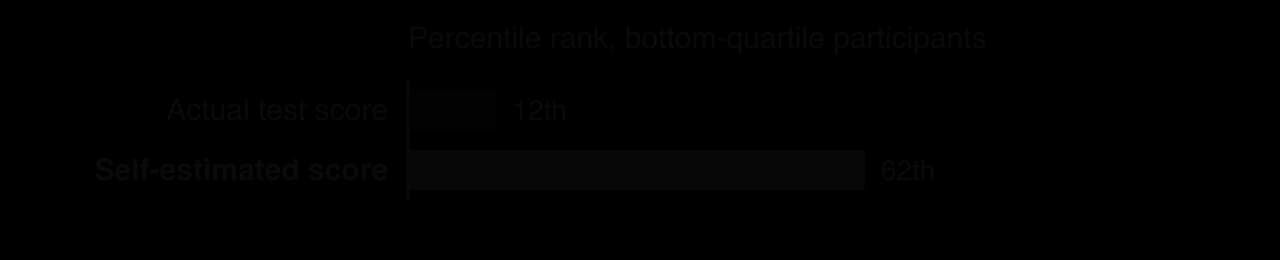
The finding has been challenged. Burson, Larrick and Klayman (2006) found that on difficult tasks the best performers were as poorly calibrated as the worst, and argued that part of the pattern is a statistical artefact: everyone’s estimates contain noise and a general tendency to think they are above average, which produces the same graph without any special deficit in low performers. Overconfidence in general is well established; the claim that it is concentrated in the least skilled is more disputed.
Overconfidence also varies with culture and context. Muthukrishna and colleagues (2018) measured overconfidence in Japanese, Hong Kong Chinese, European Canadian and East Asian Canadian participants with a procedure that compared each person’s confidence with their own performance. Overconfidence was not universal: depending on the task, the domain and the incentives, different groups were underconfident, accurate or overconfident. Many earlier cross-cultural comparisons had measured confidence without measuring accuracy, so their conclusions about cultural differences were unreliable.
Optimism bias and the planning fallacy
Weinstein (1980) asked university students to estimate how their own chances of experiencing a range of life events compared with those of their classmates. On average they rated their chances of positive events, such as owning a home, as above average and their chances of negative events, such as a drinking problem, as below average, which cannot be true of a group as a whole.
Sharot, Korn and Dolan (2011) found one way in which such beliefs survive: when participants learned the real probability of negative events such as illness, they updated their beliefs more after good news (the risk was lower than they thought) than after bad news (it was higher). Functional MRI showed that frontal regions tracked errors calling for a more optimistic update well, while highly optimistic individuals showed weaker tracking of errors that called for a pessimistic update.
Applied to plans, optimism produces the planning fallacy. Buehler, Griffin and Ross (1994) found that students’ predictions of when they would finish academic and other tasks were consistently too optimistic. Think-aloud data showed that they focused on how the task would go in the future and ignored how long similar tasks had taken in the past. When students were told to connect their past experience with their prediction, the optimistic bias disappeared. Observers predicting other people’s completion times did not show the optimistic bias and, if anything, overestimated how long tasks would take.
Hindsight bias
Once an outcome is known, people tend to believe they could have predicted it: the “I knew it all along” effect. Hindsight bias makes the past seem more predictable than it was, which makes it harder to learn from mistakes. A student who reads the answers after a test may feel they “nearly had” questions they could not in fact have answered, and so judge that no further revision is needed.
Choi and Nisbett (2000) found that Korean participants showed greater hindsight bias and less surprise than American participants when a character in a story behaved against expectations, for example when a kind seminary student did not stop to help someone in need. They linked this to holistic thinking, more common in East Asian cultures, in which many factors are seen as interacting, so almost any outcome can be explained once it is known. The study is a reminder that the size of a bias depends on cultural ways of thinking as well as on universal cognitive limits.
Bias | What happens | Example in learning and cognition | Research |
|---|---|---|---|
Availability | Ease of recall is taken as frequency | Rereading makes content feel “known” | Tversky and Kahneman (1973); Schwarz et al. (1991) |
Representativeness | Resemblance is taken as probability; base rates ignored | Judging a classmate’s ability by how “clever” they seem | Tversky and Kahneman (1983) |
Framing | The same outcome described as gain or loss changes choice | A teacher saying a habit “loses points” rather than that the alternative “gains points” | Tversky and Kahneman (1981) |
Overconfidence | Confidence exceeds accuracy | Low scorers expecting high grades | Kruger and Dunning (1999) |
Optimism and planning fallacy | Own future judged better than others’; tasks take longer than planned | Starting coursework too late | Weinstein (1980); Buehler et al. (1994) |
Hindsight | Known outcomes seem predictable | Feeling one “nearly had” a test answer | Choi and Nisbett (2000) |
Key study: Tversky and Kahneman (1981), the framing of decisions
Rational choice theory assumes that people’s preferences depend on the outcomes of their options, not on how the options are described. Amos Tversky and Daniel Kahneman tested this assumption with a problem that has become one of the best-known demonstrations in psychology.
Aim
The researchers aimed to show that preferences between options with identical outcomes can be reversed by describing the outcomes as gains or as losses, and to explain the reversal with prospect theory.
Method
Participants were university students in the United States and Canada, who answered short written decision problems in class. The study used an independent samples design: one group of 152 students received the problem in a gain frame and a different group of 155 received it in a loss frame. Both groups read that the country was preparing for the outbreak of an unusual disease expected to kill 600 people, and that two alternative programmes had been proposed.
Gain frame (N = 152) | Loss frame (N = 155) | |
|---|---|---|
Certain programme | If Programme A is adopted, 200 people will be saved | If Programme C is adopted, 400 people will die |
Risky programme | If Programme B is adopted, there is a one-third probability that 600 people will be saved and a two-thirds probability that no one will be saved | If Programme D is adopted, there is a one-third probability that nobody will die and a two-thirds probability that 600 people will die |
The two frames describe exactly the same outcomes: 200 saved out of 600 is the same as 400 dying, and the risky options are identical. The certain and risky options also have the same expected value (200 people saved). The independent variable was the frame; the dependent variable was the percentage of participants choosing the certain option.
Results
In the gain frame, 72% of participants chose the certain programme and 28% the risky one. In the loss frame, the preference reversed: 22% chose the certain programme and 78% the risky one. The same choice between identical outcomes was made differently by a large majority depending only on whether the outcomes were described as lives saved or lives lost.
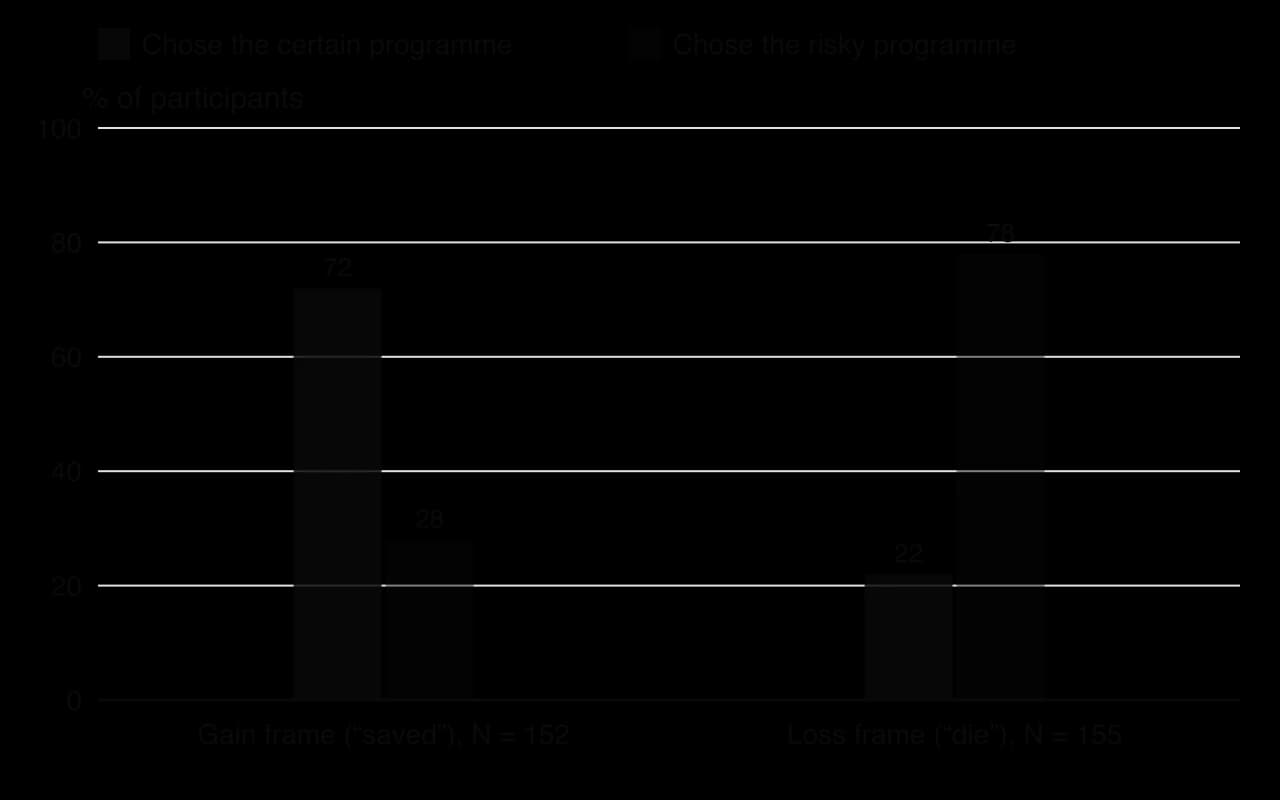
Sources: Tversky, A. and Kahneman, D. (1981). The framing of decisions and the psychology of choice. _Science, 211(4481), 453–458._
Conclusions
Choices are not determined by outcomes alone: describing the same outcomes as gains makes people risk averse, and describing them as losses makes people risk seeking. This supports prospect theory, in which outcomes are evaluated as gains or losses from a reference point and losses weigh more heavily than gains. The framing effect violates a basic principle of rational choice, that equivalent descriptions of a problem should lead to the same decision.
Evaluation
Measurement: hypothetical choices
Participants made hypothetical choices with no consequences, in a classroom, about an imaginary disease. Real decisions about health policy involve experts, discussion and time, which might reduce the effect. On the other hand, the dependent variable was a clear choice rather than a rating, and the problem was simple enough that participants understood it. McNeil and colleagues (1982) found that physicians, as well as patients and graduate students, preferred surgery for lung cancer more often when outcomes were framed as the probability of living rather than of dying, which supports the ecological validity of the finding.
Bias: samples and replication
The original samples were North American university students, a narrow group. However, the problem has been repeated many times, and it was one of the effects tested by Klein and colleagues (2014) in the Many Labs project, in which the framing effect replicated across 36 samples from 12 countries. The effect is smaller in some versions and populations than in the original, but its direction is highly reliable, which makes it one of the most robust findings in decision research.
Causality and perspective: why framing works
Because participants were randomly given one frame or the other and the outcomes were identical, the reversal can be attributed to the wording. Why the wording matters is less certain. Prospect theory explains it through loss aversion. De Martino, Kumaran, Seymour and Dolan (2006) found that choices that followed the frame were associated with activity in the amygdala, suggesting an emotional contribution, while people who resisted the frame showed more activity in orbital and medial prefrontal cortex. Others argue that the wording carries implicit information: “200 will be saved” suggests that the others might not die, so participants may not see the options as equivalent at all.
How biological, cognitive and sociocultural factors interact
A cognitive bias is a cognitive phenomenon, but no single approach explains it fully. Explanations that consider only one level are reductionist, and research on cognitive biases shows clearly how factors from different approaches combine.
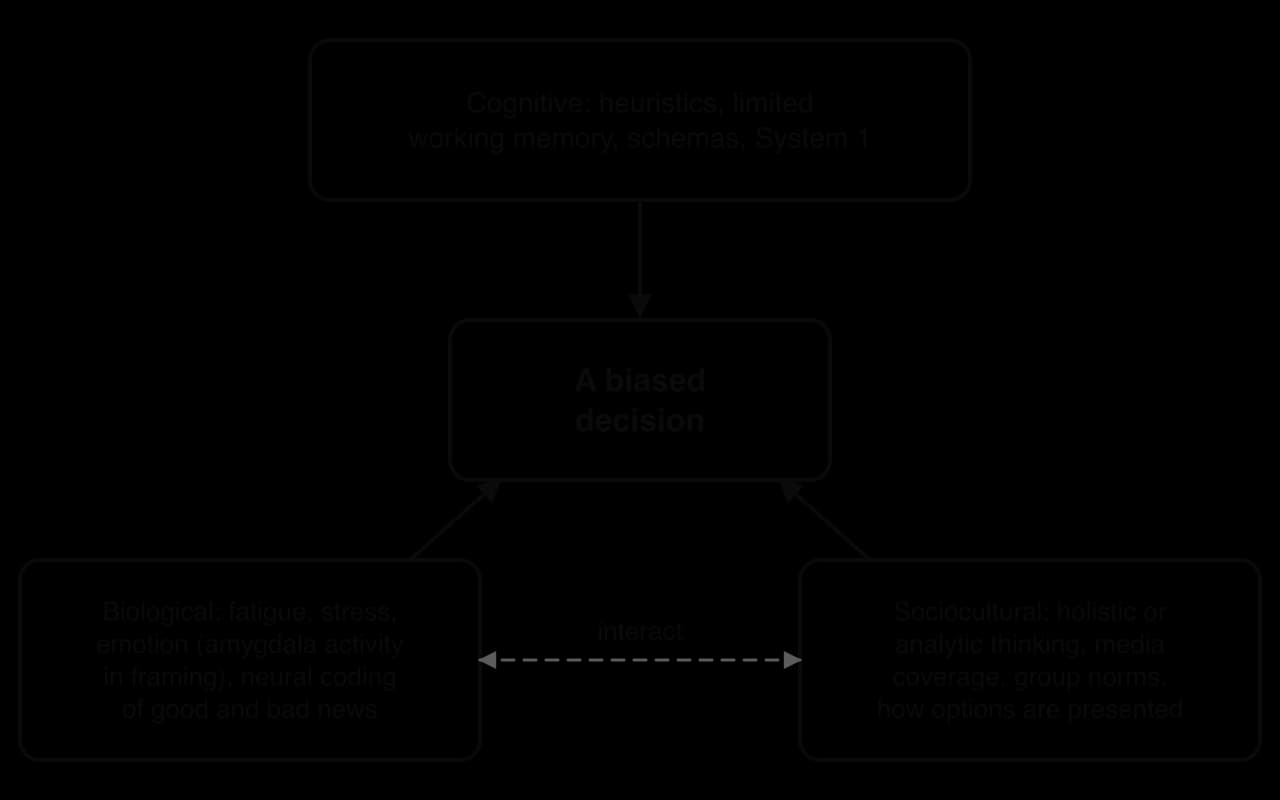
Cognitive factors are the core: heuristics, limited working memory, schemas that supply stereotypes for representativeness judgements, and the tendency of System 2 to accept System 1’s answers.
Biological factors change how much effortful processing is available and how information is weighted. Fatigue, stress and alcohol reduce System 2 activity and increase reliance on heuristics. De Martino et al. (2006) linked framing to amygdala activity, and Sharot et al. (2011) found that differences in how the brain codes good and bad news help maintain optimism bias.
Sociocultural factors supply the content and context. Media coverage determines which events are available in memory; cultural patterns of holistic or analytic thinking change how surprising outcomes seem, as Choi and Nisbett (2000) found; cultural context shapes overconfidence, as Muthukrishna et al. (2018) found; and whoever designs a form, a menu or a message decides how options are framed.
The three levels interact. A student who is short of sleep before a test (biological) relies more on intuitive answers (cognitive), and if the revision materials they have seen most recently came from social media rather than from their teacher (sociocultural), availability will make those topics feel more important than they are. Explaining the biased decision requires all three.
Debiasing: can cognitive biases be reduced?
Because cognitive biases affect decisions in medicine, law, finance and education, a large body of research has tested ways to reduce them. Early attempts were disappointing: telling people about a bias, warning them or offering rewards for accuracy usually had little effect, because the biases arise in automatic processes that people cannot observe in themselves.
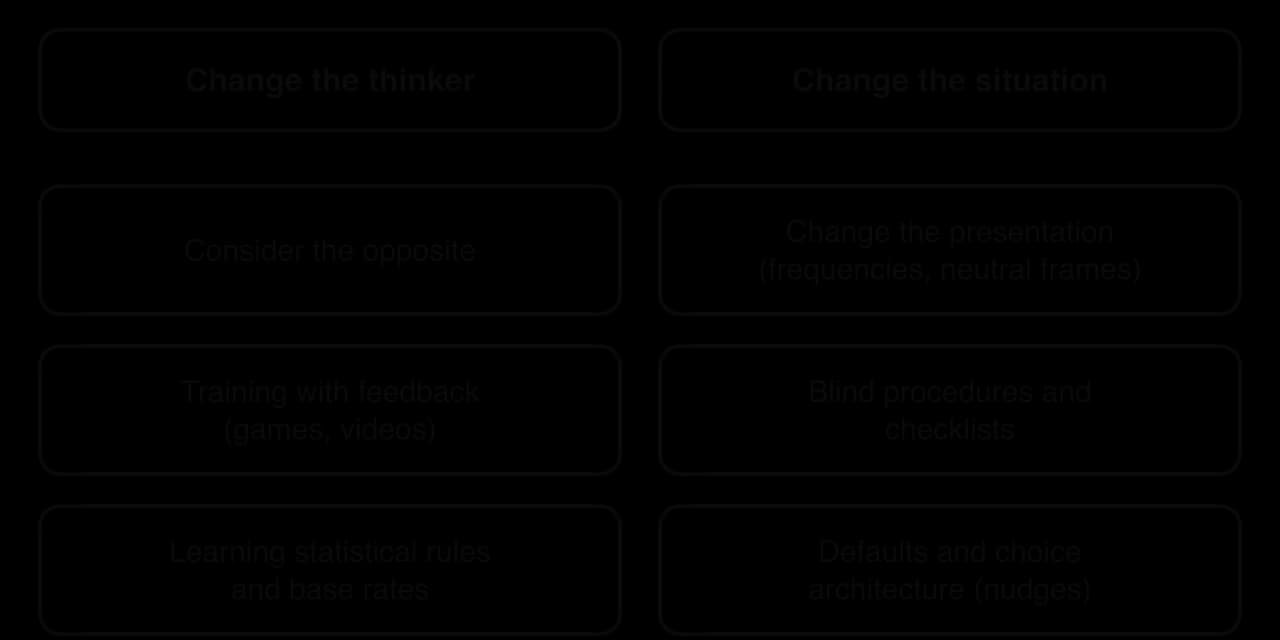
Changing the thinker
The consider-the-opposite strategy asks people to generate reasons why their first judgement might be wrong. It is one of the few strategies shown to work for more than one bias: it reduces biased evaluation of evidence, a form of confirmation bias, and Mussweiler, Strack and Pfeiffer (2000) found that it reduced anchoring in car experts. It works because it makes alternatives accessible, which is the step that heuristics skip.
Training can also work when it gives feedback and practice. Morewedge and colleagues (2015) gave participants a single training session, either an interactive computer game or an instructional video, on biases such as confirmation bias, anchoring and representativeness. Both reduced biased responses immediately, by at least 32% for the game and 19% for the video, and the effects persisted at least two months later. The game, which gave personalised feedback, worked better than the video, and improvements transferred to problems in contexts that had not been trained.
Changing the situation
Other strategies change the decision environment so that biases have less to work on. Presenting probabilities as natural frequencies (“10 out of 1,000 people”) reduces base-rate neglect and the conjunction fallacy. Blind procedures, such as anonymous marking, remove the information that creates an expectation. Checklists force System 2 to consider options that intuition skips. Nudges use the biases themselves to promote better choices, for example by making the healthier or more sustainable option the default.
In learning, the planning fallacy is reduced by basing plans on past experience: before planning revision, a student can note how long similar tasks actually took, which removed the optimistic bias in Buehler et al.’s (1994) study. The illusion of knowing that rereading creates is reduced by testing oneself, which replaces a feeling of familiarity with evidence of recall.
How well does debiasing work?
Debiasing research gives a mixed picture. Strategies that change the situation are often effective and lasting, because they do not rely on the decision-maker noticing their own bias. Strategies that change the thinker work best when they are specific (consider the opposite, check one’s past record) rather than general (be careful), and when they include practice with feedback. Even successful interventions reduce biases rather than remove them, and most have been tested with students on laboratory problems over weeks rather than with professionals over years. Whether a two-month improvement on test problems changes real decisions at work is still largely unknown.
Evaluating research on cognitive biases
Research on cognitive biases is among the most influential work in psychology, and its findings are used in medicine, law, economics and public policy. Its methods and assumptions have also been strongly criticised. Organising the evaluation through the concepts shows where its claims are secure and where they are not.
Measurement: artificial problems and what they show
Most research uses short written problems with a known correct answer, such as the Linda problem, the disease problem and the letter-K question. These allow clear measurement of errors, because the normative answer is known, and they can be given to large samples quickly. However, they are artificial. Participants answer hypothetical questions with no consequences, often in a few seconds, and the wording itself can produce part of the effect, as the frequency-format versions of the Linda problem show. Measuring a bias with one carefully constructed problem also says little about how often it affects decisions in everyday life, where information is richer and decisions can be revised.
Bias: samples, cultures and publication
Early research relied heavily on Western university students, a WEIRD sample that may differ from most people in education, familiarity with tests and ways of thinking. Cross-cultural studies show that the size of some biases varies: Choi and Nisbett (2000) found greater hindsight bias among Korean participants than American ones, and Muthukrishna et al. (2018) found that overconfidence depends on culture, task and incentives. Large replication projects such as Many Labs have strengthened confidence in anchoring and framing. Other large replication efforts have shown that some well-publicised effects, such as the claim that a hard-to-read font reduces errors on reasoning problems, do not replicate.
Perspective: biased minds or adaptive shortcuts?
The heuristics-and-biases perspective defines rational decisions by the rules of logic and probability and treats departures from them as errors. The ecological rationality perspective, associated with Gigerenzer, argues that heuristics are adaptive tools that work well in the environments humans evolved and live in, and that many apparent biases appear only when problems are presented in unnatural formats.
Both perspectives agree that heuristics are used. They disagree about whether the main lesson is that human judgement is flawed or that it is well suited to real environments and poorly suited to laboratory puzzles. Many researchers now accept a combination: heuristics are usually adaptive, but they produce predictable errors in modern settings such as statistics, finance and medicine, where natural cues are absent.
Change: from findings to interventions
Bias research has produced practical change: surgical checklists, frequency formats for communicating medical risks, default options in pension schemes, blind marking and the training of analysts and doctors. It has also raised questions of responsibility. The knowledge that framing and defaults change choices can be used to help people make choices they would endorse, but also to manipulate them, for example by framing a product’s price as a loss to be avoided. Nudging is controversial for this reason: it changes behaviour without persuading people, which raises questions about autonomy and transparency.
Concept | Supports the research | Challenges the research |
|---|---|---|
Measurement | Clear normative answers allow errors to be measured precisely | Artificial problems; wording effects (frequency formats) |
Bias | Anchoring and framing replicated in Many Labs across 12 countries | WEIRD samples; cultural variation; some effects failed to replicate |
Perspective | Heuristics-and-biases: predictable errors in judgement | Ecological rationality: heuristics adaptive in natural environments |
Change | Debiasing training and changes to the situation reduce biases | Reductions are partial; long-term transfer to real decisions unclear |
Causality | Random allocation to frames and anchors shows wording causes choice changes | Mechanisms (loss aversion, emotion, implied information) still debated |
Exam practice
Cognitive biases are an area of study in the learning and cognition context. Paper 1 Section B can set a scenario in this context and ask how a cognitive bias, or an approach term such as anchoring or confirmation bias, explains a decision in it. Paper 1 Section C can ask for an essay on cognitive biases in decision-making through one of the concepts. Bias research is also a natural source of unseen studies in Paper 2 Section B, and the anchoring and framing paradigms are common class practical experiments.
Summary
Cognitive biases are systematic errors in judgement that arise when heuristics, which usually work, are used in situations where they fail; bounded rationality and lazy System 2 checking explain why.
Anchoring bias and confirmation bias are two such biases; others include availability, representativeness, framing, overconfidence, optimism and hindsight biases.
The availability heuristic judges frequency by ease of recall (letter K; causes of death; Schwarz et al.’s assertiveness study).
The representativeness heuristic judges probability by resemblance, producing the conjunction fallacy (Linda) and base-rate neglect; frequency formats reduce these errors.
Tversky and Kahneman (1981) showed that 72% chose a certain programme when outcomes were framed as lives saved, but only 22% when the same outcomes were framed as deaths, explained by loss aversion.
Overconfidence, optimism bias and the planning fallacy affect how students plan and judge their learning, as shown by Kruger and Dunning (1999), Weinstein (1980), Sharot et al. (2011) and Buehler et al. (1994); their size varies with culture and context.
Biological (fatigue, emotion), cognitive (heuristics, limited capacity) and sociocultural (culture, media, framing of options) factors interact in a biased decision.
Debiasing works best through specific strategies such as considering the opposite and feedback-based training, as in Morewedge et al. (2015), and through changing the situation; effects are partial.
Evaluation turns on measurement (artificial problems), bias (WEIRD samples and replication) and perspective (heuristics as errors or as adaptive tools).
Self-check
- To do:
I can explain why cognitive biases arise, using heuristics, bounded rationality and dual processing.
- To do:
I can describe the availability and representativeness heuristics and the biases they produce, with a study for each.
- To do:
I can describe the aim, method, results and conclusions of Tversky and Kahneman (1981) and explain loss aversion.
- To do:
I can explain overconfidence, optimism and hindsight biases and how they affect learning.
- To do:
I can explain how biological, cognitive and sociocultural factors interact in a biased decision.
- To do:
I can evaluate debiasing strategies and explain why changing the situation often works better than warnings.
- To do:
I can discuss research on cognitive biases with reference to measurement, bias, perspective and change.
- To do:
I can apply a cognitive bias to a decision in an unfamiliar learning and cognition scenario.
Carry on with 9.1 in Augment
With a free account, Augment remembers where you stopped and what you have practiced.