 YouTube
Evaluate the value of the dual processing model for understanding thinking and decision-making, using research on belief bias, conflict detection, expert intuition, culture and a famous failed replication.
Each is in the Psychology glossary, with every other term in the subject.
The tendency to judge the logical validity of an argument by whether its conclusion is believable, accepting believable but invalid conclusions and rejecting unbelievable but valid ones.
The process by which reasoners sense, often quickly and without awareness, that an intuitive answer conflicts with logical or probabilistic principles, shown for example by lower confidence in intuitive answers to conflict problems.
The subjective experience that processing information is difficult, for example when text is printed in a hard-to-read font; it was proposed as a cue that triggers deliberate System 2 thinking.
A form of deductive argument in which a conclusion is drawn from two premises; it is valid if the conclusion must be true whenever the premises are true, whatever its real-world truth.
A research method in which participants answer a reasoning problem twice, first quickly under a deadline or load that blocks deliberate thinking, then again with unlimited time, to separate intuitive from deliberate responses.
Explain what makes a cognitive model valuable for understanding thinking and decision-making.
Explain belief bias in reasoning using the dual processing model.
Describe research on conflict detection and the two-response paradigm, and explain how it has changed the model.
Explain when intuitive judgements can be trusted, with reference to expertise and reflective reasoning.
Discuss cultural variation in reliance on intuitive and formal reasoning.
Describe and evaluate Alter et al. (2007) and its large-scale replication by Meyer et al. (2015).
Evaluate the value of the dual processing model with reference to measurement, causality, perspective and bias.
Thinking and decision-making in schools, hospitals, courts and everyday life depend on how people reason when an answer feels obvious. The dual processing model is one of the main tools psychologists use to explain this reasoning, and its value lies in how well it explains real thinking, predicts when errors will occur and suggests how reasoning can be improved.
In the learning and cognition context, the model draws on the cognitive approach (working memory, schemas and attention), but a full explanation also needs biological factors such as fatigue and brain development, and sociocultural factors such as the reasoning styles a culture values. Research on it raises questions of measurement, causality and perspective.
With a free account, Augment remembers where you stopped and what you have practiced.
Dual processing theory distinguishes two types of thinking. System 1 is fast, automatic and intuitive and supplies a default answer through association and heuristics. System 2 is slow, effortful and deliberate; it depends on working memory and can check and override the default, but only when a person notices a problem and has the time, capacity and motivation to think it through. The Cognitive Reflection Test shows the pattern: most people give the intuitive wrong answer to the bat-and-ball problem unless they stop to check it.
Many researchers now speak of Type 1 and Type 2 processing. Evans and Stanovich (2013) defined the difference as one of working memory: Type 2 processing loads working memory and allows hypothetical thinking, while Type 1 processing does not. This narrower definition matters when judging the model, because it makes clear what the model claims and what it does not.
YouTubeA cognitive model is a simplified representation of a mental process that is used to explain findings, generate predictions and guide applications. The dual processing model cannot be judged by asking whether it is “true”, because every model simplifies. It can be judged by asking what it adds to understanding.
Criterion | Question to ask | How the dual processing model fares |
|---|---|---|
Explanatory power | Does it explain a range of findings in one framework? | Strong: biases, belief bias, time-pressure and load effects and individual differences fit one account |
Predictive power | Does it make predictions that could turn out to be wrong? | Mixed: some predictions confirmed (load effects), some failed (disfluency), some forced revisions (fast correct answers) |
Testability | Can its key terms be measured? | Weak in places: the two types of processing are inferred from speed and accuracy, not observed |
Application | Does it lead to useful ways of improving thinking? | Useful but limited: reflection helps in some settings, and intuition is reliable in others |
Cultural range | Does it hold across groups? | Partly: the distinction appears widely, but when people rely on intuition varies with culture |
One of the clearest uses of the model is in explaining errors in logical reasoning. In a syllogism, two premises lead to a conclusion, and the task is to judge whether the conclusion follows logically from the premises, whether or not it is true in the real world.
Valid but unbelievable: All mammals can walk. Whales are mammals. Therefore whales can walk.
Invalid but believable: All flowers need water. Roses need water. Therefore roses are flowers.
The first argument is logically valid even though its conclusion is false, because the conclusion follows from the premises as stated. The second is invalid, because needing water does not make something a flower, even though its conclusion is true. People find both hard, because the believability of the conclusion pulls their judgement in the opposite direction from the logic. The resulting error is called belief bias.
Evans, Barston and Pollard (1983) gave participants syllogisms in which validity and believability were varied independently. Participants accepted believable conclusions far more often than unbelievable ones, and the effect of belief was strongest for invalid arguments. When participants thought aloud, the bias was linked to attending first to the conclusion rather than to the premises.
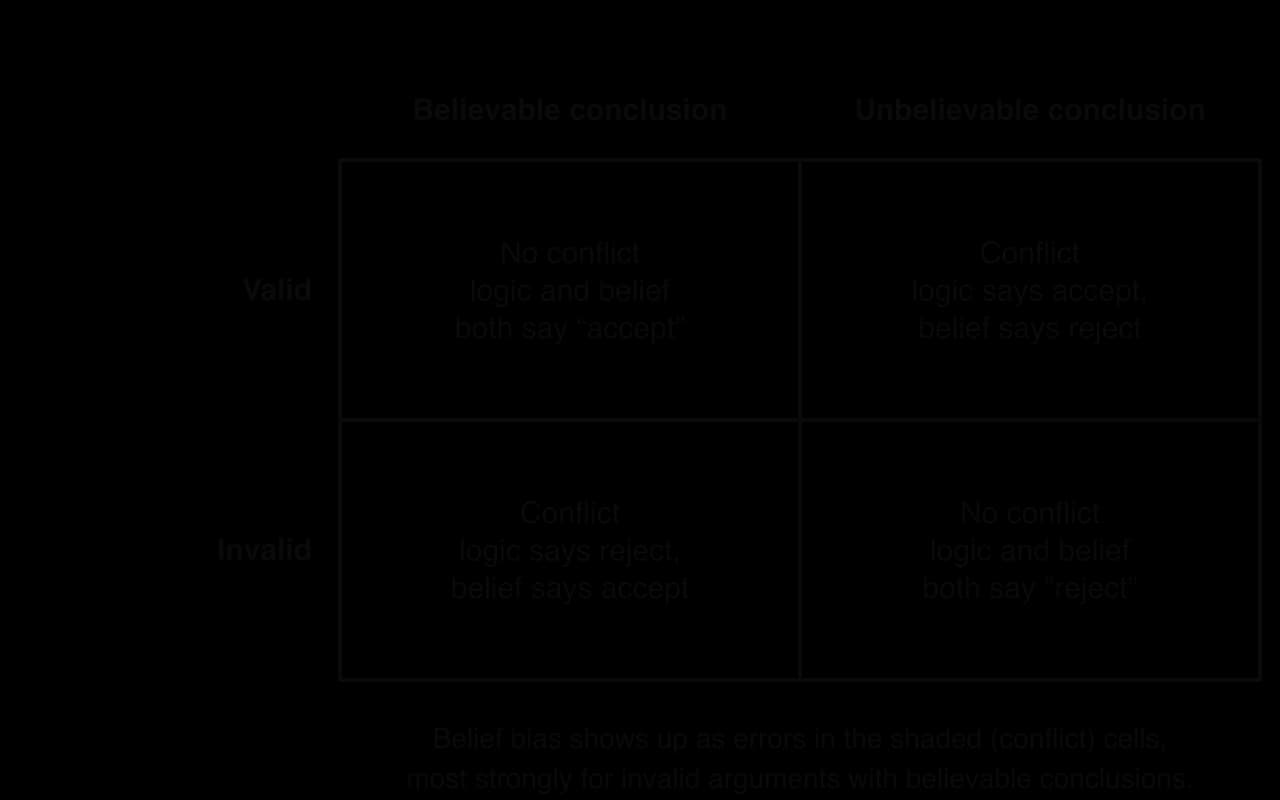
The dual processing model explains this pattern. System 1 responds to whether the conclusion fits what a person already knows about the world, which is quick and usually useful. Judging logical validity requires System 2 to set beliefs aside and work through the structure of the argument. When the two disagree, belief wins unless System 2 intervenes.
The model also predicted that belief bias should increase when System 2 is restricted. Evans and Curtis-Holmes (2005) tested this by requiring one group to respond within 10 seconds. Rapid responding increased belief bias and reduced the number of logically correct decisions, as the model predicts.
The default-interventionist version of the model makes a clear prediction about timing. If System 1 always answers first and System 2 corrects it later, correct answers on conflict problems should only appear after a delay, and people who give the intuitive wrong answer should not notice any problem. Research testing these predictions has led to important revisions.
De Neys, Rossi and Houdé (2013) compared the bat-and-ball problem with a control version that had the same structure but no tempting wrong answer. Participants who gave the intuitive answer of 10 cents were less confident in it than in their answer to the control problem. Even when they did not correct the error, something in their processing registered that the quick answer was questionable, so biased reasoners are not simply unaware of the conflict. This sensitivity is called conflict detection.
Bago and De Neys (2017) used a two-response paradigm. Participants solved reasoning problems twice: first as quickly as possible, under a strict deadline and while holding a memory load to block System 2, and then again with as much time as they wanted. If correct answers needed System 2, they should appear only at the second response.
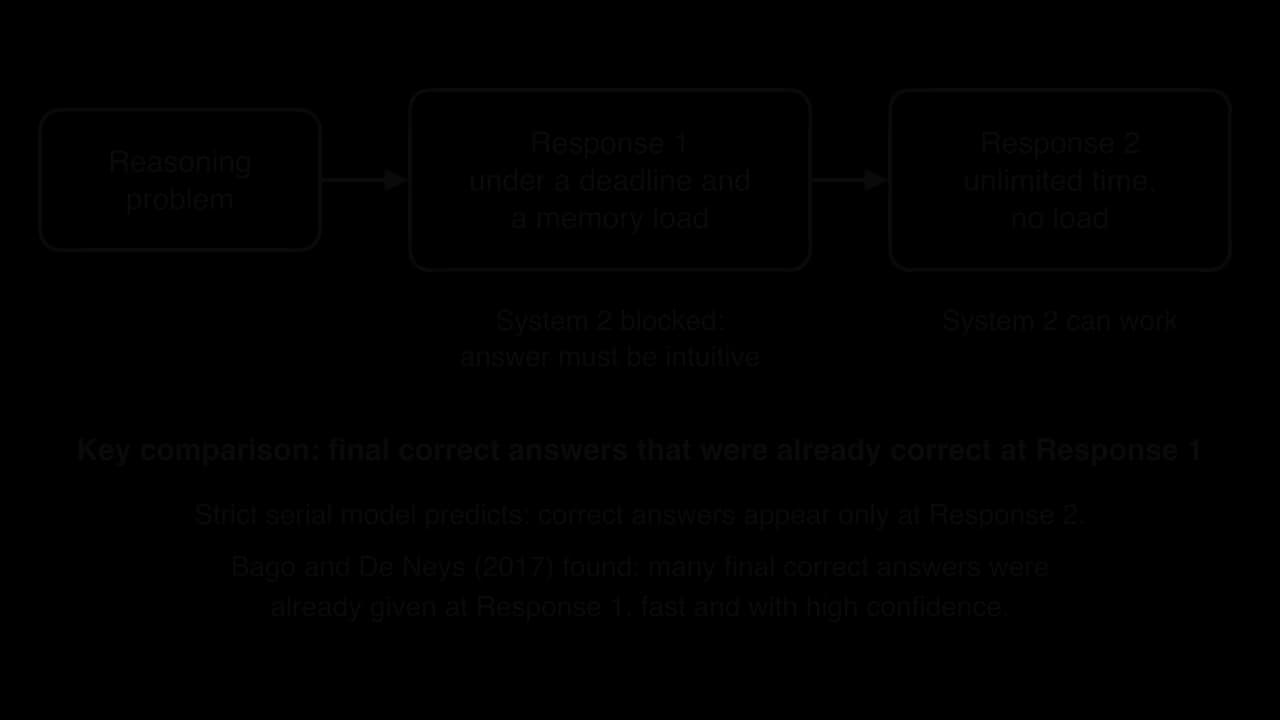
Across four experiments, many participants who gave the correct final answer had already given it as their first, intuitive response, quickly and with high confidence, even though a conflicting heuristic answer was available. The authors proposed a revised model in which System 1 can produce several intuitions at once, including a “logical intuition”, and the strongest intuition wins. System 2 is then needed less to produce correct answers than to justify them or to resolve cases where intuitions are evenly matched.
A practical question for learning is whether people should be taught to distrust their intuitions. Kahneman and Klein (2009) brought together two research traditions that seemed to disagree: research on biases, which emphasised the failures of intuition, and research on experts such as firefighters and nurses, which emphasised its successes. They concluded that intuitive skill develops only when two conditions are met: the environment is regular enough to be predictable, and the person has had long practice with rapid, clear feedback.
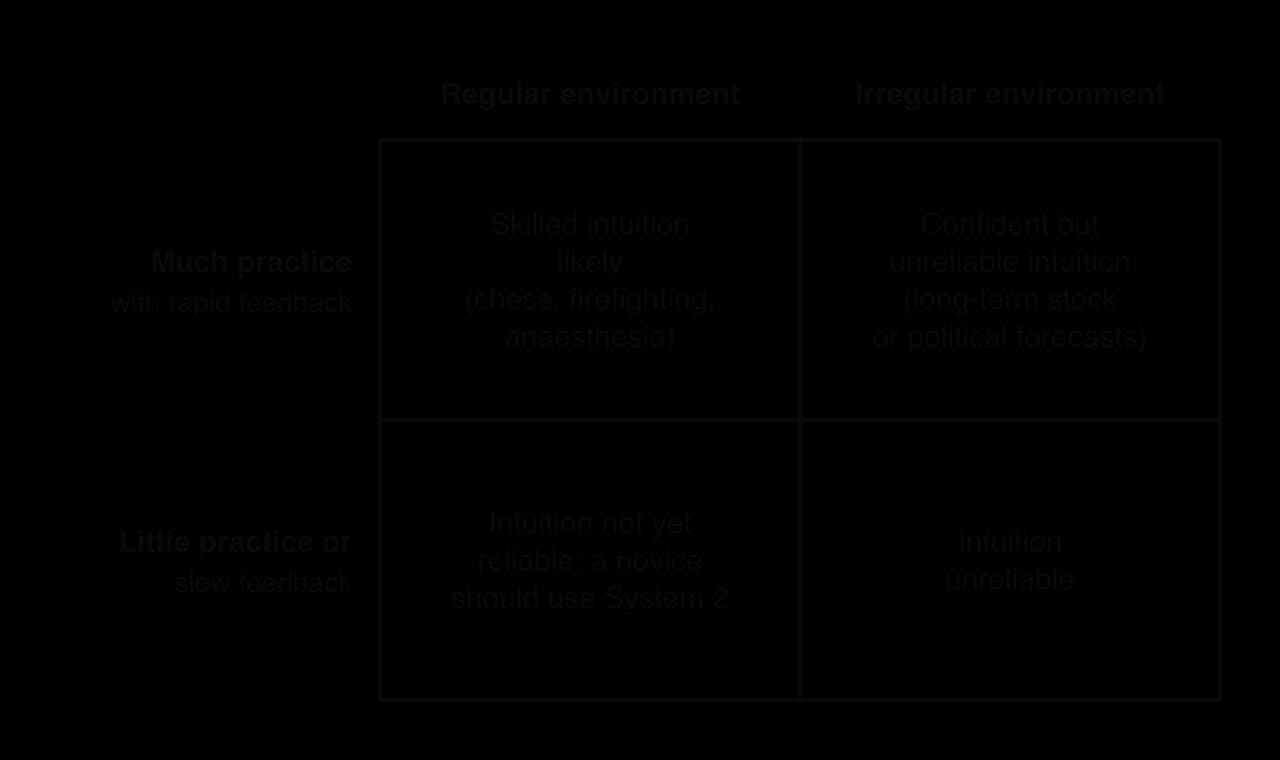
This conclusion gives the model value for education and training. In domains where feedback is quick and patterns repeat, practice can build reliable System 1 judgement, and the aim of training is to turn deliberate System 2 procedures into fast expertise. In domains without regular patterns or feedback, such as long-term forecasting, confident intuitions should be checked deliberately.
 YouTube
Mamede and colleagues (2010) tested whether deliberate reflection can correct intuitive errors in diagnosis. At the Erasmus Medical Centre in Rotterdam, 18 first-year and 18 second-year internal medicine residents first evaluated diagnoses of six clinical cases. They then diagnosed eight new cases quickly, four of which looked similar to earlier cases but had different diagnoses. Second-year residents scored lower on these look-alike cases and more often gave the earlier diagnosis, an error consistent with the availability heuristic.
When residents then re-diagnosed the same cases using structured reflection, a systematic reanalysis of the findings in each case, their accuracy improved in both years. The study shows the model’s practical value: experienced but not yet expert doctors relied on a fast pattern match that misled them, and a simple procedure that engaged System 2 corrected it.
The model describes processes assumed to be universal, but when people choose intuitive or formal strategies may depend on culture. Norenzayan, Smith, Kim and Nisbett (2002) gave Chinese and Korean, Asian American and European American university students tasks in which formal rules and intuition pointed to different answers, including categorising objects and judging the validity of deductive arguments. European Americans more often set intuition aside in favour of formal rules, while Chinese and Korean students relied more on intuitive strategies, such as judging by family resemblance or by the plausibility of a conclusion. Asian Americans’ reasoning was the same as European Americans’ or in between.
When there was no conflict between the strategies, the groups reasoned similarly. The differences therefore lie in which strategy people prefer when the two clash, not in the capacity for formal reasoning. This supports the model’s distinction between two types of processing while showing that the balance between them is shaped by sociocultural experience, such as education systems that emphasise formal logic.
If System 2 is switched on when something feels difficult, it might be possible to improve reasoning simply by making information harder to read. This idea became one of the best-known applications of the dual processing model, and its large-scale replication is a clear example of how predictions from the model are tested.
Alter, Oppenheimer, Epley and Eyre (2007) aimed to test whether a metacognitive experience of difficulty, or disfluency, acts as a signal that activates deliberate System 2 reasoning and so reduces reliance on intuitive answers.
Alter and colleagues reported four experiments in which disfluency was created by a degraded font (Experiments 1 and 4), by difficult-to-read lettering (Experiment 2) or by asking participants to furrow their brow (Experiment 3). In the best-known, Experiment 1, 40 Princeton students completed the three-item Cognitive Reflection Test. Half were randomly allocated to read the problems in a normal, clear font and half in a small font in faint grey print that was legible but hard to read. The dependent variable was performance on the CRT.
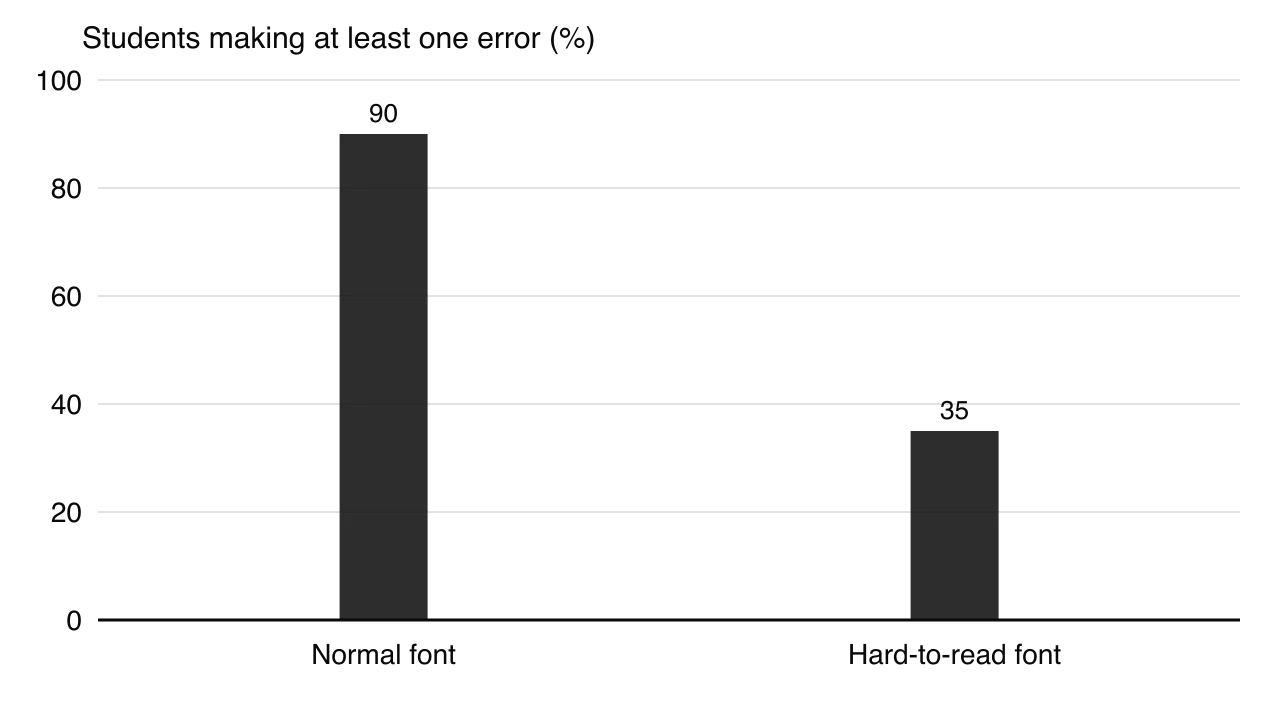
In Experiment 1, 90% of students who read the CRT in the normal font made at least one error, compared with 35% of those who read it in the hard-to-read font. In the other experiments, disfluency reduced the influence of heuristics and defaults in judgement, reduced reliance on superficial cues in persuasion and improved syllogistic reasoning. The authors concluded that experiences of difficulty act as an alarm that activates analytic reasoning, which can then correct intuitive answers.
The finding was widely publicised, including in Kahneman’s book Thinking, Fast and Slow (2011), and the idea that hard-to-read materials improve thinking spread to business and education advice.
Meyer, Frederick and colleagues (2015) tested the CRT finding again. They pooled the data from the original experiment with 16 further attempts to replicate it by research teams in several countries, giving 17 studies with more than 7,000 participants in total. They also examined possible moderators: participants’ cognitive ability, whether the test was given on paper or on screen, and the setting of the experiment.
Across the pooled data there was no effect of a disfluent font on the number of CRT problems solved. No moderator produced a benefit under any conditions. Disfluent fonts did slightly increase response times, so participants noticed the difficulty, but there was little evidence that this activated analytic reasoning or improved answers.
The original result was most likely a type I error: a chance finding in a small sample. The broader dual processing model is not refuted by the failed replication, because it does not depend on disfluency being the trigger for System 2. However, one of its most popular predictions about how System 2 can be switched on did not hold. The replication also shows that a single small study, however well publicised, needs independent replication before it is treated as evidence for a model.
Measurement. The CRT has only three items, so scores can change a lot with one answer, and the items are now so well known that many participants have seen them, which makes them a weaker measure of reflection. Measuring “System 2 activation” by CRT accuracy also assumes that a correct answer requires deliberation, an assumption that research on fast logical intuitions has questioned.
Causality. The original experiment used random allocation, so in principle it could support a causal claim. The problem was its size: with about 20 participants per condition, random variation can easily produce a large difference. The pooled replication had far greater statistical power, so its null result is much more trustworthy.
Bias. Studies with surprising positive results are more likely to be published and publicised, while failures to replicate them are less likely to appear, which is publication bias. The disfluency effect spread widely before it was tested, which illustrates how the replication crisis in psychology arose. The replication itself was a collaborative project across many laboratories, which reduces the influence of any one team’s expectations.
Sources: Alter, A. L., Oppenheimer, D. M., Epley, N., & Eyre, R. N. (2007). Overcoming intuition: metacognitive difficulty activates analytic reasoning. _Journal of Experimental Psychology: General, 136(4), 569–576. Meyer, A., Frederick, S., et al. (2015). Disfluent fonts don’t help people solve math problems. Journal of Experimental Psychology: General, 144(2), e16–e30._
Research on belief bias, conflict detection, expertise, culture and disfluency can be brought together to judge how far the dual processing model helps psychologists understand thinking and decision-making. The concepts provide a structure for that judgement.
The model’s central terms are not directly observable. Researchers infer Type 1 or Type 2 processing from response times, from whether an answer matches the intuitive or the logical response, from confidence ratings or from the effect of a memory load. The two-response paradigm is a clever operationalisation, because a deadline and a load make it very unlikely that a first answer was deliberate. Even so, measures such as the CRT confound reflection with numeracy and familiarity, and accuracy is a poor guide to which type of processing produced an answer.
Experiments that manipulate the conditions for System 2, such as time limits and memory loads, support causal conclusions: rapid responding increased belief bias, and structured reflection improved doctors’ diagnoses. Other manipulations, such as disfluent fonts, did not survive replication. The model is valuable because it produces causal predictions that can be tested, and its value is best judged by the predictions that have survived replication.
Kruglanski and Gigerenzer (2011) argued that intuitive and deliberate judgements follow the same kinds of rules, and that heuristics can be more accurate than effortful strategies when they fit the environment. From this perspective, dividing thinking into two systems is unnecessary and the “biases” revealed by puzzles may reflect rules that work well in real life. Evans and Stanovich (2013) replied that the defining feature of Type 2 processing, its use of working memory for hypothetical thinking, is supported by much evidence, even if the long lists of features attached to each system were too simple.
The research on fast logical intuitions points in a similar direction. If System 1 can produce correct, logical answers, the model needs to explain how intuitions compete, not only how System 2 corrects them. The model has become more complex as a result, and some researchers see this as healthy revision, others as a sign that the simple two-system picture was never accurate.
Most of the evidence comes from WEIRD samples of university students solving abstract tasks with a single normative answer. Norenzayan and colleagues showed that the balance between intuitive and formal strategies differs across cultural groups when the two conflict, which suggests that the model describes general processes whose use is shaped by culture and education. Tasks that define rational answers by formal logic may also undervalue forms of reasoning that are effective in everyday social life.
A full account of thinking and decision-making draws on more than one approach. The cognitive approach provides the model of two types of processing and its dependence on working memory. Biological factors affect the capacity for System 2, for example through the maturation of the prefrontal cortex in adolescence and the effects of fatigue on attention. Sociocultural factors shape which strategy people prefer and which answers count as good reasoning in a community. The model is most valuable when it is used alongside these factors rather than as a complete explanation on its own.
Concept | Evidence that supports the model’s value | Evidence that limits it |
|---|---|---|
Measurement | Two-response paradigm separates fast and slow answers | Processes are inferred; the CRT confounds reflection with numeracy and familiarity |
Causality | Time limits increase belief bias; reflection improves diagnosis | The disfluency effect failed in 17 pooled studies |
Perspective | Explains biases, belief bias and expert intuition in one framework | Single-process accounts and fast logical intuitions challenge the two-system picture |
Bias | Distinction between strategies appears across cultural groups | Preference for intuition varies with culture; most samples are WEIRD students |
In the learning and cognition context, the dual processing model can appear in Paper 1 Section B, as the theory to apply to an unseen scenario about thinking or learning, and in Paper 1 Section C, as the area of study in a concept-based essay. The scenario in Section B may come from any setting where people reason or decide, such as a classroom, a hospital or a workplace.
Section C essays need a clear line of argument. The following plan builds one around a single concept.
The dual processing model explains thinking and decision-making through fast, intuitive Type 1 processing and slow, working-memory-dependent Type 2 processing; its value lies in how well it explains, predicts and improves real reasoning.
Belief bias is the tendency to judge arguments by the believability of their conclusions; it is strongest for invalid arguments with believable conclusions and increases under time pressure, as the model predicts.
Reasoners often sense when an intuitive answer conflicts with a rule (conflict detection), and many correct answers are given quickly in the two-response paradigm, which has led to revised models with competing intuitions.
Kahneman and Klein (2009) concluded that intuition is trustworthy only in regular environments with long practice and rapid feedback; confidence is not a sign of accuracy.
Mamede and colleagues (2010) found that structured reflection improved residents’ diagnoses after an availability-based error, a practical application of System 2.
Norenzayan and colleagues (2002) found that East Asian students relied more on intuitive strategies and European Americans more on formal rules when the two conflicted, with similar reasoning when they agreed.
Alter et al. (2007) reported that a hard-to-read font reduced CRT errors (90% vs 35% making at least one error), but Meyer et al. (2015) found no effect across 17 pooled studies.
The model’s value is limited by indirect measurement, failed predictions, single-process alternatives and WEIRD samples, and it works best alongside biological and sociocultural factors.
I can explain what makes a cognitive model valuable for understanding thinking and decision-making.
I can explain belief bias using the dual processing model, with an example syllogism.
I can describe conflict detection and the two-response paradigm and explain how they changed the model.
I can explain when intuition can be trusted, with reference to expertise and reflective reasoning.
I can discuss cultural variation in reliance on intuitive and formal reasoning.
I can describe and evaluate Alter et al. (2007) and Meyer et al. (2015).
I can evaluate the value of the dual processing model with reference to measurement, causality, perspective and bias.