Explain the value of cognitive models for understanding memory and attention, compare two models of the same process, and evaluate models such as levels of processing, reconstructive memory and filter models through the concepts.
Each is in the Psychology glossary, with every other term in the subject.
Treisman’s model of attention in which unattended input is weakened rather than blocked, so that important or expected words, such as one’s own name, can still reach awareness.
Memory for events and facts from a person’s own life, combining episodic memories with semantic knowledge about the self.
The ability to focus on one conversation in a noisy setting while still noticing personally important information, such as one’s own name, from an unattended conversation.
A type of long-term memory for facts and events that can be consciously recalled and put into words; it includes episodic and semantic memory.
A research technique in which a different message is played to each ear through headphones, and participants usually repeat aloud (shadow) one of them.
A type of declarative long-term memory for personal events experienced at a particular time and place, such as a first day at school.
An account given by a person who saw an event, such as a crime or accident, describing what happened and who was involved, often used as evidence in court.
A memory of an event, or a detail of an event, that did not happen or happened differently, which the person nonetheless experiences as genuine.
Explain the value of cognitive models for understanding cognitive processes such as memory and attention.
Describe the levels of processing model and evaluate it using research, including Craik and Tulving (1975).
Compare and contrast two cognitive models of memory, such as the multi-store model and the levels of processing model.
Describe the division of long-term memory into different types and the evidence for it.
Explain reconstructive memory and the misinformation effect as a model of retrieval, with reference to eyewitness testimony.
Compare and contrast the filter and attenuation models of selective attention.
Evaluate cognitive models with reference to the concepts of measurement, perspective and change.
Apply cognitive models to a learning and cognition scenario.
In the learning and cognition context, cognitive models are used to understand processes such as memory and attention well enough to improve them: to help students study, to question witnesses fairly or to design a classroom that does not overload attention. Different models of the same process often coexist, and comparing them shows what each one explains and what it leaves out.
A cognitive model can be built for any cognitive process. Memory has the richest set of models, including the multi-store, working memory and levels of processing models and the reconstructive account of retrieval; attention has the filter and attenuation models. Each is evaluated through the concepts, especially measurement, perspective and change.
With a free account, Augment remembers where you stopped and what you have practiced.
Broadbent’s (1958) model of attention in which a filter selects one input on the basis of physical features, such as the ear or voice, and blocks the others before their meaning is processed.
Learning that happens without an intention to learn, studied by giving participants a task with material and then an unexpected memory test.
A question whose wording suggests a particular answer, which can bias the reply and, in eyewitness research, alter what is later remembered.
A model of memory proposed by Craik and Lockhart (1972) in which how long information is retained depends on the depth of processing at encoding, from shallow (structural) to deep (semantic).
The distortion of a memory by misleading information received after the event, so that a person reports details that were not part of the original experience.
A type of long-term memory for skills and how to do things, such as riding a bicycle, which is expressed in performance rather than consciously recalled.
The view that remembering is an active process of rebuilding a past event from stored fragments, schemas and later information, rather than replaying an exact copy.
The process of focusing on one source of information while ignoring others, such as following one conversation in a noisy room.
A type of declarative long-term memory for general knowledge and facts about the world, such as word meanings, independent of when they were learned.
The principle that memory is best when the kind of processing used at encoding matches the kind of processing the later memory test requires.
Scope: An area of study in the learning and cognition context: the value of cognitive models for understanding one or more cognitive processes, including comparing two models of one process. Memory is the main process used here, with attention as a second.
A cognitive model is a simplified representation of a cognitive process, showing its components and how information flows between them. Models are built from findings, used to derive predictions, tested by experiments, case studies, dual-task studies and brain imaging, and then kept or revised. Two models of memory are the usual starting point: the multi-store model of Atkinson and Shiffrin (1968), with separate sensory, short-term and long-term stores linked by attention, rehearsal and retrieval, and the working memory model of Baddeley and Hitch (1974), which divides short-term memory into a central executive, a phonological loop, a visuospatial sketchpad and an episodic buffer.
Multi-store model | Working memory model | |
|---|---|---|
Type of model | Structural: stores and the order of transfer | Structural: components of short-term memory |
Short-term memory | One passive store | An active workspace with several components |
Main supporting evidence | Serial position effect; brain-damaged patients | Dual-task studies; word-length effect; patient KF |
Main weakness | Too simple; rehearsal over-emphasised | Central executive vague |
Both are structural models: they describe memory as a set of stores. Other models of memory take a different view, describing memory in terms of processes: how deeply information is processed, or how it is rebuilt at retrieval. Comparing structural and process models is one of the clearest ways to show the value and the limits of modelling.
A model is valuable if it helps to understand, predict and improve a cognitive process. Four kinds of value can be distinguished, and they give a useful structure for any evaluation of a model.
Value | What it means | Example |
|---|---|---|
Explanation | The model accounts for existing findings in one framework | The multi-store model explains primacy and recency effects as long-term and short-term storage |
Prediction and testing | The model gives hypotheses that can be supported or refuted | Levels of processing predicts that semantic questions will produce better recall, even without an intention to learn |
Application | The model suggests ways to improve performance | Processing for meaning when studying; asking witnesses open questions |
Communication and comparison | A shared description lets researchers compare and combine accounts | Filter and attenuation models differ in one clear point: whether unattended input is blocked or weakened |
Models also have costs. Every model simplifies, and a simplification that works for one task may mislead for another. A model can be so flexible that any result fits it, which makes it impossible to test, and models built in laboratories with word lists may not describe how people remember conversations, faces or events in their lives. The value of a model therefore depends on what it is used for and on how well its predictions survive testing.
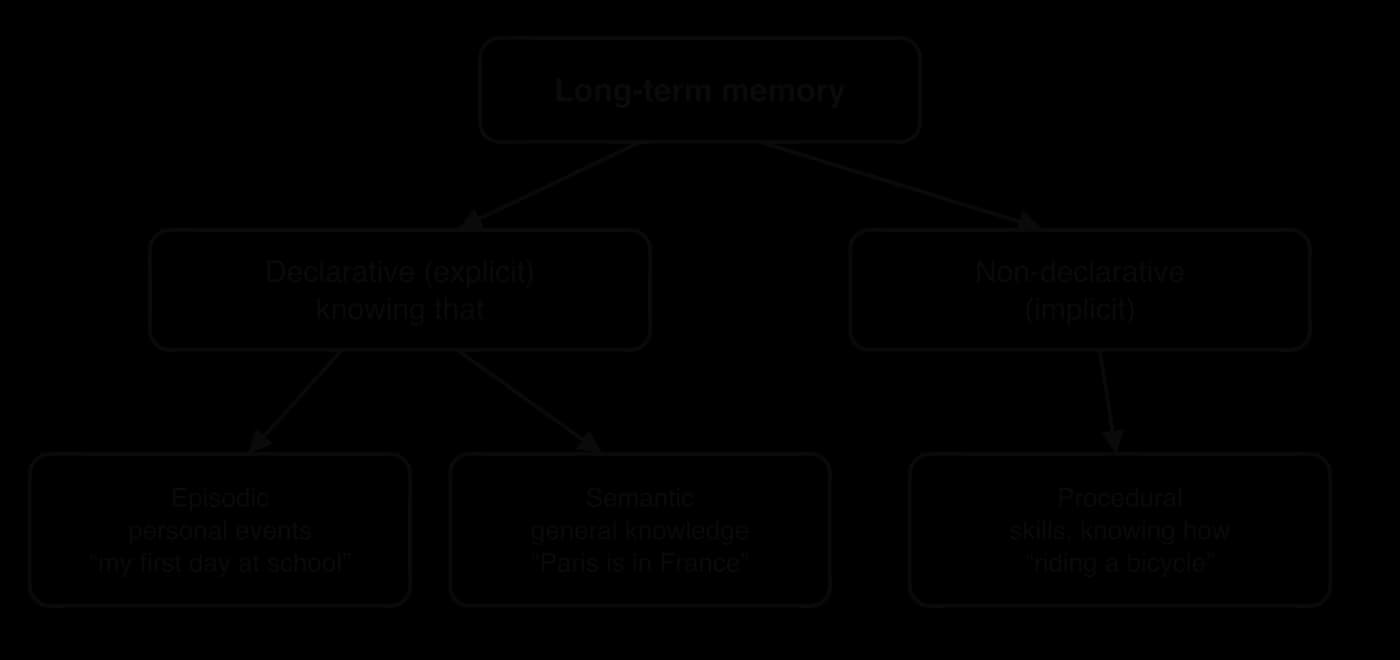
The multi-store model treats long-term memory as a single store. Later models divide it into systems that hold different kinds of knowledge. Declarative memory holds knowledge that can be consciously recalled and put into words (“knowing that”), and non-declarative memory holds knowledge expressed in performance (“knowing how”), such as procedural memory for skills.
Tulving (1972) divided declarative memory into two systems. Episodic memory holds personal events tied to a time and place, such as a first day at school; semantic memory holds general knowledge, such as word meanings or the fact that Paris is the capital of France, independent of when it was learned. Autobiographical memory combines the two: memories of one’s own life include both specific episodes and general knowledge about oneself.
The strongest evidence for separate systems comes from dissociations in patients with brain damage. People with amnesia after damage to the hippocampus, such as the patient H.M., can lose the ability to form new episodic memories while still learning new motor skills, which shows that procedural memory does not depend on the same system. Semantic and episodic memory can also be affected differently: some people with damage to the temporal lobes gradually lose general knowledge of word meanings while still remembering recent personal events.
This model is valuable for learning and cognition because different kinds of learning need different methods. Facts and concepts (semantic memory) benefit from processing for meaning and from retrieval practice; skills (procedural memory) benefit from repeated practice with feedback until they become automatic. A limitation is that the systems interact constantly: semantic knowledge is built up from many episodes, and the boundaries between types are not always clear.
Craik and Lockhart (1972) proposed the levels of processing model as an alternative to the multi-store model. They argued that memory does not depend on which store information is held in or on how long it is rehearsed, but on the depth at which it is processed when it is first encountered. Memory is a by-product of processing: the more deeply information is analysed, the more durable the trace it leaves.
Depth runs from shallow to deep, and three levels are usually distinguished. Structural processing deals with what a word looks like (its letters, its case). Phonemic processing deals with what it sounds like. Semantic processing deals with what it means, for example by linking it to other knowledge or judging whether it fits a sentence.
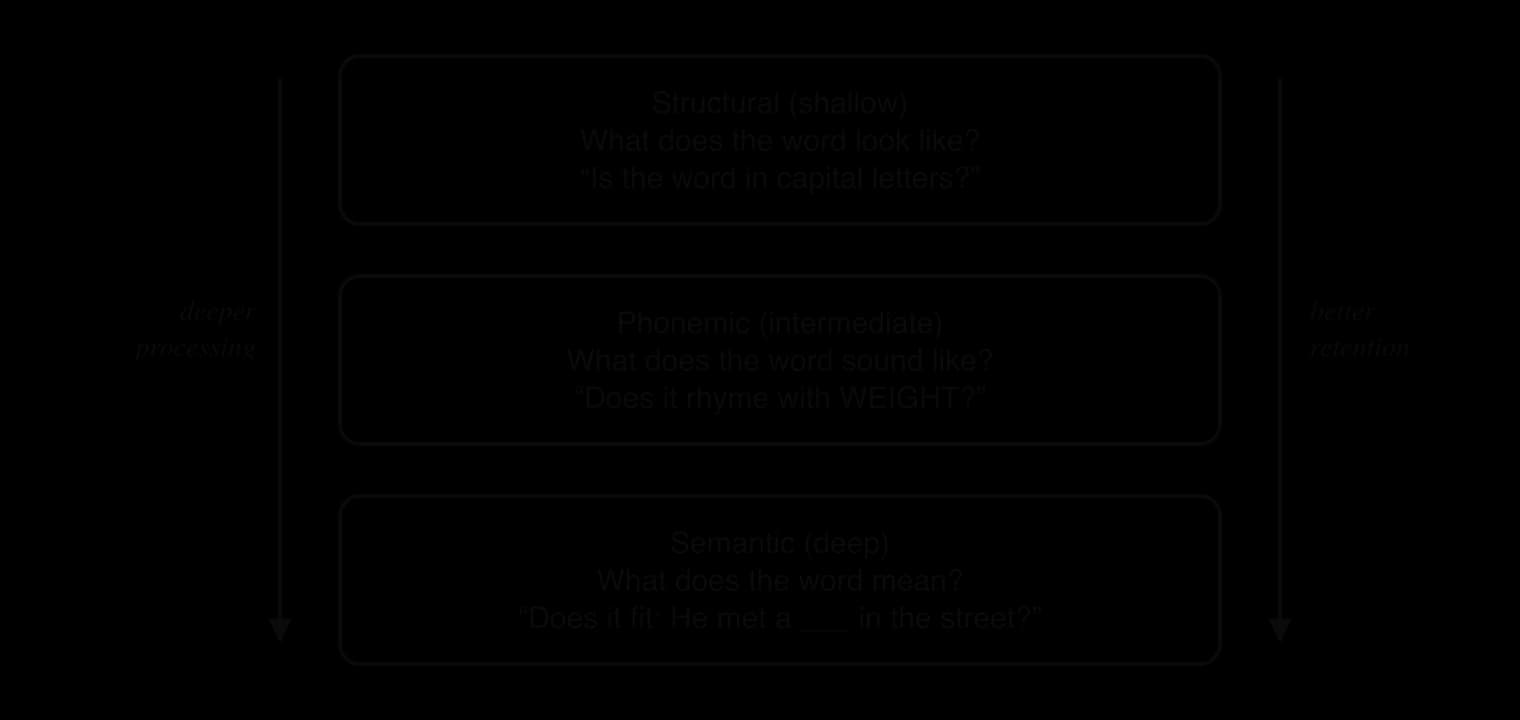
The model distinguishes two kinds of rehearsal. Maintenance rehearsal repeats information at the same level, like repeating a phone number, and keeps it available for a short time without improving long-term retention much. Elaborative rehearsal processes information more deeply, by thinking about its meaning and linking it to what is already known, and produces lasting memories. This is a direct challenge to the multi-store model, in which the amount of rehearsal is what transfers information to long-term memory.
Hyde and Jenkins (1973) gave participants a list of words with a task that required either semantic processing (rating each word as pleasant or unpleasant) or shallow processing (checking for particular letters). Some participants were told that their memory would be tested and others were not. Recall was much higher after the semantic task, and participants who processed the words for meaning without knowing about the test recalled about as many words as those who were trying to learn them, so the kind of processing mattered more than the intention to learn.
The most influential test of the model is the series of experiments by Craik and Tulving (1975), described in the key study, which used incidental learning with questions designed to require structural, phonemic or semantic processing. Later research found a self-reference effect: Rogers, Kuiper and Kirker (1977) showed that judging whether a word describes oneself produced even better recall than other semantic judgements, which fits the idea that linking information to rich existing knowledge deepens processing.
The most serious criticism is that depth is defined circularly. Baddeley (1978) pointed out that there is no independent measure of depth: deep processing is identified by good recall, and good recall is then explained by deep processing. Processing time cannot serve as the measure either, because Craik and Tulving found that a slow, effortful structural task still produced poor memory.
The model also ignores what the memory test requires. Morris, Bransford and Franks (1977) gave participants semantic or rhyme questions and then tested them either with a standard recognition test or with a test asking which new words rhymed with the studied words. Semantic processing was better for the standard test, but rhyme processing was better for the rhyming test. Memory is best when the processing at encoding matches the processing needed at retrieval, a principle called transfer-appropriate processing.
Finally, the model is more a description than an explanation. It shows that semantic processing helps memory but not why, and it says little about how information is stored or retrieved, or why people with amnesia who can still process meaning normally cannot form new memories. Craik and Lockhart later presented the framework as a guide for research rather than a complete theory.
The multi-store model and the levels of processing model offer two different answers to the same question: why some information is remembered for years and other information is forgotten in seconds. Comparing them shows the difference between a structural and a process model.
Point of comparison | Multi-store model (1968) | Levels of processing model (1972) |
|---|---|---|
Type of model | Structural: separate stores | Process: depth of analysis |
Why information is retained | It is rehearsed in short-term memory and transferred to long-term memory | It is processed deeply, especially for meaning |
Role of rehearsal | The amount of rehearsal decides transfer | The type matters: elaborative helps, maintenance does little |
Short-term and long-term memory | Separate stores with different capacity, duration and encoding | Not the focus; memory is a by-product of processing |
Key evidence | Serial position effect; amnesic patients | Hyde and Jenkins (1973); Craik and Tulving (1975) |
Testability | Clear predictions about stores | Depth hard to measure independently (circular) |
Similarity: both are information-processing models, both focus on encoding, and both are based mainly on laboratory research with word lists. | ||
The two models are not entirely in conflict. Both accept that what happens at encoding determines what lasts, and Atkinson and Shiffrin themselves distinguished simple rehearsal from deeper coding. The levels of processing model can be seen as correcting the multi-store model’s emphasis on rehearsal, while the multi-store model provides structural evidence, such as patients with selective short-term memory loss, that the levels model does not address.
Structural and process models mostly describe how information is encoded and stored, whereas the reconstructive model describes retrieval. According to the idea of reconstructive memory, remembering is not replaying a stored copy but rebuilding the event from fragments, general knowledge in the form of schemas, and information received after the event. The idea goes back to Bartlett (1932), whose participants changed an unfamiliar folk tale to fit their own culture as they recalled it; schema theory explains how such reconstruction works.
Elizabeth Loftus developed the idea into a model of how memories change after an event. In the misinformation effect, misleading information received after an event becomes part of the memory of the event.
Loftus, Miller and Burns (1978) showed participants a series of slides of a car–pedestrian accident in which a car stopped at a junction with either a stop sign or a yield sign. Some participants were then asked a question that mentioned the other sign. When later asked to choose which slide they had seen, participants given the misleading question were more likely to choose the slide with the sign they had only heard about. Across five experiments with more than 1,200 participants, misleading information had a larger effect when it was given shortly before the test than immediately after the event.
The misinformation effect matters most for eyewitness testimony, the accounts witnesses give to police and courts. A leading question is one form of misinformation: as in Loftus and Palmer’s (1974) study, the wording of a question can change what a witness later reports. Repeated questioning, conversations with other witnesses and media reports are others. Over time, a witness may develop a confident false memory of a detail that was never there.
The model has been challenged. McCloskey and Zaragoza (1985) argued that the original memory may not be changed at all: misled participants may simply report the suggested detail when they are unsure. In six experiments with a test in which the misleading detail was not one of the choices, misled participants chose the correct item about as often as controls. Loftus, Schooler and Wagenaar (1985) replied that a more sensitive test still showed a small effect of misinformation, and field research on real witnesses has found more accuracy than laboratory studies suggest. Because the model is stated clearly, the debate could be reduced to a specific question that experiments can test: whether the original trace is overwritten or only competes with a new one.
 YouTube
Attention is the process of selecting some information for further processing while ignoring the rest. Selective attention is attention to one source among many, such as one conversation in a noisy room. Models of selective attention differ mainly on the point in processing at which unattended information is filtered out.
Most early research used dichotic listening: participants wear headphones with a different message in each ear and repeat one message aloud as they hear it (called shadowing), which keeps their attention on that ear. Researchers then test what, if anything, they noticed in the other ear. Cherry (1953) found that participants noticed physical changes in the unattended ear, such as a switch from a male to a female voice or a tone, but rarely noticed a switch to a different language or speech played backwards.
 YouTube
Broadbent (1958) proposed the filter model of attention. All incoming information is held briefly in a sensory buffer, and a selective filter then lets through only one channel, chosen by physical features such as which ear it arrives at, the pitch of the voice or its loudness. Only the selected channel is analysed for meaning; the rest is blocked and decays. The model is an early selection model, because selection happens before meaning is processed, which explains Cherry’s finding that participants noticed voice changes but not changes of meaning.
Broadbent’s own split-span studies supported the model. Participants heard three pairs of digits, one digit of each pair to each ear at the same time, and found it easier to report all the digits from one ear and then the other than to report them pair by pair, as if attention switched between ears as channels.
Several findings showed that unattended information is sometimes processed for meaning. Moray (1959) found that participants noticed their own name in the unattended ear on about a third of occasions; this is the cocktail party effect, the ability to pick out personally important information from a conversation one is not following.
Gray and Wedderburn (1960) played “Dear 7 Jane” to one ear and “9 Aunt 6” to the other; participants often reported “Dear Aunt Jane”, grouping words by meaning across ears rather than by ear. Treisman (1960) switched the shadowed story to the other ear in the middle of a sentence and found that participants often followed the story to the “wrong” ear for a word or two.
Treisman’s attenuation model revised Broadbent’s rather than replacing it. The filter does not block unattended information; it attenuates (weakens) it. Weakened information still passes on to analysis of meaning, where words have recognition thresholds. Words that are very important, such as a person’s own name, or that the context makes likely, as in a sentence that continues in the other ear, have low thresholds, so even a weakened signal can activate them and reach awareness.

Deutsch and Deutsch (1963) went further with a late selection model, in which all input is analysed for meaning and selection happens only when choosing a response. Later research suggests that the point of selection is flexible: when a task is demanding, little unattended information is processed; when it is easy, more gets through.
Point of comparison | Filter model: Broadbent (1958) | Attenuation model: Treisman (1964) |
|---|---|---|
Similarities | Both describe a limited-capacity system with early selection by physical features, in which only one channel is processed fully. | |
Unattended message | Blocked before meaning is analysed | Weakened but still passed on |
Explains | Cherry’s finding that voice changes, but not language changes, are noticed; split-span results | Moray’s own-name finding; “Dear Aunt Jane”; following a story across ears |
Weakness | Cannot explain meaningful unattended information breaking through | Hard to test how much weakening occurs; “attenuation” is vague |
All the models here take an information-processing perspective: they describe cognition as stores, filters and levels through which information flows. This makes them precise and testable, but it is a form of reductionism. They leave out how emotion, motivation and social context shape memory and attention, and they describe cognition separately from the brain. Combining perspectives gives fuller explanations: the hippocampus helps explain why amnesic patients can process meaning but not store it, which the levels of processing model cannot; culture helps explain why the same story is reconstructed differently by different readers.
Every model here is tested indirectly, by measuring recall, recognition, reaction times or what people notice in an unattended ear. The conclusions depend on these measures. Depth of processing has no measure independent of the memory it is meant to explain; a false report in a misinformation study may reflect guessing rather than a changed memory; and in dichotic listening, participants may briefly switch attention to the “unattended” ear, so noticing a name does not prove it was processed without attention. Better measures, such as brain imaging during encoding, help but still measure correlates of the process rather than the process itself.
The history of these models shows scientific change. Broadbent’s filter model was revised into Treisman’s attenuation model when findings such as the cocktail party effect did not fit; the multi-store model’s short-term store was replaced by working memory; the levels of processing model was qualified by transfer-appropriate processing; the working memory model gained the episodic buffer. Each revision extended the range of findings that the model could explain.
Most research behind these models used university students in Western countries, with word lists, letters and tones. Such samples and materials raise questions of cultural bias: what people attend to and how they reconstruct events may differ between cultures, as research on cultural schemas shows. The strong control of laboratory tasks also limits ecological validity: recognising words after answering “Does it rhyme?” is a narrow kind of memory.
Concept | How it applies to cognitive models of memory and attention |
|---|---|
Perspective | Information-processing models are precise but reductionist; biology and culture add what they leave out |
Measurement | Processes are inferred from recall, recognition and noticing; depth is circular; false reports may be guesses |
Change | Models are revised by evidence: filter → attenuation; levels of processing → transfer-appropriate processing |
Causality | Experiments manipulate encoding tasks, so causal claims about processing are strong within the laboratory |
Bias | Western student samples and artificial materials limit generalisability |
Responsibility | Deception about memory tests; models of eyewitness memory carry responsibility because they influence legal decisions |
Craik and Tulving aimed to test the levels of processing model: whether words that are processed more deeply (for meaning) are remembered better than words processed shallowly (for appearance or sound), even when participants do not know their memory will be tested.
The paper reports ten experiments. In Experiment 2, the clearest test, 24 students of both sexes, paid for their time, were tested individually. On each of 60 trials, a question was read aloud and two seconds later a word (a common, concrete five-letter noun) appeared for 200 milliseconds; the participant pressed a “yes” or “no” key as quickly as possible. The task was presented as a test of perception and reaction time, so the later memory test was unexpected.
Level of processing | Example question | Answer for the word FRIEND |
|---|---|---|
Structural (case) | “Is the word in capital letters?” | Yes |
Phonemic (rhyme) | “Does the word rhyme with WEIGHT?” | No |
Semantic (sentence) | “Would the word fit the sentence: He met a _ in the street?” | Yes |
Twenty words were assigned to each type of question, ten requiring a “yes” and ten a “no”, in random order. After the 60 trials, each participant received a typed list of 180 words, the 60 they had seen mixed with 120 new words, and was asked to tick every word seen earlier. The independent variable was the type of question (level of processing); the dependent variable was the proportion of words correctly recognised. The design was repeated measures, with question type randomised across trials.
Response time rose with depth: case questions were answered fastest and sentence questions slowest, a difference of about 0.2 seconds. Recognition rose much more steeply. For words given a “yes” answer, recognition increased from 15% after case questions to 81% after sentence questions, more than a five-fold increase for the same participants; for “no” words it rose less sharply, from 19% to 49%.

Other experiments in the paper found the same pattern with free recall instead of recognition, and when participants knew they would be tested. In Experiment 5, a difficult structural task (deciding the pattern of consonants and vowels in a word) took about twice as long as a sentence question (around 1.7 seconds against 0.85 seconds) but still produced poorer recognition. This showed that the effect was due to the kind of processing, not simply to time spent on the word.
Craik and Tulving concluded that the level at which a word is processed at encoding strongly affects how well it is remembered, with semantic processing producing the most durable memory. They also concluded that depth alone was not a complete explanation: the better memory for “yes” answers suggested that words which fit into a meaningful whole (a sentence, a category) are encoded more richly, a point they described in terms of the elaborateness and congruity of encoding.
The type of question was manipulated within participants, and words were allocated to question types in more than one arrangement, so differences in recognition can be attributed to the type of processing rather than to the words or to individual differences. Experiment 5 dealt with the most obvious alternative explanation, processing time. The incidental design rules out the idea that participants simply tried harder to learn some words.
Depth was operationalised by the type of question, and the researchers used response time as a check on it. Yet Experiment 5 showed that time does not measure depth, which leaves depth without an independent measure; critics argue that calling the sentence task “deeper” because it produced better memory is circular. Recognition of single words is a reliable but narrow measure of memory, and the “yes”/“no” difference shows that more than one property of the task affected recall.
The samples were small groups of paid students, and the materials were isolated English nouns, so the findings may not generalise to other populations, languages or meaningful material such as lessons and conversations. However, the depth effect has been replicated many times with different materials and tests, and has been found in brain imaging studies, which show greater activity in frontal and medial temporal areas during semantic encoding.
Sources: Craik, F. I. M., & Tulving, E. (1975). Depth of processing and the retention of words in episodic memory. _Journal of Experimental Psychology: General, 104(3), 268–294._
In learning and cognition, cognitive models can appear in Paper 1 Section B, where a scenario often describes a new model or a study testing one, and in Section C, where the area of study is evaluated through a concept. Comparing two models is a likely demand in either section.
Cognitive models are valuable because they explain findings, generate testable predictions, guide applications and allow comparison; their limits are simplification and, sometimes, untestable flexibility.
Long-term memory is divided into declarative memory (episodic and semantic) and non-declarative memory, including procedural memory, supported by dissociations in brain-damaged patients.
The levels of processing model of Craik and Lockhart (1972) proposes that retention depends on depth of processing; elaborative rehearsal helps, maintenance rehearsal does little.
Craik and Tulving (1975) found recognition rose from 15% after case questions to 81% after sentence questions (“yes” answers), and that the effect was not due to processing time.
Criticisms of levels of processing include circularity and transfer-appropriate processing (Morris, Bransford and Franks, 1977).
The reconstructive model treats retrieval as rebuilding; the misinformation effect and leading questions can create false memories, although McCloskey and Zaragoza (1985) questioned whether original memories are overwritten.
Broadbent’s filter model blocks unattended input; Treisman’s attenuation model weakens it, explaining the cocktail party effect.
Models are evaluated through perspective (reductionist), measurement (indirect, sometimes circular), change (revised by evidence) and bias (Western samples, artificial tasks).
I can explain the value of cognitive models, with examples of explanation, prediction, application and comparison.
I can describe the levels of processing model and evaluate it using Craik and Tulving (1975) and its critics.
I can compare and contrast the multi-store model and the levels of processing model, including a similarity.
I can describe the types of long-term memory and the evidence that they are separate.
I can explain reconstructive memory and the misinformation effect, with reference to eyewitness testimony.
I can compare and contrast the filter and attenuation models of attention.
I can evaluate cognitive models through perspective, measurement and change.
I can apply a cognitive model to a learning and cognition scenario.