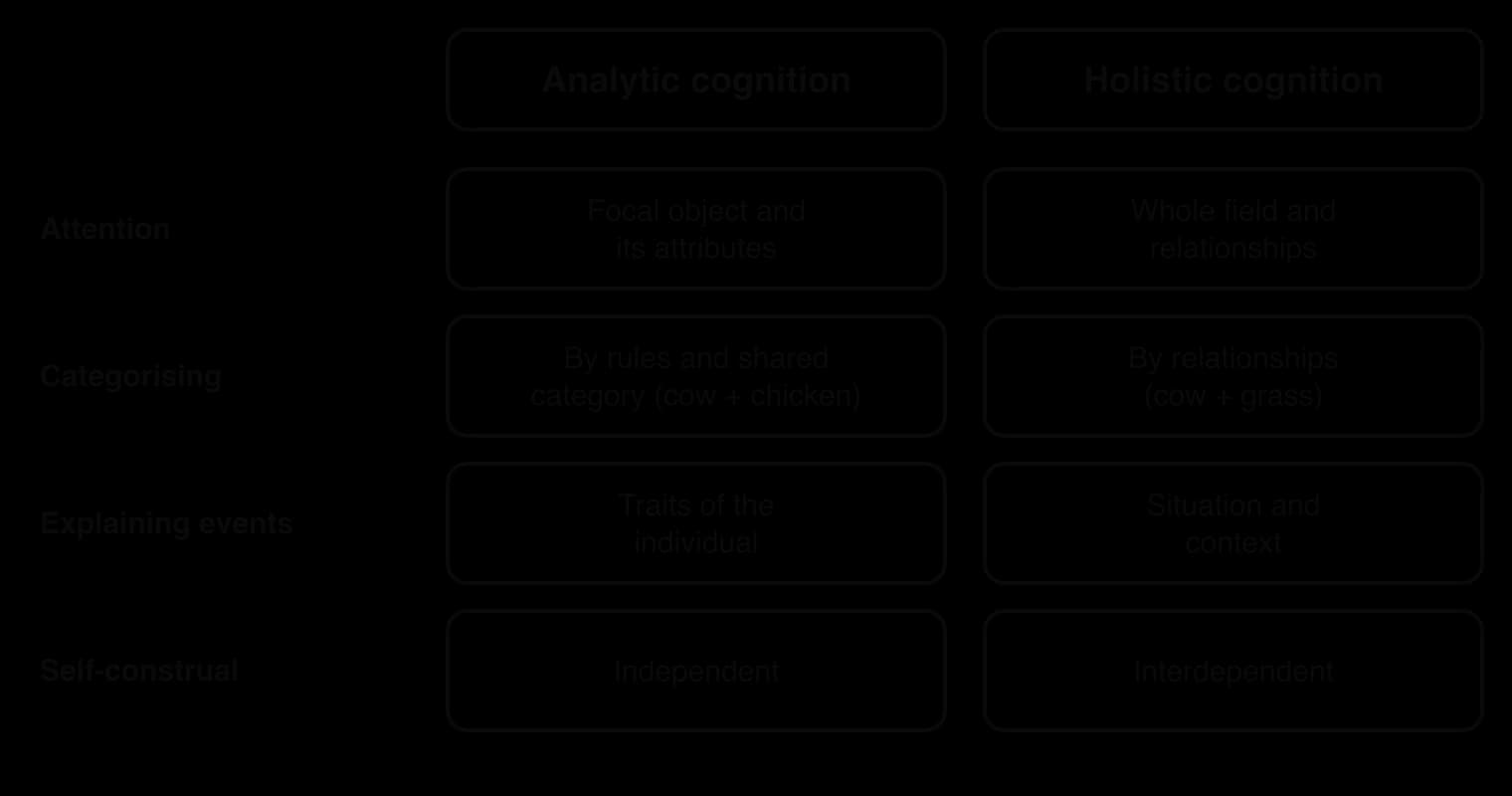
Explain how cultural factors such as cognitive style, language, schooling and ecology shape attention, perception and memory, evaluate cross-cultural research through the concepts, and apply it to unfamiliar scenarios.
Each is in the Psychology glossary, with every other term in the subject.
A style of thinking in which attention focuses on a central object separated from its context, objects are categorised by rules and attributes, and events are explained by the object’s properties.
The proposal that people raised among rectangular buildings learn to read angles in drawings as three-dimensional corners, which makes them more susceptible to illusions such as the Müller-Lyer illusion.
An aspect of culture, such as shared values, language, schooling, social practices or the environment a group lives in, that influences behaviour or a cognitive process.
The tendency for perception of an object to be influenced by its surrounding context, measured for example by the rod and frame test.
A style of thinking in which attention is spread over the whole field, objects are understood through their relationships and context, and events are explained by the situation.
The hypothesis that the structure and vocabulary of the language a person speaks influence how they perceive, remember and think about the world.
A visual illusion in which two lines of equal length appear to differ in length because of the direction of arrow-like fins at their ends.
Explain what a cultural factor is and how culture can shape a cognitive process.
Describe holistic and analytic cognition and explain how they are thought to arise from social practices.
Describe and evaluate Masuda and Nisbett’s (2001) study of attention and memory in Japanese and American participants.
Explain how culture affects perception, with reference to the Müller-Lyer illusion and the carpentered world hypothesis.
Discuss the role of language in perception and memory, including the replication record of linguistic relativity research.
Explain how ecology and cultural practices can shape memory, including research with Indigenous participants.
Evaluate cross-cultural research on cognition with reference to bias, measurement and causality.
Apply cultural explanations of cognition to an unfamiliar situation in learning and cognition.
Cultural factors are the shared practices, values, languages and environments of a group that can shape how its members think. Research on them asks whether basic cognitive processes, such as what people attend to, how they see a simple drawing and what they remember from a scene, are the same everywhere or are partly learned through culture. The answer matters for education, for the design of tests used across countries and for the claim, made by much of psychology, that findings from one population describe all people.
The research draws on the sociocultural approach, especially culture, enculturation and cultural dimensions such as individualism and collectivism, and on the cognitive approach, whose models of
With a free account, Augment remembers where you stopped and what you have practiced.
Culture is the set of beliefs, values, norms and practices shared by a group and passed from one generation to the next. A cultural factor is any part of culture that can be shown to influence behaviour or cognition. For cognition, the most studied cultural factors are the values a society emphasises (such as independence or interdependence), the language people speak, schooling and literacy, and the physical and economic environment in which a culture developed, sometimes called its ecology.
Cultural factors are thought to shape cognition mainly through enculturation, the learning of one’s own culture through socialisation. Children learn what to attend to from the way parents talk about the world, how to categorise objects from their language and schooling, and what is worth remembering from the stories told about the family and the past. Over years of practice, these habits become automatic, so that adults from different cultures may process the same scene in different ways without being aware of it.
The most influential theory of culture and cognition was developed by Richard Nisbett and colleagues. It proposes that people raised in East Asian cultures tend towards holistic cognition: attending to the whole field, noticing relationships between objects and explaining events by their context. People raised in Western cultures, especially North America and Western Europe, tend towards analytic cognition: attending to a focal object, analysing its attributes, sorting it into categories by rules and explaining events by the properties of the object itself.
The two styles are ends of a continuum. Individuals in every culture use both, and the claim is only that cultures differ in which style people use more often and more automatically.
Nisbett and Masuda (2003) linked the two styles to differences in social life. In societies where people depend closely on family, village and work group, success depends on paying attention to others and to the social situation, and this habit of attending to relationships is thought to spread to the way the physical world is perceived. In societies that value independence and personal goals, attention is drawn to individual objects and to what they can be used for. They also suggested that farming that needs cooperation, such as irrigated rice farming, may have encouraged interdependence over centuries.
The link to the self is captured by the terms independent self-construal and interdependent self-construal. A person with an independent self-construal sees the self as a separate individual defined by personal traits; a person with an interdependent self-construal sees the self as part of a network of relationships. Holistic cognition is thought to go with an interdependent self-construal and analytic cognition with an independent one. Research on rice- and wheat-growing regions within China by Talhelm et al. (2014) supports the idea that farming practices, not only nationality, are linked to holistic thinking.
Chiu (1972) showed Chinese and American children sets of three pictures, such as a cow, a chicken and grass, and asked which two went together. American children tended to group the cow and the chicken because “both are animals”, a rule-based category; Chinese children tended to group the cow and the grass because “the cow eats the grass”, a relationship. Similar differences have been found with university students given sets of words.
Ji, Peng and Nisbett (2000) used the rod and frame test, in which participants look down a long box and judge when a rod is vertical while a frame around it is tilted. Chinese participants’ judgements were more influenced by the position of the frame than those of American participants. Being influenced in this way is called field dependence: difficulty separating an object from the field around it, which is what holistic attention predicts.
If holistic and analytic styles differ in attention, the difference should be visible in what people look at. Chua, Boland and Nisbett (2005) used eye-tracking to record the eye movements of American and Chinese students while they viewed photographs of a focal object on a complex background. American participants looked at the focal object sooner and fixated it for longer; Chinese participants made more eye movements to the background. The cultural differences in memory and judgement may therefore begin with differences in what is attended to.
Masuda and Nisbett (2006) used change blindness, the difficulty of noticing changes between two versions of a scene shown one after another. American participants were more likely to detect changes in focal objects, while Japanese participants were more likely to detect changes in the context and in relationships between objects. Nisbett and Masuda (2003) also reported that the scenes themselves mattered. When scenes resembled a Japanese city, with many overlapping objects, both Japanese and American participants found it easier to detect changes in the field; when scenes resembled an American city, both found object changes easier. The physical environment a culture builds may therefore train attention.
 YouTube
Masuda and Nisbett aimed to find out whether East Asians, who were known to explain events more by their context than Americans, also attend to the context more, and whether this affects what they remember.
The study was a quasi-experiment: the independent variable was culture (Japanese or American), which cannot be randomly allocated, and participants were students in Japan and the United States.
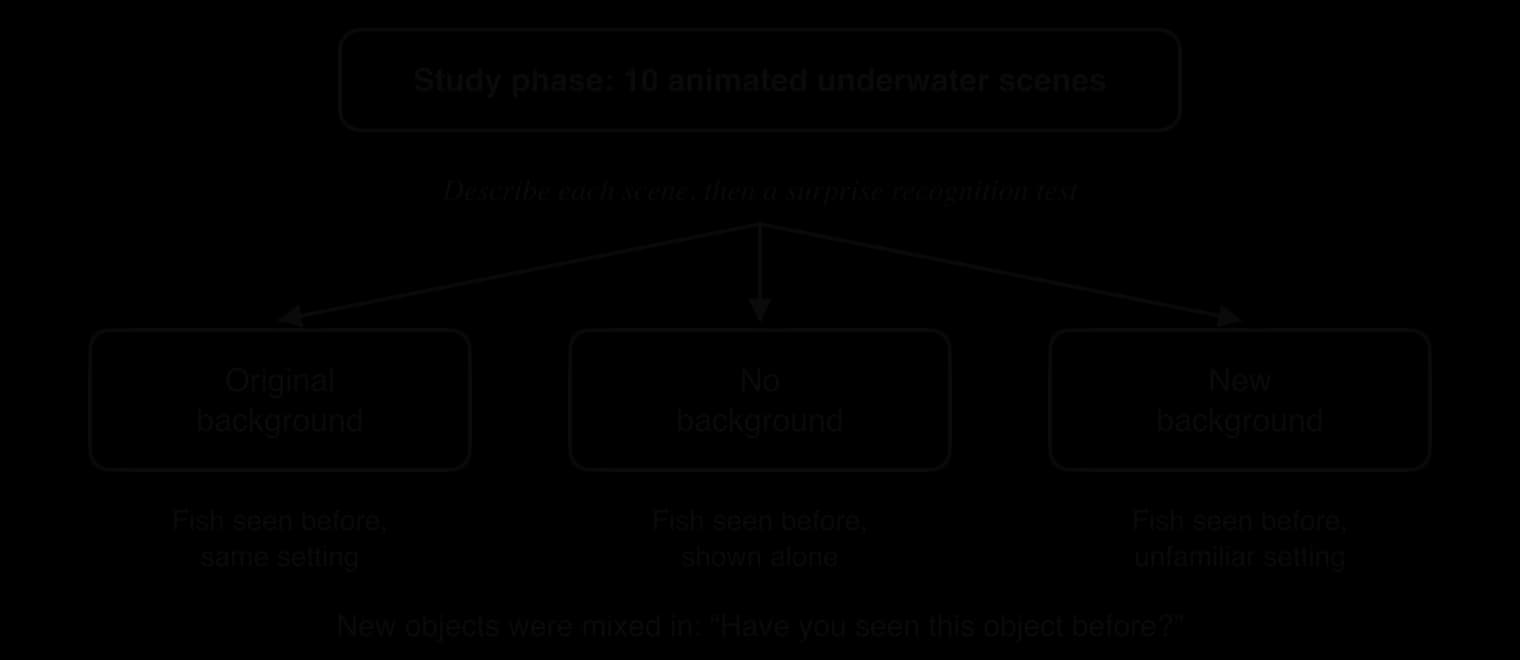
In Study 1, participants watched ten animated vignettes of underwater scenes, each lasting 20 seconds and shown twice. Each scene contained one or more focal fish, larger, faster and more brightly coloured than the other objects, among plants and other, smaller animals and objects. After each vignette participants described what they had seen, and their statements were coded as referring to focal objects, to the field (such as water colour, the floor or inert objects) or to relationships between objects and the field.
Participants then took a surprise recognition test. They saw still pictures of 45 objects they had seen before and 45 they had not, and judged whether each was old or new. The previously seen objects were shown against their original background, with no background or against a new background. Study 2 repeated the recognition test with photographs of wildlife.
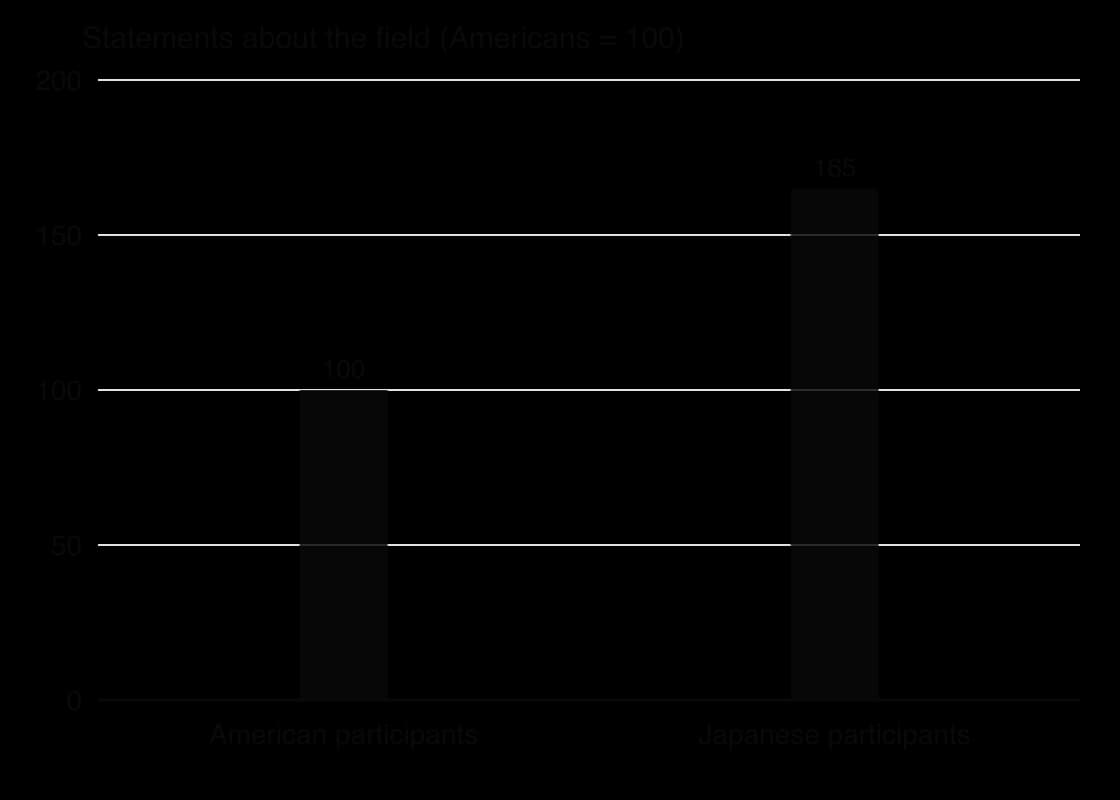
In their descriptions, American participants began by mentioning a focal object far more often than Japanese participants, while Japanese participants began by mentioning the field almost twice as often as Americans. In total, Japanese participants made 65% more statements about the field and almost twice as many statements about relationships between objects and the field.
In the recognition test, American participants’ accuracy was almost unaffected by the background. Japanese participants made substantially more errors when a fish was shown against a new background than when it was shown against its original background. Study 2 replicated this pattern with photographs of wildlife.
Japanese participants encoded focal objects together with their context, so that the object was harder to recognise without that context, while American participants encoded focal objects as separate from their background. Culture appears to affect what is attended to, which in turn affects what is remembered and how memory depends on context. The results fit Nisbett’s theory of holistic and analytic cognition.
Because culture cannot be assigned, the study shows a difference between two groups, not what caused it. Japanese and American participants differ in many ways other than holistic and analytic values: language, education, the scenes they see every day and familiarity with the materials. Japan has a strong fishing culture and Japanese participants may have been more familiar with underwater scenes, which could make the background more meaningful to them. Later studies that change the context, such as the city scenes in the change blindness research, give more direct evidence that environment and attention are causally linked.
The strength of the study is that it used two different measures: a free description, which shows what people spontaneously attend to, and a recognition test, which shows how memory depends on context without relying on language. The convergence of the two, and the later eye-tracking evidence from Chua et al. (2005), make it unlikely that the result is simply a difference in how people talk. However, coding descriptions into “focal” and “field” statements involves judgement, and the scenes were artificial animations rather than real environments.
The samples were university students, who are a small and unusual part of each culture. Treating one Japanese and one American sample as representative of “East Asians” and “Westerners” ignores large differences within each region, and a study run by researchers with one theory in mind risks confirmation bias in the design and coding. Replication across other groups, such as Chinese participants in the eye-tracking studies, reduces but does not remove this problem.
Sources: Masuda, T., & Nisbett, R. E. (2001). Attending holistically versus analytically: comparing the context sensitivity of Japanese and Americans. _Journal of Personality and Social Psychology, 81(5), 922–934. Nisbett, R. E., & Masuda, T. (2003). Culture and point of view. PNAS, 100(19), 11163–11170._
Perception is the process of organising and interpreting sensory information. It depends partly on assumptions learned from experience, and visual illusions show these assumptions at work. In the Müller-Lyer illusion, two lines of equal length look different because of the direction of the fins at their ends: the line with fins pointing outwards usually looks longer.
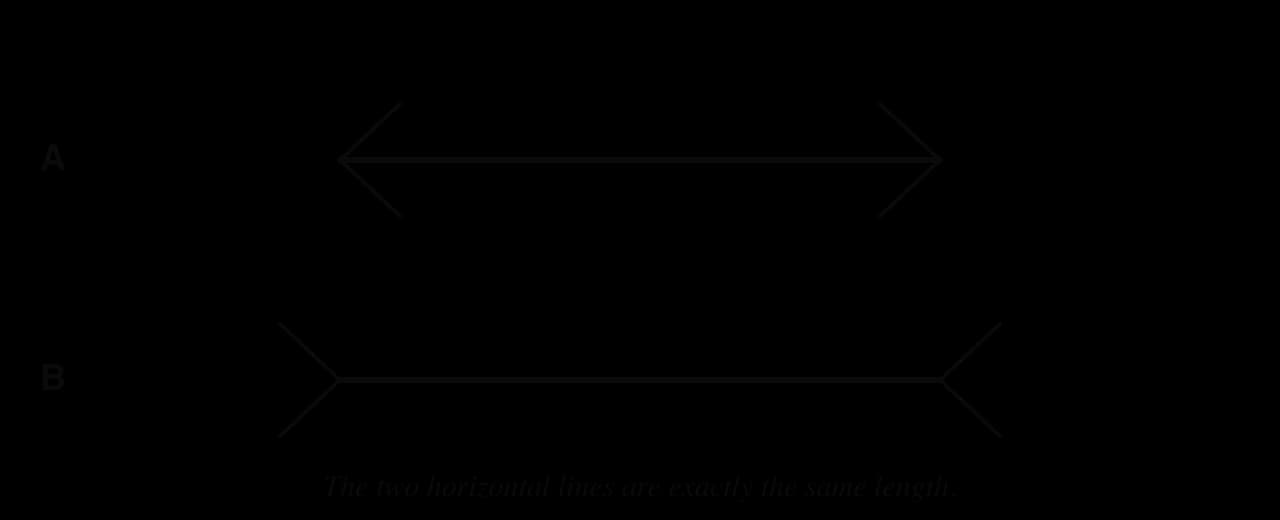
Segall, Campbell and Herskovits (1963) presented four geometric illusions to 16 samples: three of European origin, twelve from Africa and one from the Philippines. For the Müller-Lyer illusion, the average misperception of line length ranged from 1.4% to 20.3%. The three European-derived samples were the most susceptible, and San foragers of the Kalahari Desert were the least. The researchers proposed that people learn different habits of perceptual inference from their visual environment.
Their explanation was the carpentered world hypothesis. People who grow up surrounded by rectangular buildings, straight edges and right-angled corners learn to interpret angles in a flat drawing as corners in three-dimensional space. The fins of the Müller-Lyer lines then look like the near or far corners of a building, and the brain adjusts the perceived length to allow for distance. People who live in environments with fewer straight lines and right angles have less practice with this inference and are less susceptible.
The research is important for perspective: it suggests that even a basic perceptual effect, once assumed to be universal, depends on experience. The evidence is correlational, however, and later studies disagree. Gustav Jahoda found no significant difference in susceptibility between members of one African group living in a traditional rural setting and members of the same group living in cities, and his later work suggested that differences in retinal pigmentation might play a part. In contrast, Ahluwalia (1978) found that urban Zambian children and young adults were more susceptible than rural ones. Illusion strength is also measured with drawings on paper, which are more familiar to some groups than others.
The carpentered world hypothesis therefore remains a plausible but unproven explanation. The strongest support comes from comparisons within one culture, such as urban and rural Zambians, where many other cultural variables are held roughly constant.
Language is one of the most important parts of culture, and the hypothesis of linguistic relativity proposes that the language a person speaks affects how they perceive, remember and think. Its strong form, that language determines thought, is generally rejected. A weaker form, that language influences some aspects of cognition, is supported by some well-controlled studies and challenged by others.
English uses one basic word for blue, but Russian makes an obligatory distinction between lighter blues (goluboy) and darker blues (siniy). Winawer et al. (2007) asked English and Russian speakers to decide which of two blue squares matched a third. Russian speakers were faster when the two colours fell on different sides of the goluboy–siniy boundary than when they were in the same category, while English speakers showed no such advantage. The Russian advantage disappeared when participants had to perform a verbal task at the same time, but not a spatial task, which shows that language was being used during the perceptual task.
The Pirahã, an Indigenous people of the Amazon, have no words for exact numbers, not even “one”. Frank et al. (2008) found that Pirahã speakers could match large numbers of objects exactly when the objects were in front of them, but were inaccurate when the task required them to remember a quantity. The researchers concluded that number words do not change the basic perception of quantity, but act as a cultural tool for remembering exact amounts across time and space. Language therefore affected memory rather than perception in this case.
Boroditsky (2001) reported that Mandarin speakers, whose language often describes time vertically (earlier months as “up”), were faster to judge time relations after seeing vertical arrays of objects, while English speakers were faster after horizontal arrays. January and Kako (2007) reported six unsuccessful attempts to replicate the key finding and concluded that it provided no support for linguistic relativity. The case shows why single findings about language and thought should be treated with caution until they have been replicated.
 YouTube
Cultural values affect what people remember about their own lives. Wang (2001) asked 256 American and Chinese university students for their earliest childhood memory: the Americans’ earliest memories were on average almost six months earlier and were longer, more specific and more focused on themselves, while the Chinese students’ memories more often concerned collective activities and general routines. Autobiographical memory seems to be shaped by whether a culture encourages people to talk about themselves as individuals.
Culture also provides the schemas that shape memory at encoding and retrieval. When people remember stories from another culture, they tend to reconstruct them to fit their own expectations, as in Bartlett’s War of the Ghosts research and the study by Steffensen, Joag-Dev and Anderson (1979) of American and Indian readers. These are examples of reconstructive memory guided by cultural knowledge, explained by schema theory.
Ecology, the physical environment a culture has adapted to, may also shape memory. Kearins (1981) reported that Aboriginal children from the Western Desert of Australia outperformed white Australian children on visual-spatial memory tasks, in which they had to remember where objects had been placed in an array and put them back. She argued that survival in the desert, where finding water and food depends on remembering small features of the land, had encouraged a strong visual memory, supported by cultural practices.
The finding has not replicated consistently. In an honours study at the Australian National University, later published as Knapp and Seagrim (1981), Knapp (1979) repeated tasks from Kearins’s earlier studies with Aboriginal children from Alice Springs and children of European descent. She found no consistent advantage for the Aboriginal children, and in some tasks the European children did better. Knapp concluded that differences in visual memory are best explained by children’s environmental experience rather than by long-term adaptation to the desert.
Research of this kind raises questions of perspective and responsibility. Tasks designed by outsiders may not tap the skills that matter in Indigenous communities, and conclusions about “Aboriginal memory” can easily become stereotypes. Indigenous psychologies stress that research should be designed with communities, use tasks that are meaningful to them and avoid treating their cognition only in comparison with Western norms.
Cultural factors do not act alone. Culture shapes attention through the cognitive habits learned during enculturation, and repeated practice of those habits may change the brain through neuroplasticity. The physical environment that a culture builds, such as busy cities or open desert, provides the experience from which perceptual inferences are learned. An explanation that refers only to “culture” is therefore incomplete: it needs to show how social practices, language and environment become cognitive habits, and how those habits are supported by the brain.
Cultural factor | Cognitive process | Example of research | Strength of evidence |
|---|---|---|---|
Holistic vs analytic values | Attention and memory | Masuda & Nisbett (2001); Chua et al. (2005) | Consistent across tasks; quasi-experimental |
Built environment | Perception | Segall et al. (1963), Müller-Lyer illusion | Large cross-cultural sample; correlational |
Language: colour words | Perception | Winawer et al. (2007) | Controlled; effect removed by verbal interference |
Language: number words | Memory | Frank et al. (2008), Pirahã | Small, unique sample; clear task contrast |
Language: time metaphors | Thinking about time | Boroditsky (2001) | Failed to replicate |
Ecology and practices | Spatial memory | Kearins (1981); Knapp (1979) | Mixed findings |
Most research in psychology has used WEIRD samples, from Western, educated, industrialised, rich and democratic societies, and then treated the results as universal. Cross-cultural research on cognition is one of the main reasons this assumption is now questioned: attention, perception and memory all show cultural variation. At the same time, the cross-cultural studies themselves often compare only two groups of university students and are usually designed by Western researchers, which risks cultural bias in the choice of tasks and in the interpretation of the results.
A task may not measure the same thing in two cultures. Line drawings, photographs of fish and pictures of cows and chickens may be more familiar to some groups than others, and instructions translated into another language may change their meaning. This is the problem of measurement equivalence. Using an instrument developed in one culture as if it were universal is an imposed etic.
Researchers reduce the problem by using several different tasks, by testing bilinguals in each language and by working with researchers from each culture. In one study reported by Nisbett and Masuda (2003), Taiwanese students described events with the same pattern whether they were randomly assigned to write in Mandarin or in English, so the cultural difference was not caused by the testing language.
Culture is a package of many variables, so a difference between two cultural groups does not show which part of culture caused it. Researchers address this in three ways: by comparing groups within one country that differ on a single factor, such as rice and wheat farming regions; by manipulating a factor experimentally, such as the busy or simple city scenes in the change blindness research or the verbal interference task in Winawer et al. (2007); and by studying people who change culture, such as migrants and bilinguals. Evidence that combines these methods gives the strongest case that culture causes differences in cognition.
If cognitive styles are learned, they should change when culture changes. Nisbett and Masuda (2003) described how mothers of schoolchildren in Beijing, asked about their hopes for their children over ten years of rapid economic change, moved from mainly social goals to goals of individual ambition and skill. Research on bicultural people also shows that cultural reminders can shift thinking towards one style or the other. These findings support a view of culture as an ongoing influence rather than a permanent difference between groups.
Cultural factors in cognitive processes appear in Paper 1 Section B, as an unseen scenario in learning and cognition, and in Section C, as a concept-based essay. In both, the key is to name a specific cultural factor and a specific cognitive process and to explain the link between them.
Section C essays on this area of study are organised around the named concept. Bias fits cross-cultural research particularly well, because the research both exposes and risks cultural bias.
A cultural factor is an aspect of culture, such as values, language, schooling, social practices or ecology, that influences a cognitive process; its effects are learned through enculturation.
Holistic cognition (attention to the field and relationships) is more common in East Asian samples and analytic cognition (attention to focal objects and rules) in Western samples; both are tendencies, not types.
Masuda and Nisbett (2001) found that Japanese participants made 65% more statements about the background of underwater scenes and that their recognition of fish fell when the background changed; Americans’ did not.
Eye-tracking, change blindness and categorising tasks support the claim that culture shapes attention and therefore memory.
Susceptibility to the Müller-Lyer illusion varies across societies; the carpentered world hypothesis links it to experience of rectangular environments.
Language can affect perception (Russian blues) and memory (Pirahã number), but some findings, such as Boroditsky’s on time, have failed to replicate.
Ecological claims, such as Kearins’s on Aboriginal spatial memory, have mixed support and raise questions of perspective and responsibility.
Cross-cultural research reduces psychology’s cultural bias but faces problems of sampling, measurement equivalence and causality, because culture cannot be manipulated.
I can explain what a cultural factor is and how it can shape a cognitive process through enculturation.
I can describe holistic and analytic cognition and explain how they may arise from social practices.
I can describe and evaluate Masuda and Nisbett’s (2001) study.
I can explain cultural differences in the Müller-Lyer illusion and evaluate the carpentered world hypothesis.
I can discuss linguistic relativity using evidence for and against it.
I can explain how ecology and cultural practices may shape memory, including the debate over research with Aboriginal children.
I can evaluate cross-cultural research on cognition with reference to bias, measurement and causality.
I can apply a cultural explanation of memory to an unfamiliar scenario.