 YouTube
Explain classical and operant conditioning as ways of learning, describe how operant conditioning is applied to change behaviour in classrooms and apps, and evaluate these applications through the concepts.
Each is in the Psychology glossary, with every other term in the subject.
The systematic application of learning principles, especially reinforcement, to change a specific, observable behaviour, which is measured before, during and after the intervention.
The use of game design elements such as points, badges, levels, leaderboards and streaks in non-game settings, such as learning, to motivate behaviour.
A classroom management method in which teams win privileges if members break class rules fewer than a set number of times, so each pupil’s behaviour affects the whole team.
The principle that a more frequent, preferred activity can reinforce a less frequent one when access to the preferred activity depends on doing the other first.
A behaviour modification system in which tokens are given immediately for target behaviours and later exchanged for backup reinforcers such as privileges, activities or items.
Describe examples of classical and operant conditioning as ways of learning in everyday life and in education.
Explain how conditioning contributes to the formation of habits.
Explain how operant conditioning is applied to change behaviour through behaviour modification, token economies, the Premack principle and gamification.
Describe and evaluate the Good Behavior Game as an application of group-contingent reinforcement.
Discuss how biological, cognitive and sociocultural factors interact in learning through conditioning.
Evaluate the use of conditioning to change behaviour with reference to change, causality, measurement and responsibility.
Apply conditioning principles to design or analyse a behaviour change programme in a learning setting.
Conditioning is the simplest way in which experience changes behaviour, and much everyday learning, from feeling nervous in a particular classroom to checking a phone for messages, is shaped by it. In education, operant conditioning has also been used deliberately for over half a century to change behaviour, through praise, points, tokens, games and apps.
Conditioning sits at one end of a range of ways of learning in the learning and cognition context. It needs no conscious reasoning, while observational learning, schemas and deliberate thinking and decision-making rely increasingly on cognition. Explanations of learning by conditioning draw on all three approaches: the biological approach (the brain’s reward system and dopamine), the cognitive approach (expectations about consequences, intrinsic motivation) and the
With a free account, Augment remembers where you stopped and what you have practiced.
In classical conditioning, a neutral stimulus that is repeatedly paired with an unconditioned stimulus comes to trigger a similar response on its own. It is learning about which events predict which, and it mainly shapes emotional and physiological responses such as fear, pleasure and nausea. Conditioned responses fade through extinction when the conditioned stimulus appears without the unconditioned stimulus, and spread to similar stimuli through stimulus generalisation.
In operant conditioning, voluntary behaviour becomes more or less likely depending on its consequences. Positive reinforcement adds something desirable, negative reinforcement removes something unpleasant, and punishment makes behaviour less likely. The pattern of reinforcement, its schedule of reinforcement, affects how fast and how persistently people respond, and new behaviour can be built step by step through shaping.
YouTubeClassrooms produce strong emotions, and the places, people and objects present when those emotions occur can become conditioned stimuli. A student who has repeatedly felt humiliation or fear in timed tests may come to feel anxious at the sight of a test room, a stopwatch or a particular subject’s textbook. This kind of test anxiety can be understood partly as a conditioned emotional response, and it matters for learning because high anxiety uses up attention and working memory that the task needs.
The same process can work in a positive direction. When a classroom is regularly associated with warmth, interest and success, the room, the teacher and the subject can come to produce pleasant feelings and a readiness to engage. Students who avoid a feared subject cannot have the experiences that would extinguish the fear, which is one reason why an early bad experience with a subject such as mathematics can have lasting effects. When avoidance becomes severe, as in school refusal, it is treated with graded exposure, one of the psychological treatments for anxiety.
Much of what children learn at home and at school is shaped by consequences. Praise, a teacher’s smile, good marks and peer approval reinforce behaviours such as answering questions and finishing work; loss of privileges and disapproval punish others. Feedback itself can act as a reinforcer: a correct answer marked immediately in a quiz app is followed by a pleasant signal and points, so the learner is more likely to keep practising.
Operant learning is not always intended. A teacher who pays attention mainly to pupils who misbehave may reinforce misbehaviour without realising it, because attention is a powerful reinforcer for many children. A student who copies homework and avoids the stress of doing it is negatively reinforced for copying. Understanding these hidden contingencies is often the first step in changing them.
A habit is a behaviour that has become automatic: it is triggered by a cue in a familiar context, with little conscious thought. Habits form through both kinds of conditioning. The context (a time of day, a place, a phone notification) becomes a cue, and the behaviour that follows it is reinforced by its consequences, so over many repetitions the cue alone starts the behaviour.
Lally and colleagues (2010) asked 96 volunteers to choose a new healthy eating, drinking or exercise behaviour and carry it out every day in the same context, such as after breakfast, for 12 weeks. Participants rated each day how automatic the behaviour felt. Automaticity rose steeply at first and then levelled off, and the time taken to reach that level ranged from 18 to 254 days. Missing a single day did not seriously disrupt habit formation. Habit formation therefore depends on consistent repetition in a stable context, which is useful knowledge for building study routines.
Behaviour modification is the systematic use of conditioning principles, mainly reinforcement, to increase desirable behaviour and reduce undesirable behaviour. It is used in classrooms, special education, parenting programmes, workplaces and health settings. In its professional form it is also called applied behaviour analysis.
A behaviour modification programme follows a set sequence. The target behaviour is defined in observable terms (“stays in seat during individual work”, not “behaves well”), and a baseline is recorded, often as an ABC chart of the antecedents, behaviour and consequences, to discover what currently reinforces the behaviour. The planner then chooses reinforcers that the learner actually values and a schedule, applies the contingency consistently, and adjusts it using shaping. Finally, artificial reinforcers are faded so that natural ones, such as praise, success and enjoyment, maintain the behaviour.
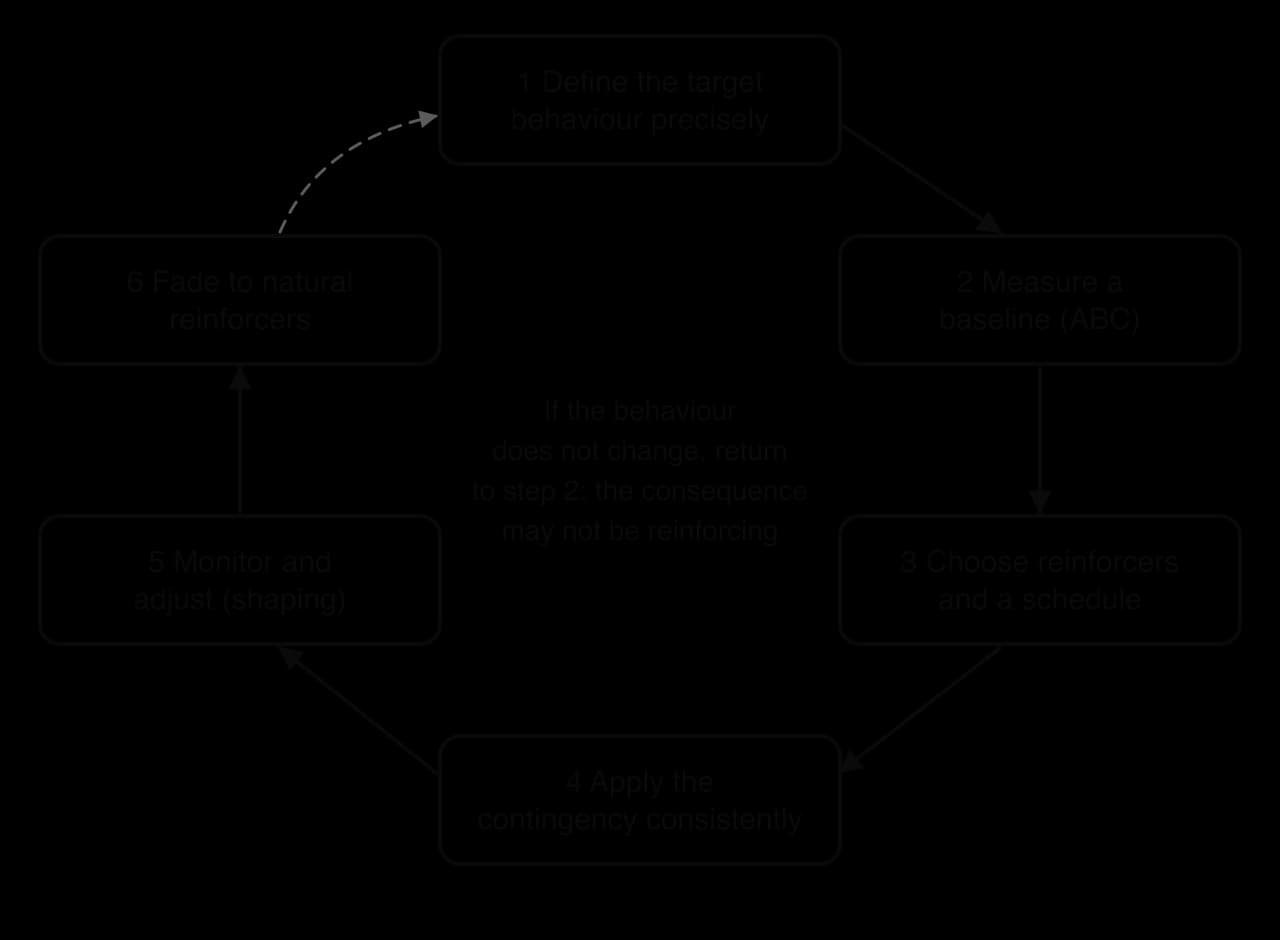
The cycle in the figure explains why many programmes fail. Common problems are vague targets that cannot be counted, “rewards” that the learner does not actually value, inconsistent use by different adults, and stopping the reinforcement suddenly rather than fading it, which leads to extinction of the new behaviour.
 YouTube
A token economy is a behaviour modification system in which learners earn tokens, such as points, stickers or counters, for target behaviours, and later exchange them for backup reinforcers. The approach was first used systematically by Ayllon and Azrin with long-stay psychiatric patients in the 1960s, and was soon adapted for classrooms, special schools and residential units for young people.
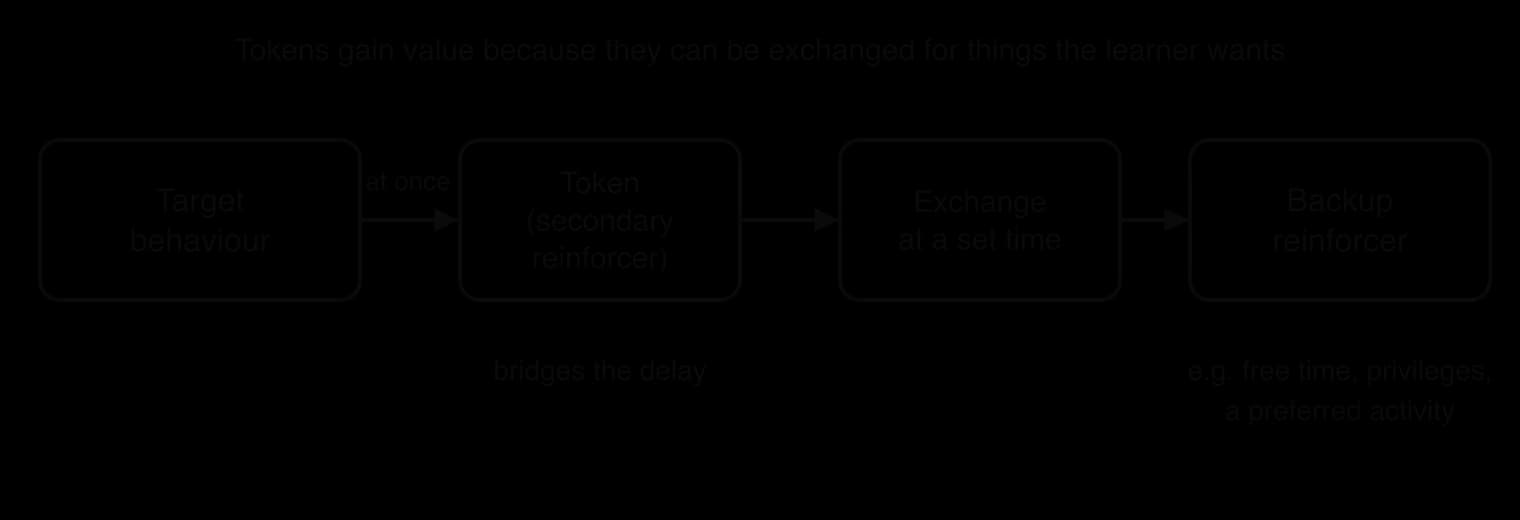
In a classroom, a teacher might give a point for each completed task or each period spent on task, with points exchangeable on Friday for free time or a chosen activity. The tokens work as secondary reinforcers: they gain their value from what they can buy, they can be given immediately and in small amounts, and one type of token can be linked to many backup reinforcers, so it does not lose its value when the learner has had enough of one reward.
Evidence for classroom token economies is positive but less strong than often assumed. Maggin and colleagues (2011) systematically reviewed studies of token economies for students with challenging behaviour. Most studies reported improvements, but many used weak designs, and the review concluded that the research did not yet meet the standards needed to call token economies an evidence-based practice. Effects also tend to fade when the system is removed unless reinforcement is gradually thinned and replaced by natural reinforcers.
Premack proposed that reinforcers do not have to be objects or treats: any activity a person does often, given free choice, can reinforce an activity they do less often. This is the Premack principle, often summarised as “first work, then play”. Premack (1959) developed it from laboratory research on reinforcement, and it has since become a standard technique in classrooms, parenting and behaviour therapy.
The Premack principle is useful because it allows reinforcement without material rewards. A student who prefers playing video games to revising can make games depend on completing a set amount of revision. Ayllon and Azrin had used the same idea when they chose backup reinforcers from activities their patients chose frequently, such as walks and time alone.
Gamification is the use of game design elements, such as points, badges, levels, leaderboards and streaks, in non-game settings such as education. Many of these elements are operant techniques: points and badges are secondary reinforcers, levels shape behaviour by raising the requirement gradually, and random rewards use variable ratio schedules. Language-learning apps that count a user’s “streak” of consecutive days also use negative reinforcement, because practising avoids the unpleasant loss of the streak.
Sailer and Homner (2020) carried out a meta-analysis of experiments on gamification in education. They found significant small positive effects on cognitive learning outcomes (g = 0.49, from 19 studies with 1,686 participants), motivational outcomes (g = 0.36) and behavioural outcomes (g = 0.25). The effect on cognitive outcomes held up in the best-designed studies, but the effects on motivation and behaviour were less stable. For behavioural outcomes, gamification worked better when it included a story or game fiction and when competition was combined with collaboration.
Sources: Sailer, M. and Homner, L. (2020). The gamification of learning: a meta-analysis. _Educational Psychology Review, 32, 77–112._
Reinforcement principles have also been used in public policy outside Western classrooms. Mexico’s Progresa programme, begun in 1997, gave cash payments to poor rural families on condition that their children attended school and family members attended health check-ups. It was evaluated by randomly selecting which eligible communities received the programme first, one of the first large randomised evaluations of a social policy in a lower-income country, and it increased school enrolment. Programmes of this kind, called conditional cash transfers, have since been adopted in many countries in Latin America, Africa and Asia.
Conditional cash transfers show both the reach and the limits of an operant approach. Making payment contingent on attendance changes behaviour on a large scale, but it treats the family as responding to rewards, while economic, cultural and practical factors, such as the cost of travel to school, the value placed on education and the need for children’s work, also shape whether children attend.
The Good Behavior Game is a classroom behaviour management method based on group-contingent reinforcement. It is one of the best-studied applications of operant conditioning in education, because it has been tested both in a small, detailed classroom experiment and in a large randomised trial that followed children into adulthood.
Barrish, Saunders and Wolf (1969) aimed to find out whether a simple game, in which rewards for a whole team depended on the behaviour of each member, would reduce disruptive behaviour in an ordinary classroom. Later, Kellam and colleagues tested whether playing the game in the first years of school could have long-term effects on problems known to follow early aggressive and disruptive behaviour, such as drug and alcohol misuse.
The original study. Barrish and colleagues worked with one fourth-grade class in the USA (children aged about 9–10) that included several pupils the teacher described as problem children. Observers first recorded baseline rates of two operationalised behaviours: being out of seat without permission, and talking out without permission.
Next, the class was divided into two teams “to play a game”. Each time any child broke a rule, a mark was put on the board against their team. Teams that stayed under a set number of marks, or the team with fewer marks, won privileges already available in the classroom, such as extra break time, being first in line for lunch, time for special projects, stars and name tags.
In the design, the game was introduced first during maths lessons while reading lessons continued as normal, and later in reading lessons as well, and it was withdrawn and reintroduced in maths. This combined a reversal design with a multiple baseline design, so that any change could be linked to the introduction of the game in each lesson.
The long-term trial. Kellam and colleagues tested the game in 19 public elementary schools in Baltimore, in five poor to lower-middle-class, mainly African American urban areas, beginning in 1985–86. Schools were matched and randomly assigned to the Good Behavior Game, a reading programme, or standard practice, and within the intervention schools classrooms and teachers were randomly assigned.
In game classrooms, teachers placed first-grade children into teams balanced for sex, aggressive behaviour and shyness; the game began at 10 minutes three times a week and was lengthened gradually, with rewards later delayed until the end of the day or week. The analysis of the first cohort followed 922 children, 238 of them in game classrooms, and assessed them at ages 19–21.
In the original study, out-of-seat and talking-out behaviour fell sharply whenever the game was in operation in maths, returned towards baseline when it was withdrawn, and fell again when it was reintroduced. The same reduction appeared in reading lessons when the game was introduced there, which showed that the change followed the game itself rather than other events in the school year.
In the long-term trial, males from game classrooms had significantly lower rates of drug abuse or dependence disorders and of regular smoking by ages 19–21 than males in control classrooms in the same schools. The effects were largest for boys whom teachers had rated as highly aggressive and disruptive in first grade. There was no significant effect for females, and in a second cohort, whose teachers had less training and support, the effects were generally smaller.

Sources: Barrish, H. H., Saunders, M. and Wolf, M. M. (1969). Good behavior game: effects of individual contingencies for group consequences on disruptive behavior in a classroom. _Journal of Applied Behavior Analysis, 2(2), 119–124; Kellam, S. G. et al. (2008). Effects of a universal classroom behavior management program in first and second grades on young adult behavioral, psychiatric, and social outcomes. Drug and Alcohol Dependence, 95(Suppl. 1), S5–S28._
A simple group contingency, using privileges already available in school, can change classroom behaviour quickly. Played regularly over the first school years, it may also reduce serious problems in young adulthood for the boys most at risk, probably because it reduces early aggressive behaviour and helps children learn the role of a student. The game shows operant conditioning being applied to change behaviour at the level of the whole class rather than the individual.
The original study used one class, but the reversal and multiple baseline design allowed strong conclusions about cause within that class, because behaviour changed each time and only when the game was introduced. The Baltimore trial used random allocation of classrooms and teachers, which is much stronger evidence that the game caused the long-term differences. However, outcomes were measured 13–15 years later, and the paths from first-grade behaviour to adult drug use pass through many other factors, so the mechanism is inferred rather than observed.
Disruptive behaviour in the original study was recorded by trained observers using clear, countable definitions, which makes the measurement objective but narrow: it shows less talking out and wandering, not more learning. In the long-term trial, effects were concentrated in high-risk boys, were absent for girls and were weaker in the replication cohort, which shows that results depend on who receives the programme and how well teachers are supported. Randomised trials in other countries, such as the Netherlands and Belgium, have also found benefits, although results have varied between measures and informants, so generalisability to different school systems cannot be assumed.
A group contingency uses peer pressure: one child’s behaviour can cost the whole team its reward. This can encourage peers to support each other, but it can also lead to blaming or excluding a child who repeatedly breaks the rules, especially a child with additional needs. Teachers using the game are therefore advised to balance teams carefully, keep rewards positive and avoid public humiliation, which raises the question of who is responsible for the social side effects of a behaviour change technique.
Conditioning was once explained in purely behavioural terms, but learning through conditioning is now understood as the product of interacting biological, cognitive and sociocultural factors. Single-level explanations are reductionist, and the interactions explain why the same programme can work well for one learner and not for another.
Reinforcement depends on the brain’s reward system. Neurons that release dopamine respond strongly to unexpected rewards, and with learning they come to respond to cues that predict reward instead. This “prediction error” signal fits the finding from classical conditioning that learning depends on how surprising an outcome is, and it helps to explain why unpredictable rewards, such as random rewards in games and apps, are so effective. Biological preparedness also limits what is learned easily: fears of some objects and aversions to tastes are acquired faster than other associations.
How learners interpret a reward affects its effect. In the overjustification study of Lepper, Greene and Nisbett (1973), nursery children who drew in order to win an expected certificate later chose to draw only about half as much as children who received no award or an unexpected one. For teachers this is a caution: tangible, expected rewards for activities students already enjoy, such as reading for pleasure, may reduce intrinsic interest, while informative praise and feedback on progress usually do not. Expectations also matter: people often change their behaviour as soon as they are told about a new contingency, before experiencing it.
What counts as a reinforcer is learned within a culture. Public praise and individual prizes are common in many Western classrooms, but in some cultures being singled out in front of peers can feel embarrassing, so group recognition may be more reinforcing than individual awards. Cultural norms also shape attitudes to punishment: physical punishment is accepted in some communities and banned in many countries. Social reinforcement from peers can compete with a teacher’s reinforcers, which is one reason why group contingencies such as the Good Behavior Game, which put peer approval on the side of the classroom rules, can be effective.
Concept | Strengths | Limitations |
|---|---|---|
Change | Produces rapid, measurable change in specific behaviours; the Good Behavior Game may change long-term outcomes | Change often lasts only while reinforcement continues; behaviour may not transfer to new settings; rewards can reduce intrinsic motivation |
Causality | Reversal designs and randomised trials show that contingencies cause changes in behaviour | Long-term effects pass through many other factors; many classroom studies are small with weak designs |
Measurement | Target behaviours are operationalised and counted, so progress is objective | Counting observable behaviour leaves out understanding, interest and well-being |
Responsibility | Positive reinforcement is less harmful than punishment-based discipline | Raises issues of control, consent, peer pressure in group contingencies, and data collection and persuasive design in apps |
Perspective | A clear behavioural account that teachers can apply | Reductionist without cognitive and sociocultural factors; what reinforces depends on the learner and culture |
A central question about change is whether conditioning changes only behaviour or also the learner. Supporters argue that once a behaviour such as reading or punctuality is established, natural consequences take over: reading becomes enjoyable, and arriving on time brings social approval. Critics argue that learners taught mainly through external rewards may become dependent on them and less able to regulate their own behaviour. The evidence suggests that the answer depends on how rewards are used: informative feedback, gradual fading and choice support lasting change, while controlling, expected rewards for interesting tasks can undermine it.
Questions of responsibility are sharpest in commercial learning apps. The same techniques that encourage daily practice, such as streaks, variable rewards and notifications, are used to maximise time spent in apps, and children may not understand how they are being influenced. Designers and schools therefore have a responsibility to use reinforcement in learners’ interests, to be open about it and to protect learners’ data.
Classical and operant conditioning is an area of study in the learning and cognition context. It can be the setting for a Paper 1 Section B question, which gives a learning scenario and asks how a theory such as operant conditioning applies, or the focus of a Section C concept-based essay.
Classical conditioning shapes emotional learning in education, such as test anxiety or liking for a subject; operant conditioning shapes voluntary behaviour through its consequences.
Habits form when a behaviour is repeated in a stable context and reinforced; Lally et al. (2010) found automaticity took 18–254 days to level off.
Behaviour modification applies reinforcement systematically: define and measure the target, choose real reinforcers, apply consistently, shape and fade.
Token economies use secondary reinforcers exchangeable for backup reinforcers; classroom evidence is positive but often methodologically weak.
The Premack principle uses preferred activities as reinforcers; gamification uses points, badges, levels and streaks, with small positive effects on learning.
The Good Behavior Game reduced disruptive behaviour in Barrish et al. (1969) and, in the randomised trial of Kellam et al. (2008), later drug misuse and smoking in high-risk boys.
Learning by conditioning involves biological (dopamine and prediction error), cognitive (expectations, overjustification) and sociocultural (what is reinforcing in a culture) factors.
Conditioning produces measurable change, but change may not last when reinforcement stops and raises issues of control, peer pressure and persuasive design.
I can describe examples of classical and operant conditioning as ways of learning in education.
I can explain how conditioning contributes to habit formation.
I can explain behaviour modification, token economies, the Premack principle and gamification as applications of operant conditioning.
I can describe and evaluate the Good Behavior Game.
I can discuss how biological, cognitive and sociocultural factors interact in learning through conditioning.
I can evaluate the use of conditioning to change behaviour with reference to change, causality, measurement and responsibility.
I can apply conditioning to design or analyse a behaviour change programme.