Explain and evaluate evidence-based strategies for improving memory and attention, from retrieval practice and spacing to mnemonics, brain training and mindfulness, and apply them to design a plan for a learner.
Each is in the Psychology glossary, with every other term in the subject.
Repeated practice on computerised tasks or games intended to improve general cognitive abilities such as working memory or attention.
Conditions of learning, such as retrieval practice, spacing and interleaving, that make learning feel harder and slower at first but improve long-term retention and transfer.
A learning strategy in which material is represented in both words and images, giving two linked memory codes and two routes for retrieval.
An encoding strategy in which new information is connected to existing knowledge, for example by explaining why a fact is true or how it relates to other ideas.
Improvement in an ability or setting different from the one trained, such as better reasoning after working memory training; near transfer is improvement on closely similar tasks.
A practice strategy in which different types of problem, skill or topic are mixed within a session rather than practised in separate blocks.
A technique, such as an acronym, a rhyme or the method of loci, that organises information into a memorable structure to aid encoding and retrieval.
A learning strategy in which information is actively recalled from memory, for example through self-testing, which strengthens long-term retention more than restudying the same material.
Explain what it means to improve a cognitive process and the criteria used to judge whether a strategy works.
Explain retrieval practice and spaced practice and why they improve long-term memory.
Describe and evaluate Roediger and Karpicke’s (2006) study of the testing effect.
Explain how interleaving, elaboration, dual coding and mnemonics act on encoding and retrieval.
Evaluate claims that brain training and mindfulness training improve memory and attention, with reference to transfer.
Explain why learners often choose less effective strategies, with reference to metacognition.
Evaluate research on improving a cognitive process with reference to change, measurement and causality.
Apply research to design a strategy that improves memory for a learner in an unfamiliar situation.
Strategies to improve a cognitive process are planned changes in how people learn, practise or live that make a process such as memory or attention work better. They range from simple changes in how students revise, such as testing themselves instead of rereading, to commercial brain-training games and mindfulness courses. Because millions of students and older adults use such strategies, it matters which ones work, for whom and for how long.
Research on improving cognition applies the cognitive approach: models of memory explain why a strategy should work and predict which stage of memory it affects. It draws on the biological approach for factors such as sleep and exercise, and on the concept of change, since the aim is deliberate improvement. Memory is the main process discussed, with attention where a strategy targets it.
With a free account, Augment remembers where you stopped and what you have practiced.
A learning strategy in which study of the same material is spread across several sessions separated in time, which improves long-term retention compared with massing study into one session.
A strategy improves a cognitive process if people who use it perform better on a later, relevant task than they would have done otherwise. Three questions decide how much a strategy is worth. Does the improvement last, or does it disappear after a few minutes or days? Does it generalise to different materials, learners and settings, including real classrooms? And does it transfer beyond the practised material to the skills that actually matter, such as understanding a topic or solving new problems?
Dunlosky et al. (2013) reviewed ten learning techniques against these criteria, looking at whether each worked across learning conditions, learner characteristics, materials and types of test. They rated each technique as having high, moderate or low utility. The ratings are a useful map of the evidence, and they show that the techniques students use most are not those with the strongest evidence.
Utility | Techniques | Reason for the rating |
|---|---|---|
High | Practice testing (retrieval practice); distributed practice (spacing) | Benefits learners of different ages and abilities, across many kinds of test, including in real educational settings |
Moderate | Elaborative interrogation; self-explanation; interleaved practice | Promising, but evidence in real educational settings was limited |
Low | Summarisation; highlighting; the keyword mnemonic; imagery for text; rereading | Benefits limited to some learners, materials or short retention intervals |
Sources: Dunlosky, J., Rawson, K. A., Marsh, E. J., Nathan, M. J., & Willingham, D. T. (2013). _Psychological Science in the Public Interest, 14(1), 4–58._
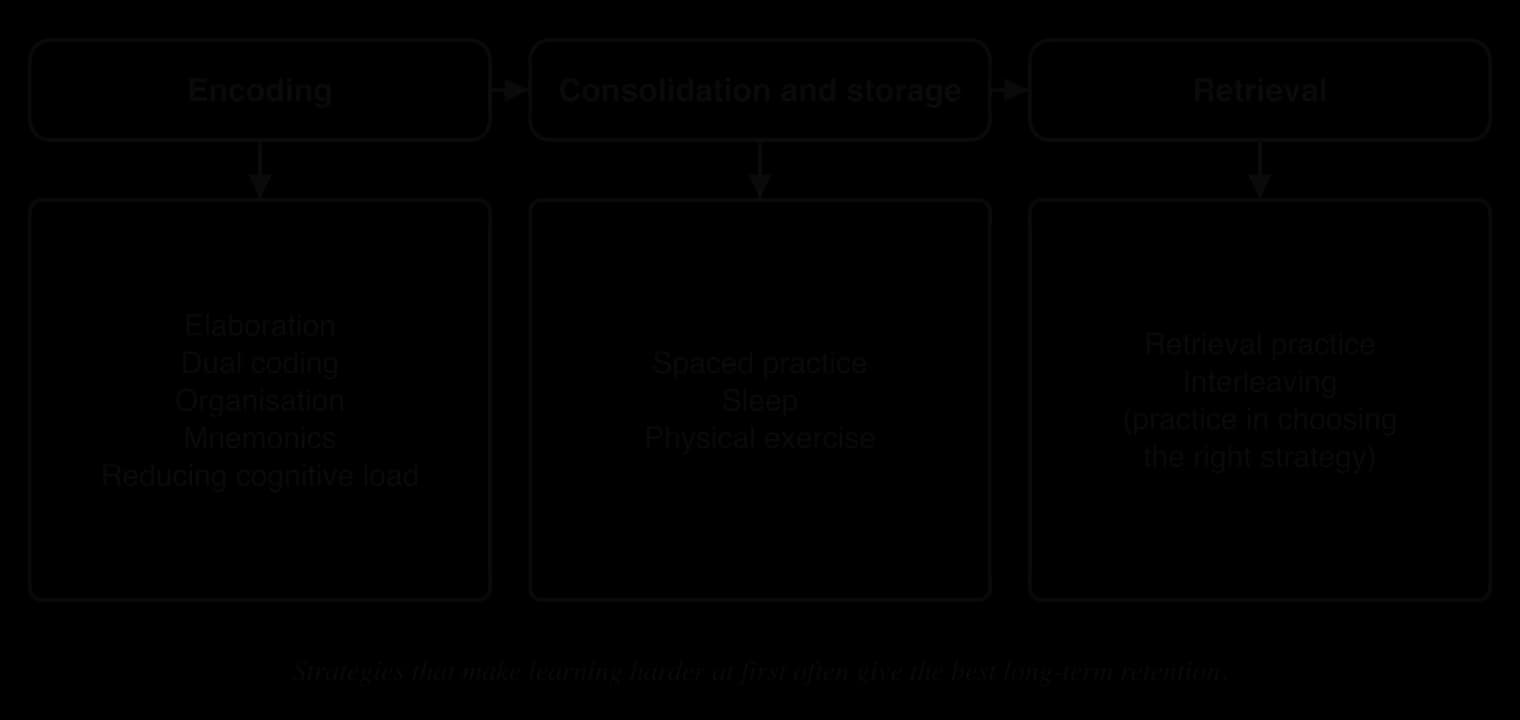
The figure groups strategies by the stage of memory they mainly act on. A useful idea that links many of them is that of desirable difficulties, proposed by Robert Bjork: some conditions that make learning slower and more effortful, such as testing oneself, spacing practice or mixing types of problem, produce better long-term retention than conditions that make learning feel easy.
Retrieval practice means bringing information to mind from memory, for example by answering questions, writing down everything one remembers about a topic or using flashcards, instead of reading the information again. The improvement in long-term memory that follows is known as the testing effect. The test is used as a learning activity, not only as an assessment.
Several mechanisms have been proposed. Each successful retrieval strengthens the route to the memory and makes it easier to retrieve again, much as a path becomes clearer the more it is used. Retrieval also involves reconstructing the memory, which may add new links to related knowledge, a form of elaboration. And because a test shows what has not been learned, it gives learners feedback about what to study next, which improves their metacognition.
Karpicke and Blunt (2011) compared retrieval practice with concept mapping, an elaborative strategy widely used in science teaching. Students who practised retrieval learned more from science texts, including on questions that required understanding and inference, and even on a final test in which they had to draw a concept map. The benefits of retrieval practice therefore extend from isolated facts to meaningful learning.
A strategy that works in a laboratory may not work in a school, where students differ, materials are complex and teachers have little time. Yang et al. (2021), a team led by researchers at Beijing Normal University, combined the results of 222 classroom studies including 48,478 students. Quizzing raised academic achievement to a medium extent compared with other activities, and the size of the effect depended on factors such as whether corrective feedback was given and whether the quizzes matched the format and material of the final test.
 YouTube
Roediger and Karpicke aimed to find out whether taking a memory test improves long-term retention of educational material more than restudying it, and whether this happens only because a test gives another chance to see the material.
Both experiments used two short prose passages from a test-preparation book for the Test of English as a Foreign Language, one about the Sun and one about sea otters, of 256 and 275 words. Each passage was divided into 30 idea units for scoring. Recall was scored by counting the idea units correctly recalled, and two raters who scored the same 40 tests agreed closely (r = .95), which shows good inter-rater reliability.
In Experiment 1, 120 undergraduates at Washington University in St Louis, aged 18–24, studied each passage once. They then either restudied one passage or took a free-recall test on it without feedback, in a repeated measures design with the order counterbalanced. A final recall test was given after 5 minutes, 2 days or 1 week.
In Experiment 2, 180 undergraduates were randomly allocated to one of six groups of 30, in an independent samples design. They learned one passage in four 5-minute periods: four study periods (SSSS), three study periods and one test (SSST), or one study period and three tests (STTT). They then rated, on a 7-point scale, how well they expected to remember the passage in a week, and took a final recall test after 5 minutes or 1 week.
In Experiment 1, restudying led to better recall than testing after 5 minutes (81% vs 75%), but the pattern reversed on the delayed tests: after 2 days the tested group recalled 68% and the restudy group 54%, and after 1 week 56% and 42%. The tested group recalled as much after a week as the restudy group did after only 2 days.
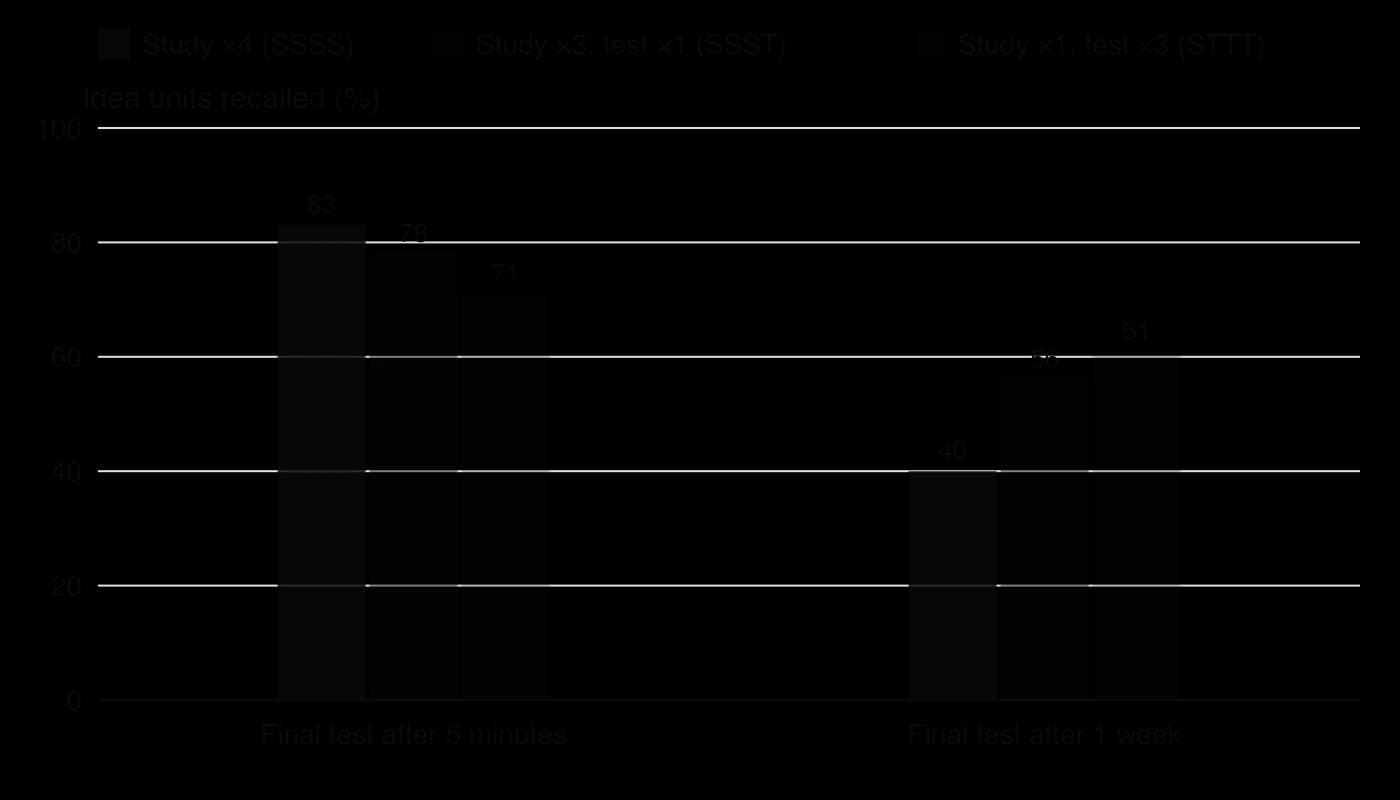
Experiment 2 showed the same crossover. After 5 minutes, the SSSS group recalled the most (83%, compared with 78% for SSST and 71% for STTT); after 1 week, the order reversed (40%, 56% and 61%). Measured as a proportion of what each group had recalled at first, the SSSS group forgot 52% over the week, the SSST group 28% and the STTT group 14%. This happened although the SSSS group had read the passage on average 14.2 times and the STTT group only 3.4 times.
The students’ predictions were the opposite of the results. The SSSS group expected to remember the passage best (a mean rating of 4.8), compared with 4.2 for SSST and 4.0 for STTT, although they remembered the least after a week.
Retrieval practice produced much better long-term retention than restudying, even though restudying gave better immediate recall and much more exposure to the material. Testing can therefore improve memory as well as measure it. The students’ predictions show that learners misjudge which strategies work, because the ease of rereading feels like learning.
Experiment 2 used random allocation, the same passages and the same total time in every condition, so the differences in recall can be attributed to the learning conditions. Experiment 1 replicated the effect within participants and across three delays. The crossover pattern makes alternative explanations unlikely: if the tested group had simply been more motivated, they would have done better at 5 minutes as well.
Memory was operationalised as free recall of idea units from short passages, a valid measure of remembering prose but not of understanding, applying or explaining it. The passages were short and the final test was the same kind of task as the practice tests, which may favour testing. Later research, such as Karpicke and Blunt (2011), has shown benefits on inference questions, which addresses part of this limitation.
The participants were American university students taking part for course credit, a WEIRD sample used to studying. Whether the effect holds for younger pupils, other cultures and real courses is a question of generalisability. The classroom meta-analysis by Yang et al. (2021), which includes studies from many countries and school levels, suggests that the effect does generalise to real classrooms.
Sources: Roediger, H. L., III, & Karpicke, J. D. (2006). Test-enhanced learning: taking memory tests improves long-term retention. _Psychological Science, 17(3), 249–255._
Spaced practice, also called distributed practice, means spreading study of the same material over several sessions separated in time, rather than massing it into one long session as in cramming. The improvement in long-term retention that follows is called the spacing effect, one of the most reliable findings in memory research.
Cepeda et al. (2006) carried out a meta-analysis of 839 assessments of distributed practice in 317 experiments. Spaced study produced better retention than massed study, and the best gap between study sessions depended on how long the material had to be remembered: the longer the retention interval, the longer the best gap. For a test in a week, reviewing after a day or two may be best; for material needed months later, gaps of weeks are better.
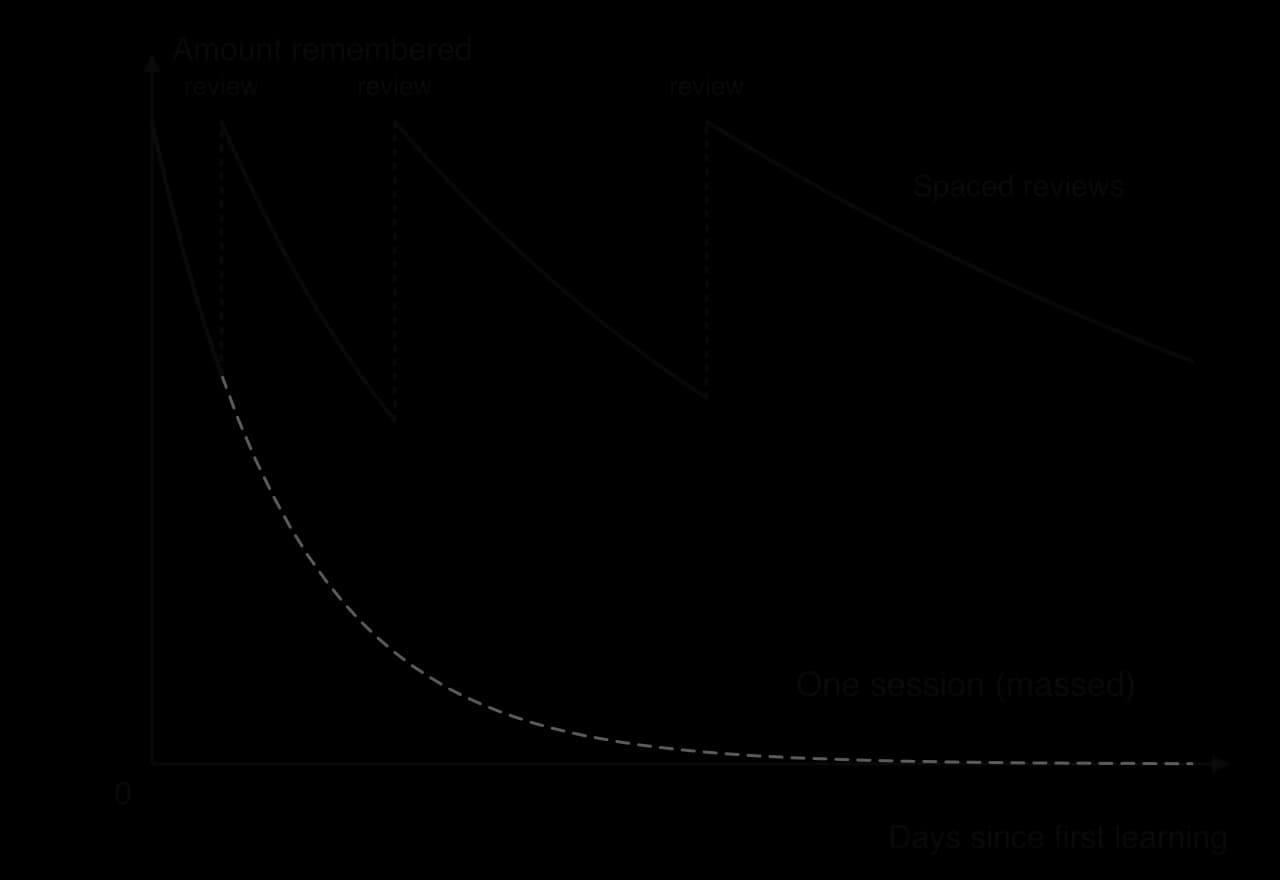
Several explanations have been proposed. When a review comes after a gap, the learner has partly forgotten the material, so the review involves more effortful retrieval, a desirable difficulty. Each review also happens in a slightly different context, giving more retrieval cues, and spacing allows time for memory consolidation, including during sleep, between sessions. These explanations link the cognitive strategy to the biological factors that support memory.
Interleaving means mixing different types of problem or different topics within one practice session, rather than practising one type at a time in blocks. A mathematics student who mixes problems on area, volume and angles is interleaving; one who completes twenty area problems and then twenty volume problems is blocking.
Kornell and Bjork (2008) found that interleaving examples of different categories, rather than presenting all examples of one category together, improved people’s ability to learn the categories and recognise new examples. A likely reason is that interleaving makes learners compare the categories, which highlights the differences between them; it also forces them to decide which strategy a problem needs, which blocked practice never requires. Dunlosky et al. (2013) rated interleaving as moderate in utility because the evidence was still limited to certain kinds of material.
Elaboration means connecting new information to what one already knows, for example by asking and answering “why” and “how” questions about it. It applies the idea of the levels of processing model that deeper, more meaningful processing leads to better memory, and the idea from schema theory that new information is easier to learn when it can be attached to an existing schema. Dunlosky et al. (2013) rated elaborative interrogation and self-explanation as moderate in utility.
Dual coding is based on Allan Paivio’s proposal that information can be stored in two codes, verbal and visual. Presenting or recalling material in both forms, such as a diagram with a short explanation, or drawing a timeline while revising history, creates two routes to the same memory. Dual coding is consistent with the working memory model, whose separate verbal and visuospatial components can process words and images at the same time.
Organising material into a meaningful structure also improves encoding. Bower et al. (1969) presented lists of words either arranged in conceptual hierarchies, such as minerals divided into metals and stones, or in random order. Recall was far better for the organised lists, because the hierarchy provided a plan for both storing and retrieving the words. Grouping notes into categories, headings and concept maps applies the same principle.
A mnemonic is a technique that gives material a structure to make it easier to remember, such as an acronym, a rhyme or the method of loci, in which items are imagined at places along a familiar route. Dresler et al. (2017) studied 23 of the world’s most successful memory athletes, who rely on such techniques, and trained people with ordinary memory in a mnemonic strategy for six weeks. The trained participants’ brain networks became more like those of the athletes, and their memory improvements lasted up to four months.
Mnemonics are very effective for lists and arbitrary associations, such as the order of the planets or vocabulary in a new language, but they help little with understanding. Dunlosky et al. (2013) rated the keyword mnemonic as low in utility for most school learning, because it is hard to apply to complex material and its benefits were often short-lived.
According to cognitive load theory, working memory has a limited capacity, and learning suffers when too much of it is taken up by unnecessary demands, such as searching between a diagram and a separate text. Teaching that removes such demands, for example by integrating labels into diagrams and using worked examples with beginners, leaves more capacity for building schemas in long-term memory. In this case the strategy improves memory by changing the material rather than the learner’s study habits.
Some strategies improve memory by changing the biological conditions for learning rather than the way material is studied. Sleep before learning supports encoding, and sleep after learning, especially slow-wave sleep, supports consolidation, so a regular sleep schedule during a period of study is itself a memory strategy. Late-night cramming combines two weak strategies, massed practice and lost sleep.
Aerobic exercise is a second lifestyle strategy. In a randomised controlled trial with older adults, a year of aerobic exercise increased the volume of the hippocampus and improved spatial memory compared with a control group. Lifestyle strategies have broad benefits for health as well as cognition, but their effects on memory are slower and smaller than those of changing how material is studied, and most of the evidence comes from older adults.
Brain training programmes claim to improve general cognitive abilities, such as working memory or attention, through repeated practice on computer tasks or games. The key question is transfer: practice on a task is bound to improve that task, but the programmes claim that the improvement spreads to untrained abilities and to everyday life. Improvement on similar tasks is called near transfer, and improvement on different abilities, such as reasoning or school performance, is called far transfer.
Melby-Lervåg and Hulme (2013) carried out a meta-analysis of 23 studies of working memory training with 30 comparisons, including children with and without attention problems and adults. The programmes produced reliable short-term improvements in working memory itself, but for verbal working memory these were not maintained at follow-up, and there was no convincing evidence of transfer to other skills such as verbal and nonverbal ability, attention, word reading or arithmetic.
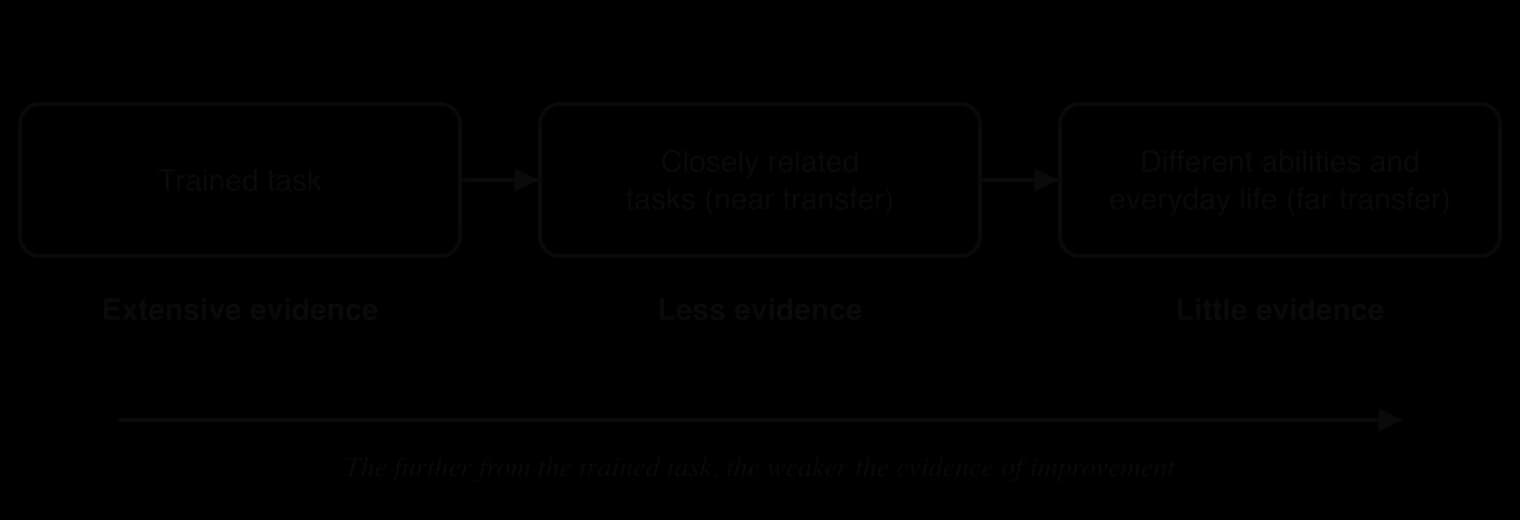
Simons et al. (2016) reviewed the studies cited by brain-training companies themselves. They found extensive evidence that training improves the trained tasks, less evidence for closely related tasks and little evidence for distantly related tasks or everyday cognitive performance, and none of the studies met all of the standards needed for clear conclusions. In 2016 the company behind the Lumosity programme agreed to a settlement with the United States Federal Trade Commission over claims of false advertising.
Mindfulness training teaches people to pay attention to the present moment and to notice when the mind wanders, without judging the thoughts. Because mind-wandering takes attention away from the task, training that reduces it should improve tasks that depend on sustained attention and working memory. In a randomised controlled trial, Mrazek et al. (2013) found that a two-week mindfulness course improved working memory capacity and reading-comprehension scores on the GRE, a graduate admissions test, and reduced distracting thoughts during the tests; the improvement was explained by reduced mind-wandering among participants who were easily distracted at the start.
The study is promising because it was randomised and measured a meaningful outcome, but the participants were American university students and the follow-up was short. Mindfulness is not a single technique, and its effects on cognition across different courses, ages and cultures are still being established.
Metacognition is knowledge about one’s own thinking and the ability to monitor and control it, for example judging how well something has been learned and choosing what to study next. Research on learning strategies repeatedly finds that learners’ judgements are biased by fluency: material that feels easy to process, such as a passage read for the third time, feels well learned even when it is not. This is why students in Roediger and Karpicke’s (2006) study predicted the opposite of their results.
The same illusion explains the popularity of rereading and highlighting, which feel productive, and the unpopularity of retrieval practice and spacing, which feel difficult and show what has been forgotten. Improving a cognitive process therefore involves improving metacognition as well: learners need to know why effortful strategies work, and to judge their learning by testing themselves rather than by how familiar material feels.
 YouTube
Advice on note-taking is a further example of a strategy that spread faster than its evidence. Mueller and Oppenheimer (2014) reported that students who took notes by hand did better on conceptual questions about lectures than students who typed, but a large direct replication by Urry et al. (2021) found no difference in quiz performance between laptop and longhand note-takers.
This area of study is about deliberate change. Retrieval practice and spacing produce changes that last for weeks or months and appear in real classrooms, so they meet the strongest criteria. Mnemonics produce large but narrow changes, brain training produces changes that rarely spread beyond the trained task, and mindfulness may produce changes in attention whose size and duration are not yet clear.
Whether a strategy appears to work depends on when and how memory is measured. Roediger and Karpicke’s results reversed between 5 minutes and 1 week, so a study with only an immediate test would have reached the wrong conclusion. Recall of word lists or short passages differs from understanding a course, and brain-training studies may measure performance on tasks almost identical to the training. Strong evaluations use delayed tests and outcomes that matter to learners.
Much of the evidence comes from randomised experiments, so a causal claim is well supported within each study. Classroom studies are harder to control: teachers who volunteer to use quizzes may teach differently in other ways, and students cannot be blinded to their strategy. Meta-analyses such as Cepeda et al. (2006) and Yang et al. (2021) increase confidence by combining many studies, but they can only be as good as the studies they include.
Most studies use Western university students, so whether strategies work equally well for younger children, adults with less education and learners in other cultures is less well known, although classroom research from China and elsewhere is reducing this gap. Commercial interests also create bias: companies selling brain training cite favourable studies, and few of these meet high standards. Researchers and educators have a responsibility to communicate which strategies have strong evidence, so that students and schools do not spend time and money on those that do not.
Strategies to improve a cognitive process appear in Paper 1 Section B, often as a scenario in which a learner, teacher or older adult wants to improve memory or attention, and in Section C, where the concept of change fits especially well.
In Section C, an essay on this area of study is strongest when it compares strategies with different levels of evidence and judges them against clear criteria, organised by the named concept.
A strategy improves a cognitive process if it produces lasting gains that generalise to real settings and transfer to the skills that matter.
Dunlosky et al. (2013) rated practice testing and distributed practice as high utility, and rereading and highlighting as low utility.
Roediger and Karpicke (2006): restudying gave better recall after 5 minutes, but repeated testing gave much better recall after 1 week (61% vs 40%), although learners predicted the opposite.
Spaced practice beats massed practice for the same total time, and the best gap increases with how long material must be remembered.
Interleaving, elaboration, dual coding and mnemonics act mainly on encoding and on choosing the right knowledge at retrieval; mnemonics are powerful but narrow.
Brain training improves the trained tasks but shows little far transfer to other abilities or everyday life.
Mindfulness training may improve attention and working memory by reducing mind-wandering, but the evidence is still limited.
Learners choose ineffective strategies because fluency feels like learning; improving metacognition is part of improving memory.
I can explain what it means to improve a cognitive process and the criteria for judging a strategy.
I can explain retrieval practice and spaced practice and why they improve long-term memory.
I can describe and evaluate Roediger and Karpicke’s (2006) study, including its results at both delays.
I can explain how interleaving, elaboration, dual coding and mnemonics work.
I can evaluate brain training and mindfulness training with reference to near and far transfer.
I can explain why learners often prefer less effective strategies, using the idea of metacognition.
I can evaluate research on improving memory with reference to change, measurement and causality.
I can design a strategy to improve memory for a learner in an unfamiliar scenario.