Explain how schemas shape learning, expertise, cultural understanding and eyewitness memory, evaluate the research through the concepts, and apply schema theory to learning and cognition scenarios.
Each is in the Psychology glossary, with every other term in the subject.
A short introduction given before new material, such as a title, overview or analogy, that activates relevant prior knowledge so the new material can be linked to existing schemas.
A police interviewing technique based on memory research that helps witnesses retrieve more accurate detail by reinstating the context, reporting everything, and recalling in different orders and from different perspectives.
A schema learned through membership of a culture, such as a script for a wedding or a meal, which members of that culture share and use to interpret events and texts.
The knowledge a learner already holds in long-term memory before meeting new material, organised in schemas to which the new material can be linked.
A situation in which awareness of a negative stereotype about one’s group is thought to impair performance on a task that the stereotype concerns.
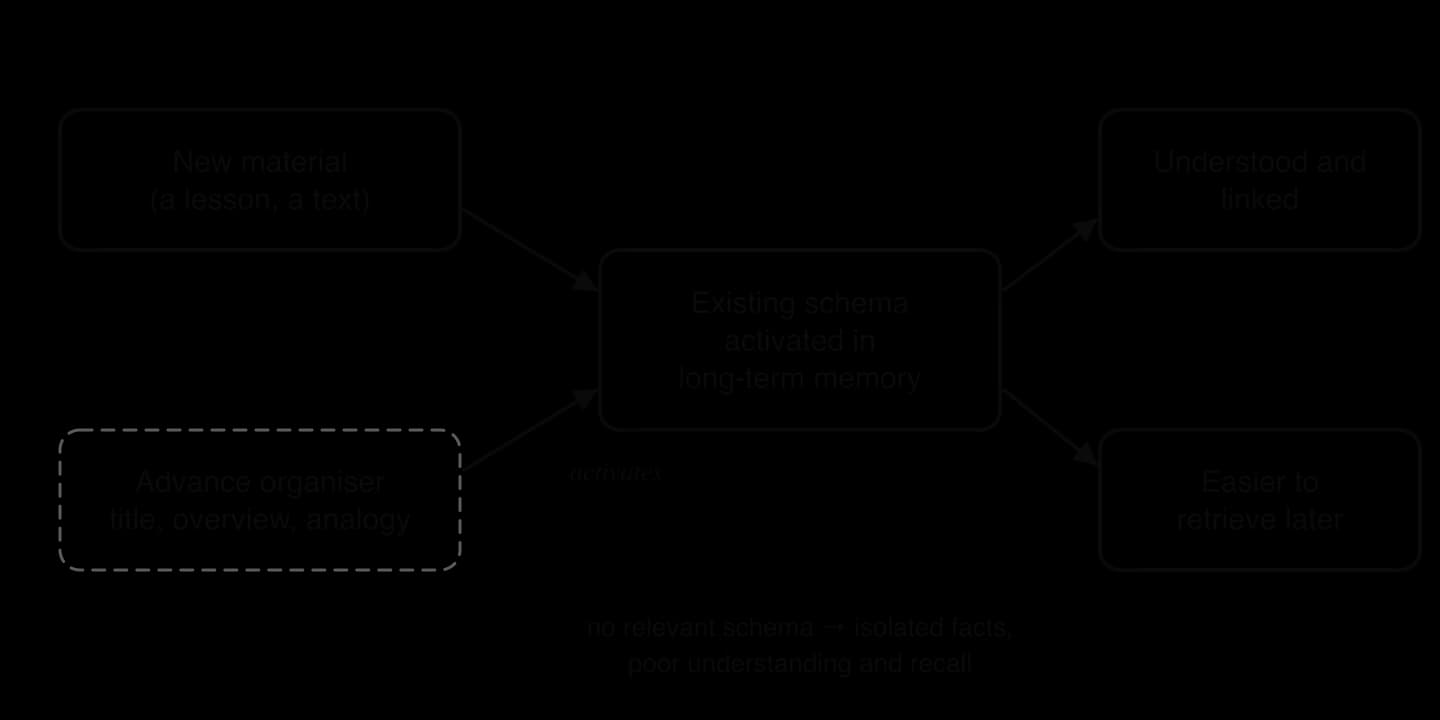
Explain how prior knowledge, organised in schemas, affects how well new material is understood and remembered.
Explain how expertise depends on rich schemas, with reference to research on chess players.
Describe and evaluate research on cultural schemas in reading and memory, including Steffensen, Joag-Dev and Anderson (1979).
Explain how schemas contribute to errors in eyewitness testimony, and evaluate laboratory and field research on this.
Discuss how self-schemas and stereotypes may affect performance, including the replication record of stereotype threat.
Evaluate research on schemas in learning and cognition with reference to measurement, bias and causality.
Apply schema theory to an unfamiliar situation in learning and cognition.
Schemas influence much of what people learn and remember: a student who already knows a topic learns more from the same lesson than one who does not, a chess master remembers a board position at a glance, and a witness may confidently “remember” details that fit what usually happens in a crime. In the learning and cognition context, schema theory is used to explain these differences and to design better teaching and better questioning of witnesses.
Schemas also show how the approaches interact. They are cognitive structures, but many are learned through culture, and their formation and use depend on brain systems for memory. Explanations of learning that use schemas alone, without culture or biology, are incomplete.
With a free account, Augment remembers where you stopped and what you have practiced.
A schema is a mental framework of organised knowledge about an object, person, event or situation, built from experience and stored in long-term memory. According to schema theory, schemas create expectations that guide processing from the top down: they direct attention, help to interpret ambiguous information, provide a structure for encoding new material, and fill gaps when memories are reconstructed. Schemas change through assimilation (fitting new information in) and accommodation (changing the schema).
Two consequences matter most for learning and cognition. Schemas make processing faster and learning easier when the material fits what is already known, and they make memory predictably inaccurate, drifting towards what is typical. Classic demonstrations include Bransford and Johnson’s (1972) “washing clothes” passage, which was understood and recalled far better when its topic was given first, and Brewer and Treyens’s (1981) office study, in which some participants recalled books that were not there.
Prior knowledge is what a learner already knows about a topic before new material is presented. Schema theory treats it as the framework onto which new material is attached: a new fact about the heart is easier to understand and remember for a student who already has a schema for how pumps and pipes work. Without a relevant schema, new material is stored as isolated facts that are hard to understand, hard to retrieve and quickly forgotten.
For teaching, the main lesson of Bransford and Johnson’s (1972) study is about timing. Because a title given after the passage did not help, background information is most useful at the start of a lesson or reading, when it can guide how the material is encoded. A summary given only at the end cannot repair material that was encoded without a framework.
Ausubel (1960) proposed that teachers should begin new material with an advance organiser: a short introduction at a more general level than the lesson, such as an overview, a title, a key question or an analogy, that activates relevant prior knowledge or provides a framework where none exists. An analogy that compares an electric circuit to water flowing through pipes is an example, because it lets students attach new terms (current, resistance) to a familiar schema.
Reviews of research on advance organisers have generally found positive but modest effects, larger when the organiser is concrete and when students have little background knowledge of the topic. This fits schema theory: an organiser helps most when a learner would otherwise lack a framework, and adds little when a good schema is already active.
Experts differ from beginners less in general memory ability than in the schemas they have built for their field. Chase and Simon (1973) showed chess players of different levels a chessboard for 5 seconds and then asked them to reconstruct it on an empty board. With positions taken from real games, the most skilled player placed far more pieces correctly than the beginner. With pieces placed randomly, the advantage largely disappeared.
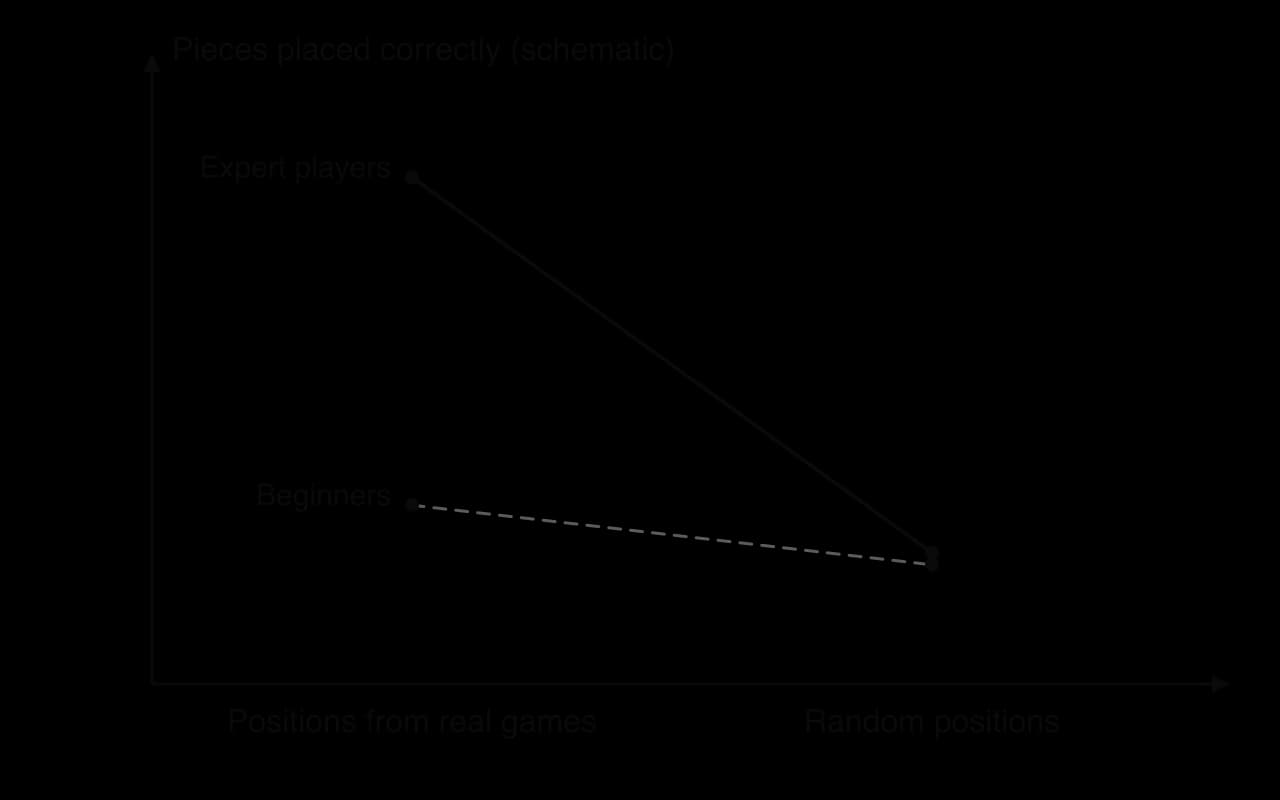
The interaction rules out the explanation that experts simply have better memories. Their advantage came from recognising familiar patterns (an attacking formation, a common castle position) as single chunks stored in long-term schemas, so a whole group of pieces took up only one place in short-term memory. Random positions contain no familiar patterns, so experts had to remember them piece by piece, like everyone else.
The same principle applies in school subjects. An experienced mathematics student sees a problem as “a simultaneous equations problem” and retrieves a schema for solving it, while a beginner sees a list of numbers and symbols. Worked examples and practice with many varied problems help because they build problem schemas that let later problems be recognised and solved with less effort.
Research with animals suggests that schemas also change how quickly the brain stores new information. Tse et al. (2007) trained rats over several weeks to learn which flavours of food were hidden at which places in an arena, building what the researchers called a schema. Once the schema existed, the rats learned new flavour-place pairs in a single trial, and these new memories quickly became independent of the hippocampus, a process normally thought to take much longer. The study links the psychological idea of a schema to the biology of memory consolidation, although generalising from rats in an arena to human classroom learning requires caution.
Many schemas are learned through enculturation, so members of a culture share them. A cultural schema for a wedding, a meal or a story tells people what usually happens, who takes part, what matters and what can be left unsaid. Texts written within a culture rely on these shared schemas, so readers from another culture may understand and remember them less well even when they understand every word.
Bartlett’s (1932) research first suggested this, when British participants changed an unfamiliar Native American story to fit their own expectations. The strongest test of cultural schemas, however, compares people from two cultures reading material from both cultures, so that neither text can simply be harder. Steffensen, Joag-Dev and Anderson (1979) used this design with American and Indian readers and letters describing a wedding in each culture.
Steffensen and Colker (1982) extended the design to Indigenous participants. Fifteen Aboriginal women in northern Australia and fifteen American women in Illinois, matched for age and education, heard two stories, each based on the medical beliefs and practices of one of the two cultures, and retold them; the Aboriginal women could retell them in Australian Creole English if they chose. Each group produced culturally based elaborations of the story from its own culture, and the American women, who knew nothing of Aboriginal culture, showed clearly how missing schemas limit comprehension and recall.
These findings have practical consequences in health care and education. Steffensen and Colker pointed out that patients who lack the schemas behind a doctor’s explanation may fail to follow medical advice even when they are willing to. Reading tests that use passages based on one culture’s schemas can underestimate the comprehension of students from other cultures, and teachers working with students from different backgrounds may need to provide background knowledge before a text rather than assuming it.
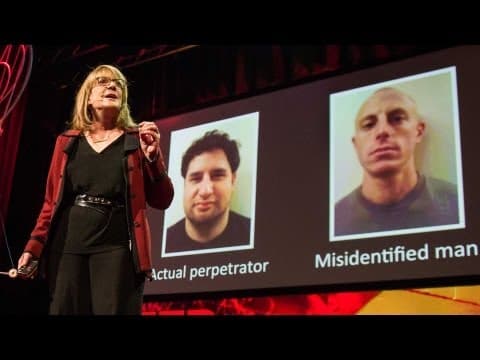
Eyewitness testimony is an account given to the police or in court by a person who saw an event. Because memory is reconstructive, witnesses rebuild the event at recall from what they stored and from what their schemas say usually happens. Their schemas for a robbery or a car accident, and the words used in questions, can therefore change what they report.
Loftus and Palmer (1974) showed how this works in a controlled setting. In their second experiment, 150 students watched a film of a multiple car accident and were asked how fast the cars were going when they “smashed into” or “hit” each other, or were not asked about speed. A week later they were asked whether they had seen broken glass; there was none in the film.
Condition (one week earlier) | Participants reporting broken glass |
|---|---|
Verb “smashed” | 16 of 50 (32%) |
Verb “hit” | 7 of 50 (14%) |
No question about speed (control) | 6 of 50 (12%) |
Sources: Loftus, E. F., & Palmer, J. C. (1974). Reconstruction of automobile destruction. _Journal of Verbal Learning and Verbal Behavior, 13(5), 585–589._
Schema theory explains the result. The verb “smashed” activates a schema for a severe crash, in which broken glass is typical, and the witness’s memory is reconstructed to fit it. The leading question did not add a fact directly; it changed which schema guided retrieval, and the schema supplied the false detail.
 YouTube
Laboratory studies may exaggerate how easily memories are distorted. Yuille and Cutshall (1986) interviewed 13 witnesses to a real armed robbery and shooting in Vancouver four to five months after the event and compared their accounts with police records. The witnesses remained highly accurate, and two misleading questions, including one about a broken headlight that did not exist, had little effect on what they reported.
The contrast suggests that schema-driven errors are most likely when an event is brief, seen without personal involvement and of little importance to the witness, as with a laboratory film, and less likely for a frightening, personally significant event. It also suggests caution in generalising from students watching videos to real witnesses in court.
 YouTube
The cognitive interview was developed by Geiselman, Fisher and colleagues in 1984 as a police interviewing method based on memory research. Witnesses are asked to reinstate the context mentally, to report every detail however minor, to recall the event in different orders and to describe it from the perspective of someone else who was present. The last technique applies schema research directly: as Anderson and Pichert (1978) showed, a new perspective activates a different schema and gives access to details that the first one did not retrieve.
Research has generally found that cognitive interviews produce more correct details than standard police interviews, with a small increase in errors, so the overall proportion of accurate information stays similar. The method also avoids leading questions, which reduces the chance that the interviewer’s own schemas are passed on to the witness.
Schemas about the self and about social groups can affect performance as well as memory. Stereotype threat is the proposal that when people are aware of a negative stereotype about their group’s ability in a task, the threat of confirming it can impair their performance. Steele and Aronson (1995) gave African American and European American college students a difficult verbal test. When the test was described as a measure of intellectual ability, African American students performed worse than European American students with similar prior test scores; when it was described as a problem-solving exercise unrelated to ability, the difference was much smaller.
Schema theory explains the proposed effect as the activation of a stereotype and a threatened self-schema, which may increase anxiety and take up attention needed for the task. The idea became very influential in education, but its replication record is mixed. A meta-analysis by Flore and Wicherts (2015) of studies on girls’ mathematics performance found a small average effect that may be inflated by publication bias, and a large pre-registered study by Flore, Mulder and Wicherts (2018), with 2,064 Dutch secondary school students, found no effect of stereotype threat on girls’ mathematics scores.
Schema theory is a cognitive explanation, but research in learning and cognition shows that it works best combined with the other approaches. A single-approach account is reductionist: it explains one part of a complex process and treats it as the whole.
Approach | What it adds to explaining schemas in learning | Example |
|---|---|---|
Cognitive | Schemas as knowledge structures that guide attention, encoding and retrieval | Advance organisers; chess experts’ chunking; leading questions |
Sociocultural | Where schemas come from: culture, schooling, language and social groups | Cultural schemas in reading (Steffensen et al.); stereotypes and stereotype threat |
Biological | How schemas are stored and how they change memory consolidation | Tse et al. (2007): rats with a schema learned new pairs in one trial |
A full explanation of why an Indian student understands a story about a Hindu wedding better than an American student does needs all three: the culture that taught the wedding schema, the cognitive processes through which the schema guides comprehension, and the brain systems that store it and link new information to it.
Schemas cannot be observed, so they are inferred from what participants recall, how fast they read and what errors they make. Studies differ in how they operationalise these effects: Steffensen and colleagues counted idea units, elaborations and distortions, which required judgement about what counts as a distortion; Chase and Simon counted pieces placed correctly, a more objective measure. False reports, such as broken glass, may reflect guessing or a wish to give the expected answer rather than a changed memory, which is a problem of demand characteristics as much as of memory.
Studies that manipulate an activated schema, such as giving a title or changing a verb, can show that the schema causes a change in understanding or memory. Studies that compare existing groups, such as chess experts and beginners or American and Indian readers, are quasi-experiments: the groups differ in many ways besides their schemas, so causal conclusions are weaker. The full crossed design used in cultural schema research reduces this problem by showing that each group does better on its own material, so the result cannot be due to one group being better readers or one text being easier.
Much schema research uses university students from Western countries, which limits generalisation. Cross-cultural studies also carry a risk of cultural bias in scoring: a researcher from one culture may not recognise an appropriate elaboration from another. Steffensen and colleagues dealt with this by having every recall scored by both a native American and a native Indian researcher, which reduces researcher bias in scoring.
Some schema research uses realistic materials: personal letters about weddings, a real office, real chess positions or witnesses to a real crime. These have higher ecological validity than word lists. Other key studies use short films and student participants who know they are in a study, and their findings, such as the size of the effect of leading questions, may not hold for real events with real consequences.
Concept | How it applies to schema research in learning and cognition |
|---|---|
Measurement | Schemas are inferred from recall, speed and errors; scoring elaborations and distortions involves judgement |
Causality | Manipulating a schema shows cause; comparing experts with beginners or cultures with each other is quasi-experimental |
Bias | Western student samples; cultural bias in scoring reduced by researchers from both cultures |
Perspective | Cognitive explanations need sociocultural and biological perspectives to be complete |
Change | Advance organisers and the cognitive interview apply schema theory to change learning and testimony |
Responsibility | Deception about memory tests; findings on stereotypes and culture are socially sensitive and can be misused |
The researchers aimed to test whether cultural schemas affect reading comprehension and memory, using a complete cross-cultural design: readers from two cultures each reading a text based on their own culture and a text based on the other culture. This design allows cultural schemas to be separated from differences in reading ability or text difficulty.
The participants were 19 Indian adults and 20 American adults, all living in a university community in Illinois and about equally divided between men and women. Each American was matched with an Indian participant on sex, age, education, academic specialisation and marital status. In this quasi-experiment, nationality was a pre-existing variable and the passage was varied within participants.
Two letters were written in the style of a personal letter: one described a typical American wedding and one a typical Indian wedding. The letters were matched for grammatical complexity and divided into idea units (136 and 127). Participants read each letter while their reading time was recorded, completed a filler task, and then wrote down as much as they could recall, keeping to the original wording where possible. The order of the two letters varied between participants.
Recall was scored for the gist of each idea unit, for elaborations (culturally appropriate additions that fitted the text) and for distortions (culturally inappropriate changes or intrusions from the reader’s own culture). Every protocol was scored by both a native American researcher and a native Indian researcher, who resolved disagreements by discussion. A separate group of 48 participants from both cultures rated how important each idea unit was.
Each group read its own culture’s letter faster and recalled more of it. American readers took a mean of 168 seconds to read the American letter and 213 seconds for the Indian letter; Indian readers took 304 seconds for the American letter and 276 seconds for the Indian one. Gist recall showed the same crossed pattern.
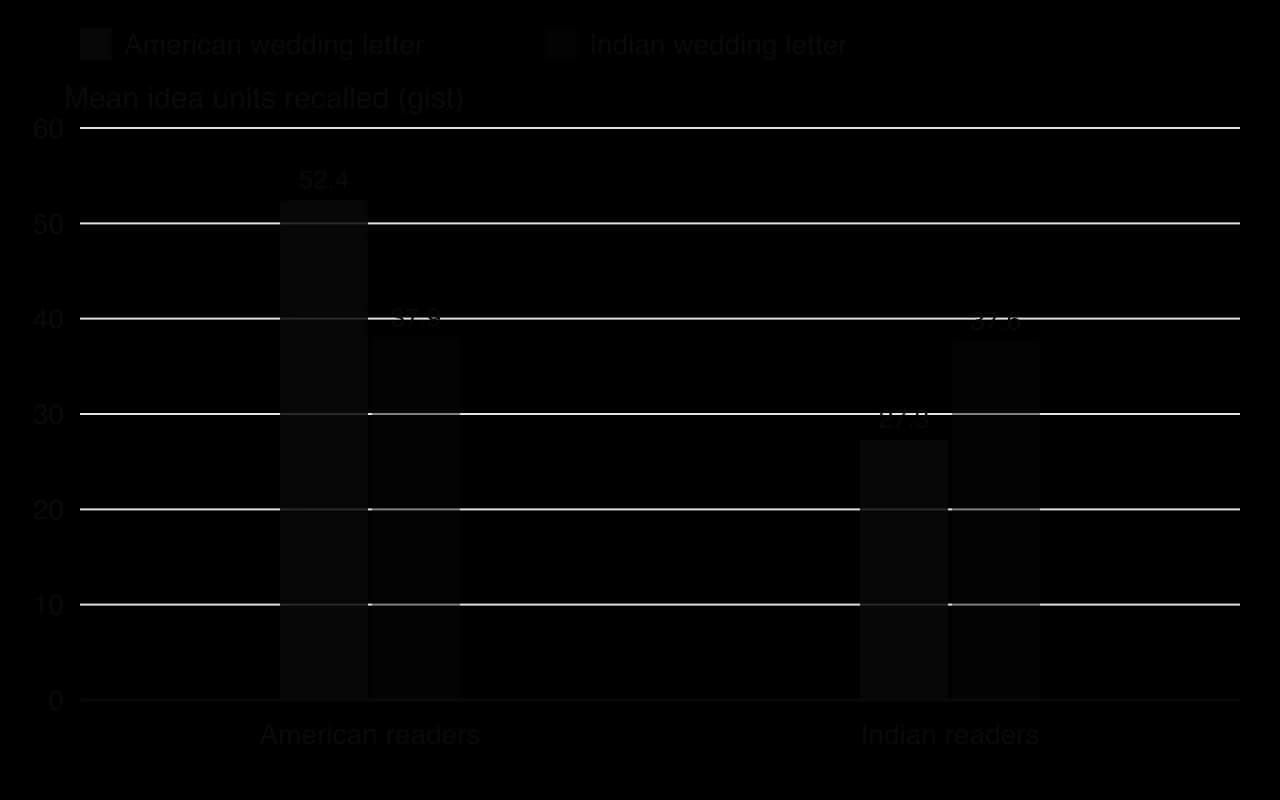
The pattern of errors was even clearer. Elaborations appeared almost only in recall of the native letter, and distortions almost only in recall of the foreign letter. For example, one Indian participant recalled that the American bride’s heirloom wedding dress was “too old and out of fashion”, missing the American tradition of wearing a family dress; American participants recalled the one-way gifts to the groom’s family in the Indian letter as an “exchange of gifts”.
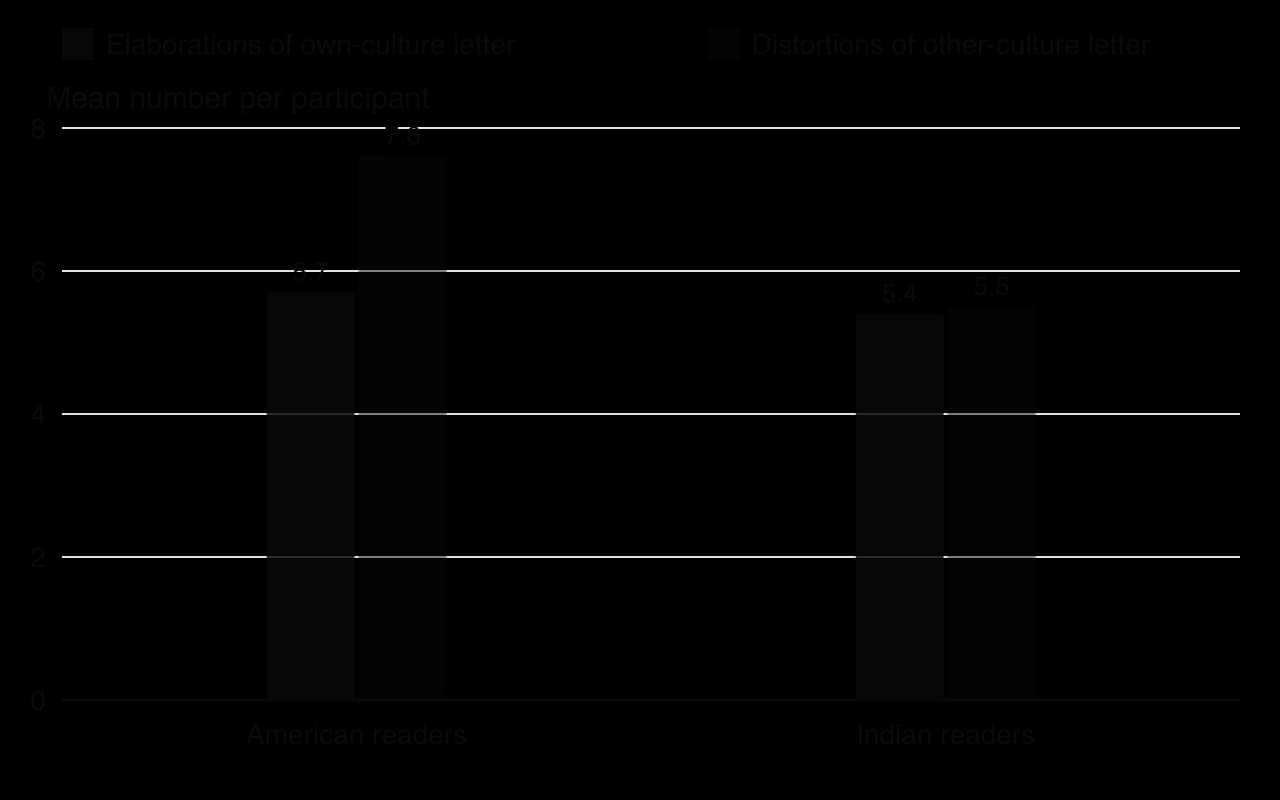
Measure (mean) | Americans: American letter | Americans: Indian letter | Indians: American letter | Indians: Indian letter |
|---|---|---|---|---|
Reading time (seconds) | 168 | 213 | 304 | 276 |
Gist recall (idea units) | 52.4 | 37.9 | 27.3 | 37.6 |
Elaborations | 5.7 | 0.1 | 0.2 | 5.4 |
Distortions | 0.1 | 7.6 | 5.5 | 0.3 |
Sources: Steffensen, M. S., Joag-Dev, C., & Anderson, R. C. (1979). A cross-cultural perspective on reading comprehension. _Reading Research Quarterly, 15(1), 10–29; data from the 1978 technical report of the same study (Center for the Study of Reading, Technical Report No. 97)._
Participants also recalled more of the idea units that their own culture rated as important (34%) than of those it rated as unimportant (29%), whichever letter they were recalling. Among the Indian participants, rated familiarity with American weddings correlated with the amount of gist recalled (r = 0.58).
The researchers concluded that schemas embodying cultural knowledge have a strong influence on how well a text is understood, learned and remembered. Because each group did better on its own culture’s text, the results cannot be explained by one text being more difficult or one group being better readers. Readers fill the gaps in a text with their own cultural knowledge, producing appropriate elaborations when the text fits their schema and distortions when it does not.
Deciding whether a recalled sentence is an elaboration or a distortion requires cultural knowledge, which a single researcher from one culture might lack. Scoring by a researcher from each culture, with disagreements discussed, increased the credibility of these judgements. However, the authors also noted that they could not tell whether the effects arose while reading or later while writing the recall, so the measures show that cultural schemas matter but not exactly when they act.
The samples were small (19 and 20) and the Indian participants were living in the United States, so many already knew something about American weddings; familiarity was correlated with recall. This probably made the cultural difference smaller than it would be with Indian readers who had never left India. The letters were also written for the study rather than taken from real correspondence, so they may have been more typical, or less natural, than real letters.
Nationality could not be randomly allocated, so the study is a quasi-experiment, but the crossed design is a strong one: an interaction in which each group does better on its own material is very hard to explain without cultural knowledge. The use of personal letters about a familiar life event gives the materials good ecological validity compared with word lists.
In learning and cognition, schema theory can appear in Paper 1 Section B as a theory to apply to an unseen scenario, and in Section C as an area of study evaluated through a concept. Section B rewards a well-developed application to the scenario; Section C rewards critical analysis organised around the concept, with links explained throughout and a reasoned conclusion.
Schemas link new material to prior knowledge: material that fits an active schema is understood and recalled better, and an advance organiser activates the schema before learning.
Expertise depends on rich schemas: chess experts recall real positions far better than beginners but have little advantage with random positions.
Tse et al. (2007) found that rats with an existing schema learned new associations in one trial, linking schemas to memory consolidation.
Cultural schemas shape comprehension and memory: in Steffensen, Joag-Dev and Anderson (1979), American and Indian readers each read their own culture’s letter faster, recalled more of it and distorted the other.
Eyewitness memory is reconstructed through schemas: a leading verb increased false reports of broken glass (32% vs 14%), but real witnesses studied by Yuille and Cutshall (1986) were highly accurate.
The cognitive interview applies schema research, for example by asking witnesses to recall from different perspectives.
Stereotype threat is a schema-based explanation of underperformance whose effect has proved much smaller and less reliable in large replications.
Schemas are inferred, not measured directly; cross-cultural and field designs strengthen the evidence, while student samples and laboratory films limit it.
I can explain how prior knowledge and advance organisers affect learning, using schema theory.
I can explain expertise in terms of schemas and chunking, with the chess research as evidence.
I can describe and evaluate Steffensen, Joag-Dev and Anderson (1979), including its crossed design and results.
I can explain how schemas contribute to errors in eyewitness testimony and compare laboratory and field findings.
I can discuss stereotype threat and why its replication record matters.
I can evaluate schema research in learning and cognition through measurement, causality and bias.
I can apply schema theory to an unfamiliar learning or memory scenario.