The research proposal and choosing a topic
Understand what the IA research proposal is, choose a real-life problem and population of interest, pick one of the four permitted methods, stay within the ethics rules and word limit, and plan the work.
- IB Psychology
- Internal assessment
- SL and HL
What the research proposal is
The internal assessment (IA) in psychology is a research proposal: a written plan for an investigation into a real-life problem that affects a particular group of people. You design the study in detail, explain and justify every important decision, and discuss what it could find and why that would matter. You do not carry the study out. There are no participants, no data and no results.
The proposal is marked out of 24, with four criteria worth 6 marks each, and it is the same task at SL and HL. Your teacher marks it and a sample of the school’s work is moderated by the IB. The whole report has a limit of 2,200 words.
The task asks you to think like a psychologist who wants to improve people’s lives. Applied research usually begins with a problem (teenagers sleeping too little, newly arrived families struggling to settle, older adults feeling lonely), and the method is chosen afterwards to suit the evidence that would help. The IA asks you to work in the same order. It rewards justified decisions: why this group, why this method, why these questions, why these ethical safeguards.
What the proposal is not
Many weak proposals go wrong because the student has the wrong picture of the task. The table sets out the most common misunderstandings.
The proposal is… | The proposal is not… |
|---|---|
A plan for a study you would carry out if you had the resources | A report of a study you have carried out, with results |
A set of decisions, each explained and justified | A description of a method with no reasons given |
Focused on one real-life problem in one population of interest | A general essay about a topic such as “sleep” or “stress” |
Based on one of four methods: experiment, interview, observation or questionnaire | A correlational study, case study, brain scan or meta-analysis |
Ethical as if it had to pass an ethics committee | Free of ethics because nobody will actually take part |
Short: 2,200 words at most for everything that is assessed | A long literature review with the design added at the end |
Because the study is never conducted, a proposal may include things a school student could not do. You could propose interviewing adults who have been diagnosed with depression, a study that follows the same students for three years, or a sample of 400 people from several schools. What matters is that each choice is appropriate and explained. The proposal is marked on the quality of your reasoning, not on whether you have designed a perfect study; every design has weaknesses, and recognising them is part of the task.
How the IA links to the six concepts
The proposal draws on all six concepts of the course, and seeing these links makes the decisions easier to explain.
Concept | Where it appears in the proposal |
|---|---|
Your own researcher bias (personal history, gender, culture, values) discussed in the Discussion; participant and sampling bias as challenges in Data collection | |
Whether your method can show cause and effect or only a relationship, which affects how you word the aim and the potential findings | |
How the findings could improve life for the population of interest through policy or practice | |
Building a data collection tool that measures what it is meant to measure, through clear operationalisation | |
Drawing on research from one or more approaches, and taking the point of view of the population you study | |
Designing research that meets ethical considerations, especially for vulnerable participants and sensitive topics |
The four sections and the four criteria
The proposal is written in four sections, and each section is marked by one criterion. Following this structure exactly makes it easy for your teacher and the moderator to find each element, and it stops you from spending words on material that earns no marks.
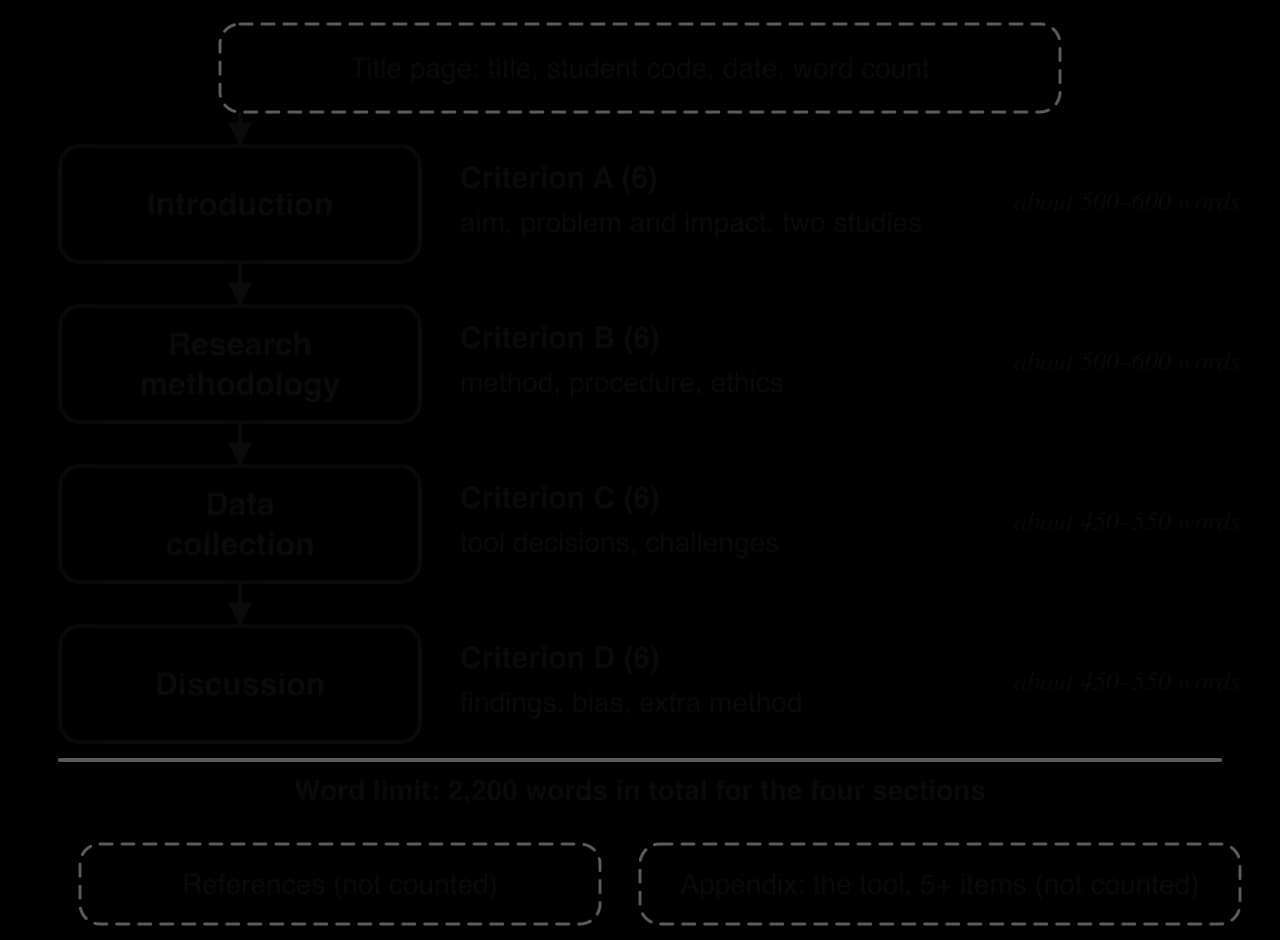
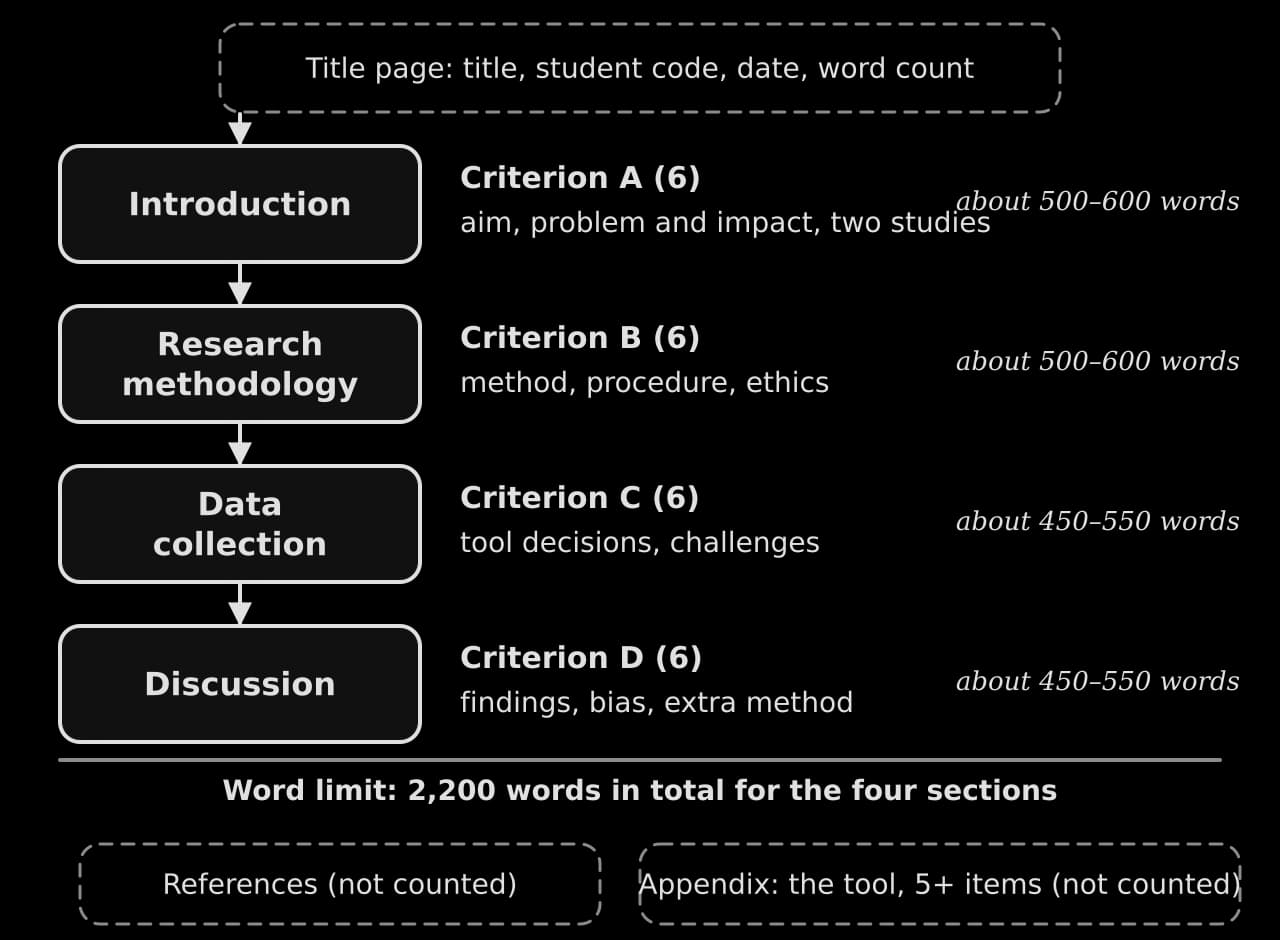
The criteria are equal in value, so a balanced proposal is a strong one. A common pattern in weak proposals is a long, well-researched introduction followed by a thin discussion written in the last hundred words. The table summarises what each section contains.
Section | Criterion | What it must contain |
|---|---|---|
Introduction | A (6 marks) | An aim or research question focused on the population of interest; a real-life problem and its impact on that population; the findings and conclusions of two relevant studies, explained and linked to your proposal |
Research methodology | B (6 marks) | The method chosen and why it fits the aim; the procedure (sampling technique, sample characteristics, design if it is an experiment, setting, process); the ethical considerations and how each is addressed |
Data collection | C (6 marks) | One data collection tool with at least five items (in the appendix); the decisions made in building it; potential challenges in collecting the data |
Discussion | D (6 marks) | Potential findings and their implications for policy or practice; how researcher bias could affect the investigation; one additional method and how it would increase understanding |
Choosing a population of interest
The population of interest is the group your proposal is about. It is the group affected by the real-life problem and the group whose behaviour you want to understand. Every later decision (the aim, the sampling technique, the wording of the items, the ethics) depends on who this group is, so it is worth defining it carefully at the start.
The population can come from your school community, your local community or the national community. It does not have to be a group you can reach, because you will not collect data. It can be a group you know well (students at your school) or a group you have never met (nurses working night shifts, refugee families in your country).
What makes a population of interest well defined
A well-defined population is specific enough that a reader could decide whether a given person belongs to it. Three features usually achieve this: an age range or life stage, a shared characteristic linked to the problem, and a place or setting.
Too broad or vague | Well defined | Why it is better |
|---|---|---|
Teenagers | Students aged 16–18 in the final two years of secondary school at three international schools in one city | Age, life stage and setting are all stated, so the sample and the findings have clear limits |
People with anxiety | First-year university students who report test anxiety before their first examinations | The shared characteristic is tied to a real situation that can be studied |
Immigrants | Adolescents aged 12–15 who arrived in the country in the last two years and attend state secondary schools | Time since arrival matters for acculturation, so it is part of the definition |
Old people | Adults aged 70 and over living alone in a rural district | Living alone links directly to a problem such as loneliness |
A population that is too broad produces an aim that cannot be answered and a sample that cannot represent it. A population that is too narrow (for example, “my three best friends”) makes the problem trivial and the findings useless beyond a handful of people. Aim for a group that is large enough to matter and specific enough to describe.
Choosing a real-life problem
The proposal investigates a real-life problem: a situation that harms, limits or worries the population of interest, and that psychology can help to understand. “Real-life” means the problem exists outside the classroom and affects people’s well-being, learning, relationships or health. Typical starting areas include sleep and mental health, body image and self-esteem, stress and memory, social media and self-esteem, and language learning and acculturation.
A good problem passes five tests. Running through them early saves weeks of work on a topic that later has to be abandoned.
It is psychological. It concerns behaviour, thinking, emotion or relationships, and it can be explained by theories and research from the biological, cognitive or sociocultural approach.
It affects your population of interest. You can show that the problem is real for this group, ideally with evidence such as survey figures or published research on similar groups.
Research exists on it. You can find at least two published studies whose findings relate to it. Without them, Criterion A cannot be completed.
It can be studied with one of the four permitted methods. You can picture an experiment, interview, observation or questionnaire that would produce useful data on it.
It is ethical and allowed. It is not on the list of banned topics, and it could be studied in a way an ethics committee would approve.
Personal interest matters too. You will spend about twenty hours of lesson time on the proposal, plus your own time, so a problem you care about makes the reading and writing easier. Personal interest also gives you material for the reflexivity part of the Discussion, because your reasons for choosing the topic are a possible source of bias.
Problems that work and problems that do not
Starting idea | Problem with it | A workable version |
|---|---|---|
“Is social media bad?” | Not a problem in a population; “bad” cannot be measured | Time spent on image-based social media and body satisfaction among students aged 15–17 at two schools |
“Memory” | A topic, not a problem | Effect of revising with a phone on the desk on recall of vocabulary in students aged 14–16 |
“Why people become criminals” | Too broad, and studying offenders raises serious ethical and access problems that are hard to justify | Perceived fairness of school rules and rule-breaking at lunchtime among students aged 12–14 |
“Stress in the world” | No population and no specific situation | Coping strategies used by nurses in their first year of night-shift work |
From topic to research question
A good proposal moves from a broad topic to a single, focused question in steps. Each step narrows the one above it, and each narrowing is a decision you can explain in the introduction.
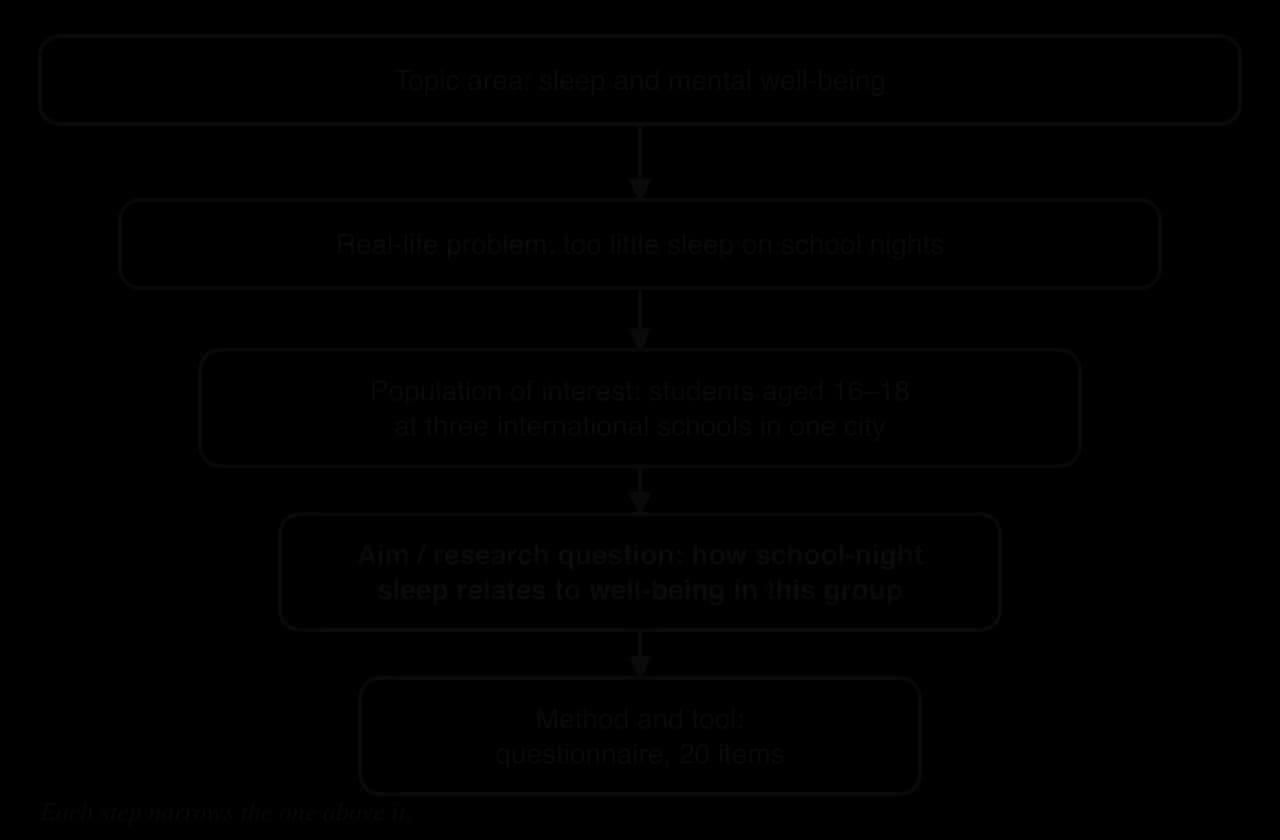
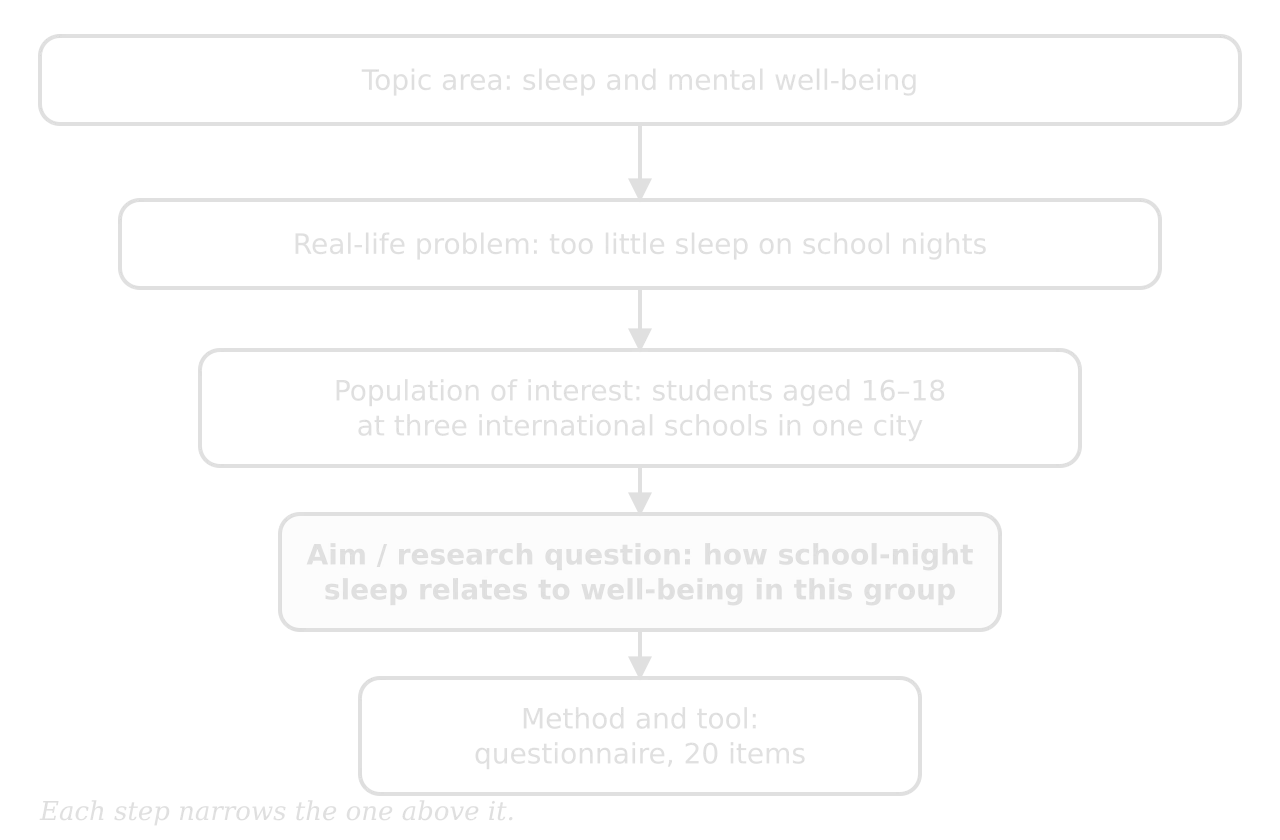
You may state your focus as an aim (“To investigate…”) or as a research question (“To what extent…?”). Either is acceptable; what matters is that it is clear and focused on the population of interest. A focused aim names the variables or experience being studied, the population, and the kind of relationship or understanding sought. Both versions are shown for the running example.
Aim: To investigate the relationship between self-reported school-night sleep duration and mental well-being among students aged 16–18 in the final two years of secondary school at three international schools in one city.
Research question: To what extent is self-reported school-night sleep duration related to mental well-being among students aged 16–18 in the final two years of secondary school at three international schools in one city?
The wording also has to match the method. An experiment can test whether one variable affects another, so its aim can use cause-and-effect language. A questionnaire, interview or observation can show what people do, think or experience and how measured variables are related, but not what causes what. Writing “the effect of sleep on well-being” in a questionnaire proposal promises something the method cannot deliver, a problem of causality that loses marks in Criterion A.
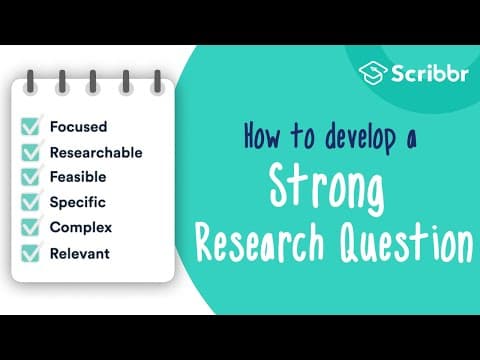 YouTube
The four permitted methods
The proposal must use one of the four methods studied in the class practicals. Each has permitted sub-types, and you may choose any of them.
Method | Permitted forms | Best for aims that ask… |
|---|---|---|
whether changing one variable (the IV) causes a difference in another (the DV), or whether existing groups differ | ||
how people experience a problem, what it means to them, and why they act as they do | ||
Naturalistic or controlled; overt or covert; participant or non-participant | what people actually do in a setting, rather than what they say they do | |
Survey or questionnaire | Questions or rating scales (such as Likert scales) completed by participants | how common a view or behaviour is in a group, and how measured variables are related |
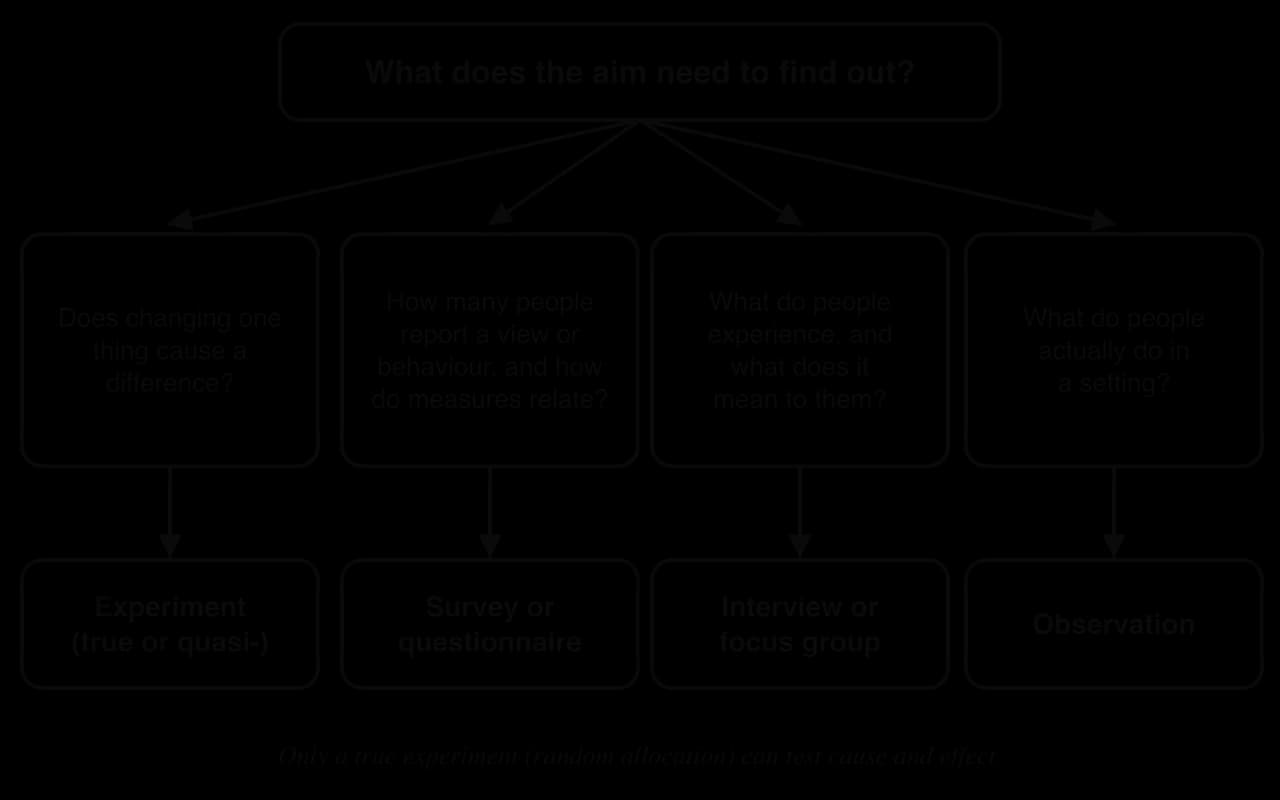
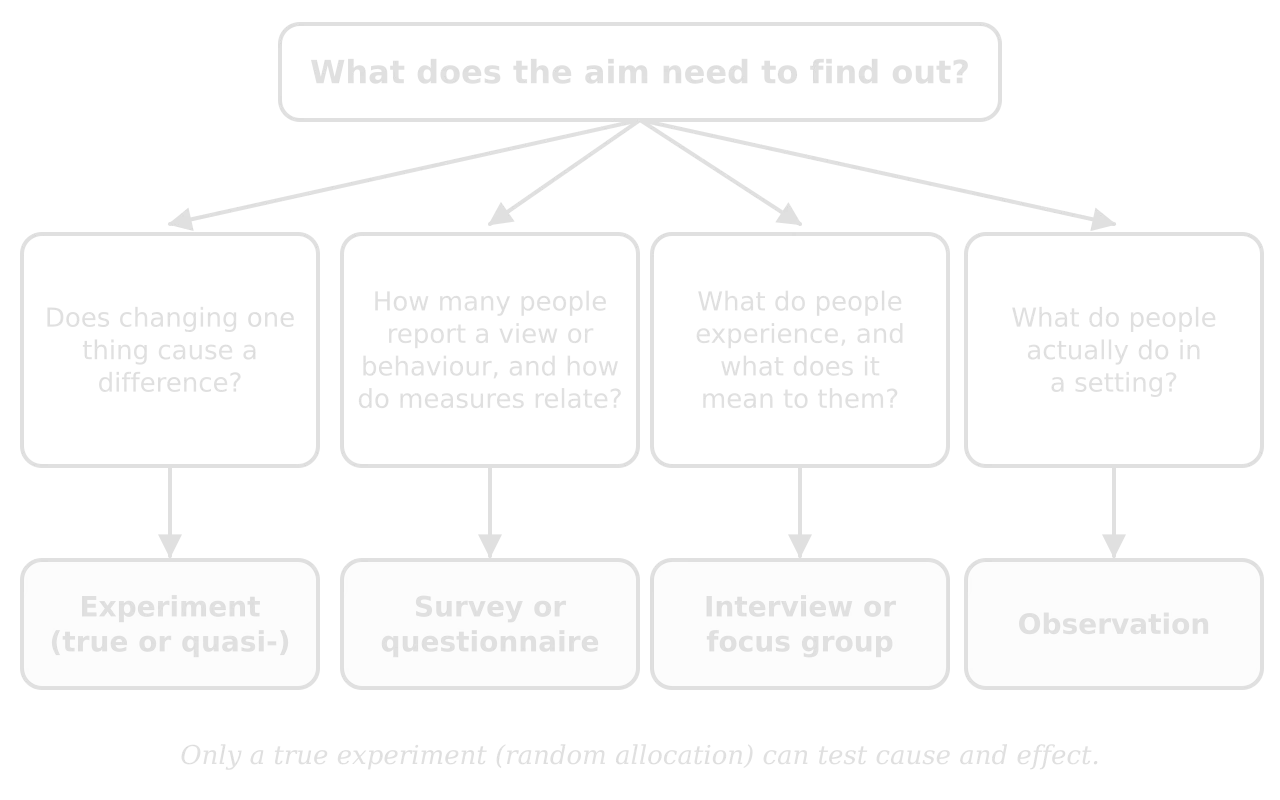
The IA asks you to apply what you know about these methods, including their strengths and limitations, to one investigation. A survey or questionnaire may be used to look for a relationship between two measured variables, as in the running example. The method is still called a questionnaire; you then explain that the analysis would be correlational and what that means for conclusions.
Topic ideas for each method
The same broad area can usually be studied with any of the four methods, each giving a different kind of answer. The ideas in the table are starting points, not finished aims; each would still need a sharper population and real research behind it.
Method | Topic idea (population of interest in italics) |
|---|---|
Experiment | • Does revising with a phone face-down on the desk reduce recall of vocabulary compared with the phone in another room? (students aged 14–16; true experiment) |
Interview | • How do newly arrived adolescents experience learning the host-country language at school? (students aged 12–15 who arrived in the last two years; semi-structured) |
Observation | • How often do children share toys during free play, and does it differ by group size? (children aged 4–5 in nursery classes; naturalistic, overt, non-participant) |
Survey or questionnaire | • How is time on image-based social media related to body satisfaction? (students aged 15–17 at two schools) |
Ethics rules and banned topics
Although nobody takes part, the proposal must be designed as if it had to be approved by an ethics committee. The ethical standards of the class practicals apply: informed consent, the right to withdraw, protection from harm, anonymity and confidentiality, debriefing where deception is used, and extra safeguards for children and other vulnerable groups. Three further rules apply to the proposal.
No ingestion. Participants may not be given anything to eat or drink, including caffeine, energy drinks or sweets. Studying self-reported diet (“How many caffeinated drinks did you have yesterday?”) is allowed.
No animals. All participants must be people.
No unjustifiably unethical designs. Withholding food, forcing people to take part and publicly humiliating participants are examples of designs that would never be approved.
The proposal can, however, address some sensitive topics that are not allowed in class practicals, such as mental health, body image, neurodiversity and cultural differences. These topics come with heavier ethical responsibilities. A proposal on body image among adolescents, for example, must explain how participants would be protected from distress, how the data would be kept anonymous, and where participants could find support afterwards.
Topics that cannot be the focus
Some topics are too distressing to be read and marked by teachers and moderators, so they must not be the focus of the proposal:
abuse of any kind (sexual, physical or emotional);
self-harm, including suicide;
pornography, rape or other sexual acts;
serial killers or acts of torture.
The list is not complete. Your teacher may judge that other topics are unsuitable, particularly ones that are sensitive or controversial where you live. Agree your topic with your teacher before starting the reading.
Idea | Allowed? | Reason, and a workable alternative |
|---|---|---|
Give students an energy drink before a memory test | No | Ingestion. A questionnaire on self-reported caffeine intake and sleep would be allowed |
Social media use and suicidal thoughts in adolescents | No | Suicide is a banned focus. Social media use and life satisfaction could be studied instead |
Body image and image-based social media among girls aged 15–17 | Yes, with care | A sensitive topic that is allowed; strong safeguards against distress are needed and must be explained |
Experiences of adults diagnosed with depression | Yes, with care | Allowed because the study is not conducted; vulnerable participants need detailed protection |
Stress responses of dogs to loud noises | No | Animals are not allowed |
Embarrassing students in front of the class to measure conformity | No | Public humiliation is unjustifiably unethical |
Word limit and format
The proposal is a written report of no more than 2,200 words. Your teacher and the moderator stop reading at 2,200 words, so anything after the limit earns nothing. If the Discussion falls beyond the limit, a whole criterion is lost.
What counts and what does not
Part of the report | Counted in the 2,200 words? | Notes |
|---|---|---|
Introduction, Research methodology, Data collection, Discussion | Yes | All four sections; count the text in your own tables too, to be safe |
Title page | No | Title, IB student code, date of submission and word count |
References | No | Not marked, but needed for academic integrity; translate the titles of sources not in English |
Appendix | No | Must contain the data collection tool (at least five items); other material only if essential |
Your teacher will tell you how words in tables are counted; the safest approach is to count them and keep tables short. Tables, graphs or pictures may be used where they help, for example a flow chart of the procedure. You do not need to include a consent form, a debriefing script or standardised instructions; the tool is the only completed material the appendix must contain.
Sources may be in any language, which allows you to use research carried out with populations in your own country. Qualitative and quantitative designs are equally acceptable: a semi-structured interview proposal can reach the top band just as a true experiment can.
Planning the proposal
About twenty hours of lesson time are given to the IA. This includes your teacher explaining the task, time to research the topic, a review of the ethics rules, writing a rough draft, and meetings with your teacher. A plan that spreads the work over two to three months avoids the most common problem, which is a rushed Discussion.
Stage | What to do | Output |
|---|---|---|
1. Understand the task | Read the four criteria and an example proposal; note what each section must contain | A checklist for each section |
2. Choose the problem and population | List three ideas; run each through the five tests and the banned list; agree one with your teacher | A one-paragraph topic plan |
3. Read broadly | Find five to ten studies on the problem; read abstracts first; keep a reference list as you go | Notes on each study; two chosen for the introduction |
4. Write the aim and introduction | Write the aim or research question; explain the problem, its impact and the two studies | Draft of Criterion A |
5. Design the study | Choose and justify the method, sampling technique, sample, design, setting, process and ethics | Draft of Criterion B |
6. Build the tool | Write at least five items; check them against the aim; ask two or three classmates to read them for clarity (without collecting data) | The tool for the appendix; draft of Criterion C |
7. Discuss | Predict possible findings and implications; reflect on your own biases; choose an additional method | Draft of Criterion D |
8. Rough draft and feedback | Submit a complete rough draft; your teacher comments on it | Teacher feedback |
9. Final version | Revise, check every criterion, count words, add title page, references and appendix | The final proposal |
Your teacher normally comments on one complete rough draft, so make that draft as complete as possible, with every section present, rather than handing in a polished introduction and notes for the rest. Feedback on a whole proposal is far more useful than feedback on one section.
The running example: sleep and well-being
The running example is one invented proposal, followed through every criterion so that each decision can be traced from the topic to the discussion. It is a model written to illustrate the advice, not a real student’s work.
Element | Decision in the running example |
|---|---|
Real-life problem | Many students in the last two years of secondary school sleep less than the 8–10 hours recommended for their age on school nights, which may lower their mood, energy and concentration |
Population of interest | Students aged 16–18 in the final two years of secondary school at three international schools in one city |
Research question | To what extent is self-reported school-night sleep duration related to mental well-being among these students? |
Two studies | Owens, Belon and Moss (2010): a later school start time was followed by longer sleep and less depressed mood. Lo et al. (2016): adolescents randomly allocated to a week of five-hour nights showed worse attention and less positive mood than those given nine hours |
Method | An anonymous online questionnaire; the relationship between the two variables would be analysed by correlation |
Sampling and sample | Stratified sampling by school and year group from the school rolls, aiming for about 300 students |
Data collection tool | 20 items: six written by the student on school-night sleep, plus the 14-item Warwick-Edinburgh Mental Well-being Scale (WEMWBS) for well-being |
Discussion | Possible findings and school policy (homework deadlines, sleep education); the student’s own bias as a tired DP student; semi-structured interviews as the additional method |
Summary
The IA is a research proposal: a justified plan for an investigation that is never carried out, marked out of 24 with four criteria of 6 marks each.
It is written in four sections (Introduction, Research methodology, Data collection, Discussion), each marked by one criterion, in no more than 2,200 words.
The population of interest is the group the proposal is about; define it by age or life stage, a shared characteristic linked to the problem, and a setting.
A good real-life problem is psychological, affects the population, has published research on it, suits one of the four methods and is ethical.
The aim or research question names the population, the variables or experience studied and the kind of relationship sought, in wording the method can deliver.
The four permitted methods are experiment (true or quasi-), interview (structured, semi-structured or focus group), observation and survey or questionnaire.
Ethics apply as if the proposal had to pass an ethics committee: no ingestion, no animals, no unjustifiably unethical designs, and no focus on abuse, self-harm or suicide, sexual acts, or serial killers and torture.
Plan the work in stages, balance the four sections, and submit a complete rough draft for feedback.
Self-check
- To do:
I can explain what a research proposal is and why it is never carried out.
- To do:
I can describe the four sections of the proposal and the criterion that marks each.
- To do:
I can define a population of interest precisely and explain how it differs from a sample.
- To do:
I can test a starting idea against the five features of a good real-life problem.
- To do:
I can write a focused aim or research question whose wording matches the method.
- To do:
I can state the four permitted methods and their sub-types, and choose one that fits an aim.
- To do:
I can apply the ethics rules and list the topics that cannot be the focus of the proposal.
- To do:
I can state the word limit, what is counted, and what goes on the title page and in the appendix.
Carry on with Psychology in Augment
With a free account, Augment remembers where you stopped in the notes and which questions you have marked.