Criteria A and B: introduction and research methodology
Write an IA introduction with a focused aim, a real-life problem and its impact, and two studies explained and linked, then justify the method, explain the procedure and link the ethics to the investigation.
- IB Psychology
- Internal assessment
- SL and HL
What Criteria A and B reward
The first two sections of the research proposal set up the investigation. The Introduction (Criterion A) explains what problem is being studied, in which group, and what published research already says about it. The Research methodology (Criterion B) explains how the study would be done and why each decision was made, including how participants would be protected. Each criterion is worth 6 marks.
Both criteria reward the same habit: every statement is tied to your population of interest and your aim. A paragraph that could be pasted into anyone else’s proposal (a general account of sleep, a textbook definition of informed consent) earns little. The top band rewards paragraphs that explain why each choice suits this investigation.
The running example is an invented questionnaire proposal on school-night sleep and mental well-being among students aged 16–18 at three international schools in one city. Its weak and strong extracts show what separates the bands, and short examples from experiment, interview and observation proposals show the same advice applied to the other methods.
Criterion A: the introduction
The introduction has three elements, and each is judged separately. The table paraphrases what distinguishes the three bands.
Element | Band 1–2 | Band 3–4 | Band 5–6 |
|---|---|---|---|
Aim or research question | Stated, but unclear or too broad | Clearly stated, but only partly focused | Clearly stated and focused |
Real-life problem | Stated | Described, but its impact on the population of interest is not addressed | Described, and its impact on the population of interest explained |
Two pieces of research | Findings and conclusions not clear and not made relevant, or only one study | Both described and linked, or only one explained and linked | Findings and conclusions of both explained and linked to the investigation |
A useful way to plan the introduction is as a chain of reasoning in which each step leads to the next. The problem matters because of its impact on a particular group; research has found certain things about it; those findings leave a question open; the aim sets out to answer it.
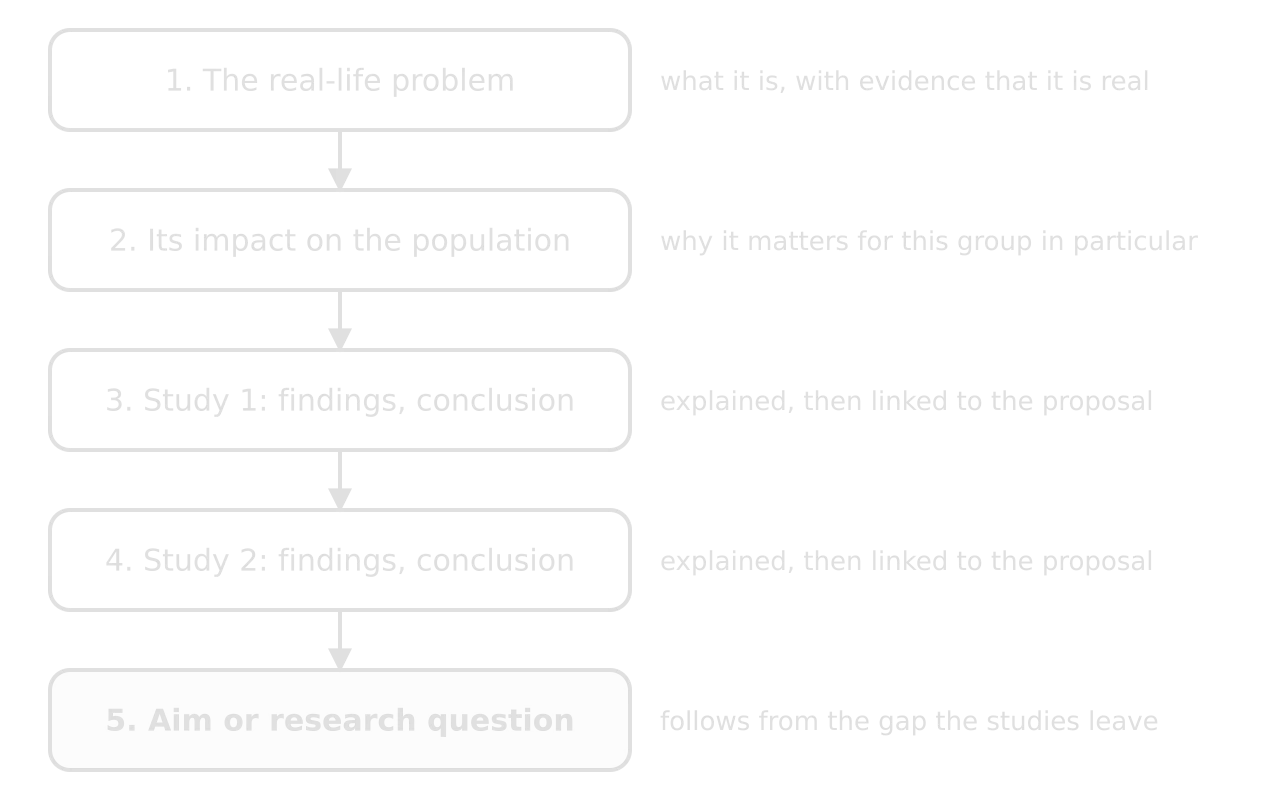
Many students state the aim first, at the start of the introduction, and that is also acceptable. What matters is that the aim, the problem and the two studies clearly belong together. A typical length is 500–600 words.
Writing a focused aim or research question
An aim or research question is focused when a reader can tell exactly who is being studied, what is being measured or explored, and what kind of answer the study could give. The same three checks apply to every method.
Who: the population of interest, defined precisely enough to tell who belongs to it.
What: the variables (for an experiment or questionnaire) or the experience or behaviour (for an interview or observation), named clearly enough to be measured or explored.
What kind of answer: a difference caused by an independent variable (experiment), a relationship or level (questionnaire), experiences and meanings (interview), or patterns of behaviour (observation).
The same checks work for the other methods. For an interview proposal, a focused research question might be: “How do adolescents aged 12–15 who arrived in the country in the last two years experience learning the host-country language at school?” For an experiment: “To investigate whether having a phone face-down on the desk, compared with in another room, reduces the recall of vocabulary in students aged 14–16.” For an observation: “To investigate how often children aged 4–5 share toys during free play in nursery classes, and whether this differs between groups of two and groups of four.”
Describing the problem and explaining its impact
The second element asks you to describe the real-life problem and explain its impact on the population of interest. The description says what the problem is and how common it is; the explanation says why it matters for this group in particular. Most proposals that stop at band 3–4 describe the problem well but never explain the impact on their population.
Evidence makes the description credible. National or international survey figures, a school well-being survey, or published research on similar groups all show that the problem is real. The impact is then explained through what is distinctive about the population: their age, their situation, the demands on them, the consequences for their learning, health or relationships.
The two pieces of research
The third element is a short literature review built on two pieces of relevant research. For each, you give the findings and key conclusions, as an abstract does, and then explain them and link them to your proposal. Details of the procedure are not needed unless they are directly relevant, for example because the study used a similar sample to the one you propose.
Choosing the two studies
Read broadly before choosing: five to ten abstracts on the problem give a sense of what is known and which studies are most useful. The best pair of studies usually has these features.
Directly relevant. The study investigates the same problem or the same variables, ideally in a similar population (an age group, setting or culture close to yours).
Published and traceable. Peer-reviewed journal articles are best. Abstracts on PubMed or Google Scholar give the findings and conclusions you need.
Complementary. Two studies that show different things (one in real-world conditions and one under control; one with a Western sample and one elsewhere; one that supports the expected relationship and one that complicates it) leave a clearer gap for your proposal to fill.
Understood. You must be able to explain the findings in your own words. A study you cannot explain cannot be linked.
Classic textbook studies are rarely the best choice. A study from the 1970s on a quite different topic, chosen because it is familiar from class, is usually only loosely relevant to a specific real-life problem in a specific population.
Writing about each study: findings, conclusion, link
A three-part pattern works for each study: what was found, what the researchers concluded, and why that matters for your proposal. The link is what moves the writing into the top band, and it should be specific: it should say how the study shapes your aim, population, method or tool, or what it leaves unanswered.
Sources: Owens, J. A., Belon, K. and Moss, P. (2010). Impact of delaying school start time on adolescent sleep, mood, and behavior. _Archives of Pediatrics & Adolescent Medicine, 164(7), 608–614._
The second study in the running example complements the first. Owens et al. observed a real school but could not control other changes; an experiment can show cause and effect but under artificial conditions. Together they justify a study of what actually happens in the population.
Sources: Lo, J. C., Ong, J. L., Leong, R. L. F., Gooley, J. J. and Chee, M. W. L. (2016). Cognitive performance, sleepiness, and mood in partially sleep deprived adolescents: The Need for Sleep Study. _Sleep, 39(3), 687–698._
Criterion B: the research methodology
The methodology section explains how the study would be carried out and why each choice was made. It has three elements: the choice of method, the procedure, and the ethical considerations.
Element | Band 1–2 | Band 3–4 | Band 5–6 |
|---|---|---|---|
Choice of research method | Described, with errors in understanding | Described | Explained |
Procedure | Described, but unclear because of errors or omissions | Described, but lacking detail | Explained |
Ethical considerations | Described, but not linked to the investigation | Relevant ones described, some not linked | Relevant ones described and explicitly linked to the investigation |
The difference between describing and explaining is the theme of the whole section. A description says what will happen; an explanation also says why that choice suits this aim and this population. A typical length is 500–600 words, and a short table of the procedure can save words.
Justifying the choice of method
Name the method precisely (including its sub-type) and explain why it is the right tool for the aim. A strong justification usually does three things: it shows how the method produces the kind of data the aim needs, it explains why it suits this population and topic, and it acknowledges what the method cannot do, which links to causality.
The same pattern justifies other methods. An interview proposal on newly arrived adolescents’ experiences might explain that a semi-structured interview lets participants describe experiences in their own words while the schedule keeps the topics consistent, and that a questionnaire would impose the researcher’s categories on experiences that are not yet well understood. An observation proposal on toy-sharing might explain that children aged 4–5 cannot reliably report their own behaviour, so watching it in a naturalistic observation gives more valid data than asking them.
Explaining the procedure
The procedure covers every decision about planning and carrying out the study. Five parts are expected, and each needs both the decision and its reason.
Part of the procedure | What to state | What to explain |
|---|---|---|
How participants would be selected from the population of interest | Why this technique suits the aim and population, and what bias it reduces or risks | |
Sample characteristics | How many participants, of what age, background and setting; any inclusion or exclusion rules | Why this size and these characteristics are appropriate |
Design (experiments only) | Independent samples, repeated measures or matched pairs; conditions of the IV | Why this design controls the main threats to the comparison |
Setting | Where and when the study would take place | How the setting supports valid data and protects participants |
Process | The steps in order, from recruitment to debriefing | Why steps are ordered and standardised as they are |
Sampling technique and sample
The sampling technique is often the most poorly explained part of Criterion B. State the technique, describe how it would be carried out in practice, and explain why it suits the aim. For a population drawn from several schools, the explanation usually turns on representativeness: whether the sample would reflect the population of interest closely enough for the findings to apply to it.
 YouTube
Other methods call for other techniques. An interview proposal on newly arrived adolescents might use purposive sampling through school language departments, explaining that only students who meet the arrival criterion can answer the question, and possibly snowball sampling to reach families who are hard to contact. An observation of toy-sharing might sample two nursery classes by opportunity sampling, explaining that the classes allow observation in a normal setting and that the findings would therefore be limited in how far they apply to other nurseries.
Design, setting and process
Only experiments need a design. If your proposal is an experiment, state the design and explain how it deals with participant variables or order effects. In the phone-on-the-desk experiment, an independent samples design with random allocation would be explained like this: a repeated measures design would let participants learn the vocabulary test, so different participants would be used in each condition, and random allocation would spread differences in ability across both conditions.
The setting and the process are often merged into a numbered sequence of steps. Each step should be precise enough that another researcher could follow it, with brief reasons where a choice needs one. The procedure in the running example could be set out as follows.
Permission is obtained from the heads of the three schools, and the proposal is reviewed by an ethics committee.
Selected students receive an information sheet explaining the aim, what taking part involves, the right to withdraw and how anonymity is protected, and give written consent online.
In the same mid-term week (not during examinations or after a holiday, when sleep patterns are unusual), students complete the questionnaire on their own devices in a tutor period. The tutor reads standardised instructions and does not look at screens.
The questionnaire takes about ten minutes. No names are collected; each response receives a random code.
The final screen thanks participants, summarises the aim and gives contact details for the school counsellor and a confidential support service.
Data are stored in a password-protected account, used only for this study and deleted once the analysis is complete. Average school-night sleep would be compared with total well-being scores using a correlation coefficient.
The reasons in steps 3 and 4 make this an explanation rather than a description: the timing avoids periods when sleep is unusual, which would distort the relationship, and the tutor not looking at screens reduces pressure to answer in a particular way.
Ethical considerations
The third element asks you to explain the ethical considerations relevant to your investigation and the steps that would address each one. The top band needs them to be explicitly linked to the investigation: not a list of principles, but an explanation of how each applies to this population, this topic and this procedure. Particular care is needed for vulnerable populations (children, people with mental health conditions, refugees) and sensitive topics (mental health, body image, cultural differences).
Consideration | How it applies in the running example | Step taken |
|---|---|---|
Participants are students aged 16–18; some are minors in their country | Written consent from each student; schools inform parents and follow local rules on consent for under-18s | |
Students may feel they must take part if asked in a tutor period | Participation is voluntary and stated as such; students may close the questionnaire at any point; non-participants do other work, so nobody can tell who declined | |
Well-being answers are personal, and peers or teachers might identify individuals | No names or class details collected; random codes; only the researcher sees raw data; results reported for groups only | |
Questions about low mood could make some students aware of distress | Well-being items are positively worded; counsellor and support contacts on the final screen; schools alerted to the timing so support is available | |
Data protection | Responses are stored online | Password-protected storage, used only for this study and deleted after analysis |
Ethics differ between methods, and a strong proposal addresses the issues its method raises. A covert observation in a café has no consent, so the proposal must explain why it is acceptable: observing only behaviour that people would expect strangers to see, recording no identifying details, and not interfering. An interview with newly arrived adolescents would need parental consent, an interpreter where needed, and care with questions that could bring back distressing memories of migration. An experiment involving deception would need to explain why full information would change the results and how participants would be debriefed.
Checklist for Criteria A and B
Before handing in a draft, check each element against the questions in the table. A “no” to any question shows where marks are likely to be lost.
Element | Questions to ask of your draft |
|---|---|
Aim or research question | Does it name the population precisely? Are the variables or experiences named clearly? Does its wording (“relationship”, “effect”, “experience”) match the method? |
Real-life problem | Is there evidence that the problem is real? Is its impact explained for this population, not people in general? |
Two studies | Are there exactly two? Are the findings and conclusions given accurately? Is each explained and linked to the aim, population or method? Is procedural detail only included where it matters? |
Method | Is the method one of the four permitted, with its sub-type? Is it explained why it suits this aim, and what it cannot show? |
Procedure | Are the sampling technique, sample, design (if an experiment), setting and process all present, each with a reason? Could another researcher follow the steps? |
Ethics | Is each consideration linked to this population and procedure, with a concrete step? Are vulnerable participants and sensitive topics addressed where relevant? |
Summary
Criterion A rewards a clearly stated and focused aim or research question, a real-life problem with its impact on the population explained, and two studies explained and linked.
A focused aim states who is studied, what is measured or explored, and what kind of answer the method can give.
The impact of the problem must be explained through the features of the population of interest, not people in general.
For each of the two studies, give the findings and conclusions, then explain them and link them to the proposal; include procedure only where it matters to the link.
Criterion B rewards an explained choice of method, an explained procedure and ethical considerations explicitly linked to the investigation.
Justify the method by what the aim needs, why alternatives fit less well, and what the method cannot show about causality.
Explain each part of the procedure (sampling technique, sample, design if experimental, setting, process) with a reason tied to the population and aim.
Ethics are linked when each consideration names the risk in this study and the step that addresses it.
Self-check
- To do:
I can describe the three elements of Criterion A and what separates the bands for each.
- To do:
I can write a focused aim or research question and check it for who, what and what kind of answer.
- To do:
I can describe a real-life problem with evidence and explain its impact on my population of interest.
- To do:
I can present two studies through their findings and conclusions, and explain and link each to my proposal.
- To do:
I can explain why my method suits my aim better than the alternatives, and what it cannot show.
- To do:
I can explain my sampling technique, sample, setting and process, with a reason for each decision.
- To do:
I can explain the ethical considerations of my proposal and link each one to a concrete step.
Carry on with Psychology in Augment
With a free account, Augment remembers where you stopped in the notes and which questions you have marked.