Criteria C and D: data collection and discussion
Build an effective IA data collection tool and explain its design and the challenges of using it, then discuss potential findings and implications, your own researcher bias and one additional method, and run the final checks.
- IB Psychology
- Internal assessment
- SL and HL
What Criteria C and D reward
The second half of the research proposal turns the design into something that could be used and then looks beyond it. Data collection (Criterion C) presents the one tool that would gather the data, explains the decisions behind it, and discusses what could go wrong when using it. Discussion (Criterion D) considers what the study might find and what that would mean in practice, how the researcher’s own position could bias it, and which other method would add to understanding. Each criterion is worth 6 marks.
These two sections are where proposals most often lose marks, usually because time or words run out. They are also where a student shows the most original thinking: nobody else has written your items, and nobody else has your reasons for choosing the topic. The running example continues: a questionnaire proposal on school-night sleep and mental well-being among students aged 16–18 at three international schools in one city.
Criterion C: data collection
Criterion C has three elements. The tool itself is in the appendix; the section explains it.
Element | Band 1–2 | Band 3–4 | Band 5–6 |
|---|---|---|---|
The data collection tool | Appropriate, but contains errors | Appropriate | Appropriate and effective |
Decisions in creating the tool | In limited detail, or of limited relevance to the aim | Described and relevant to the aim | Explained and relevant to the aim |
Potential challenges in collecting data | In limited detail, or not relevant to the investigation | Described and relevant | Explained and relevant |
An effective tool measures what the aim needs, in a way that participants can answer accurately and the researcher can analyse. A typical length for the section is 450–550 words, because the tool itself is not counted.
The data collection tool
The proposal uses one data collection tool, chosen to fit the method. It must contain at least five items (five questions, five statements, five behavioural categories) and a complete copy goes in the appendix. You do not need to include consent forms, standardised instructions or any other completed material.
Method | Typical tool | What counts as an item |
|---|---|---|
Survey or questionnaire | A questionnaire, often with Likert-type scales | Each question or rated statement |
Interview | Each main question (prompts and follow-ups support it) | |
Observation | An observation schedule or checklist | Each behavioural category, defined so it can be recognised and counted |
Experiment | The measure of the dependent variable, such as a recall test, a rating scale or an observation checklist | Each test question, rating or category |
Five items is the minimum. A tool should have as many items as the aim needs and no more: enough to cover each part of the construct, but short enough that participants answer carefully to the end.
The tool in the running example
The running example uses a 20-item online questionnaire in two parts. Part A is the 14-item Warwick-Edinburgh Mental Well-being Scale (WEMWBS), a published measure of mental well-being. Part B has six items on sleep written for the proposal. The table shows Part B, as it would appear in the appendix, with the type of each item.
Item | Wording | Response format | Type |
|---|---|---|---|
B1 | On most school nights in the last two weeks, at what time did you usually fall asleep? | Half-hour bands from “before 21:00” to “after 01:00” | Closed, ordered categories |
B2 | On most school days in the last two weeks, at what time did you usually wake up? | Half-hour bands from “before 05:30” to “after 08:00” | Closed, ordered categories |
B3 | On most school nights in the last two weeks, how many hours of sleep did you usually get? | Less than 5 / 5 to less than 6 / 6 to less than 7 / 7 to less than 8 / 8 to less than 9 / 9 or more | Closed, ordered categories |
B4 | In the last two weeks (10 school nights), on how many school nights did you sleep less than 7 hours? | 0 to 10 | Closed, numerical |
B5 | In the last two weeks, on how many school nights did you use a phone or other screen in bed after you meant to go to sleep? | None / 1–2 / 3–5 / 6–8 / 9–10 | Closed, ordered categories |
B6 | When you went to sleep later than you planned, what was the main reason? | Social media, gaming or videos / Homework or revision / Worries or stress / Paid work / Family responsibilities / Other (please write) / I did not go to sleep later than planned | Closed with an open “other” option; options shown in random order |
Part A uses the WEMWBS exactly as published: 14 positively worded statements about the last two weeks, such as “I’ve been feeling optimistic about the future”, each rated on a five-point scale from “None of the time” to “All of the time”, giving a total score from 14 to 70. Permission would be obtained from the scale’s owners, as its conditions of use require, and the full scale would be reproduced in the appendix.
Sources: Tennant, R. et al. (2007). The Warwick-Edinburgh Mental Well-being Scale (WEMWBS): development and UK validation. _Health and Quality of Life Outcomes, 5, 63. Clarke, A. et al. (2011). WEMWBS: validated for teenage school students in England and Scotland. BMC Public Health, 11, 487._
Tools for the other methods
The same principles apply to every kind of tool. An observation proposal on toy-sharing among children aged 4–5 might use five behavioural categories, each defined precisely enough for two observers to agree: offers a toy to another child; accepts a toy offered; takes a toy without asking; refuses a request for a toy; plays with the same toy as another child.
An interview proposal on newly arrived adolescents might use a schedule of six main questions, from an easy opening (“Can you tell me about your first week at this school?”) to the core topic (“How do you feel when you have to speak the new language in class?”), each with prompts for follow-up. An experiment on phones and vocabulary would use a recall test of, for example, 20 word pairs, scored as the number recalled correctly.
Explaining the decisions behind the tool
The second element asks you to explain why the tool was built as it was. Every tool involves a chain of decisions, from the abstract construct in the aim down to the wording of each item and its response format. Each link in that chain is a decision that can be explained.
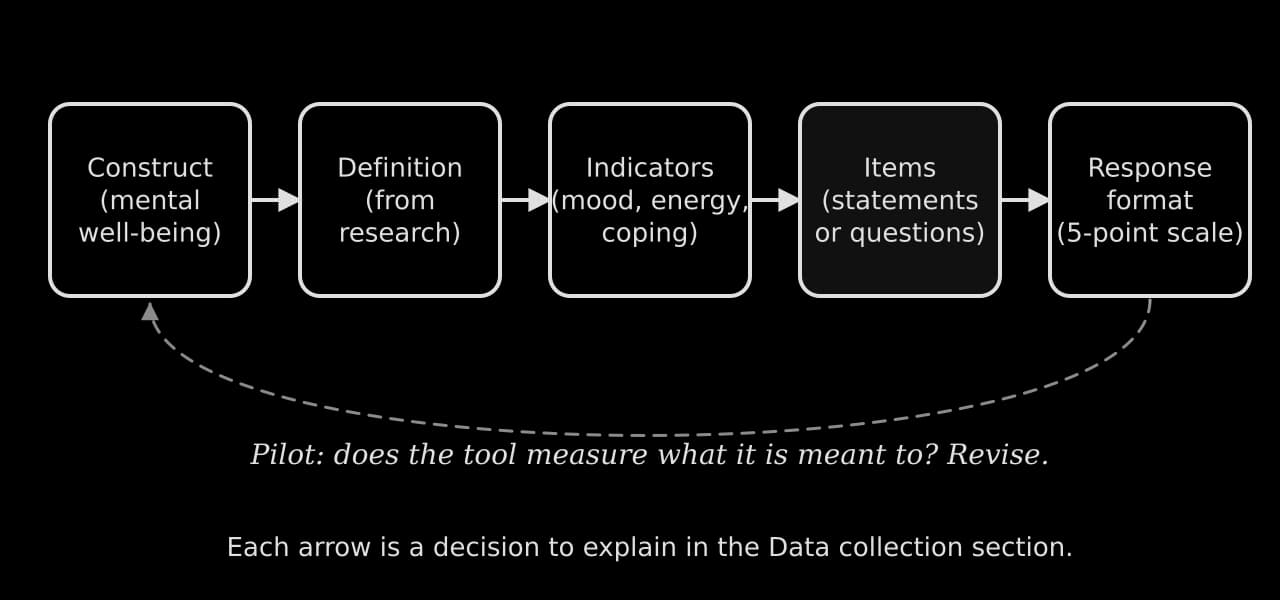
Decisions worth explaining include:
Operationalisation: how each variable in the aim is turned into something measurable (sleep duration as reported hours on school nights; well-being as a total scale score).
Types of question: closed or open, numerical or rated, and why that type suits the variable and the analysis.
Links to existing measures: whether a published scale is used, adapted or avoided, and why.
Wording and order: how items avoid leading, double-barrelled questions or jargon, and why they appear in the order they do.
Validity: how the tool as a whole measures what it is intended to measure, and how this would be checked, for example with a pilot study.
Using a published scale is not required, and many strong proposals write all their own items. When items are written for the proposal, the explanation focuses on how each one operationalises part of the construct, why its wording is clear and neutral, and how it was adapted from research or checked in a pilot. When a published scale is used, the explanation focuses on its evidence of validity and its fit to the population.
Potential challenges in collecting data
The third element asks you to discuss factors that could affect the data and the findings. The challenges that usually apply come from a familiar list: participant variability, practice effects (including fatigue and boredom), order effects, researcher bias, response bias, the validity of the data collection tool, controlling variables, and demand characteristics or social desirability bias. Choose the two or three that matter most for your study and explain each: how it would arise in this investigation, how it would affect the data, and what would be done to reduce it.
Challenge | How it would arise in the running example | Effect on the data | How it would be reduced |
|---|---|---|---|
Validity of the tool | Students estimate their own sleep and may not know how long they actually slept | Sleep duration is measured with error, which weakens any relationship found | B1 and B2 provide a cross-check on B3; inconsistent responses are flagged |
Social desirability bias | Students may report more sleep or higher well-being to appear organised and happy, especially if a teacher is nearby | Scores are pushed towards what seems acceptable | Anonymous online responses; tutor does not look at screens; no names collected |
Response bias (acquiescence) | All 14 WEMWBS items are positively worded, so a student who agrees with everything scores high | Well-being is overestimated for some participants | Acknowledged as a limitation; rewording some items negatively would remove the published scale’s evidence of validity, so the scale is kept as it is |
Order effects | Answering sleep items first could make students think about tiredness before rating their well-being | Well-being ratings could be lowered by the sleep items rather than reflect the last two weeks | Well-being items come first (Part A), sleep items second |
Controlling variables | Sleep and well-being change around examinations, holidays and illness | A relationship could reflect the time of term rather than everyday sleep | All schools use the same mid-term week, away from examinations and holidays |
Participant variability | Some students have part-time jobs, long journeys or are naturally late sleepers | These factors add variation that is not about sleep and well-being | A larger sample and stratified sampling spread these differences; B6 records the reason for late sleep |
Criterion D: the discussion
The Discussion has three parts, shown in the diagram. Each is marked as a separate element of the criterion.
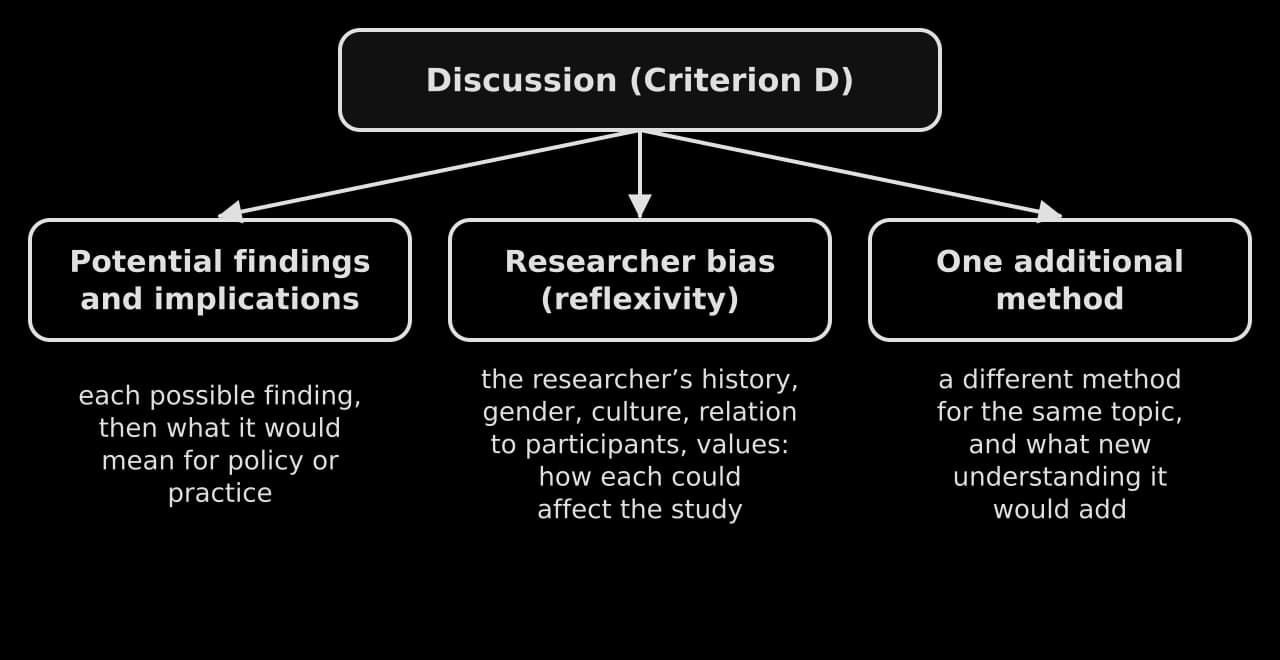
Element | Band 1–2 | Band 3–4 | Band 5–6 |
|---|---|---|---|
Potential findings and implications | Findings described; implications for policy or practice not addressed | Findings described; implications partly addressed | Findings described in detail; implications explained |
Researcher bias | One or more examples identified | One or more relevant examples described | One or more relevant examples of how researcher bias may affect the investigation discussed |
Additional method | Its usefulness described, with no reference to increasing understanding | Its usefulness discussed, with no reference to increasing understanding | Its usefulness discussed with reference to increasing understanding of the area |
Potential findings and implications
Because the study is never carried out, there are no results. Instead you describe what the study could find and what each outcome would mean. Describing findings “in detail” means being specific about the pattern in the data, not just “the hypothesis will be supported”. Considering more than one possible outcome shows that you understand the study could surprise you.
Implications are then explained for policy or practice. A policy can be small (a school’s homework or well-being policy) or large (a national health campaign). Practice means practical applications that would benefit the population of interest or others. Implications for future research can also be discussed, but they do not replace implications for policy or practice.
Wording implications to match the method
Implications must be no stronger than the evidence the method could provide, which is a question of causality. A true experiment with random allocation can support a claim that one change would cause an improvement. A questionnaire or observation can show that two things go together, so its implications are better framed as reasons to try and evaluate a change. An interview study shows how people experience a problem, so its implications often concern how services are designed or communicated. Matching the strength of the claim to the method shows understanding of the design as a whole.
 YouTube
Researcher bias and reflexivity
The second element asks you to discuss how researcher bias could affect the investigation. This is personal reflexivity: thinking critically about how the researcher’s own history, identity and values could shape the choice of topic, the design, the interpretation of the data and the conclusions. In the proposal, the researcher is you, so this part is written about yourself.
Three questions help to find relevant examples:
How has my personal history influenced the choice of topic? Experiences that led you to the problem may also lead you to expect a particular answer.
How do my gender, culture or background, and my relation to my potential participants, influence my position on the topic? A researcher who shares the participants’ situation may understand it well but also take some of it for granted; one who is an outsider may misread it.
How might my personal values or beliefs influence how I interpret the data and draw conclusions? Strong views about what should change can lead to reading the data selectively.
 YouTube
A relevant example is discussed when it shows a specific way in which the bias could affect this investigation, and ideally what would be done about it. The best examples point to a real feature of the design: an item, the sample, the wording of the aim, or the way the findings would be interpreted.
For other methods, researcher bias takes different forms. An interviewer who has been through migration may ask follow-up questions that steer newly arrived adolescents towards experiences like their own, and code their answers with those themes in mind. An observer who expects boys to share less may record ambiguous behaviour from boys as “takes a toy without asking”, which is a form of observer bias. In each case, the discussion links a feature of the researcher to a specific way the data or interpretation could be affected.
One additional method
No method gives a complete picture of a psychological problem. The third element asks you to propose one additional method for investigating the same topic and to discuss how it would increase understanding of the area, for example by showing why a relationship exists, what it means to participants, whether it is causal, or whether it holds in actual behaviour as well as in self-report.
The strongest additional methods are chosen because they answer a question your own method leaves open. Looking back at the limitations of the main method is a reliable way to find one.
Main method | What it leaves open | An additional method that adds understanding |
|---|---|---|
Questionnaire (running example) | Why students sleep little, and how they experience its effects | Semi-structured interviews with students who report short sleep |
Experiment (phone on the desk and recall) | Whether the effect occurs in real study at home | A questionnaire or diary study of phone habits and grades during real revision |
Interview (newly arrived adolescents) | How common these experiences are across the population | A questionnaire measuring acculturation strategies and school belonging in a larger sample |
Observation (toy-sharing in nursery) | What children understand about sharing | Structured interviews with the children, using pictures, or with their teachers |
Final checks
Before submitting the final version, check the whole proposal against the four criteria and the format rules. Each section should contain the elements in the table, and the proposal as a whole should pass the format checks in the checklist.
Section | Must contain | Common gap |
|---|---|---|
Introduction (A) | A focused aim or research question; the real-life problem with its impact on the population explained; two studies with findings and conclusions explained and linked | Impact not explained for this population; studies described but not linked |
Research methodology (B) | The method explained; sampling technique, sample, design (if an experiment), setting and process explained; ethics linked to the investigation | Decisions stated without reasons; generic ethics |
Data collection (C) | One tool with five or more items in the appendix; the decisions behind it explained; challenges explained and relevant | Tool described, not explained; challenges listed |
Discussion (D) | Potential findings in detail with implications for policy or practice; researcher bias discussed; one additional method with reference to increasing understanding | Findings written as results; participant bias instead of researcher bias; additional method with generic advantages |
- To do:
The four sections have the headings Introduction, Research methodology, Data collection and Discussion.
- To do:
The four sections together are no more than 2,200 words, with the Discussion well within the limit.
- To do:
The title page gives the title, the IB student code, the date of submission and the word count.
- To do:
The appendix contains the complete data collection tool, with at least five items.
- To do:
Every source cited is in the reference list, with titles of non-English sources translated.
- To do:
The whole proposal is written as a plan (future or conditional), with no results reported.
- To do:
The topic is not on the list of banned topics, and the design involves no ingestion and no animals.
Summary
Criterion C rewards an appropriate and effective tool, explained decisions in creating it, and explained, relevant challenges in collecting data.
The proposal uses one data collection tool, with at least five items, placed in full in the appendix.
Explain the chain of decisions from construct to items: operationalisation, question types, links to existing measures, wording and order, and how validity would be checked.
Discuss two or three challenges that genuinely threaten the data, saying how each arises, how it affects the findings and how it is reduced.
Criterion D rewards potential findings in detail with explained implications for policy or practice, a discussion of researcher bias, and one additional method that increases understanding.
Describe possible patterns, not results, and match the strength of the implications to what the method can show about causality.
Researcher bias is about the person proposing the study: personal history, gender, culture, background, relation to participants and values, each linked to a specific effect on the investigation.
The additional method should answer a question the main method leaves open, and the proposal should explain what new understanding it adds.
Self-check
- To do:
I can describe the three elements of Criterion C and what separates the bands for each.
- To do:
I can build a data collection tool with at least five items that fits my method and aim.
- To do:
I can explain the decisions behind my tool, including operationalisation and links to existing measures.
- To do:
I can explain two or three challenges in collecting my data and how each would be reduced.
- To do:
I can describe potential findings in detail and explain their implications for policy or practice.
- To do:
I can discuss how my own history, identity, relation to participants and values could bias the investigation.
- To do:
I can propose one additional method and explain how it would increase understanding of the topic.
- To do:
I can check a complete proposal against the four criteria and the format rules.
Carry on with Psychology in Augment
With a free account, Augment remembers where you stopped in the notes and which questions you have marked.