Paper 2: evaluating an unseen study
Discuss an unseen study through two or more concepts for Paper 2 Section B: read it for evidence, choose concepts, anchor every point in its details and argue to a reasoned conclusion.
- IB Psychology
- Exam skills
- SL and HL
Section B of Paper 2 gives a short description of a research study you have not seen before and asks you to discuss it with reference to two or more of the six concepts. The study may be experimental or non-experimental and is set in one of the four contexts. The question lists four or more of the concepts, and you choose at least two of them.
The task is evaluation. The examiners already know the study and want to see how well you can use concepts such as bias, causality and measurement to judge how far its conclusions can be trusted. The most important single skill is anchoring: every point must rest on a specific detail of this study, not on what is generally true of studies of this kind.
What the question looks like
A typical question reads: “Discuss the following study with reference to two or more of the following concepts: bias, causality, measurement and/or responsibility.” The study itself is usually a paragraph or two: an aim, a sample, a method and procedure, results with a few numbers, and the conclusion the researchers drew. Ethical details such as consent or deception are often mentioned briefly.
The command term is discuss: a considered and balanced review with a range of arguments, ending in a clear conclusion supported by evidence. In this question the evidence is the study itself.
What the markband looks for | Lower bands | Top band (13–15) |
|---|---|---|
Engagement with the concepts | Basic or some engagement with at least one concept | Very good understanding of and critical engagement with two or more concepts in relation to the study |
Analysis | Mostly descriptive; analysis superficial or undeveloped | Well-developed critical analysis |
Links to the study | Occasional or sometimes ineffective references to the study | Specific and effective references to the study throughout; links between concepts and the study relevant and well developed |
Conclusion | Simplistic or only partly consistent | A reasoned, clearly stated conclusion consistent with the arguments |
Terminology | Used, but often imprecisely | Accurate and precise; points relevant, accurate and detailed |
 YouTube
A practice study
The study that follows is invented for practice and is used in the examples and the full worked answer. It is set in the learning and cognition context and, like an exam stimulus, contains material for several concepts.
Researchers investigated whether a short daily mindfulness exercise improves adolescents’ working memory. An announcement in a school assembly invited Grade 10 students at one international school to take part, and 62 students volunteered.
The 31 volunteers in two classes whose teacher agreed to run the programme formed the mindfulness group: at the start of every lesson for six weeks, the teacher played a 10-minute recording of a guided breathing exercise. The 31 volunteers in two other classes formed the comparison group and had lessons as normal. Students in the mindfulness classes who had not volunteered read quietly during the exercise.
Before and after the six weeks, every participant completed a digit-span task on a laptop (the longest sequence of digits recalled correctly in order) and rated the statement “I am able to stay focused in lessons” from 1 (never) to 7 (always). The teacher who ran the mindfulness exercise also gave both tests to both groups.
In the mindfulness group, mean digit span rose from 6.1 to 6.8 and mean focus rating from 4.0 to 5.3. In the comparison group, mean digit span rose from 6.2 to 6.3 and mean focus rating from 4.1 to 4.1. No inferential statistics were reported. Parents gave written consent for every participant. The researchers concluded that mindfulness improves working memory and recommended that all secondary schools introduce daily mindfulness exercises.
Reading the study
An unseen study is short, and almost every sentence in it is there for a reason. A stimulus study is usually written to contain material for several concepts: a convenience sample, a self-report measure, a missing control, a strong conclusion, an ethical shortcut. The first job is to find these details before choosing concepts.
Five things to mark
The sample: who, how many, from where, and how they were recruited (volunteers, one school, one country, one gender).
The design: whether anything was manipulated, how participants got into groups (random allocation or not), what was controlled and what was not, whether there was a comparison or control group.
The measures: how each variable was operationalised: a test, a single self-report item, an observation, a physiological measure; who collected the data and whether they knew the hypothesis.
The results and conclusion: the numbers, how big the differences are, whether statistics are reported, and how far the conclusion goes beyond the data (especially words such as “causes”, “proves” or “all”).
The ethics: consent, deception, debriefing, harm, withdrawal, confidentiality, and any vulnerable group.
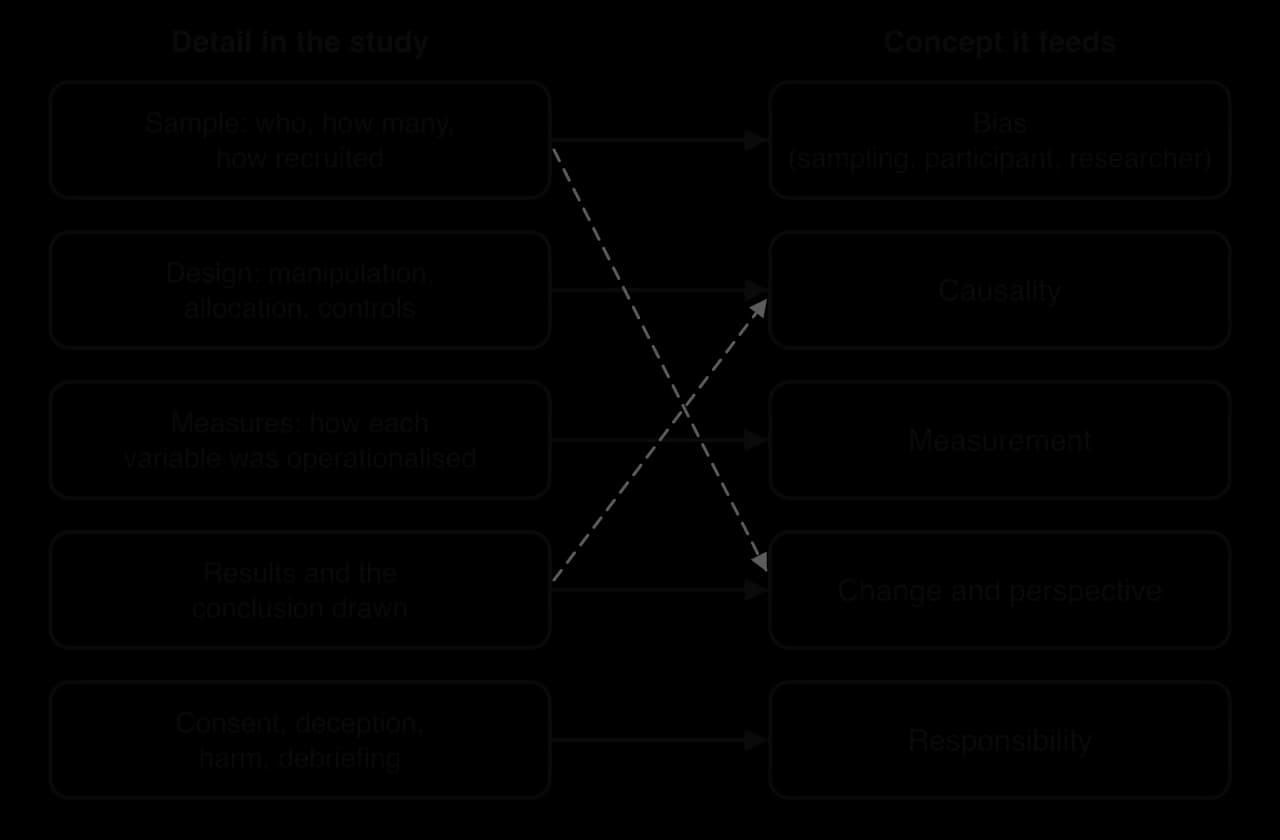
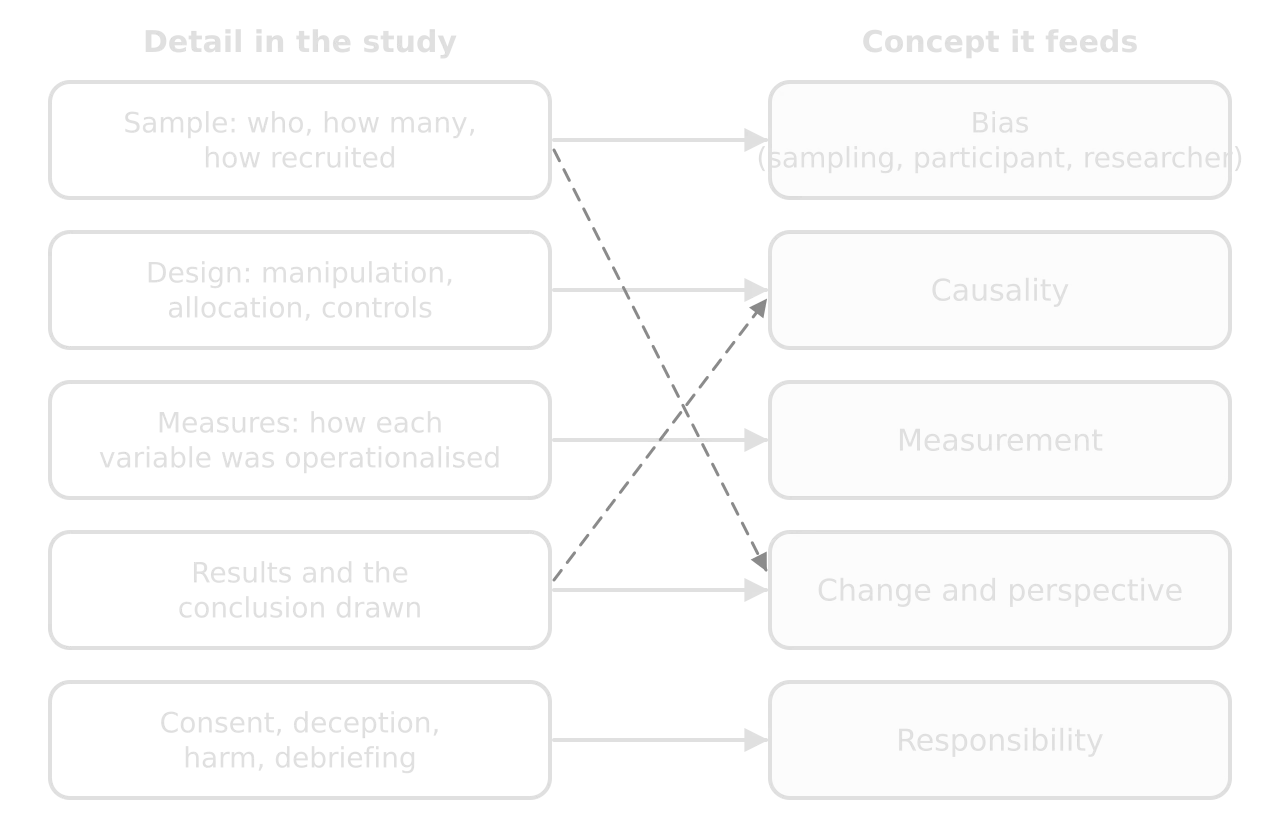
Marking the stimulus with the initial of the concept each detail feeds (B, C, M, R) takes a minute and turns the reading into a plan. Details that feed two concepts are the most valuable, because they let the answer show how concepts interact.
Choosing the concepts
The question lists four or more concepts, and an answer must engage with at least two. Choosing well matters more than covering many. Two or three concepts, each developed with several anchored points, almost always score higher than four or five touched on briefly.
Choose the concepts for which the study gives the most material. A study with volunteers, a non-blind researcher and a self-report measure is rich in bias and measurement; a study with no random allocation and a causal conclusion is rich in causality. Responsibility is a good choice only when the study raises a real ethical issue, not just the presence of consent forms.
Questions to ask of any study
Concept | Questions to ask of the study |
|---|---|
Bias | Who is in the sample and who is missing (sampling bias)? Could participants have guessed the aim or wanted to look good (demand characteristics, social desirability bias)? Did the researcher know the conditions or have a stake in the result (researcher bias)? Is there cultural bias in the measures? |
Causality | Was the IV manipulated? Were participants randomly allocated? Were confounding variables controlled? If the data are correlational, could the effect run the other way (bidirectional ambiguity) or be due to a third variable? Does the conclusion claim more than the design allows? |
Measurement | How was each construct operationalised? Is the measure valid (does it measure the construct) and reliable (would it give the same result again)? Is it self-report, behaviour or physiology? Are the numbers large enough, and are statistics reported? |
Change | Does the study measure change over time, and is the period long enough? Do the findings justify the change in policy or practice the researchers recommend? Would the change last? |
Perspective | Which approach does the study take, and what does it leave out? Is it etic or emic? Whose viewpoint do the measures reflect? Are the findings generalisable to other cultures? |
Responsibility | Were consent, withdrawal, debriefing and confidentiality handled properly? Was anyone harmed or deceived? Is the topic socially sensitive? Is it responsible to recommend a change on this evidence? |
Concepts that interact
The top band rewards links between concepts and the study that are well developed, and showing how two concepts interact is one of the clearest ways to develop them. Some combinations come up in almost every study.
Measurement and bias: a self-report measure (measurement) is open to demand characteristics (bias), especially when participants know which group they are in.
Bias and causality: a confounding variable or a non-random allocation is a source of bias that also prevents a causal conclusion.
Causality and change: a recommendation to change policy (change) depends on a causal claim, so a weak design undermines the recommendation.
Measurement and responsibility: researchers have a responsibility not to overstate findings from weak measures, especially when they will be used to change practice.
Anchoring every point in the study
A generic point is one that could be written about almost any study: “the sample was small, so the results cannot be generalised”, “it was a lab experiment, so it lacks ecological validity”. Such points show some understanding of the concept but make no specific reference to the study, and they cap an answer in the middle bands however many of them there are.
An anchored point quotes or paraphrases a specific detail of the study, explains why that detail matters for this study’s aim and conclusion, and considers what limits or offsets the problem. It usually takes three to five sentences.
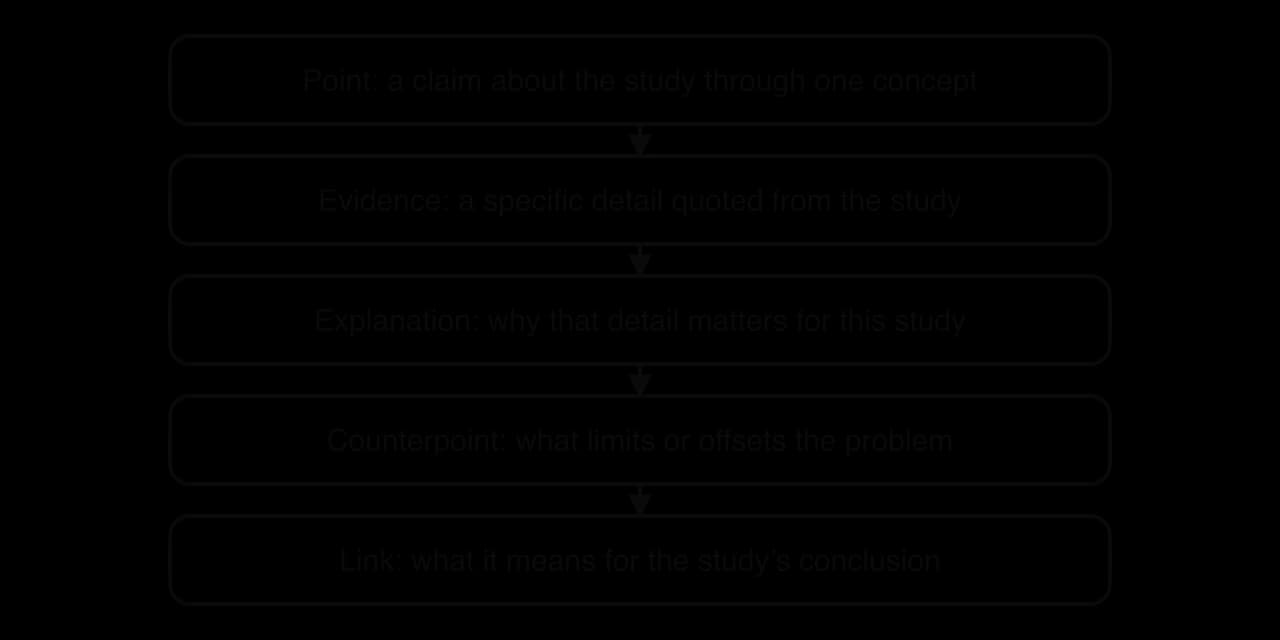
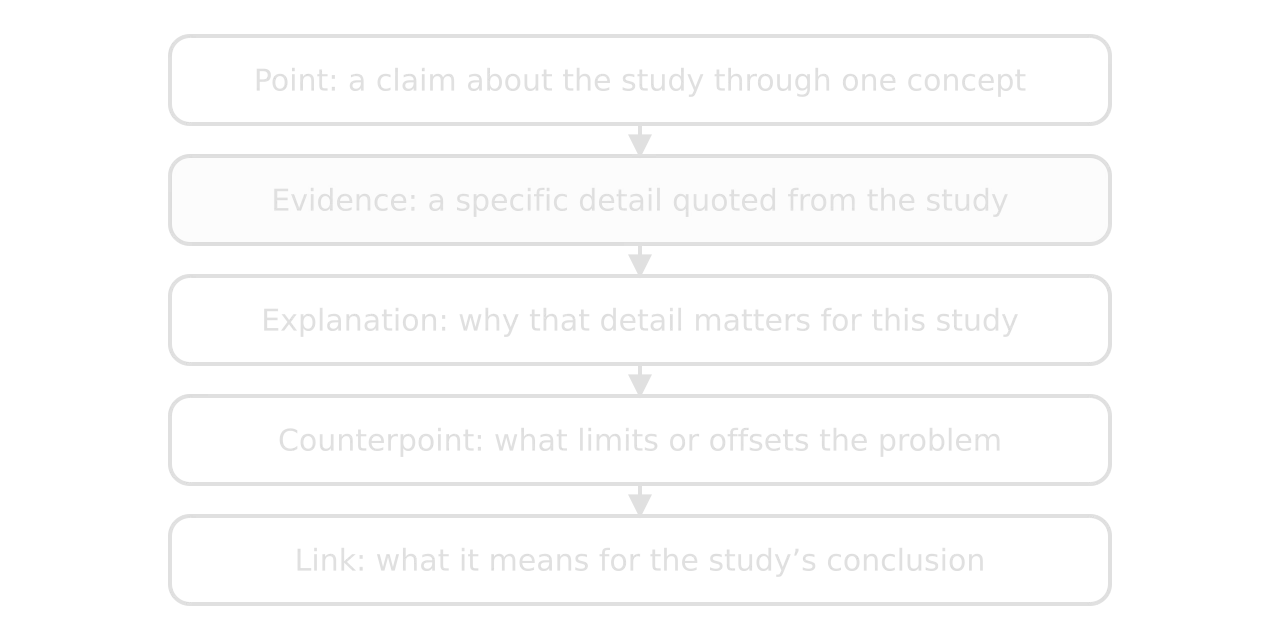
Strengths count too
A discussion is balanced. A study with real strengths, such as a comparison group, pre- and post-tests or an objective measure, should get credit for them, because a judgement on the conclusion depends on weighing strengths against limitations. Strengths must be anchored in exactly the same way: “the digit-span task is an objective, standardised measure of working memory that does not depend on what students think about mindfulness” is anchored; “experiments are scientific” is not.
Structuring the answer
There is no single required structure, but a clear one makes the critical analysis easier to follow and the conclusion easier to justify. The structure that follows works for almost any study and any pair of concepts.
Part | What it does | Length |
|---|---|---|
Introduction | Sum up the study in one sentence (method, sample, main finding, conclusion), name the concepts chosen and state the line of argument | 2–3 sentences |
Concept 1 | Two or three anchored points, including at least one strength or counterpoint | 2 paragraphs |
Concept 2 | Two or three anchored points, ideally showing how it interacts with concept 1 | 2 paragraphs |
Concept 3 (optional) | One or two anchored points, if the study gives strong material | 1 paragraph |
Conclusion | A judgement on how far the study supports the researchers’ conclusion, drawing the concepts together, and what would make the evidence stronger | 3–4 sentences |
A full worked example
The full answer uses the practice study on mindfulness and working memory.
Question. Discuss the study with reference to two or more of the following concepts: bias, causality, change, measurement and/or responsibility. [15]
Step 1: read and mark
Detail in the study | Concepts it feeds |
|---|---|
62 volunteers from one international school, recruited by assembly announcement | Bias (sampling), change (generalising the recommendation), perspective |
Groups formed by class, depending on which teacher agreed to run the programme | Causality (no random allocation; teacher and class confounds), bias |
Comparison group with lessons as normal; no placebo activity | Causality, bias (expectations) |
Teacher who ran the exercise also gave both tests to both groups | Bias (researcher bias), measurement |
Digit span on a laptop; single 1–7 item on focus | Measurement (objective versus single self-report item) |
Digit span 6.1 → 6.8 vs 6.2 → 6.3; focus 4.0 → 5.3 vs 4.1 → 4.1; no inferential statistics | Measurement, causality |
Non-volunteers in the mindfulness classes read quietly | Responsibility |
Conclusion “mindfulness improves working memory”; recommendation to all secondary schools | Causality, change, responsibility |
Step 2: choose the concepts and the line of argument
Causality and measurement have the most material, and bias interacts with both. Change is worth a short section because the recommendation to all schools is the study’s boldest claim. The line of argument is that the study gives some evidence of an effect on how focused students feel, weak evidence of an effect on working memory, and too little to support the recommendation.
Step 3: the model answer
Why the model answer reaches the top band
Two or more concepts with very good engagement: causality, measurement and change are each developed with several points, and bias is used where it interacts with them.
Specific and effective references to the study: every paragraph quotes details (volunteers from one school, groups formed by class, the same teacher testing, 6.1 to 6.8, 4.0 to 5.3, 31 per group, no inferential statistics).
Critical analysis that is developed: strengths are credited (comparison group, objective task), then weighed against limitations; each point explains why the detail matters for the conclusion.
A reasoned conclusion: it separates what the study does support (a possible small effect on digit span) from what it does not (the cause, the focus result, the recommendation) and says what would make the evidence stronger.
A second study for practice
The second invented study is non-experimental and set in the human development context. A plan is given rather than a full answer.
Researchers investigated whether caregivers’ smartphone use in public playgrounds affects young children’s attention-seeking. Over four weekday mornings, two researchers sat on benches in three public playgrounds in one city and observed 40 caregiver–child pairs, with children judged to be aged 2–5. Caregivers were not told they were being observed. For each pair, the researchers recorded for 10 minutes whether the caregiver was looking at a phone, and counted the child’s “bids for attention” (calling the caregiver, pulling at them, or bringing them an object).
Children whose caregivers used a phone for more than half of the 10 minutes made a mean of 7.2 bids, compared with 3.9 bids for children whose caregivers did not. The researchers concluded that caregivers’ phone use causes children to seek attention and that parents should put their phones away in playgrounds.
Summary
Section B gives an unseen study and asks for a discussion through two or more of the four or more concepts listed.
The skill rewarded most is anchoring: every point uses a specific detail of the study and explains what it means for the study’s conclusion.
Reading the study for its sample, design, measures, results and conclusion, and ethics shows which concepts have the most material.
Two or three well-developed concepts score higher than many touched on briefly; showing how concepts interact develops the analysis.
Strengths are credited and weighed, so the discussion is balanced.
Generic points (“small sample”, “lacks ecological validity”) cap the mark unless they are tied to this study’s details and claims.
The conclusion is a reasoned judgement on how far the study supports its own conclusion, and what would strengthen it.
Self-check
- To do:
I can explain what the Section B markband rewards and why anchoring matters.
- To do:
I can read an unseen study and mark its sample, design, measures, results and ethics.
- To do:
I can choose the two or three concepts with the most material in a given study.
- To do:
I can turn a generic point into an anchored point with a detail, an explanation and a counterpoint.
- To do:
I can show how two concepts interact in a study, such as measurement and bias.
- To do:
I can structure a full answer and write a reasoned conclusion about the study’s own claim.
Carry on with Psychology in Augment
With a free account, Augment remembers where you stopped in the notes and which questions you have marked.