Paper 2: class practical questions
Answer the four Paper 2 Section A questions on any class practical: describe the method, explain a concept, compare and contrast methods and design a study, using a practical record and the method × concept grid.
- IB Psychology
- Exam skills
- SL and HL
Section A of Paper 2 asks four compulsory questions about one of your class practicals. The question names the research method (interview, observation, survey or questionnaire, or experiment) and you answer about the practical you carried out with that method. Because the method is not known in advance, you need to be ready to answer on all four.
The four question types are the same in every session; only the method and the concept change. That makes Section A one of the most predictable parts of the course. Students who prepare a clear record of each practical and practise each question type on each method can plan most of their answers before they enter the exam room.
What the four questions ask
Each question tests a different skill, signalled by its command term. The first two are worth 4 marks each and the last two 6 marks each. Each is marked with its own markband, and the markbands reward different things.
Question | Typical wording | Command term and skill | What the top band rewards |
|---|---|---|---|
1a [4] | Describe how you used an interview or focus group in your class practical. | Describe: a detailed account of the method as used | Detailed knowledge of the research methodology of your practical, with accurate terminology |
1b [4] | Explain the concept of bias in relation to your interview or focus group class practical. | Explain: the concept with reasons, applied to your practical | Well-developed understanding of the concept, with clear and detailed links to the practical |
1c [6] | Compare and contrast the use of an interview or focus group in your class practical with an experiment. | Compare and contrast: similarities and differences, referring to both methods throughout | Both similarities and differences discussed in detail, with method terminology used effectively |
1d [6] | Design an observation to investigate the same topic as you investigated in your class practical. | Design: a plan for a new study on the same topic | A procedure explained with accuracy and detail, with method terminology used effectively |
The focus of all four questions is the research method, not the context the practical was set in. In an interview practical on exercise and mood, the marks come from showing how an interview works, what it can and cannot show, and how its design decisions affect its data, so the psychology of mood itself needs no more than a sentence.
 YouTube
Preparing a practical record
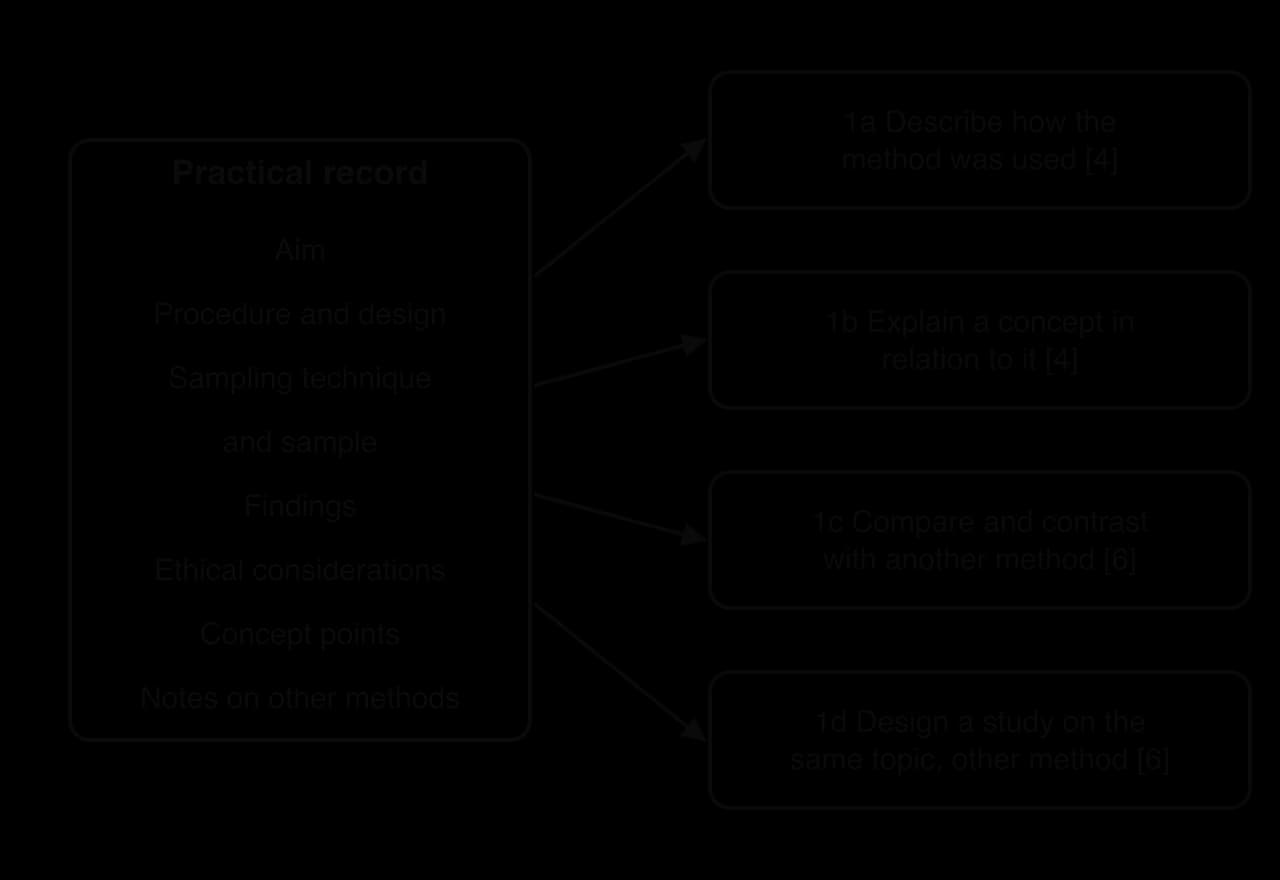
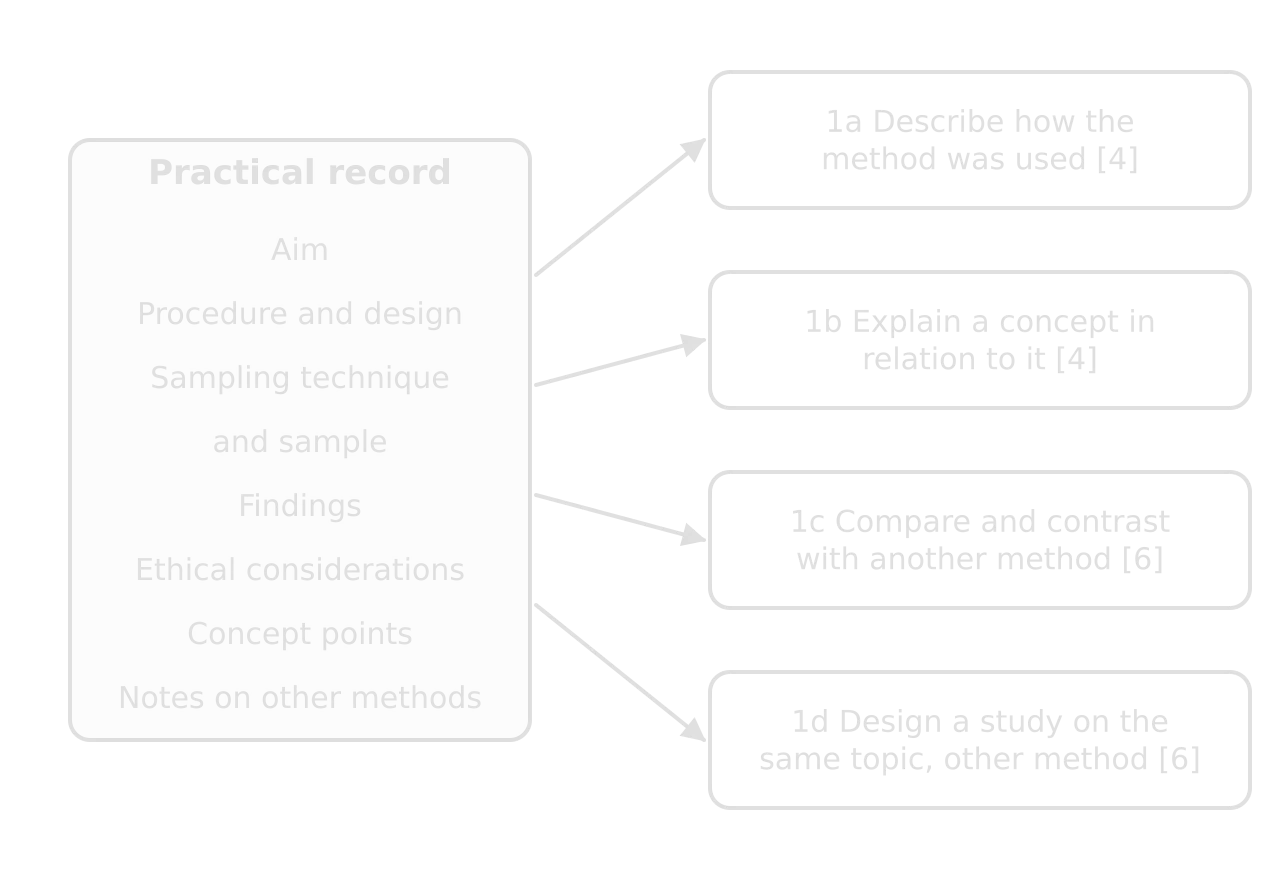
The course advises keeping a short record of each class practical. It is not assessed, but it is the single most useful revision document for Section A and a useful starting point for the internal assessment. A record written during or straight after the practical holds the details you will otherwise forget: the exact aim, how many participants there were, how they were chosen, which questions or categories were used, and what was found.
What the record contains
Heading | What to write | Used in |
|---|---|---|
Aim | One sentence naming the method, the variables or topic and the participants: “To investigate … in … using a …” | 1a, 1d |
Method and design | The exact type: semi-structured interview or focus group; naturalistic or controlled, overt or covert, participant or non-participant observation; online or paper questionnaire; true or quasi-experiment, laboratory or field, and the experimental design | 1a, 1c |
Procedure | Materials (schedule, checklist, questionnaire, task), the setting, how data were recorded, how long it took, any pilot study, what the researcher said | 1a, 1b |
Sampling technique and sample | How participants were chosen, how many, their age and any relevant characteristics, and why that technique was used | 1a, 1b |
Data and findings | What kind of data was collected and how it was analysed; two or three concrete findings (themes, tallies, means, a correlation) | 1a, 1b |
Ethical considerations | Consent forms (and parental consent where needed), right to withdraw, anonymity, any partial deception and the debrief, how data were stored and deleted | 1a, 1b |
Concept points | Two or three points per concept, each tied to a decision in the practical | 1b |
Other methods | How the same topic could be studied with each of the other three methods | 1c, 1d |
The last two headings go beyond the minimum record, but they turn a description into a revision tool. Concept points written in advance mean that the explain question becomes a matter of choosing the best three, not inventing them under pressure. Notes on the other methods mean that a design question is never met for the first time in the exam.
A worked record: a focus group on managing exam stress
The following practical record is used in the interview model answers. The details are hypothetical, but they show the level of precision that a record needs.
Heading | Record |
|---|---|
Aim | To investigate how Grade 11 students describe the strategies they use to manage stress before exams, using a focus group. |
Method and design | One focus group of six participants, run as a semi-structured group interview with a facilitator (a student researcher) and a note-taker. |
Procedure | An interview schedule of seven open questions (for example, “What do you do in the week before an exam to look after yourself?”) with planned probes; piloted with two students, after which one leading question was reworded. The group met in an empty classroom after school for 35 minutes. The discussion was audio-recorded, transcribed with names replaced by letters, and the recording was deleted after transcription. |
Sampling technique and sample | Opportunity sampling: six Grade 11 students (four girls, two boys, aged 16–17) from one psychology class who were free after school. A student-led focus group needs three to eight participants. |
Data and findings | Qualitative data: one 6,200-word transcript. Two students coded it separately using thematic analysis, then compared codes and agreed three themes: “planning as control” (timetables and lists reduce worry), “escaping through screens” (gaming and social media used to switch off, often with guilt afterwards) and “peers as both help and pressure” (studying together helps, comparing revision hours increases stress). |
Ethical considerations | Signed consent forms with the aim, the right to withdraw at any time and the right to skip any question; no questions about mental health conditions or diagnosis; group members agreed not to repeat what others said; anonymised transcript; participants were offered a summary of the themes; the teacher supervised. |
Question 1a: describe how you used the method
The describe question asks for a detailed account of how the method was used in your practical. The markband rewards detailed knowledge of the research methodology and accurate terminology. In practice that means using the precise name of each design decision and giving the concrete detail of your study for each one.
A strong answer covers, briefly, the aim; the type of method and its sub-type; the procedure, including the data collection tool; the sampling technique and sample; how data were recorded and analysed; one or two findings; and the main ethical steps. It does not need an introduction or a conclusion, and it does not evaluate. Some versions of the question ask explicitly for the aim and procedure; include both in every answer anyway.
What to name for each method
Method | Terminology the answer should use accurately |
|---|---|
Interview or focus group | Structured, semi-structured or unstructured; focus group and facilitator; interview schedule, open questions, probes; rapport; audio recording and transcript; thematic analysis or content analysis; codes and themes |
Observation | Naturalistic or controlled; overt or covert; participant or non-participant; observation schedule; behavioural categories and how they were operationalised; event sampling or time sampling; tallies; inter-rater reliability; field notes if qualitative |
Survey or questionnaire | Closed and open items; Likert scale; reverse scoring; existing scale or new items; pilot; administration (online or paper, anonymous); response rate; scoring; descriptive statistics or a correlation |
Experiment | True or quasi-experiment; laboratory or field; independent variable (IV) and dependent variable (DV), operationalised; independent samples design, repeated measures design or matched pairs; random allocation or counterbalancing; standardisation of instructions; hypothesis; mean or median per condition |
The model answer gives a precise detail for every methodological decision: the type of interview, the sample size and sampling technique, the tool and an example question, the pilot, the setting, recording and transcription, the analysis and the findings. Each of these shows knowledge of interview methodology, not of stress.
Question 1b: explain a concept in relation to your practical
The second question names one of the six concepts (bias, causality, change, measurement, perspective or responsibility) and asks you to explain it in relation to the practical. With four methods and six concepts there are 24 possible questions, but a single structure answers all of them.
The markband has two parts: understanding of the concept, and clear and detailed links to the practical. A paragraph that explains the concept well but could have been written about any study stays in the lower band. Each point therefore needs a specific decision from your practical and its effect on the data or conclusions.
A structure for every concept question
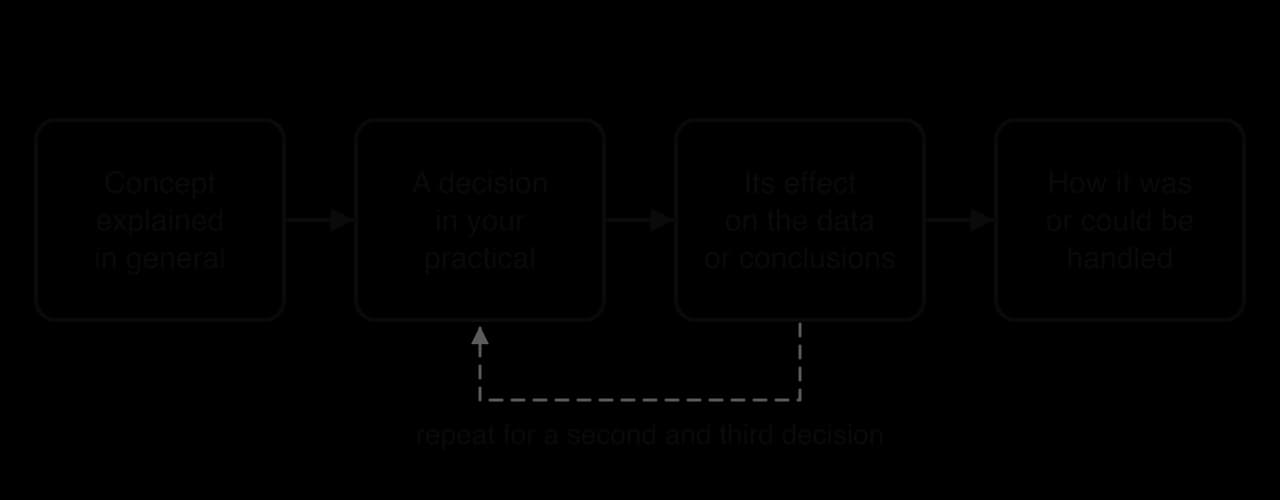
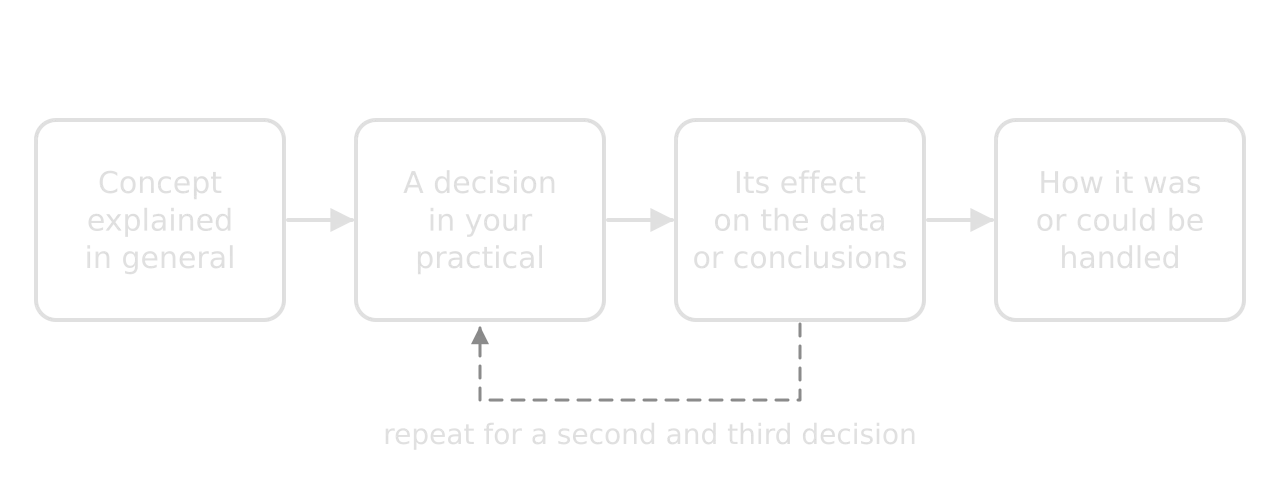
Explain the concept in one or two sentences, in the meaning it has in research: bias as systematic distortion of data or conclusions, measurement as how a construct is operationalised and how reliable and valid the measure is, and so on.
Link it to a specific decision in your practical: your sampling technique, a question you wrote, a category you defined, how you allocated participants, what you told participants.
Explain the effect: what that decision did to the data, or what it means for the conclusions you can draw.
Say how it was handled or could be handled: a control you used, a change you would make.
Repeat for a second (and if time allows, third) link.
The method × concept grid
The grid gives the strongest point for each of the 24 combinations, as a starting point for your own concept points. The detail in each cell must be replaced by what happened in your practical.
Concept | Interview or focus group | Observation | Survey or questionnaire | Experiment |
|---|---|---|---|---|
Bias | Social desirability bias in answers; interviewer effects; dominant voices and conformity in a focus group; researcher bias in coding | Observer bias when deciding which category a behaviour fits; reactivity in overt observation; who is present to be observed | Social desirability and acquiescence; leading items; non-response bias and self-selection | Demand characteristics; experimenter expectancy; sampling bias from opportunity samples; order effects in repeated measures |
Causality | Cannot establish cause: nothing is manipulated; records what participants believe causes their behaviour | Cannot establish cause in naturalistic settings; can show behaviours that occur together | Usually correlational: bidirectional ambiguity and third variables | A true experiment can, through manipulation of the IV, control and random allocation; a quasi-experiment cannot |
Change | Findings suggest interventions; repeat interviews can track how experiences change | Repeated observation tracks developmental change or the effect of a programme | Repeating the questionnaire over time tracks change in attitudes | Tests whether an intervention changes behaviour or cognition |
Measurement | Self-reported words, not behaviour; quality of the schedule; credibility of the analysis (second coder) | Constructs operationalised as behavioural categories; inter-rater reliability; direct measurement of behaviour | Constructs operationalised as items; several items and reverse scoring for reliability; validity of self-reported data | Operationalising the IV and DV; whether the DV is a valid measure of the process (internal validity versus ecological validity) |
Perspective | Emic and holistic: participants’ own terms; the researcher’s perspective shapes questions and themes (reflexivity) | Categories chosen by the researcher are etic; meaning of behaviour depends on culture | Closed items impose the researcher’s categories; open items allow participants’ own terms | Reductionist: one variable at a time; often cognitive and etic |
Responsibility | Consent, right to skip questions, anonymised transcripts, avoiding sensitive topics; how these shaped what was said | Public places only without consent; parental consent for children; no identifiable recordings | Consent page, anonymity, right to stop, no sensitive items, data deletion | Consent, partial deception only when justified, debriefing, right to withdraw data, no stressful tasks |
The model answer explains the concept, then makes two links (the operationalisation of categories, and the reliability check), each with its effect on the data and an improvement. Every sentence after the first refers to something that happened in the practical.
Question 1c: compare and contrast with another method
The compare and contrast question names a second method and asks you to compare it with the one used in your practical. The top band requires both similarities and differences discussed in detail. Answers that list only differences, which is the most common pattern, cannot go above the middle band however detailed they are.
The command term also requires reference to both methods throughout. A paragraph on interviews followed by a paragraph on experiments is two descriptions, not a comparison. Each sentence should hold both methods together, using linking words such as “both”, “similarly”, “whereas” and “unlike”.
Axes of comparison
The same few axes give both similarities and differences for any pair of methods. Choosing two similarities and two or three differences from the list, each grounded in your practical, is enough for the top band.
Axis | Questions to ask of the two methods |
|---|---|
Type of data | Qualitative or quantitative? Words, tallies, scores or measurements? |
Control and causality | Is anything manipulated? Are extraneous variables controlled? Can cause and effect be established? |
Researcher involvement and bias | How much does the researcher interpret the data? Interviewer, observer or experimenter effects? |
Participant awareness and bias | Do participants know they are being studied? Social desirability, demand characteristics, reactivity? |
Setting and ecological validity | Natural or artificial setting and task? How far do findings reflect everyday behaviour? |
Sample | Typical sample size; how many participants are needed; time per participant |
Analysis | Thematic analysis, tallies, descriptive statistics, correlation, inferential tests? |
Ethics | Consent, deception, privacy and the special issues of each method |
The model answer gives three similarities (self-report and its bias, the need for well-written and piloted questions, no causal conclusions) and three differences (data type and analysis, anonymity and sample size, standardisation and the researcher’s role). Every point names both methods and refers to the practical.
Question 1d: design a study with another method
The design question asks you to plan a new study on the same topic as your practical, using a different method named in the question. The markband rewards a procedure explained with accuracy and detail and effective use of the terminology of the new method. It does not reward a perfect study, and it does not need the results.
The key is to keep the topic but change everything that belongs to the method. A student whose experiment was on phone presence and digit span, asked to design an observation, must still study phones and attention, but now as behaviour recorded with an observation schedule in a real setting.
A checklist for every design
Element | What to specify |
|---|---|
Aim | The same topic, phrased for the new method (an observation records behaviour; a questionnaire measures self-reported variables and their relationship; an interview explores experiences and meanings; an experiment tests the effect of an IV on a DV) |
Type of method | The precise sub-type and why it suits the aim: for example, naturalistic, covert, non-participant observation |
Participants and sampling | Who, how many, the sampling technique and why; consent arrangements |
Tool and operationalisation | The data collection tool with two or three examples: categories, items, questions, the IV and DV |
Procedure | Where, when, how long, who collects the data and how it is recorded; controls or a pilot |
Data and analysis | What data result and how they are analysed (tallies and percentages, means, a correlation, themes) |
Ethics | The issues specific to this design and how they are addressed |
The model answer specifies the type of observation and why, the setting, the ethics of observing students, the tool and four behavioural categories, the sampling of behaviour (time sampling) and of participants, the pilot and reliability check, the data and their analysis. It ends with one sentence on what the design can and cannot show, which demonstrates understanding of the method without turning the answer into an evaluation.
Preparing for all 24 combinations
Because the method in the question is not known in advance, preparation means four practical records and, for each, a set of concept points and notes on the other methods. That sounds like a lot, but much of it overlaps: the axes of comparison are the same for every pair, and the design checklist is the same for every method.
Preparation task | For each of the four practicals |
|---|---|
Record | A one-page record with numbers, materials and findings learned |
Describe | One timed 1a answer, checked against the terminology list for that method |
Concepts | Two or three points for each of the six concepts, each tied to a decision in the practical (24 sets in total) |
Compare and contrast | For each of the other three methods: two similarities and three differences (12 comparisons, but only six different pairs of methods, so each pair serves two practicals) |
Design | A short plan of the same topic using each of the other three methods (12 plans) |
Common problems across Section A
Mixing up the questions. Evaluation in 1a, description in 1c and an essay on the topic in 1d all miss the demands of the command term. Underlining the command term before writing helps.
Vague terminology. “We asked some students some questions” is limited; “a semi-structured interview with an eight-question schedule and six participants recruited by opportunity sampling” is accurate and detailed.
Inventing a different practical. Answers must be about the practical actually carried out. Pretending to have done a more impressive study usually produces inconsistencies, and a real practical with modest results is perfectly adequate.
Forgetting ethics in 1a and 1d. Consent, withdrawal, anonymity and debriefing belong in the procedure, briefly.
Running out of time on 1c and 1d. They carry 6 marks each, more than 1a and 1b; plan time to match the marks.
Summary
Section A asks four questions on one class practical, named by its method: describe [4], explain a concept [4], compare and contrast [6] and design [6].
The focus is the research method, not the topic of the practical; background psychology earns nothing.
A practical record with aim, method and design, procedure, sampling technique and sample, findings and ethics, plus concept points and notes on other methods, prepares every answer.
A describe answer gives a precise detail for every methodological decision, using accurate terminology.
A concept answer explains the concept, then makes two or three links to decisions in the practical and explains their effect on the data.
A compare and contrast answer needs both similarities and differences, with both methods referred to throughout.
A design answer keeps the topic, changes the method, and specifies type, sample, tool, procedure, analysis and ethics.
The method × concept grid gives a starting point for all 24 combinations, which must then be grounded in the actual practical.
Self-check
- To do:
I can state the four Section A question types, their command terms and what each markband rewards.
- To do:
I have a complete record of each of my four class practicals, with numbers and findings learned.
- To do:
I can write a detailed describe answer for each of my practicals using accurate method terminology.
- To do:
I can explain any of the six concepts in relation to any of my practicals, with specific links.
- To do:
I can compare and contrast any two methods, giving both similarities and differences.
- To do:
I can design a study on the same topic as each practical using each of the other three methods.
- To do:
I can recognise and avoid generic points that could apply to any study.
Carry on with Psychology in Augment
With a free account, Augment remembers where you stopped in the notes and which questions you have marked.