Augment Education
    • Question bank
    • Quick fire
    • Worksheets
    • Flashcards
    • Notes
    • Try a quick-fire round
    • All features
    • Business
    • Digital Society
    • Economics
    • Geography
    • Global Politics
    • History
    • Philosophy
    • Psychology
    • Anthropology
    • World Religions
    • Biology
    • Chemistry
    • Physics
    • Computer Science
    • Design Technology
    • ESS
    • SEHS
    • Language and literature
    • Language acquisition
    • Maths AA
    • Maths AI
    • Dance
    • Film
    • Music
    • Theatre
    • Visual Arts
    • Grade calculator
    • Grade boundaries
    • Subject checker
    • Focus timer
    • Exam countdown
    • All free tools
    • IB guide
    • All subjects
  • Blog

Search

Search subjects, the syllabus, glossary terms, the booklets, the IB guide, help and the blog

Log inStart free
augment

Augment Education

IB Diploma revision built around the syllabus.

contact@augment-education.com

Product

  • Features
  • Question bank
  • Quick fire
  • Worksheets
  • Flashcards
  • Notes
  • Subjects
  • What's new

Learn

  • IB guide
  • Booklets, explained
  • Glossary
  • Blog
  • Free tools
  • Grade calculator
  • Subject checker

Company

  • About
  • Help
  • For parents
  • For teachers
  • Comparisons

Subjects

  • English A Lit
  • English A Lang & Lit
  • Chinese A Lit
  • Chinese A Lang & Lit
  • Spanish A Lit
  • Spanish A Lang & Lit
  • English Lit & Perf
  • Spanish Lit & Perf
  • English B
  • Mandarin B
  • Spanish B
  • English ab initio
  • Mandarin ab initio
  • Spanish ab initio
  • Business
  • Digital Society
  • Economics
  • Geography
  • Global Politics
  • History
  • Philosophy
  • Psychology
  • Anthropology
  • World Religions
  • Biology
  • Chemistry
  • Physics
  • Computer Science
  • Design Technology
  • ESS
  • SEHS
  • Maths AA
  • Maths AI
  • Dance
  • Film
  • Music
  • Theatre
  • Visual Arts

Augment Education is developed independently of the International Baccalaureate Organization and is not endorsed by it. “IB” and “International Baccalaureate” are its trademarks.

© 2026 Augment Education. All rights reserved.

  • Privacy
  • Terms
  1. Subjects
  2. Psychology
  3. Paper 1: concept-based extended response

Paper 1: concept-based extended response

Write the Paper 1 Section C essay: read a concept-based question, plan an argument led by the concept, link concepts and evidence throughout, reach a reasoned conclusion, and use model essays and plans to prepare.

  • IB Psychology
  • Exam skills
  • SL and HL

27 min readLast reviewed 15 Oct 2026

Section C of Paper 1 is a single essay worth 15 marks, the largest share of the paper. You choose one of two questions, each set in a different context. Every question joins an area of study from a context (for example “attachment” in human development or “cognitive biases” in learning and cognition) to one of the six concepts: bias, causality, change, measurement, perspective or responsibility. The essay is called a concept-based extended response because the concept, not the topic, is what you are asked to think with.

Definition

Concept-based extended response: the Paper 1 Section C essay, worth 15 marks, in which the student evaluates or discusses an area of study from one context through one of the six concepts and argues to a reasoned conclusion.

The focus of assessment is conceptual understanding and critical thinking. Knowledge of the specific details of research studies is not assessed for its own sake. Research is still the main way to show critical thinking, because evidence is what you analyse and weigh, but a study earns credit only when it is used to make a point about the concept and the question.

Reading a Section C question

The parts of the question

Section C questions are longer than short-answer questions and contain several instructions. Most follow one of two patterns.

Pattern

Example (our own)

What it asks

Context + command term + area + concept

“In the context of learning and cognition, evaluate research into cognitive biases with reference to the concept of measurement.”

Weigh the strengths and limitations of research on cognitive biases, judged by how well behaviour was measured.

A claim to discuss

“One claim in human development is that early attachment determines later relationships. Discuss this claim with reference to the concept of causality.”

Weigh evidence for and against the claim, judged by what it can and cannot show about cause and effect.

The command term is nearly always an AO3 term: “discuss”, “evaluate” or “to what extent”, possibly “examine”. Each needs a balanced argument and a conclusion; “to what extent” needs a conclusion that states a degree.

Worked example

Take apart this question: “In the context of health and well-being, to what extent can stress be said to cause health problems? Answer with reference to the concept of causality.” [15]

Show the solution

Context: health and well-being. Evidence should come from research on stress and health, not from other contexts.

Command term: to what extent (AO3). The conclusion must state how far the claim holds, for example “only partly”.

Area of study: stress and health. The focus is the link between stress and health problems, so both physical and mental outcomes are relevant.

Concept: causality. Every paragraph should judge whether the evidence shows cause and effect: experimental or correlational design, direction of effect, third variables, interaction of factors.

First line of argument: “Stress contributes to some health problems through the HPA axis and immune function, but most evidence is correlational and the effects depend on interaction with other factors, so stress is better described as one cause among several.”

Choosing between the two questions

Take two or three minutes to choose. Read both questions completely, then ask three things: which area of study you know best, whether you have three or four pieces of evidence that you can evaluate through the named concept, and whether you can already state a line of argument. The question with a clear argument is usually the better choice, even if the other topic feels more familiar.

Tip

A quick test for each question: write the concept and three evidence words in the margin (for example “measurement: Strange Situation, Q-sort, AAI”). If you cannot fill three slots in thirty seconds, choose the other question.

How the essay is marked

The essay is marked with a single 15-mark markband in five bands. The table paraphrases each band, and its right-hand column shows the change that moves an essay up.

Marks

What an answer in this band is like

To move up

1–3

Shows little grasp of what the question asks. Mostly description; any analysis is superficial. Links between concepts are missing or irrelevant. Terminology is absent or misused.

Answer the actual question and use the concept by name.

4–6

Some grasp of the question. Relevant knowledge is described rather than explained. Mostly descriptive; links between concepts are stated and partly relevant; the conclusion is simplistic. Terminology is used, but often inappropriately, and points are often vague.

Explain, not just describe, and say why each piece of evidence matters for the concept.

7–9

The question is understood but only partly addressed. Knowledge is partly explained. There is analysis, but it is not developed. Links between concepts are explained but only partly relevant; the conclusion does not always follow from the argument.

Develop each point (strength, limitation, alternative), and make the conclusion follow from the paragraphs.

10–12

The demands of the question are addressed. Knowledge is mostly explained. Critical analysis is present but not fully developed. Links between concepts are included and explained. The essay argues to a consistent conclusion. Terminology is mostly appropriate.

Sustain concept links through every paragraph and justify the conclusion with the strongest arguments.

13–15

The demands of the question are addressed and knowledge is fully explained. Critical analysis is well developed. Links between concepts run throughout and are fully explained. The essay reaches a reasoned, clearly stated conclusion consistent with the argument. Terminology is accurate and precise.

—

Three threads run through the bands. Analysis must move from description to critical analysis that is developed. Links between concepts must move from stated, to explained, to present throughout. The conclusion must move from simplistic, to consistent, to reasoned and clearly stated. Accurate terminology is assessed in every band.

The top band depends on the concept organising the whole essay. An essay that describes three good studies and mentions the concept only in the introduction and conclusion stays in the middle bands, however accurate the studies are.

Exam tip

“Links between concepts” has two meanings that both earn credit: linking the named concept to the content (how the evidence relates to measurement, causality and so on), and showing how the named concept interacts with other concepts (for example, how a measurement problem creates a problem of bias or limits a causal conclusion). Strong essays do both.

The six concepts as lenses

Each concept points to a different set of questions about the same evidence. Learning these questions turns the concept into a tool for evaluation, rather than a word to mention.

Concept

Questions to ask of the evidence

Typical points

Bias

Who was studied and who was not? Could researchers’ or participants’ expectations have shaped the results? Which findings were published?

Sampling bias, WEIRD samples, cultural and gender bias, researcher bias, demand characteristics, publication bias, reductionism as a bias towards one perspective

Causality

Does the evidence show cause and effect, or only a relationship? In which direction? Could a third variable explain it? Do several factors interact?

Experiments versus correlational studies, bidirectional ambiguity, third variables, controls, interaction of biological, cognitive and social factors

Change

Can the behaviour be changed, how and for how long? Is the change caused by an intervention or by maturation or time? What are the barriers?

Effectiveness of treatments and interventions, relapse, longitudinal evidence, resistance to change, scale (individual to global)

Measurement

How was the behaviour operationalised? Are the measures valid and reliable? Direct or indirect? What do the measures miss?

Operationalisation, self-report problems, construct validity, brain imaging as indirect measurement, triangulation

Perspective

Which approach does the explanation come from? What does it leave out? Do other approaches or cultures see it differently?

Biological, cognitive and sociocultural explanations, reductionism versus holism, emic and etic views, Indigenous perspectives

Responsibility

Was the research ethical? Who could be harmed by its findings or applications? How should uncertainty be communicated?

Informed consent, protection from harm, cost–benefit analysis, stigma, socially sensitive research, advocacy, use of findings in policy

The concepts overlap, and the overlaps are where links between concepts come from. A sampling problem is a matter of bias, but it also limits generalisability; a correlational design is a matter of causality, but it also affects which treatments can be justified, which is a matter of responsibility.

Structure: a concept-led essay
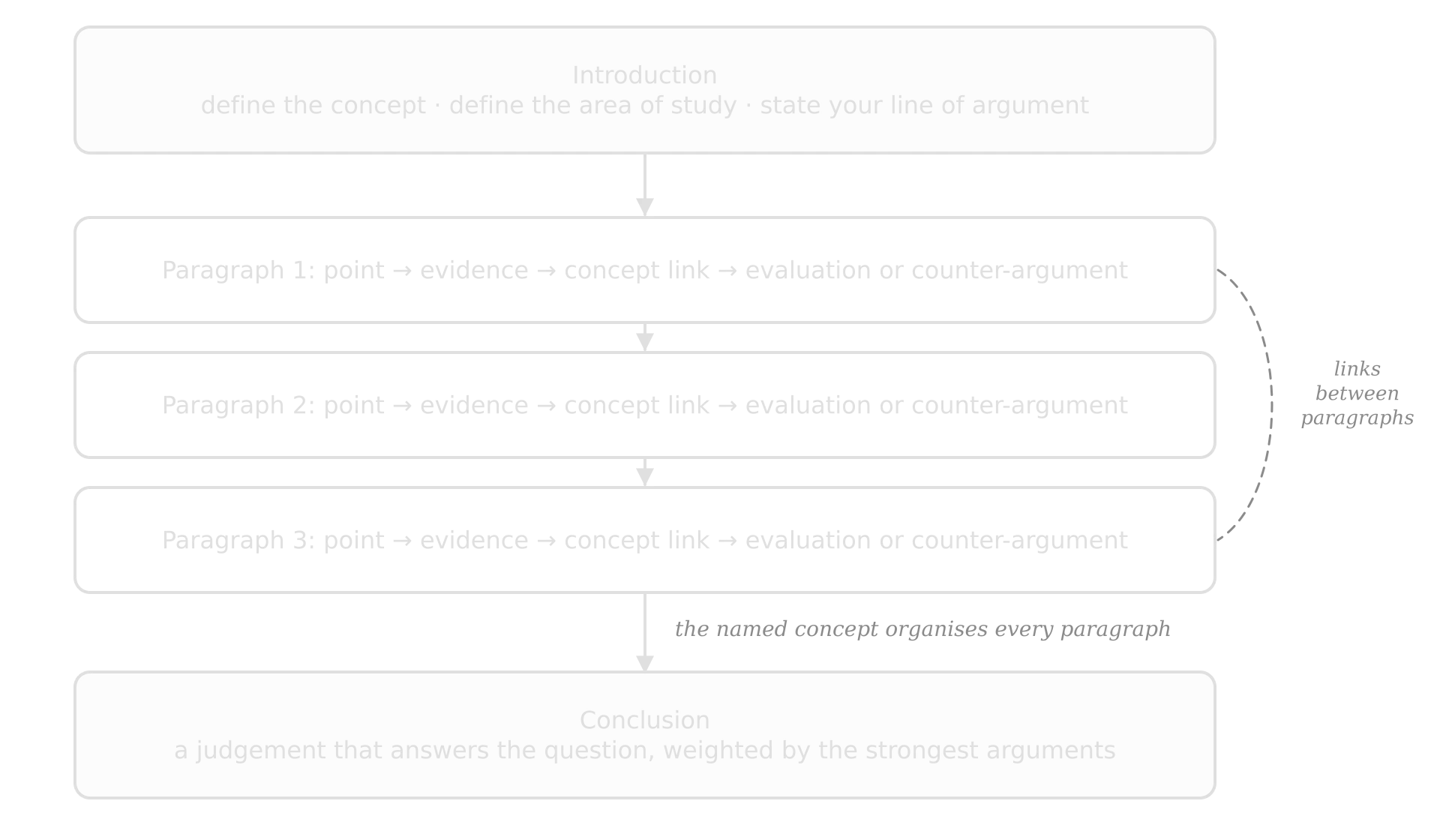
Essay structure: an introduction defining the concept and the area of study and stating the line of argument; three paragraphs each moving from point to evidence to concept link to evaluation; a conclusion giving a reasoned judgement.Essay structure: an introduction defining the concept and the area of study and stating the line of argument; three paragraphs each moving from point to evidence to concept link to evaluation; a conclusion giving a reasoned judgement.
Each body paragraph ends with a concept link and an evaluative point, and the conclusion weighs those points; the dashed line shows paragraphs referring to each other.

Introduction

Three or four sentences are enough. Define the named concept in the way it applies to this question, define or briefly explain the area of study, and state your line of argument: the position the essay will defend. The line of argument is the most useful sentence in the essay, because every paragraph can be checked against it.

Example introduction. “Measurement in psychology is the process of turning a construct that cannot be observed directly into variables that can be recorded, and it raises questions of validity and reliability. Attachment is the emotional bond between an infant and a caregiver, which researchers infer from behaviour such as proximity-seeking and responses to separation. This essay argues that attachment can be measured reliably in controlled settings, but that the validity of the main measures across cultures is limited, so conclusions about attachment types should be treated with caution outside the samples on which the measures were developed.”

Body paragraphs

Three or four developed paragraphs are better than six short ones. Each paragraph follows the same pattern:

  1. Point: a claim that answers part of the question, written in terms of the concept.

  2. Evidence: a study, theory or real-world example, described only as far as the point needs.

  3. Concept link: an explanation of what the evidence shows about the concept, using its related terms (validity, sampling bias, direction of causality…).

  4. Evaluation: a strength, limitation, alternative explanation or counter-argument, and what it means for the point.

A final sentence that refers back to the question or forward to the next paragraph turns a list of points into an argument.

Comparing a descriptive paragraph with a concept-led one

The two paragraphs in the table use the same study for the same question: “Evaluate research into theory of mind with reference to the concept of measurement.”

Descriptive (4–6 band)

Concept-led (13–15 band)

“Baron-Cohen, Leslie and Frith (1985) tested children with autism, children with Down syndrome and typically developing children on the Sally-Anne task. Sally puts a marble in a basket and leaves, and Anne moves it to a box. Children were asked where Sally would look. Most children with autism said the box, while most of the other children said the basket. This shows that children with autism lack theory of mind. This study relates to measurement.”

“False-belief tasks such as the Sally-Anne task operationalise theory of mind as the ability to predict where a character will look for an object that was moved without her knowledge. Baron-Cohen and colleagues (1985) found that most autistic children in their sample failed the task while most children with Down syndrome passed it. The measure is reliable and easy to standardise, but its validity is limited: the task depends on language and on memory for the story, so a child may fail for reasons other than a lack of theory of mind. This measurement problem limits the causal conclusion that autism involves a deficit in theory of mind, because failure on one verbal task is an indirect measure of an unobservable ability. Studies using non-verbal looking-time measures, which suggest some false-belief understanding in infants, show that the age at which theory of mind appears depends partly on how it is measured.”

The concept-led paragraph uses the same study but makes a claim about measurement, explains why the measure is limited, links measurement to causality (a link between concepts), and brings in contrasting evidence. The descriptive paragraph spends its words on the procedure and names the concept only at the end.

Common mistake

Ending each paragraph with “This links to the concept of measurement.” A stated link is credited in the lower bands; the higher bands need the link explained: what exactly the evidence shows about measurement, and why it matters for the answer.

Conclusion

The conclusion answers the question directly and says why. It weighs the arguments rather than repeating them: which points are strongest, which limitations matter most, and what follows. For “to what extent”, it states a degree. It may also say what further evidence would change the judgement. A reasoned conclusion is short, usually three to five sentences, but it must follow from the paragraphs; a conclusion that suddenly takes a different position from the essay is marked down.

Example conclusion. “Attachment can be measured reliably: standardised observation produces consistent classifications between observers and across studies. However, the evidence on validity, especially from Japan and from Indigenous and non-Western samples, shows that the same behaviour can have different meanings in different caregiving cultures. The Strange Situation is therefore a valid measure of attachment only to a limited extent outside the cultures in which it was developed, and claims about cultural differences in attachment type are more convincing when they are supported by home observation or emic research.”

YouTube
Themantic Education (Travis Dixon) on how to prepare for the Paper 1 essays in the current course, including building evidence that can serve several concepts.

Showing links between concepts

Links between concepts are explicitly rewarded, and they are also the easiest way to show critical thinking. Concepts link when a problem under one concept causes or explains a problem under another. The table shows common links that can be used in many essays.

Link

How it works

Example sentence

Measurement → causality

An indirect or self-report measure weakens a causal conclusion.

“Because stress was measured by self-report at one time point, the study cannot show that stress came before illness.”

Bias → measurement

A measure built in one culture may not be valid in another.

“Using a Western questionnaire in rural Kenya is an imposed etic, so lower scores may reflect bias in the measure rather than a real difference.”

Causality → responsibility

Weak causal evidence makes it irresponsible to present a cause as proven.

“Telling patients that depression is caused by a chemical imbalance overstates correlational evidence.”

Perspective → causality

Explanations from one approach are reductionist, so causes are interactive.

“A biological explanation identifies one cause, but the diathesis–stress model shows that genes and environment interact.”

Responsibility → measurement

Ethical limits restrict what can be measured.

“Because children cannot be exposed to harm, effects of adversity are studied correlationally, which limits measurement of causes.”

Change → measurement

Whether change is real depends on how and when it is measured.

“Improvement measured straight after therapy says nothing about relapse at one year.”

Tip

When planning, write the named concept in the middle of the page and draw lines to any other concepts your evidence touches. Each line is a possible sentence that links concepts.

A full model essay

The model essay is written at about the length and depth that can be produced in 40 minutes, and its annotations show why it would reach the top band.

Worked example

Paper 1 Section C [15 marks]: In the context of health and well-being, to what extent does bias affect our understanding of cultural differences in mental health? Answer with reference to the concept of bias.

Show the model essay

Introduction. Bias in psychology is a systematic distortion in how research is designed, conducted or interpreted, so that conclusions depart from what is true. In research on cultural differences in mental health, it can enter through who is sampled, how disorders are measured and how clinicians interpret symptoms. This essay argues that bias has a large effect on our understanding of cultural differences, especially through measures developed in Western cultures, but that some differences are real and that emic research can reduce the distortion.

Paragraph 1: sampling and cultural bias in the knowledge base. Most of what psychology knows about mental health comes from a narrow group of people. Henrich, Heine and Norenzayan (2010) estimated that 96% of samples in leading psychology journals came from Western industrialised countries with only about 12% of the world’s population. Diagnostic categories for depression were developed mostly by Western clinicians working with these populations.

This is sampling bias at the level of a whole discipline: the “typical” symptoms of depression are typical of the groups that were studied, not necessarily of people elsewhere. The consequence is that behaviour in other cultures is compared with a Western standard, so differences risk being read as deviations rather than as different expressions of distress. This bias does not show that cultural differences are false, but it means the baseline used to compare cultures is itself culturally specific.

Paragraph 2: bias in measurement and diagnosis. The most important effect of bias is on measurement. Kleinman (1982) studied patients in Hunan, China, who had been diagnosed with neurasthenia, a condition defined mainly by bodily symptoms such as fatigue and headaches. When he reassessed them with Western diagnostic criteria, most also met the criteria for major depressive disorder. Ryder and colleagues (2008) found that Chinese outpatients with depression reported more bodily symptoms than Euro-Canadian outpatients, who reported more psychological symptoms such as sadness and guilt.

If depression is measured with questionnaires built around psychological symptoms, Chinese patients may be under-diagnosed, which is an imposed etic. Bias in the measure therefore creates an apparent cultural difference in prevalence that is partly an artefact of measurement. However, Ryder and colleagues also argued that the Western emphasis on psychological symptoms may be the more culturally unusual pattern, which shows that the bias lies in treating one culture’s expression as the norm, not in Chinese patients’ reports.

Paragraph 3: are prevalence differences real or biased? Large cross-national surveys find very different rates of depression. Weissman and colleagues (1996) reported lifetime rates from about 1.5 per 100 adults in Taiwan to 19 per 100 in Beirut. Some of this variation is likely to be real: the Beirut sample had lived through years of war, which is a well-established environmental risk factor, so the difference is consistent with a causal effect of trauma.

But some variation is likely to reflect bias. Where mental illness is stigmatised, people may under-report symptoms to interviewers, which is social desirability bias, and translated interviews may not capture local expressions of distress. Here bias links to causality: because measurement bias and real risk factors are confounded, the data cannot show how much of the difference is caused by culture or circumstances and how much by the way it was measured.

Paragraph 4: reducing bias through emic research. Bias is not inevitable. Patel and colleagues (1997) developed the Shona Symptom Questionnaire in Zimbabwe by first using qualitative interviews to find local idioms of distress, such as kufungisisa (“thinking too much”), and combining them with some items from international measures. The resulting tool identified common mental disorders in primary care with good accuracy. The Cultural Formulation Interview in the current DSM similarly asks clinicians to explore how patients themselves understand their distress.

These approaches show that bias can be reduced when measures are built from within a culture. Their limitation is that emic tools make cross-cultural comparison harder, because each culture has its own measure, so there is a trade-off between avoiding bias and comparing cultures, which is also a question of perspective.

Conclusion. Bias affects our understanding of cultural differences in mental health to a large extent. The strongest evidence is from measurement: when Western symptom lists are used in other cultures, apparent differences in prevalence partly reflect the measure rather than the people. Not all differences are produced by bias, since environmental factors such as war plausibly cause real differences in rates. The most reasoned judgement is that bias distorts the size and nature of cultural differences more than it creates them from nothing, and that combining emic measures with etic comparison is the most reliable way to separate real differences from biased ones.

Why this essay would reach the top band
  • The concept organises every paragraph. Each paragraph opens with a point about bias (sampling bias, measurement bias, bias in prevalence data, reducing bias).

  • Evidence is used, not described. Each study gets one or two sentences; the rest of the paragraph explains what it shows about bias.

  • Links between concepts are explained. Bias is linked to measurement (paragraph 2), causality (paragraph 3) and perspective (paragraph 4), each with a reason.

  • Critical analysis is developed. Counter-arguments appear inside paragraphs (Ryder’s reversal of the assumption; some differences are real; emic tools limit comparison).

  • The conclusion is reasoned and states a degree (“to a large extent”), follows from the paragraphs and weighs the strongest argument (measurement).

Annotated essay plans

A plan written in the first five minutes is the best predictor of a well-organised essay. Three further plans cover the other three contexts, with different concepts and command terms. Each shows the line of argument, the paragraphs, the concept links and the conclusion.

Worked example

Paper 1 Section C [15 marks]: In the context of human development, to what extent can attachment be validly measured across cultures? Answer with reference to the concept of measurement.

Show the plan

Introduction. Define measurement (operationalising a construct; validity and reliability) and attachment (an emotional bond with a caregiver, inferred from behaviour). Line of argument: attachment can be measured reliably, but the validity of the main measure across cultures is limited.

Paragraph 1: the Strange Situation as a standardised measure. Point: it operationalises attachment through behaviour at separation and reunion. Evidence: Ainsworth’s classification into secure, avoidant and resistant types. Concept link: standardisation gives high inter-rater reliability, so results can be compared across studies. Evaluation: reliability does not guarantee validity.

Paragraph 2: cross-cultural comparisons. Evidence: van IJzendoorn and Kroonenberg (1988) combined 32 Strange Situation studies from eight countries; secure attachment was the most common type everywhere, and variation within countries was larger than between them. Concept link: the measure can detect a broadly similar pattern across cultures, which supports some validity. Evaluation: most samples were from industrialised countries, so the conclusion is limited by sampling bias (link to bias).

Paragraph 3: validity problems in Japan. Evidence: Japanese infants studied by Takahashi (1990) were very distressed at separation, and many were classified as resistant, with none classified as avoidant. Concept link: the infants were rarely separated from their mothers, so the situation was more stressful for them than for American infants; the same behaviour may mean something different. This is an imposed etic, a measurement problem that becomes a problem of bias.

Paragraph 4: alternative measures. Evidence: home observation methods such as the Attachment Q-sort, and emic studies of multiple caregiving (for example in communities where infants are cared for by many adults). Concept link: triangulation across methods increases validity. Evaluation: different measures do not always agree, so attachment type depends partly on the measure used.

Conclusion. To a limited extent: the Strange Situation measures attachment reliably and seems valid in the cultures where it was developed, but its validity drops where caregiving practices differ. Valid cross-cultural measurement needs several methods and local knowledge of what infant behaviour means.

Annotation: the plan keeps measurement in every paragraph, links it to bias and to generalisability, and gives a conclusion with a degree. Paragraph 2 deliberately includes evidence for validity, so the essay is balanced.

Exam tip

Balance does not mean equal space for both sides. It means that the strongest counter-argument is taken seriously and answered. In the attachment plan, paragraph 2 gives the best case for valid measurement before paragraphs 3 and 4 limit it.

Worked example

Paper 1 Section C [15 marks]: In the context of learning and cognition, discuss environmental influences on cognitive processes with reference to the concept of causality.

Show the plan

Introduction. Define causality (showing that a change in one variable produces a change in another, which needs control of other variables and the right temporal order) and environmental influences (features of a person’s surroundings, such as poverty, toxins or technology, that affect thinking, memory or attention). Line of argument: environmental influences on cognition are real, but strong causal claims are only justified where natural experiments or true experiments rule out alternative explanations.

Paragraph 1: poverty and cognitive performance. Evidence: Mani and colleagues (2013) found that the same sugarcane farmers in India scored better on cognitive tests after harvest, when they had money, than before it. Concept link: testing the same farmers twice controls for many participant variables, which strengthens the causal claim that financial worry uses mental resources. Evaluation: Carvalho and colleagues (2016) tested low-income people in the United States before and after payday and found no difference in cognitive performance, so the cause may depend on how severe and long-lasting the financial pressure is.

Paragraph 2: toxins and the problem of confounding. Evidence: a pooled analysis of seven cohort studies by Lanphear and colleagues (2005) found that children with higher blood lead levels had lower IQ scores, even at low levels of exposure. Concept link: the data are correlational, and lead exposure is linked to poverty, poor housing and nutrition, which are third variables. Evaluation: the researchers controlled statistically for some confounds, and animal studies show a mechanism, so a causal claim is reasonable but not proven by these data alone (link to measurement: blood lead is measured at one time).

Paragraph 3: technology and memory. Evidence: Sparrow, Liu and Wegner (2011) reported that people who expected information to be saved on a computer remembered less of it and more about where it was stored (the Google effect). Concept link: a true experiment can show causation in the laboratory. Evaluation: in a large replication project, Camerer and colleagues (2018) did not reproduce one of its key effects, so even experimental evidence needs replication before a causal claim is accepted (link to bias: publication bias favours striking positive results).

Paragraph 4: interaction rather than single causes. Point: environments act through and with biological and cognitive factors, for example stress hormones affect memory, and poverty affects sleep and nutrition. Concept link: causality in cognition is usually multiple and interactive, so “the environment causes…” is reductionist (perspective).

Conclusion. The environment influences cognitive processes, and the case is strongest where designs control for alternative explanations (within-person comparisons, true experiments). Many claims rest on correlational data or on effects that have not replicated, so environmental influences are best described as contributing causes that interact with other factors.

Annotation: each paragraph uses a different research design (within-participants field study, cohort correlation, laboratory experiment), so the essay discusses causality by comparing what each design can show. This is critical analysis that grows from the concept rather than being added at the end.

The causality plan works because the choice of evidence was made with the concept in mind. Three studies with three different designs give three different answers about cause and effect, which is exactly the material a “discuss” question needs.

Worked example

Paper 1 Section C [15 marks]: In the context of human relationships, evaluate strategies for improving relationships with reference to the concept of change.

Show the plan

Introduction. Define change (deliberate change in behaviour or attitudes brought about by an intervention, and how long it lasts) and strategies for improving relationships (planned interventions, from couples therapy to programmes that bring groups together). Line of argument: strategies can change behaviour within the setting where they are used, but changes in attitudes, and changes that last or spread to other settings, are harder to achieve and to show.

Paragraph 1: changing intergroup behaviour through contact. Evidence: Mousa (2020) randomly assigned Christian footballers in post-ISIS Iraq to teams with or without Muslim teammates. Those with Muslim teammates were more likely to train with Muslims and to vote for a Muslim player for a sportsmanship award, but did not change behaviour outside football. Concept link: a randomised field experiment shows that cooperative contact causes change, but the change was limited to the setting. Evaluation: because behaviour outside football was also measured, the study shows the limits of the change as well as its presence.

Paragraph 2: changing norms through media. Evidence: Paluck (2009) found that a year of a radio soap opera in Rwanda changed listeners’ perceptions of social norms and some behaviours, such as willingness to express disagreement, but not their personal beliefs. Concept link: change in norms and behaviour can happen without change in beliefs, so “improving relationships” depends on which outcome is measured (measurement link).

Paragraph 3: changing relationships in the classroom. Evidence: Aronson’s jigsaw classroom, in which students depend on each other’s part of the material, increased liking between ethnic groups in desegregated American schools. Evaluation: effects were found within classrooms; evidence on lasting change outside them is weaker. Concept link: barriers to change, such as existing friendship groups, limit how far the effect spreads.

Paragraph 4: changing close relationships. Evidence: couples therapies based on observational research (for example Gottman’s work on conflict) improve satisfaction for many couples in the short term, but follow-up studies show that some improvement fades. Concept link: change must be judged over time, which needs longitudinal measurement. Evaluation: self-report of satisfaction is open to social desirability bias (bias link).

Conclusion. Strategies for improving relationships do bring about change, and the best evidence comes from randomised field studies. The change is usually narrower and shorter-lived than the strategy aims for: behaviour changes before attitudes, and within a setting before beyond it. The strategies are therefore effective for specific, measurable changes, and less convincing as ways of transforming relationships in general.

Annotation: the plan uses the concept’s related terms (barriers to change, effectiveness, longitudinal evidence, intervention) and evaluates every strategy by the same three questions: what changed, for how long, and how do we know.

Timing within the essay

About 40–45 minutes is a realistic share of the paper for the essay, after the short answers. Within that time, a fixed routine prevents the most common problem: an essay that runs out of time before its conclusion.

Stage

Time

What to do

Choose

2–3 minutes

Read both questions; test each with the three-evidence check

Plan

4–5 minutes

Line of argument, three or four paragraph points, concept links, conclusion in one sentence

Introduction

3–4 minutes

Define concept and area; state the line of argument

Body paragraphs

7–8 minutes each

Point, evidence, concept link, evaluation

Conclusion

3–4 minutes

Answer the question with a reasoned judgement

Check

1–2 minutes

Concept named in every paragraph? Conclusion consistent?

If time is short, write the conclusion before the last body paragraph. An essay with three paragraphs and a reasoned conclusion scores more than one with four paragraphs and none.

YouTube
Travis Dixon (Themantic Education) writes Paper 1 essays under timed conditions and talks through his choices. It is long; watch the planning stage for how a line of argument is chosen.

Preparing for Section C

There are many possible combinations of area of study and concept, so memorising whole essays does not work. The more efficient approach is to build an evidence bank for each area of study: three or four pieces of evidence (studies, theories, real-world applications) chosen because each can be evaluated through several concepts.

Evidence (area: stress and health)

Bias

Causality

Measurement

Responsibility

A natural experiment on examination stress and immune function

Student sample

No random allocation; examination period is the natural IV

Immune markers versus self-reported stress

Low risk; blood samples need consent

A prospective study of life events and later illness

Volunteer sample

Correlational; reverse causation possible

Life-event scales ignore appraisal

Questions on distressing events

An animal study of chronic stress

Species bias in generalising

Experimental control

Behavioural measures of “depression” in animals are indirect

Harm to animals; the 3Rs

With a bank like this, any concept can be addressed by reading down the right column. For each area of study you also need one or two sentences that define the area accurately, and for each concept a definition and its main related terms.

Add to your notes: an evidence bank for each area of study you are most likely to choose: three or four pieces of evidence in rows, the six concepts in columns, and one sentence in each cell. Then practise turning one column into a paragraph plan in five minutes.

Common weaknesses

Weakness

Why it loses marks

Fix

Writing about the topic instead of the question

The demands of the question are only partly addressed

Write the line of argument first and check every paragraph against it

Mentioning the concept only at the start and end

Links must be included throughout

Start each paragraph with a point about the concept

Describing studies in detail

Study details are not assessed; time is lost

One or two sentences of evidence, then analysis

One-sided argument

Critical analysis needs counter-arguments and alternatives

Include the strongest opposing evidence in at least one paragraph

Listing strengths and limitations

Analysis stays undeveloped

Say which matters more and why

A conclusion that summarises

The top band needs a reasoned judgement

Answer the question, state a degree, and give the main reason

Using evidence from the wrong context

The question sets the context

Choose evidence that belongs to the named context and area

Common mistake

Writing a prepared essay on a different concept. An essay on “bias in research on peer influence” reused for a question on change will describe relevant studies but answer the wrong question. If the concept in the question is not the one you prepared, use the same evidence but rewrite every concept link for the new concept.

Exam tip

Use the concept’s own vocabulary to show precision: for measurement, “operationalisation”, “construct validity”, “triangulation”; for causality, “bidirectional ambiguity”, “third variable”, “random allocation”; for change, “effectiveness”, “relapse”, “barriers to change”. Precise terminology is part of every band.

Summary

  • Section C is one 15-mark essay chosen from two questions, each joining an area of study from one context to one of the six concepts.

  • The command terms are AO3 terms (discuss, evaluate, to what extent, sometimes examine), so the essay needs balanced critical analysis and a conclusion.

  • The markband rewards three things above all: developed critical analysis, links between concepts throughout, and a reasoned, clearly stated conclusion.

  • Structure: an introduction that defines the concept and area and states a line of argument; three or four paragraphs of point, evidence, concept link and evaluation; a conclusion that weighs the arguments.

  • Study details are not assessed for themselves; use evidence briefly and spend words on what it shows about the concept.

  • Links between concepts (for example measurement limiting causality) are explicitly rewarded and show critical thinking.

  • Prepare an evidence bank per area of study that can be evaluated through any concept, rather than memorised essays.

  • Keep to a time routine: choose, plan, write, and leave time for the conclusion.

Self-check

  • To do:

    I can take apart a Section C question into context, command term, area of study and concept.

  • To do:

    I can explain what moves an essay from the middle bands to the top band.

  • To do:

    I can write an introduction that defines the concept and area and states a line of argument.

  • To do:

    I can write a body paragraph with a point, evidence, an explained concept link and evaluation.

  • To do:

    I can show links between the named concept and at least two other concepts.

  • To do:

    I can write a reasoned conclusion that states a degree for a “to what extent” question.

  • To do:

    I have an evidence bank for the areas of study I am most likely to choose.

  • To do:

    I can plan an essay in five minutes and write it within the time I have set.

Keep your place

In Augment the notes remember where you stopped and which pages you have finished.

Open in Augment

More IB Psychology notes

  • Paper 1: short-answer questionsThe page before this.
  • Paper 2: class practical questionsThe next page.
  • Psychology assessmentEach Psychology paper, the internal assessment and grade boundaries.
  • IB PsychologyThe Psychology syllabus, how it is assessed and every notes page.

Carry on with Psychology in Augment

With a free account, Augment remembers where you stopped in the notes and which questions you have marked.

Start free