Augment Education
    • Question bank
    • Quick fire
    • Worksheets
    • Flashcards
    • Notes
    • Try a quick-fire round
    • All features
    • Business
    • Digital Society
    • Economics
    • Geography
    • Global Politics
    • History
    • Philosophy
    • Psychology
    • Anthropology
    • World Religions
    • Biology
    • Chemistry
    • Physics
    • Computer Science
    • Design Technology
    • ESS
    • SEHS
    • Language and literature
    • Language acquisition
    • Maths AA
    • Maths AI
    • Dance
    • Film
    • Music
    • Theatre
    • Visual Arts
    • Grade calculator
    • Grade boundaries
    • Subject checker
    • Focus timer
    • Exam countdown
    • All free tools
    • IB guide
    • All subjects
  • Blog

Search

Search subjects, the syllabus, glossary terms, the booklets, the IB guide, help and the blog

Log inStart free
augment

Augment Education

IB Diploma revision built around the syllabus.

contact@augment-education.com

Product

  • Features
  • Question bank
  • Quick fire
  • Worksheets
  • Flashcards
  • Notes
  • Subjects
  • What's new

Learn

  • IB guide
  • Booklets, explained
  • Glossary
  • Blog
  • Free tools
  • Grade calculator
  • Subject checker

Company

  • About
  • Help
  • For parents
  • For teachers
  • Comparisons

Subjects

  • English A Lit
  • English A Lang & Lit
  • Chinese A Lit
  • Chinese A Lang & Lit
  • Spanish A Lit
  • Spanish A Lang & Lit
  • English Lit & Perf
  • Spanish Lit & Perf
  • English B
  • Mandarin B
  • Spanish B
  • English ab initio
  • Mandarin ab initio
  • Spanish ab initio
  • Business
  • Digital Society
  • Economics
  • Geography
  • Global Politics
  • History
  • Philosophy
  • Psychology
  • Anthropology
  • World Religions
  • Biology
  • Chemistry
  • Physics
  • Computer Science
  • Design Technology
  • ESS
  • SEHS
  • Maths AA
  • Maths AI
  • Dance
  • Film
  • Music
  • Theatre
  • Visual Arts

Augment Education is developed independently of the International Baccalaureate Organization and is not endorsed by it. “IB” and “International Baccalaureate” are its trademarks.

© 2026 Augment Education. All rights reserved.

  • Privacy
  • Terms
  1. Subjects
  2. Psychology
  3. Paper 1: short-answer questions

Paper 1: short-answer questions

Answer Paper 1 Sections A and B: explain an approach term with an explained example, apply a term to an unseen scenario, and use the markbands, structures and model answers to reach the top band.

  • IB Psychology
  • Exam skills
  • SL and HL

25 min readLast reviewed 15 Oct 2026

Paper 1 opens with four compulsory short-answer questions. Sections A and B both test the 27 approach terms of the biological, cognitive and sociocultural approaches, but in different ways. Section A asks you to show that you understand a term and can illustrate it with an example. Section B gives you an unseen scenario from one of the four contexts and asks you to apply a term to it. Together they make up 20 of the paper’s 35 marks, and they are the most predictable part of the paper, so preparation pays off directly.

Section A

Section B

Questions

Two, both compulsory

Two, both compulsory

Marks

4 each

6 each

What is tested

Knowledge and understanding of an approach term, shown through an explanation and an example

Application of an approach term to an unseen scenario

Source of the questions

Two of the three approaches; no context named

A scenario from one of the four contexts; the two questions use different contexts

Main command terms

Explain, describe

Explain, suggest (often “with reference to this scenario”)

What earns the top band

Detailed knowledge and a relevant example that is explained

Accurate, detailed knowledge and well-developed application to the scenario

Definition

Short-answer question: a Paper 1 Section A question worth 4 marks that asks for an explanation or description of an approach term, illustrated with one example of behaviour.

Section A: explaining an approach term

What the questions look like

Section A questions are built from the names of the approach terms themselves: “neurotransmission”, “schema theory”, “compliance techniques”, “emic approach” and so on. Because any term can be taught through any context, no context is named; you choose the example. Typical forms are:

  • “Explain [term] with reference to one example of human behaviour.”

  • “Describe how [one item, such as one chemical messenger] plays a role in one human behaviour.”

  • “Explain one limitation of [an argument or method linked to the term].”

  • “Describe [one model or theory listed under the term].”

The two questions come from two different approaches, so you might have one biological and one sociocultural question, or one cognitive and one biological. Research methodology terms are not used in Section A.

Exam tip

Section A is not a test of research. Details of studies, such as sample sizes, dates and percentages, earn no credit for themselves. What is assessed is your understanding of the term, shown through how well you explain it and how relevant your example is. A study is often the clearest example, but a real-world case or a realistic hypothetical example can score just as well if it is explained.

How Section A is marked

Each question is marked on a 4-mark markband. Markbands are descriptions of the quality of an answer: the examiner reads the whole answer, decides which description fits it best, then chooses the mark within that band.

Marks

Knowledge

Example

0

Nothing relevant to the question

—

1–2

Limited knowledge relevant to the question

Relevant, but not explained

3–4

Detailed knowledge relevant to the question

Relevant and explained

Definition

Markband: a level descriptor used to mark an answer holistically; the examiner chooses the band whose description best fits the whole answer, then a mark within it.

The table shows why the example matters so much. An answer with an accurate definition but an example that is only named (“for example, Asch’s study”) cannot pass 2 marks, however good the definition is. The step from 2 to 3 is the step from naming an example to explaining how it shows the term.

A structure that works

A reliable structure for Section A has four moves: define the term, explain how it works, give one example, and link the example back to the term. A similar structure is taught as “T-REX” (term, restate the question, explain, example); the name matters less than making all four moves.
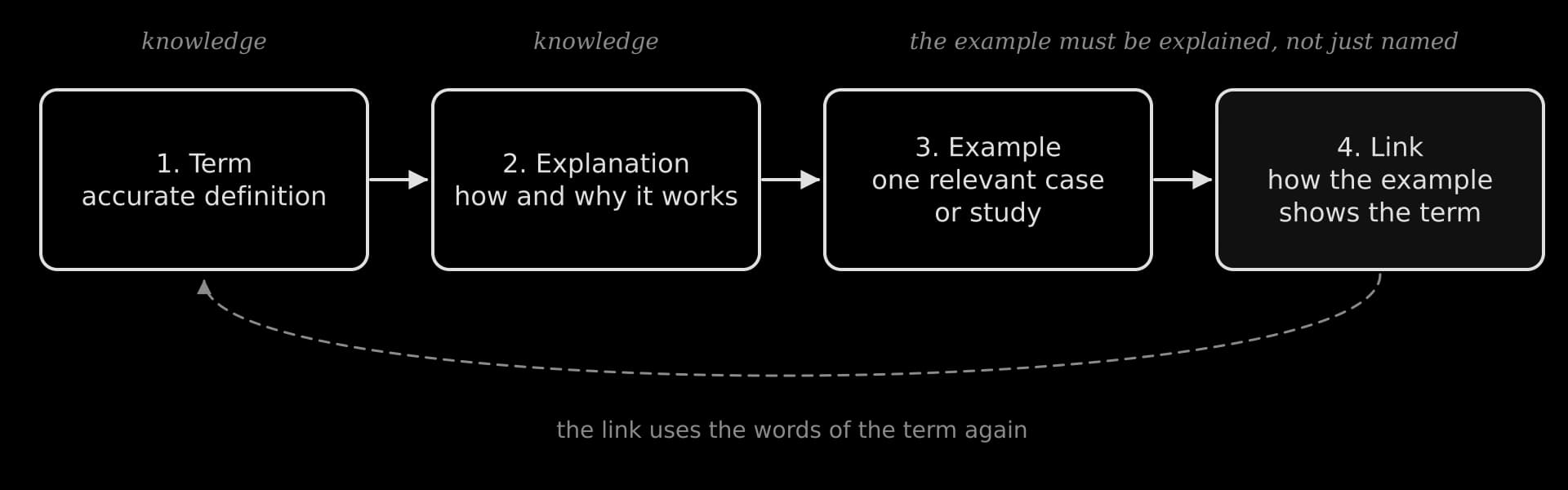
Four boxes in a row: 1 term, accurate definition; 2 explanation, how and why it works; 3 example, one relevant case or study; 4 link, how the example shows the term. A dashed arrow returns from the link to the term.Four boxes in a row: 1 term, accurate definition; 2 explanation, how and why it works; 3 example, one relevant case or study; 4 link, how the example shows the term. A dashed arrow returns from the link to the term.
The last box carries the marks for the example: it says how the example shows the term, using the term’s own words again.
  1. Term. One or two sentences that define the term precisely, in the course’s wording.

  2. Explanation. Two or three sentences on how and why it works: the mechanism, the components, the conditions.

  3. Example. A brief account of one relevant example: a study, a real case or a realistic scenario.

  4. Link. One or two sentences that say exactly how the example shows the term. This is the sentence most often missing from weak answers.

An answer of about 150–250 words is enough. Longer answers usually add study details that earn nothing and take time from Sections B and C.

YouTube
Themantic Education (Travis Dixon) on his T-REX structure for short answers in the current course: define the term, restate the question, explain the topic and explain the example. Watch for how the example is tied back to the term.

What counts as an explained example

An example is explained when the reader can see which part of the behaviour corresponds to which part of the term. A helpful test is to cross out the name of the term in your link sentence: if the sentence still makes sense without it, the link is probably too vague.

Not explained

Explained

“An example of social identity theory is football fans.”

“Football fans categorise themselves as members of their club (social categorisation) and take on the group’s norms, such as wearing its colours (social identification). They then compare their club favourably with rivals, which raises their self-esteem through positive distinctiveness. This shows social identity theory, because the fans’ hostility to rivals follows from their need for a positive social identity, not from any personal conflict.”

“Maguire et al. (2000) studied taxi drivers, which shows neuroplasticity.”

“London taxi drivers had larger posterior hippocampi than controls, and the volume was greater in drivers with more years of experience. Because volume increased with experience, the result suggests that years of spatial navigation changed the structure of the hippocampus, which is neuroplasticity: the brain changing in response to experience.”

Common mistake

Giving two or three examples to be safe. The question asks for one, and the markband rewards an example that is explained. Three examples in the same number of words means three examples that are each named rather than explained, which keeps the answer in the 1–2 band.

Model answers for Section A

The Section A model answers come from three different approaches and use three kinds of example: a measure developed through research, a hypothetical case and an experiment. The first is shown at two levels, so that the difference between the bands is visible.

Worked example

Paper 1 Section A [4 marks]: Explain the emic approach with reference to one example of human behaviour.

Show answers at two levels

Answer in the 1–2 band. The emic approach is when psychologists study a culture from the inside. An example is Patel et al. (1997), who made a questionnaire in Zimbabwe in the Shona language. It was given to 302 people at clinics and had 14 items.

Why it stays in the band: the definition is accurate but thin, and the example is relevant but not explained. The sample size and number of items earn nothing. The answer never says what was emic about the study or why that mattered.

Answer in the 3–4 band. The emic approach studies behaviour from within a culture, using the concepts and meanings that members of that culture use themselves rather than categories brought in from outside. Researchers usually begin with qualitative methods, such as interviews or ethnography, so that local understandings emerge from the data. The aim is to describe behaviour in its own terms, which avoids imposing one culture’s assumptions on another.

An example is the development of the Shona Symptom Questionnaire in Zimbabwe by Patel and colleagues. Instead of only translating a Western checklist, the researchers began with ethnographic and qualitative work with local people, including patients consulting traditional healers, to find out how distress is expressed locally. This produced items based on local idioms of distress, such as kufungisisa, “thinking too much”, which would not appear in a Western checklist.

This shows the emic approach, because the content of the measure came from the culture’s own concepts of distress rather than from outside categories. As a result, the questionnaire is better placed to recognise distress that a translated Western tool might miss.

Why it reaches the top band: the term is defined and explained (how emic research is done and why), the example is relevant, and the last paragraph explains exactly how the example shows the term.

Tip

A quick check for the link sentence: it should contain the word “because” and the name of the term. “This shows the emic approach, because…” forces you to give the reason.

Worked example

Paper 1 Section A [4 marks]: Describe one model of acculturation with reference to one example of human behaviour.

Show a model answer

Model answer. Acculturation is the process of cultural and psychological change that follows contact between people of different cultures. Berry’s model of acculturation proposes that people moving into a new culture face two separate questions: how far they want to keep their heritage culture and identity, and how far they want contact with and participation in the larger society.

Crossing the two questions gives four strategies. Integration means keeping the heritage culture while also taking part in the new one. Assimilation means giving up the heritage culture and adopting the new one. Separation means keeping the heritage culture and avoiding contact with the new one, and marginalisation means losing contact with both. Berry argued that the strategy available also depends on the host society: integration is possible only if the host culture accepts diversity.

For example, a 15-year-old who moves from Brazil to Canada might speak Portuguese and celebrate Brazilian festivals with her family while joining a school sports team and making Canadian friends. In Berry’s terms she values both her heritage culture and contact with the host culture, so she is using integration. Research with immigrant adolescents in many countries, such as the study by Berry and colleagues (2006), found that integration tends to go with the best psychological and school adjustment, which suggests her strategy is likely to help her adapt.

The acculturation answer uses a hypothetical example, which is fully acceptable. What makes it work is that the example is described in terms of both of Berry’s dimensions, so the reader can see why it is integration rather than assimilation.

Worked example

Paper 1 Section A [4 marks]: Describe how one chemical messenger plays a role in one human behaviour.

Show a model answer

Model answer. Cortisol is a hormone released by the adrenal cortex when the HPA axis is activated by stress. When a stressor is perceived, the hypothalamus signals the pituitary gland, which releases a hormone that travels in the blood to the adrenal glands, where cortisol is produced. Cortisol helps the body cope with stress by raising blood glucose, but it also acts on the brain, where the hippocampus has many cortisol receptors.

One behaviour it affects is memory retrieval. High levels of cortisol at the time of recall reduce the ability to retrieve declarative memories, such as facts and word lists. De Quervain and colleagues (2000) showed this in an experiment: healthy participants who took a single dose of cortisone (which the body converts to cortisol) shortly before a memory test recalled fewer words learned the previous day than participants given a placebo.

This describes the role of cortisol in memory, because raising the level of the hormone at the moment of retrieval, while keeping learning the same, was enough to reduce recall. It also helps to describe a familiar behaviour: a student who is highly stressed at the start of an examination may “go blank” on material they knew well the day before.

Exam tip

“Describe how one chemical messenger plays a role in one human behaviour” asks for one messenger and one behaviour. Name both early, describe the mechanism (where it is released, what it acts on) and then describe how it affects the behaviour. Writing about several hormones, or about stress in general, spreads the answer too thin.

Preparing for every term

Because Section A can use any of the approach terms, preparation is a matter of coverage. For each term, prepare a precise one-sentence definition, a short explanation of how it works and one example you can explain in three or four sentences. Where a term contains several items (for example “chemical messengers” or “compliance techniques”), prepare one item in depth.

Approach

Terms

Planning note

Biological

animal research and animal models; biological reductionism; brain imaging techniques; chemical messengers; diathesis–stress model; genetic inheritance; localisation of function; neuroplasticity; neurotransmission

Questions may ask for a limitation (reductionism, localisation) or the use of a method (imaging, animal models) as well as an explanation with an example.

Cognitive

anchoring bias; classical conditioning; cognitive load theory; cognitive models; confirmation bias; dual processing theory; operant conditioning; schema theory

For “cognitive models”, prepare one model of one cognitive process (for example the multi-store model of memory) that you can describe and illustrate.

Sociocultural

cognitive dissonance; compliance techniques; conformity; cultural dimensions; emic approach; enculturation; etic approach; models of acculturation; social identity theory; social learning theory

Emic and etic can be asked as approaches to research: prepare an example of a study that used each and why.

Add to your notes: a one-page “term card” for each of the 27 approach terms: definition, mechanism in two sentences, one example, and a ready-made link sentence beginning “This shows [term], because…”. Practise writing any card from memory in eight minutes.

Section B: applying a term to a scenario

What the questions look like

Each Section B question begins with a short scenario set in one of the four contexts: health and well-being, human development, human relationships, or learning and cognition. A question then asks you to apply an approach term to it. Because the scenario is unseen, the question tests whether you can use your knowledge flexibly, not whether you can repeat a prepared answer. This is why Section B questions are often called applied short-answer questions.

Definition

Applied short-answer question: a Paper 1 Section B question worth 6 marks that presents an unseen scenario from one of the four contexts and asks the student to apply an approach term to it.

Section B questions take several forms:

  • Account for a behaviour: “With reference to this scenario, explain how [term] could account for [the behaviour described].”

  • Change a behaviour: “Explain how [term] could be used to [reduce conflict / promote empathy / increase attendance].” These often use “suggest”.

  • Evaluate a research tool in context: a short study is described (for example a rat study or an fMRI study) and you explain the value or a limitation of an approach term such as animal models, brain imaging, or the etic approach in that study.

  • Use a model: a model of a cognitive process is described and you explain its role or value in understanding that process.

How Section B is marked

Marks

Knowledge and understanding

Application

0

Nothing relevant

—

1–2

Limited

Relevant but limited

3–4

Some detail, mostly accurate

Relevant and partly developed

5–6

Accurate and detailed

Well developed

Two things are judged together: how accurately and fully you know the term, and how well you apply it. Application is “well developed” when several details of the scenario are each linked to a specific part of the theory, and the consequence of each link is explained. It is “partly developed” when the scenario is mentioned but only one detail is used, or when links are asserted (“this is social learning”) without saying how.

A structure that works
Flow: read the scenario and underline three or four details, explain the term briefly, do what the command term asks. Below, three rows each link a detail of the scenario to a part of the theory and to what follows from it.Flow: read the scenario and underline three or four details, explain the term briefly, do what the command term asks. Below, three rows each link a detail of the scenario to a part of the theory and to what follows from it.
The marks for application come from the three lower rows: each detail of the scenario is matched to a part of the theory, and the answer says what follows from the match.
  1. Read the scenario twice and underline the three or four details that the question writer included on purpose: ages, settings, what people said, what changed. Almost every sentence in a scenario is there to be used.

  2. Open with the term, defined accurately in one or two sentences. Keep it brief: Section B rewards application more than a long account.

  3. Work through the details, one short paragraph each. In each, quote or paraphrase the detail, name the part of the theory it matches, and explain what follows.

  4. Do what the command term asks. If the question says “suggest”, end with a specific proposal; if it asks about a limitation, make sure the limitation is the focus.

About 250–350 words is enough for a strong answer. A useful check before moving on is to count the sentences that mention the scenario. If fewer than half do, the answer is too general.

YouTube
Themantic Education (Travis Dixon) gives a quick overview of Paper 1 in the current course, including how Sections A and B differ.

Common mistake

Writing a Section A answer in Section B. A full account of social learning theory with the Bobo doll study, followed by one sentence (“This explains why the children in the scenario copy the coach”), shows knowledge but almost no application. The scenario, not the theory, must organise the answer.

Model answers for Section B

The Section B model answers come from three contexts and show two question forms: explaining a limitation of a research approach, and accounting for a behaviour.

Worked example

Paper 1 Section B [6 marks]: Health and well-being. A charity working with refugees from Afghanistan in a European city wants to know how many of them have depression. It translates a short depression questionnaire, developed and tested in the United States, into Dari and Pashto. Most items ask about feelings such as sadness, guilt and loss of interest. Very few refugees score above the cut-off for depression, but local doctors report that many refugees come to them with headaches, tiredness and chest pain that have no physical cause.

With reference to this scenario, explain one limitation of using an etic approach in this research.

Show a model answer

Model answer. The etic approach studies behaviour from outside a culture, using concepts and measures assumed to be universal so that groups can be compared. The charity uses an etic approach, because it applies a questionnaire developed in the United States to a different cultural group, assuming that depression is expressed in the same way.

One limitation is that the measure may not be valid in the new culture, which is an imposed etic. The questionnaire’s items focus on psychological symptoms such as sadness and guilt, which reflect how depression is commonly described in North America. Translating the words into Dari and Pashto does not make the concepts equivalent: a translated item can be understood correctly and still miss the way distress is usually expressed. This is a problem of measurement equivalence.

The scenario suggests this is happening. Few refugees score above the cut-off, yet doctors report many with headaches, tiredness and chest pain with no physical cause. These may be somatic expressions of distress, which research has found to be more common in many non-Western groups; for example, Ryder and colleagues (2008) found that Chinese outpatients with depression reported more bodily symptoms than Euro-Canadian outpatients, who reported more psychological ones. Because the questionnaire contains few bodily items, refugees who express depression in this way would score low.

As a result, the charity is likely to underestimate the prevalence of depression and may conclude that few refugees need help. An emic step, such as interviewing refugees and local doctors about how distress is expressed before choosing items, would reduce this limitation.

The etic answer uses every detail of the scenario: the origin of the questionnaire, the translation, the content of the items, the low scores and the doctors’ reports. The research example is kept to one sentence, because its job is to support the point about the scenario, not to be described for its own sake.

Worked example

Paper 1 Section B [6 marks]: Human development. In a nursery, a researcher puts out a new set of toys and tells a group of four-year-olds that the toy tool kit is “for boys” and the toy jewellery box is “for girls”. Over the next week, most boys play with the tool kit and most girls with the jewellery box. When asked a week later, the children remember more about the toys labelled for their own gender. One girl who had played with the tool kit says, “I was only helping the boys.”

With reference to this scenario, explain how schema theory could account for the children’s behaviour.

Show a model answer

Model answer. A schema is a mental representation of knowledge about an object, person, event or group, built up from experience. Schema theory proposes that schemas guide attention, interpretation and memory through top-down processing: information that fits a schema is noticed and remembered more easily, and information that does not fit is ignored or reinterpreted. By the age of four most children have a gender schema, a set of beliefs about what is “for boys” and “for girls”, and a self-schema that includes their own gender.

The labels “for boys” and “for girls” activate the children’s gender schemas, so the new toys are classed as belonging to one gender. Because the children’s self-schemas include their own gender, toys labelled for their own group are seen as relevant to them, so they approach and play with those toys. This accounts for boys choosing the tool kit and girls the jewellery box, even though the toys were new and had no gender before the labels were given.

The schema also explains the memory finding. Children paid more attention to toys that fitted “my gender”, so those toys were encoded in more detail and recalled better a week later. Toys labelled for the other gender were processed less deeply. This matches research by Bradbard and colleagues (1986), in which children remembered more about unfamiliar objects labelled for their own gender.

Finally, the girl’s comment shows how schemas handle inconsistent information. Playing with a “boys’ toy” does not fit her gender schema, so she reinterprets her behaviour as “helping the boys”, which keeps the schema intact. Schema theory therefore accounts for the children’s choices, their memory and the way they explain behaviour that does not fit.

Exam tip

In Section B, a short reference to research can strengthen application if it shows that the mechanism you are applying is real, as in the gender schema answer. Keep it to one sentence and connect it straight back to the scenario.

Worked example

Paper 1 Section B [6 marks]: Learning and cognition. A primary school in Kuala Lumpur wants pupils to read more at home. It introduces an app in which pupils earn 10 points for every book they finish. Points can be swapped for small prizes, and each week the top three readers are announced in assembly. In the first month, the number of books read rises sharply. However, teachers notice that many pupils choose very short books, and some who used to love reading now say they only read “for the points”.

With reference to this scenario, explain how operant conditioning could account for the changes in the pupils’ reading behaviour.

Show a model answer

Model answer. Operant conditioning is learning in which the frequency of a behaviour changes because of its consequences. Behaviour followed by a pleasant consequence (positive reinforcement) becomes more frequent, and behaviour followed by an unpleasant consequence becomes less frequent. In Skinner’s account, the specific behaviour that produces the consequence is the behaviour that is learned.

The rise in reading can be explained by positive reinforcement. Finishing a book is followed by 10 points, which work as secondary reinforcers because they can be exchanged for prizes, and by public recognition in assembly. Because finishing a book is reliably followed by rewards, the behaviour becomes more frequent, which explains the sharp increase in the first month.

The choice of short books follows from what exactly is reinforced. Points are given per book finished, not per page or for understanding, so the response that earns the most reinforcement for the least effort is finishing short books. Operant conditioning predicts that pupils will learn this, because the consequence shapes the specific behaviour that produces it, not the behaviour the school intended.

Pupils who now say they read “for the points” show a limit of reinforcement known as the overjustification effect: when a strong external reward is given for an activity that was already enjoyable, people may come to explain their behaviour by the reward, and intrinsic interest can fall. Lepper, Greene and Nisbett (1973) found this when children who expected a reward for drawing later chose to draw less in free time. If the school removes the points, operant conditioning predicts extinction of the reading behaviour for these pupils, unless reading has become rewarding in itself.

Timing strategy

Sections A and B are worth 20 of the paper’s 35 marks, but the 15-mark essay needs the longest block of time. A practical rule is to spend roughly 2.5 minutes per mark and to keep the short answers to their share so that the essay is not rushed.

Part

Marks

Suggested time

What the time is for

Section A, question 1

4

8–10 minutes

One minute to plan the four moves; 7–9 minutes writing

Section A, question 2

4

8–10 minutes

Same as question 1

Section B, question 1

6

13–15 minutes

Two to three minutes reading and underlining the scenario; the rest writing

Section B, question 2

6

13–15 minutes

Same as question 1

Section C essay

15

40–45 minutes

Five minutes to choose and plan; 35–40 minutes writing; a short check

  • Start with the question you know best. You may answer in any order. Starting with a confident answer settles nerves and banks time.

  • Do not overwrite Section A. A 4-mark answer that runs to a page is a sign of study details that earn nothing. Stop once the link sentence is written.

  • Read Section B scenarios before you write anything. Underlining takes two minutes and makes the rest of the answer faster.

  • Leave a gap and move on if you cannot remember a term. A partial answer to every question scores more than a perfect answer to three.

Tip

In timed practice, write the time you should finish each question at the top of the page before you start (for example “A1 by 0:10, A2 by 0:20”). Checking against a written plan is quicker than doing arithmetic under pressure.

Common weaknesses

Most lost marks in short answers come from a small number of habits. The table pairs each habit with its fix.

Weakness

Why it loses marks

Fix

The example is named, not explained

The 3–4 band needs an explained example

Finish with “This shows [term], because…”

Study details instead of explanation

Samples, dates and percentages are not assessed

Keep only the details needed to show the term at work

Definition is vague or slightly wrong

Knowledge must be accurate and detailed

Learn one precise definition per term and use its key words

Answering a different term

Confusing conformity with compliance, or emic with etic, makes the answer irrelevant

Underline the term in the question and check it against your definition

Theory dump in Section B

Application is the main criterion

Make most sentences refer to the scenario

Ignoring part of the question

For example, giving an account when it asked for a limitation

Box every qualifier: “one”, “limitation”, “how … could be used”

Inventing details not in the scenario

Application must be to the scenario given

Use “may” or “could” when you infer, and base the inference on a detail

Common mistake

Treating “explain one limitation” as “evaluate”. The question asks for one limitation, explained in depth: what the limitation is, why it arises, and what effect it has on what can be concluded. Listing three limitations in a sentence each gives three undeveloped points instead of one developed one.

Both sections reward explanation over information. In Section A, the example must be explained in terms of the term; in Section B, the term must be explained in terms of the scenario. An answer that only names, lists or describes cannot reach the top band.

Practise with these questions

Plan each answer in two minutes, then write it in the time from the timing table. Check it against the four-move structure (Section A) or the detail-by-detail structure (Section B).

  • Section A: Explain dual processing theory with reference to one example of human behaviour.

  • Section A: Explain one limitation of using animal models to study human behaviour.

  • Section A: Explain the foot-in-the-door technique with reference to one example of human behaviour.

  • Section B (human relationships): Two neighbouring villages have argued for years over water from a shared river. A charity plans a project in which young people from both villages will work together to build a new well. With reference to this scenario, explain how social identity theory could be used to improve relations between the villages.

  • Section B (learning and cognition): A driving instructor notices that learners who have been told that their test examiner is “very strict” make more mistakes than learners who were told nothing. With reference to this scenario, explain how one cognitive bias could account for the learners’ behaviour.

Plan for the social identity theory question

Term: social identity theory: people categorise themselves into groups, identify with them and compare them with out-groups to gain positive distinctiveness, which can produce in-group favouritism and intergroup hostility.

Detail 1: “two villages … argued for years”: each village is an in-group and the other an out-group; long conflict has made the village identity salient and comparisons competitive.

Detail 2: “young people from both villages will work together”: cooperative contact on a shared task can create a superordinate goal that neither village can reach alone.

Detail 3: “build a new well”: success depends on both groups, which encourages recategorisation into a common in-group (“young people who built the well”), so the comparison that fed hostility becomes less relevant.

Do what the question asks: explain how this would improve relations, and note a condition (equal status in the project, support from village leaders), because contact without these can strengthen group boundaries.

Summary

  • Section A asks you to explain or describe an approach term with one example; the two questions come from two different approaches and name no context.

  • The top Section A band needs detailed knowledge and an example that is relevant and explained; study details earn nothing for themselves.

  • Use four moves in Section A: term, explanation, example, and a link sentence saying how the example shows the term.

  • Section B gives an unseen scenario from one of the four contexts and asks you to apply an approach term to it.

  • Section B rewards accurate knowledge and well-developed application: link several details of the scenario to specific parts of the theory and say what follows.

  • Spend about 8–10 minutes on each Section A answer and 13–15 minutes on each Section B answer, keeping 40–45 minutes for the essay.

  • Prepare a term card for each of the 27 approach terms: definition, mechanism, example and link sentence.

Self-check

  • To do:

    I can explain what Section A and Section B of Paper 1 each test and how they are marked.

  • To do:

    I can write a Section A answer with a term, an explanation, an example and an explained link.

  • To do:

    I can tell the difference between an example that is named and one that is explained.

  • To do:

    I have a prepared definition and example for each of the 27 approach terms.

  • To do:

    I can pick out the key details of an unseen scenario and link each one to part of a theory.

  • To do:

    I can answer “account for”, “could be used to” and “one limitation” forms of Section B question.

  • To do:

    I can keep to the time plan for Sections A and B in timed practice.

Keep your place

In Augment the notes remember where you stopped and which pages you have finished.

Open in Augment

More IB Psychology notes

  • Command termsThe page before this.
  • Paper 1: concept-based extended responseThe next page.
  • Psychology assessmentEach Psychology paper, the internal assessment and grade boundaries.
  • IB PsychologyThe Psychology syllabus, how it is assessed and every notes page.

Carry on with Psychology in Augment

With a free account, Augment remembers where you stopped in the notes and which questions you have marked.

Start free