Command terms
Recognise every command term used in psychology questions, know the depth of answer each one asks for, and turn it into a structure for a short answer or an essay.
- IB Psychology
- Exam skills
- SL and HL
Every examination question in psychology begins with a command term: a verb or phrase such as “describe”, “explain” or “evaluate” that tells you what kind of thinking the answer must show. Two questions about the same topic can need completely different answers. “Describe social identity theory” asks for an accurate account of the theory; “Evaluate social identity theory” asks for a judgement about how well it is supported. An answer that is excellent for the first question earns few marks for the second.
Psychology has fifteen command terms. Each one has a fixed meaning, a typical shape of answer and a depth that the marks reward. Learning them early makes it easier to plan answers quickly and to avoid writing the right content for the wrong task.
Command terms and the assessment objectives
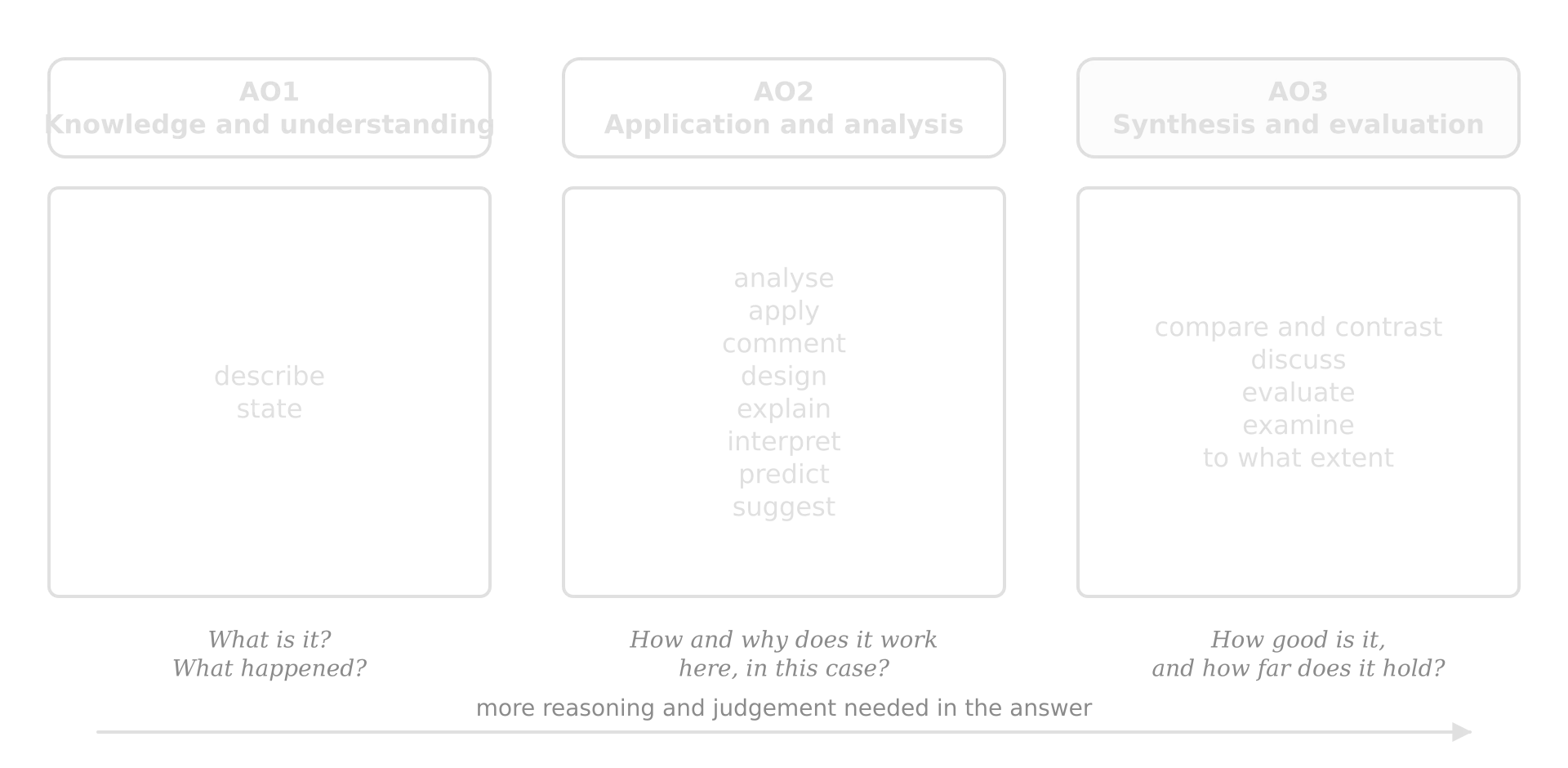
Each command term belongs to one of three assessment objectives (AOs), the broad skills the course assesses. The objective tells you the level of thinking expected; the command term tells you the exact task.
Assessment objective | What it means | Command terms |
|---|---|---|
AO1 Knowledge and understanding | Showing that you know and understand terms, theories, models and research accurately. | describe, state |
AO2 Application and analysis | Using knowledge in a new situation, breaking information down, explaining causes and reasons. | analyse, apply, comment, design, explain, interpret, predict, suggest |
AO3 Synthesis and evaluation | Weighing strengths and limitations, bringing evidence together and reaching a judgement. | compare and contrast, discuss, evaluate, examine, to what extent |
The objectives form a ladder. An AO3 answer still needs AO1 and AO2 inside it: you cannot evaluate a theory without first describing it accurately and explaining how it applies. What changes as you go up the ladder is how much of the answer is spent on judgement rather than on account.
Command terms also tell you about the papers. Paper 1 Section A asks you to “explain” or “describe” an approach term with an example; Section B asks you to “explain” how a term applies to a scenario, sometimes with “suggest”. Paper 1 Section C and Paper 2 Section B use “discuss”, “evaluate” and “to what extent”. Paper 2 Section A uses “describe”, “explain”, “compare and contrast” and “design”. Paper 3 (HL) uses “explain”, “analyse”, “state”, “discuss” and “to what extent” about a set of sources.
AO1: knowledge and understanding
State
Meaning: give a specific name, value or brief answer, with no explanation or calculation. A “state” answer is usually a word, a phrase or one sentence. It is the shortest answer any question asks for, and writing more earns nothing.
What an answer looks like: one precise sentence that uses the correct term. In psychology “state” appears mainly in Paper 3 (“state a conclusion”), where it is joined to an AO2 task.
Describe
Meaning: give a detailed account. A description says what something is, what happens in it or what was done, in an organised order and with accurate terms. It does not need reasons, but it does need detail: a one-line answer to “describe” is too thin.
What an answer looks like: the key parts of a theory, model, process or procedure in a logical sequence, each part named with its psychological term. For a process, describe the steps in order; for a model, its components and how they connect; for a study, its aim, method and findings. In Paper 2 Section A, “Describe how you used an interview in your class practical” needs the aim, the type of interview, the sample, the procedure and how data were recorded.
AO2: application and analysis
AO2 terms ask you to do something with your knowledge: give reasons, use it on a new case, break data down or produce a plan. Most short-answer questions on Paper 1 use them.
Explain
Meaning: give a detailed account that includes reasons or causes. “Explain” is the most common command term in psychology. The difference from “describe” is the word because: a description says what happens, an explanation says why or how it happens.
What an answer looks like: the term or idea defined accurately, then the mechanism (how and why it works), then, if the question asks for an example, an example in which you show how it demonstrates the term. Sentences that contain “because”, “so”, “which leads to” and “this means that” are signs of explanation.
Apply
Meaning: use an idea, principle or theory in relation to a given problem or issue. “Apply” is the skill behind Paper 1 Section B, even when the question uses “explain”: the scenario is the problem and the approach term is the theory you apply to it.
What an answer looks like: each relevant part of the theory is matched to a specific detail of the problem, and the answer says what follows from that match. A general account of the theory, followed by one sentence about the scenario, is not application.
Analyse
Meaning: break something down to bring out its essential elements or structure. In psychology you analyse data, a study or an argument. Analysis is not a summary: it picks out the parts that matter and shows how they relate to each other.
What an answer looks like: for data, the main pattern, the size of differences, any exceptions and what the numbers do and do not show. For a study, its design, variables and how the conclusion depends on them. In HL Paper 3, “analyse the findings… and state a conclusion” asks for both: a breakdown of the data, then a one-sentence conclusion linked to it.
Interpret
Meaning: use knowledge and understanding to recognise trends and draw conclusions from given information. Interpreting goes one step beyond analysing: it asks what the pattern means, using psychological knowledge to explain it.
What an answer looks like: identify the trend in a graph, table or extract, then say what it suggests about behaviour, with a reason based on theory or research. A good interpretation also says how confident the conclusion can be.
Comment
Meaning: give a judgement based on a given statement or result. A comment is short but must contain a judgement and a reason for it. It is likely to appear about a statement or result in a source.
What an answer looks like: “This result suggests… because…, although…” The judgement comes first, then the reason, then a qualification if there is one.
Predict
Meaning: give an expected result. A prediction is a clear, specific statement of what will happen, and in psychology it is normally based on a theory or on earlier findings.
What an answer looks like: the expected outcome stated precisely, with its direction. If the question asks for a reason, add one sentence linking it to theory.
Short example. Predict the effect on conformity of adding one confederate who gives the correct answer in an Asch-type line-judgement task. Conformity to the incorrect majority will fall sharply, because a single ally breaks the group’s unanimity and reduces the normative pressure to agree.
Suggest
Meaning: propose a solution, hypothesis or other possible answer. “Suggest” accepts more than one correct answer, as long as yours is plausible and justified. It appears in Paper 1 Section B scenarios (“suggest one way the school could…”) and in research questions (“suggest one reason for this finding”).
What an answer looks like: a specific proposal, explained through psychological theory so that it is clear why it would work. Vague suggestions (“they should educate people”) earn little; precise ones (“peer mentors from the same year group could model the behaviour, because observers are more likely to imitate models they see as similar to themselves”) show understanding.
Design
Meaning: produce a plan, simulation or model. In psychology “design” almost always means planning a study, and it appears in Paper 2 Section A (“Design an observation to investigate the same topic as your class practical”).
What an answer looks like: an aim, the method and design, the sample and how it is obtained, the procedure in enough detail to be carried out, how variables are operationalised and measured, and the main ethical safeguards. The plan must use the method named in the question, with its correct terms.
AO3: synthesis and evaluation
AO3 terms ask for judgement. Every AO3 answer needs three things: accurate knowledge, critical analysis (strengths, limitations, alternative explanations), and a conclusion that follows from the analysis. The terms differ in what is judged and how the conclusion is framed.
In Paper 1 Section C and Paper 2 Section B, AO3 is shaped by a concept (bias, causality, change, measurement, perspective or responsibility). The concept tells you which kind of strengths and limitations to look for: an essay on measurement evaluates how behaviour was operationalised and how valid and reliable the measures are; an essay on responsibility evaluates ethics and the consequences of applying research.
Evaluate
Meaning: make an appraisal by weighing up strengths and limitations. The key word is weighing: a list of strengths followed by a list of limitations is not yet an evaluation. You must say which points matter more and what that means overall.
What an answer looks like: a brief account of what is being evaluated, then strengths and limitations, each explained with evidence and, where relevant, linked to a concept, then a judgement about overall value. Typical sources of evaluation are the quality of the supporting evidence, generalisability across cultures and groups, alternative explanations, practical usefulness and ethics.
Discuss
Meaning: offer a considered and balanced review that includes a range of arguments, factors or hypotheses, with opinions and conclusions presented clearly and supported by evidence. “Discuss” is broader than “evaluate”. It allows several explanations, viewpoints or factors to be set against each other, and it often asks you to discuss a claim.
What an answer looks like: the claim or issue set out, arguments for and against (or several competing explanations) each supported by evidence, then a clear conclusion that says which view is better supported and why. Balance means a fair hearing for more than one side, not an equal word count.
Short example. Discuss the claim that depression is caused by low serotonin. Arguments for: SSRIs relieve symptoms in some patients; tryptophan depletion can briefly lower mood in people with a history of depression. Arguments against: an umbrella review by Moncrieff and colleagues (2022) found no consistent evidence of lower serotonin in people with depression; SSRIs raise serotonin within hours but take weeks to improve mood; cognitive and social factors predict depression independently. Conclusion: serotonin may play a part in some cases, but the claim that it is the cause is not supported, and an interactionist explanation fits the evidence better.
To what extent
Meaning: consider the merits or otherwise of an argument or concept, with opinions and conclusions presented clearly and supported by evidence and sound argument. The phrase asks for a degree: your conclusion must say how far the statement holds, not just whether it does.
What an answer looks like: a position stated early (“largely”, “only partly”, “to a limited extent”), evidence and arguments that support and limit it, and a conclusion that states the degree with the main reason. Answers that end “so it is true to some extent” without saying which extent, or why, miss the point of the command term.
Compare and contrast
Meaning: give an account of similarities and differences between two or more items, referring to both (or all) of them throughout. The command term has two halves and both must be done. It appears in Paper 2 Section A (“compare and contrast your interview with an experiment”).
What an answer looks like: organise by point, not by item. Each paragraph or sentence takes one feature (for example, control of variables, type of data, ethical issues) and says how the two items are similar or different on it. Writing everything about item A and then everything about item B leaves the comparison for the reader to do.
Organised by item (weak) | Organised by point (strong) |
|---|---|
“Interviews collect qualitative data and allow follow-up questions. They are flexible. Experiments manipulate an independent variable and collect quantitative data. They allow cause and effect…” | “Both methods can study the same behaviour and both must protect participants’ well-being. They differ in control: an experiment manipulates an independent variable so that cause and effect can be inferred, whereas an interview has no manipulation and explores participants’ own explanations. They also differ in data: an experiment normally produces quantitative data, while a semi-structured interview produces qualitative data…” |
Short example of balance. Comparing a questionnaire and an interview: similar in relying on self-reported data, so both are open to social desirability bias; different in that a questionnaire can reach hundreds of people quickly and be scored consistently, while an interview reaches fewer people but allows probing questions that clarify what participants mean.
Examine
Meaning: consider an argument or concept in a way that uncovers its assumptions and interrelationships. “Examine” asks you to look underneath a claim: what does it take for granted, and how is it connected to other ideas?
What an answer looks like: the argument stated, its hidden assumptions identified and tested against evidence, and its connections to other concepts or explanations shown. It suits Section C essays because concepts interact: an essay examining causality in research on stress and health will uncover assumptions about measurement (how stress is measured) and bias (who was sampled).
Short example. Examine the assumption that brain imaging shows the cause of a behaviour. The assumption is that a region active during a task produces the behaviour. Imaging data are correlational, so activity may be a consequence of the behaviour or part of a wider network. The assumption also links to reductionism: explaining behaviour through one region ignores cognitive and social factors that interact with it.
Terms that are easy to confuse
Several pairs of command terms look similar but ask for different answers. The table sets out the differences most often missed.
Pair | The difference | Quick test |
|---|---|---|
Describe / explain | Describe says what happens; explain adds why or how. | Does the answer contain reasons (“because”, “so”)? |
Explain / evaluate | Explain gives an account with reasons; evaluate weighs strengths and limitations. | Does the answer judge how good or well supported something is? |
Evaluate / discuss | Evaluate appraises one thing; discuss reviews a range of arguments, factors or explanations. | Are several viewpoints or explanations set against each other? |
Discuss / to what extent | Both need a balanced review; to what extent needs a conclusion that states a degree. | Does the conclusion say how far, not just whether? |
State / predict | State gives a fact; predict gives an expected result. | Could the answer be tested by running the study? |
Analyse / interpret | Analyse breaks information into its parts; interpret says what the pattern means. | Does the answer draw a conclusion from the pattern? |
Apply / suggest | Apply uses a theory on a given problem; suggest proposes a possible answer or solution. | Is there a new proposal, or an existing theory matched to the case? |
Other words in the question that matter
The command term is only the first instruction. Phrases later in the question narrow the task, and ignoring them is a common way to lose marks.
“With reference to one example of human behaviour”: the example must be explained, not just named, and one is enough. Two half-explained examples are weaker than one developed example.
“With reference to this scenario / study”: every main point must use details from the stimulus. Generic material that could fit any scenario is not credited as application.
“One or more”: one well-developed item is acceptable. A second item helps only if it adds depth, for example a contrasting explanation.
“With reference to the concept of…”: the concept must organise the answer, not appear only in the last sentence.
“Two or more of the following concepts” (Paper 2 Section B): at least two concepts must be discussed, and each must be linked to the study.
“A claim”: when a question states a claim, your conclusion must say how far the claim is supported.
Reading the question: a five-step routine
Before writing anything, spend a short time taking the question apart. This routine works for every paper and every command term.
Circle the command term and note its objective (AO1, AO2 or AO3). This sets the depth.
Underline the topic: the approach term, area of study, method or concept the question is about. Check the exact wording: “one compliance technique” is not “compliance”.
Box the qualifiers: “one”, “with reference to”, “in the context of”, “this scenario”, “the concept of”.
Check the marks. A 4-mark question needs a focused paragraph or two; a 15-mark question needs a planned essay.
Write a one-line plan for short answers, or a short paragraph plan for essays, that shows the command term will be met.
Command terms in practice: one topic, five questions
The clearest way to see how command terms change an answer is to keep the topic fixed. All five questions in the table are about schema theory; only the command term and qualifiers change.
Question | What the answer must do | Signs of a good answer |
|---|---|---|
Describe schema theory. | Give an account of what schemas are and how they affect processing. | Defines schema; describes types (scripts, self-schemas, stereotypes); describes top-down processing, assimilation of new information and distortion. |
Explain schema theory with reference to one example of human behaviour. | Add why and how schemas affect behaviour, with an explained example. | Says schemas reduce cognitive load by filling gaps, so recall shifts towards the expected; shows this in an example such as recall of an office in Brewer and Treyens (1981). |
With reference to this scenario, explain how schema theory could account for the teacher’s judgement. [scenario given] | Apply the theory to the specific details. | Uses the scenario’s details (what the teacher expected, what she noticed, what she missed) to show schema-driven processing. |
Evaluate schema theory. | Weigh strengths and limitations. | Strengths: explains distortions in memory, supported by many studies; limitations: schemas are inferred, not observed (a measurement problem), so the theory is hard to falsify; judgement. |
To what extent does schema theory explain errors in eyewitness memory? | Argue to a conclusion with a degree. | Evidence for (reconstruction towards expectations), against (stress, leading questions, weapon focus explained by other factors), conclusion such as “partly: it explains the direction of errors but not their frequency”. |
Summary
A command term tells you what to do with your knowledge; the same topic needs a different answer for each term.
AO1 terms (describe, state) ask for accurate knowledge; AO2 terms (analyse, apply, comment, design, explain, interpret, predict, suggest) for use and reasons; AO3 terms (compare and contrast, discuss, evaluate, examine, to what extent) for judgement.
“Explain” adds reasons to a description; “evaluate” weighs strengths and limitations; “discuss” reviews a range of arguments; “to what extent” ends with a conclusion that states a degree.
“Compare and contrast” needs both similarities and differences, organised point by point.
Qualifiers such as “with reference to this scenario”, “one example” and “the concept of” are part of the task and must be met.
Old command terms (outline, identify, define, distinguish) are not used; rewrite old practice questions before answering them.
Every AO3 answer ends with a conclusion that follows from its arguments.
Self-check
- To do:
I can state the meaning of all fifteen command terms in my own words.
- To do:
I can sort the command terms into the three assessment objectives.
- To do:
I can explain the difference between describe and explain, and between evaluate, discuss and to what extent.
- To do:
I can write a compare and contrast answer organised point by point.
- To do:
I can take a question apart: command term, topic, qualifiers and marks.
- To do:
I can write a conclusion that states a degree for a “to what extent” question.
- To do:
I can rewrite an old-style question with a current command term.
Carry on with Psychology in Augment
With a free account, Augment remembers where you stopped in the notes and which questions you have marked.